




Advertise here with Carbon Ads
This site is made possible by member support. 💞
Big thanks to Arcustech for hosting the site and offering amazing tech support.
When you buy through links on kottke.org, I may earn an affiliate commission. Thanks for supporting the site!
kottke.org. home of fine hypertext products since 1998.
Beloved by 86.47% of the web.
Entries for October 2017
Love letters and time machines
Hi everyone: Tim Carmody here, filling in for Jason this week. I don’t know exactly what he’s doing, but I’ve seen the photos and it looks freaking awesome. Much-deserved.
Every time I guest host The Best Blog in the World, I try to make it part of a bigger project. The last time I was here, Kottke readers helped us build a time capsule for the World Wide Web. This week, I have a similar theme, inspired by Jason’s recent post about his guest appearance on Halt and Catch Fire.
What strikes me about this essay is how much love pours off the page. Note: Jason is somehow even more midwestern than me. (I’m an ethnic Catholic from Detroit; I yell and cry and tell people too much and only feel terrible about all of it later.) He does not wear his emotions on his sleeve. So when he loosens up like this, it’s a big deal:
When I was a kid, there was nothing I was more interested in than computers. My dad bought one of the first available IBM PC-compatibles on the market. I’ve read and watched a ton about the PC revolution. I used online services like Prodigy. And the web, well, I’ve gotten to experience that up close and personal. One of the reasons I love Halt and Catch Fire so much is that it so lovingly and accurately depicts this world that I’ve been keenly interested in for the past 35 years of my life. Someone made a TV show about my thing and it was great, a successor to Mad Men great. Getting to be a microscopically tiny part of that? Hell yeah, it was worth it.
You can see how much he loves the show, how much he loves what the show was about, and how much he loved getting to be a part of it.
And I love that energy. For all the fisking and venting and social grooming and general chatter, I think that core feeling of “I love this! Why don’t you find something you love this much too?” is what propelled blogging from the beginning. It’s an enthusiast art, and it’s a folk art, from a country known for turning its enthusiast folk art into global industries.
So, this week, what I would like to do with you is to open up a little and talk about the things I love. It’s going to be a series of open love letters about art, literature, music, movies, nature, sports, technology — all that Liberal Arts 2.0 geek shit we all fill up on at Kottke. And if you’re worried that it’s just going to be a big dumb ultrapositive lovefest, don’t: the things I love are all strange and sad, and some of them are lost forever, so I’ve got you covered on that emotional side too.
Even Jason’s story about Halt and Catch Fire has that tinge of melancholy that makes it that much sweeter: the show is over, the world it describes is gone, the experience is a memory. Edgar Allen Poe was right: there’s nothing more beautiful than something we love that is forever gone. And Proust was right: we need a time machine, whether chemical or mechanical, to recapture that feeling again. The song of the Sirens is beautiful because it is doomed.
This week is also going to be about love: the weird processes by which we come to have so much affection for immanent and transcendent things in the universe. It’s not the same way we come to love people, but it’s not not the same way either. And it’s going to be in no small part about time; time lost, time present, and time yet to come.
One last thing: I couldn’t do this by myself. Or I didn’t want to, which amounts to the same thing. So throughout the week, there will be expert guest contributors offering their thoughts on the subjects we’re covering. It’s an amazing group: you’ll recognize a bunch of them, and I’m thrilled to smuggle all of them into Kottke.org with me, because they really shine.
Okay? Okay. Let’s get started.
The Universe is much bigger than it is old
In a Twitter thread, author Oliver Morton compares the physical scale of the Universe with its age (from the perspective of humans).
If a human life is 70 years long, there has been room for 200 million lives since the big bang, but 200 million humans, end to end, would reach just a bit further than the moon. If you had started walking towards the centre of the galaxy on the day of the big bang (had there been days, you, paths & galaxies), you would have got about 20 parsecs by now: just 0.25% of the way.
Maybe walking pace is the wrong metric. A nerve impulse travels around 70 times faster than a person walks. But even at the speed of thought, the age of the universe is too small for something to have reached the centre of the galaxy.
The situation is even worse when you choose another reference object, like UY Scuti, the largest known star. The red hypergiant is nearly 1.5 billion miles across and, because of its size and position near the center of the galaxy, is probably around 13 billion years old, just a few hundred million years younger than the age of the Universe itself.
Even if you use light as a marker, the size of Universe remains unfathomably immense. Over the course of the Universe’s lifetime, a photon could have travelled 13.8 billion light-years, just 15% of the current estimate of the Universe’s diameter of 93 billion light-years. See also what are the physical limits of humanity?
Great summary of Halt and Catch Fire. “Computers aren’t the thing. They’re the thing that gets you to the thing.”
Paper Trail, a hand-drawn experimental animation
Paper Trails is a “hand-drawn animation with ink, white-out and collage” by Jake Fried. It’s only a minute long, but it’s got so much crammed into it, it looks as though it took years to make. I also really liked Brain Lapse from 2014:
(via colossal)
The Windows of New York


José Guizar is a Mexican designer living in NYC with an obsession for the city’s windows. For his Windows of New York project, he’s done dozens of illustrations of all styles of window from around the city (mostly lower Manhattan).
The Windows of New York project is a illustrated fix for an obsession that has increasingly grown in me since I first moved to this city. A product of countless steps of journey through the city streets, this is a collection of windows that somehow have caught my restless eye out from the never-ending buzz of the streets. This project is part an ode to architecture and part a self-challenge to never stop looking up.
(via @ladyslippers)
Swimming Pool by Maria Svarbova


I love the retro, sterile, futuristic, bright (and also somehow dull) look of these swimming pool photos by Maria Svarbova. She’s collected them into a book called Swimming Pool coming out in November. (via colossal)
“The eclipse was not black but some other color that screamed evil”

Even two months later, I’m still reeling from seeing the total solar eclipse. When I think about that day and those two minutes, a chill goes right down my spine. Vi Hart, who took part in Atlas Obscura’s eclipse festival in Oregon, wrote a beautifully poetic piece about witnessing the eclipse that took me right back there.
I’m not sure exactly what I expected, but this wasn’t it. I’d seen photos of coronas around suns, but this wasn’t that. And I’d expected that those photos, like many astronomical pictures, are long exposure, other wavelengths, and otherwise capturing things the naked eye can’t see. I thought there might be a glow of light in a circle, or nothing, or, I don’t know. What I did not expect was an unholy horror sucking the life and light and warmth out of the universe with long reaching arms, that what I’d seen in pictures was not an exaggeration but a failure to capture the extent of this thing that human eyes, and not cameras, are uniquely suited to absorb the horror of.
I protest the idea that the sun, or the moon, or the hole in the universe where the sun was ripped away from us, was black. It was not black. It was a new color, perceivable to the human eye only in certain conditions. I’ve read the literature on color perception and color philosophy. I’ve got the ontological chops. I feel qualified to make this statement, that this thing in the sky was not black. I could understand why people would describe it as black, just as without a word for red you might describe blood as black. But it wasn’t, and so no photograph could possibly capture what it’s like, and no screen can yet display it.
(thx, geoff)
How balloons are made
A cool kid-friendly look at how balloons are made, from the origins of latex rubber to what looks like the very fun job of balloon quality control. I gasped while watching how they make the rubber ring at the end of the balloon…industrialization is bloody clever sometimes. Oh, and they also do hot air balloons…the air in the average hot air balloon weighs a ton! (via the kid should see this)
Leonardo da Vinci is overrated

Tyler Cowen asks Is Leonardo da Vinci overrated? and, in a rebuke to Betteridge, proceeds to answer “yes”.
He has no work as stunning as Michelangelo’s David, and too many of his commissions he left unfinished or he never started them. The Notebooks display a fertile imagination, but do not contain much real knowledge of use, except on the aortic valve, nor did they boost gdp, nor are they worth reading. Much of his science is weak on theory, even relative to his time.
So Leonardo was perhaps not the best at any one thing but he was very good or great at many different things. He is literally the quintessential “Renaissance man” and yet Cowen fails to evaluate him on that basis. Not surprising…history’s generalists are under-celebrated as a rule. Anyway, I’m looking forward to reading Walter Isaacson’s biography of Leonardo in the next couple of weeks.
See also how the Mona Lisa became overrated.
Kickstarter for a book of 50 handwritten letters that answer the question “What’s worth preserving?”
A trip to the vast expanse of Mongolia

Fulfilling a long-held dream, Kevin Kelly recently visited Mongolia and returned with dozens of photos of the country’s people and places.
40 years ago I had a vivid dream of flying into Mongolia, soaring over bare winter trees, but that vision did not come to pass. The parts of Mongolia I saw were much like my expectation: treeless to the horizon. There is much grass in Mongolia. Imagine a lawn 1,000 kilometers wide. It is hard to appreciate the vastness of Mongolia: for as far as you can see, no roads, no fences, no wires, just grass, rock, sky. And the occasional shepherd on a pony, happy to chat.
Most of the 3 million inhabitants live in the handful of towns and one capital city. The rest are distributed sparsely onto the grass, which they share with millions of herding animals: sheep, goats, cows, horses, yaks and camels. A large percent of rural Mongolians are nomadic herders, and proud of their nomadism. A few of them in the far west, where the culture and language is Kazak, they use eagles to hunt game and fur.
Dot Piano

Dot Piano is a web-based visual piano that works with a MIDI keyboard peripheral or with your regular computer keyboard. As you play, colorful dots dance across the screen in a variety of ways. Hit record and you can easily save and share your composition with others. This one is fun to watch. (via prosthetic knowledge)
Historians Suggest ‘Goodfellas’ YouTube Clips May Be Fragments Of Larger Work
The movement of David Fincher’s camera is a surrogate for your eyes
This is a really keen observation by Evan Puschak about the camera movement in David Fincher’s films: it mimics your eyes in paying attention to the behavior in a scene. The effect is sometimes subtle. When a character shifts even slightly, the camera keeps that person’s eyes and face in the same place in the frame, just as you would if you were in the room with them.
Are the Health Plans Trump Promoted Any Good? (Per Betteridge, of course the answer is “no”.)
The Seven Deadly Sins of AI Predictions
Writing for the MIT Technology Review, robotics and AI pioneer Rodney Brooks, warns us against The Seven Deadly Sins of AI Predictions. I particularly enjoyed his riff on Clarke’s third law — “any sufficiently advanced technology is indistinguishable from magic” — using Isaac Newton’s imagined reaction to an iPhone.
Now show Newton an Apple. Pull out an iPhone from your pocket, and turn it on so that the screen is glowing and full of icons, and hand it to him. Newton, who revealed how white light is made from components of different-colored light by pulling apart sunlight with a prism and then putting it back together, would no doubt be surprised at such a small object producing such vivid colors in the darkness of the chapel. Now play a movie of an English country scene, and then some church music that he would have heard. And then show him a Web page with the 500-plus pages of his personally annotated copy of his masterpiece Principia, teaching him how to use the pinch gesture to zoom in on details.
Could Newton begin to explain how this small device did all that? Although he invented calculus and explained both optics and gravity, he was never able to sort out chemistry from alchemy. So I think he would be flummoxed, and unable to come up with even the barest coherent outline of what this device was. It would be no different to him from an embodiment of the occult — something that was of great interest to him. It would be indistinguishable from magic. And remember, Newton was a really smart dude.
Brooks’ point is that from our current standpoint, something like artificial general intelligence is still “indistinguishable from magic” and once something is magical, it can do anything, solve any problem, reach any goal, without limitations…like a god. Arguments about it become faith-based.
Political scientists warn: American democracy is in decline
Sean Illing reports on a recent gathering of political scientists at Yale where some alarm bells were going off about the state of democracy in the United States.
On October 6, some of America’s top political scientists gathered at Yale University to answer these questions. And nearly everyone agreed: American democracy is eroding on multiple fronts — socially, culturally, and economically.
The scholars pointed to breakdowns in social cohesion (meaning citizens are more fragmented than ever), the rise of tribalism, the erosion of democratic norms such as a commitment to rule of law, and a loss of faith in the electoral and economic systems as clear signs of democratic erosion.
Illing highlighted a talk by Timothy Snyder as one of the most interesting of the gathering:
Strangely enough, Snyder talked about time as a kind of political construct. (I know that sounds weird, but bear with me.) His thesis was that you can tell a lot about the health of a democracy based on how its leaders - and citizens - orient themselves in time.
Take Trump’s “Make America Great Again” slogan. The slogan itself invokes a nostalgia for a bygone era that Trump voters believe was better than today and better than their imagined future. By speaking in this way, Snyder says, Trump is rejecting conventional politics in a subtle but significant way.
Why, after all, do we strive for better policies today? Presumably it’s so that our lives can be improved tomorrow. But Trump reverses this. He anchors his discourse to a mythological past, so that voters are thinking less about the future and more about what they think they lost.
“Trump isn’t after success — he’s after failure,” Snyder argued. By that, he means that Trump isn’t after what we’d typically consider success — passing good legislation that improves the lives of voters. Instead, Trump has defined the problems in such a way that they can’t be solved. We can’t be young again. We can’t go backward in time. We can’t relive some lost golden age. So these voters are condemned to perpetual disappointment.
The counterargument is that Trump’s idealization of the past is, in its own way, an expression of a desire for a better future. If you’re a Trump voter, restoring some lost version of America or revamping trade policies or rebuilding the military is a way to create a better tomorrow based on a model from the past.
For Snyder, though, that’s not really the point. The point is that Trump’s nostalgia is a tactic designed to distract voters from the absence of serious solutions. Trump may not be an authoritarian, Snyder warns, but this is something authoritarians typically do. They need the public to be angry, resentful, and focused on problems that can’t be remedied.
Snyder calls this approach “the politics of eternity,” and he believes it’s a common sign of democratic backsliding because it tends to work only after society has fallen into disorder.
Snyder is the author of this list of lessons from the 20th century on how to fight authoritarianism, which he turned into a book, On Tyranny.
1. Do not obey in advance. Much of the power of authoritarianism is freely given. In times like these, individuals think ahead about what a more repressive government will want, and then start to do it without being asked. You’ve already done this, haven’t you? Stop. Anticipatory obedience teaches authorities what is possible and accelerates unfreedom.
2. Defend an institution. Follow the courts or the media, or a court or a newspaper. Do not speak of “our institutions” unless you are making them yours by acting on their behalf. Institutions don’t protect themselves. They go down like dominoes unless each is defended from the beginning.
Goodbye Uncanny Valley
For years, the idea of the uncanny valley has dominated computer graphics. Computers were powerful enough to produce real-ish looking people, places, or things but not quite powerful enough to make audiences believe they were actually real…to the point where they’re actually kind of creepy. In this excellent video essay, Alan Warburton argues that the uncanny valley is behind us and previews where CG is headed next.
It’s 2017 and computer graphics have conquered the Uncanny Valley, that strange place where things are almost real… but not quite. After decades of innovation, we’re at the point where we can conjure just about anything with software.
The question is, now that computers can realistically simulate anything, what will big movie studios, individual filmmakers, game makers, artists, and media outlets do with this capability? Computer graphics are so good, how can we trust what our eyes are seeing on a screen?
I wouldn’t say “Goodbye Gatekeepers” necessarily. It’s a changing of the guard allowing temporary gatecrashing.
Here’s why we like, really like, repetition in music.
Pop music songs have become increasingly repetitive in recent years — think Taylor Swift’s Shake It Off, Beyonce’s 7/11 or Formation, and just about anything by Rihanna — and there’s a good reason for this: we like repetition. When people repeat words, it stops sounding like speaking and starts sounding like singing. Lyrical repetition makes songs sound more musical.
Intrigue in the online mattress review world
For Fast Company, David Zax wrote about the Casper mattress company suing mattress-reviewing bloggers over their affiliate marketing relationships.
As Casper flourished through 2014 and early 2015, I learned, it enjoyed a mutually beneficial relationship with Sleepopolis and similar sites. For many bloggers, in fact, Casper was among the first mattress companies to offer affiliate commissions, leading its competitors to respond in turn. The reviews sites were key parts of what marketers call the “purchase funnel,” converting a vague interest in mattresses into awareness of a specific brand, and often the decision to buy it. Many consumers were Googling terms like “best mattress,” landing on sites like Sleepopolis, and learning about e-tailers like Casper for the first time.
Indeed, one would never have predicted looming lawsuits from a friendly 2015 email exchange, in which Casper CEO Philip Krim attempted to court an affiliate marketer named Jack Mitcham, who ran a Sleepopolis-like site called Mattress Nerd.
In January 2015, Krim wrote Mitcham that while he supported objective reviews, “it pains us to see you (or anyone) recommend a competitor over us.”
Krim went on: “As you know, we are much bigger than our newly formed competitors. I am confident we can offer you a much bigger commercial relationship because of that. How would you ideally want to structure the affiliate relationship? And also, what can we do to help to grow your business?”
I was just thinking the other day about how these companies like Casper formed to undercut the price gouging mattress stores and now, with millions of VC dollars behind them, they’re pulling their own brand of underhanded tricks to manipulate people into buying their products. In five years, Casper will probably have dozens of retail stores and 10 different kinds of mattress at different price points — they already have more than a dozen stores and 3 models ranging from $600 to $1850 — just like the companies they are trying to replace. Their origin story won’t matter…VC-fueled marketing will paper over all of that and, tada, meet the new boss, same as the old boss.
Noo!!! They’re redesigning the Hall of Gems & Minerals at the Natural History Museum in NYC. Goodbye carpeting!
Dictionary of Ikea product name meanings
The Ikea Dictionary is a listing of the meanings of the names of more than 1300 Ikea products.
Part of what makes IKEA unique is their product names. Each name means something, often in a funny or ambigious way. When IKEA went international, they decided to use the same Swedish names everywhere. This makes sense from an organizational sanity standpoint, but it deprives most of the world of this particular joy.
Some examples:
JERRIK - Ancient Scandinavian boy name
TROLSK - magic/enchanted, troll-like
MÖRRUM - city in south east Sweden
SNITTA - (to) cut (flowers)
SOLVAR - Norwegian boy name
VÄGGIS - made up -IS word ‘Vägg’ means ‘wall’, so ‘väggis’ could mean ‘wall thingie’
Myself hanging out with myself


Photographer Conor Nickerson has photoshopped himself into old family photos of him as a kid. Projects like this have been done before — most notably Ze Frank’s Young Me/Now Me — but this one is particularly well executed. (via colossal)
Twitter has become “a pretty hate machine”
Mike Monteiro wrote an essay about Twitter that is good and very much worth reading.
Twitter was built at the tail end of that era. Their goal was giving everyone a voice. They were so obsessed with giving everyone a voice that they never stopped to wonder what would happen when everyone got one. And they never asked themselves what everyone meant. That’s Twitter’s original sin. Like Oppenheimer, Twitter was so obsessed with splitting the atom they never stopped to think what we’d do with it.
Twitter, which was conceived and built by a room of privileged white boys (some of them my friends!), never considered the possibility that they were building a bomb. To this day, Jack Dorsey doesn’t realize the size of the bomb he’s sitting on. Or if he does, he believes it’s metaphorical. It’s not. He is utterly unprepared for the burden he’s found himself responsible for.
Chilling Video Footage of a 1939 Nazi Rally at Madison Square Garden
On February 20, 1939, a crowd of 20,000 gathered at Madison Square Garden for a “Pro-American” rally sponsored by the German American Bund, a pro-Nazi organization. I’d seen photos of the event, but I didn’t know there was film footage as well.
There is a moment during an on-stage scuffle involving a protestor (a Brooklyn man named Isadore Greenbaum), right around the 4:15 mark, when a young boy in the background rubs his hands and does a gleeful jig — I…I don’t even know what to say about how I felt watching that. After Greenbaum is spirited away, his clothes nearly ripped from his body, the crowd roars. As director Marshall Curry said in an interview about the film:
In the end, America pulled away from the cliff, but this rally is a reminder that things didn’t have to work out that way. If Roosevelt weren’t President, if Japan hadn’t attacked, is it possible we would have skated through without joining the war? And if Nazis hadn’t killed American soldiers, is it possible that their philosophy wouldn’t have become so taboo here?
(via open culture)
My media diet for the past two weeks
Quick reviews of some things I’ve read, seen, heard, and experienced in the past two weeks or so. I’ve been working and traveling, so there have been fewer books and more podcasts in my life. On the way home from NYC, I started The Devil in the White City on audiobook and can’t wait to get back to it.
From Cells to Cities. Sam Harris podcast interview of Geoffrey West, author of Scale. Two genuinely mind-blowing moments can’t quite salvage the remained 2 hours of rambling. (A-/C-)
Cloudy With A Chance Of Meatballs. I much prefer the book. (C+)
Kingsman: The Secret Service. Entertaining enough. I’ll give the new one a try. (B+)
Philip Glass Piano Works by Vikingur Olafsson. This is relaxing to listen to in the morning. (A-)
Luciferian Towers by Godspeed You! Black Emperor. This sounds very much like all their other albums and I am not complaining. (B+)
mother! An intense film but it was too overly metaphorical for me to take any of the intensity seriously. (B)
The Unexplainable Disappearance of Mars Patel. “A fun, high-quality, serial mystery that can be described as Goonies meets Spy Kids meets Stranger Things for 8-12 year olds.” My kids and I listened to season one over the course of a week and they could not wait to hear more. (A-)
The Vietnam War original score. By Trent Reznor and Atticus Ross. An unusual choice for the score to a Ken Burns film. (B+)
Blade Runner 2049. Seeing this in IMAX (real IMAX not baby IMAX) really blew my doors off. Visually and sonically amazing. At least 20 minutes too long though. (A-)
New Yorker TechFest. I hadn’t been to a tech conference in awhile because the ratio of style to substance had gotten too high. The caliber of the speakers set this conference apart. My full report is here. (B+)
Items: Is Fashion Modern? Great collection of items, but I’m not sure I’m any closer to knowing the answer to the question in the title. (A-)
LBJ’s War. A short, 6-part podcast on Lyndon Johnson and the Vietnam War, consisting mostly of interviews and audio recordings from the period in question. A good companion to the PBS series on the war. (B+)
Driverless Dilemma by Radiolab. Revisiting an old episode of Radiolab about the trolley problem in the context of self-driving cars. (B)
Max Richter: Piano Works by Olivia Belli. Short and sweet. (A-)
Jerry Before Seinfeld. This felt pretty phoned-in. Some of these old jokes — “women, am I right?” — should have stayed in the vault. (B-)
Blade Runner 2049 soundtrack. A critical part of the movie that also stands alone. (A-)
Spielberg. A solid appreciation of Spielberg’s career, but more of a critical eye would have been appreciated. Also, was surprised how many of his movies referenced his parents’ divorce. (B+)
Universal Paperclips. Ugh, I cannot ever resist these incremental games. What an odd name, “incremental games”. Aren’t most games incremental? (A-/F)
Full Moons on Flickr
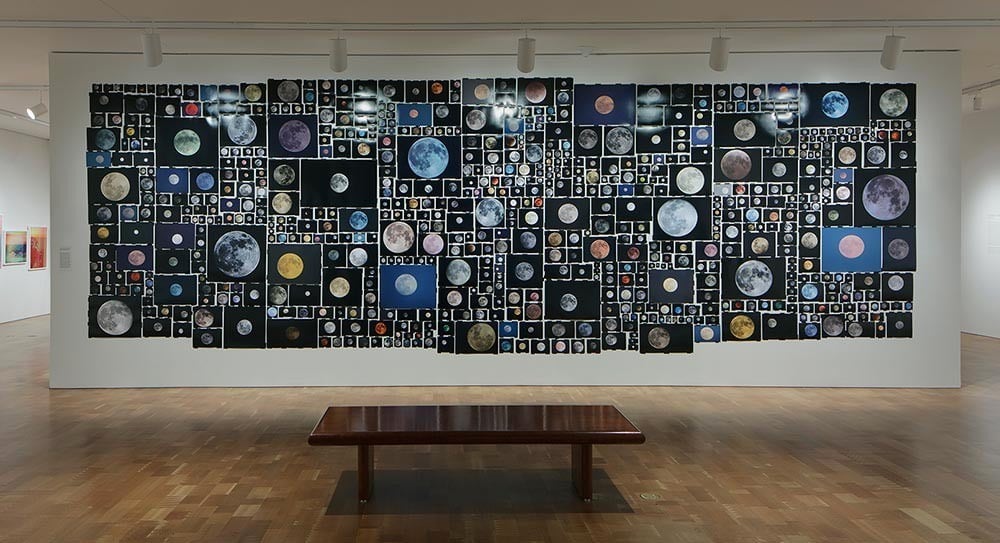
For a pair of projects, Penelope Umbrico collected hundreds of photos of full Moons from Flickr and arranged them into massive wall-sized collages.
Everyone’s Photos Any License, looks at a purportedly more rarified photographic practice: taking a clear photograph of the full moon requires expensive specialized photographic equipment. However, when I searched Flickr for ‘full moon’ I was surprised to find 1,146,034 nearly identical, technically proficient images, most with the ‘All Rights Reserved’ license. Seen individually any one of these images is impressive. Seen as a group, however, they seem to cancel each other out. Everyone’s Photos Any License seeks to address the shifts in meaning and value that occur when the individual subjective experience of witnessing and photographing is revealed as a collective practice, seen recontextualized in its entirety.
For one of the project, Umbrico requested permission to display “Rights Reserved” photos from 654 photographers in exchange for 1/654 of the profit from any potential sale. Many of them were not into that arrangement, so she substituted images with Creative Commons licences instead.
See also Umbrico’s Sunset Portraits, Suns from Sunsets from Flickr, and TVs from Craigslist. (via austin kleon)
We’ve been playing with Slinkys all wrong
We all know that Slinkys walk down stairs, alone or in pairs. What this video presupposes is, maybe that’s not the best way to play with them? Who knew that you could treat a Slinky kind of like a yo-yo or juggling ball? Here’s a slightly shorter video of equally impressive tricks.
I have a message for you…
Klara Prowisor, now 92 and living in Tel Aviv, escaped the gas chamber at Auschwitz by leaving her sick father and jumping from a train in Belgium. Years later, she received a message from him. Just watch this…it might be the best 13 minutes you’ll spend online all week.
My grandmother Lea once told me a story about the woman who lived next door to her in Tel Aviv, of her capture by the Nazis in Belgium and of an unfathomable decision she had to take to save herself. I never forgot it, and am pleased to share it with you in this Op-Doc film.
Even as a teenager, I was familiar with stories from the Holocaust. My grandfather had survived the horrors of the camps himself, and his stories formed a large part of our family’s shared narrative.
But this woman’s story felt different. Her pain and horror were woven with love, loss, guilt and redemption - and the epilogue was truly extraordinary. Many years later, once I’d become a documentary filmmaker, I decided to find out whether the woman was still alive.
Amazing, incredible story. You can see the whole world, all of humanity, in this wonderful woman’s face.

Socials & More