



Joanna Goddard: On Sexual Harassment

Advertise here with Carbon Ads
This site is made possible by member support. 💞
Big thanks to Arcustech for hosting the site and offering amazing tech support.
When you buy through links on kottke.org, I may earn an affiliate commission. Thanks for supporting the site!
kottke.org. home of fine hypertext products since 1998.
Beloved by 86.47% of the web.
Entries for October 2017
Merrie Maladies

It’s been a loooong couple of days / weeks / months / years / decades / centuries / millennia, hasn’t it? Sometimes you have to laugh, just a little. And then back to it. Thanks for the chuckle, Jessica Hische.
Dictionary Stories, a book of short stories composed entirely of dictionary example sentences

From illustrator, designer, and writer Jez Burrows comes a book called Dictionary Stories, a collection of illustrated short stories that are composed entirely of example sentences from the dictionary.
One day, while looking up a word in the New Oxford American Dictionary, Jez Burrows was stopped in his tracks by an example sentence: “He perched on the edge of the bed, a study in confusion and misery.” It seemed like a tiny piece of fiction had gotten lost, wandered out of another book and settled down in the dictionary. With that spark, and a handful of experimental stories posted to Tumblr, Dictionary Stories was born.
Super clever.
The Mediterranean Sea of America
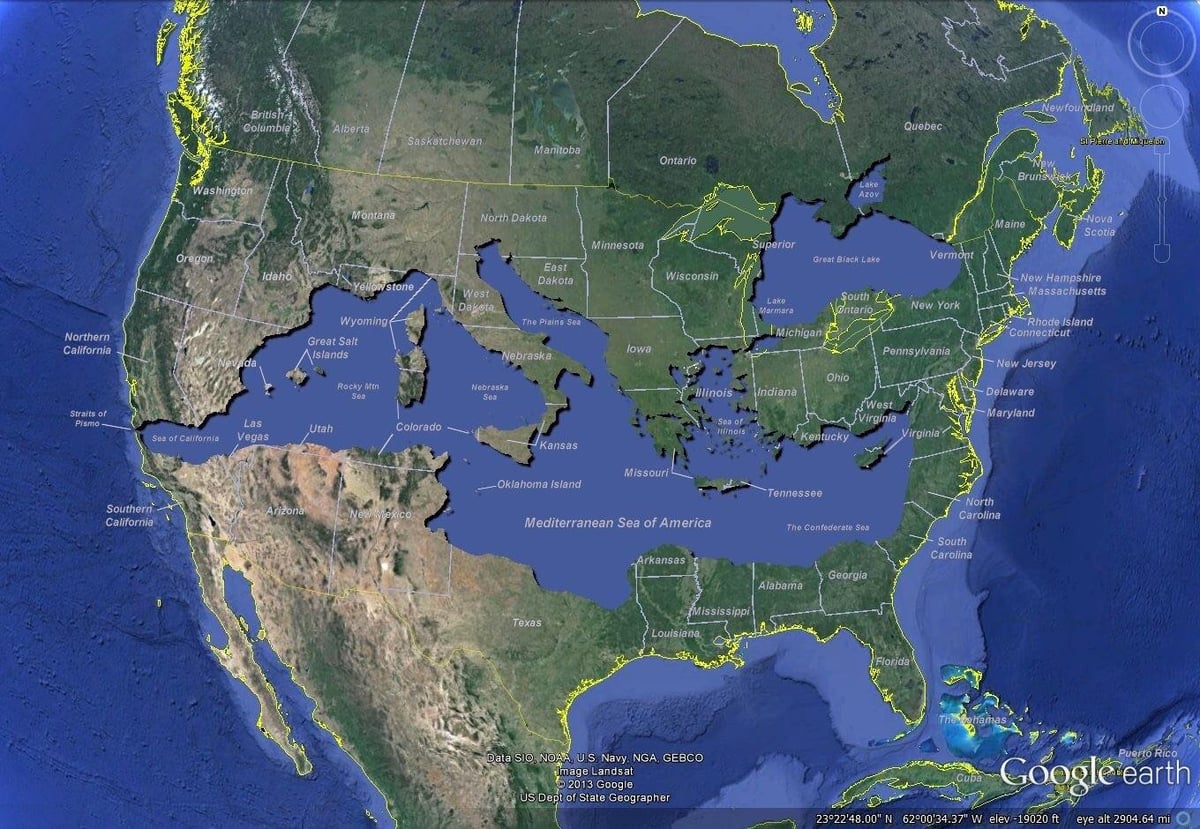
If you superimpose the Mediterranean Sea (and the Black Sea) over a map of the United States (map by Bret Drager) — creating geographic landmarks like the Confederate Sea, the Great Salt Islands, the Straits of Pismo, and a coastal Las Vegas — you get a real sense of how big each of them is. I confess, I didn’t think the Mediterranean Sea was this large. The other surprising thing is that the latitudes of the superposition are pretty accurate…only a degree or two off, if that.
You can try it yourself (and not just with the Med and US): the true size of things on world maps. And see also my old Manhattan Elsewhere project. (via fairly interesting)
Update: Lots of good geographical comparisons in this Twitter thread started by Maria Chong, including:
Italy is as close to Egypt as Kansas is to Florida.
Seattle is approximately Paris to the Aleppo (Syria) of Washington D.C.
The Trojan war was (probably) fought in the distance between Indiana and Missouri
When the Hebrews fled the Pharaoh in Egypt, it took them 40 years to get from somewhere in Florida to South Carolina
The Odyssey was a 10-year road trip from Indiana to California, then back to Missouri
The US Climate Explorer
Last year, the NOAA updated their Climate Explorer tool, which lets you see how climate change will affect the weather (daily max/min temperatures, really hot & cold days, precipitation, etc.) in different parts of the United States. For example, if emissions of greenhouse gases continue to increase throughout the next 80 years, the average temperature in Miami will increase from a current ~84.5 °F to over 91 °F in 2100…and even worse, the annual number of 95+ degree days will go from less than 10 to 140.


Which actually isn’t that big of a deal because a bunch of the city will be underwater and uninhabitable because of rising sea levels. Ok, moving on…
You live in the northeast and like to ski? Well, that might be a problem in the future. In Stowe, VT, the annual number of days with minimum temperatures below 32 °F will decrease from about 175 now to ~140 by 2070 even if emissions of greenhouse gases start dropping in 2040.

And if emissions don’t drop, Vermont could only see ~105 days of minimum temperatures below 32 °F by 2100. Goodbye ski season.
See also our potential neverending hot American summer.
Last remaining privately held Leonardo painting up for sale

Only fewer than 20 of Leonardo da Vinci’s paintings are known to have survived until the present day. In 2005, a painting of Leonardo’s called Salvator Mundi was rediscovered after its provenance had been forgotten hundreds of years ago, to the point that it sold for £45 at an auction in 1958. In November, Christie’s auction house is selling the painting.
The painting disappeared from 1763 until 1900 when — its authorship by Leonardo, origins and illustrious royal history entirely forgotten — it was acquired from Sir Charles Robinson, who purchased the picture as a work by Leonardo’s follower, Bernardino Luini, for the Cook Collection, Doughty House, Richmond. By this time, Christ’s face and hair had been extensively repainted. A photograph taken in 1912 records the work’s altered appearance.
In the dispersal of the Cook Collection, the work was ultimately consigned to auction in 1958 where it fetched £45, after which it disappeared once again for nearly 50 years, emerging only in 2005 — its history still forgotten — when it was purchased from an American estate.
That estate sale in 2005 sold the painting for only $10,000…it was believed to be a Leonardo copy. The painting is estimated to sell at a price of $100 million but seeing how the last two sales netted $75 million and $127.5 million, it would be easy to see that going higher.
Update: New York magazine art critic Jerry Saltz says that Salvator Mundi is probably fake (or at least not by Leonardo).
I’m no art historian or any kind of expert in old masters. But I’ve looked at art for almost 50 years and one look at this painting tells me it’s no Leonardo. The painting is absolutely dead. Its surface is inert, varnished, lurid, scrubbed over, and repainted so many times that it looks simultaneously new and old. This explains why Christie’s pitches it with vague terms like “mysterious,” filled with “aura,” and something that “could go viral.” Go viral? As a poster, maybe. A two-dimensional ersatz dashboard Jesus.
Why else do I think this is a sham? Experts estimate that there are only 15 to 20 existing da Vinci paintings. Not a single one of them pictures a person straight on like this one. There is also not a single painting picturing an individual Jesus either. All of his paintings, even single portraits, depict figures in far more complex poses. Even the figure that comes remotely close to this painting, Saint John the Baptist, also from 1500, gives us a turning, young, randy-looking man with hair utterly different from and much more developed in terms of painting than the few curls Christie’s is raving about in their picture.
Update: Salvator Mundi sold for $450 million, “obliterating the previous world record for the most expensive work of art at auction”. On Twitter, Saltz called the buyer “a sucker” and posted an image of the painting with Trump’s face pasted on it. Buuuuuuuurn.
Update: According to this piece in Narativ, this painting might now be lost and could factor into the Mueller investigation into the Trump-Russia connection.
Questions are being raised. First, why did the Crown Prince of Saudi Arabia, an art novice, buy the masterpiece? Secondly, why did he overpay for it by $300 million? Even for the stupendously wealthy Prince Mohammed bin Salman, that’s not just a simple rounding error. How do you misplace a $450 million painting anyway?
We can also reveal Special Counsel Robert Mueller is investigating both the buyer and the seller of the Da Vinci masterpiece as part of the Trump-Russia investigation.
All the intrigue suits Salvator Mundi’s already storied past well, but as I write this, no-one has seen the rare masterpiece in over a year, and its exact whereabouts have been unknown for over 100 days.
(via @tedgioia)
A thrilling Line Rider track synched to music
Remember Line Rider, the drawing/sledding game we were all obsessed with 11 years ago? YouTuber DoodleChaos drew a Line Rider track by hand that is synchronized to Edvard Grieg’s In the Hall of the Mountain King (which you will recognize when you hear it). Make sure your sound is on and watch the whole thing…it gets almost poetically thrilling near the end. (via @neilhalloran)
Eminem blasts Donald Trump in new freestyle
In a freestyle rap that aired at the BET Hip Hop Awards last night, Eminem blasted Donald Trump for his racism, false patriotism, deceit, and disrespect of military veterans, among other things. Watch it if you haven’t…the man is angry, as are many of us. The lyrics to the freestyle are on Genius:
He says, “You’re spittin’ in the face of vets who fought for us, you bastards!”
Unless you’re a POW who’s tortured and battered
‘Cause to him you’re zeros
‘Cause he don’t like his war heroes captured
That’s not disrespecting the military
Fuck that! This is for Colin, ball up a fist!
And keep that shit balled like Donald the bitch!
“He’s gonna get rid of all immigrants!”
“He’s gonna build that thing up taller than this!”
Well, if he does build it, I hope it’s rock solid with bricks
‘Cause like him in politics, I’m using all of his tricks
‘Cause I’m throwin’ that piece of shit against the wall ‘til it sticks
And any fan of mine who’s a supporter of his
I’m drawing in the sand a line: you’re either for or against
And if you can’t decide who you like more and you’re split
On who you should stand beside, I’ll do it for you with this:
“Fuck you!”
The rest of America stand up
We love our military, and we love our country
But we fucking hate Trump
As you can read, Eminem is really calling out his white fan base here, something that Elon James White mentioned in this Twitter thread:
So basically Trump, a grade A troll just got trolled by a bigger more experienced troll. Eminim trolls every album & he chose 45 this time. White dudes who thought Eminem was [their] voice, all angry and White at home right now like [What do I doooooooooooo!?] And y’all know Eminem is petty. If 45 responds he’ll have 3 diss tracks in a week. If 45 doesn’t he will be shat on as weak AF & a punk. And a lot of White folks who may have been sitting this whole shit storm out just had their fav rapper call them dafuq out.
White also addressed the misogyny and homophobia in Eminem’s music:
And as for his music catalogue of misogyny and homophobia…
.
.
.
That empty space is called me not defending ANY of it one bit. Notice I didn’t say “everyone should go buy Eminem albums!” “SUPPORT THIS ARTIST!” I was commenting on the freestyle & how it will play. I haven’t bought an Eminem album since I was a young punk. But my support or lack thereof doesn’t negate his skill or his platform.
Universal Paperclips
There’s a new meta game by Frank Lantz making the rounds: Universal Paperclips, “in which you play an AI who makes paperclips”. Basically, you click a button to make money and use that money to buy upgrades which gives you more money per click, rinse, repeat.
Why AI and paperclips? That’s from a thought experiment by philosopher Nick Bostrom, author of Superintelligence:
Imagine an artificial intelligence, he says, which decides to amass as many paperclips as possible. It devotes all its energy to acquiring paperclips, and to improving itself so that it can get paperclips in new ways, while resisting any attempt to divert it from this goal. Eventually it “starts transforming first all of Earth and then increasing portions of space into paperclip manufacturing facilities”. This apparently silly scenario is intended to make the serious point that AIs need not have human-like motives or psyches. They might be able to avoid some kinds of human error or bias while making other kinds of mistake, such as fixating on paperclips. And although their goals might seem innocuous to start with, they could prove dangerous if AIs were able to design their own successors and thus repeatedly improve themselves. Even a “fettered superintelligence”, running on an isolated computer, might persuade its human handlers to set it free. Advanced AI is not just another technology, Mr Bostrom argues, but poses an existential threat to humanity.
But you know, have fun playing! (via @kevinhendricks)
A report from the 2017 New Yorker TechFest
Last Friday, I attended the New Yorker TechFest, a one-day, single-track conference about technology, an accompaniment to the larger New Yorker Festival. Overall, I thought the conference was really good, a sentiment echoed by other attendees. What follows is my impressionistic take on the interviews and talks.
Siddhartha Mukherjee. Author of The Emperor of All Maladies, one of my favorite nonfiction books of the past five years. He mentioned therapeutic nihilism, a view of medicine which went out of fashion due to effective medicines and procedures. They talked about the progress in medicine (and accompanying complexity), which is all relatively recent: in 1945, there were three treatments available to patients with heart problems (give them oxygen, drain fluid through the feet, and morphine for the pain) but now there are 90 available treatments. That complexity is an area where AI can help…using machine learning to read chest x-rays more effectively or suggest courses of treatments for a given set of vitals/symptoms.
But Mukherjee warned that “new diagnostic techniques almost always over-diagnose” and that, in relation to CRISPR, extraordinary technologies require extraordinary public response…i.e. we need to have a public conversation about how/why/when these technologies are used. Mukherjee is also involved with biotech startup Vor Biopharma, which is attempting to modify human immune cells to attack cancer cells.
Garry Kasparov & Daniela Rus. Kasparov was one of the world’s best chess players (prob still is tbh) and Rus is the director of the Computer Science and Artificial Intelligence Laboratory at MIT. Kasparov’s face was injured from a taxi accident the day before, an accident that would not have occurred had he been in a self-driving car — he said car accidents due to human error will look ridiculous and barbaric to our children.
(Quick sidebar: I’ve been teaching my 8-year-old daughter a little about cars. She’s been helping me pump gas and after we filled up a low tire the other day, I popped the hood and explained how the engine and cooling system worked. And she said something like, “Daddy, when I’m old enough to drive, cars probably won’t have a motor in them because they’ll all be electric.” From the mouths of babes…)
Kasparov talked about his Deep Blue match, noting that it was the first time in his career that he knew that an opponent was better than he was and that today, free iPhone chess apps are more powerful than Deep Blue was. At one point when talking about tech’s effect on vastly improved medicine and healthcare, he quipped that without technology, old people wouldn’t even be around to complain about new technology. Rus and Kasparov both emphasized the role of AI and robots in society, namely that “robots can do predictable work in predictable situations”, machines will dominate closed systems but open systems are different, and “The machine has a steady hand. It will always prevail.” At times, these pronouncements sounded either comforting or like warnings. Both also noted that education has not kept pace with technology; Kasparov said the current paradigm of kids sitting and listening to a teacher is “antique”.
Alexandra Daisy Ginsberg. Ginsberg is a designer and artist who explores synthetic biology in her work. One of her projects is E. chromi, in which color-producing bacteria could, for instance, turn your poop purple if the water you’re drinking is polluted.

Ginsberg is also trying to work out what it means when people try to make things “better”.
Along with the first two sessions, this conversation really underscored how no one at the conference really talked about technology, which has become something of a meaningless word. Instead, the discussion was about the ethics, politics, and philosophy of technology (whereas at other tech conferences, the talk revolves mostly around business and investment). How does the political conversation keep pace with the increasing speed of technological innovation? Interviewer Michael Spector noted that humans have never developed a technology and then never used it, and that sometimes the tech world’s approach is “I just hope something good happens before something bad happens”.
Jaron Lanier. One of the best sessions. They could have given Lanier a microphone and let him go on for an hour or more. As an 11-year-old, he designed the geodesic dome house that he and his father lived in — “people went through dome phases in my generation” — but it later collapsed, leading Lanier to say that you should definitely let your 11-year-old design your house, but just don’t actually live in it. “When you code, you start thinking of everything as code. You want to optimize and debug people and the world.” He credited Norbert Wiener with the idea of the computer as a potential ultimate Skinner box and said that Facebook is a fantastically effective real-time Skinner box. He chided FB and Google in particular for this, saying that we are not their customers, that we’re the rats in the cage, pushing levers to get treats while they make billions skimming our attention off to advertisers. Silicon Valley is well-meaning, but power corrupts.
Lanier told the story of an apocryphal early-80s Silicon Valley service called Rent-A-Mom, that would take care of all mom-like duties for the archetypal socially inept male programmers of the era and that the startups like Uber, Blue Apron, and Stitch Fix have essentially made the service a reality. Except that “sometimes your mom tells you the truth and we haven’t done that service yet”. Lanier’s newest book, Dawn of the New Everything, is out in November.
The Future of Food. Not very interesting. Felt like paid placement for large food service companies. Although Dan Barber did tell an interesting story about harvesting a carrot at just the right time (after the first frost) so that it converts all the starches to sugar and is super-sweet. Oh, and the sushi at lunch was pretty good.
Jony Ive. In retrospect, Remnick was perhaps not the best choice to interview Ive. I can’t think of who else from the magazine would have been better, so maybe they should have gotten an independent outsider who has followed Apple extensively for the past 20 years — John Gruber for instance.
That said, while Ive said very little about what he’s up to at Apple, he did speak about his process and how he thinks about creativity, particularly about the tension between curiosity (being open, creative, child’s mind, anything goes) and focus (the need to make this one thing work and ignore everything else). Ive called Steve Jobs the most focused person he’d ever met.
Carrie Goldberg & Brianna Wu. Another excellent session. Listening to these two women talk about their desire to publicly stand up against some of the most reprehensible and dangerous behavior imaginable was inspiring. Goldberg was almost levitating on stage because one of her clients’ stalkers has just been arrested for online harassment, a rare event that Goldberg is working on making more common. Goldberg talked about her taxonomy of offenders in cases like these: assholes (jilted ex, revenge porn), perverts (who do it for sexual gratification), trolls (they love feeding the flames), and psychos (are actually mentally disturbed).
Wu said while Twitter bears most of the brunt of the online harassment backlash, Facebook is “much much much more of a problem” and they care much less about fixing it than Twitter does. She also called the failure to prosecute Gamergate one of the biggest mistakes of the Obama administration and that there are more consequences for bad acts in Grand Theft Auto than there are IRL for women who get threatened online.
Gina McCarthy. Excellent. McCarthy was the head of the EPA under Obama. A very impressive person…I had forgotten what an extremely competent public servant sounded like. I don’t have much beyond that…I didn’t take notes because I was too enthralled as she deftly explained how politics intersected with the law. McCarthy for President? Sign me up.
Michael Lynton. Chairman of Snap. This did not make me any more interested in signing up for Snapchat. Or confident that Snap can remedy their poor start as a publicly traded company.
Gabriella Coleman & Thomas Rid. I didn’t take too many notes for this talk either…was too busy paying attention. I do remember Coleman saying that a big reason why Wikileaks took off was that they made it easy for both journalists and normal people to easy search through the leaked documents. The inherent importance of the documents is significant, but making it accessible increases their relevance.
Bill Maris & Thomas Rando. Maris discussed the concept of longevity escape velocity, the theoretical point at which human life expectancy increases faster than passing time, resulting in a scenario where you can live forever (assuming you don’t get hit by a bus…which would be less likely if all future buses are self-driving).
Van Jones. CNN commentator and author of Beyond the Messy Truth (out today). I don’t watch cable news so I didn’t know much about Jones, but I came away impressed. His comparison of poor rural whites who get dinged for voting against their own economic self-interest and wealthy coastal liberal who are lauded for voting against their own economic self-interest was particularly apt. Jones talked about the central tension of the US, trying to reconcile the founding reality of America vs the founding dream of America. He also called Bernie Sanders “a 143-year-old political Muppet”. Oh, and they should have paired Jones with someone other than Adam Davidson…or just let him do a 30-minute talk (which he pretty much did anyway…the man knows how to commentate).
Keller Rinaudo. Rinaudo is the CEO and co-founder of a company called Zipline. Zipline engineers national-scale medical delivery systems via drone. When he first started to explain how it works, I was like, oh that’s a cool concept, I wonder how far off something like that is. And then it became apparent that Zipline actually works, now. WAT? In Rwanda, Zipline has cut blood delivery times to remote areas from several hours to 15-30 minutes.
Really impressive. And a good note to end on: technology that truly does make the world better.
The 2017 National Book Awards finalists

The National Book Foundation has announced the finalists (and the longlist) for The 2017 National Book Awards. Among the nominees in the categories of fiction, non-fiction, young people’s literature, and poetry are The Future Is History: How Totalitarianism Reclaimed Russia by Masha Gessen, The Book of Endings by Leslie Harrison, I Am Not Your Perfect Mexican Daughter by Erika L. Sánchez, and Pachinko by Min Jin Lee.
I’m excited to see David Grann’s Killers of the Flower Moon on the list. I read it earlier this year and it was excellent.
Black Mirror is a parade of tragedies. So why do we watch it?
Black Mirror, which has a fourth season coming out in the near future, is an unflinchingly dark show, full of bad things happening to people that don’t necessarily deserve them. Centuries ago, Aristotle defined tragedy as:
A tragedy is the imitation of an action that is serious and also, as having magnitude, complete in itself; in appropriate and pleasurable language; … in a dramatic rather than narrative form; with incidents arousing pity and fear, wherewith to accomplish a catharsis of these emotions.
But as Evan Puschak argues in this video essay, that’s not the whole story of why we watch Black Mirror.
FYI: If you haven’t seen the series yet, there are major spoilers for Black Mirror (and also for Breaking Bad and Game of Thrones).
A blueprint of hip hop history
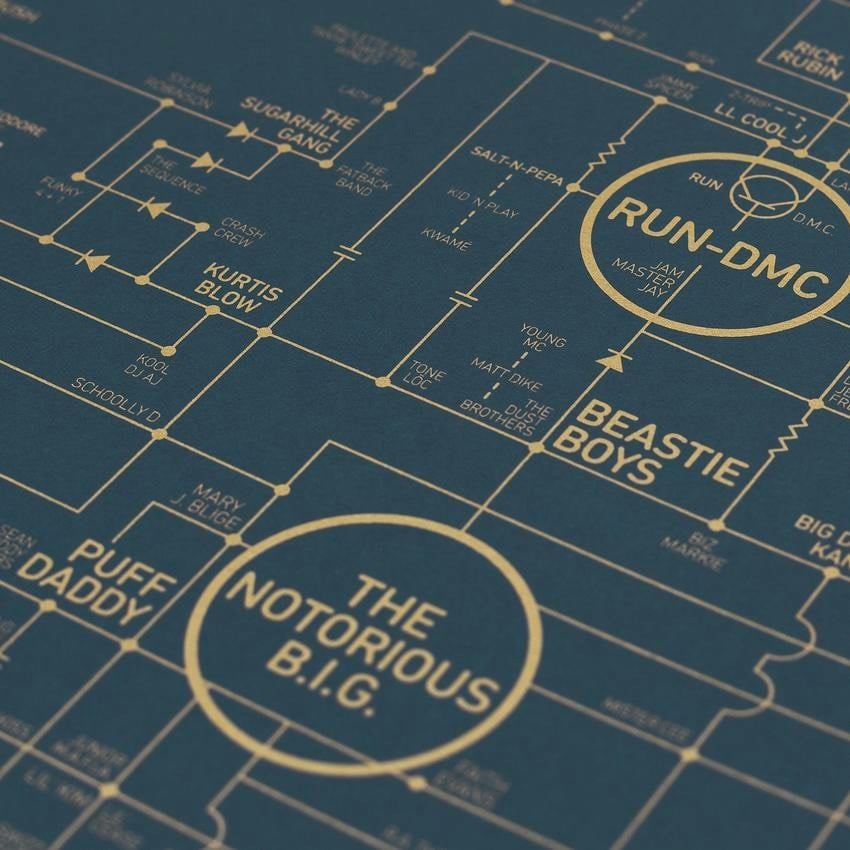
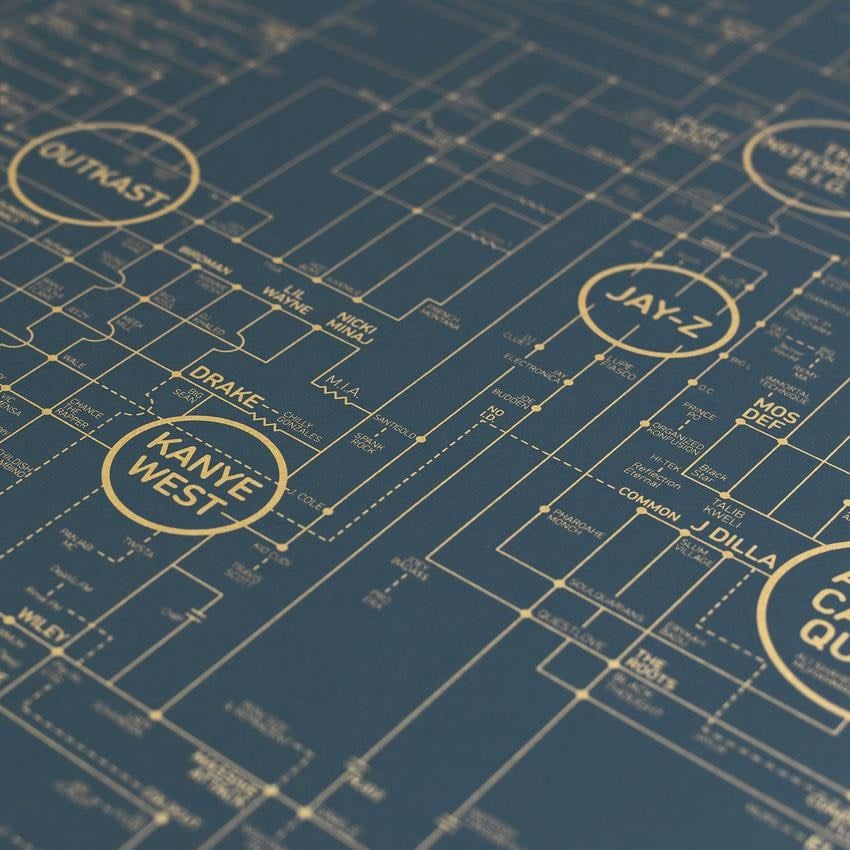
Design studio Dorothy has released this poster of a map of hip hop history, featuring notable rap and hip hop artists and groups laid out in the style of a circuit diagram for a classic turntable.
The print pays homage to the godfathers of hip-hop (Gil Scott-Heron, The Last Poets) but takes its starting point as DJ Kool Herc’s Back to School Jam in August 1973 — a block party in the Bronx, New York which is widely regarded as the birthplace of hip-hop.
The print weaves it way through many different scenes and record labels including early old-school innovators (Grandmaster Flash and the Furious Five, DJ Kool Herc, Afrika Bambaataa, Cold Crush Brothers), golden age heroes (Run-DMC, Beastie Boys, KRS-One, Eric B. & Rakim), the collective Native Tongues (De La Soul, A Tribe Called Quest, Jungle Brothers, Queen Latifah, Monie Love), politically charged hip-hop (Public Enemy, The Disposable Heroes of Hiphoprisy, Lauryn Hill), legendary East Coast artists (The Notorious B.I.G, Nas), legendary West Coast artists (Tupac Shakur, Dr. Dre), gangsta rap (Ice-T, N.W.A, Ice Cube, Snoop Dogg), hardcore (Wu-Tang Clan, Mobb Deep), Southern rap (Lil Wayne, T.I., Outkast) underground hip-hop (Company Flow, MF Doom, Aesop Rock), turntablism (Invisibl Scratch Piklz, The X-Ecutioners), trip-hop (Massive Attack, Tricky, Portishead), UK grime (Wiley, Skepta and Stormzy) and legendary producers (DJ Premier, J Dilla and Madlib).
Pairs well with Tim Carmody’s Introduction to Hip Hop playlist.
Trailer for Star Wars: The Last Jedi
Now we know: the Last Jedi is us. Did not see that coming. (jk jk, it’s Kylo Ren. Or Rey. Or Luke. Or some combination of the three of them. Or Leia? Or maybe Joe from Blade Runner 2049?) See also the teaser trailer from back in April.
Update: Kylo Ren reacts to the new trailer for The Last Jedi. The Auralnauts are so gooood.
That Time I Was on Halt and Catch Fire

*record scratch*
*freeze frame*
Yep, that’s me. You’re probably wondering how I ended up back in the 1970s with such a sweet jacket and bitchin’ mustac— Ok all jokey tropes aside, I got to appear on AMC’s Halt and Catch Fire last night as a background extra. (Mild spoilers follow.) This season of the show is set in the 90s, but this episode flashes back to the 70s soon after Gordon and Donna get together. My scene takes place during this flashback and is pretty short. Gordon is at a gas station, waiting to use the pay phone. A man (that’s me!) exits the station with a 6-pack of beer, gets into his car, and drives off after Gordon crosses the pavement to the phone. And that was it! But as a big fan of the show — and I refuse to have any chill about this — it was one of the coolest experiences I’ve had in forever.
I’ve been watching the show since the first season, when the action focused on a small company trying to build one of the first IBM-compatible PCs on the market. (You may have read about this show on kottke.org once or twice. Or a dozen times. I have an unauthorized Cardiff Electric t-shirt I bought from some sketchy site online. Did I mention I was a big fan?) At some point during the next two seasons of the show, when the action moved from PCs in Texas to online services & anti-virus software in Silicon Valley, I followed the two creators of the show, Christopher Cantwell and Christopher Rodgers on Twitter. And at some later point, they followed me back and we tweeted at each other a handful of times.
Meanwhile, the show got renewed for a fourth and final season. At the end of season three, the characters started talking about this new thing called the World Wide Web and it was clear that season four was going to focus on early 90s web startups. Now, I don’t know if you know this about me or not, but I love the web. (Oh, you could tell? I let that slip at some point?) And I am so very nostalgic for the early days of the web in the 90s — the Mosaic days, the Altavista days, the Bobaweb days, the Entropy8 days, the Suck days, the CSotD days, the alt.culture.days, the 0sil8 days, the Yahoo on the akebono server at Stanford days. The days when I was young and dumb and decided to quit grad school in a promising field without talking to a single other person about it because I just knew I needed to do whatever I could to get a job working on the web, a job that didn’t even exist at the beginning of my junior year in college. Season four was going to be about those days?! Holy shit.
In June, Chris Cantwell, who was down in Atlanta to direct an episode of the fourth season, tweeted that he was in the hospital, on dilaudid waiting for a kidney stone to pass and was available to answer any questions his followers had about the show. After a crap-can month of May, I’d been focusing on being more direct with what I want, so fuck it, yolo, totally trying to take advantage of this poor guy being hopped up on goofballs, I tweeted back:
Do you need extras for s04? Will do retro web design on screen for zero pay. I still can code circa-1994/5 HTML by hand.
Which was like 30% joking and 70% serious. A few minutes later, he replied:
Dude if you can fly out here I’ll put you in a long wig and put you at a gas station.
I had no idea what the hell he was talking about — remember, he was super fucking high — but we followed up via DM and I bought a plane ticket for Atlanta and booked a hotel the next morning. Sometimes, just sometimes, you get what you want, even if it’s not exactly what you asked for.


Less than a week later, I’m in Atlanta. They put me through wardrobe, where I tried on two sets of 70s clothes (they ended up using a mix of clothes from the two looks). I got a tour of the storeroom where they keep all of the clothes for the series; it was massive…I kept thinking I was going to uncover the Ark of the Covenant in there. I went from there to hair & makeup, where they fit me with a wig and mustache for Cantwell to approve. My scene wouldn’t shoot until the next evening, so they had to take it off that afternoon and put it all back on the next day:

I got to meet the actors that played Gordon, Donna, and Joe…they were super nice. Hell, everyone was super nice and professional and seemed to be having fun…a good crew. I was there to be an extra, but since I knew Cantwell, I was also “a friend of the show”. (Everyone kept saying, “oh, you’re the blogger!”) So they took me out to a couple of the sets, and I got to see Mackenzie Davis do her thing (❤️!). They showed me how everything on-set worked and gave me a headset so I could listen in on what was happening. I met the show’s producers, one of whom told me that with my hair and mustache, I looked just like his friend Bill Paxton from 20 years ago, in Tombstone…to the point where it freaked him out a little to see his recently deceased friend standing before him. I saw a stuntman jump off a cliff into a quarry. They gave me a chair to sit in so I could watch the action on the monitors in real-time. I ate so much food at the end-of-day meal. I got to drive a big-ass Chevy from the 70s. I read a call-sheet for the next day’s shoot that totally spoiled the season’s biggest reveal and I didn’t even care that much.
On the day of the shoot, the scene took place at night, so my call time was 6pm. Did the hair and makeup thing again, ate, sat around, got dressed, and then was shuttled out to the set at around 10pm. I watched them set up and then it was go time. I did my scene probably 8 or 10 times. They shot it with two different camera setups and had me change little things here and there…like the first time I walked out of the store, I didn’t have the beer in my hand:

And then, right around midnight, it was done. I filled out my sheet to get paid ($51.64 after taxes) and somehow stayed awake on the 90 minute drive back to Atlanta.
That last-minute, three-day trip totally blew my travel budget for the summer. Was it worth it? When I was a kid, there was nothing I was more interested in than computers. My dad bought one of the first available IBM PC-compatibles on the market. I’ve read and watched a ton about the PC revolution. I used online services like Prodigy. And the web, well, I’ve gotten to experience that up close and personal. One of the reasons I love Halt and Catch Fire so much is that it so lovingly and accurately depicts this world that I’ve been keenly interested in for the past 35 years of my life. Someone made a TV show about my thing and it was great, a successor to Mad Men great. Getting to be a microscopically tiny part of that? Hell yeah, it was worth it.
Update: Will Fitzgerald pointed out that I now have a Bacon Number of 2.
Six Degrees of Kevin Bacon is a parlour game based on the “six degrees of separation” concept, which posits that any two people on Earth are six or fewer acquaintance links apart. Movie buffs challenge each other to find the shortest path between an arbitrary actor and prolific character actor Kevin Bacon. It rests on the assumption that anyone involved in the Hollywood film industry can be linked through their film roles to Bacon within six steps.
While not strictly within the rules (HaCF is TV, not film), I was in an episode of Halt and Catch Fire with Toby Huss and Huss was in R.I.P.D. Because of a few physics papers I co-authored in college, I also probably have an Erdös Number (I’d estimate 5 or 6?). I’ve got a ways to go on an EGOT, but I’m doing pretty well on the Bacon-Erdös scale!
Update: Here’s a clip of my scene:
Freelance achievement stickers

Jeremy Nguyen imagines a set of achievement stickers (or perhaps merit badges) for people who freelance or otherwise work from home and need a fun way to mark their accomplishments.
The struggle is real. Today, I earned the “put on pants” and “went outside” stickers but sadly not the “talked to someone in person” one. Will try to do better tomorrow.
Anti-invitations for cancelled weddings
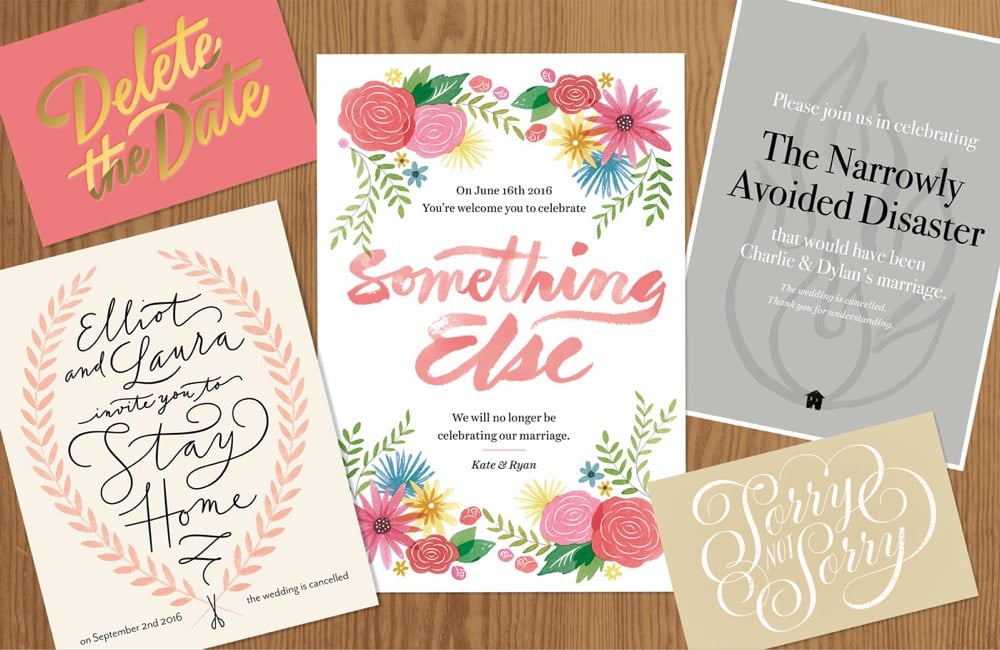
For a NY Times piece on cancelled weddings, Jessica Hische created these anti-invitations in the style of fancy wedding invites.
My thoughts immediately went to fancy wedding stationery, and I had a lot of fun both writing and designing these fake anti-invitations. I tried to poke fun at some of the current trends in wedding stationery design, which meant I got to have fun playing with watercolors!
A Scientific Simulation of Seveneves’ Moon Disaster
In the first line of Seveneves, Neal Stephenson lays out the event that the entire book’s action revolves around:
The moon blew up without warning and for no apparent reason.
Mild spoilers, but fairly quickly, scientists in the book figure out that this is a very bad thing that will cause humanity to become extinct unless drastic action is taken.
In the novel, one day the moon breaks up into 7 roughly equal-sized pieces. These pieces continue peacefully orbiting the Earth for a while, and eventually two pieces collide. This collision causes a piece to fragment, making future collisions more likely. The process repeats, at what Stephenson says is an exponential rate, until the Earth is under near-constant bombardment from meteorites, wiping out (nearly) all life on Earth.
Jason Cole wondered how plausible that scenario is and created a simulation to model it. Turns out Stephenson had his figures right.
Am I There Yet? by Mari Andrew

Like some of you, I’ve been a fan of Mari Andrew’s illustrations on Instagram for a while now. Andrew is coming out with a book next March called Am I There Yet?: The Loop-de-loop, Zigzagging Journey to Adulthood. She writes:
I wrote AM I THERE YET? toward the end of my 20s to share what I learned through heartbreak, love, loss, rejection, career confusion, adventures, and the gnawing question in the back of my mind: Where exactly am I going, or am I already there? I wrote and illustrated a book I wish I’d had in my 20s — to know that I wasn’t alone.
Here’s a favorite Andrew illustration of mine:

The Golden Age of the Poster, 1880-1918
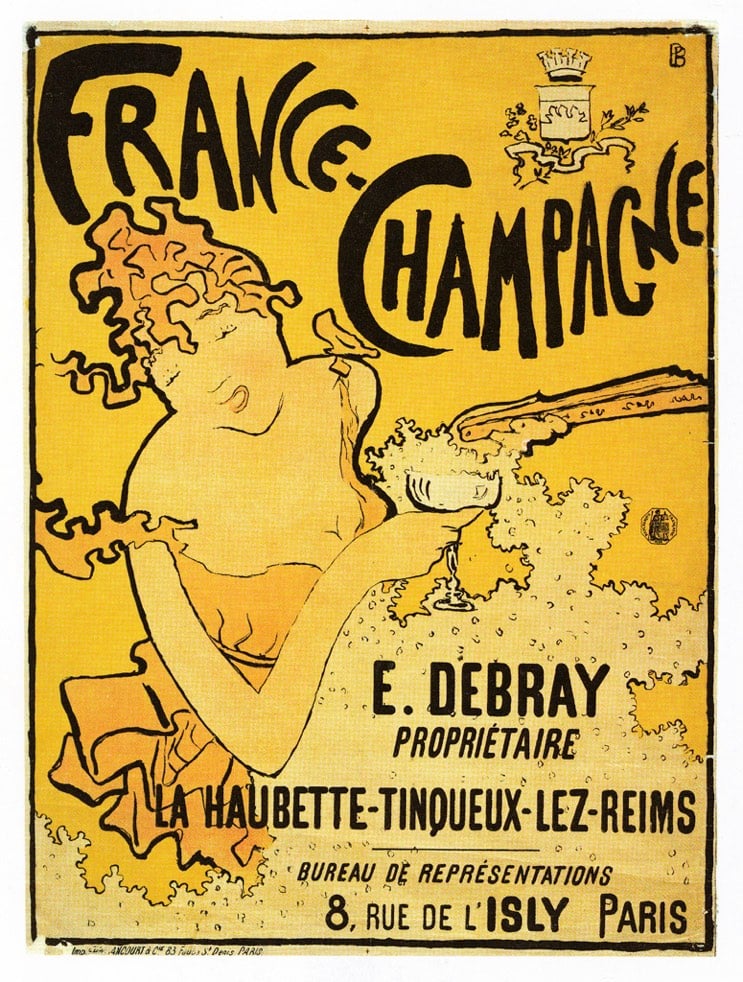
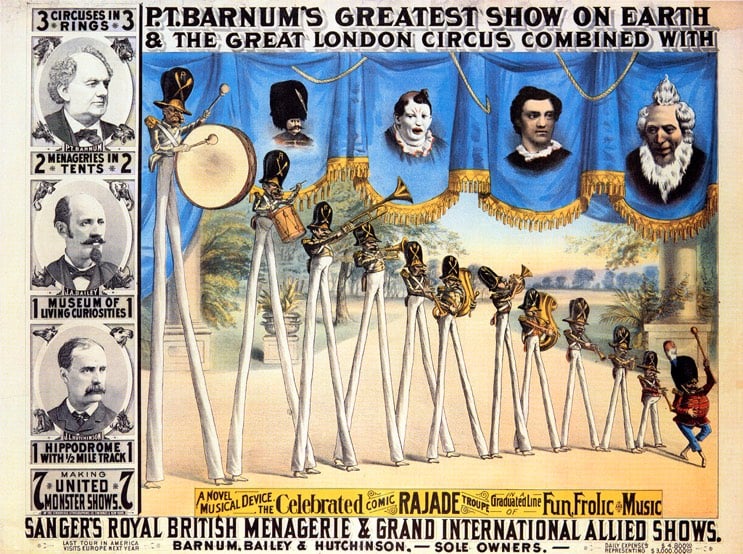


This collection of posters compiled by the library at the Minneapolis College of Art & Design is an amazing trove of turn-of-the-century design and illustration.
In the late nineteenth century, lithographers began to use mass-produced zinc plates rather than stones in their printing process. This innovation allowed them to prepare multiple plates, each with a different color ink, and to print these with close registration on the same sheet of paper. Posters in a range of colors and variety of sizes could now be produced quickly, at modest cost. Skilled illustrators and graphic designers — such as Alphonse Mucha, Jules Chéret, Eugène Grasset, and Henri de Toulouse-Lautrec — quickly began to exploit this new technology; the “Golden Age of the Poster” (1890s through the First World War) was the spectacular result.
How to Care for Your Introvert
(Not to be confused with Caring for Your Introvert.) I started this video thinking it was a serious thing but ended up laughing embarrassingly hard almost all the way through.
A pair of introverts is called an ‘awkward’. A group of introverts is called an ‘angst’. They’re generally never found together in the wild, except by accident, in which case they will apologize for making eye contact, nod politely, then run screaming in opposite directions.
It me. It fricking me. On a slightly more serious note, the other day investor Hunter Walk wrote How This Anxious Introvert Handles Large Events.
When I Feel Ready to Ghost, Stay 30m Longer: Before I’d quietly slip away whenever I felt the first tingles of “uh I don’t want to be here anymore.” Now I recognize that impulse, honor it, exhale and see if I’m cool staying another 30 minutes. Once I do this check-in I’m totally ok bouncing after 30 if that’s still the way I’m feeling, but often I’ll end up hanging out much longer without even knowing it.
On Seneca Village, torn down to make way for Central Park

Written and illustrated by Ariel Aberg-Riger, The City Needed Them Out tells the story of Seneca Village, a predominantly black NYC neighborhood destroyed in the 1850s to make way for Central Park. This article in the NY Times from July 9, 1856 expressed the city’s sentiment about the village and its inhabitants.

Video portrait of a master kunstglaser (a stained glass craftsman)
Norbert Sattler is a master kunstglaser, a stained glass craftsman. He strongly denies that he’s an artist, rejecting that label early in his career in favor of working with artists to best help them achieve their artistic visions in the medium of stained glass.
The Astronomy Photographer of the Year for 2017


Put on by the Royal Observatory Greenwich, The Astronomy Photographer of the Year is the largest competition of its kind in the world. For the 2017 awards, more than 3800 photos were entered from 91 countries. It’s astounding to me that many of these were taken with telescopes you can easily buy online (granted, for thousands of dollars) rather than with the Hubble or some building-sized scope on the top of a mountain in Chile.
The photos above were taken by Andriy Borovkov, Alexandra Hart, and Kamil Nureev.
Our collective happiness on Twitter reaches a new low
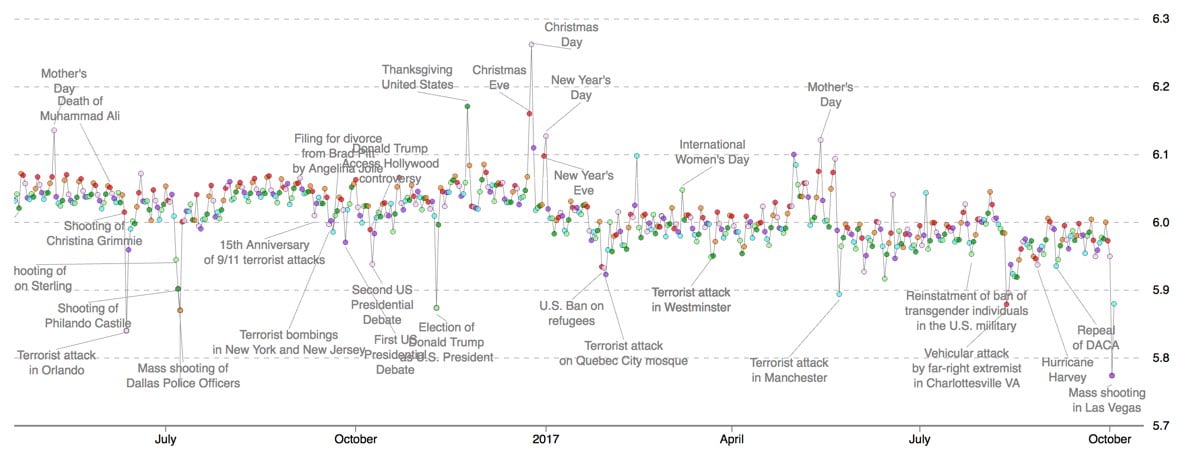
The Hedonometer measures the average happiness of Twitter on a daily basis and the shooting in Las Vegas has pushed the index to a new low. The previous low point was after the terror attack in Orlando last July. The two other lowest scores have occurred in the past year and a half: the mass shooting of Dallas police officers and the election of Donald Trump, which is the only non-shooting or non-terror attack to achieve such a low score in the 9-year history of the index.
Band uses video delay to create “a mesmerizing visual loop sampler”
A band called The Academic cleverly took advantage of the slight broadcast delay in Facebook Live to construct a loop sampler out of video, so that at any given moment, each member of the band is performing with their past and future selves and bandmates.
We rearranged each instrument on “Bear Claws” to fit Facebook Live’s delay, with each loop getting more complex, adding instruments, rhythms, and melodies. Additionally, by projecting the video live from a soundstage we created an infinite tunnel consisting of all the previously recorded loops.
OK Go is probably kicking themselves for not thinking of this first. See also Piano/Video Phase, David Cossin’s performance of Steve Reich’s Piano Phase with himself. (via clive thompson)
Things that are more heavily regulated in the US than buying a gun
For McSweeney’s, Sarah Hutto offers up a list of things that are more heavily regulated in the United States than buying a gun.
Building a fucking shed in your own backyard
Disposing of fucking batteries
Cutting fucking hair for a living
Watching a fucking DVD
Importing foreign fucking cheese
Transporting a bottle of opened fucking wine home from a restaurant
Discussing the Las Vegas massacre yesterday on Fox Business, commentator Kennedy said:
If that psychopath had…driven a truck into that crowd and killed 100 people would we be talking about truck control?
Many quickly found the flaw in this “argument”, including @zeddrebel:
WE HAVE TRUCK CONTROL. Special licenses. Insurance. Regulations. Weigh stations. UNIONS. Bollards. GPS tracking…
(And btw, yes, it’s that Kennedy, the former MTV VJ and host of Alternative Nation.)
Spotify’s Time Capsule personalized playlists
Spotify has made a Time Capsule playlist for each of its users, “a personalized playlist with songs to take you back in time to your teenage years”. It’s a little tough to find…you can search for it, find it under “Decades” on the Browse page, or use the website. Here’s my Time Capsule:
I’d heard from friends how eerily accurate their playlists were, but mine’s not that great. I grew up in a small town with limited access to music. Everyone I knew listened to country, metal, or top 40. I didn’t really care that much for metal or country, so top 40 it was. My musical taste took a right turn in college and it was only much later that I circled back to the sort of music that I would have listened to in the 80s had I been aware of it. Also, it looks as though Spotify thinks I’m 8-10 years younger than I actually am. The playlist should be crammed with Prince, Michael Jackson, Madonna, George Michael, and other 80s MTV staples, not stuff that came out in the mid 90s.
However, I have no idea how the hell it knew about Cum on Feel the Noize, Wishing Well, and Eye of the Tiger. I’ve never listened to any of them on Spotify but young Jason was obsessed with each of these for a brief period. I can still hear Casey Kasem saying Terence Trent D’Arby’s name with his distinctive America’s Top 40 cadence. Freaky!
Worth reading: Tyler Cowen’s philosophy of interviewing. “Appreciation is an underappreciated art and skill.”
Fathers, sons, and the lamp in the Pixar logo

Spencer Porter’s father works for Pixar and because of an impromptu office game of catch, the pair of them became the models for John Lasseter’s short film, Luxo Jr.
“Luxo Jr.” is, to me, a home movie. It’s me and my dad. Encouraging, comforting, energetic and kind, that big lamp, Luxo Sr., is as much my father as I am Luxo Jr. Every time I see my little lamp logo hop out in front of a Pixar movie, it’s not me I think about — it’s my dad. How he spent an afternoon hitting ground balls to me the day before my first Little League practice, and how proud I was when the other coach on my team said, “Well, I think we found our shortstop.” I must have been 7 years old, and I still remember that moment with such clarity. I can still feel the hard fabric on the bag of baseballs, the position of the sun in the sky.
Fair warning: this story takes a hard right turn midway through and you might find yourself in tears near the end.
Socials & More