Entries for August 2015
From Mark Christian, a selection of deliciously pun-filled food truck name ideas. Some favorites:
Shwarmageddon
Calamari Damacy
Get Quiche Or Die Tryin’
What About Kebab?
Planet of the Crepes
Naan Disclosure Agreement
Entrée the Giant
(via @mathowie)
These folks created a real-life first person shooter game and invited strangers on Chatroulette to control the action.
Here’s a behind-the-scenes look at how they did it. (thx, oren)

Banksy has opened an apocalyptic theme park called Dismaland in an abandoned resort in an English coastal town, Weston-super-Mare.
Are you looking for an alternative to the sugar-coated tedium of the average family day out? Or just somewhere a lot cheaper? Then this is the place for you. Bring the whole family to come and enjoy the latest addition to our chronic leisure surplus…
The entrance fee is £3 and the park will be open for five weeks. Colossal has the scoop, including a list of artists who contributed art to the park, er, show.
A demented assortment of bizarre and macabre artworks from no less than 50 artists from around the world including Damien Hirst, Bill Barminski, Caitlin Cherry, Polly Morgan, Josh Keyes, Mike Ross, David Shrigley, Bäst, and Espo. In addition, Banksy is showing 10 artworks of his own.
Colossal’s own Christopher Jobson curated the park’s short film program. Congrats! (Also, super jealous!)
Update: For a closer look at the park, check out the trailer:
The newest app from Tinybop (The Human Body, Homes, and The Robot Factory apps) is called The Everything Machine. A small sampling of what you can do with it:
Use a simple programming language to connect, control, and play with all the sensors and tools. Put the camera, microphone, speaker, screen, gyroscope, and light to work for you.
Playing around with the app with Minna for 30 minutes this evening (she loved it) reminded me of my college electronics classes + Scratch + LabVIEW. Super fun.
Two weeks ago, 99% Invisible broadcast an audio documentary from 1998 about one of the last remaining flophouses on The Bowery in NYC called The Sunshine Hotel. It is an amazing time capsule from a Manhattan that just doesn’t exist anymore.
The Sunshine Hotel opened in 1922. Rooms — or really, cubicles — were 10 cents a night. The Sunshine, like other flop houses, was always a men-only establishment. In 1998, the hotel had raised it’s rates to 10 dollars a night and it was managed by resident Nathan Smith. He sat behind a metal cage at the front desk, answering the phone and doling out toilet paper to residents for 35 cents. Smith had once worked in a bank until he was injured, and then fired. His wife left him and he ended up in the Bowery, and eventually at the Sunshine Hotel.
The interviewees sound like they’re characters in a play, not real people. It’s so good. There is also a documentary film released in 2001 about The Sunshine Hotel which is available on Amazon Instant; here’s a trailer:
NASA’s original logo looked something like this:
It was referred to, colloquially, as the meatball. In the 1970s, the meatball was switched out for the worm, a more Modernist take:

This logo was done by Richard Danne and Bruce Blackburn, and Danne wrote an essay about the experience.
And here is one of the most interesting exchanges I’ve ever witnessed in a design presentation:
Fletcher: “I’m simply not comfortable with those letters, something is missing.”
Low: “Well yes, the cross stroke is gone from the letter A.”
Fletcher: “Yes, and that bothers me.”
Low: “Why?”
Fletcher: (long pause) “I just don’t feel we are getting our money’s worth!”
Others, not just the designers were stunned by this last comment. Then the discussion moved back to the strong red/rust color we were proposing. We had tried many other colors of course, including the more predictable blue range, but settled on red because it suggested action and animation. It seemed in spirit with the Can Do nature of the Space Agency.
Fletcher: And this color, red, it doesn’t make much sense to me.”
Low: “What would be better?”
Fletcher: “Blue makes more sense… Space is blue.”
Low: “No Dr. Fletcher, Space is black!”
NASA’s Graphics Standards Menu utilizing the worm logo can be seen here.
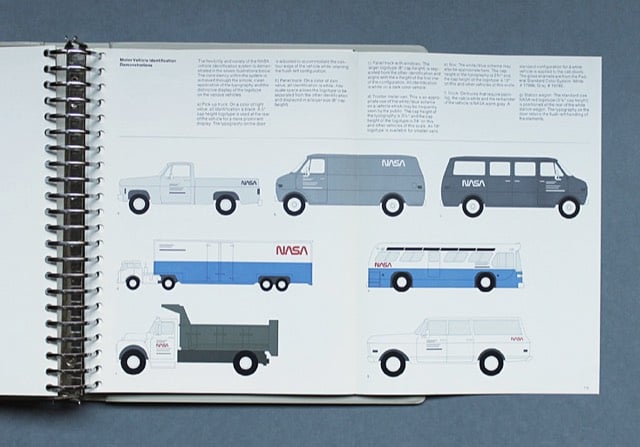
The space agency switched back to the original logo in 1992. Michael Bierut compared the two:
The worm is a great-looking word mark and looked fantastic on the spacecraft. By any objective measure, the worm was and is absolutely appropriate, and the meatball was and is an amateurish mess.
(thx, jarrett)
Matt Might, who is a professor in computer science at the University of Utah and a professor at the Harvard Medical School, responded to a question on Quora about minimizing the chances of having a disabled child and ended up answering two seemingly unrelated questions as well: How do you get tenure? and How do you live the good life? Long story short: he got tenure and started living the good life because he had a disabled child. But you should read the long story; it’s worth it.
My son forced me to systematically examine what matters in life — what really matters — and in the end, I came to appreciate a quote from his namesake, Bertrand Russell, more than I could have ever imagined:
“The good life is one inspired by love and guided by knowledge.”
My first year as a tenure-track professor cannot be described as anything other than an abject failure. I was so desperate to publish and raise funds that I began thin-slicing my research and submitting lots of poor quality papers and grant proposals.
I must have had a dozen rejections in a row that year. It sucked.
I remember huddling on the porch at the end of that year with my wife, telling her, “Well, I’ll at least have a job for six more years.”
I looked at my young son, cuddled in her arms. I saw his very existence hung in the balance between knowledge and ignorance.
Then it hit me: Life is too precious and too fleeting to waste my time on bullshit like tenure. I didn’t become a professor to get tenure. I became a professor to make the world better through science. From this day forward, I will spend my time on problems and solutions that will matter. I will make a difference.
I stopped working on problems for the sole purpose of notching up a publication. I shifted gears to cybersecurity. I found a project on cancer in the med school. I joined a project in chemical engineering using super-computing to fight global warming.
Suddenly, my papers started getting accepted.
You may remember Might and his son from a recent New Yorker article on people with ultra-rare diseases.
The Jefferson Grid is an Instagram account which posts satellite photos picturing one square mile of land.


The account takes its name from the grid Thomas Jefferson used to divide up the growing United States.
The Land Ordinance of 1785, drafted by Thomas Jefferson, extended government authority over the Mississippi River and the Great Lakes regions. As a response to what he believed to be a confusing survey system already in use, Jefferson suggested a new grid system based on the rectangle. The grid divided land into plots one mile square, each consisting of 640 acres. The grid also placed a visible design upon a relatively untouched landscape. The ordinance was the first of its kind in America but would continue to affect urban, suburban and farmland planning to present day.
(via @bldgblog)
How massive are they? The Sun is 1 solar mass and as wide as 109 Earths. Sagittarius A, the black hole at the center of the Milky Way, weighs 4.3 million solar masses and is as wide as Mercury is far from the Sun. The black hole at the center of the Phoenix Cluster is one of the largest known black holes in the Universe; it’s 73 billion miles across, which is 19 times larger than our entire solar system (from the Sun to Pluto). As for how much it weighs, check this out:
I also like that if you made the Earth into a black hole, it would be the size of a peanut. (thx, reidar)
Google’s latest project is called Project Sunroof. Sunroof utilizes Google Earth data to estimate the solar energy potential of buildings.
Enter Project Sunroof, my recent 20% project. Project Sunroof is a new online tool we’re testing to help homeowners explore whether they should go solar. Available in the San Francisco Bay Area, Fresno (in central California), and the Boston area for now, the tool uses high-resolution aerial mapping (the same used by Google Earth) to help you calculate your roof’s solar energy potential, without having to climb up any ladders.
If you’re in one of our test regions, simply enter your address and Project Sunroof will crunch the numbers. It first figures out how much sunlight hits your rooftop throughout the year, taking into account factors like roof orientation, shade from trees and nearby buildings, and local weather patterns. You can also enter your typical electric bill amount to customize the results. The tool then combines all this information to estimate the amount you could potentially save with solar panels, and it can help connect you with local solar providers.
Google still has 20% time?
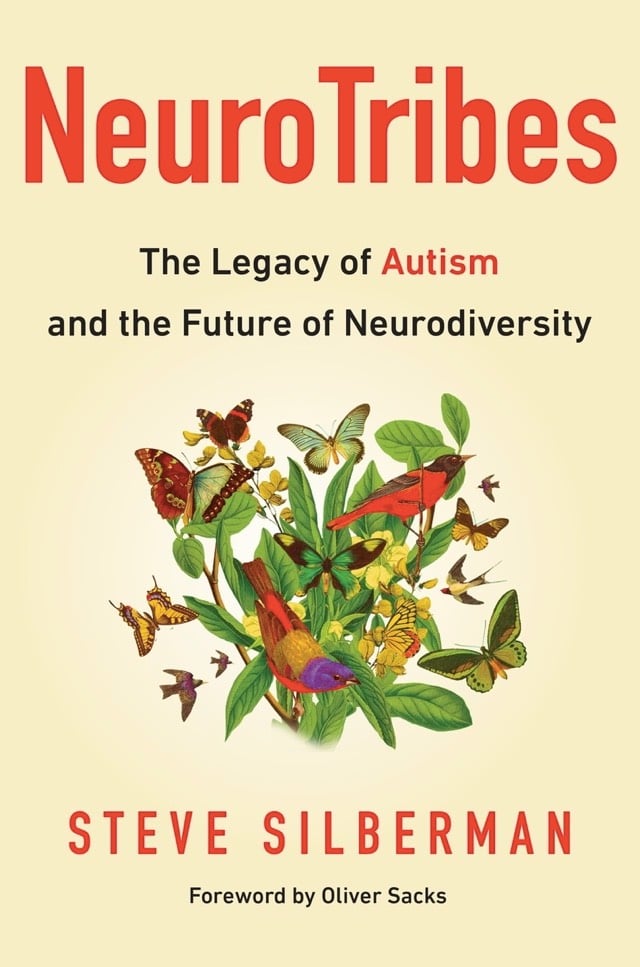
Added to the series of things I thought I posted about but never did is Steve Silberman’s new book, NeuroTribes: The Legacy of Autism and the Future of Neurodiversity, out next week.
What is autism? A lifelong disability, or a naturally occurring form of cognitive difference akin to certain forms of genius? In truth, it is all of these things and more-and the future of our society depends on our understanding it. WIRED reporter Steve Silberman unearths the secret history of autism, long suppressed by the same clinicians who became famous for discovering it, and finds surprising answers to the crucial question of why the number of diagnoses has soared in recent years.
Jennifer Senior wrote a largely positive review for the NY Times.
“NeuroTribes” is beautifully told, humanizing, important. It has earned its enthusiastic foreword from Oliver Sacks; it has found its place on the shelf next to “Far From the Tree,” Andrew Solomon’s landmark appreciation of neurological differences. At its heart is a plea for the world to make accommodations for those with autism, not the other way around, and for researchers and the public alike to focus on getting them the services they need. They are, to use Temple Grandin’s words, “different, not less.” Better yet, indispensable: inseparably tied to innovation, showing us there are other ways to think and work and live.
Update: NeuroTribes has won the prestigious 2015 Samuel Johnson prize for non-fiction. The Guardian’s Stephen Moss interviewed Silberman about the prize and book.
Silberman was born in New York, the son of two teachers who were communists and anti-war activists. “I was raised to be sensitive to the plight of the oppressed. One of the things I do is frame autism not purely in a clinical or self-help context, but in a social justice context. I came to it thinking I was going to study a disorder. But what I ended up finding was a civil-rights movement being born.”
He says the fact he is gay also conditioned his approach. “My very being was defined as a form of mental illness in the diagnostic manual of disorders until 1974. I am not equating homosexuality and autism — autism is inherently disabling in ways that homosexuality is not — but I think that’s why I was sensitive to the feelings of a group of people who were systematically bullied, tortured and thrown into asylums.”
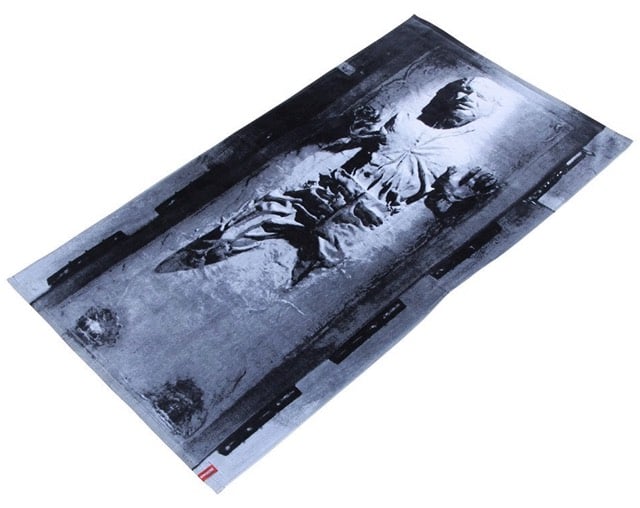
This beach towel featuring Han Solo frozen in carbonite is the only Star Wars merch I want in my life. (thx, meg)
Update: Ok, I had forgotten about the Han Solo frozen in carbonite ice cube tray, which is slightly more awesome. (via @ajsheets)
I can’t decide if this video of an ouroboros model train is soothing, menacing, or just kinda boring.
Wait for the Law & Order-esque twist at the 2:00 mark. chung chung
Oh man, this episode of This American Life on desegregation and the Normandy School District (aka the Missouri district that Michael Brown attended) just totally wrecked me. Tears of sadness and rage.
Right now, all sorts of people are trying to rethink and reinvent education, to get poor minority kids performing as well as white kids. But there’s one thing nobody tries anymore, despite lots of evidence that it works: desegregation. Nikole Hannah-Jones looks at a district that, not long ago, accidentally launched a desegregation program.
America likes to pride itself on its focus on the importance of education and everyone getting a crack at living the American Dream, but as this story makes clear, neither of those things are actually true. See also part two of the series and Hannah-Jones’ series on segregation at ProPublica.
John Lasseter, Chief Creative Officer of Pixar, writing in The Onion: I’ve Got You Dumb Motherfuckers Eating Right Out Of My Hand.
Yes, after the success of our first few movies we had a hunch you’d continue to enjoy the wonderfully designed animation and our smart, lyrical writing, but I didn’t think we’d create a horde of drooling morons ready to drop everything just to watch a fucking rat cook dinner. Time and time again, though, there you chumps are, lined up around the block with your stupid little kids, eager to have your stupid little hearts filled with whimsy.
See also Disney’s Lasseter: Woody will find love in ‘Toy Story 4’.
From Orbital Mechanics, a visualization of the 2153 nuclear weapons exploded on Earth since 1945.
2153! I had no idea there had been that much testing. According to Wikipedia, the number is 2119 tests, with most of those coming from the US (1032) and the USSR (727). The largest device ever detonated was Tsar Bomba, a 50-megaton hydrogen bomb set off in the atmosphere above an island in the Barents Sea in 1961. Tsar Bomba had more than three times the yield of the largest bomb tested by the US. The result was spectacular.
The fireball reached nearly as high as the altitude of the release plane and was visible at almost 1,000 kilometres (620 mi) away from where it ascended. The subsequent mushroom cloud was about 64 kilometres (40 mi) high (over seven times the height of Mount Everest), which meant that the cloud was above the stratosphere and well inside the mesosphere when it peaked. The cap of the mushroom cloud had a peak width of 95 kilometres (59 mi) and its base was 40 kilometres (25 mi) wide.
All buildings in the village of Severny (both wooden and brick), located 55 kilometres (34 mi) from ground zero within the Sukhoy Nos test range, were destroyed. In districts hundreds of kilometers from ground zero wooden houses were destroyed, stone ones lost their roofs, windows and doors; and radio communications were interrupted for almost one hour. One participant in the test saw a bright flash through dark goggles and felt the effects of a thermal pulse even at a distance of 270 kilometres (170 mi). The heat from the explosion could have caused third-degree burns 100 km (62 mi) away from ground zero. A shock wave was observed in the air at Dikson settlement 700 kilometres (430 mi) away; windowpanes were partially broken to distances of 900 kilometres (560 mi). Atmospheric focusing caused blast damage at even greater distances, breaking windows in Norway and Finland. The seismic shock created by the detonation was measurable even on its third passage around the Earth.
The Soviets did not give a fuck, man…what are a few thousand destroyed homes compared to scaring the shit out of the capitalist Amerikanskis with a comically large explosion? Speaking of bonkers Communist dictatorships, the last nuclear test conducted on Earth was in 2013, by North Korea.
Update: Since this post was published, North Korea has tested a few more nuclear devices, the last one in 2017.
Earlier in the month, I wrote about a man who lost his sense of smell.
Over lunch, he says: “I joke I can’t smell my daughter’s diaper. But I can’t smell my daughter. She was up at 4 o’clock this morning. I was holding her, we were laying in bed. I know what my son smelt like as a little baby, as a young kid. Sometimes not so good, but he still had that great little kid smell to him. With her, I’ve never experienced that.”
Jason Caplin lost his sense of smell suddenly five years ago, but recently regained that ability. It has not been the fantastic experience you might expect.
And so to tonight. Here it is, then. Smell at full blast. The inside of my head is basically completely uncalibrated. My nose just has no idea what to do with this rediscovered fury of data. Walking to the tube, I tentatively tried breathing in through my nose. Once. I felt alarm bells going off at the back; smells that had no place together (and which I could only vaguely recall in name) set my eyes watering and made me gag. I sneezed, a lot. At the big roundabout I could smell mint, horses, an outdoor pool from a family holiday when I was eight. The supermarket smelt of hair, even though I don’t think I could tell you what hair smells like, and it set me wondering how much of this my brain was reconstructing on the fly. The tube was almost unbearable and I blinked to stop crying.
That happened back in May…I hope things have settled down for him. (via gyford)
This is an epic display of top-notch lip syncing and world-class shade throwing. I smiled the whole way through this.
Songs performed include Wannabe by The Spice Girls, The Sign by Ace of Base, Thong Song by Sisqo, and Orinoco Flow by Enya.
Update: A playlist of the songs sung in the video are now available on Rdio and Apple Music.
(via @jemaleddin & @murtaugh)
Are your palms dry? Do you wish they were soaked with sweat right now? Then you should definitely watch Spencer Seabrooke walk on a slack line across a 210-foot gap almost 1000 feet in the air without any ropes or safety harnesses.
I mean, Jesus. (via devour)
Drunk Stoned Brilliant Dead is a documentary about National Lampoon coming out this fall. Here’s the trailer:
From the 1970s thru the 1990s, there was no hipper, no more outrageous comedy in print than The National Lampoon, the groundbreaking humor magazine that pushed the limits of taste and acceptability — and then pushed them even harder. Parodying everything from politics, religion, entertainment and the whole of American lifestyle, the Lampoon eventually went on to branch into successful radio shows, record albums, live stage revues and movies, including Animal House and National Lampoon’s Vacation. The publication launched the careers of legends like John Belushi, Bill Murray, Chevy Chase, Christopher Guest and Gilda Radner, who went on to gigs at Saturday Night Live and stardom.
Director Douglas Tirola’s documentary about the Lampoon, DRUNK STONED BRILLIANT DEAD: THE STORY OF THE NATIONAL LAMPOON, cleverly chronicles its founding by two former Harvard students, its growth, demise and everything in between. Told thru fresh, candid interviews with its key staff, and illustrated with hundreds of outrageous images from the mag itself (along with never-seen interview footage from the magazine’s prime), the film gives fans of the Lampoon a unique inside look at what made the magazine tick, who were its key players, and why it was so outrageously successful: a magazine that dared to think what no one was thinking, but wished they had.
(via subtraction)
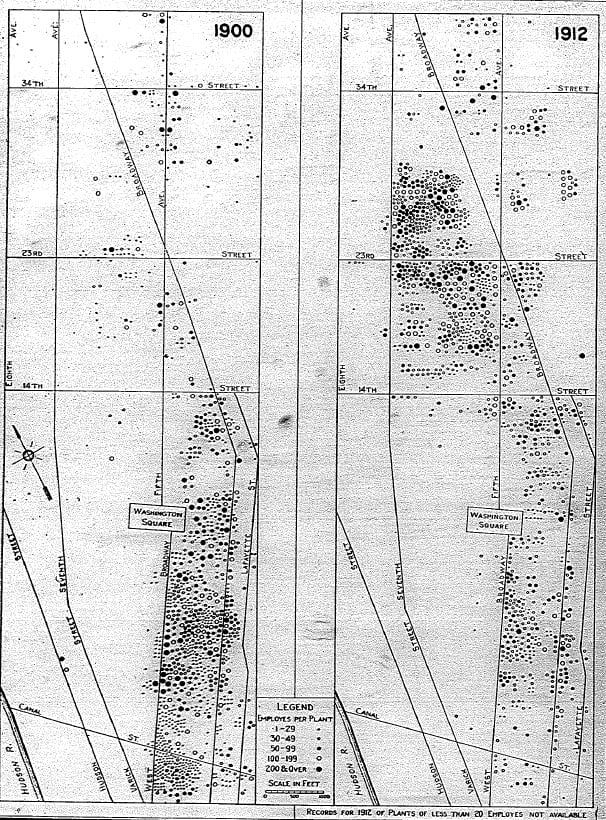
Economist William Easterly and some of his colleagues built a site that focuses on the economic development of a single block in NYC, Greene Street between Houston and Prince. In the past 175 years, use of the block has gone from wealthy residential to sex work to garment manufacturing to artist galleries to luxury retail.
133 Greene Street, for example, has been part of the large Bayard farm, a grand residential home, a brothel, a garment factory, part of a slum, an art gallery, and is today the home of luxury co-op residences and a Dior Homme store.
Many of these shifts took only a decade and could have been very difficult to anticipate.
The site was built to accompany an academic paper on economic development.
By 1870, the Greene Street Block contained 14 brothels, the highest concentration of any block in the City. Just as surprising was the sudden end of prostitution on the block. Brothels still abounded in 1880, but during the next decade entrepreneurs demolished and rebuilt almost the entire block as castiron factories and warehouses, and what was left of the red-light district moved up town.
The site is a little confusing to navigate, but is worth checking out in detail. For instance, check out how quickly the garment manufacturing industry shifted from downtown to the present-day Garment District.

(via wired)
Rolling Stone’s 100 Greatest Songwriters of All Time. The top rap artist is Biggie all the way down at #52? Come. On.
Photographer Carlos Gonzalez, aka Theonepointeight, captured these photos of an abandoned LA shopping mall.

PDN has an interview with Gonzalez about the series.
I shot everything in one day. I would say that I spent about five or six hours in there just exploring and shooting. I wasn’t escorted inside but once I snuck into the parking structure, there were a few teens on skateboards that pointed me in the right direction. Without their guidance, there’s no way I would’ve found a way in. The place is simply too massive. In fact, as the daylight was fading I almost got trapped inside since I couldn’t find my way out.
Obama’s off for a couple of vacation weeks on Martha’s Vineyard and is taking the following books with him on vacation: All That Is by James Salter, All The Light We Cannot See by Anthony Doerr, The Sixth Extinction by Elizabeth Kolbert, The Lowland by Jhumpa Lahiri, Between The World and Me by Ta-Nehisi Coates, and Washington: A Life by Ron Chernow. Solid.
My summer reading list so far: Quiet, The Antidote, The Martian, Ready Player One, and the kids and I are slowly working our way through Harry Potter and the Order of the Phoenix.
Update: POTUS has also made a Spotify playlist of his favorite summer songs. The Temptations, Dylan, Coldplay, and Aretha. No Jay or Bey?
Update: Ah, he also made a list for a summer night and there’s some Beyonce on there. Thank you, Mr. President.
PBS is airing a documentary in September about Muppets creator Jim Henson called In Their Own Words: Jim Henson.
I had never really noticed before that Henson’s natural speaking voice obviously sounds a lot like Kermit. (via @khoi)
Mark Reay is a former model, actor, and fashion photographer who was homeless in NYC for six years. Homme Less is a documentary on Reay; here’s a trailer:
So began a period of my life sleeping rough. It was pretty tiring, and I didn’t have much luck with the photos, but I stuck it out. I’ve never let the lack of money stop me having a good time, and I still had (dwindling) savings from my modelling. It was a happy time. At night I would always treat myself to a rotisserie chicken, but I always wanted a chilled rosé with it. So, in the afternoon, I would sneak into a minimarket, get the cheapest one from the shelf and hide it under the frozen peas. Then, at night, I would put on a fresh shirt and go to one of the fancy bars with my wine in my bag. Again, maybe because I had a certain look, no one ever checked my bag. I’d just go in, nick a glass off the counter and drink my wine surrounded my millionaires.
You can get away with anything if you’re confident. Oh, and male, white, and good looking.
The Rosses were expecting twins but learned that one of the two, Thomas, wouldn’t live much past birth. They decided to donate Thomas’s body to science. And then, they decided to investigate just what it was they had given and how it had helped others. Great piece by Radiolab.
See also this piece in the Philadelphia Inquirer.
The next day, Gray met James Zieske, the institute’s senior scientist, who told her “infant eyes are worth their weight in gold,” because, being so young, they have great regenerative properties. Thomas’ corneas were used in a study that could one day help cure corneal blindness.
Thirteen more studies had cited that study. Gray felt a new emotion: pride.
Google announced earlier in the week that they were creating a new company, Alphabet, to house a collection of companies, including Google.
What is Alphabet? Alphabet is mostly a collection of companies. The largest of which, of course, is Google. This newer Google is a bit slimmed down, with the companies that are pretty far afield of our main Internet products contained in Alphabet instead. What do we mean by far afield? Good examples are our health efforts: Life Sciences (that works on the glucose-sensing contact lens), and Calico (focused on longevity).
Google has been focused on diversifying their business for a long time, even before their IPO. In August of 2003, they posted a job listing on Craigslist looking for a manager to run their collection of Googlettes, which were essentially startups within Google:
What is a Googlette? It’s a new business inside of Google that is just getting started — the start-up within the start-up. We’re looking for an experienced, entrepreneurial manager capable of offering direction to a team of PMs working on a wide array of Googlettes. You will define Google’s innovation engine and grow the leaders of our next generation of businesses.
Georges Harik, who is now an advisor for Google Ventures, was a former director of the Googlettes:
As director of Googlettes, his team was responsible for the product management and strategy efforts surrounding many nascent Google initiatives including Gmail, Google Talk, Google Video, Picasa, Orkut, Google Groups and Google Mobile.
At the time, I riffed on this idea a little and imagined Google spinning out these businesses as a confederation of stand-alone companies:
Instead of generating ideas and people for internal use, what if they’re incubating start-ups to spin off into companies of their own? Fast forward five years and instead of being a big huge company, Google is a big huge company at the center of a network of 10-20 large to medium-sized companies with similar goals, values, and business practices. Most of these spin-offs would be engaged in businesses similar (and probably complementary) to each other and the Google Mother Ship, some of them maybe even directly competing with each other.
In hindsight, Alphabet is a much better name than Google Mother Ship.
Here’s the teaser trailer for Quentin Tarantino’s The Hateful Eight. (This one was certainly not the trailer.)
Update: A second longer trailer is out:
Larch Wood Enterprises is a Nova Scotian company specializing in the manufacture of cutting boards from end grain wood…that is, the top surface of the board shows the rings of the tree. Not only that, but each row on the board is cut from the same stick of wood so you can see how the grain changes through the tree. It’s tough to explain…just watch how they make ‘em.
End Grain is when the individual boards of wood are arranged so that the grain of the wood (the growth rings) runs vertically (up and down). This puts one end of each board up so that the cutting surface is actually the end of many individual pieces of wood. With the grain aligned in this manner (up and down), when the knife strikes the surface during cutting, the grain of the wood actually separates and then closes when the knife is removed. This accounts for the self-healing aspect of the end-grain surface. The wood itself is not cut, but instead you are cutting between the fibers.
A medium sized board costs $220 but if you can pass it on to your grandkids, perhaps it’s worth the price to upgrade yourself. (via devour)

What are you doing today Jason? Oh not much just exploring Mars. The hell you say. Like fun I am! NASA has released a pair of web apps: one lets you drive Curiosity around the surface of Mars and the other is a 3D visualization of the planet. Oh cool that’s what I’m doing today now too. And when you’re done with that, follow NASA’s new Tumblr. Far out man.
As if you needed more proof that dolphins are cool: they enjoy surfing.
Newer posts
Older posts



Socials & More