Entries for August 2015
Justin Hall has been sharing his life online for over 20 years at links.net. Justin’s Links from the Underground was one of the first sites I found and read regularly, back in the mid 90s. Now Hall has made a documentary about his time online, overshare: the links.net story.
Starting in 1994, my personal web site Justin’s Links from the Underground has documented family secrets, romantic relationships, and my experiments with sex and drugs.
overshare: the links.net story is a documentary about fumbling to foster intimacy between strangers online. Through interviews, analysis and graphic animations, I share my motivations, my joys and my sorrows from pioneering personal sharing for the 21st century. In 2004 the New York Times referred to me as “perhaps the founding father of personal weblogging.” I hope this documentary reveals that I was a privileged white male with access to technology who worked to invite as many people as possible to join him in co-creating an internet where we have a chance to honestly share of our humanity.
The movie is available in various formats, including as a digital download with extra footage from VHX for $11.99.

David McCullough (Truman, John Adams, Pulitzer Prize, National Book Award) recently published a new book on The Wright Brothers. James Salter has a nice review in the New York Review of Books.
They knew exactly the importance of what they had accomplished. They knew they had solved the problem of flight and more. They had acquired the knowledge and the skill to fly. They could soar, they could float, they could dive and rise, circle and glide and land, all with assurance.
Now they had only to build a motor.
Update: British Pathe has footage of a flight by the Wright Brothers:
It’s labelled “First Flight” but the footage is actually from much later…that is clearly not Kitty Hawk and the first two-person flights did not occur until 1908. It is also unclear whether Orville and Wilbur were flying together in the video. From Salter’s piece:
He and Wilbur had never flown together so that if there were ever a fatal accident it would not involve both of them, and one of them would live to continue the work. On that one occasion, they took off to fly together, with Orville at the controls, side by side.
If the footage is from the flight Salter describes, that would make it from 1910. (via @SavageReader)
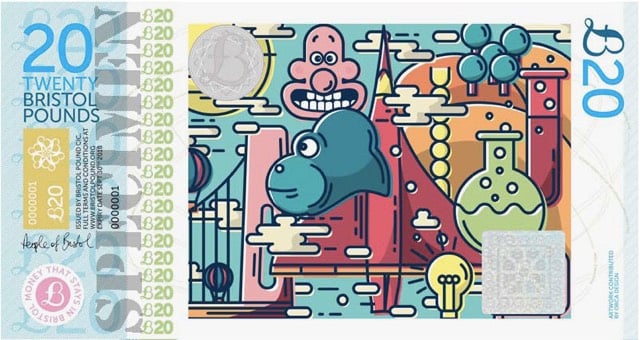
Cities, businesses, and artists are producing small batches of paper currency designed to be spent locally. I love the £20 note from Bristol, England (above)…it’s got Wallace’s head on it!
The local currency, though, is intended not as collectible but to encourage trade at the community businesses where they are accepted, rather than chain stores, where money taken in tends to flow out of town and into the coffers of multinational corporations. (Compare it to the farmers’ market: Homegrown lettuce now has a whole new meaning.)
“If you use a local currency, you keep the money local, and that has a ‘lifts all boats’ vibe to it,” said David Wolman, the author of “The End of Money.”
Emily Lakdawalla provides an update on all of the exploration that’s going on in our solar system this month. Here’s a quick map view of the 20+ spacecraft exploring our solar system beyond Earth:
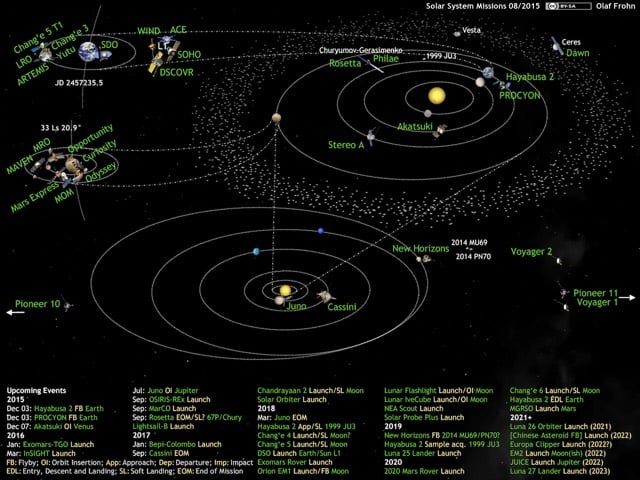
Mars remains the most active spot beyond Earth in the solar system. This week, Mars Reconnaissance Orbiter reaches its 10th anniversary of service in space, but it’s far from the oldest spacecraft in orbit at Mars; Mars Express and Mars Odyssey are still at work up there. Mars Orbiter Mission has ventured into an extended mission and is still returning photos, though apparently none of the full-disk images in a variety of phases that I had hoped for from its 4-Megapixel color camera. Even Mars’ newest resident, MAVEN, is three-quarters of the way through its one-year primary science mission, which began on November 16, 2014. MAVEN’s mission will undoubtedly be extended long beyond that, as it will be needed to support surface missions if and when Odyssey and Mars Reconnaissance Orbiter eventually fail.
Both Opportunity and Curiosity have been very active lately. Opportunity has finally reached Marathon Valley, a site identified from orbit to have signs of clay chemistry. The team is excited about the science prospects even though the rover’s memory problems persist.
What the hell? Google is now Alphabet?
In Rolling Stone, Eric Holthaus writes that as far as climate change is concerned, we are already past the point of no return. The things climate scientists have warned against are already beginning to happen…and faster than predicted.
Hansen’s new study also shows how complicated and unpredictable climate change can be. Even as global ocean temperatures rise to their highest levels in recorded history, some parts of the ocean, near where ice is melting exceptionally fast, are actually cooling, slowing ocean circulation currents and sending weather patterns into a frenzy. Sure enough, a persistently cold patch of ocean is starting to show up just south of Greenland, exactly where previous experimental predictions of a sudden surge of freshwater from melting ice expected it to be. Michael Mann, another prominent climate scientist, recently said of the unexpectedly sudden Atlantic slowdown, “This is yet another example of where observations suggest that climate model predictions may be too conservative when it comes to the pace at which certain aspects of climate change are proceeding.”
Since storm systems and jet streams in the United States and Europe partially draw their energy from the difference in ocean temperatures, the implication of one patch of ocean cooling while the rest of the ocean warms is profound. Storms will get stronger, and sea-level rise will accelerate. Scientists like Hansen only expect extreme weather to get worse in the years to come, though Mann said it was still “unclear” whether recent severe winters on the East Coast are connected to the phenomenon.
You might also like to read Adam Sobel’s reaction to this piece. As I wrote in reaction to James Hansen’s recent paper: “That’s the thing about nonlinear systems like the Earth’s climate: things happen gradually, then suddenly.”
Update: A group of climate scientists at Climate Feedback analyzed Holthaus’ piece at his request for accuracy.
While the information within the article is mostly accurate, the main issue for scientists is the article’s framing of the information. More specifically, the article implicitly attributes many weather events to human-induced climate change, while the influence of human activity on these events is not always supported by science, or is at the frontier of scientific knowledge and still debated.
The walls of the elevator to the observatory at the top of 1 World Trade Center are covered with screens and when you ride it to the top, you see a time lapse of NYC’s development, from 1500 to the present.
The observatory is open daily from 9am to 8pm.
Hey olds! Confused by Snapchat? Read this guide and be saved.
An oral history of Kids. Harmony Korine: “I figured it should take about a week to write.”

Susan Kare, who famously designed the original icons for the Apple Macintosh, has teamed up with Areaware to offer real decks of cards with her artwork from Windows 3.0’s version of Solitaire. Nice example of defictionalization. They’re currently sold out but I’m hoping they restock so I can order a deck. (via subtraction)
Update: Areaware tells me that the cards aren’t out of stock, they are just not in stock yet. So don’t worry…they haven’t sold out or anything.

Tyler Ford was born a girl, transitioned to being a man in college, but now identifies as an agender person.
I have been out as an agender, or genderless, person for about a year now. To me, this simply means having the freedom to exist as a person without being confined by the limits of the western gender binary. I wear what I want to wear, and do what I want to do, because it is absurd to limit myself to certain activities, behaviours or expressions based on gender. People don’t know what to make of me when they see me, because they feel my features contradict one another. They see no room for the curve of my hips to coexist with my facial hair; they desperately want me to be someone they can easily categorise. My existence causes people to question everything they have been taught about gender, which in turn inspires them to question what they know about themselves, and that scares them. Strangers are often desperate to figure out what genitalia I have, in the hope that my body holds the key to some great secret and unavoidable truth about myself and my gender. It doesn’t. My words hold my truth. My body is simply the vehicle that gives me the opportunity to express myself.
Ford uses the “they”, “them”, and “their” pronouns to refer to themselves. (Is it themselves? Or would it be themself? English is a relatively young and fluid language but even it can’t keep up.)
Netflix made big news by increasing its maternity and paternity leave to a year. But in a really interesting piece, The New Yorker’s Vauhini Vara provides some historical and economic background and makes the case why not all paid family leave regulations should be left up to private employers:
Among the earners of the highest wages, twenty-two per cent have access to paid family leave, while among the lowest earners, only four per cent do. It turns out that a disparity exists even within Netflix.
That time in Latvia when some folks cut a huge circle of ice out of a frozen lake, attached an outboard motor to it, and made an ice carousel.
(via devour)
In the future, when time travel is a totally normal thing to do, people will use it to do stuff like tell their 10-year-old selves to learn the guitar so their adult selves can impress women.
(via @mouser_nerdbot)
From the abstract of a paper on the relationship between impatience and procrastination, this caught my eye:
We find substantial evidence of time inconsistency. Namely, more that half of the participants who receive their check straight away instead of waiting two weeks for a reasonably larger amount, subsequently take more than two weeks to cash it.
This reminded me of a passage I read recently in Oliver Burkeman’s The Antidote1 about the pitfalls of positive visualization.
Yet there are problems with this outlook, aside from just feeling disappointed when things don’t turn out well. These are particularly acute in the case of positive visualisation. Over the last few years, the German-born psychologist Gabriele Oettingen and her colleagues have constructed a series of experiments designed to unearth the truth about ‘positive fantasies about the future’. The results are striking: spending time and energy thinking about how well things could go, it has emerged, actually reduces most people’s motivation to achieve them. Experimental subjects who were encouraged to think about how they were going to have a particularly high-achieving week at work, for example, ended up achieving less than those who were invited to reflect on the coming week, but given no further guidelines on how to do so.
In one ingenious experiment, Oettingen had some of the participants rendered mildly dehydrated. They were then taken through an exercise that involved visualising drinking a refreshing, icy glass of water, while others took part in a different exercise. The dehydrated water-visualisers — contrary to the self-help doctrine of motivation through visualisation — experienced a significant reduction in their energy levels, as measured by blood pressure. Far from becoming more motivated to hydrate themselves, their bodies relaxed, as if their thirst were already quenched. In experiment after experiment, people responded to positive visualisation by relaxing. They seemed, subconsciously, to have confused visualising success with having already achieved it.
In a similar way, it may be that the people who received their checks right away but didn’t cash them “relaxed” as though they had actually spent the money, not just gotten the check. (via mr)
The Cornell Lab of Ornithology has digitized their vast library of animal sounds, dating back to 1929, and made them available online.
It took archivists a dozen years to complete the monumental task. The collection contains nearly 150,000 digital audio recordings equaling more than 10 terabytes of data with a total run time of 7,513 hours. About 9,000 species are represented. There’s an emphasis on birds, but the collection also includes sounds of whales, elephants, frogs, primates and more.
Even with those thousands of hours of recordings, some contemporary species remain unrecorded. The library maintains a list of their most wanted calls. On the list for North America are the Arctic Loon, Shiny Cowbird, and Surf Scoter. (via @alexismadrigal)
In August of 1946, the New Yorker dedicated an entire issue to a piece called Hiroshima by John Hersey. As an introduction, the editors wrote:
TO OUR READERS. The New Yorker this week devotes its entire editorial space to an article on the almost complete obliteration of a city by one atomic bomb, and what happened to the people of that city. It does so in the conviction that few of us have yet comprehended the all but incredible destructive power of this weapon, and that everyone might well take time to consider the terrible implications of its use. The Editors.
For the 70th anniversary of the dropping of the bomb on Hiroshima, the New Yorker has digitized Hersey’s piece. The piece is quite long (30,000 words) so it can also be found in book form if that’s easier to read. Here’s the opening paragraph to get you going:
At exactly fifteen minutes past eight in the morning, on August 6, 1945, Japanese time, at the moment when the atomic bomb flashed above Hiroshima, Miss Toshiko Sasaki, a clerk in the personnel department of the East Asia Tin Works, had just sat down at her place in the plant office and was turning her head to speak to the girl at the next desk. At that same moment, Dr. Masakazu Fujii was settling down cross-legged to read the Osaka Asahi on the porch of his private hospital, overhanging one of the seven deltaic rivers which divide Hiroshima; Mrs. Hatsuyo Nakamura, a tailor’s widow, stood by the window of her kitchen, watching a neighbor tearing down his house because it lay in the path of an air-raid-defense fire lane; Father Wilhelm Kleinsorge, a German priest of the Society of Jesus, reclined in his underwear on a cot on the top floor of his order’s three-story mission house, reading a Jesuit magazine, Stimmen der Zeit; Dr. Terufumi Sasaki, a young member of the surgical staff of the city’s large, modern Red Cross Hospital, walked along one of the hospital corridors with a blood specimen for a Wassermann test in his hand; and the Reverend Mr. Kiyoshi Tanimoto, pastor of the Hiroshima Methodist Church, paused at the door of a rich man’s house in Koi, the city’s western suburb, and prepared to unload a handcart full of things he had evacuated from town in fear of the massive B-29 raid which everyone expected Hiroshima to suffer. A hundred thousand people were killed by the atomic bomb, and these six were among the survivors. They still wonder why they lived when so many others died. Each of them counts many small items of chance or volition — a step taken in time, a decision to go indoors, catching one streetcar instead of the next — that spared him. And now each knows that in the act of survival he lived a dozen lives and saw more death than he ever thought he would see. At the time, none of them knew anything.
The piece made quite an impression upon its release, which you can read about on Wikipedia.
As something of an expert on the topic, I thought this New York Magazine piece about spending time alone in the Big Apple is pretty good. The opening of the piece gets at why busy, crowded NYC is actually a good place for an introvert to be:
Being alone here is a state of mind, a perpetual choice, and an occasional imposition, a burden, and a gift — and sometimes the very best way to meet a fellow stranger. “Every form of human expressiveness is on display,” Vivian Gornick writes of walking the streets by herself, “and I am free to look it right in the face, or avert my eyes if I wish.”
And this tip on the Empire State Building is one for the ol’ bucket list:
A lot of people don’t know this, but the Empire State Building is open until 2 a.m. The last elevator leaves at 1:15. If you go up then, it’s empty, it’s beautiful, and the city sounds like the ocean.
From Back to the Future’s DeLorean to Dr. Who’s Tardis, here’s a listing of sci-fi vehicles ranked from slowest to fastest.
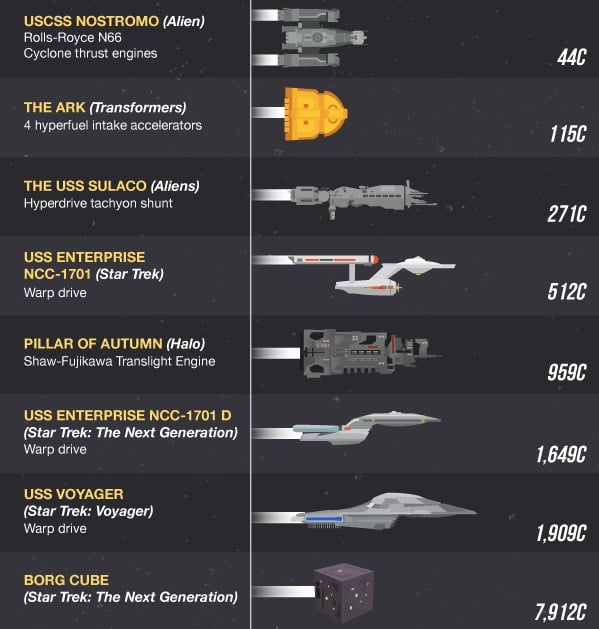
In the ongoing struggle of Star Wars vs. Star Trek, Wars is the clear winner in the speed category: the Millennium Falcon is thousands of times faster than the Enterprise. Also, I didn’t know the Death Star was so fast!
This is just flat-out incredible… NASA’s Deep Space Climate Observatory satellite captured a series of photos of the Moon as it moved between it and the Earth.

The image shows the “dark side” of the Moon, which we can’t see from Earth because it’s always pointed away from us.
The lunar far side lacks the large, dark, basaltic plains, or maria, that are so prominent on the Earth-facing side. The largest far side features are Mare Moscoviense in the upper left and Tsiolkovskiy crater in the lower left. A thin sliver of shadowed area of moon is visible on its right side.
“It is surprising how much brighter Earth is than the moon,” said Adam Szabo, DSCOVR project scientist at NASA’s Goddard Space Flight Center in Greenbelt, Maryland. “Our planet is a truly brilliant object in dark space compared to the lunar surface.”
I don’t know why, but this image gives me chills up my spine! Is anyone else freaking out about this?
From The Verge, The New Devil’s Dictionary, a new economy take on Ambrose Bierce’s The Devil’s Dictionary.
lifehack (v.): To embarrass your ancestors by bragging about an “ingenious” solution to a trivial problem.
operating system (n.): A set of instructions designed to make a particular machine incompatible with other machines.
See also Greg Knauss’ The Devil’s Dictionary 2.0 from many years ago.
blogosphere, noun. An poisonous environment of methane, self-satisfaction and other hot gasses.
podcast, verb. The audible form of “blog,” in much the same way that a series of unhappy grunts and splashes is the audible form of “stomach flu.”
KonMari, meet Mallory Ortberg. She has some hardcore advice for ridding your life of clutter so you can “live abundantly”. Some tips:
How many of the spices lining your pantry have you ever actually used? “Most of them?” Get rid of them. Every one. If you’re not using a spice right now, it’s not important. Your lymph nodes should be covered in turmeric 100% of the time, but you don’t even know where the lids to your Tupperware containers are, do you? Look at the moon. That’s all of the spice you need.
Thank every item in your refrigerator deeply — kiss each one of them softly and slowly with your mouth — then prepare for each item a small Viking funeral. Set them adrift on a blazing ship into the waters of a very cold lake. In the future, when you are hungry, eat your memories. The only thing that belongs in your refrigerator is mindfulness.
Throw away everything in your dirty laundry hamper. If a piece of clothing really mattered to you, you wouldn’t let it get dirty.
There is no need for a bed in the truly de-cluttered life. You should hover gently several inches above the floor in perfect harmony with your surroundings during your yearly nap, like a seahorse.
Are computer generated special effects ruining movies? Freddie Wong says no; CG is so good these days that we only notice it when it’s bad and in bad movies.
My biggest concern with CG is with unrealistic camera movements, e.g. like when the camera is following Spider-Man swooping all over NYC. I can’t not notice it and it almost always takes me out of the experience, which is the opposite of what I want. (via @tonyszhou)
Nick Johnson slammed his head on the ice while playing hockey last year and hasn’t been able to smell anything since then.
At the time of his accident, Nick’s wife was eight months pregnant with their second child. Over lunch, he says: “I joke I can’t smell my daughter’s diaper. But I can’t smell my daughter. She was up at 4 o’clock this morning. I was holding her, we were laying in bed. I know what my son smelt like as a little baby, as a young kid. Sometimes not so good, but he still had that great little kid smell to him. With her, I’ve never experienced that.”
Much of the article focuses on research about how smell can send signals we are not aware of (e.g. body odor can “smell” like stress), but my favorite thing about smell is its connection to memory…which makes the quote above all the more poignant. There are certain scents that when I smell them, they zap me so vividly back to when I was a kid or in college…it’s like time travel.
The best way to get me to click on something is to label it “Michael Jordan Rookie Year Highlights”.
What a time capsule. (via devour)
GravityLight is an electric light that draws its power from gravity. You lift up a weight attached to the light and as it falls, it generates enough power to light the light for 20 minutes.
GravityLight is installed to provide a 6ft/1.8m drop of a 12kg weight. This weight is lifted and on release starts falling very slowly (about 1mm/second).
This movement powers a drive sprocket, which rotates very slowly with high torque (force). A polymer geartrain running through the product turns this input into a high speed, low torque output that drives a DC generator at thousands of rotations per minute.
This generates just under a tenth of a watt, a deciwatt, to power an onboard LED and ancillary devices. Given the ever-increasing efficiency of LEDs, this produces a light over 5 times brighter (lux) than a typical open-wick kerosene lamp.
Once the weighted bag reaches the floor, which depends on how high it was installed, it is simply lifted to repeat the process.
(via @craigmod)
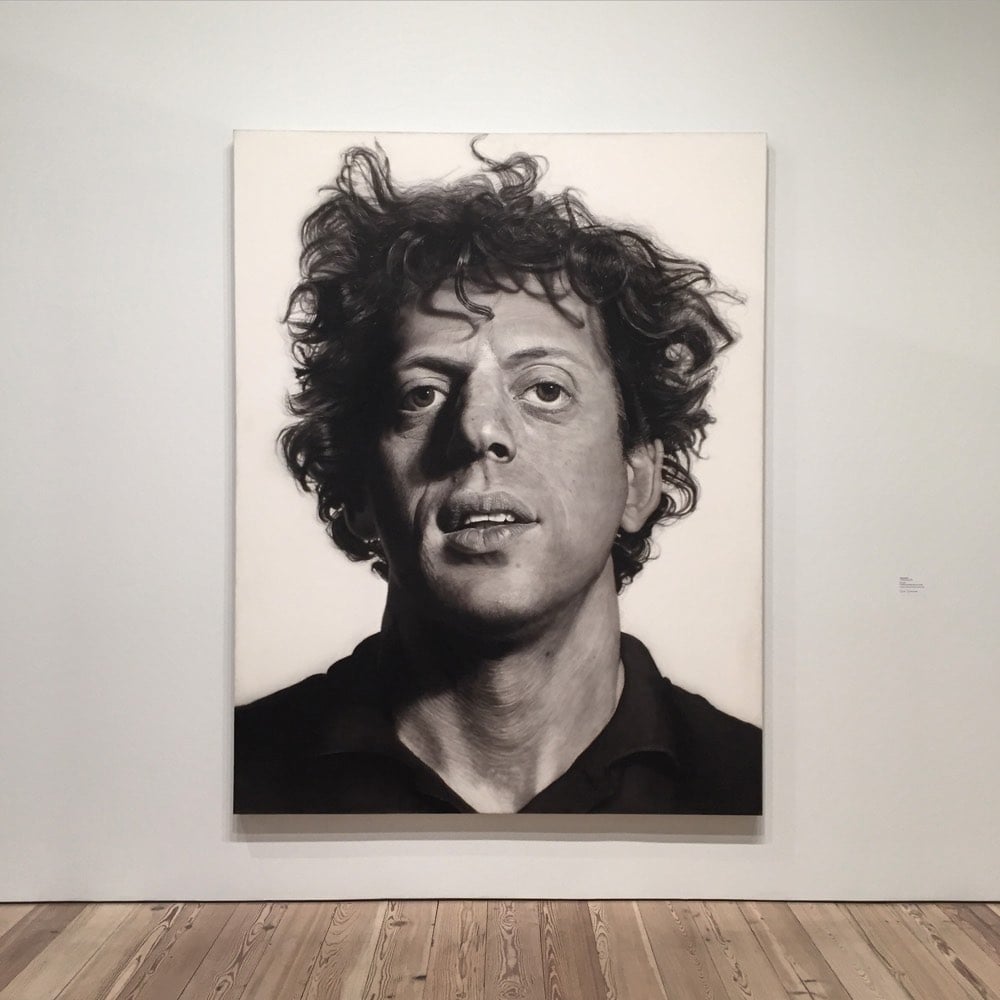
I thought I’d posted about Philip Glass’ new memoir, Words Without Music, when it came out back in April, but I can’t find anything in the archives, so let’s do it right now. I was reminded of it after reading this review by Dan Wang, which pushed Glass’ book to the top of my queue.
These biographical details are manifestations of a quality I admire. Glass never needed much convincing to drop everything in his life to go on a risky venture. I’m not familiar with the many plot twists in his life, and found the book engaging because I had no idea what new adventure he was going to go on next. It’s astonishing how open-minded he is. Consider: His decision to go to India was based entirely on seeing a striking illustration in a random book he grabbed off a friend’s shelf. In addition, he never hesitated to go into personal debt, at times quite steep, because his music couldn’t wait. The book is filled with instances of him saying “sure, when?” to improbable proposals without dwelling on their costs.
He seemed uninterested in stabilizing his position with more regular income. He never took up an honorary conductor position. He never ensconced himself in a plush conservatory professorship. And he didn’t even apply for grants because he didn’t like that they imposed terms.
See also the 2007 documentary Glass: A Portrait of Philip in Twelve Parts. (via mr)
Walter Chang saved up, quit his job, travelled around the world for three years, and made this video.
I went to South America and trekked through Patagonia. In Zimbabwe, hippos, lions, and elephants roamed through our camping ground. When I got to South Korea, my relatives treated me as one of their own, despite having last seen them 18 years prior.
It was in China, the third country of my trip, when I realized that what I was doing wasn’t totally crazy. I had already met a multitude of other backpackers taking extended trips ranging from several months to four years. Young people from abroad were prioritizing travel over hurrying into careers.
This video makes me happy. And sad…I am clearly not grabbing enough tiger by the tail in life currently. Chang is doing a Kickstarter campaign for a book of photos from the trip.
Newer posts



Socials & More