Incanto owner Mark Pastore explains why his restaurant isn’t on Opentable. His analysis is that Opentable is too expensive and monopolistic to offer much in the way of value to restaurants.
The recurring themes were the opinion that OpenTable took home a disproportionate (relative to other vendors) chunk of the restaurants’ revenues each month and the feeling of being trapped in the service, it was too expensive to keep, but letting it go could be harmful. The GM of one very well known New York restaurant group, which spends thousands of dollars on OpenTable each month, put it to me this way, “OpenTable is out for itself, the worst business partner I have ever worked with in all my years in restaurants. If I could find a way to eliminate it from my restaurants I would.” Another high-profile, 3.5-star San Francisco restaurateur told me he feels held hostage by OpenTable. For the past several years, his payments to them have been substantially more than he has himself earned from 80-hour workweeks at his restaurant. But he believes that if he stops offering it, his customers will revolt and many would stop coming to his restaurant. So he keeps paying, but carries a grudge and wishes for something better.
A profile of the woman who does the announcements — the ones you can actually understand — for the NYC subway. Since becoming “the voice”, she hasn’t actually ridden the subway.
On the telephone, her voice does not have quite as much oomph as it does on the subway. “My husband says he doesn’t hear the nice voice as often as he’d like,” she said.
But the nice voice cannot be disobeyed. Before 9/11, when they lived in Louisville, Ky., he drove to the airport to pick up her. He was early. He parked right in front of the terminal. He could hear her on the public-address system, saying no one was supposed to park there.
A traffic officer came along and said he had to follow the voice’s orders.
Her husband said, “I don’t listen to that voice at home; I’m not going to listen to it here.”
One of the fun things about having an Amazon Associates account for kottke.org is that I can see what my readers are ordering on the site. (Amazon only shows the items ordered, not the associated names or anything like that. I have no idea who ordered what.) As one might expect, you folks buy lots of cameras and books and hard drives and movies but also paper towels, sweatpants, soap, and guitar strings.
So anyway, I was browsing around the other day when I noticed that someone had bought a bunch of Whip-It! whipped cream chargers. Four 50-packs for around $115. “Whoa!” I exclaimed to my wife, “Someone out there really likes whipped cream!”
Readers, I could almost hear the eyeroll as my wife explained to this naive bumpkin that people use these canisters of compressed nitrous oxide to get high. So whoever you are, thank you for the novel experience of learning a new Urban Dictionary term from my wife.
It’ll be called Moon Rise Kingdom, it’s set in the 1960s, and check out this cast:
I’m told that Bruce Willis, Edward Norton, Bill Murray, Frances McDormand and Tilda Swinton are all in talks to star in Moon Rise Kingdom, a script that Anderson wrote with Roman Coppola and which Anderson will direct late next spring.
My library was always working library, with the rare books beside my computer as I was writing. But in the last few years, the books were viewed only when a visitor requested a look at the Galileo, Playfair, or Picasso books, or when I took a nostalgic look in the library. Furthermore, the important books in my library are the unread books. My introduction to the Christie’s catalog explains exactly what I’m thinking about in doing the auction. In particular, note the second to last paragraph. And I am in excellent health, delighted with new adventures in Washington, DC and New York City, and fortunate to be a working and exhibiting artist.
He also dropped the name of his next book: Seeing Around, which will likely be about landscape architecture. (thx, brian)
Psychology professor Daryl Bem ran some common psychology experiments backwards and detected statistically significant results that could indicate that people somehow can, uh, see into the future.
In one experiment, students were shown a list of words and then asked to recall words from it, after which they were told to type words that were randomly selected from the same list. Spookily, the students were better at recalling words that they would later type.
In another study, Bem adapted research on “priming” — the effect of a subliminally presented word on a person’s response to an image. For instance, if someone is momentarily flashed the word “ugly”, it will take them longer to decide that a picture of a kitten is pleasant than if “beautiful” had been flashed. Running the experiment back-to-front, Bem found that the priming effect seemed to work backwards in time as well as forwards.
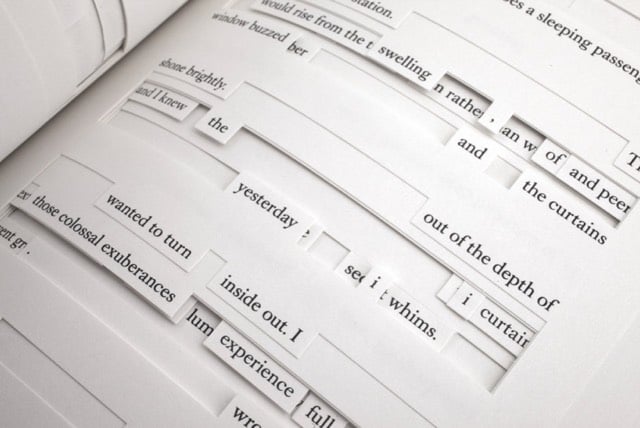
Jonathan Safran Foer’s new book is called Tree of Codes and he constructed it by taking his favorite book, The Street of Crocodiles by Bruno Schulz, and cut out words to form a completely new story.
It’s a rare novel that’s blurbed by Olafur Eliasson:
[A]n extraordinary journey that activates the layers of time and space involved in the handling of a book and its heap of words. Jonathan Safran Foer deftly deploys sculptural means to craft a truly compelling story. In our world of screens, he welds narrative, materiality, and our reading experience into a book that remembers it actually has a body.
3. Don’t over-edit. You will often estrange an author by too elaborate a revision, and furthermore, take away from the magazine the variety of style that keeps it fresh.
7. A sound editor never has a three-months’ full supply in his cupboard. When you over-buy, you narrow your future choice.
George thinks he has been offered a job, but the man offering it to him got interrupted in the middle of the offer, and will be on vacation for the next week. George, unsure whether an offer has actually been extended, decides that his best strategy is to show up. If the job was indeed his, this is the right move. But even if the job is not, he believes that the benefits outweigh the costs.
Economic concepts touched on: cost-benefit analysis, dominant strategy, and game theory. (via what i learned today)
But something about Burke’s moment — the mean-girl giggles in the audience when she asked to solve the puzzle; Sajak’s speechlessness after she did — better captured the imagination. People watching her clip as it crackled across the Internet responded the same way the stunned contestant standing next to her did. Like that poor guy named Rick, they looked at her, and back at the puzzle, back at her, and back at the puzzle, trying to figure it out: How did she do that?
“There are a million things I’m not good at,” she told me on Tuesday. “But Wheel of Fortune, I can do.”
Many of the fancy-dan cocktail bars serve their drinks with huge ice cubes so that even slow sippers don’t have to deal with over-watery cocktails (less surface area = slower melting). If you want to do the same thing at home, get yourself the impressively named Tovolo King Cube tray; it’ll churn out an infinite number of 2-inch cubes for about $8. (via american drink)
Fashioned sometime in the third century A.D., this Roman multi-tool was made for eating.
Like the common Swiss tool, the Roman version has a lot of foldaway implements stowed inside: a knife, spike, pick, fork and a spatula. Unlike the modern-day equivalent, the Roman Army Knife has a useful spoon on the end, making it likely that this iron and silver artifact, found in somewhere in the Mediterranean countries, was meant for eating with.
It was slightly later that a woman named Margaret Knight, working for another company, the Columbia Paper Bag Company of Springfield, MA, designed a machine that could produce flat/square-bottomed paper bags, a great improvement on the earlier, structurally weaker envelope-style bag design. As a result, it is Knight who is more widely recognized as the inventor of the paper bag in the general form of the one shown in Counter Space. She’s also believed to be the first woman to achieve a U.S. patent.
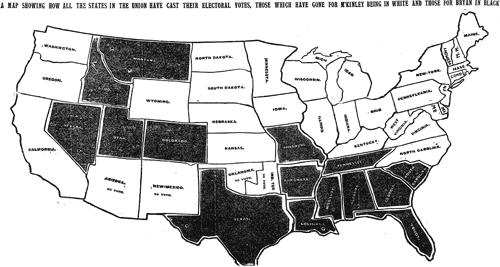
The speed with which the results made it into print boggles the mind given the technology of the day (especially considering that in the last few elections in the 2000s, with all of the technology available to us, there have been a number of states that we haven’t been able to call in the Wednesday paper).
Update: The video on Vimeo was erased for some reason, so I switched the embed to one at YouTube.
Also, the Kabul skatepark profiled in the video is looking for donations of equipment (paging @tonyhawk, @tonyhawk to the front counter, please) and money and/or assistance with shipping (shipping to Afghanistan is challenging). They’re also selling these fetching Skateistan t-shirts (and tote bags) in a variety of styles and colors.
Epic Swarm badge: Check in to a venue that has at least 1,000 people checked in. Yes, if you are number 950, you will get the badges when person number 1,000 checks in.
So with those foreskins, or more accurately, the fibroblasts from the cells of the foreskin, collagen can be lab-created, and where do you put collagen? On your face! Penis wrinkle cream, anyone? Oprah’s beloved SkinMedica product? Yup! Foreskins! One foreskin can be used for decades to grow thousands of fibroblasts.
If you crossed The Sartorialist with The Selby and put the whole thing on a bike, you’d get Downtown From Behind, a collection of photographs of creative people biking the streets of downtown Manhattan, shot from behind.
As near as I can tell, if you grow up in the magical world (as opposed to be Muggle-born, for example), you do not go to school at all until the age of eleven. In fact, it’s entirely unclear to me how the children of the wizarding world learn to read and write. There is a reason Hermione seems much more intelligent than Ron Weasley. It’s because Ron is very likely completely uneducated.
My take is that wizards are jocks, not nerds; Hogwarts is not so much a secondary school as a sports academy. What’s odd about that is that quidditch is an extracurricular…
But the service also helps city leaders detect patterns that might otherwise have escaped notice. After the first survey of 311 complaints ranked excessive noise as the number one source of irritation among residents, the Bloomberg administration instituted a series of noise-abatement programs, going after the offenders whom callers complained about most often (that means you, Mister Softee). Similarly, clusters of public-drinking complaints in certain neighborhoods have led to crackdowns on illegal social clubs. Some of the discoveries have been subtle but brilliant. For example, officials now know that the first warm day of spring will bring a surge in use of the city’s chlorofluorocarbon recycling programs. The connection is logical once you think about it: The hot weather inspires people to upgrade their air conditioners, and they don’t want to just leave the old, Freon-filled units out on the street.
The 311 system has proved useful not just at detecting reliable patterns but also at providing insights when the normal patterns are disrupted. Clusters of calls about food-borne illness or sanitary problems from the same restaurant now trigger a rapid response from the city’s health department.
Not discussed in the article is an assertion by my pal David that exclusive access to 311 data gives incumbent politicians — like, say, Michael Bloomberg — a distinct advantage when it comes to getting reelected. For instance, when campaigning on a neighborhood level, the incumbent can look at the 311 data for each neighborhood and tailor their message appropriately, e.g. promising to help combat noise in a neighborhood with lots of noise complaints or fix the streets in a neighborhood with lots of calls about potholes.
Steve Coogan and Rob Brydon try to one-up each other’s Michael Caine impressions. Brydon’s is superior but Coogan’s “broken voice” is pretty great as well.
Proposed SXSW panel: a suck.com reunion organized by Ana Marie Cox, aka Ann O’Tate.
While its sarcasm traits set Suck apart from the great majority of (painfully earnest) West Coast-based technology “ezines”, Suck’s lasting legacy is only partially based on the words it contained. Rather, Suck changed forever the way people think about writing for the web — they perfected, if not invented, the practice of embedding links not as explanatory reference points but as commentary in and of themselves. Suck imploded rather unspectacularly, but its journey offers lessons: From purchase by a deep-pocket media company (Wired) to a quick-hit book project, to its ultimately deadly jump into crowd-generated content. Is that a cycle most indie projects are doomed to complete? For a publication devoted to debunking Panglossian outlooks on the mediasphere, a shocking number of Suck alumni have turned up, closing on two decades later, as influential, even aspirational, figures in their own right, with careers based on bridging the still-extant (if narrowing) gap between old and new media.
As I told a friend a few months ago, if someone launched a site with Suck’s voice and spirit today, it would *kill*. (The Awl comes pretty close.)
With a record of 19-0, Zenyatta was a favorite to win the Breeders’ Cup Classic. As her jockey eased her into the top of the stretch, she was dead last. Right where she wanted to be.
Her owners, Jerry and Ann Moss; her trainer, John Shirreffs; and for that matter anyone who had watched and loved the great racemare Zenyatta knew that the real running — the edge-of-the-seat-drama — really didn’t start until she turned for home. Nineteen times before, Zenyatta had looked desperate and in trouble at the top of the stretch. Nineteen times before, she had found a gear to rocket past her rivals in the final strides.
So when jockey Mike Smith cornered the big girl and squared her shoulders toward the finish line in dead last, the more than 72,000 people here at Churchill Downs rose to their feet and held their breath. Zenyatta not only had 11 horses to pass, she also had a dozen or so lengths to make up.
And here’s video of the race, just in case you thought that story was too good to be true.
Linotype: The Film is a feature-length documentary film centered around the Linotype typecasting machine invented by Ottmar Mergenthaler. Called the “Eighth Wonder of the World” by Thomas Edison, the Linotype revolutionized printing and society, but very few people know about the inventor or his fascinating machine.
The Linotype completely transformed the communication of information similarly to how the internet is now changing it all again. Although these machines were revolutionary, technology began to supersede the Linotype and they were scrapped and melted-down by the thousands. Today, very few machines are still in existence.
By smashing together lead ions instead of protons, researchers at the Large Hadron Collider have produced a “mini-Big Bang”.
The collisions obtained were able to generate the highest temperatures and densities ever produced in an experiment. “This process took place in a safe, controlled environment, generating incredibly hot and dense sub-atomic fireballs with temperatures of over ten trillion degrees, a million times hotter than the centre of the Sun.
“At these temperatures even protons and neutrons, which make up the nuclei of atoms, melt resulting in a hot dense soup of quarks and gluons known as a quark-gluon plasma.” Quarks and gluons are sub-atomic particles — some of the building blocks of matter. In the state known as quark-gluon plasma, they are freed of their attraction to one another. This plasma is believed to have existed just after the Big Bang.
What they came up with is little more than an electromagnetic ring and a water pump. The ring, called a current probe, creates a magnetic field through which the pump shoots a steam of seawater (the salt is a key ingredient, as the tech relies on the magnetic induction properties of sodium chloride). By controlling the height and width of the, the operator can manipulate the frequency at which the antenna transmits and receives. An 80-foot-high stream can transmit and receive anywhere from 2 to 400 mHz, though much smaller streams can be used for varying other frequencies, ranging from HF through VHF to UHF.
On Monday night, at a screening of the movie “Due Date,” Courtney Love told a reporter from Style.com that she was trying to take better care of herself.
Shortly after 8 p.m., Ms. Love burst into the room with the Marchesa dress slung on one arm and the noted German Neo-Expressionist artist Anselm Kiefer on the other. She was entirely naked and leaning on Mr. Kiefer for support. She made one lap around the room, walking in front of a photographer, an assistant, a hairstylist and me. She pulled over her head a transparent lace dress that covered up nothing, and demanded my assistance — “Not you,” she said to Mr. Kiefer, who was bent over trying to help her — to stuff her feet into a pair of black Givenchy heels that were zipped up the back and tied with delicate laces in the front. Then she applied a slash of red lipstick in the vicinity of her mouth.
“I really must get out of here,” Mr. Kiefer said.
“Just a minute,” Ms. Love said, as she pushed her feet, shoes and all, through a pair of pink knickers that she said cost $4,000. She grabbed a trench coat, walked through the hotel lobby with her breasts exposed to an assortment of prominent fashion figures, including Stefano Pilati, the Yves Saint Laurent designer, and then exited the hotel.
Like Ms. Love, this profile of her is anything but boring.
I’m going to use Mayor Maker tomorrow during the NYC Marathon to auto check me in to every mile marker as I run past them. I’ll be running w/ my iPhone in my pocket (with GPS turned on). Every time I run over a mile checkpoint, Mayor Maker will send that checkin to foursquare and foursquare will send it back out to Facebook and Twitter. Cool, right?
“Ordering Disorder” is an overview of all of my thoughts on using the typographic grid in the practice of Web design. The first part of the book covers the theories behind grid design, the historical underpinnings of the grid, how they’re relevant (and occasionally irrelevant) to the work of Web designers — and a bit of my personal experience coming to grips with grids as a tool.
The second part of the book, which makes up its bulk, walks readers through the design of a full Web site from scratch, over the course of four projects.
Vinh did the art direction for the book himself, so it’s bound to be purty (and grid-y). The perfect early holiday gift for the web designer in your life.
The friend you sort of know, because you have friends in common and have maybe attended the same events — not together, but you’ve both ended up there because you know a lot of the same people. You perhaps would not have thought to invite this person to a small party, and yet you do include him in your wider sense of your social circle — and you now communicate with him via social media more than you ever did before such a thing existed, and you now have a surprising intimacy after years of static, unenergetic just-sort-of-knowing one another (formerly known as “an acquaintance”).
Possibly the worst idea in the world: a movie version of Lord of the Rings starring The Beatles (with Lennon as Gollum) and directed by Stanley Kubrick. According to Peter Jackson, this was a possibility but JRR said hells no.
According to Peter Jackson, who knows a little something about making Lord of the Rings movies, John Lennon was the Beatle most keen on LOTR back in the ’60s — and he wanted to play Gollum, while Paul McCartney would play Frodo, Ringo Starr would take on Sam and George Harrison would beard it up for Gandalf. And he approached a pre-2001 Stanley Kubrick to direct.
Four boarding school friends (the charmer, the looker, the student, and the joker) attempted to scale Mont Blanc and only two came back alive. Two of the four had previously scaled Everest at 19 (without sherpas) and followed that up by travelling from the North Pole to the South Pole using only manpower and natural power. So what went wrong on Mont Blanc?
They spent their first two days with an emphasis on safety measures. Lebon and Atkinson were well advised of Mont Blanc’s singular reputation. Any seasoned climber, when contemplating the world’s most dangerous mountains, looks first to the Himalayas — to Annapurna, K2, Nanga Parbat. These monsters are as forbidding as they come, and therefore have the highest fatality rates. Four out of 10 climbers who ascend Annapurna die there.
Mont Blanc comes in somewhere after Everest, the Matterhorn, and Denali, in Alaska, but in sheer numbers it kills more climbers than the whole lot of them combined. It is the Siren of major mountains; gracious and popular, it is summited by 20,000 climbers a year — pretty much anyone can climb the thing, if not safely. But it lures overly ambitious suitors too high or deep, then brutalizes them.
Tatiana and Krista Hogan are conjoined twins who not only share a bit each other’s skulls but also parts of their brains. So are they two people with two brains & personalities or one person with one brain and two (split) personalities?
Adding to the conundrum, of course, are their linked brains, and the mysterious hints of what passes between them. The family regularly sees evidence of it. The way their heads are joined, they have markedly different fields of view. One child will look at a toy or a cup. The other can reach across and grab it, even though her own eyes couldn’t possibly see its location. “They share thoughts, too,” says Louise. “Nobody will be saying anything,” adds Simms, “and Tati will just pipe up and say, ‘Stop that!’ And she’ll smack her sister.” While their verbal development is delayed, it continues to get better. Their sentences are two or three words at most so far, and their enunciation is at first difficult to understand. Both the family, and researchers, anxiously await the children’s explanation for what they are experiencing.
Here’s the story from a blogger at Nerdy Apple Bottom: her five-year-old son dressed up as Daphne from Scooby Doo for Halloween and mom & boy get shit from some of the other moms at their church preschool, thinking that the boy’s gonna catch The Gay for dressing up like a girl. The mom’s not having any of it:
But here’s the point, it is none of your damn business. If you think that me allowing my son to be a female character for Halloween is somehow going to ‘make’ him gay then you are an idiot. Firstly, what a ridiculous concept. Secondly, if my son is gay, OK. I will love him no less. Thirdly, I am not worried that your son will grow up to be an actual ninja so back off.
Right on. Without really thinking about it this year, we dressed my son in a “girlie” costume (he was a butterfly, at his request, and not a knight or robot or Batman like most of the other three-year-olds I saw) and our daughter was a Frenchman. Not an eyebrow was raised, which is unsurprising as lower Manhattan is pretty much ground zero for It Gets Better. (via @choire)
New York, the documentary film by Ric Burns, contains a great segment on the Empire State Building that is available on YouTube in three parts.
The first two parts are particularly interesting, especially the construction stuff that starts around the five minute mark of part one. Oh, and don’t miss the steelworkers throwing red hot rivets around to each other…that starts right near the end of part one and continues into part two. Some other highlights:
- The original Waldorf-Astoria hotel was torn down (with no small amount of glee from the ESB’s developers) to make room for the new skyscraper. The hotel was built by William Waldorf Astor, heir to the forture created by his father and grandfather (John Jacob Astor & John Jacob Astor III), on the site of his father’s mansion. WW Astor’s cousin, John Jacob Astor IV, went down on the Titanic and the Senate hearings into the disaster were held at the hotel.
- The steel beams were custom forged in Pittsburgh and shipped immediately to the building site…some arrived still hot to the touch from the furnaces.
- At the peak of construction, the workers were adding 4-5 stories a week. During one 22-day stretch, 22 new floors were erected. From start to finish, the entire building took an astonishing 13 months to build, about the same amount of time recently taken by the MTA to fix the right side of the stairs of the Christopher St subway station entrance.
- The building didn’t become profitable until 1950.
An interesting interview with the anthropologist-in-residence of the NYC Department of Sanitation.
The money set aside for street cleaning was going into the pockets of the Tweed and Tammany politicians. Eventually, it got to be that it was so dirty for so long, no one thought that it could be any different. Imagine, on your own block, that you can’t cross the street, even at the corner, without paying a street kid with a broom to clear a path for you, because the streets were layered in this sludge of manure, rotting vegetables, ash, broken up furniture, debris of all kind. It was called “corporation pudding” after the city government. And it was deep — in some cases knee-deep.
Watch how quickly this goalie gets back to defend his own goal.
He’s moving so comically fast compared to the other players on the pitch that it reminds me of the not-so-special effect of Clark Kent racing the train in Superman. (via unlikely words)









Socials & More