Entries for November 2010
Greg Beato on how the seemingly humble phone book “signaled the coming shift from an industrial economy to an information-based one”.
The phone itself was a pretty big deal, of course, helping intimacy transcend proximity. But phone books provided a crucial element to the system: intrusiveness. In the beginning of 1880, Shea writes, there were 30,000 telephone subscribers in the U.S. At the end of the year, that number had grown to 50,000, and because of phone books, each one of them was exposed to the others as never before. While many American cities had been compiling databases of their inhabitants well before the phone was invented, listing names, occupations, and addresses, individuals remained fairly insulated from each other. Contacting someone might require a letter of introduction, a facility for charming butlers or secretaries, a long walk.
Phone books eroded these barriers. They were the first step in our long journey toward the pandemic self-surveillance of Facebook. “Hey strangers!” anyone who appeared in their pages ordained. “Here’s how to reach me whenever you feel like it, even though I have no idea who you are.”
The only way this could be better is with Brian Johnson’s vocals stitched in there.
Wikipedia has a list of all the ridiculous titles that have been used in the North Korean media to refer to Dickhead-in-Chief Kim Jong-il. A sampling:
Superior Person
Sun of Communist Future
Highest Incarnation of the Revolutionary Comradely Love
Beloved and Respected General
Invincible and Iron-Willed Commander
World’s Leader of The 21st century
Glorious General, Who Descended From Heaven
(via @matthiasrascher)
The Super Nintendo version of There Will Be Blood:
This is pitch perfect. What really puts this video over the top are the sound effects (“milkshake!”) and that it doesn’t go on too long.
Without even looking, you could probably guess that scenes from Pulp Fiction and Requiem for a Dream would make a list of film’s greatest drug scenes. But there are 28 other worthy scenes on there as well.
Nerd Boyfriend, a site that details the sartorial choices of desirable nerds, shows us where to buy the outfit Carl Sagan wore in Cosmos.
The Japanese no-brand retailer Muji is taking an interesting approach to their iPhone and iPad apps. Instead of just having a product catalog/store app (although they have that too), they’re also offering apps that are very much like the products they offer in their real-world stores. There’s a simple calendaring app that syncs with Google Calendar, a notebook app for sketching and note-taking, and an app called Muji to Go that combines a bunch of different functions that travellers might need (weather, currency exchange, power socket guide).
If only real life had Photoshop.
Dodging the burnt toast was a fave moment.
For one thing, sleeping is more troublesome than you’d think, considering the remote location:
The onslaught of apparent days and nights would play havoc with astronauts’ body clocks, so a shutters-down and bedtime schedule is imposed by mission controllers. Each of the crew has a closet-like cabin where they can hook a sleeping bag to the wall and settle down for the night. Some strap pillows to their heads to make it feel more like lying down. The lights don’t go out completely, though. People dozing in orbit see streaks and bursts of bright colour caused by high-energy cosmic rays painlessly slamming into their retinas. Fans and air filters add to the distractions, so some astronauts wear ear plugs to block out the constant hum.
Unsurprisingly, falling asleep can take some getting used to. Just as you are nodding off, you can feel as though you’ve fallen off a 10-storey building. People who look half asleep will suddenly throw their heads back with a start and fling out their arms. It gets easier with time. One Russian crew member is renowned for doing without a sleeping bag and falling asleep wherever he ends the day. Anyone still awake after bedtime would see his snoozing form drift by, slowly bouncing off the walls, his course set by the air currents that gently pushed and pulled him.
Whoa! The whole thing is worth a read.
Disunion is a new NY Times blog that will be covering the events of the Civil War in “real-time” as it happened 150 years ago. From one of the first posts about the last ordinary day:
[November 1, 1860] was an ordinary day in America: one of the last such days for a very long time to come.
In dusty San Antonio, Colonel Robert E. Lee of the U.S. Army had just submitted a long report to Washington about recent skirmishes against marauding Comanches and Mexican banditti. In Louisiana, William Tecumseh Sherman was in the midst of a tedious week interviewing teenage applicants to the military academy where he served as superintendent. In Galena, Ill., passers-by might have seen a man in a shabby military greatcoat and slouch hat trudging to work that Thursday morning, as he did every weekday. He was Ulysses Grant, a middle-aged shop clerk in his family’s leather-goods store.
Great idea. The Times started publishing in 1851 so their archives should have a ton of stuff related to the war. (via df)
After the Chicago Bulls won their final championship of the Michael Jordan era, David Halberstam wrote this fantastic article for the New Yorker about Jordan’s final season, final game, and final shot, a jumper over the sprawling body of Bryon Russell.
The crowd, Jordan remembered, got very quiet. That was, he said later, the moment for him. The moment, he explained, was what all Phil Jackson’s Zen Buddhism stuff, as he called it, was about: how to focus and concentrate and be ready for that critical point in a game, so that when it arrived you knew exactly what you wanted to do and how to do it, as if you had already lived through it. When it happened, you were supposed to be in control, use the moment, and not panic and let the moment use you. Jackson liked the analogy of a cat waiting for a mouse, patiently biding its time, until the mouse, utterly unaware, finally came forth.
The play at that instant, Jordan said, seemed to unfold very slowly, and he saw everything with great clarity, as Jackson had wanted him to: the way the Utah defense was setting up, and what his teammates were doing. He knew exactly what he was going to do. “I never doubted myself,” Jordan said later. “I never doubted the whole game.”
When NBA history is written, my guess is that no one will be able to top what Michael Jordan accomplished on the court (Bill Russell, possibly, aside). He was a fantastic athlete and possessed the focus and discipline to make the most of his physical gifts (by which I mean he had the pathological need to completely and totally dismantle everyone else on the court: opponents, teammates, officials, etc.). Basketball is full of mostly-one-or-the-other players: Larry Bird, for example, was not particularly physically gifted but more than made up for it in discipline and Shaq is an amazing athlete but lacked a certain focus at times. Oh, you’ll say, but what about: 1. LeBron (might be more talented than Jordan but is missing the necessary clinical insanity that Jordan had) or 2. Kobe (slightly less talented and driven, but might make up for it with longevity).
But to be fair, the shot against Russell was not the final shot of Jordan’s career. After that article was written, in 1998, Jordan returned to the NBA for two lackluster seasons with the Washington Wizards. His last NBA shot was a free throw in the final two minutes of a meaningless 107-87 loss to the Philadelphia 76ers. Acting on the orders of his coach Larry Brown, Sixers guard Eric Snow fouled Jordan so that Jordan could score some points and leave the game on a high note. The Wizards fouled shortly after and Jordan left to a standing ovation. The intensity that propelled Jordan to such great heights early in his career also drove him to retire too early (twice!) and then come back after it was too late to put an odd sort of question mark on an exclamation point of a career. (via jb)
In Singapore, many apartment buildings have empty open-air ground floors called “void decks” that get put to a variety of uses: day-care, weddings, bicycle parking, small stores, etc.
More than 80% of Singapore’s population lives in public housing, in buildings designed to government specifications. And Singapore’s government ensures that every apartment building mirrors the country’s ethnic mix, with Chinese, Malays, and Indians living as neighbors in proportion to their share of the population — 77%, 14%, and 8% respectively. The void deck ensures that everyone gets to know each other, and each other’s cultures. As the Times puts it, its pleasures are actually “part of Singapore’s strictly enforced social policies aimed at ensuring harmony among the races in a region often torn by religious and ethnic strife.”
Man, what if Spike Jonze had made Being Bill Murray instead? Casey Weldon did a series of paintings of Bill Murray as characters from Wes Anderson’s movies…but non-Murray characters like Max Fischer, Margot Tenenbaum, and the Baumer.

Prints are available. And these were a part of a show called Bad Dads, consisting of art inspired by various Anderson films. Again, prints are available.
Steven Johnson on why New York has become a growing hub for technology startup companies.
As a diverse city that supports countless industries and maverick interests, New York excels at creating those eclectic networks. Subcultures and small businesses generate ideas and skills that inevitably diffuse through society, influencing other groups. As the sociologist Claude Fischer put it in an influential essay on subcultures published in 1975, “The larger the town, the more likely it is to contain, in meaningful numbers and unity, drug addicts, radicals, intellectuals, ‘swingers’, health-food faddists, or whatever; and the more likely they are to influence (as well as offend) the conventional center of the society.”
Lovely long piece in the November issue of Esquire about the brain of Henry Molaison, who you may have previously heard of as Patient H.M., aka the man who lacked the ability to remember anything for more than a couple of minutes. His brain has now been sliced into thin slices in an effort to construct a map of the human brain accurate to neuron-level.
Corkin first met Henry at Brenda Milner’s lab in Montreal in 1962, and over the years, as the mining of his mind has continued, she’s witnessed firsthand how Henry continues to give up riches, broadening our understanding of how memory works. But she’s also keenly aware of Henry’s enduring mysteries, has documented things about him that nobody can quite explain, not yet.
For example, Henry’s inability to recall postoperative episodes, an amnesia that was once thought to be complete, has revealed itself over the years to have some puzzling exceptions. Certain things have managed, somehow, to make their way through, to stick and become memories. Henry knows a president was assassinated in Dallas, though Kennedy’s motorcade didn’t leave Love Field until more than a decade after Henry left my grandfather’s operating room. Henry can hear the incomplete name of an icon — “Bob Dy …” — and complete it, even though in 1953 Robert Zimmerman was just a twelve-year-old chafing against the dead-end monotony of small-town Minnesota. Henry can tell you that Archie Bunker’s son-in-law is named Meathead.
How is this possible?
The piece is written by the grandson of the doctor who removed a portion of Molaison’s brain in an effort to cure his epilepsy.
In 1916, Kennard Thomson, consulting engineer and urban planner for New York City, wrote an article for Popular Mechanics in which he advocated (among other things) filling in the East River to merge Manhattan with Brooklyn.
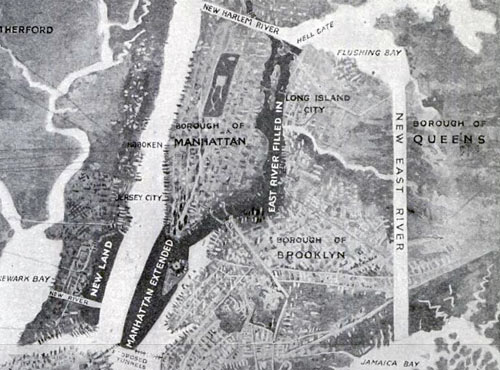
Strange Maps explains:
By Dr Thomson’s estimates, enlarging New York according to his plans would cost more than digging the Panama Canal - but the returns would quickly repay the debt incurred and make New York the richest city in the world. He then goes on to describe how he would reclaim all that land. The plan’s larger outlines: move the East River east, and build coffer dams from the Battery at Manhattan’s southern tip to within a mile of Staten Island, on the other side of the Upper Bay, and the area in between them filled up with sand. This would enlarge Manhattan to an island several times its present size.
Proximity and easy access to the new Battery would increase the total land value of Staten Island from $50 million to $500 million. “This would help pay the expenses of the project,” Dr Thomson suggests.
The project would also add large areas of land to Staten Island itself, to Sandy Hook on the Jersey shore just south of there and create a new island somewhere in between. The East River, separating Manhattan from Queens and Brooklyn, would be filled and replaced by a new canal east of there, slicing through Long Island from Flushing to Jamaica Bays.
Newer posts





Socials & More