kottke.org posts about terrorism
From Vox, a quick video summary of the war in Syria and the rise of ISIS.
The Islamic State of Iraq and Syria, which has claimed responsibility for Friday’s terror attacks in Paris, has its origins in Iraq, but the group as we know it today is in many ways a product of Syria’s civil war. That war is much bigger than ISIS, but it is crucial for understanding so much that has happened in the past year, from terror attacks to the refugee crisis. And to understand the war, you need to understand how it began and how it unfolded.
See also Syria’s civil war: a brief history.
The New Yorker’s John Cassidy wonders how we would be thinking about the Boston Marathon bombing if it had been the Boston Marathon shooting instead.
Yes, this is only a counterfactual exercise, which, like all such riffs, shouldn’t be taken too literally. But it’s hard to think about it for long without coming to the conclusion that there’s something askew with the way we think about and react to various types of extreme violence, and the weapons used in such episodes. In a country where each life (and death) is supposed to count equally, surely the victims of gun violence should be accorded the same weight as the victims of bomb violence. And the perpetrators should get equal treatment, too. But, of course, that’s not how things work.
James Surowiecki, the author of The Wisdom of Crowds, wrote about what was right and wrong about Reddit’s crowdsourced hunt for the Boston bombing suspects.
The truth is that if Reddit is actually interested in using the power of its crowd to help the authorities, it needs to dramatically rethink its approach, because the process it used to try to find the bombers wasn’t actually tapping the wisdom of crowds at all — at least not as I would define that wisdom. For a crowd to be smart, the people in it need to be not only diverse in their perspectives but also, relatively speaking, independent of each other. In other words, you need people to be thinking for themselves, rather than following the lead of those around them.
When the book came out in 2004, I wrote a short post that summarizes the four main conditions you need for a wise crowd. What’s striking about most social media and software, as Surowiecki notes in the case of Reddit, is how most of these conditions are not satisfied. There’s little diversity and independence: Twitter and Facebook mostly show you people who are like you and things your social group is into. And social media is becoming ever more centralized: Facebook, Twitter, Tumblr, Medium, Pinterest, etc. instead of a decentralized network of independent blogs. In fact, the nature of social media is to be centralized, peer-dependent, and homogeneous because that’s how people naturally group themselves together. It’s a wonder the social media crowd ever gets anything right.
UMass Dartmouth is reporting that “a person being sought in connection with the Boston Marathon bombing has been identified as a student registered at UMass Dartmouth”:
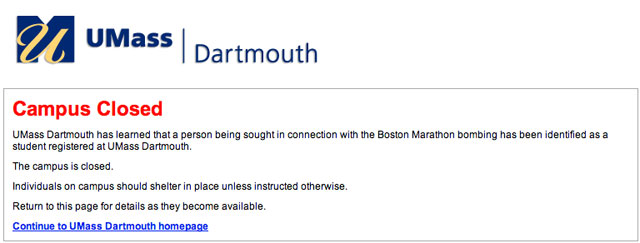
I don’t know that there’s any verified report that registered student is bombing suspect Dzhokhar Tsarnaev, but I found a blog post from August 2011 that suggests that Tsarnaev was participating in the school’s summer reading program for incoming first-year students. The students were participating in a group discussion blog while reading Malcolm Gladwell’s Blink: The Power of Thinking Without Thinking. The post in question was written by UMass Dartmouth English teacher Shelagh Smith on the concept of thin-slicing as it pertained to the case of the West Memphis Three. The post reads, in part:
I believe that thin slicing put them in jail. It helped an entire community make a rash decision and justify their actions in convicting three teens of murder. Once the town was able to identify the bogeyman, they could rest easy again.
But it all went horribly wrong. The real murderers were never found. These young men went into prison at 18 years old. Today, they walked out at 36 years old.
Being different - being unique - is a right we’re supposed to enjoy in this country. But what we can’t control is how people view us.
So what do we do about that? Is there anything we can do about it?
In response, a commenter listing his name as “Dzhokhar Tsarnaev” posted the following about a week and a half after the original posting:
In this case it would have been hard to protect or defend these young boys if the whole town exclaimed in happiness at the arrest. Also, to go against the authorities isn’t the easiest thing to do. Don’t get me wrong though, I am appalled at the situation but I think that the town was scared and desperate to blame someone. It’s because of stories like this and such occurrences that make a positive change in this world. I’m pretty sure there won’t be anymore similar tales like this. In any case, if they do, people won’t stand quiet, i hope.
Tsarnaev also made another comment in another thread on the blog a few minutes earlier in which he offered a critique of Gladwell’s book:
While I understand and agree with most of the concepts that Gladwell explained in his book, there are several ideas of his that I cannot fathom or just choose not to believe. Yes, this book was very interesting but the idea that a person can predict whether you and your partner are going to be together in the future is honestly a little hard to believe. Sure, if you put two obvious celebrities in a room talking about how they’re going to adopt six children, that’s just not going to work out. And the idea that a more experienced doctor is more likely to be sued is likely to happen because they would have way more patients and more time in the work force. “Thin-slicing” and other concepts made me want to keep reading.
This Justice Department memo about when the US government, without hearing or trial or due process or whatever other “rights” we as a country hold dear, can kill US citizens is fucking bullshit.
A confidential Justice Department memo concludes that the U.S. government can order the killing of American citizens if they are believed to be “senior operational leaders” of al-Qaida or “an associated force” — even if there is no intelligence indicating they are engaged in an active plot to attack the U.S.
The 16-page memo, a copy of which was obtained by NBC News, provides new details about the legal reasoning behind one of the Obama administration’s most secretive and controversial polices: its dramatically increased use of drone strikes against al-Qaida suspects abroad, including those aimed at American citizens, such as the September 2011 strike in Yemen that killed alleged al-Qaida operatives Anwar al-Awlaki and Samir Khan. Both were U.S. citizens who had never been indicted by the U.S. government nor charged with any crimes.
The whole memo is here. A staggering disappointment from a man many think is better than this. See also: Obama’s lethal Presidency.
Fantastic account by Nicholas Schmidle in the New Yorker about how the US located and subsequently killed Osama bin Laden in his Abbottabad safehouse.
One month before the 2008 Presidential election, Obama, then a senator from Illinois, squared off in a debate against John McCain in an arena at Belmont University, in Nashville. A woman in the audience asked Obama if he would be willing to pursue Al Qaeda leaders inside Pakistan, even if that meant invading an ally nation. He replied, “If we have Osama bin Laden in our sights and the Pakistani government is unable, or unwilling, to take them out, then I think that we have to act and we will take them out. We will kill bin Laden. We will crush Al Qaeda. That has to be our biggest national-security priority.” McCain, who often criticized Obama for his naïveté on foreign-policy matters, characterized the promise as foolish, saying, “I’m not going to telegraph my punches.”
Update: There has been some question over the authenticity of this story.
Schmidle says he wasn’t able to interview any of the 23 Navy SEALs involved in the mission itself. Instead, he said, he relied on the accounts of others who had debriefed the men.
But a casual reader of the article wouldn’t know that; neither the article nor an editor’s note describes the sourcing for parts of the story. Schmidle, in fact, piles up so many details about some of the men, such as their thoughts at various times, that the article leaves a strong impression that he spoke with them directly.
The SEALs, he writes of the raid’s climactic moment, “instantly sensed that it was Crankshaft,” the mission’s name for bin Laden, implying that the SEALs themselves had conveyed this impression to him.
Although calling it a conspiracy probably goes a little too far…mentioning the JFK assassination when writing of the US government is like Godwin’s law in online discussions. (thx, everyone)
Robert Wright ponders that question and offers a surprising answer: no, because it’s not that effective at weakening their organizations.
You might as well try to end the personal computer business by killing executives at Apple and Dell. Capitalism being the stubborn thing it is, new executives would fill the void, so long as there was a demand for computers.
Of course, if you did enough killing, you might make the job of computer executive so unattractive that companies had to pay more and more for ever-less-capable executives. But that’s one difference between the computer business and the terrorism business. Terrorists aren’t in it for the money to begin with. They have less tangible incentives - and some of these may be strengthened by targeted killings.
Omar Hammami was a fairly normal kid from a small town in Alabama — “as a teenager, his passions veered between Shakespeare and Kurt Cobain, soccer and Nintendo” — who is now in Somalia, leading terrorist attacks for a group called Shabab, which is loosely affiliated with Al Qaeda.
In the three years since Hammami made his way to Somalia, his ascent into the Shabab’s leadership has put him in a class of his own, according to United States law-enforcement and intelligence officials. While other American terror suspects have drawn greater publicity, Hammami exercises a more powerful role, commanding guerrilla forces in the field, organizing attacks and plotting strategy with Qaeda operatives, the officials said. He has also emerged as something of a jihadist icon, starring in a recruitment campaign that has helped draw hundreds of foreign fighters to Somalia. “To have an American citizen that has risen to this kind of a rank in a terrorist organization - we have not seen that before,” a senior American law-enforcement official said earlier this month.
See also a New Yorker article about Adam Gadahn, an American who is now a member of Al Qaeda.
From November 2007 but still relevant: Odds of Dying in a Terrorist Attack.
You are six times more likely to die from hot weather than from a terrorist attack
You are 87 times more likely to drown than die in a terrorist attack
You are 1048 times more likely to die from a car accident than from a terrorist attack
You are 12 times more likely to die from accidental suffocation in bed than from a terrorist attack
You are eight times more likely to be killed by a police officer than by a terrorist
I guess when you’re the President, it’s just not that impressive to say that you protected the nation’s populace from accidental suffocation in bed.
One of the tactics that the British used against the IRA was to open a laundromat. No, really.
The plan was simple: Build a laundry and staff it with locals and a few of their own. The laundry would then send out “color coded” special discount tickets, to the effect of “get two loads for the price of one,” etc. The color coding was matched to specific streets and thus when someone brought in their laundry, it was easy to determine the general location from which a city map was coded.
While the laundry was indeed being washed, pressed and dry cleaned, it had one additional cycle — every garment, sheet, glove, pair of pants, was first sent through an analyzer, located in the basement, that checked for bomb-making residue. The analyzer was disguised as just another piece of the laundry equipment; good OPSEC [operational security]. Within a few weeks, multiple positives had shown up, indicating the ingredients of bomb residue, and intelligence had determined which areas of the city were involved. To narrow their target list, [the laundry] simply sent out more specific coupons [numbered] to all houses in the area, and before long they had good addresses.
Clever. (via schneier)
Christopher Hitchens writes about getting waterboarded for the July issue of Vanity Fair.
You may have read by now the official lie about this treatment, which is that it “simulates” the feeling of drowning. This is not the case. You feel that you are drowning because you are drowning-or, rather, being drowned, albeit slowly and under controlled conditions and at the mercy (or otherwise) of those who are applying the pressure. The “board” is the instrument, not the method. You are not being boarded. You are being watered.
As you can see in the video, Hitchens maybe lasted 15 seconds or so.
Long-but-good article about the changing role of violence within Al Qaeda and other former terrorist organizations.
Fadl was one of the first members of Al Qaeda’s top council. Twenty years ago, he wrote two of the most important books in modern Islamist discourse; Al Qaeda used them to indoctrinate recruits and justify killing. Now Fadl was announcing a new book, rejecting Al Qaeda’s violence. “We are prohibited from committing aggression, even if the enemies of Islam do that,” Fadl wrote in his fax, which was sent from Tora Prison, in Egypt.
Haseltine came from an unusual place to the NSA: Walt Disney Imagineering. Between his overuse of the phrases “bad guys” and “war on terror”, there were a couple of interesting moments.
In Haseltine’s estimation, something called Intellipedia is the biggest advance in the intelligence community since 9/11. Intellipedia is basically an internal Wikipedia for people who work for one of the 16 US intelligence agencies. Its goal is to break down some of the barriers between these agencies in terms of information sharing and colloboration.
Right at the end of the session, interviewer Jane Mayer asked Haseltine if perhaps the Bush administration is overreacting to terrorism…if the mindset that danger lurks everywhere is appropriate and realistic. He replied that since he got involved in the intelligence community, he doesn’t sleep well at night. “I know too much.”
THEBLOG WEEMADE is about “sharing the artwork and creativity of kids”, and they’re inviting you to contribute. My favorite post is by the guy who runs the site...it’s a poem he wrote about terrorism when he was 8 years old in 1984.
What’s the matter Ghadafi?
Why are you so blue?
Has someone put glue
Upon your shoes?
Well, the glue may not be on your shoe,
But the glue is certainly all over you.
You’re stuck, stuck, stuck,
You’re a terrorist,
You’re the most murderous
Terrorist on our list!
Frontline’s two-part report on Bush’s War is getting good reviews.
A two-part special series that tells the epic story of how the Iraq war began and how it has been fought, both on the ground and deep inside the government.
Davenetics sums up the program’s findings:
It really was a perfect storm of bad judgment, malicious intent, a power structure out of balance, a weak Natl Sec Adviser, a marginalized secretary of state, an all-powerful veep, a lazy Congress, and outplayed British PM, a foolishly managed French foreign policy, an ignored military leadership, an Oedipal complex hall of fame President, and a media that focused on Rumsfeld’s funny press conference delivery instead of highlighting the fact that he was wrong, horribly wrong, on just about any point that mattered.
Both parts of the series are available for viewing in their entirety on the Frontline site.
Newer posts
Older posts





Socials & More