kottke.org posts about medicine
A team in Boston is working on a method for injecting oxygen straight into a person’s bloodstream, which is faster than the more traditional method (you know, breathing).
Researchers led by Harvard Medical School’s John N. Kheir engineered tiny, gas-filled microparticles, which were about three micrometers in size and invisible to the naked eye. They used a device called a sonicator, which uses high-intensity sound waves, to produce a foamy liquid solution with microparticles that consist of a single layer of lipids that trap a tiny pocket of oxygen gas. They then injected the resulting mixture directly into the bloodstream of rabbits that were severely oxygen-deprived.
Within seconds, infusions of the microparticles restored the blood oxygen saturation of these mammals to near-normal levels. When the rabbits’ windpipes were completely blocked, the solution kept them alive for 15 minutes without a single breath and reduced the likelihood of cardiac arrest and organ injury.
More here and here.
Writing for The New England Journal of Medicine, Atul Gawande reviews the history of surgery. The utility and efficacy of surgical procedures increased sharply with the use of anesthesia and antiseptic practices.
Before anesthesia, the sounds of patients thrashing and screaming filled operating rooms. So, from the first use of surgical anesthesia, observers were struck by the stillness and silence. In London, Liston called ether anesthesia a “Yankee dodge” - having seen fads such as hypnotism come and go - but he tried it nonetheless, performing the first amputation with the use of anesthesia, in a 36-year-old butler with a septic knee, 2 months after the publication of Bigelow’s report. As the historian Richard Hollingham recounts, from the case records, a rubber tube was connected to a flask of ether gas, and the patient was told to breathe through it for 2 or 3 minutes. He became motionless and quiet. Throughout the procedure, he did not make a sound or even grimace. “When are you going to begin?” asked the patient a few moments later. He had felt nothing. “This Yankee dodge beats mesmerism hollow,” Liston exclaimed.
It would take a little while for surgeons to discover that the use of anesthesia allowed them time to be meticulous. Despite the advantages of anesthesia, Liston, like many other surgeons, proceeded in his usual lightning-quick and bloody way. Spectators in the operating-theater gallery would still get out their pocket watches to time him. The butler’s operation, for instance, took an astonishing 25 seconds from incision to wound closure. (Liston operated so fast that he once accidentally amputated an assistant’s fingers along with a patient’s leg, according to Hollingham. The patient and the assistant both died of sepsis, and a spectator reportedly died of shock, resulting in the only known procedure with a 300% mortality.)

The New England Journal of Medicine recently reported on the 69 year-old man in the photo above. Constant sun exposure to one side of his face resulted in premature aging, though, the other side doesn’t look too bad for 69. The condition is called unilateral dermatoheliosis, which I think is Greek for make sure to wear sunblock.
The patient reported that he had driven a delivery truck for 28 years. Ultraviolet A (UVA) rays transmit through window glass, penetrating the epidermis and upper layers of dermis. Chronic UVA exposure can result in thickening of the epidermis and stratum corneum, as well as destruction of elastic fibers. This photoaging effect of UVA is contrasted with photocarcinogenesis.
(via gizmodo)
The Jenny McCarthy Body Count site tracks the number of vaccine-preventable illnesses and deaths in the US since June 2007.
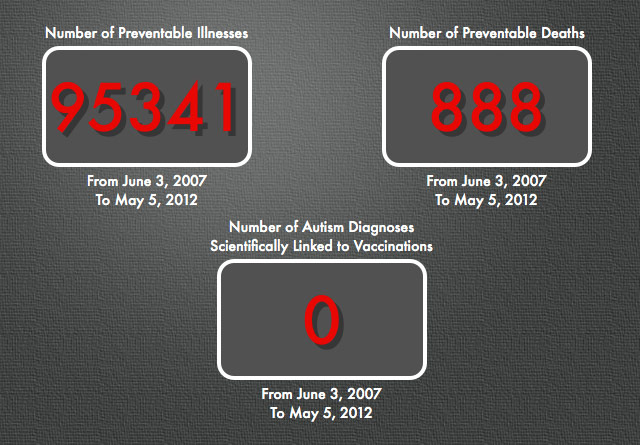
In June 2007 Jenny McCarthy began promoting anti-vaccination rhetoric. Because of her celebrity status she has appeared on several television shows and has published multiple books advising parents not to vaccinate their children. This has led to an increase in the number of vaccine preventable illnesses as well as an increase in the number of vaccine preventable deaths.
I hadn’t realized just how much of a nutter McCarthy is…her embrace of pseudoscience runs deep.
Indigo children is a term used to describe children who are believed to possess special, unusual and sometimes supernatural traits or abilities. The term is pseudoscientific. The idea is based on New Age concepts developed in the 1970s by Nancy Ann Tappe and further developed by Jan Tober and Lee Carroll. The concept of indigo children gained popular interest with the publication of a series of books in the late 1990s and the release of several films in the following decade. A variety of books, conferences and related materials have been created surrounding belief in the idea of indigo children and their nature and abilities. The interpretations of these beliefs range from their being the next stage in human evolution, in some cases possessing paranormal abilities such as telepathy, to the belief that they are more empathic and creative than their peers.
Alive Inside is a documentary that follows social worker Dan Cohen as he discovers that music can “awaken” people suffering from degenerative memory loss (Alzheimer’s, etc.). Here’s a clip in which a man goes from a near-coma state to talking about his favorite songs after listening to music for awhile on headphones.
(via ★swissmiss)
Frank Bruni, who was the food critic at the NY Times for five years, was recently diagnosed with gout. Since his diagnosis, he’s had to cut back on much of his previous food and drink favorites.
You never really quite appreciate just what a cornucopia of food alternatives exists — just how many culinary directions you can set off in — until a few are cut off and you’re forced to re-route yourself. That’s a lesson that people with celiac disease and with diabetes have learned. It’s what vegetarians have long asserted. And it’s what gout is teaching me. In diet books, the word “substitution” comes across as some pathetic euphemism for “sacrifice” and “compromise,” a positive-spin noun born of negative circumstances. But substitution is indeed a plausible course, and not necessarily a punitive one. At breakfast, oatmeal thickened with a heaping tablespoon of peanut butter can provide the same wicked indulgence that pork sausage does. At dinnertime, chicken prepared with care and ingenuity can go a long way toward replacing lamb, and the right kind of omelet can be wholly satisfying.
This is your classic “boy meets girl, boy and girl go back to her place, and he breaks his penis having sex” story. It also might be the best medical love story you’ll read all month.
Somehow the conversation turns to Margaret Thatcher. Somehow Margaret Thatcher becomes a recurring topic. Somehow Margaret Thatcher becomes our go-to sexual depressant. Somehow Margaret Thatcher ends up sitting naked on a suburban fence, legs swinging and twirling a top hat. Occasionally Reagan makes an appearance, too. There’s a lot of glitter involved. I invoke the former Prime Minister whenever I need to cool off. For emergency purposes only.
Also from The Awl, A Treasury of the World’s Worst Online Dating Stories. Warning, contains doozies.
In Infinite Jest, David Foster Wallace wrote that videophone technology wasn’t popular due in part to vanity.
And the videophonic stress was even worse if you were at all vain. I.e. if you worried at all about how you looked. As in to other people. Which all kidding aside who doesn’t. Good old aural telephone calls could be fielded without makeup, toupee, surgical prostheses, etc. Even without clothes, if that sort of thing rattled your saber. But for the image-conscious, there was of course no answer-as-you-are informality about visual-video telephone calls, which consumers began to see were less like having the good old phone ring than having the doorbell ring and having to throw on clothes and attach prostheses and do hair-checks in the foyer mirror before answering the door.
Now DC-area plastic surgeon Dr. Robert Sigal is offering what he calls the “FaceTime Facelift”.
“Patients come in with their iPhones and show me how they look on [Apple’s video calling application] FaceTime,” says Dr. Sigal. “The angle at which the phone is held, with the caller looking downward into the camera, really captures any heaviness, fullness and sagging of the face and neck. People say ‘I never knew I looked like that! I need to do something!’ I’ve started calling it the ‘FaceTime Facelift’ effect. And we’ve developed procedures to specifically address it.”
(via @timbritton)
There is increasing evidence that a parasite called Toxoplasma gondii, which many humans have gotten from cat feces, can rewire our brains and modify human behavior in unexpected ways.
The parasite, which is excreted by cats in their feces, is called Toxoplasma gondii (T. gondii or Toxo for short) and is the microbe that causes toxoplasmosis-the reason pregnant women are told to avoid cats’ litter boxes. Since the 1920s, doctors have recognized that a woman who becomes infected during pregnancy can transmit the disease to the fetus, in some cases resulting in severe brain damage or death. T. gondii is also a major threat to people with weakened immunity: in the early days of the AIDS epidemic, before good antiretroviral drugs were developed, it was to blame for the dementia that afflicted many patients at the disease’s end stage. Healthy children and adults, however, usually experience nothing worse than brief flu-like symptoms before quickly fighting off the protozoan, which thereafter lies dormant inside brain cells-or at least that’s the standard medical wisdom.
But if Flegr is right, the “latent” parasite may be quietly tweaking the connections between our neurons, changing our response to frightening situations, our trust in others, how outgoing we are, and even our preference for certain scents. And that’s not all. He also believes that the organism contributes to car crashes, suicides, and mental disorders such as schizophrenia. When you add up all the different ways it can harm us, says Flegr, “Toxoplasma might even kill as many people as malaria, or at least a million people a year.”
Some pediatricians are asking families who refuse to vaccinate their children to leave their practices.
For Allan LaReau of Kalamazoo, Mich., and his 11 colleagues at Bronson Rambling Road Pediatrics, who chose in 2010 to stop working with vaccine-refusing families, a major factor was the concern that unimmunized children could pose a danger in the waiting room to infants or sick children who haven’t yet been fully vaccinated.
In one case, an unvaccinated child came in with a high fever and Dr. LaReau feared the patient might have meningitis, a contagious, potentially deadly infection of the brain and spinal cord for which a vaccine commonly is given. “I lost a lot more sleep than I usually do” worrying about the situation, he said.
“You feel badly about losing a nice family from the practice,” added Dr. LaReau, but families who refused to vaccinate their kids were told that “this is going to be a difficult relationship without this core part of pediatrics.” Some families chose to go elsewhere while others agreed to have their kids inoculated.
Writing for Grantland, economists Tyler Cowen and Kevin Grier imagine how the NFL might end due to the increasing visibility of head injuries.
This slow death march could easily take 10 to 15 years. Imagine the timeline. A couple more college players — or worse, high schoolers — commit suicide with autopsies showing CTE. A jury makes a huge award of $20 million to a family. A class-action suit shapes up with real legs, the NFL keeps changing its rules, but it turns out that less than concussion levels of constant head contact still produce CTE. Technological solutions (new helmets, pads) are tried and they fail to solve the problem. Soon high schools decide it isn’t worth it. The Ivy League quits football, then California shuts down its participation, busting up the Pac-12. Then the Big Ten calls it quits, followed by the East Coast schools. Now it’s mainly a regional sport in the southeast and Texas/Oklahoma. The socioeconomic picture of a football player becomes more homogeneous: poor, weak home life, poorly educated. Ford and Chevy pull their advertising, as does IBM and eventually the beer companies.
Is this how soccer finally conquers America? Not that soccer doesn’t have its own concussion-related problems.
Update: Claire McNear for the Ringer: It’s Getting Harder and Harder to Deny That Football Is Doomed.
They keep telling us they’re going to find a safe way to do it — a way to play football that doesn’t result in Tre Mason’s mom telling the police that her 23-year-old son just isn’t acting right, that her boy, who couldn’t bring himself to turn up at Rams training camp this summer, now has the mind-set of a 10-year-old. They keep telling us they’re going to find a way that doesn’t end with Bruce Miller, all 248 pounds of him, wandering lost and angry and confused, looking very much like someone exhibiting the symptoms of long-term brain damage, and then attempting to enter a family’s hotel room and allegedly beating a 70-year-old man.
According to Dr. Ken Murray, doctors don’t die like the rest of us.
It’s not a frequent topic of discussion, but doctors die, too. And they don’t die like the rest of us. What’s unusual about them is not how much treatment they get compared to most Americans, but how little. For all the time they spend fending off the deaths of others, they tend to be fairly serene when faced with death themselves. They know exactly what is going to happen, they know the choices, and they generally have access to any sort of medical care they could want. But they go gently.
Of course, doctors don’t want to die; they want to live. But they know enough about modern medicine to know its limits. And they know enough about death to know what all people fear most: dying in pain, and dying alone. They’ve talked about this with their families. They want to be sure, when the time comes, that no heroic measures will happen-that they will never experience, during their last moments on earth, someone breaking their ribs in an attempt to resuscitate them with CPR (that’s what happens if CPR is done right).
People don’t know how to die anymore…advances in technology and medicine have lulled us into believing we can fix anything that’s wrong with our bodies, pain and expense be damned. And sometimes we can and do, and it’s that “what if” that makes it so difficult when thinking about what to do.
This has been happening for awhile but I hadn’t heard about it before: some coma patients are being awoken by Ativan and Ambien and paradoxically so…both are sedative drugs used for treating insomnia.
The first report of a zolpidem [aka Ambien] awakening came from South Africa, in 1999. A patient named Louis Viljoen, who, three years before, was declared vegetative after he was hit by a truck, had taken to clawing at his mattress during the night. Thinking he was suffering from insomnia, his family doctor suggested zolpidem to help him sleep. But 20 minutes after his mother ground the tablet up and fed it to him through a straw, Viljoen began to stir. His eyes, which normally wandered the room, vacant and unfocused, flickered with the light of consciousness. And then he began to talk (his first words were “Hello, Mummy”), and move (he could control his limbs and facial muscles). A few hours later he became unresponsive. But the next day, and for many days after that, zolpidem revived him, a few hours at a time.
Here was a case worthy of Hollywood: three years was well past the point at which doctors would expect any sort of spontaneous recovery. Viljoen awoke with the ability to speak in complete sentences. Not only did he recognize his mother, but he also recognized the voices of people who had spoken to him only when he was apparently vegetative. He remembered nothing of the mysterious realm he kept receding back into. When doctors asked him what it was like to slip away, he said he felt no changes at all. But he could recall conversations from the previous day’s awakening, along with bits and pieces of his former life: his favorite rugby team, specific matches he attended, players that he rooted for and against. As time passed, his cognition improved. He could laugh at jokes, and his awakenings stretched from a few hours to entire days. Eventually, he no longer needed zolpidem.
(thx, meg)
Sour candy is sour because of the acidity level. The Minnesota Dental Association has compiled a chart listing several popular sour candies, all of which are acidic enough to cause tooth enamel loss and some of which are almost as acidic as battery acid! Here’s part of the chart:

(via mlkshk)
Update: I meant to add that the ph scale is logarithmic (like the Richter scale) so that a pH of 3.0 is 10 times more acidic than a pH of 4.0. That means that even the pH 1.6 & 1.8 candies on the list aren’t quite battery acid, but it also means that a pH 2.0 candy has 100x more acidity than is required to cause enamel loss, not just 2x.
This is good news in the fight against malaria, which kills almost 800,000 people annually (that’s a San Francisco, every single year).
An experimental vaccine from GlaxoSmithKline halved the risk of African children getting malaria in a major clinical trial, making it likely to become the world’s first shot against the deadly disease.
Final-stage trial data released on Tuesday showed it gave protection against clinical and severe malaria in five- to 17-month-olds in Africa, where the mosquito-borne disease kills hundreds of thousands of children a year.
“These data bring us to the cusp of having the world’s first malaria vaccine,” said Andrew Witty, chief executive of the British drugmaker that developed the vaccine along with the nonprofit PATH Malaria Vaccine Initiative (MVI).
While hailing an unprecedented achievement, Witty, malaria scientists and global health experts stressed that the vaccine, known as RTS,S or Mosquirix, was no quick fix for eradicating malaria. The new shot is less effective against the disease than other vaccines are against common infections such as polio and measles.
GlaxoSmithKline has previously stated that they will sell the vaccine for cost + a 5% markup that will be put back into tropical disease research.
Newer posts
Older posts





Socials & More