kottke.org posts about language
Former NBA player, shot blocker extraordinaire, and humanitarian Manute Bol died over the weekend at age 47. He died of a rare skin condition caused by a medication he took while in Africa.
“You know, a lot of people feel sorry for him, because he’s so tall and awkward,” Charles Barkley, a former 76ers teammate, once said. “But I’ll tell you this — if everyone in the world was a Manute Bol, it’s a world I’d want to live in.”
According to Language Log, Bol may also have originated the phrase “my bad”.
Ken Arneson emailed me to say that he heard the phrase was first used by the Sudanese immigrant basketball player Manute Bol, believed to have been a native speaker of Dinka (a very interesting and thoroughly un-Indo-Europeanlike language of the Nilo-Saharan superfamily). Says Arneson, “I first heard the phrase here in the Bay Area when Bol joined the Golden State Warriors in 1988, when several Warriors players started using the phrase.” And Ben Zimmer’s rummaging in the newspaper files down in the basement of Language Log Plaza produced a couple of early 1989 quotes that confirm this convincingly:
St. Louis Post-Dispatch, Jan. 10, 1989: When he [Manute Bol] throws a bad pass, he’ll say, “My bad” instead of “My fault,” and now all the other players say the same thing.
USA Today, Jan. 27, 1989: After making a bad pass, instead of saying “my fault,” Manute Bol says, “my bad.” Now all the other Warriors say it too.
Update: As a recent post on Language Log notes, several people picked up on this and kinda sorta got rid of the “may have” and the story became that Bol absolutely coined the phrase “my bad”. Unfortunately, the evidence doesn’t support that theory (although it doesn’t entirely disprove it either). The internet is so proficient at twisting the original meaning of things as they propagate that Telephone should really be called Internet.
The Dictionary of Obscure Sorrows is a collection of imagined definitions for useful contemporary phrases. My two favorite recent entries are the McFly effect:
n. the phenomenon of observing your parents interact with people they grew up with, which reboots their personalities into youth mode, reverting to a time before the last save point, when they were still dreamers and rascals cooling their heels in the wilderness, waiting terrified and eager to meet you for the first time
and especially contact high-five:
n. an innocuous touch by someone just doing their job — a barber, yoga instructor or friendly waitress — that you enjoy more than you’d like to admit, a feeling of connection so stupefyingly simple that it cheapens the power of the written word, so that by the year 2025, aspiring novelists would be better off just giving people a hug.
(thx, john)
Erin McKean on What I Think About When I Think About Sewing:
6. Visualization. Where will I wear this dress? Who will be there? Will I wear it once, or over and over again? Will I blog it?
7. Shoes. Which ones? Do I already own them? Would this dress require shoes that do not, in fact, actually exist? (E.g., every pair of boots I’ve ever wanted.) Do I have a pair of shoes in a weird color that I need to make a dress to match? Am I looking for an excuse to buy a new pair of shoes in a weird color? (Lather, rinse, repeat for “Coat” and “Bag”.)
McKean is perhaps better known as a lexicographer…I like her McKean’s Law:
Any correction of the speech or writing of others will contain at least one grammatical, spelling, or typographical error.
Madonna uses a surprising number of cliches and figures of speech in this interview (conducted by Gus Van Sant).
his Girl Friday
talks the talk
walks the walk
lots of ways to skin the cat
he’s got a fire under his ass
a bee in his bonnet
a trip down memory lane
turn my lemons into lemonade
clotheshorses
so far, so good
reinvent the wheel
The interview itself may not be worth looking at unless you’re already a Madonna, GVS, or cliche fan.
A raised lettering system and alphabet developed by William Moon in the mid-1800s was based more closely on the Roman alphabet than the Braille alphabet.

Frustrated by the quality of the embossed reading systems he tried, and eager to improve worldwide literacy and access to the Bible, he set about developing his own system based on roman lettering. Moon’s system was easy to master, particularly for those who had learned to read before they lost their sight, and it became very successful.
IANAHRSYMMV**, but here are some well-known English language logos redesigned and translated into Hebrew language logos. Nice student work from a class taught by Oded Ezer.
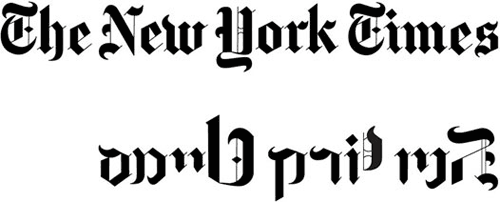
** I am a not a Hebrew reader so your mileage may vary.
In his collected writings, Shakespeare used 31,534 different words. 14,376 words appeared only once and 846 were used more than 100 times. Using statistical techniques, it’s possible to estimate how many words he knew but didn’t use.
This means that in addition the 31,534 words that Shakespeare knew and used, there were approximately 35,000 words that he knew but didn’t use. Thus, we can estimate that Shakespeare knew approximately 66,534 words.
According to one estimate, the average speaker of English knows between 10,000-20,000 words.
Me no like
green eggs and ham
Me no like dem
Sam-I-Am.
(via cyn-c)
Globish is a “decaffeinated English” that is increasingly becoming a widely used international language.
The Times journalist Ben Macintyre described how, waiting for a flight from Delhi, he had overheard a conversation between a Spanish UN peacekeeper and an Indian soldier. “The Indian spoke no Spanish; the Spaniard spoke no Punjabi. Yet they understood one another easily. The language they spoke was a highly simplified form of English, without grammar or structure, but perfectly comprehensible, to them and to me. Only now,” he concluded, “do I realise that they were speaking ‘Globish’, the newest and most widely spoken language in the world.”
More info at Wikipedia and the NY Times…it’s soon to be a book as well.
Before Minna was born, we didn’t know if she was a boy or a girl, so we had a bunch of names picked out for both genders. Since we are so so (SO!) done having kids, I thought I’d share our list in case someone else finds any of them useful.
Girls:
Beatrix
Greta
Coralie
Boys:
Milton
Emory
Milo
Emmett
Max/Maximilian
Hugo
Nico
Oscar
Finn
Sam
Ford
Of the girls names, Minna was my frontrunner from when we first heard it. Meg favored Beatrix for a long time but I finally convinced her of Minna’s intrinsic correctness. Milo was the clear frontrunner had Minna been a boy.
Over the course of their lives, salmon are known first as alevins and then fry, parr, smolts, grilse, and finally kelt.
‘Smolt’, ‘grilse’: as Richard Shelton observes, salmon are spoken of in a ‘stained-glass language’ of their own, their life stages marked by an ichthyological lexicon unchanged since Chaucer’s time. Born in a ‘redd’, a shallow, gravel-covered depression dug by the female in the days before spawning, newly hatched salmon begin life as ‘alevins’, tiny, buoyant creatures with their yolk sacs still attached.
A “jiffy” actually has a formal definition. More than one, in fact.
In electronics, a jiffy is the time between alternating current power cycles, 1/60 or 1/50 of a second in most countries.
In astrophysics and quantum physics a jiffy is the time it takes for light to travel one fermi, which is the size of a nucleon.
In computing, a jiffy is the duration of one tick of the system timer interrupt. It is not an absolute time interval unit, since its duration depends on the clock interrupt frequency of the particular hardware platform.
Those funny double-meaning headlines — like “Gator Attacks Puzzle Experts” or “McDonald’s Fries the Holy Grail for Potato Farmers” — now have a name: crash blossoms. (thx, paolo)
From the Wikipedia page about the .me domain, the top-level domain for Montenegro:
The dot-ME top level domain replaced the dot-YU (Yugoslavia) domain previously used by Serbia and Montenegro. In addition to declaring .me independent of .yu, a new .rs domain was deployed for Serbian use.
Lemme get this straight…when me was subtracted from you, what’s left over is ours?
Newer posts
Older posts





Socials & More