kottke.org posts about graffiti
Banksy took some Bob Ross narration from The Joy of Painting and dubbed it over video footage that shows the street artist painting an image of an escaping inmate on the wall of a former prison in the dead of night. Colossal has more info on why Banksy picked the wall of this particular prison to do:
The expansive and unblemished prison wall was a daring and perfect spot for a Banksy piece. It’s best known for its most famous inmate: Oscar Wilde served two years in the prison from 1895-1897 for the charge of “gross indecency” for being gay. The work is clearly a tribute to the poet, as the escape mechanism appears to be a long strand of paper emerging from a typewriter in place of the usual bed sheets.
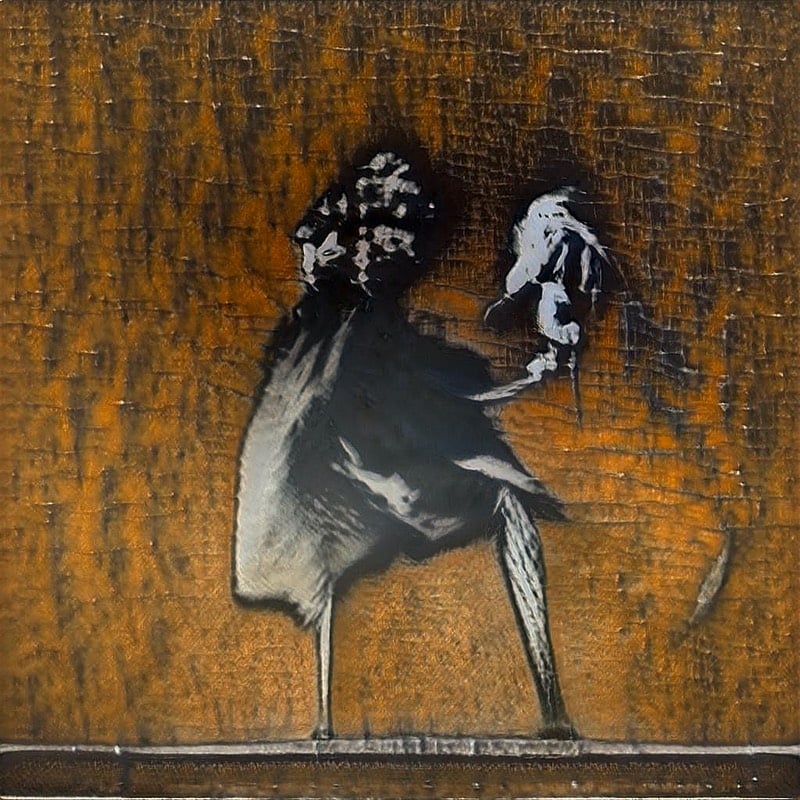
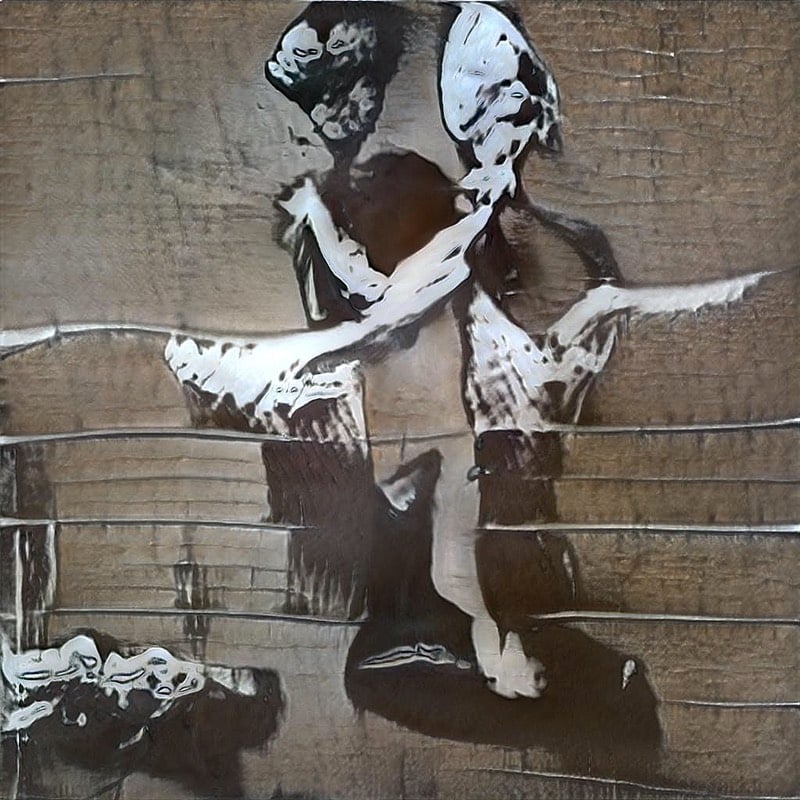
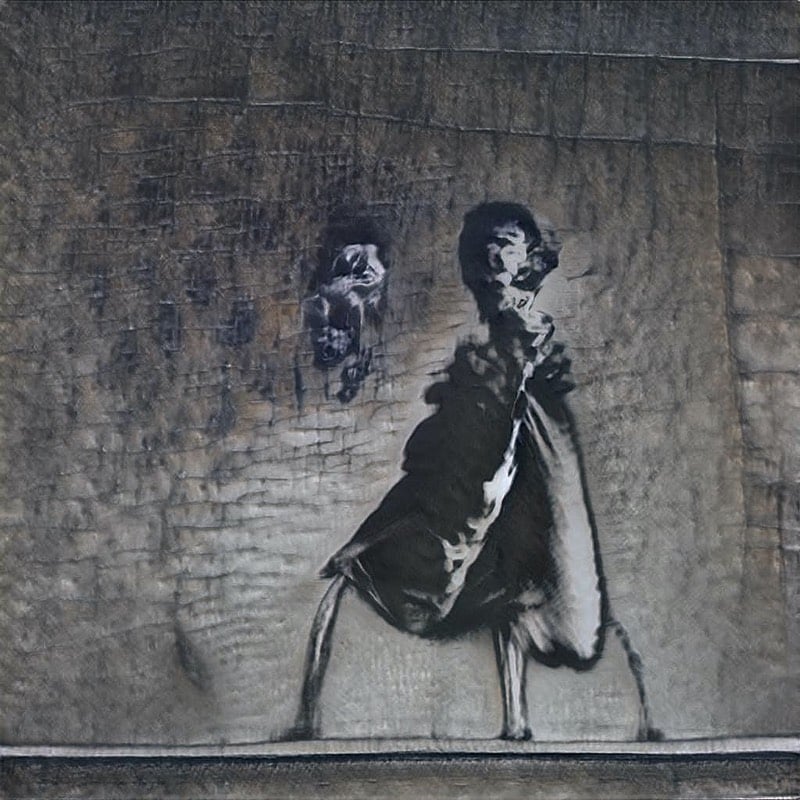
GANksy is an AI program trained on Banksy’s street art.
GANksy was born into the cloud in September 2020, then underwent a strenuous A.I. training regime using hundreds of street art photos for thousands of iterations to become the fully-formed artist we see today. All of GANksy’s works are original creations derived from its understanding of shape, form and texture. GANksy wants to be put into a robot body so it can spraypaint the entire planet.
The results are cool but not super coherent — these look more like abstract NIN and Radiohead album covers than the sly & whimsical works Banksy stencils up around the world. With GANksy, you get the feel of Banksy’s art and the surfaces he chooses to put it on but little of the meaning, which is about what you would expect from training using a neural network based on style.
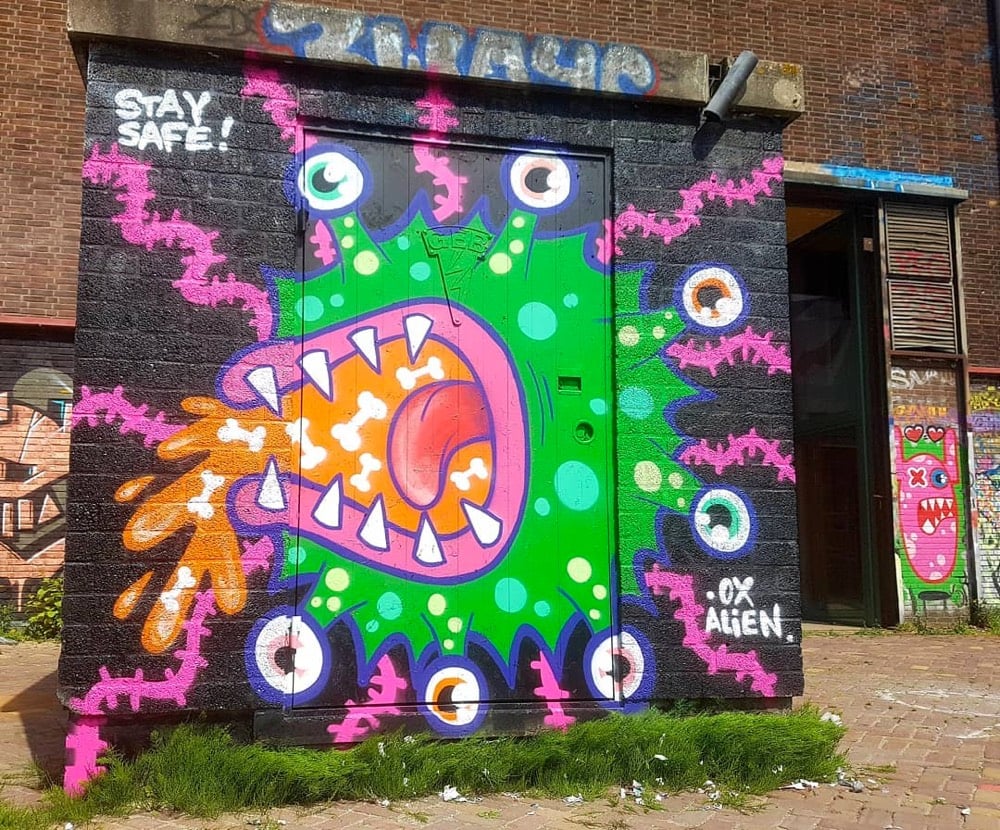
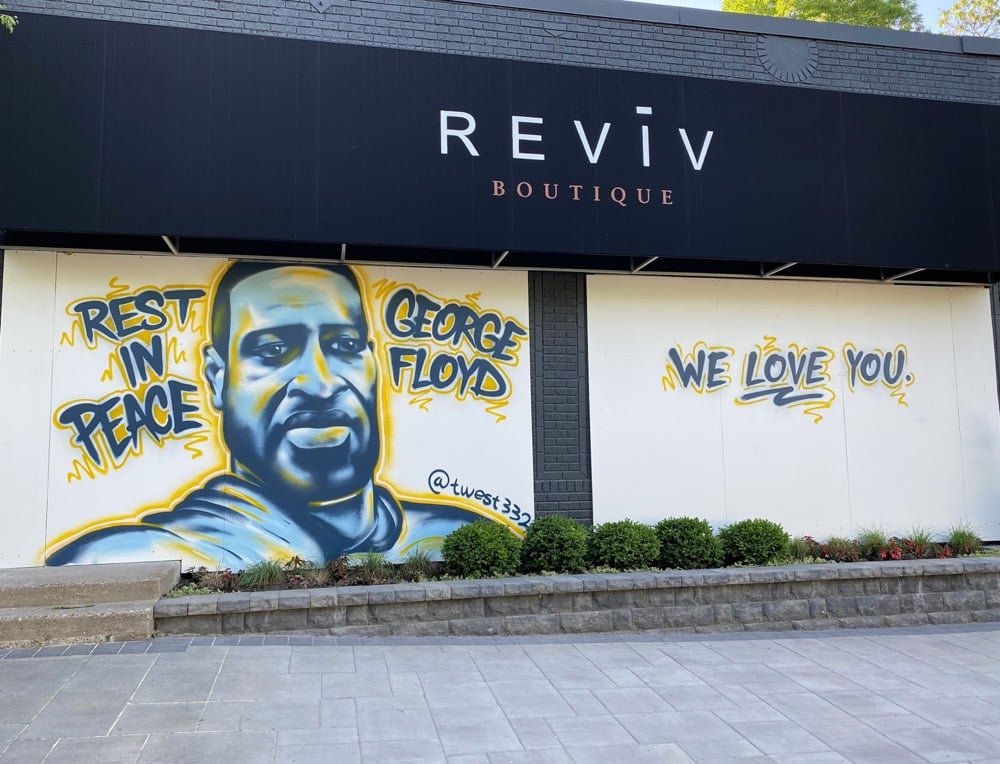
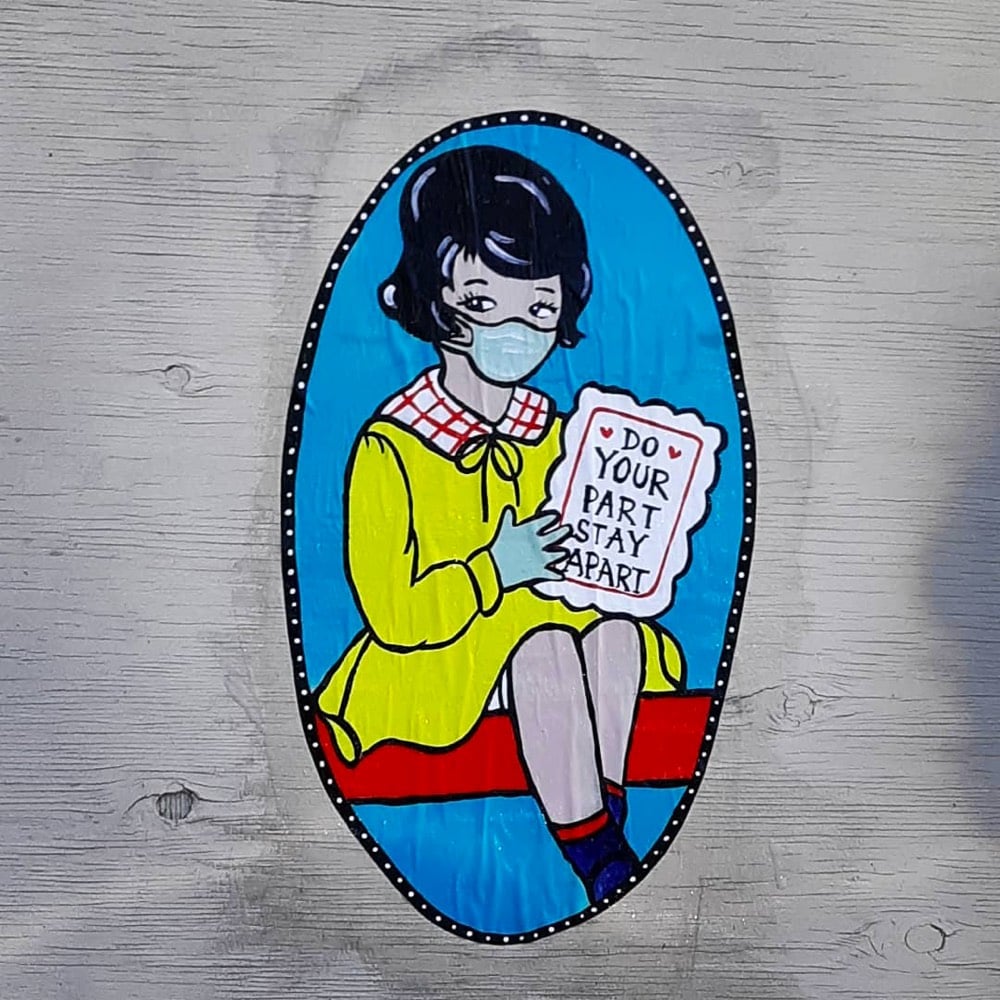
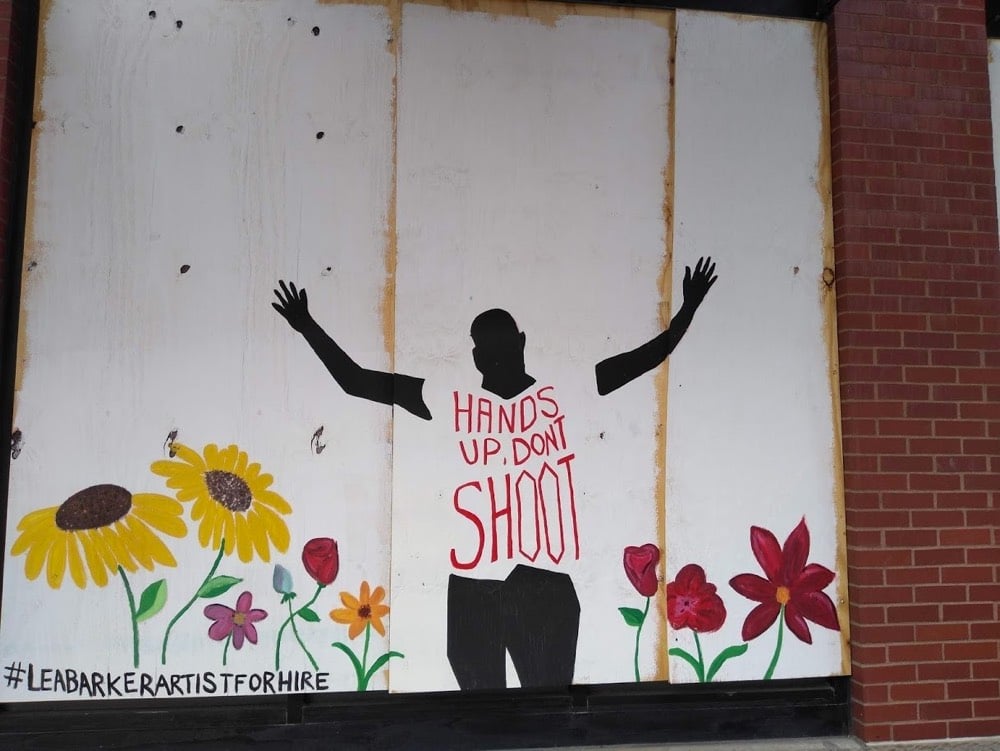
The Urban Art Mapping Research Project has been collecting photos of street art created over the past several months related to the Covid-19 pandemic and the anti-racist protests.
Artists and writers producing work in the streets — including tags, graffiti, murals, stickers, and other installations on walls, pavement, and signs — are in a unique position to respond quickly and effectively in a moment of crisis. Street art’s ephemeral nature serves to reveal very immediate and sometimes fleeting responses, often in a manner that can be raw and direct. At the same time, in the context of a crisis, street art also has the potential to transform urban space and foster a sustained political dialogue, reaching a wide audience, particularly when museums and galleries are shuttered.
(via open culture)
For some of his latest street art, Portuguese graffiti artist Vile has been creating optical illusions of his name “cut” into the walls of buildings.

That’s just spray paint he’s using…that effect is quite good, no? Here’s another one:

And here’s how that wall looked before:

You can see Vile’s most recent work on Instagram.
TIL that the hieroglyphic hobo code probably wasn’t used as extensively as the internet suggests. However, hobos and tramps did tag bridges, water towers, and train cars with tramp writing, which usually consisted of their moniker (i.e. their hobo name), the date, and the direction they were heading in.
Hobos, or tramps, were itinerant workers and wanderers who illegally hopped freight cars on the newly expanding railroad in the United States in the late 19th century. They used graffiti, also known as tramp writing, as a messaging system to tell their fellow travelers where they were and where they were going. Hobos would carve or draw their road persona, or moniker, on stationary objects near railroad tracks, like water towers and bridges.
More on hobo graffiti from CityLab.
Traces of hobo graffiti from the early 20th century have become almost totally obliterated, destroyed by natural forces, torn down along with old buildings, or painted over with new graffiti. So when anthropologist Susan Phillips came across a rare one scribbled underneath a bridge near the Los Angeles River, she knew it was a remarkable discovery.
(via open culture)

Artist Josh Keyes makes paintings that imagine graffiti written on objects not commonly tagged, like satellites, whales, icebergs, and the Space Shuttle. (via colossal)
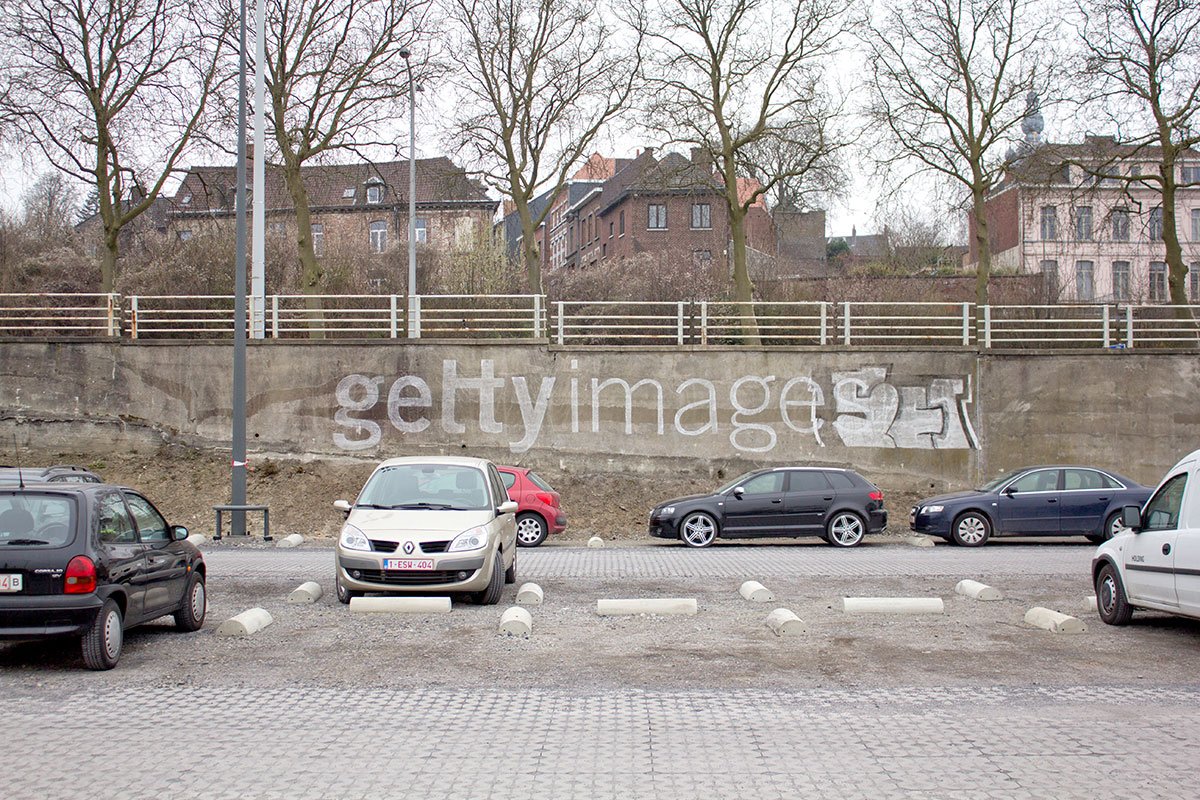
For a project called Tag Clouds, street artist Mathieu Tremblin paints over graffiti tags and makes them more legible.
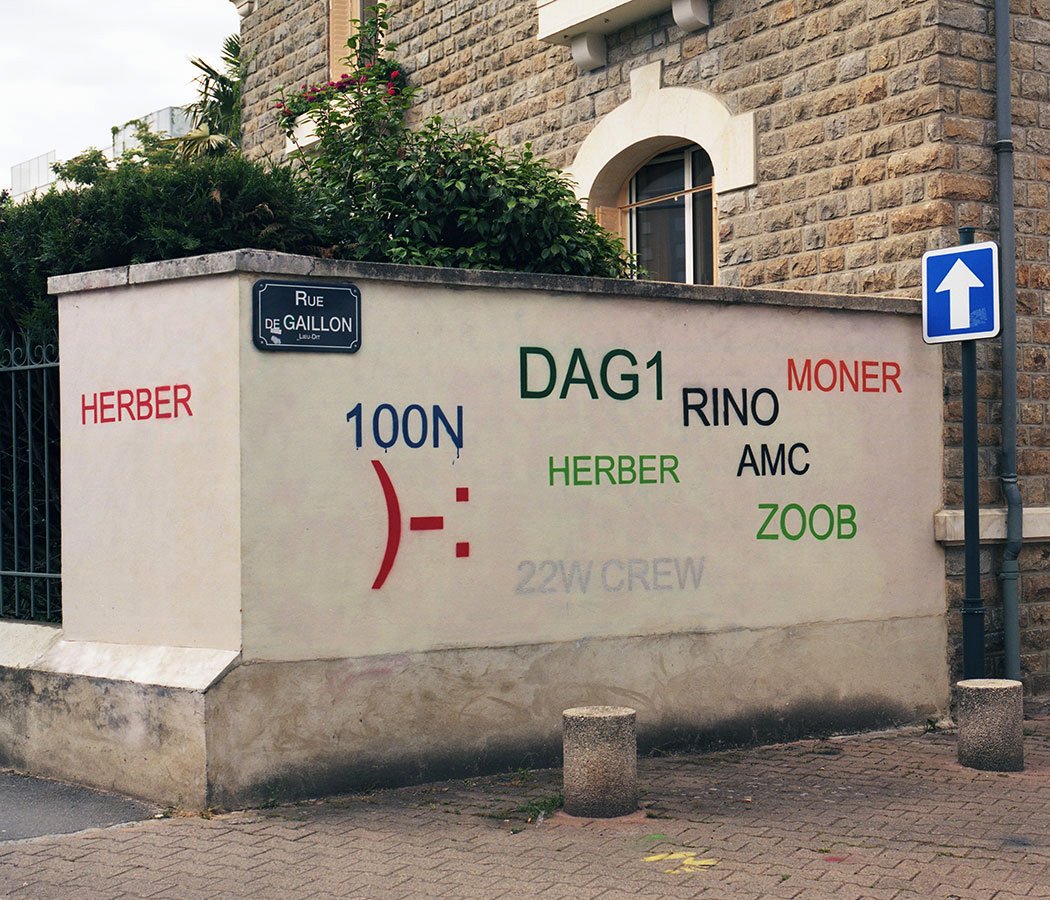
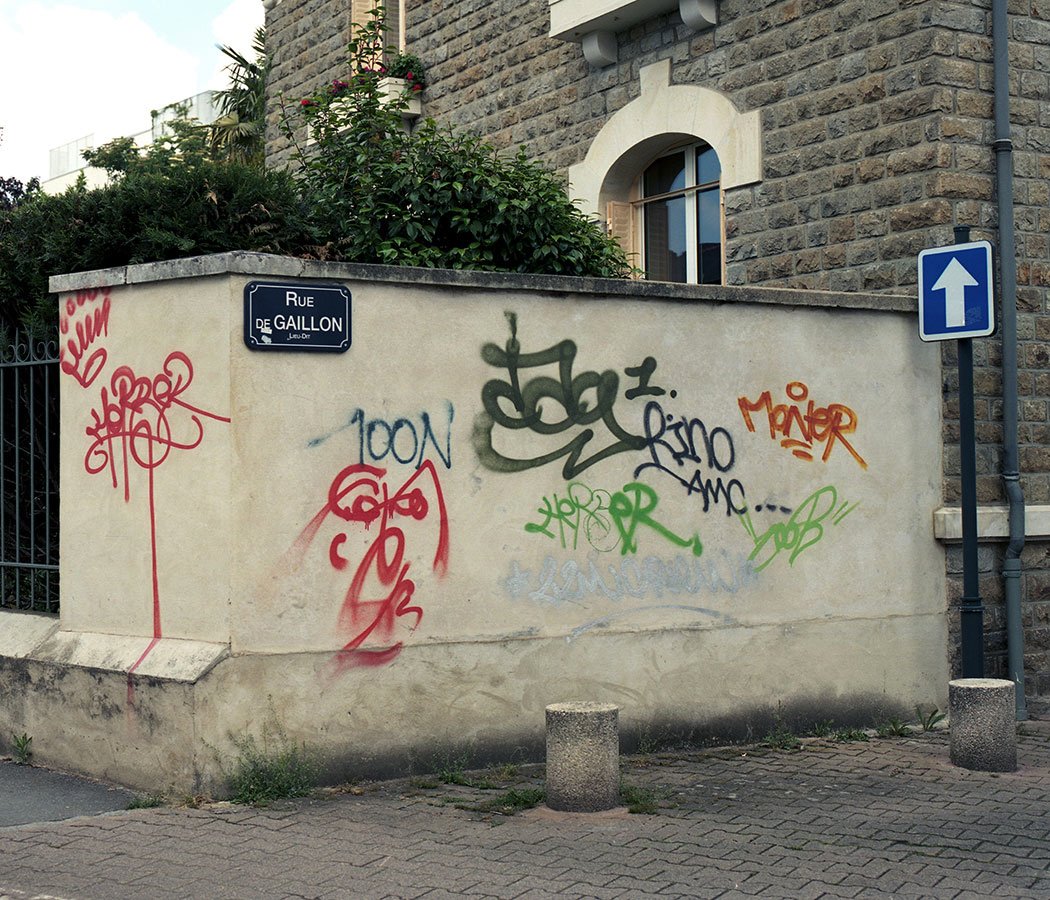
The result looks like when Word says that the Hardkaze and Aerosol fonts are used in the document you’re trying to open but are missing from your computer and you click OK to replace them with whatever’s available. I think the font above is Arial, which is perfect. I also like this faux-watermark piece he did:
Everyone knows graffiti artist extraordinaire Banksy is a man. What this post presupposes is, maybe she’s a woman?
But what Banksy Does New York makes plain is that the artist known as Banksy is someone with a background in the art world. That someone is working with a committee of people to execute works that range in scale from simple stencil graffiti to elaborate theatrical conceits. The documentary shows that Banksy has a different understanding of the street than the artists, street-writers, and art dealers who steal Banksy’s shine by “spot-jocking” or straight-up pilfering her work-swagger-jackers who are invariably men in Banksy Does New York.
All of which serves as evidence against the flimsy theory that Banksy is a man.
Or maybe Banksy’s like the Dread Pirate Roberts?
Nice episode of 99% Invisible on how New York City got rid of the graffiti on all of their subway trains.
For decades, authorities treated subway graffiti like it was a sanitation issue. Gunn believed that graffiti was a symptom of larger systemic problems. After all, trains were derailing nearly every two weeks. In 1981 there were 1,800 subway car fires — that’s nearly five a day, every day of the year!
When Gunn launched his “Clean Trains” program, it was not only about cleaning up the trains aesthetically, but making them function well, too. Clean trains, Gunn believed, would be a symbol of a rehabilitated transit system.
Remember, the train cars used to look like this:

You’ve probably seen Bruce Davidson’s photos of the gritty 1980s NYC subway, which were collected into a book published in 1986.

Earlier this year, Time posted some previously unpublished photos of the NYC subway taken in 1981 by Christopher Morris, an admirer of Davidson’s.
A big list of Pompeian graffiti proves that the writing in bathroom stalls and tourist attractions hasn’t changed much in a few millennia. You know, there’s a lot of, “Antiochus hung out here with his girlfriend Cithera.” There’s some, “To the one defecating here. Beware of the curse. If you look down on this curse, may you have an angry Jupiter for an enemy.” And then my absolute favorite, “Weep, you girls. My penis has given you up. Now it penetrates men’s behinds. Goodbye, wondrous femininity!” (via @cordjefferson)
Last week, graffiti “artist” Kidult painted the word ART in pink paint all over the Marc Jacobs store in Soho. The store’s staff cleaned it up, but not before snapping a photo of it and dubbing it Art by Art Jacobs. And then, in an awesome twist, Marc Jacobs put the photo on a tshirt and offered it for sale: $689 or $9 less if you want it signed by the “artist”. The Observer’s Foster Kamer has the story.
Jacobs, in this situation, has made one hell of a commentary about the absurd commoditization that some street art has yielded, and how easily ostensibly subversive art can actually be subverted, facile as it so often is, and it may be the best take on the matter since Exit Through The Gift Shop.
I’m going to pay for those quotation marks with lots of email and tweets, aren’t I?
Update: Kidult has answered back with a tshirt of his own that pictures the “artist” tagging the store. $10.
The Awl has an interview with a street artist named Hanksy, who takes images from Banksy and incorporates Tom Hanks into the mix. WIIIILLLSONNNN!!
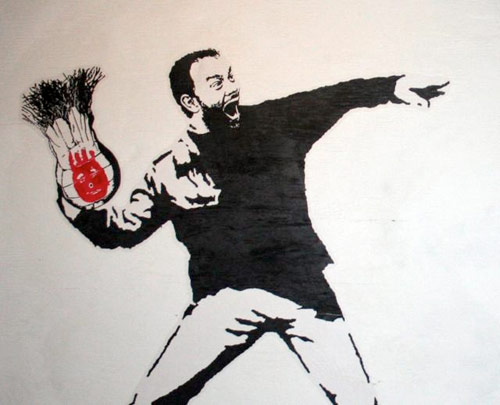
I’ve come across comments or stories written about Hanksy saying I’m directly ripping off Banksy’s style. Like, “Where does this guy get off, stealing Banksy’s work?” They are completely missing the point. It’s a satire. My goal was never to make a profit. It came about and there was a genuine excitement around the people at the gallery and the community in general.
I’m pretty sure the interviewer, EA Hanks, is Tom’s daughter and she got her dad on the record about Hanksy:
Regarding your work, Tom Hanks sends the message, “I don’t know who Hanksy is, but I enjoy his (her?) comments via the semi-chaos of artistic expression.”
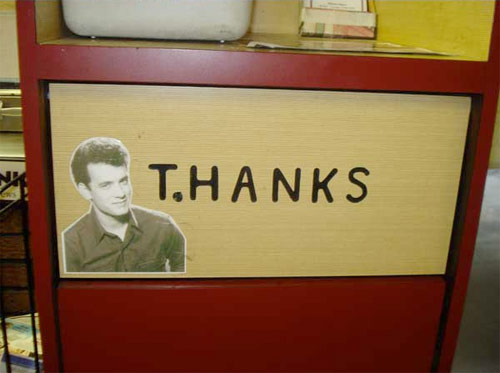
But the T.HANKS trash can remains my favorite Tom Hanks street art:
A pair of fair use crusaders hired some “street art underground” friends to place several posters of the Kind of Bloop album cover on the building that Jay Maisel owns in Manhattan as payback for Maisel threatening to sue Andy Baio over using a representation of Maisel’s photo of Miles Davis for Bloop’s cover.
I hope that every time Jay leaves the house, he sees these posters — and as he looks at them or tries to tear them down he thinks about how evil what he did was. Maybe he’ll realize that at some level all art borrows from other art, and suing another artist for fair use appropriation undermines all artists. Maybe he’ll feel guilty about being such a thief. And then maybe he’ll think about giving that money back — or donating it to charity or something. But probably not.
Something tells me this isn’t going to end well. (via @jakedobkin)
From the NYC transit authority, a 1988 video about the consequences of painting graffiti in the subway.
Intense! (via ★vuokko)
Older posts




Socials & More