



Quick soil
Metafilter feeds our needs for time-lapse photography and nutrition by linking to a full plate of time-lapse vegetation growth. Beans may be good for the heart, but pepper plants know how to shake it.

This site is made possible by member support. 💞
Big thanks to Arcustech for hosting the site and offering amazing tech support.
When you buy through links on kottke.org, I may earn an affiliate commission. Thanks for supporting the site!
kottke.org. home of fine hypertext products since 1998.
Beloved by 86.47% of the web.
Metafilter feeds our needs for time-lapse photography and nutrition by linking to a full plate of time-lapse vegetation growth. Beans may be good for the heart, but pepper plants know how to shake it.
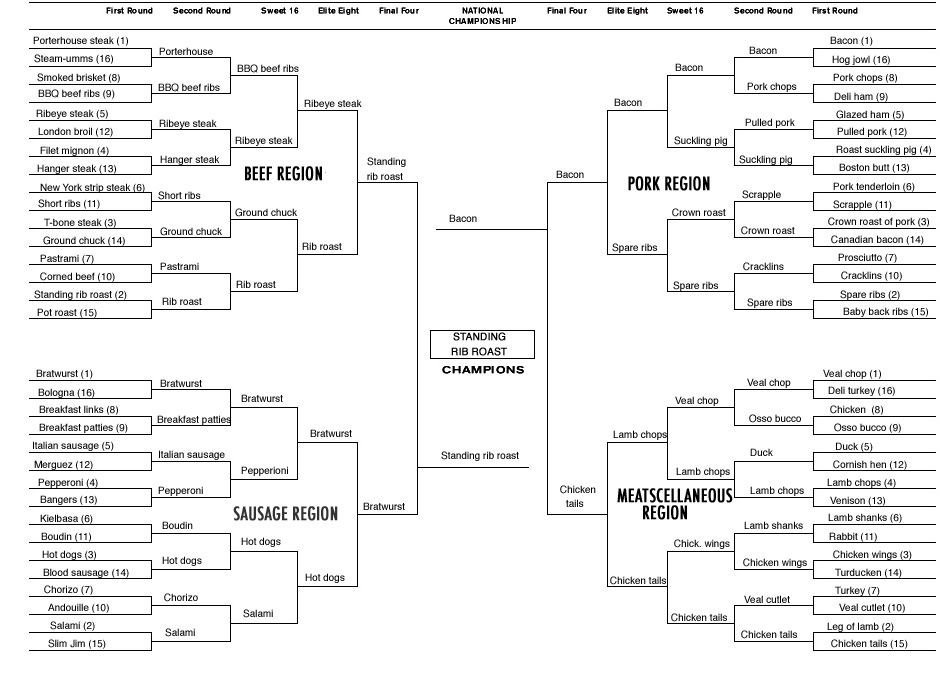
Bracket featuring the tournament of meat. The winner, hailing from the Beef Region, is deserved but bacon fans aren’t going to like it. (thx, liz)
Several food experts share their favorite misconceptions about what and how we eat.
One big myth is that fruit juice is a healthy part of our diet. Wrong. Drinking a glass of fruit juice a day — which is the equivalent of one soft drink of 110 to 180 calories — has been linked in the U.S., Australia and Spain to increased calorie intake and higher risks of diabetes and heart disease.
Also: kosher != quality.
The McGangBang has to be one of the more American things I’ve ever seen. It’s a McDonald’s Double Cheeseburger with a McChicken sandwich crammed into it.
Let that soak in a bit before you actually view this piece of hideous gorgeousness. The best part is that it only costs $2.16.
The New Yorker shares some cocktail recipes for the recession.
BlackBerry Sling
Discover that your BlackBerry doesn’t work because you haven’t paid the bill. Sling it against the wall, then buy a pre-paid phone and make some rum in your toilet.
I LOL’d at Nasdaiquiri.
Retronovation n. The conscious process of mining the past to produce methods, ideas, or products which seem novel to the modern mind. Some recent examples include Pepsi Throwback’s use of real sugar, Pepsi Natural’s glass bottle, and General Mills’ introduction of old packaging for some of their cereals. In general, the local & natural food and farming thing that’s big right now is all about retronovation…time tested methods that have been reintroduced to make food that is closer to what people used to eat. (I’m sure there are non-food examples as well, but I can’t think of any.)
Ok, wait, stop the internet for a second. Last month, reports popped up on the web that Pepsi Throwback would be released in the US with real cane sugar in place of the hated HFCS. Now comes a report of a Pepsi Natural product also hitting the shelves in select cities…with sugar and in a glass bottle. Glass bottle! Here’s a review:
While the regular version had a biting, acidic feel, the natural felt smoother and more mellow. The regular mouthfeel was inferior, being somewhat astringent. There was a grittiness on my tounge and teeth with the regular version that seemed absent with the other. Overall, the taste profile was very similar. I think that the natural version had hints of cognac, but even in the non-blind test the two drinks were difficult to distinguish. Later, a couple of my friends also used the adjective “smoother” when describing Pepsi Natural versus regular Pepsi.
It’s like Pepsi Island has time-shifted back to 1974 and I couldn’t be happier.
An interview with Alissa Hamilton about her new book, Squeezed, reveals that that fresh orange juice you’re buying might not be so fresh or even orange-y.
In the process of pasteurizing, juice is heated and stripped of oxygen, a process called deaeration, so it doesn’t oxidize. Then it’s put in huge storage tanks where it can be kept for upwards of a year. It gets stripped of flavor-providing chemicals, which are volatile. When it’s ready for packaging, companies such as Tropicana hire flavor companies such as Firmenich to engineer flavor packs to make it taste fresh. People think not-from-concentrate is a fresher product, but it also sits in storage for quite a long time.
(thx, oli)
Or so says a mathematics teacher from the UK. The formula is:
100 - [10L - 7F + C(k - C) + T(m - T)]/(S - E)
In the complex formula L represents the number of lumps in the batter and C equals its consistency. The letter F stands for the flipping score, k is the ideal consistency and T is the temperature of the pan. Ideal temp of pan is represented by m, S is the length of time the batter stands before cooking and E is the length of time the cooked pancake sits before being eaten. The closer to 100 the result is — the better the pancake.
However, a commenter notes:
According to that formula, if you left the pancake batter standing for ten years, (s-e) would be large, and so the pancake would be near perfect. If you let it stand for the same time as you left the pancake to cool, (s-e) would be zero and the pancake would be infinitely bad.
The suggestion to serve with sugar and lemon is clearly wrong as well. See also the formula for how tall high heels can go. (via buzzfeed)
Harold McGee, frequent dropper of food science, says that the home cook can prepare pasta using much less water than traditionally called for.
Heartened by the experts’ willingness to experiment, I went back to work, this time starting with hot water. I found that it’s possible to butta la pasta in 1 1/2 or 2 quarts of boiling water without having the noodles stick. Short shapes just require occasional stirring. Long strands and ribbons need a quick wetting with cold water just before they go into the pot, then frequent stirring for a minute or two.
McGee also comments that the energy equivalent of “250,000 to 500,000 barrels of oil” could be saved per year by using less water and the resulting pasta water is thicker and “very pleasant tasting”.
We won! PepsiCo is reverting to the old Tropicana OJ containers.
The about-face comes after consumers complained about the makeover in letters, e-mail messages and telephone calls and clamored for a return of the original look. Some of those commenting described the new packaging as “ugly” or “stupid,” and resembling “a generic bargain brand” or a “store brand.”
“Do any of these package-design people actually shop for orange juice?” the writer of one e-mail message asked rhetorically. “Because I do, and the new cartons stink.” Others described the redesign as making it more difficult to distinguish among the varieties of Tropicana or differentiate Tropicana from other orange juices.
David Wertheimer notes that the decoration of the packaging was not the main issue, the design was:
As a loyal Tropicana buyer, I don’t love the straw-punctured fruit or the old logo at all. What I love is Tropicana juice. And the new packaging made it hard for me to buy it. My preference was hidden in small type; the cartons no longer differentiated on the shelves. It took me longer to shop, and twice this winter I went home with the wrong juice.
(thx, david)
This is absolutely HUGE news. Wait, let’s do this properly:
PEPSI WITH REAL SUGAR COMING TO USA!!!
If they were selling it in a glass bottle, I would have used 96 pt. type. But no matter…according to BevReview.com, Pepsi is introducing Pepsi Throwback (and Mountain Dew Throwback) in the United States around mid-April and instead of using high-fructose corn syrup, it will be sweetened with real cane sugar.

This is a big deal since mainstream soft drinks in the United States are sweetened with High Fructose Corn Syrup (HFCS). Typically, the only way to get soda from the “big guys” with real sugar is to import it (i.e., Mexican Coke) or wait till Passover (Kosher Coke, Kosher Pepsi).
I know why Pepsi and Coke don’t want to permanently introduce sugared versions of their products — it would take away from their main products’ market share and it would mean admitting that the HFCS versions are inferior — but I think they would do really well in the marketplace. I don’t know how well the boutique sodas that use cane sugar (e.g. Jones, Whole Foods, etc.) are selling, but based on their availability in many more places than just a few years ago, I’d say they’re doing pretty well.
Anyway, let the stockpiling begin! (via serious eats)
Update: It is true that outdated sugar import quotas would make the production of sugared Coke and Pepsi more expensive but some drinkers would gladly pay a little extra for a Pepsi or Coke Premium product made with “natural” ingredients. (thx, peter & jason)
Three different kinds of evidence all indicate the same thing: the nutrient value of UK and US fruits and vegetables has declined over the last 50-100 years. This is particularly worrying:
Plantings of low- and high-yield cultivars of broccoli and grains found consistently negative correlations between yield and concentrations of minerals and protein, a newly recognized genetic dilution effect.
With fertilizers, clever pesticides, and genetic modification, farmers can grow more crops per acre of land but it’s more difficult for people to eat twice as much food to get the same amount of nutrients. (via the meaningfulness of little things)
Making cheese: how to turn five gallons of milk into six pounds of cheese.
This recipe for a basic hard cheese works for any kind of milk. I primarily use my own fresh goats’ milk, but have made it quite successfully with cow’s milk purchased from the grocery as well as raw cow’s milk from a local farmer.
(thx, grant)
Update: No rennet? Just use lemon juice. (thx, nathan)
Steven Heller asks why Tropicana redesigned the packaging for their orange juice.
What could Arnell, the agency that did the deed, have been thinking? It’s one thing to change the logo; it’s another to abandon the mnemonic orange with the straw in it. As package imagery goes, it was pretty smart, and decidedly memorable.
He goes on to call the redesign “a big tactical mistake”. I’m a Tropicana drinker and I think the new packaging sucks. It’s impossible to figure out at a glance which juice is which because all the packages look the same, aside from some thin lines at the very top. Horrible.
Socials & More