kottke.org posts about biology
This is what the trees look like near Chernobyl when you cut them down. It’s a biiiit tricky but see if you can spot when the nuclear plant disaster happened…

Not surprisingly, researchers have found evidence that the radiation has affected the growth of trees near the accident site. From the paper:
Mean growth rate was severely depressed and more variable in 1987-1989 and several other subsequent years, following the nuclear accident in April 1986 compared to the situation before 1986. The higher frequency of years with poor growth after 1986 was not caused by elevated temperature, drought or their interactions with background radiation. Elevated temperatures suppressed individual growth rates in particular years. Finally, the negative effects of radioactive contaminants were particularly pronounced in smaller trees. These findings suggest that radiation has suppressed growth rates of pines in Chernobyl, and that radiation interacts with other environmental factors and phenotypic traits of plants to influence their growth trajectories in complex ways.
A mammoth recently found in Siberia was so well preserved that when researchers were chipping it out of the ice, liquid blood flowed out.
Semyon Grigoriev, chairman of the university’s Museum of Mammoths and head of the expedition, said: “The fragments of muscle tissues, which we’ve found out of the body, have a natural red colour of fresh meat. The reason for such preservation is that the lower part of the body was underlying (sic) in pure ice, and the upper part was found in the middle of tundra. We found a trunk separately from the body, which is the worst-preserved part.”
The temperature was ten degrees celsius below zero when the mammoth was found, so the discovery of liquid blood was a shock. “It can be assumed that the blood of mammoths had some cryo-protective properties,” Grigoriev said. “The blood is very dark, it was found in ice cavities below the belly and when we broke these cavities with a pick, the blood came running out.”
More photos and information here. Bring on the mammoth clones, John Hammond. (via @carlzimmer)
Despite progress in recent years on causes and cures, colony collapse disorder has wreaked havoc on honeybee colonies across the country.
A mysterious malady that has been killing honeybees en masse for several years appears to have expanded drastically in the last year, commercial beekeepers say, wiping out 40 percent or even 50 percent of the hives needed to pollinate many of the nation’s fruits and vegetables.
Which is like, yeah, big whoop, it’s just bees, right? Except that:
The Agriculture Department says a quarter of the American diet, from apples to cherries to watermelons to onions, depends on pollination by honeybees.
Well, here’s something potentially interesting: researchers at Cardiff University think they have found fossils in meteorite fragments from Sri Lanka.
The most startling claims, however, are based on electron microscope images of structures within the stones (see above). Wallis and co say that one image shows a complex, thick-walled, carbon-rich microfossil about 100 micrometres across that bares similarities with a group of largely extinct marine dinoflagellate algae.
They say another image shows well-preserved flagella that are 2 micrometres in diameter and 100 micrometres long. By terrestrial standards, that’s extremely long and thin, which Wallis and co interpret as evidence of formation in a low-gravity, low-pressure environment.
Gotta take this with a massive grain of salt, but it will be interesting to see how this one plays out.
Update: One of the authors of this study holds some unusual views about life on Earth.
On May 24, 2003 The Lancet published a letter from Wickramasinghe, jointly signed by Milton Wainwright and Jayant Narlikar, in which they hypothesized that the virus that causes Severe Acute Respiratory Syndrome (SARS) could be extraterrestrial in origin and not originated from chickens.
Wickramasinghe and his mentor Fred Hoyle have also used their data to argue in favor of cosmic ancestry, and against evolution.
Like I said, big grain of salt. (thx, onno)
There’s an assumption that because of the relationship between metabolic rates, volume, and surface area, animals get an average of one billion heartbeats out of their bodies before they expire. Turns out there’s some truth to it.
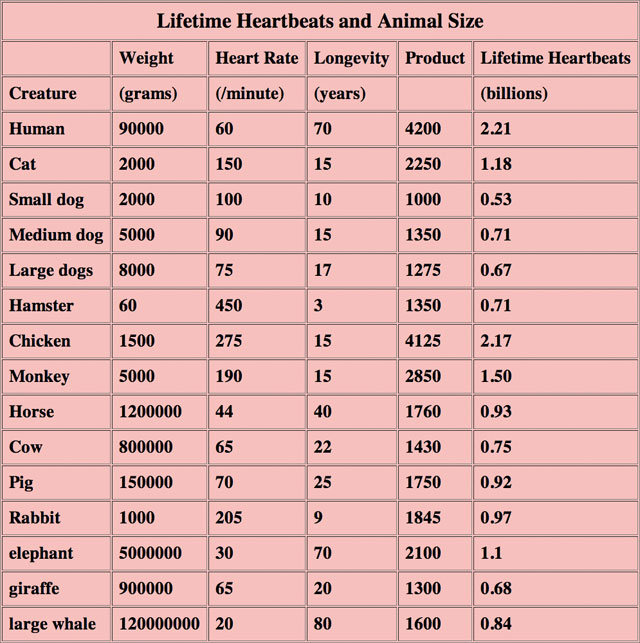
As animals get bigger, from tiny shrew to huge blue whale, pulse rates slow down and life spans stretch out longer, conspiring so that the number of heartbeats during an average stay on Earth tends to be roughly the same, around a billion.
Mysteriously, these and a large variety of other phenomena change with body size according to a precise mathematical principle called “quarter-power scaling”.
It might seem that because a cat is a hundred times more massive than a mouse, its metabolic rate, the intensity with which it burns energy, would be a hundred times greater. After all, the cat has a hundred times more cells to feed.
But if this were so, the animal would quickly be consumed by a fit of spontaneous feline combustion, or at least a very bad fever. The reason: the surface area a creature uses to dissipate the heat of the metabolic fires does not grow as fast as its body mass.
To see this, consider a mouse as an approximation of a small sphere. As the sphere grows larger, to cat size, the surface area increases along two dimensions but the volume increases along three dimensions. The size of the biological radiator cannot possibly keep up with the size of the metabolic engine.
Humans and chickens are both outliers in this respect…they both live more than twice as long as their heart rates would indicate. Small dogs live about half as long.
Looking to live forever? You might want to take a close look at the immortal jellyfish. This death-defying creature ages, but researchers studying the jellyfish found that, instead of dying, it started “to age in reverse, growing younger and younger until it reached its earliest stage of development, at which point it began its life cycle anew.” (If beginning the life cycle anew means another trip through junior high, count me out.) From NYT Magazine: Can a Jellyfish Unlock the Secret of Immortality?
Birds can detect the magnetic field of the Earth, which gives them an incredible sense of direction. Curiously, this sense of direction doesn’t work in darkness. This led scientists to discover that some birds can actually see the directions overlaid on their normal vision, like a heads-up display.
According to the new model, when a photon of light from the Sun is absorbed by a special molecule in the bird’s eye, it can cause an electron to be kicked from its normal state into an alternative location a few nanometres away. Until the electron eventually relaxes back, it creates an ‘electric dipole field’ which can augment the bird’s vision - for example altering colours or brightness.
Crucially, the alignment of the molecule compared to the Earth’s magnetic field controls the time it takes for the electron to relax back, and so controls the strength of the effect on the bird’s vision.
There are many such molecules spread throughout the eye, with different orientations. So from the patterns on top of its vision, and the change of these patterns as it moves its head, the bird learns about the direction of Earth’s magnetic field.
(via @daveg)
In this transcript of a talk given to the attendees of the Joint Summits on Translational Science, Carl Zimmer highlights an important aspect of understanding the human body and how to treat its many maladies: the ecosystem of microbes.
The microbes in your body at this moment outnumber your cells by ten to one. And they come in a huge diversity of species — somewhere in the thousands, although no one has a precise count yet. By some estimates there are twenty million microbial genes in your body: about a thousand times more than the 20,000 protein-coding genes in the human genome. So the Human Genome Project was, at best, a nice start. If we really want to understand all the genes in the human body, we have a long way to go.
Now you could say “Who cares? They’re just wee animalcules.” Those wee animacules are worth caring about for many reasons. One of the most practical of those reasons is that they have a huge impact on our “own” health. Our collection of microbes-the microbiome-is like an extra organ of the human body. And while an organ like the heart has only one function, the microbiome has many.
When food comes into the gut, for example, microbes break some of them down using enzymes we lack. Sometimes the microbes and our own cells have an intimate volley, in which bacteria break down a molecule part way, our cells break it down some more, the bacteria break it down even more, and then finally we get something to eat.
Another thing that the microbiome does is manage the immune system. Certain species of resident bacteria, like Bacteroides fragilis, produce proteins that tamp down inflammation. When scientists rear mice that don’t have any germs at all, they have a very difficult time developing a normal immune system. The microbiome has to tutor the immune system in how to do its job properly. It also acts like an immune system of its own, fighting off invading microbes, and helping to heal wounds.
While the microbiome may be an important organ, it’s a peculiar one. It’s not one solid hunk of flesh. It’s an ecosystem, made up of thousands of interacting species.
Here’s an interesting hypothesis: that all current life on Earth originated from a planet-wide super-organism named LUCA.
The latest results suggest LUCA was the result of early life’s fight to survive, attempts at which turned the ocean into a global genetic swap shop for hundreds of millions of years. Cells struggling to survive on their own exchanged useful parts with each other without competition — effectively creating a global mega-organism.
It was around 2.9 billion years ago that LUCA split into the three domains of life: the single-celled bacteria and archaea, and the more complex eukaryotes that gave rise to animals and plants (see timeline). It’s hard to know what happened before the split. Hardly any fossil evidence remains from this time, and any genes that date that far back are likely to have mutated beyond recognition.
(via @daveg)
You know how your hands and feet get all wrinkly when they’re immersed in water for a long time? There’s speculation the wrinkles might be an adaptation that allows for better gripping in wet conditions.
Now a paper in the journal Brain, Behavior and Evolution offers more evidence that wet wrinkles serve a purpose. Much like the tread on a tire, they improve traction.
In the study, an evolutionary neurobiologist and his co-authors examined 28 fingers wrinkled by water. They found that they all had the same pattern of unconnected channels diverging away from one another as they got more distant from the fingertips.
The wrinkles allow water to drain away as fingertips are pressed to wet surfaces, creating more contact and a better grip.
(via stellar)
Evolutionary biologists are increasingly studying organisms (like mice, fish, and bacteria) in urban areas like New York City to find out how they evolve to urban conditions.
Dr. Munshi-South and his colleagues have been analyzing the DNA of the mice. He’s been surprised to find that the populations of mice in each park are genetically distinct from the mice in others. “The amount of differences you see among populations of mice in the same borough is similar to what you’d see across the whole southeastern United States,” he said.
LeafSnap is a new iPhone app that uses facial recognition techniques to identify trees based on photos of their leaves.
Leafsnap contains beautiful high-resolution images of leaves, flowers, fruit, petiole, seeds, and bark. Leafsnap currently includes the trees of New York City and Washington, D.C., and will soon grow to include the trees of the entire continental United States.
Wow. Garden Design has more info. (thx, claire)
Whoa, watch the video at the top of this article to see how the human face develops in the womb from an age of one-month to ten weeks. It all just comes together right at the end!
If you watch it closely, you will see that the human face is actually formed of three main sections which rotate and come together in an unborn foetus.
The way this happens only really makes sense when you realise that, strange though it may sound, we are actually descended from fish.
The early human embryo looks very similar to the embryo of any other mammal, bird or amphibian — all of which have evolved from fish.
Your eyes start out on the sides of your head, but then move to the middle.
The top lip along with the jaw and palate started life as gill-like structures on your neck. Your nostrils and the middle part of your lip come down from the top of your head.
There is no trace of a scar; the plates of tissue and muscle fuse seamlessly. But there is, however, a little remnant of all this activity in the middle of your top lip — your philtrum.
(via hypertext)
Carl Zimmer in Slate:
Redfield blogged a scathing attack on Saturday. Over the weekend, a few other scientists took to the Internet as well. Was this merely a case of a few isolated cranks? To find out, I reached out to a dozen experts on Monday. Almost unanimously, they think the NASA scientists have failed to make their case. “It would be really cool if such a bug existed,” said San Diego State University’s Forest Rohwer, a microbiologist who looks for new species of bacteria and viruses in coral reefs. But, he added, “none of the arguments are very convincing on their own.” That was about as positive as the critics could get. “This paper should not have been published,” said Shelley Copley of the University of Colorado.
(thx, anil)
There may only be a few dozen albino redwoods in the world; they’re difficult to find so no one knows the real number. The albinos lack chlorophyll, making them unable to produce their own food, so they freeload off of a parent tree.

KQED has a short video segment about the albino redwoods as well.
Newer posts
Older posts




Socials & More