
All the news that’s fit to sew
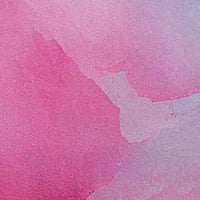
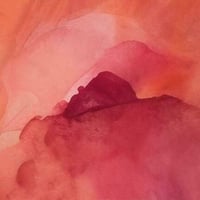
For her Sewn News project, artist Lauren DiCioccio embroiders photographs from the New York Times.

(via beautiful decay)

This site is made possible by member support. 💞
Big thanks to Arcustech for hosting the site and offering amazing tech support.
When you buy through links on kottke.org, I may earn an affiliate commission. Thanks for supporting the site!
kottke.org. home of fine hypertext products since 1998.
Beloved by 86.47% of the web.
For her Sewn News project, artist Lauren DiCioccio embroiders photographs from the New York Times.
(via beautiful decay)
Shortly before his retirement at 60, Tatsuo Horiuchi picked up a copy of Microsoft Excel and started making art with it. His art does not look anything like you’d expect Excel art to look:

Update: Here’s a short video on Horiuchi and his art:
Indonesian artist Ichwan Noor made this amazing thing, a 1953 Volkswagen Beetle formed into a sphere:

Maya Weinstein has created a DIY kit for making your own HFCS (high-fructose corn syrup). You may have already guessed that it’s an art project and that the artist lives in Brooklyn.
The DIY High Fructose Corn Syrup Kit (DIY HFCS KIT) begin as a journey to uncover the mysteries of processed food. Often times at the grocery store while reading common food labels one cannot distinguish what certain ingredients are or where they came from. The DIY HFCS Kit is a way to visualize as well as interact with the food science behind industrialized ingredients, it is citizen food science for everyone, everywhere. The ingredient chosen for this particular kit is one that is seen a lot in processed and pre-made foods, it is pretty much everywhere, and it goes by the name high fructose corn syrup. The interesting thing about high fructose corn syrup is that the ingredient pops up in so many foods; from cereal to bread, yogurt to ice cream, frozen dinners to canned soups; but high fructose corn syrup is never actually seen on its own. One of the main reasons for this is because it is a highly processed industrialized ingredient created in large factories behind very closed doors. The method for making for high fructose corn syrup was not easy to uncover, nor were the ingredients, but with a little help from some friends and a whole lotta research and testing the Kit was finally created.
Weinstein was planning a Kickstarter campaign for kit sales but “they didn’t really understand what I was doing, they said my business plan was unclear”. (via @CharlesCMann)
Heather Dewey-Hagborg collects hair, chewed gum, and smoked cigarettes, pulls the DNA out of them, and uses the genetic information to produce models of what the people who used those items might have looked like.

From this sequence, Dewey-Hagborg gathers information about the person’s ancestry, gender, eye color, propensity to be overweight and other traits related to facial morphology, such as the space between one’s eyes. “I have a list of about 40 or 50 different traits that I have either successfully analyzed or I am in the process of working on right now,” she says.
Dewey-Hagborg then enters these parameters into a computer program to create a 3D model of the person’s face.” Ancestry gives you most of the generic picture of what someone is going to tend to look like. Then, the other traits point towards modifications on that kind of generic portrait,” she explains. The artist ultimately sends a file of the 3D model to a 3D printer on the campus of her alma mater, New York University, so that it can be transformed into sculpture.
We all know that art forgeries are just cheap rip-offs of real art. What Jonathan Keats’ new book presupposes is, maybe they’re not?
Forgers are the foremost artists of our age.
I’m not talking about the objects they make. Their real art is to con us into accepting the works as authentic. They do so, inevitably, by finding our blind spots, and by exploiting our common-sense assumptions. When they’re caught (if they’re caught), the scandal that ensues is their accidental masterpiece. Learning that we’ve been defrauded makes us anxious — much more so than any painting ever could — provoking us to examine our poor judgment. This effect is inescapable, since we certainly didn’t ask to be duped. A forgery is more direct, more powerful, and more universal than any legitimate artwork.
See also Uncreative Writing, fake is the new real, even if it’s fake it’s real, and this paragraph from Joe Posnanski’s piece on pitching phenoms:
You have to understand that to a boy of the 1970s, the line between comic books and real life people was hopelessly blurred. Was Steve Austin, the Six Million Dollar Man, real or fake? Fake? Well, then, how about Evel Knievel jumping over busses on his motorcycle? Oh, he was real. The Superman ads said, “You will believe a man can fly,” and Fonzie started jukeboxes by simply hitting them, and Elvis Presley wore capes, and Nolan Ryan threw pitches 102 mph, and Roger Staubach (who they called Captain America) kept bringing the Cowboys back from certain defeat, and Muhammad Ali let George Foreman tire himself out by leaning against the ropes and taking every punch he could throw. What was real anyway?
From a 1995 article in The Independent, an account of how the CIA promoted and funded US and other Western artists during the Cold War, including abstract expressionists like Rothko and Pollock.
The decision to include culture and art in the US Cold War arsenal was taken as soon as the CIA was founded in 1947. Dismayed at the appeal communism still had for many intellectuals and artists in the West, the new agency set up a division, the Propaganda Assets Inventory, which at its peak could influence more than 800 newspapers, magazines and public information organisations. They joked that it was like a Wurlitzer jukebox: when the CIA pushed a button it could hear whatever tune it wanted playing across the world.
The next key step came in 1950, when the International Organisations Division (IOD) was set up under Tom Braden. It was this office which subsidised the animated version of George Orwell’s Animal Farm, which sponsored American jazz artists, opera recitals, the Boston Symphony Orchestra’s international touring programme. Its agents were placed in the film industry, in publishing houses, even as travel writers for the celebrated Fodor guides. And, we now know, it promoted America’s anarchic avant-garde movement, Abstract Expressionism.
(via @sippey)
Flóra Borsi inserts herself into historic photos, as though she were there photographing events with a contemporary camera. This is my favorite:

Borsi states she was inspired by “a Charlie Chaplin movie”, which is likely this clip shot in 1928 at the premiere of a Chaplin film which shows a woman who looks like she’s talking on a cellphone. See also Girl with a Pearl Earring and Point-and-Shoot Camera. (via @coudal)
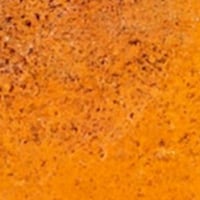
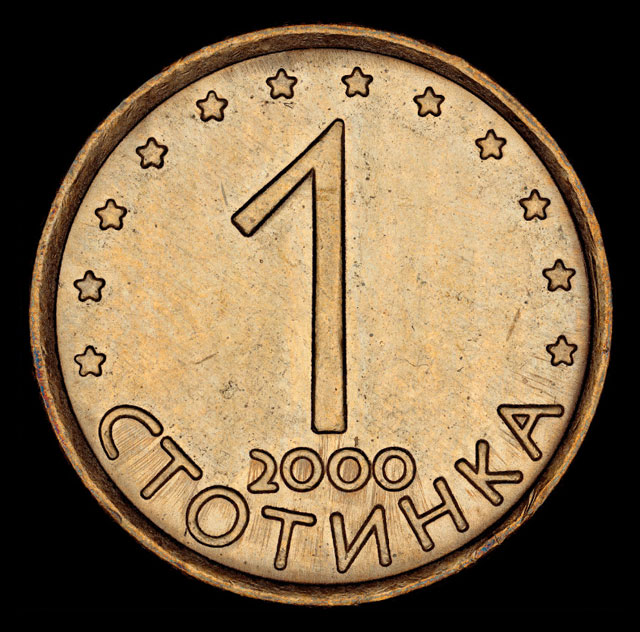
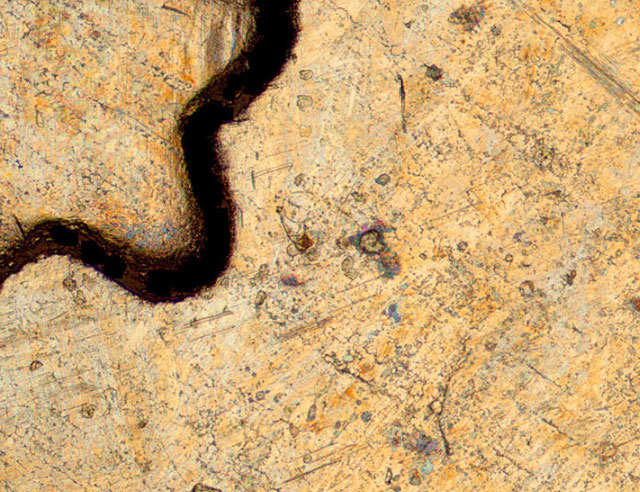
For a project called The Fundamental Units, Martin John Callanan used a very powerful 3D microscope to take 400-megapixel images of the lowest denomination coin from each of the world’s 166 active currencies. This is the 1 stotinki coin from Bulgaria:
And this is a small part of that same coin at tremendous zoom:
James Gulliver Hancock is on a mission to draw all the buildings in New York City.
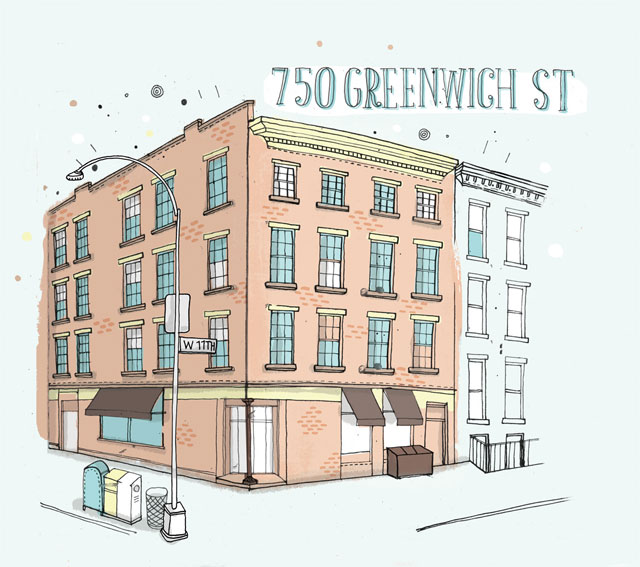
Hancock’s blog has spawned a book and prints are available as well. (via brain pickings)
For his Alpha Beauties project, artist Nazareno Crea retouches paintings and sculpture from throughout history, a process which normalizes each period’s ideal of female beauty to that of the present day. That is, much skinnier, with smaller noses, higher cheekbones, and larger breasts.


Similar projects: Venus and Eye of the Beholder.
Designer Adam Harvey, who gave the world the anti-paparazzi purse and dazzle camouflage for the face, has developed a hoodie that makes the wearer invisible to the sort of thermal imaging utilized by surveillance drones.
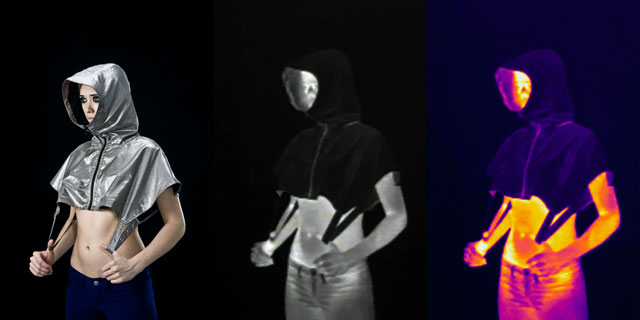
This is the most New Aesthetic thing I have ever seen. The Guardian has more:
“These are primarily fashion items and art items,” Harvey tells me. “I’m not trying to make products for survivalists. I would like to introduce this idea to people: that surveillance is not bulletproof. That there are ways to interact with it and there are ways to aestheticise it.”
I imagine that at some point, anti-drone clothing will eject chaff as a countermeasure against incoming drone-launched missiles. (via @DavidGrann)
Yago Partal pictures animals dressed up in their finest duds. Some of these are better than others…this is one of my favorites:

Prints are available.
Israeli artist Ronit Bigal does intricate calligraphy on the human body and photographs the results.
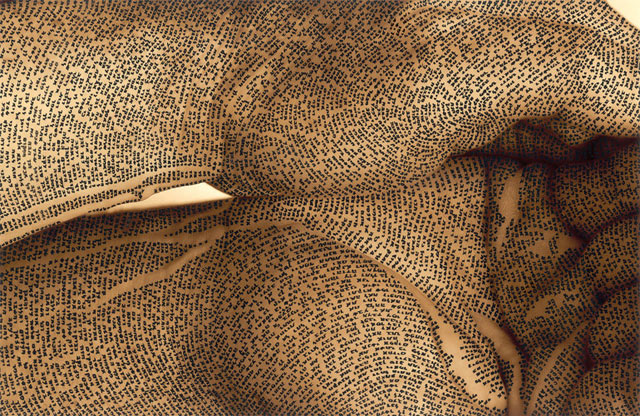
Update: I read the page wrong…the calligraphy is printed on the photographs to follow the contour of the skin, not on the skin itself. Still cool. (thx, @lorp)
At random and unannounced times throughout the year, actress (and apparently performance artist) Tilda Swinton will be sleeping in a glass box at MoMA.
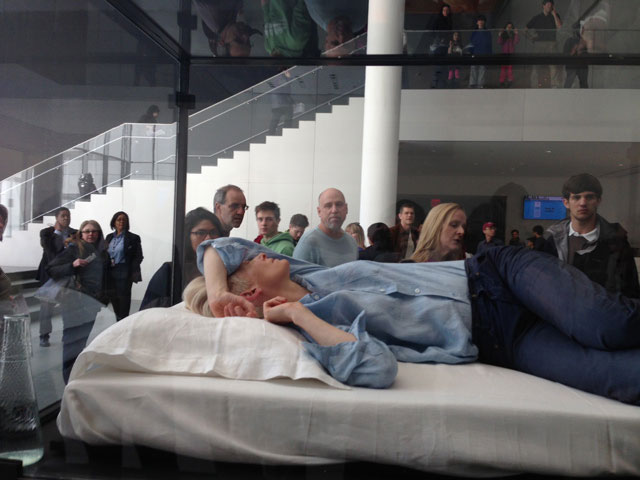
It’s part of an unannounced, surprise performance piece called “The Maybe” that will be taking place on random days all year. A MoMA source told us, “Museum staff doesn’t know she’s coming until the day of, but she’s here today. She’ll be there the whole day. All that’s in the box is cushions and a water jug.”
Clearly some crowdsourced announcement system is needed…perhaps istildaswintonsleepingatmomaornot.tumblr.com? Also, in keeping with the theme of “my kid could do that” in contemporary art, both my kids slept at MoMA in chairs with wheels on them.
Socials & More