kottke.org posts about art
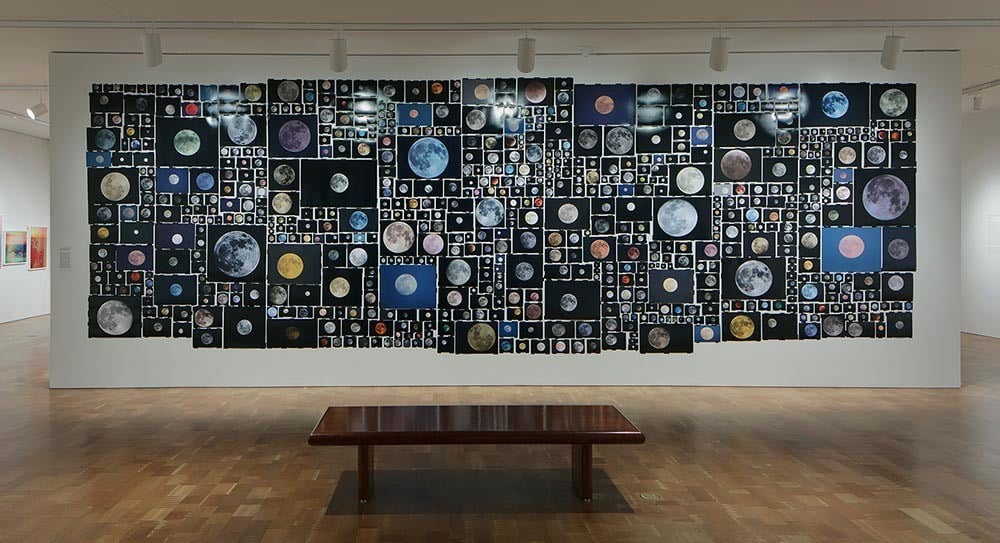
For a pair of projects, Penelope Umbrico collected hundreds of photos of full Moons from Flickr and arranged them into massive wall-sized collages.
Everyone’s Photos Any License, looks at a purportedly more rarified photographic practice: taking a clear photograph of the full moon requires expensive specialized photographic equipment. However, when I searched Flickr for ‘full moon’ I was surprised to find 1,146,034 nearly identical, technically proficient images, most with the ‘All Rights Reserved’ license. Seen individually any one of these images is impressive. Seen as a group, however, they seem to cancel each other out. Everyone’s Photos Any License seeks to address the shifts in meaning and value that occur when the individual subjective experience of witnessing and photographing is revealed as a collective practice, seen recontextualized in its entirety.
For one of the project, Umbrico requested permission to display “Rights Reserved” photos from 654 photographers in exchange for 1/654 of the profit from any potential sale. Many of them were not into that arrangement, so she substituted images with Creative Commons licences instead.
See also Umbrico’s Sunset Portraits, Suns from Sunsets from Flickr, and TVs from Craigslist. (via austin kleon)

Only fewer than 20 of Leonardo da Vinci’s paintings are known to have survived until the present day. In 2005, a painting of Leonardo’s called Salvator Mundi was rediscovered after its provenance had been forgotten hundreds of years ago, to the point that it sold for £45 at an auction in 1958. In November, Christie’s auction house is selling the painting.
The painting disappeared from 1763 until 1900 when — its authorship by Leonardo, origins and illustrious royal history entirely forgotten — it was acquired from Sir Charles Robinson, who purchased the picture as a work by Leonardo’s follower, Bernardino Luini, for the Cook Collection, Doughty House, Richmond. By this time, Christ’s face and hair had been extensively repainted. A photograph taken in 1912 records the work’s altered appearance.
In the dispersal of the Cook Collection, the work was ultimately consigned to auction in 1958 where it fetched £45, after which it disappeared once again for nearly 50 years, emerging only in 2005 — its history still forgotten — when it was purchased from an American estate.
That estate sale in 2005 sold the painting for only $10,000…it was believed to be a Leonardo copy. The painting is estimated to sell at a price of $100 million but seeing how the last two sales netted $75 million and $127.5 million, it would be easy to see that going higher.
Update: New York magazine art critic Jerry Saltz says that Salvator Mundi is probably fake (or at least not by Leonardo).
I’m no art historian or any kind of expert in old masters. But I’ve looked at art for almost 50 years and one look at this painting tells me it’s no Leonardo. The painting is absolutely dead. Its surface is inert, varnished, lurid, scrubbed over, and repainted so many times that it looks simultaneously new and old. This explains why Christie’s pitches it with vague terms like “mysterious,” filled with “aura,” and something that “could go viral.” Go viral? As a poster, maybe. A two-dimensional ersatz dashboard Jesus.
Why else do I think this is a sham? Experts estimate that there are only 15 to 20 existing da Vinci paintings. Not a single one of them pictures a person straight on like this one. There is also not a single painting picturing an individual Jesus either. All of his paintings, even single portraits, depict figures in far more complex poses. Even the figure that comes remotely close to this painting, Saint John the Baptist, also from 1500, gives us a turning, young, randy-looking man with hair utterly different from and much more developed in terms of painting than the few curls Christie’s is raving about in their picture.
Update: Salvator Mundi sold for $450 million, “obliterating the previous world record for the most expensive work of art at auction”. On Twitter, Saltz called the buyer “a sucker” and posted an image of the painting with Trump’s face pasted on it. Buuuuuuuurn.
Update: According to this piece in Narativ, this painting might now be lost and could factor into the Mueller investigation into the Trump-Russia connection.
Questions are being raised. First, why did the Crown Prince of Saudi Arabia, an art novice, buy the masterpiece? Secondly, why did he overpay for it by $300 million? Even for the stupendously wealthy Prince Mohammed bin Salman, that’s not just a simple rounding error. How do you misplace a $450 million painting anyway?
We can also reveal Special Counsel Robert Mueller is investigating both the buyer and the seller of the Da Vinci masterpiece as part of the Trump-Russia investigation.
All the intrigue suits Salvator Mundi’s already storied past well, but as I write this, no-one has seen the rare masterpiece in over a year, and its exact whereabouts have been unknown for over 100 days.
(via @tedgioia)
Norbert Sattler is a master kunstglaser, a stained glass craftsman. He strongly denies that he’s an artist, rejecting that label early in his career in favor of working with artists to best help them achieve their artistic visions in the medium of stained glass.

Women Who Draw, a directory of female illustrators, organized 88 of their members from around the world to draw the sky on August 13, 2017 at noon Eastern Time.
What each artist saw was unique to the time, the weather, and the place. The locations ranged from Tel Aviv to Brooklyn, Buenos Aires to rural Georgia. Some saw different hues of blue. Some saw black, pink, or gray. Some saw stars or clouds or fog or rain. Here it was summer. There it was night.
I love projects like these…moments of time, collectively caught in the amber.

I love this Road Runner and Wile E. Coyote stained glass piece from Saudi Arabian artist Rashed Al Shashai. The piece is not actually stained glass but acrylic over a light box, but stained glass is the effect he was going for (see this image search for “Islamic stained glass”).
See also the rules of Road Runner and Wile E. Coyote cartoons, e.g. “The Road Runner cannot harm the Coyote except by going ‘meep, meep.’” (thx, stephen)

Spacetime Coordinates sells prints, metal mementos, and t-shirts that feature the planets of the solar system in the exact locations they were in on the date of your birth (or other significant date). For their new Kickstarter campaign, they’re offering color prints.
While not as pretty as these prints, you can check what the solar system looked like for any date here.
When I was a kid, I spent far too many hours mucking around in Lotus 1-2-3 trying to make a spreadsheet to calculate how often all the planets in the solar system would line up with each other (disregarding their differing planes, particularly Pluto’s).1 I could never get it working. Turns out that a precise alignment has probably never occurred, nor will it ever. But all the planets are “somewhat aligned” every 500 years or so. Neat! (via colossal)

This is the first ever sketch of Wonder Woman by H.G. Peter from 1941. On the drawing, Peter wrote:
Dear Dr. Marston, I slapped these two out in a hurry. The eagle is tough to handle — when in perspective or in profile, he doesn’t show up clearly — the shoes look like a stenographer’s. I think the idea might be incorporated as a sort of Roman contraption. Peter
The Wonder Woman character was conceived by William Moulton Marston, who based her on his wife Elizabeth Marston and his partner Olive Byrne. (Reading between the lines about WW’s creation, you get the sense that Elizabeth deserves at least some credit for genesis of the character as well.) On the same drawing, Marston wrote back to Peter:
Dear Pete — I think the gal with hand up is very cute. I like her skirt, legs, hair. Bracelets okay + boots. These probably will work out. See other suggestions enclosed. No on these + stripes — red + white. With eagle’s wings above or below breasts as per enclosed? Leave it to you. Don’t we have to put a red stripe around her waist as belt? I thought Gaines wanted it — don’t remember. Circlet will have to go higher — more like crown — see suggestions enclosed. See you Wednesday morning - WMM.
From Wikipedia:
Wonder Woman was created by the American psychologist and writer William Moulton Marston (pen name: Charles Moulton), and artist Harry G. Peter. Olive Byrne, Marston’s lover, and his wife, Elizabeth, are credited as being his inspiration for the character’s appearance. Marston drew a great deal of inspiration from early feminists, and especially from birth control pioneer Margaret Sanger; in particular, her piece “Woman and the New Race”. The character first appeared in All Star Comics #8 in October 1941 and first cover-dated on Sensation Comics #1, January 1942. The Wonder Woman title has been published by DC Comics almost continuously except for a brief hiatus in 1986.
William, Elizabeth, Olive seemed like really interesting people. They lived together in a polyamorous relationship (which I imagine was fairly unusual for the 1940s) and William & Elizabeth worked together on inventing the systolic blood pressure test, which became a key component in the later invention of the polygraph test. Olive was a former student of William’s and became his research assistant, likely helping him with much of his work without credit.
Update: The upcoming film Professor Marston and the Wonder Women is a biographical drama about the lives of William, Elizabeth, and Olive. Here’s a trailer:
The Imaginary Worlds podcast also had an episode on the genesis of Wonder Woman (featuring New Yorker writer Jill Lepore, who wrote The Secret History of Wonder Woman):
(via @ironicsans & warren)
Wall Drawing 797 is a conceptual artwork by Sol LeWitt consisting of instructions that anyone can use to make a drawing. I found this at The Kid Should See This1 and I cannot improve on their description:
How does one person’s actions influence the next person’s actions in a shared space? Sol LeWitt’s wall drawings explore this intricate visual butterfly effect in the collaborative art entitled Wall Drawing 797, a conceptual piece that can be drawn by following LeWitt’s instructions. (He died in 2007.)
“Intricate visual butterfly effect” is such a good way of putting it. I have a huge wall right above my desk…I kind of want to make my own Wall Drawing 797 now.
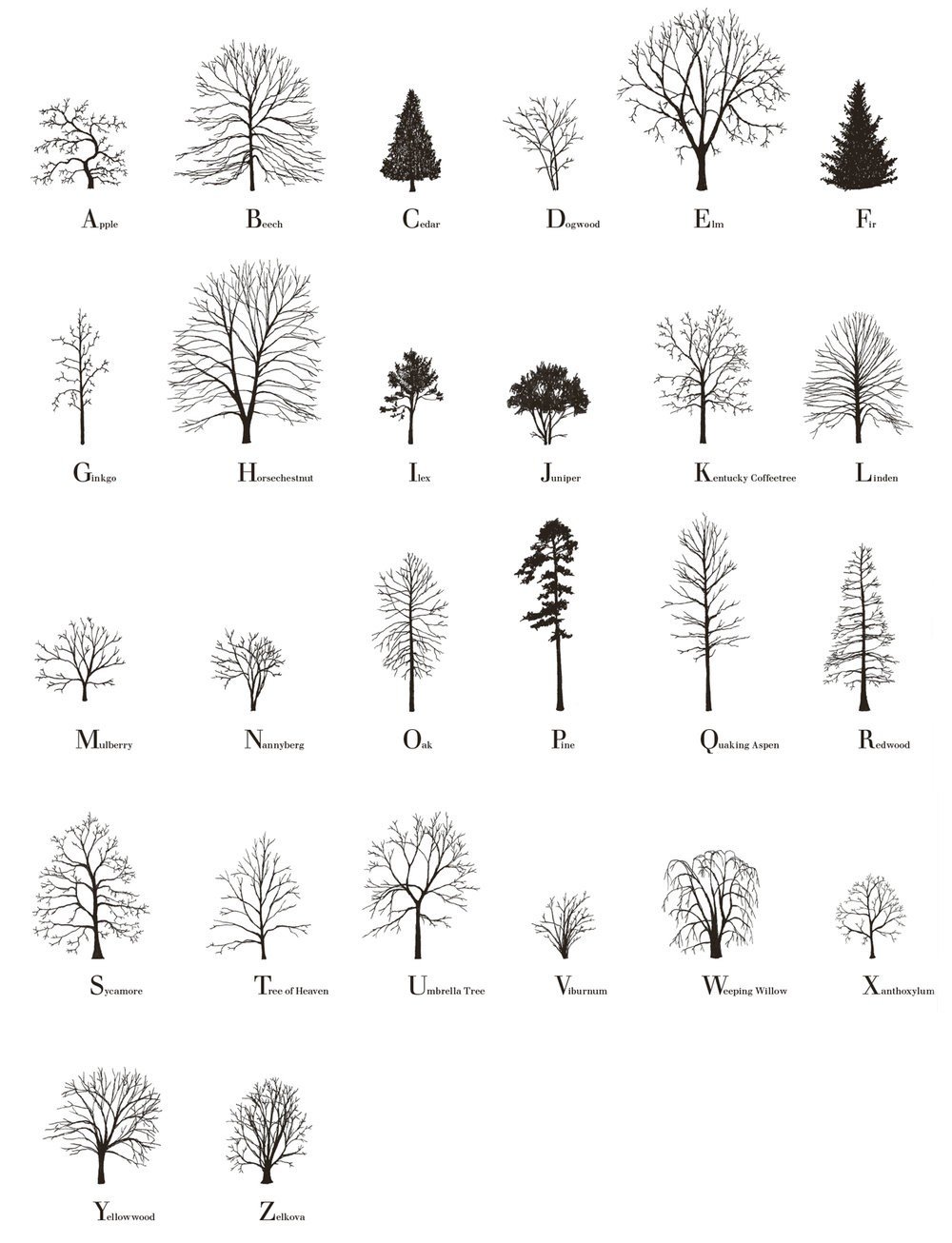
The Tree Alphabet was made by Katie Holten and was used in her book, About Trees (Amazon), which features writing from Jorge Luis Borges, Charles Darwin, Ada Lovelace, Elizabeth Kolbert, and Robert Macfarlane.
In ABOUT TREES, Katie Holten invites us to enter some of these forests. She has created a Tree Alphabet and used it to translate a compendium of well known, loved, lost and new writing. She takes readers on a journey from ‘primeval atoms’ and cave paintings to the death of a 3,500 year-old cypress tree, from Tree Clocks in Mongolia and forest fragments in the Amazon to Emerson’s language of fossil poetry, unearthing a grove of beautiful stories along the way.
The Trees font file is available for free download and prints of the Tree Alphabet are available as well.

For his projected entitled Conversation, Wonjun Jeong tossed fabric into the air and projected images of faces on them.

Artist Cindy Sherman has had a private Instagram account for some time but suddenly made it public the other day. Scrolling back through the archives, it becomes apparent that Sherman has been playing around with new techniques for altering her appearance, constructing an online exhibition of sorts in the process.
For an artist whose practice is based almost entirely on how she presents herself, Sherman has managed to remain camera-shy in her life outside of the studio. Yet, in a surprising move, the photographer has recently taken to Instagram to share images of herself that echo photographs typically reserved for gallery walls. Not only does this provide a generous look into her process for her fans, it also raises the question: Is Cindy Sherman using Instagram to make new work?


Pablo Picasso painted his first self-portrait in 1896 (top), when he was 15 years old. Many styles, years, and artistic innovations later, he made one of his last in 1972 at the age of 90 (bottom)…it was called Self-Portrait Facing Death. Open Culture has a look at how Picasso’s portrayal of himself changed over his long and productive life.
The severe youth of 15, further up, brooding, world-weary, and already an accomplished draughtsman and painter; the grimly serious romantic at 18, above — these Picassos give way to the wide-eyed maturity of the artist at 56 in 1938, at 83, 89, and 90, in 1972, the year before his death. That year he produced an intriguing series of eclectic self-portraits unlike anything he had done before.


Leonardo da Vinci was an avid taker of notes. Over the course of his working life, he filled thousands of pages with drawings, sketches, equations, and his distinctive mirrored handwriting. The British Library has one of Leonardo’s notebooks and has digitized and put all 570 pages of it online. It’s interesting to see all of the spare geometric line drawings and then every once in awhile there’s this wonderfully rendered 3D-shaded tiny masterpiece in the margin when more detail was required. (via open culture)


Artist Visoth Kakvei makes these intricately patterned illustrations and posts them to his Instagram account. Lately, he’s been playing with faux 3D illusions and augmented reality, which pairs really well with his illustration style.
Prints of his illustrations are available, but sadly not of his newer stuff.
Fun fact: Koons listens to Led Zeppelin for about an hour every day. From the Museum of Contemporary Art in LA, this is a short documentary on the life and work of artist Jeff Koons, narrated by Scarlett Johansson. I’ve been experiencing Jeff Koons’ art for almost two decades now and I still can’t decide if I like it or not or if Koons is full of shit or not. I would still love to see his project for the High Line come to fruition though.
Newer posts
Older posts



Socials & More