


Beginning in 1904, Edward Curtis travelled around North American for more than 20 years photographing Native Americans. While his collection of over a thousand photos housed at the Library of Congress isn’t a precise record of how American Indians lived at the time (he took some liberties in romanticizing the past), it is nonetheless a valuable record of a people largely marginalized by history. (via open culture)
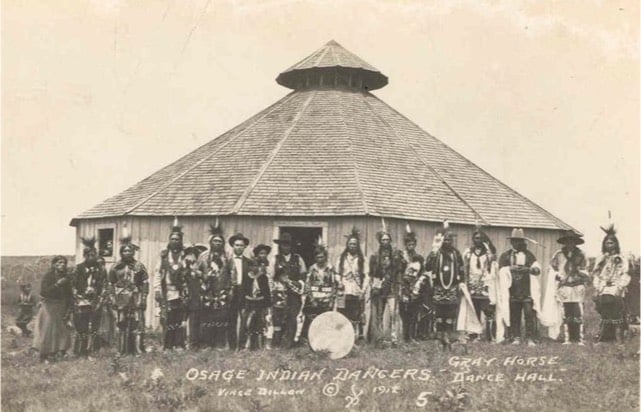
David Grann has been relatively quiet lately on Twitter and at the New Yorker, where he is a staff writer; he hasn’t written anything for them in more than four years. I figured he was busy writing a book and so he was. Killers of the Flower Moon: The Osage Murders and the Birth of the FBI is about the murders of the members of the Osage Indian Nation in the 1920s.
In the 1920s, the richest people per capita in the world were members of the Osage Indian Nation in Oklahoma. After oil was discovered beneath their land, the Osage rode in chauffeured automobiles, built mansions, and sent their children to study in Europe.
Then, one by one, they began to be killed off. One Osage woman, Mollie Burkhart, watched as her family was murdered. Her older sister was shot. Her mother was then slowly poisoned. And it was just the beginning, as more Osage began to die under mysterious circumstances.
Sounds fantastic. Grann’s previous books are The Devil and Sherlock Holmes and The Lost City of Z, which should be out in movie form sometime soon.
From eHistory, a time lapse view from 1776 to the present day of how the US government systematically took land from Native Americans through treaties and executive orders that were rarely honored for long.
There’s a companion piece at Aeon by Claudio Saunt as well as an interactive version of the map featured in the video.
The final assault on indigenous land tenure, lasting roughly from the mid-19th century to 1890, was rapid and murderous. (In the 20th century, the fight moved from the battlefield to the courts, where it continues to this day.) After John Sutter discovered gold in California’s Central Valley in 1848, colonists launched slaving expeditions against native peoples in the region. ‘That a war of extermination will continue to be waged between races, until the Indian race becomes extinct, must be expected,’ the state’s first governor instructed the legislature in 1851.
In the Great Plains, the US Army conducted a war of attrition, with success measured in the quantity of tipis burned, food supplies destroyed, and horse herds slaughtered. The result was a series of massacres: the Bear River Massacre in southern Idaho (1863), the Sand Creek Massacre in eastern Colorado (1864), the Washita Massacre in western Oklahoma (1868), and a host of others. In Florida in the 1850s, US troops waded through the Everglades in pursuit of the last holdouts among the Seminole peoples, who had once controlled much of the Florida peninsula. In short, in the mid-19th century, Americans were still fighting to reduce if not to eliminate the continent’s original residents.
FYI, it’s always a good rule of thumb to not read comments on YouTube, but in this case you really really shouldn’t read the comments on this video unless you want a bunch of reasons why it was ok for Europeans to drive Native Americans to the brink of total genocide.
David Treuer, an American Indian, is writing a series of dispatches for Slate in which he visits Indian casinos. I’d never heard the story of how casinos on Indian lands came to be. It seems a state tax bill on a mobile home led to a lawsuit which led to a legal precedent that state and federal governments have no regulatory jurisdiction on Indian lands.
The Supreme Court ruling in the Bryan case was expansive. More than just a ruling on taxation, it declared that states and the feds had the right to police the reservation only in the interest of “law and order” and had no civil or regulatory jurisdiction over sovereign Indian nations. Until this time, tribes and states more or less assumed that states had civil and regulatory power on reservations. But the Supreme Court maintained that as sovereign nations, Indian tribes had always had the right to govern themselves (including civil and regulatory powers), just as all nations do, and that tribes should deal with the U.S. federal government, not with states. Kansas, for example, has no power to levy taxes in Luxembourg — and not only because Luxembourg is far away.
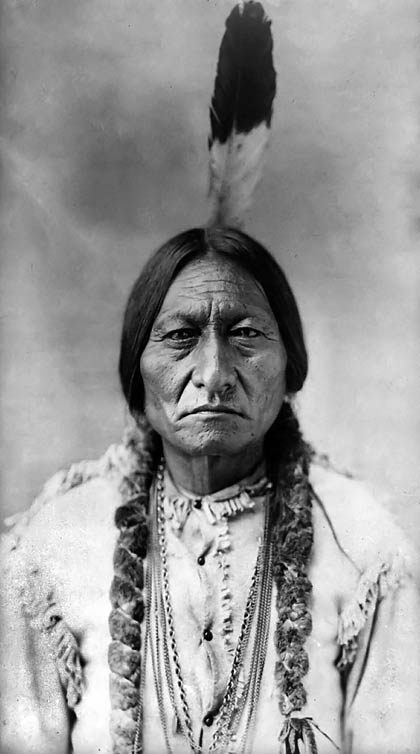
Red Cloud’s farewell address to his people on July 4, 1903.
I was born a Lakota and I shall die a Lakota. Before the white man came to our country, the Lakotas were a free people. They made their own laws and governed themselves as it seemed good to them. The priests and ministers tell us that we lived wickedly when we lived before the white man came among us. Whose fault was this? We lived right as we were taught it was right. Shall we be punished for this? I am not sure that what these people tell me is true.
Red Cloud was among the top Lakota leaders in the late 1800s, commanding his people against rival tribes & the US government. He also successfully made the transition from leading his people in war to guiding and lobbying for them in peace. He died six years after making the above speech.
President of the Oglala Sioux Tribe on the Pine Ridge Reservation, Cecilia Fire Thunder, says:
I will personally establish a Planned Parenthood clinic on my own land which is within the boundaries of the Pine Ridge Reservation where the State of South Dakota has absolutely no jurisdiction.
(via bb)
The last surviving WWII Comanche code talker dies.
The group of Comanche Indians from the Lawton area were selected for special duty in the U.S. Army to provide the Allies with a language that the Germans could not decipher.





Socials & More