kottke.org posts about Antarctica
In the past two weeks, the results of three surveys and studies about the Earth’s climate have been released: a paper on a possible dramatic climate shift, a survey of coral bleaching at the Great Barrier Reef, and a study on the West Antarctic ice sheet. All three investigations tell the story of climate change happening quicker than was previously anticipated.
From the paper published last week by former NASA climate scientist James Hansen and a number of colleagues:
Virtually all climate scientists agree with Dr. Hansen and his co-authors that society is not moving fast enough to reduce emissions of greenhouse gases, posing grave risks. The basic claim of the paper is that by burning fossil fuels at a prodigious pace and pouring heat-trapping gases into the atmosphere, humanity is about to provoke an abrupt climate shift.
In Australia, more than 40% of the Great Barrier Reef has been damaged by coral bleaching.
Scientists who have dedicated their careers to studying the reef and its ecosystem say the current bleaching is unprecedented, and perhaps unrecoverable. The emotion in their responses so far have been palpable.
“I witnessed a sight underwater that no marine biologist, and no person with a love and appreciation for the natural world for that matter, wants to see,” said Australian coral scientist Jodie Rummer in a statement, after spending more than a month at a monitoring station in the Great Barrier Reef.
Though corals comprise only about 0.2 percent of the global oceans, they support perhaps a quarter of all marine species.
And just yesterday, a study on the West Antarctic ice sheet was released that says the ice sheet could melt much faster than previously thought, raising global sea levels by 3 feet in less than 90 years. Even the normally staid NY Times invoked the Sword of Damocles in the lede.
The great ice sheet, larger than Mexico, is thought to be potentially vulnerable to disintegration from a relatively small amount of global warming, and capable of raising the sea level by 12 feet or more should it break up. But researchers long assumed the worst effects would take hundreds — if not thousands — of years to occur.
Now, new research suggests the disaster scenario could play out much sooner.
Continued high emissions of heat-trapping gases could launch a disintegration of the ice sheet within decades, according to a study published Wednesday, heaving enough water into the ocean to raise the sea level as much as three feet by the end of this century.
Miami might not make it to the end of the century.
Oh and BTW, the maximum extent of sea ice in the Arctic was a record low in 2016, February was a total Messi-esque outlier in terms of how unusually hot it was, March, while not as warm, will still be the hottest March ever, and just look at the 2016 trend in the first chart here.
You can think of the Earth as a massive machine, with many interconnected, resilient, and redundant systems. For a long time, humans thought it was too big for our actions to affect this machine in a meaningful way. But the Industrial Revolution’s release of hundreds of millions of years of stored greenhouse gases in less than 300 years put a strain on that entire machine. We didn’t notice that strain for a long time, but we’re starting to now in the form of higher temperatures, weird weather, bleaching coral reefs, rapidly melting ice sheets in Greenland & Antarctica, and dozens of other ways. I hope there’s still time to do something meaningful about it before the slower moving parts of the machine fail permanently.
This 8-minute video of a drone’s eye tour of the coast of Antarctica is just flat-out gorgeous.
While working as a filmmaker as part of the Scott Expedition, Temujin Doran made a beautifully shot and edited short film about a small team of people who live and work on Antarctica’s Union Glacier during the summer.
For me, this film seems a bit like an antithesis to many expedition and adventure documentaries. There is no great achievement or record broken, nor any real challenge to overcome. Instead it concerns minor details; the everyday tasks of the staff that were made more special by the environment surrounding them. And in fact, I think that’s what attracted me to make this film - the delightful trivialities of an average life, working in Antarctica.
Wes Anderson-esque. (thx, joseph)
Ben Saunders and Tarka L’Herpiniere are reaching the end of their 105-day, 1800-mile solo (nearly) unsupported journey to the South Pole and back again. Towing sledges across unchanging icy terrain for 100 days doesn’t exactly make for compelling reading, but it’s been a highlight of each morning during the past three months to read what the boys have been up to. I hope offering my congratulations on a job well done isn’t premature.
There is fossil evidence that Antarctica may have been covered by forests.
The discovery has come in the form of fossilized impressions of wood and leaves in the region of Antarctica’s Mount Achernar. Even the stumps of ancient tree trunks have been uncovered, believed to date back to prehistoric times.
It is commonly accepted that during the late Permian and early Triassic periods, as much as 250 million years ago, the whole world would have been far hotter than it is today.
Sarah Feakins, a biogeochemist from the University of Southern California, posits that the Antarctic coast was once lined with beeches and conifers; based on evidence taken from leaf waxes found in sediment cores extracted from the Ross Ice Shelf.
A period of warmer climate around 15 million years ago, known as the Miocene period, could have had areas of the Antarctic resembling the kind of forested tundra seen today in New Zealand or parts of Chile. Chemical study of the leaf wax samples indicates that during the summer months, the coast of Antarctica could have been as warm as 15°F.
(via @daveg)
70 days ago, Ben Saunders and Tarka L’Herpiniere set out from the edge of Antarctica, bound south. Their goal was to ski, alone and unsupported, to the South Pole and back along the route Captain Robert Falcon Scott travelled in 1912. I’ve been following their blog every day since then, and they were making the whole thing — skiing 19 miles/day in -30° white-outs hauling 300 lbs. and blogging about it the whole way — seem easy somehow. They reached the Pole the day after Christmas were hauling ass (and sled) back toward the coast.
But their seemingly steady progress hid a potentially life-threatening truth: they needed to be skiing more miles a day in order to travel quickly enough to not exhaust their food supply. They’d been missing their mileage goals and in an attempt to catch up, weren’t sleeping and eating as much as they should have been. Things could have gone very wrong at this point, but luckily Ben and Tarka came out ok.
Our depot was still 74km away and we had barely more than half a day’s food to reach it; eight energy bars each, half a breakfast and half an evening meal. 16km into the following day Tarka started to slow again as he led, before stopping entirely and waving me forward to talk. “I feel really weak in the legs again”, he said. “OK. What do you want to do?” I answered snappily, before realising this was on me. I came here to be challenged and tested, to give my all to the hardest task I have ever set myself and to the biggest dream I have ever had. And here was the crux. This was the moment that mattered, not standing by the Pole having my photograph taken, but standing next to my friend, in a howling gale, miles away from anyone or anything. “Let’s put the tent up”, I said, “I’ve got an idea”.
Adventure is never about battling the environment or elements or whatever. It’s always a struggle with the self. And as this battle reached a fevered pitch, Ben and Tarka were not found wanting. Calling for resupply, and thereby giving up on one of the major goals of this expedition 10 years in the making, was probably the hardest thing Ben has ever had to do in his entire life. But he did it, for his family, his loved ones, and his teammate. Ben, Tarka, I’m proud of you. Thank you for letting us follow along on your journey, for showing us what is humanly possible, and for the reminder that pushing the boundaries is never about how far you can tow a sled but about what you do when confronted with the no-win scenario: beating yourself.
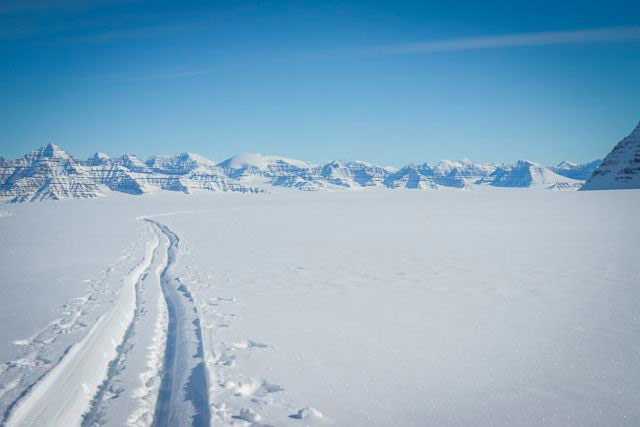
Right now, two men on skis pulling 440 lb sleds are inching their way across the Antartic continent, bound for the South Pole and then back again. Ben Saunders and Tarka L’Herpiniere are attempting to complete, solo and unsupported, the same journey that claimed the lives of Robert Falcon Scott and his party in 1912. They’re calling it The Scott Expedition.
Saunders has been working towards this goal for more than 10 years with many false starts. His former partner in exploration, Tony Haile, explains the journey before the journey:
In short, a South Pole expedition is pretty much the worst way to spend four months you could possibly imagine, but if you were to ask Ben I don’t think he would say that’s the tough part. The tough part is getting to the start line in the first place. Antarctica is far away from everywhere and doing anything in Antarctica is ridiculously expensive. Imagine if you kept a car in New York but the only way to fuel that car was to charter a private jet and fly fuel in from England. That’s the logistics of an Antarctic expedition and between us we had no cash and no clue how to get any.
We didn’t go to the South Pole in 2003. Or 2004. Or 2005. Living month to month on whatever I could scrounge together, putting together small expeditions or managing other people’s just so I wouldn’t lose my connection to the cold places, I grew to fear and then hate my parent’s yearly Christmas letter to their friends which would explain ‘Anthony has decided to postpone his South Pole expedition for another year to raise more funds’. For Ben and I, we had proclaimed a grand goal. We had told people year after year this was the year we were finally going to go south. And every year we had to look at the nervous smiles as we publicly failed. Again and again.
The journey is just underway…the plan is to travel 1800 miles to and from the South Pole and you can track their progress online and read tweets and blog posts from Ben and Tarka along the way. Back in 2005, when Ben and Tony were planning this trip the first time around, they sold miles of the expedition for donations of $100 apiece. They didn’t make it that year obviously and in the days before Kickstarter, crowdsourcing $180,000 was a bit more difficult than it is now. But I bought a mile back then (I actually got mile #900, the point at which they’ll reach the pole) and I am beyond excited that they’ve set off and can’t wait to see how the trip progresses. Good luck, Ben and Tarka!
Color photographs of Ernest Shackleton’s 1914 Antarctic expedition by Frank Hurley.

Early in 1915, their ship ‘Endurance’ became inexorably trapped in the Antarctic ice. Hurley managed to salvage the photographic plates by diving into mushy ice-water inside the sinking ship in October 1915.
(via @polarben)
There are two ATM machines in Antarctica. They are located at McMurdo Station and operated by Wells Fargo. Here’s an interview with a Wells Fargo VP about the unique challenges of operating those machines.
You know, the other thing too that you may find interesting — I don’t know how much you know about folks that need to go down to Antarctica — it’s a huge process to do it. So when we’re preparing for the vendor visit, it’s like a ten-month process. The reason being is, they obviously go in the off-season when it’s obviously warmer because no planes fly onto the ice in their winter months. And so anybody that goes to Antarctica has to be cleared with a physical, a dental, and a psychological evaluation, because if for some reason the plane can’t get out, you’re trapped down there until the next season.
(via jimray)
Maciej Ceglowski tells the story of how the cure for scurvy was discovered, lost, and finally redsicovered, but not before it disrupted Robert Falcon Scott’s 1911 expedition to reach the South Pole.
This is a good example of how the very ubiquity of vitamin C made it hard to identify. Though scurvy was always associated with a lack of greens, fresh meat contains adequate amounts of vitamin C, with particularly high concentrations in the organ meats that explorers considered a delicacy. Eat a bear liver every few weeks and scurvy will be the least of your problems.
But unless you already understand and believe in the vitamin model of nutrition, the notion of a trace substance that exists both in fresh limes and bear kidneys, but is absent from a cask of lime juice because you happened to prepare it in a copper vessel, begins to sound pretty contrived.
Antarctic ice isn’t melting as much as predicted because the overall global warming trend and the Antarctic hole in the ozone are at cross purposes with each other. Temporarily.
As the ozone hole heals in the coming decades, the winds will weaken, the continent will become much warmer in summer — and melting will increase.
In 1961, surgeon Leonid Rogozov was the only physician stationed on an isolated 12-man Soviet base in Antarctica when he developed appendicitis. He had to remove his appendix himself.
“I didn’t permit myself to think about anything other than the task at hand. It was necessary to steel myself, steel myself firmly and grit my teeth. In the event that I lost consciousness, I’d given Sasha Artemev a syringe and shown him how to give me an injection. I chose a position half sitting. I explained to Zinovy Teplinsky how to hold the mirror. My poor assistants! At the last minute I looked over at them: they stood there in their surgical whites, whiter than white themselves. I was scared too. But when I picked up the needle with the novocaine and gave myself the first injection, somehow I automatically switched into operating mode, and from that point on I didn’t notice anything else.
Anticipating cries of “photos or it didn’t happen”, his assistants documented the scene: here’s Rogozov operating on himself (and another).
Down 50 pounds, running on 15% lung capacity, and unable to remember coordinates properly, Todd Carmichael works his way toward the South Pole, still attempting to set a speed record.
“I just don’t know what to do,” Carmichael says to the camera. “No way of communicating with anyone. No way of making water.” His voice rises with resentment. “I have no water! That’s it. I have no water. If you don’t have water, you don’t have life.”
The two comments following the story are also interesting. One is from a member of a Canadian team who broke the speed record a few days after Carmichael’s attempt ended.
The abandoned supply shacks of Antarctic explorers Robert Falcon Scott and Ernest Shackleton are still intact and have been preserved by the cold.
While the preservation of food in the freezing temperatures and dry climate has been noted, bacterial decay still occurs. Besides, the World Monuments Watch describes it as one of the hundred most endangered sites in the world, and New Zealand’s Antarctic Heritage Trust (AHT) has been working in the last years to preserve it from corrosion.
These structures and the supplies contained within are almost 100 years old.
Let’s talk Antarctica blogs.
Antarctic Journal is one of the best; it’s written by a grad student studying penguin ecology. Big Dead Place is also great (but not strictly a blog); check out the stories and interviews section. Also of note but of varying quality and timeliness are a blog by the British Antarctic Survey, John Bean’s Antarctica blog, a U of Delaware blog, Antarctic Blog, and Antarctica Blog.
I’m still looking forward to the SOUTH expedition blog whenever that happens.
Update: One more: 75 Degrees South. Very nice photos, as in this post. (thx, pete)
Update: More Antarctica blogs and such: UAB in Antarctica, Blog Rogers (which includes info about the book, Antarctica: Life on the Ice), Nathan Duke, elisfanclub, Concordia Base, Base Dumont d’Urville, Mr Rose Géophy CZT45, and Andrill. (thx, everyone)
Newer posts
Older posts







Socials & More