


The Real Reason You Should Get an E-bike: they’re fun! “One of the best ways to improve your life: Ditch your car.”

Advertise here with Carbon Ads
This site is made possible by member support. 💞
Big thanks to Arcustech for hosting the site and offering amazing tech support.
When you buy through links on kottke.org, I may earn an affiliate commission. Thanks for supporting the site!
kottke.org. home of fine hypertext products since 1998.
Beloved by 86.47% of the web.
Entries for October 2023
“The Nature Conservancy estimates that 5.75 billion sunflower sea stars died over the span of three years, a 94 percent global decline.” 94% in 3 years! Climate change + disease is to blame.
How Do Black Holes Compare to Regular Holes?
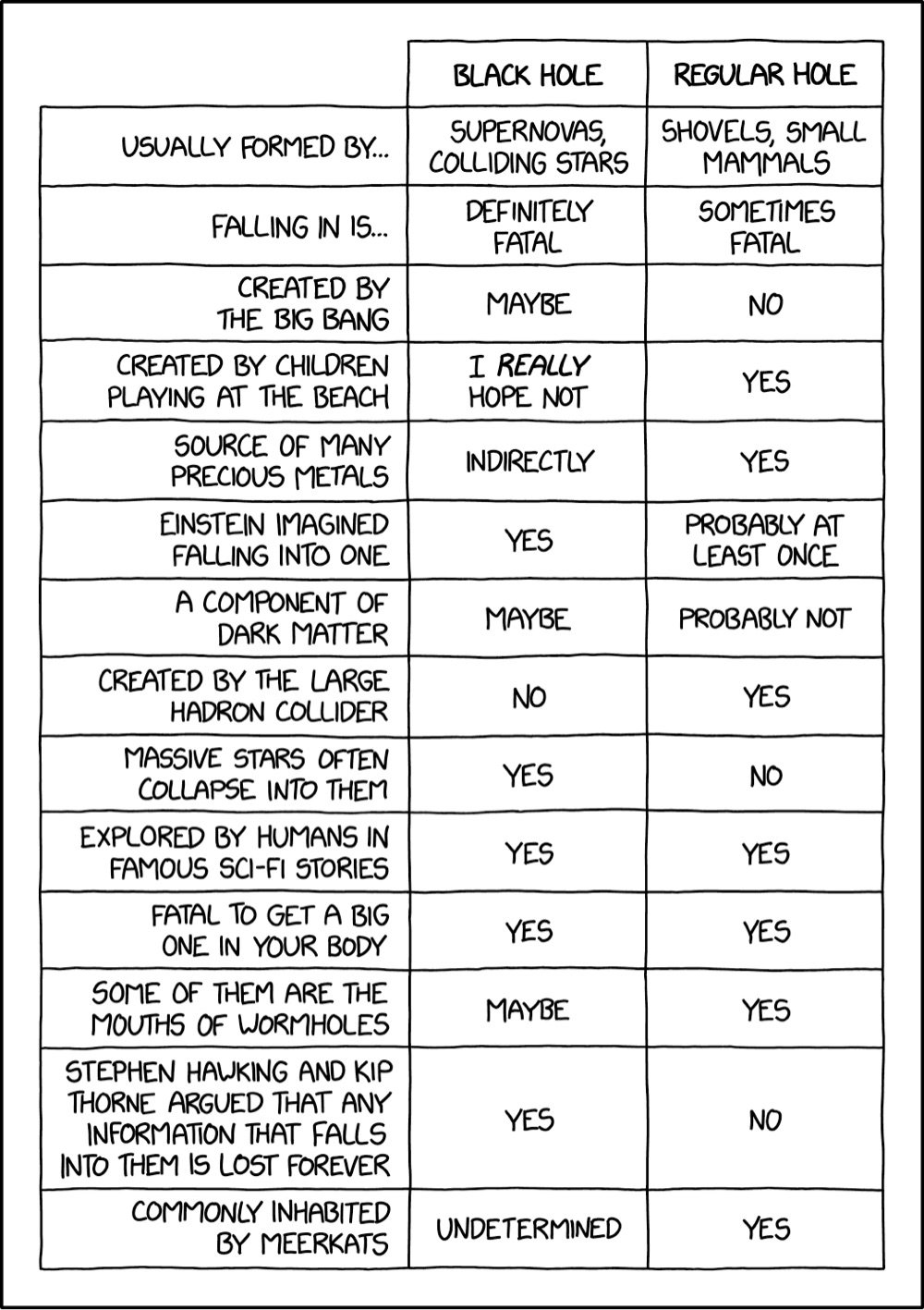
From XKCD, a comparison chart that shows how black holes and regular holes measure up to one another. Some of these are pretty clever: “some of them are the mouths of wormholes”.
The Debt Collective just canceled almost $10 million in student debt for Morehouse College students. They paid $125,000 for the debt.
The English Gave Birds People Names and Some of Them Stuck
In a piece about how English and North American robins (two unrelated species that don’t even share a biological genus or family) got their names, Robert Francis shares how some English birds were given people names…and some of them stuck.
During the 15th century, the English had an endearing practice of granting common human names to the birds that lived among them. Virtually every bird in that era had a name, and most of them, like Will Wagtail and Philip Sparrow have been long forgotten. Polly Parrot has stuck around, and Tom Tit and Jenny Wren, personable companions of the English countryside, are names still sometimes found in children’s rhymes. Other human names, however, have been incorporated so durably into the common names that still grace birds as to almost entirely obscure their origin. The Magpie, a loquacious black and white bird with a penchant for snatching shiny objects, once bore the simple name “pie,” probably coming from its Roman name, “pica.” The English named these birds Margaret, which was then abbreviated to Maggie, and finally left at Mag Pie.[2] The vocal, crow-like bird called Jackdaw was also once just a “daw” named “Jack.”
The English also gave their ubiquitous and beloved orange-bellied, orb-shaped, wren-sized bird a human name. The first recorded Anglo-Saxon name for the Eurasian Robin was ruddoc, meaning “little red one.” By the medieval period, its name evolved to redbreast (the more accurate term orange only entered the English language when the fruit of the same name reached Great Britain in the 16th century). The English chose the satisfyingly alliterative name Robert for the redbreast, which they then changed to the popular Tudor nickname Robin. Soon enough, the name Robin Redbreast became so identified with the bird that Redbreast was dropped because it seemed so redundant.
I found this list of other people names for birds as well — other examples include jays and martins. (via @gretchenmcc)
I’ve been using Mimestream as my MacOS email client for less than a day and it’s already so much better than the increasingly janky Gmail web interface. What’s your email setup these days?
“How Lauren Groff, One of ‘Our Finest Living Writers,’ Does Her Work.”
I am currently reading1 Lauren Groff’s The Vaster Wilds, so I was interested to read about her writing process, which includes:
When Groff starts something new, she writes it out longhand in large spiral notebooks. After she completes a first draft, she puts it in a bankers box — and never reads it again. Then she’ll start the book over, still in longhand, working from memory. The idea is that this way, only the best, most vital bits survive.
“It’s not even the words on the page that accumulate, because I never look at them again, really, but the ideas and the characters start to take on gravity and density,” she said.
“Nothing matters except for these lightning bolts that I’ve discovered,” she continued, “the images that are happening, the sounds that are happening, that feel alive. Those are the only things that really matter from draft to draft.”
And also this:
In the afternoon, Groff deals with the business of being an author, responding to emails, doing publicity, writing blurbs. And she reads. A lot. In just the past few days, she said, she finished “Living and Dying With Marcel Proust,” completed a reread of “Moby Dick,” and started a graphic novel called “Roaming.” She estimates she reads about 300 books a year.
Groff will drop quotes into casual conversation, citing, say, Frank Lloyd Wright’s take on form and function, but she manages to do this in an entirely unaffected way, just tossing out an interesting nugget for consideration. Her editor, McGrath, said that Groff reread all of Shakespeare so she could write a version of “The Vaster Wilds” in iambic pentameter “just for fun,” as a way for her to master Elizabethan rhythms.
All of Shakespeare, just for fun. Yep.
Or at least, trying to read. I’ve been super busy with work and at the end of the day, the last thing I want to do is read more. But I will get back to it!↩
I may have hallucinated this but I think a bunch of folks were talking about this book on Bluesky yesterday? Three Bags Full: A Sheep Detective Story. “It’s rather as if Agatha Christie had rewritten The Wind in the Willows…”
Happy 17th anniversary to The Marginalian, Maria Popova’s bloggy love-letter to the diversity and profundity of the human experience.
“An off-duty pilot who was in a jump seat in the cockpit of an Alaska Airlines flight on Sunday has been charged with more than 80 counts of attempted murder.” 80 counts of attempted murder!
Ella Fitzgerald & Mel Tormé Answer “What Is Jazz?”
This is wonderful: at the 1976 Grammys, Mel Tormé asked Ella Fitzgerald how she explains to people what jazz is and then the pair of them effortlessly launch into a scat duet that is just fantastic to listen to. Ella Fitzgerald, what a voice! Mel Tormé, what a voice! Here’s the pair performing together in the 60s:
Super Mario of the Flower Moon is my personal Barbenheimer. “Two great artworks from important small Italians on the same day?!”
An analysis by Mona Chalabi: “The New York Times has consistently mentioned Israeli deaths more often than Palestinian deaths.” And Israelis are mentioned by name and Palestinians are often anonymous. I have noticed this as well.
Running in a Body That’s My Own: runner Caster Semenya’s long struggle to compete as herself. “Its restrictions aren’t about leveling the playing field; they are about getting certain types of women off the field completely.”
The Bird Migration Explorer
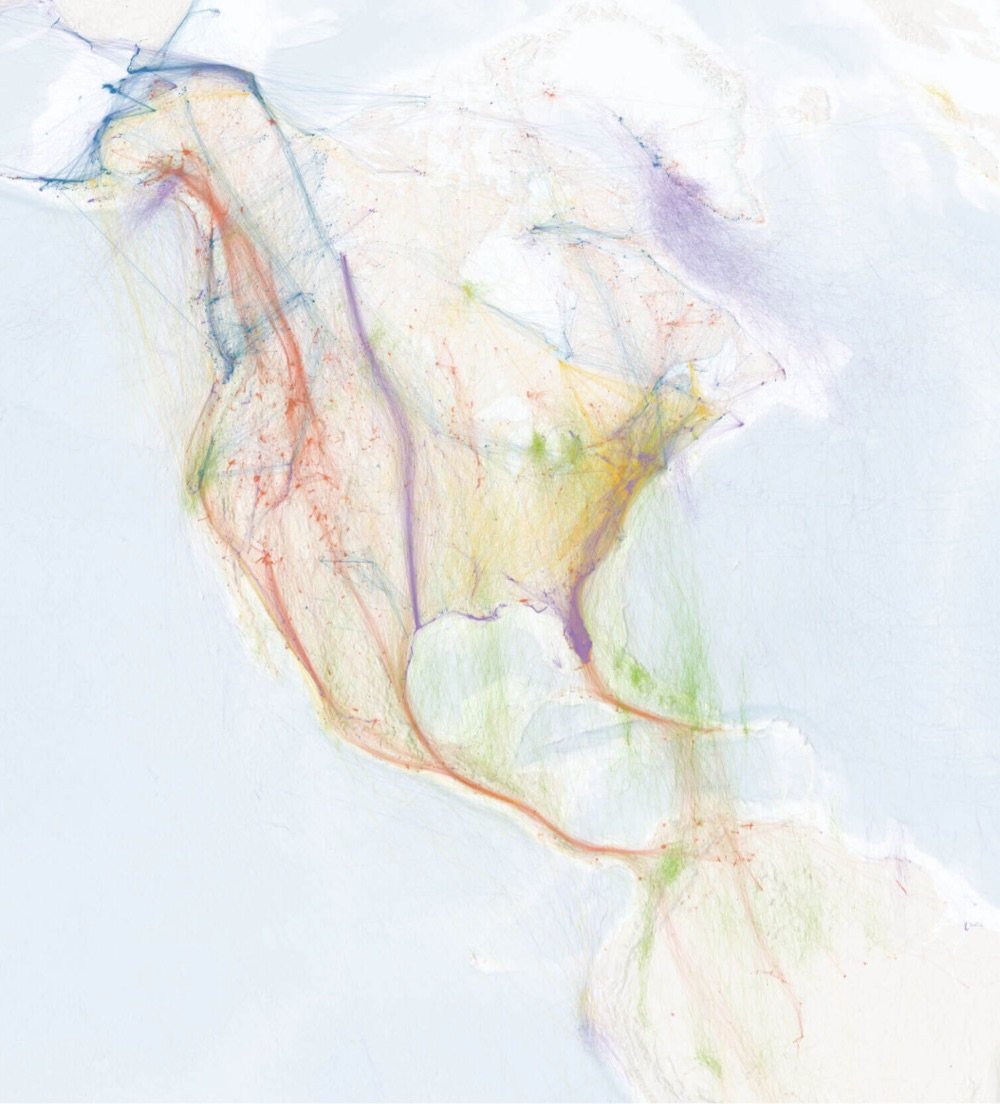
I loved playing around with the National Audubon Society’s Bird Migration Explorer, which is a beautifully designed interactive map of the Western hemisphere that shows the seasonal migration patterns of more than 450 species of birds. What a resource…so much information to explore here. (via marco c. in the comments)
Evangelical Christians yearning for the Second Coming want Israel to wipe out the Palestinians, followed by the “annihilation of the Jews”. “What it amounts to is cheering on Armageddon from the cheap seats — and directing funds to ensure it occurs.”
Who Are the People in the Neighborhood?
One of the things I was thinking about doing with the comments is having posts on Fridays that are specifically participatory. So let’s try it out today. Currently, there’s no profile information available for commenters…you can’t click on a name to visit their Instagram acct or whatever. That feature is on my to-do list but it might be awhile before I get to it. But I know folks are curious about who reads the site…
So, in the meantime, if you feel comfortable sharing, you can use this thread to introduce yourself: maybe where you live, what you’re into, your social accounts. I think many of us smartly err on the side of not sharing too many specific details about ourselves online (myself included, but it’s obviously complicated 🙃) due to safety issues, but I think it’s possible to get to know each other a little bit without spilling too many beans. (thx to Russell for the idea)
How’s Everyone Liking the Comments?
Hey everyone. I rolled out a new comments system (in beta!) on Monday and it seems to have been well-received so far. I’ve fixed some of the most egregious bugs and rolled out some tweaks and it seems to be holding up pretty well. 🤞 (Is there a knock-on-wood emoji?)
It’s early days and I’m rolling things out slowly (only ~10 posts were open for comments this week out of about 50), but commenting activity waned as the week went on. Discovery is still poor (there’s no list of open comment threads) and there aren’t any notifications — even as an admin user, I have to go to the front page of the site and click into individual threads to see if there’s anything new. That’s an obvious hinderance to participation and I’m gonna make a first pass at fixing it next week.
I also recognize that it’s tough for readers to make room for a new online social space. People have their routines with Mastodon, Threads, Reddit, Instagram, etc. and each of those spaces has different social norms and unspoken rules. Getting used to a new space and learning what it’s “for” takes time. At the end of the day, it’s on me to facilitate discussion here. I’m not used to writing posts to spark conversation and it’s gonna take some time for that muscle to develop and to find a balance — I don’t want the site to become a series of prompts. (“Here’s a cool thing about giraffes. Do YOU like giraffes?” 🥴)
Like LLMs, we’ve all been trained on contemporary social media and tend to interact online in that way now. But per the community guidelines, I’m asking us to try for a slightly different sort of discussion:
There are three types of feedback I get often via email or social media that I love: 1) when someone sends me a link related to something I’ve shared (often with a short explanation/summary), 2) when a reader with expertise about something I’ve posted about shares their knowledge/perspective, or 3) when someone tells a personal story or shares an experience they had related to a post or link. When readers share this sort of constructive feedback, it improves the original post so much…that’s what I want to happen with comments on kottke.org.
The internet is full of places for people to go to express their opinions or argue about others’ opinions, so I’d like to steer away from that here. If we can prioritize talking about facts, sharing stories, experiences, and expertise over opinions, it’ll make for better, more informative threads.
I’d also like folks participating in threads to think a little bit less about what you might want out of making a comment and a little bit more about how your comment might help improve the community’s understanding of the topic at hand.
When I think about the posts & comments on social sites that I’m most interested in, they’re often experiences/personal stories, informed opinion, or, my personal favorite, links to related content. I’m gonna share some comments from this past week that hit these marks. First is Steven’s comment in the best 50 bars thread:
Our friend Kate Mikkelson has been tracking the best bars for years and maintaining her own list which may be of some relevance here. We were just in Brooklyn and while we didn’t make it to any of the bars on the most recent list we did go to Long Island Bar (twice) and had the best martini we’ve ever had, and enjoyed a great meal with excellent cocktails at Maison Premiere. Probably the best bar we’ve been to in recent memory was Artillery, in Savannah, but we’ve been lucky to visit many others, both with Chris and Kate and without, mostly in New Orleans, San Francisco, and Austin.
An excellent link, some context, and a little personal story.
I loved everyone sharing their favorite music videos in this thread. It took some cajoling by Caroline, but the thread got instantly better for everyone when people started sharing links to the videos they were talking about. Sharing links is a form of Showing Your Work and it only takes a few additional moments.
Though it contains fewer than 10 comments, I thought the best thread of the week was on the What a Japanese Neighborhood Izakaya Is Like post. I easily could have pinned every comment in the thread but I’ll highlight two here. First, this one by Thom:
One of the best gift’s a friend ever gave me was (silently) insisting we always meet at the same coffee shop. Over time, the connections we created and overall vibe of doing so spilled into other aspects of my life, especially when I travel. Usually when you go somewhere new you want to try as many things as possible. But I try and go to the same place repeatedly, glorying in the warmth of them learning my name, picking up on what I like to order, and finally telling me about things I should check out they think I’d like.
I don’t know if it’s a skill to do so, but, having now moved between cities and countries multiple times in my life, it’s my first objective when I find a new home. Go somewhere enough times until they know my name. In this small way it feels like my spending money there matters more than it would in a place where the staff turnover even day by day would make this impossible.
And Josh:
Love this. I recently stumbled onto a show on Netflix called Midnight Dinner about a guy who runs a Izakaya (though I didn’t know what it was called until this post). It follows the stories of his regulars and has been warm comfort TV as the nights get colder. Y’all might appreciate it as I’ve been doing.
I’ve added Midnight Dinner to my Netflix queue — I hadn’t heard of it before. Comments like these make whatever posts I’ve written so much better — many thanks to these readers and everyone that else that took the time to comment this week.
I’ve been working nights and weekend for the past few weeks to get this thing going, quite happily for the most part, but I’m wiped. So I’m taking the rest of the day off (aside from one more post (with comments on!) after this one) to get a few things done around the house, do a bit of reading, and go watch my daughter play soccer. I’ll see you next week!
Estonia’s capital made mass transit free a decade ago. Transit traffic went up but car traffic increased faster. “Any extra money should be put toward transit service, and not zero fares.”
Tape Measure Spider-Man. So dumb and yet perfect.
Scientists lay out a sweeping roadmap for transitioning the US off fossil fuels. “A 600-plus-page report from the National Academies of Science includes 80 recommendations for how the U.S. can achieve its target of net-zero emissions by 2050.”
Ed Zitron completely dismantles Marc Andreessen’s “outdated and childish” techno-optimist manifesto. “These people do not care about the future. They are eternally mired in the past, grinding their axes and scowling at those who would stop them…”
All of the Whole Earth Catalog Is Now Available Online for Free


The influential Whole Earth Catalog, along with a number of related publications, has been uploaded to The Internet Archive and is now available online for free at the Whole Earth Index. From Wired:
The Whole Earth Catalog was the proto-blog — a collection of reviews, how-to guides, and primers on anarchic libertarianism printed onto densely packed pages. It carried the tagline “Access to Tools” and offered know-how, product reviews, cultural analysis, and gobs of snark, long before you could get all that on the internet.
At the time of its initial publication in the late 1960s, the periodical became a beacon for techno-optimists and back-to-the-land hippies. The Whole Earth Catalog preached self-reliance, teaching young baby boomers how to build their own cabins, garden sheds, and geodesic domes after they had turned on, tuned in, and dropped out — well before they grew wealthy enough to buy up all the three-bedroom single-family homes. The catalog also had a profound impact on Silicon Valley’s ethos, and is credited with seeding the ideas that helped fuel today’s startup culture.
Martin Scorsese’s 81 Greatest Movie Characters, Ranked. So many great characters here that even Bill the Butcher barely cracks the top 10.
The Economist: “Although the official number of deaths caused by Covid-19 is now 7M, our single best estimate is that the actual toll is 27.1M people. We find that there is a 95% chance that the true value lies between 17.9M and 32.9M additional deaths.”
Sandra Newman’s Julia is a bold retelling of Orwell’s 1984 from the perspective of Winston Smith’s lover. From a review: “About halfway through, I began to feel more convinced by Julia’s responses to this totalitarian state than I had ever been by Smith’s”.
David Byrne’s Dance Rehearsals for Stop Making Sense
Even if you haven’t seen Stop Making Sense, you are likely familiar with the herky jerky dance moves of Talking Heads’ frontman David Byrne. In this video, which has only recently been made public, you can see Byrne practicing his now-iconic moves.
40 years ago, David Byrne rehearsed dances for Talking Heads’ upcoming Speaking in Tongues tour by recording video of himself to determine which moves worked better than others, which developed into many of the iconic moves seen in the Stop Making Sense movie, filmed at the end of 1983 and released in 1984. It was recently rereleased by A24 in restored 4K. These videos, recorded in David Byrne’s loft, have been mentioned before in interviews and now after 40 years the footage is finally available!
If you don’t want to sit through the full 25-minute video, here’s an hors d’oeuvres version:
(via open culture)
Great story about going to see Galaxy Quest in an empty theater near the end of its run. “The projectionist strode down the aisle toward me [and] my first thought was that the matinee was canceled due to low turnout…”
An index of dozens of aesthetic categories, from Boho Chic and Corporate Gen-X Cyber to Whimsigothic and Internet Awesomesauce.
Is Rural America Even a Thing?
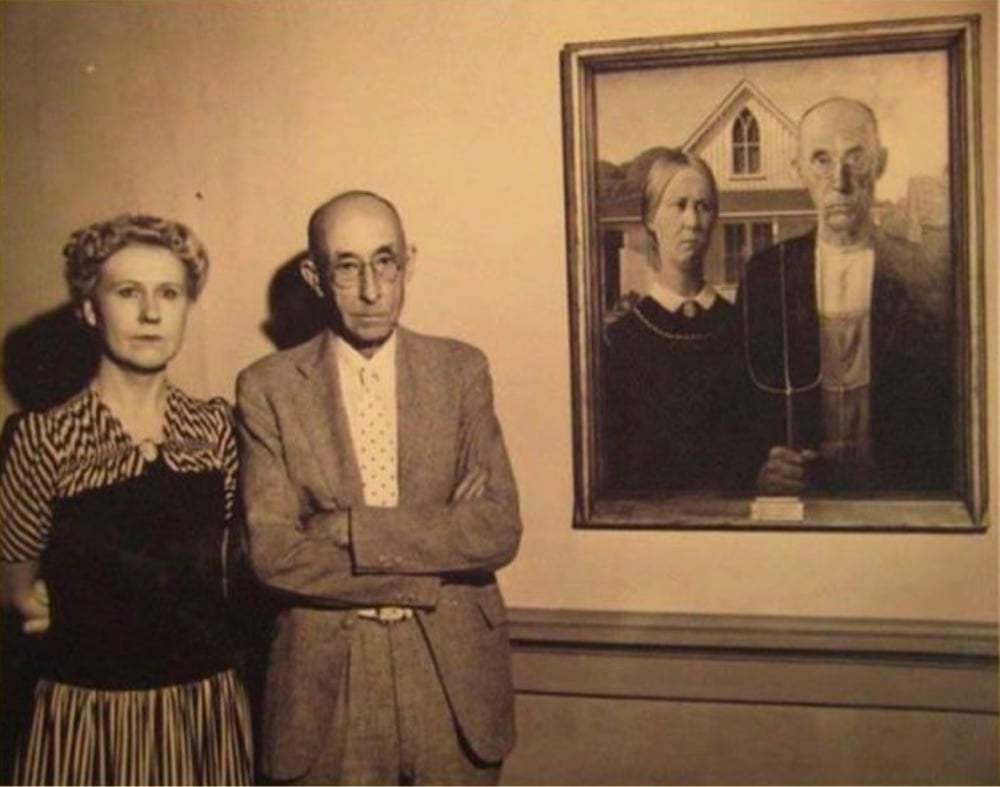
For the New Yorker, Daniel Immerwahr reviews a new book, Steven Conn’s The Lies of the Land: Seeing Rural America for What It Is — and Isn’t (Bookshop.org), which makes the case that what we typically think of as rural America or “real America” is a mirage.
A piercing, unsentimental new book, “The Lies of the Land” (Chicago), by the historian Steven Conn, takes the long view. Wistful talk of “real America” aside, Conn, who teaches at Miami University, in Oxford, Ohio, argues that the rural United States is, in fact, highly artificial. Its inhabitants are as much creatures of state power and industrial capitalism as their city-dwelling counterparts. But we rarely acknowledge this, Conn writes, because many of us — urban and rural, on the left and the right — “don’t quite want it to be true.”
For one thing, the predominant rural population in what is now the United States was coercively removed and eliminated by the federal government:
Settlers styled themselves as pioneers who had won their land with their bare hands. This is how it went in “Little House on the Prairie,” with the frontier family racing ahead of the law to seize Indian property. (“Little Squatter on the Osage Diminished Reserve” would have been a more accurate title, the literary scholar Frances W. Kaye has archly suggested.) Yet in the end land ownership came, directly or indirectly, from the state. The Homestead Act of 1862, along with its successors, gridded up and gave away an area the size of Pakistan. And although homesteading sounds like a relic from the sepia-toned past, its most active period came, the historian Sara Gregg has pointed out, in the twentieth century. The final homesteader got his land in 1988.
1988! The very next paragraph:
One irony is that — after Indigenous towns — it’s the havens of the East Coast ‘elite, such as Boston, New York, and Philadelphia, which have the deepest roots. Most bastions of “real America” are, by contrast, relatively new. Wasilla, Alaska, where Sarah Palin served as mayor, really is a small town in a farming area. But most of its farms were created by a New Deal campaign to relocate struggling farmers from the Upper Midwest. (Hence Palin’s “you betcha” accent, similar to the Minnesota ones in the film “Fargo.”) Palin’s proud patch of “real America,” in other words, was courtesy of Franklin Delano Roosevelt.
This is one of those pieces I could quote every other paragraph so I’m gonna stop there.
Poet Lemn Sissay: “Superman was a foster child. Harry Potter was a foster child. Jane Eyre was adopted. Luke Skywalker was fostered. The fostered, adopted, and orphaned child is central to popular culture.”
How Large Before It Goes In?
One of the best uses of technology is to make people laugh. In this three-part series, the Numerical YouTube channels uses some simple editing to increase the size of the goal until some laughably off-the-mark strikes by professional footballers Ousmane Dembélé, Harry Kane (his penalty miss vs France), and Nicolas Jackson finally find their targets. The misses just get more and more funny as the goal gets bigger.
While Ikea was refurbishing a building for a new store in London, they covered it with scaffolding that looks like a giant, blue Ikea bag. “It’s a simple idea, maybe the most obvious idea, and all the better for that. Nothing else needed.”
Great Books Explained
One of my recent favorite YouTube channels is James Payne’s Great Art Explained, which does exactly what it says on the tin, showcasing works of art like Starry Night, the Great Wave, and A Sunday on La Grande Jatte. Payne recently launched a new channel in the same vein: Great Books Explained. Here’s a trailer, featuring a short clip of his exploration of Alice’s Adventures in Wonderland.
Being an avid reader, I always wanted to do a book channel as well, but did not have the time, so these films are collaborations with different writers who are passionate about certain books, and the first release will be James Joyce’s Ulysses (in this case co-created with Henry Mountford). This will be followed by Alice.
The video on James Joyce’s Ulysses is out now:
(via open culture)
Nomophobia is the fear of being without your mobile phone. “The term is short for ‘no mobile phone phobia’.”
She Was Oprah Before Oprah. A profile of Alice Travis, the first Black woman to host a nationally syndicated talk show. “Travis’s goal was to treat her audience with respect and to present a nuanced portrait of modern Black womanhood…”
The Winners of the 2023 Nikon Small World Photomicrography Competition


Nikon has announced the winners of the Small World Photomicrography Competition for 2023. I’ve included a few of my favorites above. From the top:
- The optic nerves of a rodent by Hassanain Qambari & Jayden Dickson.
- A heart shape is visible amongst breast cancer cells shot by Malgorzata Lisowska.
- Sunflower pollen on an acupuncture needle by John-Oliver Dum.
And I love a good slime mold photo too. (via ars technica)
Analogue is making a console that will play Nintendo N64 games with 100% compatibility (no emulation). 4K, Bluetooth for controllers, more features to come. You’ll never get one though — all their stuff sells out in like 4 seconds.
Sure, Trump Is an Authoritarian Grifter, but at Least He’s Three Years Younger Than Biden. NY Times op-ed page 🤝 independent moderate voters.
Project Primrose: Interactive Digital Fashion
At their recent creativity conference, Adobe showed off Project Primrose, in the form of a dress that changes colors and patterns at the click of a button. The garment could also display animations, including ones that respond to the wearer’s movements. From The Kid Should See This:
Created with small scales or petals that are programmed with Adobe software, the futuristic ‘fabric’ can be used for clothing, handbags, curtains, furniture, and endless other surfaces.
Research Scientist Christine Dierk and her team designed and programmed everything about it. Dierk also stitched it together.
Mario Can’t Be Super Without Psychedelic Power-Ups. “Nintendo’s mascot is boring. So for nearly four decades, it has fed the jumping plumber an increasingly bizarre diet of items.” 🍄😂
Extremely relevant to my interests: the New England Cider Donut Map. Over 350 donut destinations, including my favorite: Burtt’s Apple Orchard.
Just announced: The World’s 50 Best Bars. I’ve been to a few of these and would like to go to the rest sometime please.
Pepper X, developed by the founder of PuckerButt Pepper Company, is now the spiciest pepper in the world, measuring 2.693 million on the Scoville scale. The old record was 1.64 mil. “That scale’s logarithmic, so it’s more like three times hotter.”
How Far Does $1 From 1999 Go Today? A visualization that uses the Consumer Price Index to measure how much prices have increased for things like food, housing, medical expenses, and education. Would love to know why medical exp. is a straight line!
To promote his forthcoming book on keyboards called Shift Happens, Marcin Wichary made a little quiz game based on the book’s slipcase cover (which consists of 45 shift keys from 100+ years of keyboards).
The Eye of the Universe Looking Back at Us
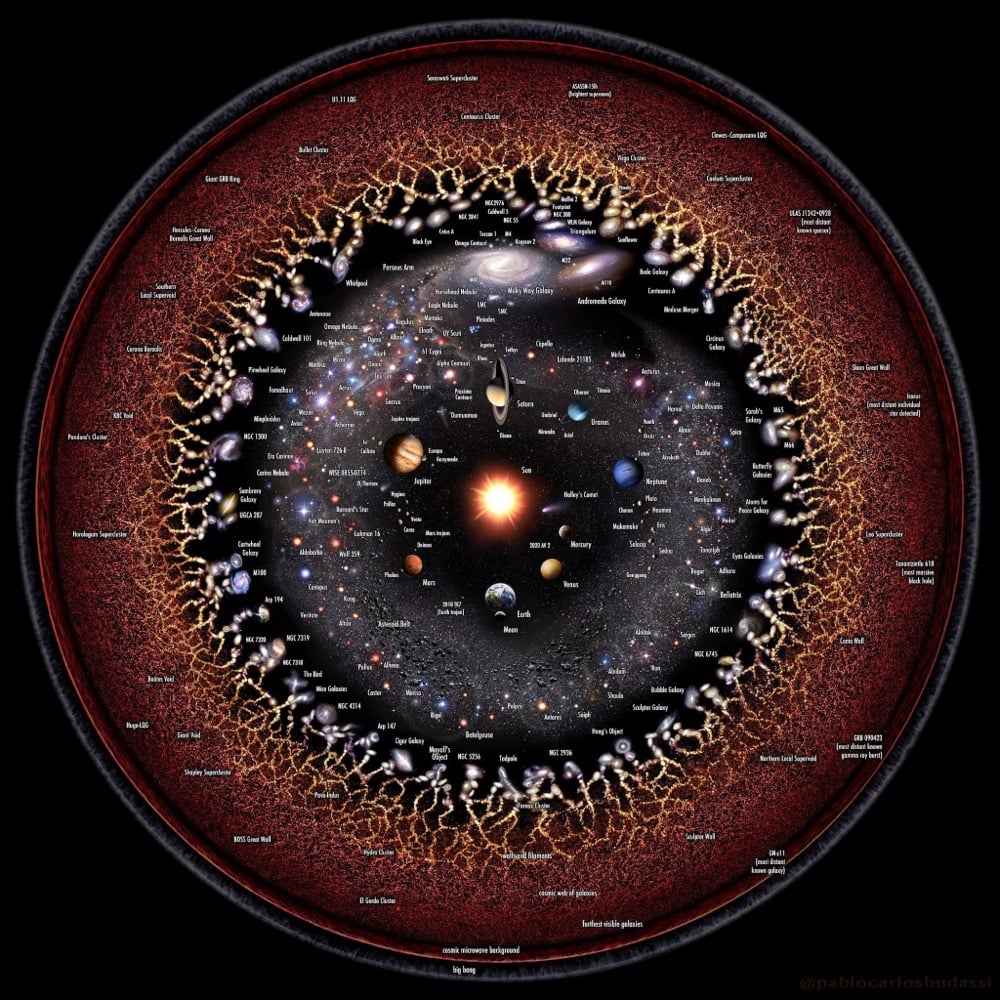
From illustrator Pablo Carlos Budassi, this is a circular map of the universe.
The solar system is located in the center. Towards the edges, the scale is progressively reduced to show in detail the most distant and biggest structures of the observable universe sphere.
There are several other representations of the universe on Budassi’s site, including links to prints, posters, and other products.
It was cloudy and I worked all weekend (on comments), so I didn’t get to see much about the annular solar eclipse. I dug up some eclipse photos online but am curious if you’ve seen (or taken!) any worth sharing?
A quick update about the Design Squiggle t-shirt: the other day I sent another donation to the National Network of Abortion Funds for $2,352.00. Thanks so much for helping support an organization working to provide vital health care to those who need it.

Socials & More