



Advertise here with Carbon Ads
This site is made possible by member support. 💞
Big thanks to Arcustech for hosting the site and offering amazing tech support.
When you buy through links on kottke.org, I may earn an affiliate commission. Thanks for supporting the site!
kottke.org. home of fine hypertext products since 1998.
Beloved by 86.47% of the web.
Entries for April 2022
Tales of Filmmaking From Edward Zwick
On his Twitter account, filmmaker Edward Zwick (Glory, Legends of the Fall, The Last Samurai) is writing these amazing short threads on the films that he’s made and the lessons he’s learned, many of them celebrating actors he’s worked with (these are my favorites). Here are some selections from some of the threads.
The Fates can kiss or kill. I’d been working on Defiance, off and on, for ten years. Daniel read the script the night it arrived as he sat in bed and wrote back the next day to say yes. I was floored. It was only the first of many times he would astonish me.
Daniel simply said he was moved by the script. I later learned that his grandfather was among the first British soldiers to enter the camps at Bergen-Belsen. I found this out from Dan’s girlfriend; it would have been unlike Daniel to talk about himself.
We shot in freezing rain and snow. Our forest set was miles from base camp and Dan never set foot in his trailer. When I once dared compliment him at the end of a scene, he looked perplexed, “Not hard to act cold when you’re freezing your nuts off,” he said.
Anthea Sylbert tried two hundred jackets on Warren Beatty before finding one sexy enough for SHAMPOO. Imagine Anna Taylor-Joy’s character without outfits evoking chess pieces in The Queen’s Gambit? The costumer doesn’t dress actors, she clothes the movie.
All good writing is personal. That doesn’t mean autobiographical. Whether a period piece or a sci-fi space opera, characters aren’t created, they pre-exist and must be found within you. Imagine yourself as a sinner or a saint and you’ll find their voices.
Why write something personal when the studios want superheroes? The secrets you think are yours alone are the ones people will respond to. Ask yourself, what is my own story about? What is it REALLY about? And why the fuck should anyone care?
During rehearsals, I kept Matt and the others apart from Denzel Washington, whose interrogation of them drives the plot. As fate would have it, his first day of shooting was scheduled opposite Denzel. And his close-up was up first.
You can tell something special is happening on set by watching the crew. Even the dolly grip, who had made hundreds of movies, was paying attention. As the two actors began to work, it was as if a spell had been cast over the set…
As we finished Matt’s coverage, Denzel caught my eye and nodded approvingly. Later, he took me aside. “Who is the kid?” he asked? I told him it was Matt’s first big role. “Damn,” he said, “Better get my game on. He almost blew me off the screen.”
The house that Apocalypse Now built:
Joe was cast as the Sergeant who brings a drunk Martin Sheen his orders and throws him into the shower. It was the most exciting day of Joe’s life. Shooting went slowly and they planned to finish the scene the next day. That night, though, Sheen had a heart attack.
They sent Joe home, promising to bring him back when Sheen recovered. But Joe had been hired as a day player rather than on a ‘drop-and-pick-up’ so they were obliged to keep him on salary. Every producer’s nightmare was Joe’s dream. Then the Hurricane hit.
Anne Hathaway and crying on cue:
I asked Jake Gyllenhaal to go first. He was every bit as anxious but agreed without hesitation. As we rolled, though, it just wasn’t happening and he knew it. Off-camera, Anne could see he was having trouble and realized he needed help.
It’s impossible to exaggerate how much one actor’s work influences another’s. But as Jake found the magic and his performance blossomed, I happened to glance off-camera and saw Anne’s face wet with tears. She was giving herself to him completely.
Some of the threads are a series of blind items, slices of life about the movie biz. Like:
The lead actor wouldn’t take direction. His co-star sensed disaster. She begged him to help her run lines each morning, during which she would subtly direct the scenes. The stellar reviews credited the director with eliciting great performances from them both.
What happens in season 3 of a TV show?:
You’ve worn out the various permutations of relationships among the principal cast. Do you… a) go around once more? B) kill off a character? C) introduce a new lead? Why not surprise them and break the mold. Remember, The Wire was reinvented every year.
At times our disagreements erupted. We yelled, swore, threw chairs. The crew would walk away and let us have it out. But after each blow up, we’d make up and mean it. It was never personal; Brad’s a good guy. The movie we made reflects our passion.
Brad wasn’t pleased with my cut. He felt I’d underplayed the character’s madness. He was also unhappy when People Magazine named him Sexiest Man of the Year. After we were both nominated (and lost) at the Golden Globes, Brad and I didn’t speak for a year.
When Zemeckis was directing Used Cars, Spielberg started to take over. Kurt Russell told him, ‘I can take direction from you or I can take direction from Bob. I don’t care who, but it can only be one of you.’ Spielberg apologized. He didn’t on Poltergeist, though.
By lunch on Welles’ first day the studio was angry he hadn’t gotten a shot. By 3 they were apoplectic. Minutes before wrap they were about to fire him when he called action. The 7 minute opening shot of Touch Of Evil is genius. “Cut!” he yelled. “We’re 3 days ahead!”
As we stood on the platform shouting ‘Fuck You, No, Fuck You’ the train sped off for another loop. With it went the crew. I remember the producer’s horrified face pressed against the window as they disappeared. The deserted platform was suddenly quiet.
After a few more fuck you’s we were running out of dialogue. Suddenly I heard myself say, “Jim… I’m scared. If we fall behind, I’ll get fired. Maybe they’ll fire us both.” He looked at me. “Aw, don’t worry,” he said, “I got ya.” And pulled me into a hug.
All this has got to be for a book or something, right? Or should be…
Giving Is a Form of Attention
I’ve been reading David Whyte’s Consolations over the past couple of weeks, skipping around, seeking illumination, counsel, and understanding for some of life’s present challenges. The chapter on giving was particularly resonant; here’s an excerpt:
Giving means paying attention and creating imaginative contact with the one to whom we are giving; it is a form of attention itself, a way of acknowledging and giving thanks for lives other than our own.
The first step in giving may be to create a budget, to make a list or to browse a shopfront or the web, but the essential deed is done through the door of contemplation: of the person, the charity, the cause, finding the essence of the need, the person or the relationship. Out of this image comes the surprise of understanding and the ability again to surprise the recipient by showing that someone else understands them and, through a display of virtuosity, can even identify needs they cannot admit themselves. The full genius of gift-giving is found when we give what a person does not fully feel they deserve, but that does not overstretch the point; it is the appropriate but surprising next step in their lives. It disarms and moves and empowers all at once, while gratifying the one who gives beyond most everyday satisfactions.
To give is to make an imaginative journey and put oneself in the body, the mind and the anticipation of another. To give is to make our own identities more real in the world by committing to something specific in the other person and something tangible that could represent that quality. To give is also to carry out the difficult task of putting something of our own essence in what we have given. The perfect gift may be tiny and inexpensive, but accompanied by a note that moves the recipient; the perfect gift may be enormous, extravagant, expensive and jaw-dropping as a courageous act of flamboyance and devil-may-care love, but to give appropriately always involves a tiny act of courage, a step of coming to meet, of saying I see you, and appreciate you and am also making an implicit promise for the future.
See also Friendship, an essay of Whyte’s I revisit every few months.
Scientists at Fermilab report that the mass of the W boson is 0.1% heavier than the Standard Model predicts. This discrepancy could “bring about the first major rewriting of the laws of quantum physics in half a century”.
Life expectancy in the US fell for a second consecutive year in 2021 (due to Covid) – it’s now just 76.6 years. “It just continues to boggle my mind how poorly we’ve come through this pandemic.”
Just sent out the latest issue of the @kottke newsletter. It’s a good one (I hope)!
Marcel The Shell With Shoes On, The Movie
Dean Fleischer-Camp and Jenny Slate are turning the subject of their series of short films into a feature length movie. Marcel The Shell With Shoes On, shot in a mockumentary style, features the titular character searching for his family. The trailer is very cute. Here’s the original short, from 2010. (via cool stuff ride home)
Home Sweet Homepage. A lovely comic about publishing online for the first time. My first homepage was also coded offline and shuttled to a network-connected computer on a floppy disk.
Alphabet Truck
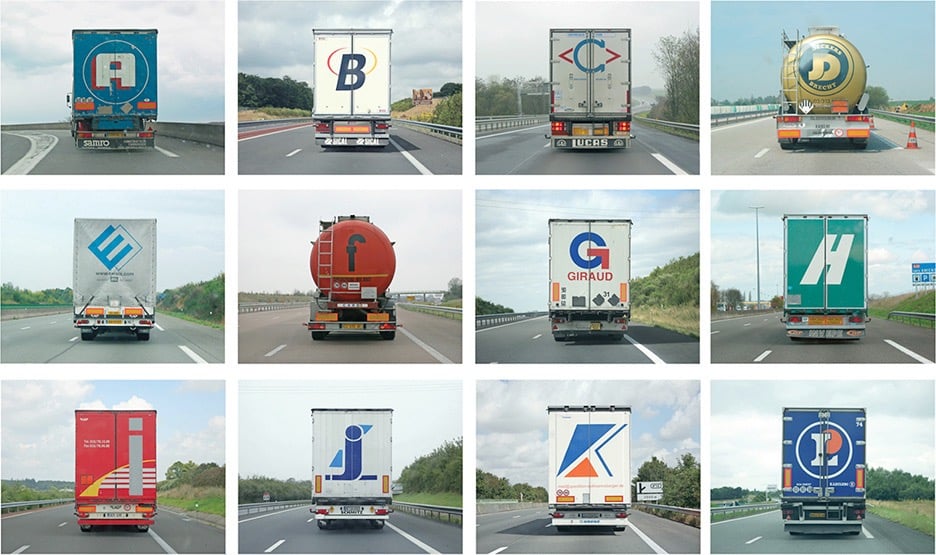
Over a period of four years and after thousands of miles of driving, Eric Tabuchi photographed the backs of semi-trailers with letters of the alphabet on them, eventually compiling all 26 letters. Here’s the first dozen:
(via present & correct)
Famous Authors On Rollercoasters. Emily Dickinson: “Aah aaaaaaah – ah aah aaah – ah aaaah – / Aah aaah aaah ah aah aaaah –”
The Holodomor: When Stalin Starved Ukraine
In the early 1930s, desiring the bountiful wheat harvests of its farmlands to sell to Europe and wanting to subjugate its people, Soviet dictator Joseph Stalin carried out a genocide in Ukraine that killed millions and hid it behind the guise of food shortages. It’s known as the Holodomor.
In Ukraine, it’s become known as “the Holodomor,” meaning “death by starvation.” It was a genocide carried out by a dictator who wanted to keep Ukraine under his control and who would do anything to keep it covered up for decades.
In the 1930s, Soviet leaders under Joseph Stalin engineered a famine that killed millions as they sought to consolidate agricultural power. In Ukraine, they used additional force as they sought to clamp down on a burgeoning Ukrainian national identity. There, at least 4 million died. As hunger spread among residents, Stalin spearheaded a disinformation campaign to hide the truth from other Soviet citizens and the world. So many Ukrainians died that officials had to send people to resettle the area, setting off demographic shifts that last to this day.
Collecting Bodies in Bucha
The details of the atrocities committed against the people of Bucha, Ukraine by Russian soldiers are more horrifying than language has words for. Luke Mogelson and photographer James Nachtwey are reporting for the New Yorker from Bucha as loved ones and volunteers try to make sense of the destruction. Note: the descriptions and photos in this piece may be disturbing (but IMO, we cannot turn away from this). This is one of the tamer paragraphs:
On the far side of a stretch of railroad tracks, two elderly women had been killed in their house. One lay in the doorway, another in the kitchen. Both were bundled in heavy winter coats. Neighbors said that they had been sisters, both in their seventies. Their small house was filled with hardcover books, and they did not own a television; it was impossible not to imagine their quiet, literary life together before it was annihilated. In the only bedroom, two narrow mattresses were pushed together and covered by a single blanket.
Update: From the NY Times, Bucha’s Month of Terror.
As the Russian advance on Kyiv stalled in the face of fierce resistance, civilians said, the enemy occupation of Bucha slid into a campaign of terror and revenge. When a defeated and demoralized Russian Army finally retreated, it left behind a grim tableau: bodies of dead civilians strewn on streets, in basements or in backyards, many with gunshot wounds to their heads, some with their hands tied behind their backs.
We Have the Tools to Fix the Climate. We Just Need to Use Them.
A new video from Kurzgesagt is designed to provide a little hope that humans can figure a way out of the climate crisis, without being overly pollyannish.
And so for many the future looks grim and hopeless. Young people feel particularly anxious and depressed. Instead of looking ahead to a lifetime of opportunity they wonder if they will even have a future or if they should bring kids into this world. It’s an age of doom and hopelessness and giving up seems the only sensible thing to do.
But that’s not true. You are not doomed. Humanity is not doomed.
There’s been progress in the last decade, in terms of economics, technology, policy, and social mores. It’s not happening fast enough to limit warming to 1.5°C, but if progress continues, gains accumulate, people keep pushing, and politicians start to figure out where the momentum is heading, we can get things under control before there’s a global apocalypse.
In fighting the climate crisis, the scale of cities is an advantage. “The growing concentration of people and activities is an opportunity to increase resource efficiency and to decarbonize at scale.”
As VP of Comms For the Newsletter Company, It’s Really Important That I Make Sure Everyone Associates Our Brand With Being a Huge Unaccountable Dipshit. This is pitch perfect.
The Del Monte $20 Bill

Somehow, during the printing process at a US Treasury Department printing facility, this $20 bill got a Del Monte banana sticker affixed to it…and then the seal and serial number was printed over it. The bill, known as the Del Monte Note, was sold at auction in January 2021 for $396,000.
The Museum of Endangered Technology Sounds

The Museum of Endangered Sounds is a soundboard of dozens of sounds from old technologies, from the ICQ message notification (“uh oh!”) to the Windows 95 startup sound to a rotary telephone to a dial-up modem. Suuuuper nostalgic.
See also Conserve the Sound. (via swissmiss)
Yes, But…


I love this series of simple comics that contrast two opposing views of the same situations. (via @thegreaterbombay)
I didn’t know that airliners have been using sustainable fuels (made from waste like used cooking oils) in passenger flights for years. These fuels are refined and burn just like regular jet fuel.
A few things to know before stealing this Porsche 914. “But first, you’ll need to press the gas pedal to the floor exactly four times. Not three. Not five. Four.”
Michelin Star Onions
I don’t know why I thought that chefs at really high-end restaurants cut onions the same way I do at home (except perhaps more carefully), but it turns out that they absolutely do not. The rationale behind the fussiness makes sense: the pieces need to be small enough to “melt away” when you’re making sauces. (via digg)
Aerial Photos of Vast Solar Farms


For his Solar Power Series, photographer Tom Hegen aerially photographed solar power plants in France, Spain, and the US. It’s not an accident that some of these look like flowers and plants — the compact geometry to ideally capture solar power is similar in both instances.
In a single hour, the amount of power from the sun that strikes the Earth is more than the entire world consumes in a year. Having this in mind, renewable energy sources could be the key to combating climate change.
What does transforming towards more sustainable sources of energy look like?
(via colossal)
Saturn’s rings are disappearing. We only have another 300 million years to enjoy them.
There’s No One In That Spider-Man Suit: Superhero Movies and Digital Doubles
If you’ve seen a superhero film in the past 10-15 years, chances are that when you see a character wearing a suit, what you’re seeing is almost 100% computer generated. Sometimes the character on the screen is motion-captured but sometimes it’s completely animated. It’s amazing how much these movies are made like animated movies — they can make so many different kinds of changes (clothes, movements, body positioning) way after filming is completed. (via @tvaziri)
The Pontiac Aztek came with a cooler that GM said could hold twelve 12oz cans. That’s true, but only if you can figure out the very specific way of packing them in there.
After his girlfriend was killed by one, Stéphane Bourgoin made a career out of his obsession with serial killers. But then, some fans on the internet started digging into his story…
Overseen Text Messages


#nyc is photographer Jeff Mermelstein’s collection of photos he’s taken on the streets of NYC of text messages on people’s phone screens. From a review of the book at LensCulture:
At once detached and intimate, we are offered a collection of fragmentary texts that register the daily life events and feelings of a city’s occupants, a raw vox pop assortment of broken and interrupted and incomplete messages. We watch users reading, texting and even editing on their phones. There are texts about break ups, declarations of love, dreams, lusts, illnesses, affairs, abortion, pregnancy, death, sexual proclivities, money, as well as recipes, cooking, dirty shower curtains and roach traps. Some messages remain unfathomable and enigmatic: “The nun said, ‘That’s OK…”
I wonder about the privacy aspect of this, but it’s always fascinating to see how other people communicate.
Unsurprised on many levels that Trump’s Truth Social isn’t working. The big reason: there are no libs to own. It’s like a movie without an antagonist.
Nirvana wanted to work with producer Steve Albini on their third album (In Utero) and he sent them this great letter in response. “I would like to be paid like a plumber: I do the job and you pay me what it’s worth.” (He got the job.)
“Things Have Gotten Less Clear As I Have Gotten Older”
I have been really in my feelings lately — about relationships, work, parenting, the general state of the world, and my own bullshit — and well, this video meditation by Hank Green was really lovely to watch with my emotional thermostat turned up to 11. He called the video “I Don’t Have a Good Title for This Video” and I don’t really have a good way to describe it either, so maybe just take 4 minutes and watch it? (via waxy)
In a study, a group of Fox News viewers were paid to switch to CNN for a month. Lo and behold, some of the conservative brainwashing effects disappeared. “We hope you think of partisan media a bit differently – and more like state media.”
Impressive Drone Fly-Through Video of a New Tesla Factory
This drone fly-through of Tesla’s new factory in Berlin is amazing. I’ve never seen anything quite like this — the drone flies through the robotic machinery in between cycles of stamping out parts and also through the cars as they are being assembled. A uniquely effective how-things-are-made video.
Randall Munroe is coming out with a sequel to What If?, his book of “serious scientific answers to absurd hypothetical questions”. Preorder now, release date is early September.
This Is What It’s Like to Witness a Nuclear Explosion. “Sixty-three years later, what I saw remains etched in my mind, which is why I’m so alarmed that the use of nuclear weapons can be discussed so cavalierly in 2022.”
Recently Unearthed Film Footage of Prince at 11 Years Old
While reviewing some old film footage of a 1970 teacher’s strike stored in the archives of WCCO in Minneapolis, a production manager stumbled across an amazing artifact: a brief interview with Prince. I love when they show the clip to his childhood friends for confirmation that it’s actually him. (via, who else, anil)
Update: The NY Times did a piece on the discovery of the video.
Short as the interview is, it gives context to the causes Prince would later support, such as public education, labor rights and fair compensation for artists, said Elliott H. Powell, a professor of American Studies at the University of Minnesota who teaches a course on Prince.
The interview with the young Prince was conducted in north Minneapolis, a predominantly Black part of the city where young activists led uprisings in the 1960s protesting police brutality, the harassment of young Black people in white-owned businesses, and commercial development that was decimating the neighborhood, Professor Powell said.
“Prince is growing up in that environment and seeing the impact of Black youth activists,” he said.

Socials & More