



The 25 greatest achievements in dumb internet video, e.g. Strong Bad, Downfall parodies, keyboard cat, etc.

Advertise here with Carbon Ads
This site is made possible by member support. 💞
Big thanks to Arcustech for hosting the site and offering amazing tech support.
When you buy through links on kottke.org, I may earn an affiliate commission. Thanks for supporting the site!
kottke.org. home of fine hypertext products since 1998.
Beloved by 86.47% of the web.
Entries for June 2021
In a recent trial, the use of virus-blocking bacteria in mosquito populations reduced the incidence of dengue fever by 77%. Between stuff like this, mRNA vaccines, and CRISPR, we’re set to make major progress against deadly disease in the next 10 years.
Ed Yong of The Atlantic won a well-deserved Pulitzer Prize for his outstanding coverage of the pandemic. Cheers, @edyong209!
Soothing Shutter Sounds of 18 Cameras
Photographer Sails Chong recorded something we don’t hear much of these days: the sounds of camera shutters. Accompanied by a song by Arcade Fire from the Her soundtrack, Chong presents the shutter sounds of 18 different cameras, from 35mm all the way up to large format cameras. Interestingly, the lineup does not include the iconic Leica shutter sound — “a photograph sounds like a kiss”. (thx, david)
I love a good errand hang. “The errand hang dances in the sweet vulnerability that comes from the everyday.”
The Shortcut. Once begun, it’s difficult not to watch this all the way through.
Yo-Yo Ma Answers Questions About the Cello
As part of the Tech Support series, Wired had Yo-Yo Ma answer some questions about the cello and music sent in by Twitter users. What I like about this is that no critic or professional interviewer would ask these questions (they are “bad” interview questions) and yet Ma answers them all generously and thoughtfully. It reminds me a little bit of when Vogue trained an AI program to interview Billie Eilish:
What I really loved hearing Billie say was that human interviewers often ask the same questions over and over, and she appreciated that the AI questions don’t have an agenda in the same way, they’re not trying to get anything from her.
Perhaps with interesting subjects who are game, having “good” interview questions maybe isn’t that important, particularly if they are repeated queried about the same topics in every interview.
Give Yourself Permission to be Creative
At TED2020, Ethan Hawke gave a remote talk about the benefits of being creative. As someone who often struggles to find meaning in whatever it is I do here, this bit was especially good to hear:
Do you think human creativity matters? Well, hmm. Most people don’t spend a lot of time thinking about poetry. Right? They have a life to live, and they’re not really that concerned with Allen Ginsberg’s poems or anybody’s poems, until their father dies, they go to a funeral, you lose a child, somebody breaks your heart, they don’t love you anymore, and all of a sudden, you’re desperate for making sense out of this life, and, “Has anybody ever felt this bad before? How did they come out of this cloud?”
Or the inverse — something great. You meet somebody and your heart explodes. You love them so much, you can’t even see straight. You know, you’re dizzy. “Did anybody feel like this before? What is happening to me?” And that’s when art’s not a luxury, it’s actually sustenance. We need it.
(via swissmiss)
For the First Time Since Early 2020…
For many of us in the US and other parts of the world, with Covid-19 on the decline because of vaccinations, the last month or two has seen people getting back into the world for the first time since the pandemic began in early 2020. XKCD’s Randall Munroe plotted out some of these experiences on a scale from “normal” to “alarming”:

Transformation of a Bonsai Tree Over 12 Months
Ever since I learned about bonsai trees as a kid, I’ve been fascinated with them. In my 20s, my girlfriend bought me a juniper bonsai for my birthday. I was really excited to see what I could do with it, but it was dead in a month and a half, forever dimming my enthusiasm for ever practicing bonsai myself. But I still love observing the process and seeing the results, so I’ve enjoyed watching Bucky Barnes’1 Bonsai Releaf videos. His latest video (above) documents the year-long transformation of a Japanese larch tree he purchased for £30 into something that looks like it’s been majestically clinging to a windswept cliff for hundreds of years.
Observation, healing, experimentation, growth, making irreversible choices — so many lovely little themes, lessons, and moments in this video. At one point, well into the process, he clips off most of a long branch and I exclaimed “Oh my God!” out loud. I guess I still need to work on letting go of attachments.
A portable planetarium owner shares about how they talk to people who believe the Earth is flat. “These people fold pretty quickly if you can answer 3 questions in a row. They are looking for something to believe, they want to feel smart.”
Nikola Jokic, Unlikely NBA MVP
To the casual basketball fan, Nikola Jokic seems like an unlikely pick for NBA MVP. Outwardly, his game resembles middle-aged-guy-at-the-rec-center — “god-tier old man game” is how Gene Demby put it — but this video makes a good case that Jokic is “revolutionizing the center position”, “the best offensive passing big man ever”, and possibly even “the best offensive center in NBA history”.
The Keystone XL Pipeline Is Officially Dead. “We were not willing to sacrifice our water or safety for the financial benefit of a trans-national corporation.”
The 30 Greatest Action Movies of All Time. Great to see personal favorite Drunken Master II on here.
The Circles of Friendship
This chart caught my eye yesterday:
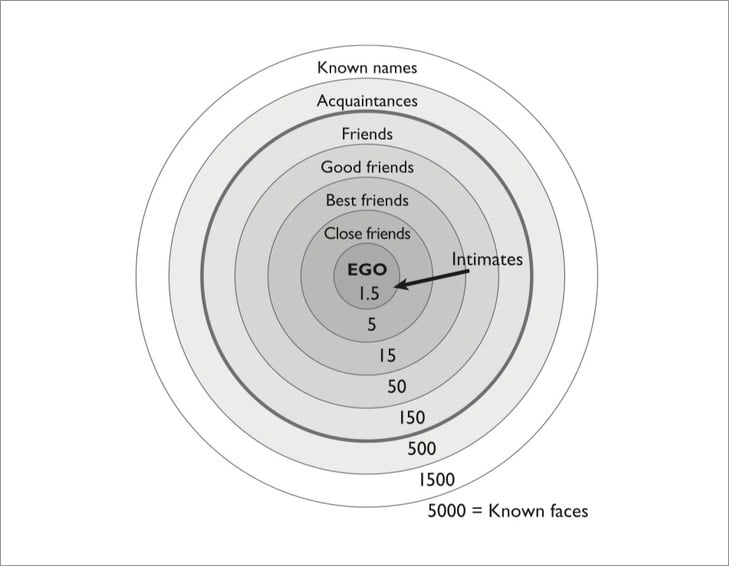
It’s from Robin Dunbar’s recent book, Friends: Understanding the Power of Our Most Important Relationships. You might recall the author’s name from his concept of Dunbar’s number:1 that on average people can maintain about 150 friendships with others, a limit that is determined by human brain size and function. The chart is a more detailed version of the concept: it shows, roughly, the number of people we can have meaningful relationships with at various levels of intimacy. Dunbar explains in this Atlantic interview:
The innermost layer of 1.5 is [the most intimate]; clearly that has to do with your romantic relationships. The next layer of five is your shoulders-to-cry-on friendships. They are the ones who will drop everything to support us when our world falls apart. The 15 layer includes the previous five, and your core social partners. They are our main social companions, so they provide the context for having fun times. They also provide the main circle for exchange of child care. We trust them enough to leave our children with them. The next layer up, at 50, is your big-weekend-barbecue people. And the 150 layer is your weddings and funerals group who would come to your once-in-a-lifetime event.
The layers come about primarily because the time we have for social interaction is not infinite. You have to decide how to invest that time, bearing in mind that the strength of relationships is directly correlated with how much time and effort we give them.
The interview is interesting throughout — there’s evidence that introverts have fewer connections in each layer than extroverts, your numbers go down as you get older when relationship become harder to replace, “falling in love will cost you two friendships”, and how much time is necessary to form a friendship:
It takes about 200 hours of investment in the space of a few months to move a stranger into being a good friend. This fits with our data, which suggests that close friends are very expensive in terms of time investment to maintain. I think the figures are a guideline rather than precise. It just means friendships require work.
I’ve been thinking a lot about friendship over the many months of the pandemic — about how my friend circles changed during that time and what friendship actually means to me. It is not much of an exaggeration to say that my close friends saved my life during the past year — there were 3 or 4 people that I leaned heavily on (and they on me) for advice, sanity checks, shoulder-crying, going on long walks, emotional support, grieving, getting unfunked, relationship advice, and generally feeling like a normal & whole person in the midst of an unprecedentedly awful situation. We talked and cried and raged about anything and everything. We went deep and got intimate. If there’s a silver lining to the pandemic for me, it’s the development and deepening of these incredible friendships. ♥
Fun note on this… When I searched to find the Wikipedia page for Dunbar’s number, Google helpfully(?) gave me the phone number for a local physical therapist named Dunbar.↩
America’s Individualism and Our Poor Pandemic Response
Ed Yong writing in The Atlantic, Individualism Is Still Sabotaging the Pandemic Response:
From its founding, the United States has cultivated a national mythos around the capacity of individuals to pull themselves up by their bootstraps, ostensibly by their own merits. This particular strain of individualism, which valorizes independence and prizes personal freedom, transcends administrations. It has also repeatedly hamstrung America’s pandemic response. It explains why the U.S. focused so intensely on preserving its hospital capacity instead of on measures that would have saved people from even needing a hospital. It explains why so many Americans refused to act for the collective good, whether by masking up or isolating themselves. And it explains why the CDC, despite being the nation’s top public-health agency, issued guidelines that focused on the freedoms that vaccinated people might enjoy. The move signaled to people with the newfound privilege of immunity that they were liberated from the pandemic’s collective problem. It also hinted to those who were still vulnerable that their challenges are now theirs alone and, worse still, that their lingering risk was somehow their fault. (“If you’re not vaccinated, that, again, is taking your responsibility for your own health into your own hands,” Walensky said.)
The pandemic demonstrated, in plain and easily understandable numbers of Covid deaths, that America is a place where the swift leave the stragglers to the wolves. I hope against hope that’ll change for the better in the future.
Simone Biles, Mesmerizing in Slow Motion
Gymnast Simone Biles won her 7th US Gymnastics Championship this past weekend, further cementing her status as the world’s best gymnast and one of the most dominant athletes of all time in any sport. In her floor exercise routine on the first day of the competition, Biles absolutely nailed a triple double — that’s three twists while doing two backflips. Timothy Burke took the footage and slowed it down so that we can see exactly what’s going on in the air. And, Jesus, I was NOT prepared for what I saw. The two handsprings that set up the final move are beautiful slowed down, leisurely even. But then Biles launches herself impossibly high into the air — like absurdly and spectacularly high — and starts twisting and flipping at a speed that seems fast even for slow motion. And the landing — it’s like she was standing there all along, waiting for the rest of her spirit to join her. Watching the routine at regular speed makes you appreciate the move even more.
In reaction to this move, NBA head coach Stan Van Gundy, who has seen his fair share of elite athletes doing amazing things over the years, exclaimed: “How is that even humanly possible?” As if to preemptively answer him and everyone else watching, the sparkly leotard that Biles wore during her routine had a picture of a goat sown into it because she is the GOAT.

See also Who Could Jump Higher on a Trampoline, LeBron James or Simone Biles? (via the kid should see this)
Update: Physicist David Young analyzes Biles’ triple-double:
Assuming her rotation rates around each axis remain constant, to get three full flips in would require an extra 0.65 seconds, which requires a launch speed of 22.6 miles per hour, all other things being equal. This is not possible, even if we assume her max launch speed is 18 miles per hour, which is apparently her top sprinting speed.
However, if she could do three full flips, she would also be able to get in one-and-a-half more twists at her current rotation rate! What would this even be called?! What might be more likely would be to try to gain an extra half twist so that she would take off facing left and land facing right, still only completing two full flips.
(thx, donny)
Edo Period Shadow Puppetry Woodblock Prints


Circa 1842, ukiyo-e artist Utagawa Hiroshige released an 11-print series revealing the secrets of shadow puppetry performances. From the description of one of these woodblock prints held in the collection at The Minneapolis Institute of Art:
As comic entertainment, shadow performances were among the many diversions, including music and dance, offered at teahouse parties during the Edo period. In the eleven-print series Improvised Shadow Performances, Hiroshige depicted figures making shadows on shōji screens by contorting their bodies. The images demonstrate how to create ingenious shadows and could easily have been used as a how-to guide for clever shadow making.
You can find more of Hiroshige’s shadow prints at Ukiyo-e.org. (via colossal)
Adam Gopnik on the return of spending time together in public & private spaces after the worst of the pandemic. “What we call culture is basically the act of sharing air with strangers.”
Bo Burnham Welcomes You to the Internet
I have been hearing nothing but good things, and lots of them, about comedian Bo Burnham’s new show on Netflix called Inside. Burnham did the entire thing by himself in his house during the pandemic — writing, music, cinematography, editing, etc. In this clip from the show, Burnham performs a song called “Welcome to the Internet”. (via waxy)
Who Are You, Charlie Brown?
Who Are You, Charlie Brown? is a forthcoming feature-length documentary about the Peanuts comic strip and its creator, Charles Schulz.
Honoring the “everyman” creator, Charles “Sparky” Schulz, “Who Are You, Charlie Brown?” celebrates the significance and global multi-generational popularity of the comic strip and its timeless artistry and design to profile the man whose simple characters would touch the lives of millions through the decades and become beloved cultural icons. Featuring interviews with Jean Schulz, the widow of Charles Schulz, along with Drew Barrymore, Al Roker, Kevin Smith, Billie Jean King, Paul Feig, Ira Glass, Noah Schnapp, Miya Cech, Keith L. Williams, Chip Kidd, Lynn Johnston, Robb Armstrong and more, the documentary interweaves a new animated story that follows Charlie Brown on a quest to discover himself.
Narrated by Lupita Nyong’o, the film premieres on Apple TV+ on June 25.
England fans are booing players taking the knee in solidarity against racism in soccer. This was the most disheartening part about fans returning to stadiums in the Premier League – hearing boos as players knelt.
Germany Came to Terms with Its Nazi Past. Why Can’t America Do the Same with Slavery?
For the Washington Post, Michele Norris wonders what it will take for the US to finally and fully acknowledge its history of slavery.
America experienced 246 years of slavery before it was officially ended with the passage of the 13th Amendment. That was followed by decades of legal segregation and oppression under Jim Crow, followed by a period of willful blindness and denial. A tourist from a foreign land might well conclude that the Confederacy had actually won the Civil War, based on the number of monuments, buildings and boulevards still named for heroes of its defeated army. The real truth of our shared history was a casualty of that war and, like any wound left untended, the results can be catastrophic.
A full accounting of slavery is one of terror and trauma, and for decades the natural inclination was to ask, why would anyone want to claim that history? But at a moment when the United States is dangerously divided, when we are having bitter and overdue conversations about policing, inequality and voting rights, when marauders fueled by white-nationalist rhetoric can overwhelm the Capitol, proudly waving the Confederate battle flag, the more important question is this: What happens if we don’t?
She uses Germany’s remembrance and examination of Nazism and the Holocaust as an example of a country that has properly faced up to its terrible past in order to move fully forward.
Vergangenheitsaufarbeitung refers to Germany’s efforts to interrogate the horrors of the Holocaust and the rise of Nazism. It has been a decades-long exercise, beginning in the 1960s, to examine, analyze and ultimately learn to live with an evil chapter through monuments, teachings, art, architecture, protocols and public policy. The country looks at its Nazi past by consistently, almost obsessively, memorializing the victims of that murderous era, so much so that it is now a central feature of the nation’s cultural landscape. The ethos of this campaign is “never forget.”
I visited Germany back in 2018 and its efforts to engage with past horrors were quite noticeable and stood in stark contrast to American activity along similar lines.
In particular, as a nation the US has never properly come to terms with the horrors it inflicted on African Americans and Native Americans. We build monuments to Confederate soldiers but very few to the millions enslaved and murdered. Our country committed genocide against native peoples, herded them onto reservations like cattle, and we’re still denying them the right to vote.
As Norris convincingly argues, “it is long past time to face where truth can take us”.
There’s going to be an annular solar eclipse on June 10 that will be partially visible in the US, particularly on the East Coast. “From New York City, the eclipse magnitude will reach a whopping 0.80 (80%).”
N.K. Jemisin’s The Broken Earth trilogy will be adapted into something (movie series? TV series?) by TriStar & Jemisin herself.
Great profile of Mare of Easttown’s Kate Winslet. “But she is not Daniel Day-Winslet; she is said to be fun once the shooting wraps for the day.”
The Mistake Waltz
This is a 3-minute clip of The Concert (or The Perils of Everybody) by choreographer Jerome Robbins, in which the dancers are intentionally, and comically, out of sync. You can see why it’s colloquially called the Mistake Waltz. Open Culture’s Ayun Halliday has collected several more of these performances in this post.
It must be incredibly hard for dancers to execute this piece, to deliberately perform out of step with the music and their fellow performers after a lifetime of practice & performance designed to drill the opposite instinct to them. Bravo!
YES! A prequel to Master and Commander: The Far Side of the World is in the works. Rewatched M&C during the pandemic and it’s a masterpiece.
Roadrunner: A Film About Anthony Bourdain
Filmmaker Morgan Neville (who did the Fred Rogers doc Won’t You Be My Neighbor?) has directed a documentary about Anthony Bourdain called Roadrunner that opens in theaters on July 16.
It’s not where you go. It’s what you leave behind… Chef, writer, adventurer, provocateur: Anthony Bourdain lived his life unabashedly. Roadrunner: A Film About Anthony Bourdain is an intimate, behind-the-scenes look at how an anonymous chef became a world-renowned cultural icon. From Academy Award®-winning filmmaker Morgan Neville (20 Feet From Stardom, Won’t You Be My Neighbor?), this unflinching look at Bourdain reverberates with his presence, in his own voice and in the way he indelibly impacted the world around him.
This trailer makes me want to buy a movie ticket — and about 10 plane tickets. So looking forward to this. I need more unabashed living in my life.
Socials & More