


Video of the closed Verrazano Bridge oscillating in high winds. Don’t miss the musical tune played by the bridge as it flexes – it sounds like a track from the score of Christopher Nolan’s next film.

Advertise here with Carbon Ads
This site is made possible by member support. 💞
Big thanks to Arcustech for hosting the site and offering amazing tech support.
When you buy through links on kottke.org, I may earn an affiliate commission. Thanks for supporting the site!
kottke.org. home of fine hypertext products since 1998.
Beloved by 86.47% of the web.
Entries for December 2020
How Children Took the Smallpox Vaccine Around the World
With the first approved Covid-19 vaccines set to roll out in the US soon, some of the focus has shifted to how the vaccine will be distributed and its equitable allocation. Part of the distribution logistics puzzle is making sure there are enough glass vials to hold and transport the vaccine around the nation to those waiting to be vaccinated. For the New Yorker, Christopher Payne took some photos of two Corning factories that are manufacturing vials as fast as they can.
But back in the early 19th century, for a colonial empire dealing with overseas smallpox epidemics, glass vials were not an option. Smallpox vaccination at that time was most reliably accomplished by transferring material from cowpox blisters on one person (or cow) to another person. The freshly inoculated person got a little sick but later proved to be immune to the much deadlier smallpox. So when Spain’s Royal Philanthropic Vaccine Expedition set sail in 1803 to inoculate the inhabitants of their overseas colonies for smallpox, they used the bodies of human beings to transport the vaccine. To be more specific, they used “twenty-two orphan boys, ages three to nine”.1
And so it was that, “in the era before refrigeration, freeze-dried vaccines, and jet aircraft,” writes medical historian John Bowers, “the successful circumnavigation of the globe with the vaccine…rested on a single medium — little boys.” During the long crossing, approximately twenty-two orphans who had not previously contracted smallpox or cowpox were “vaccinated in pairs every ninth or tenth day,” via arm-to-arm inoculation (taking lymph from an unbroken pustule on a recently vaccinated boy and introducing it under the skin of another). This created a vaccine chain — the vaccine remained active and viable for the entire journey.
The three-year expedition was success and an early & effective example of philanthropic healthcare, but you also have to note here that the reason the Americas were ravaged by smallpox was because Spain brought it there in the first place.
Update: In The Atlantic, Sam Kean provides some more detail on the vaccination effort.
Given the era, it’s likely that no one asked the orphans whether they wanted to participate — and some seemed too young to consent anyway. They’d been abandoned by their parents, were living in institutions, and had no power to resist. But the Spanish king, Carlos IV, decided to make them a few promises: They would be stuffed with food on the voyage over to make sure they looked hearty and hale upon arrival. After all, no one would want lymph from the arm of a sickly child. Appearance mattered. And they’d get a free education in the colonies, plus the chance at a new life there with an adoptive family. It was a far better shake than they’d get in Spain.
The article describes these children as “orphaned” but I wonder if it’s not more accurate to describe them as “enslaved”. Surely these kids didn’t have a real choice in whether they wanted to be infected with cowpox and carried overseas in a cramped ship.↩
If @kottke readers have been wondering where @tcarmody went last year, he explains in a long, brutally honest newsletter entry. “Stick with me a little longer, and I think we can make this work.”
Japanese businesses that last for hundreds of years (like a 1020-year-old mochi shop) may hold some lessons on how to build a resilient business. “Each generation is like a runner in a relay race. What’s important is passing the baton.”
Repurposing WWII-era posters warning against sexually transmitted diseases for the Covid-19 era. “Covid can be cured. But there’s no medicine for regret.”
What Ancient Egyptian Sounded Like (and How We Know)
For most of us, ancient Egyptian is a highly visual language represented by the familiar hieroglyphs left behind on monuments, papyrus documents, and even sarcophagi. But of course it was a spoken language as well…and linguists even have a good idea of what it sounded like. As NativLang’s Josh Rudder explains in this video, by studying the language family that ancient Egyptian descended from, the languages that evolved from it (like Coptic), and languages it traded words with, researchers have been able to determine how many ancient Egyptian words were pronounced.
For more, you can check out Rudder’s extensive list of sources, notes, and quotes related to the video. (via open culture)
The Rapidly Falling Cost of Solar Energy Visualized
Check out this graph from Our World in Data of the price of electricity from new power plants. In 2009, solar was the most expensive energy source and in 2019 it’s the cheapest.
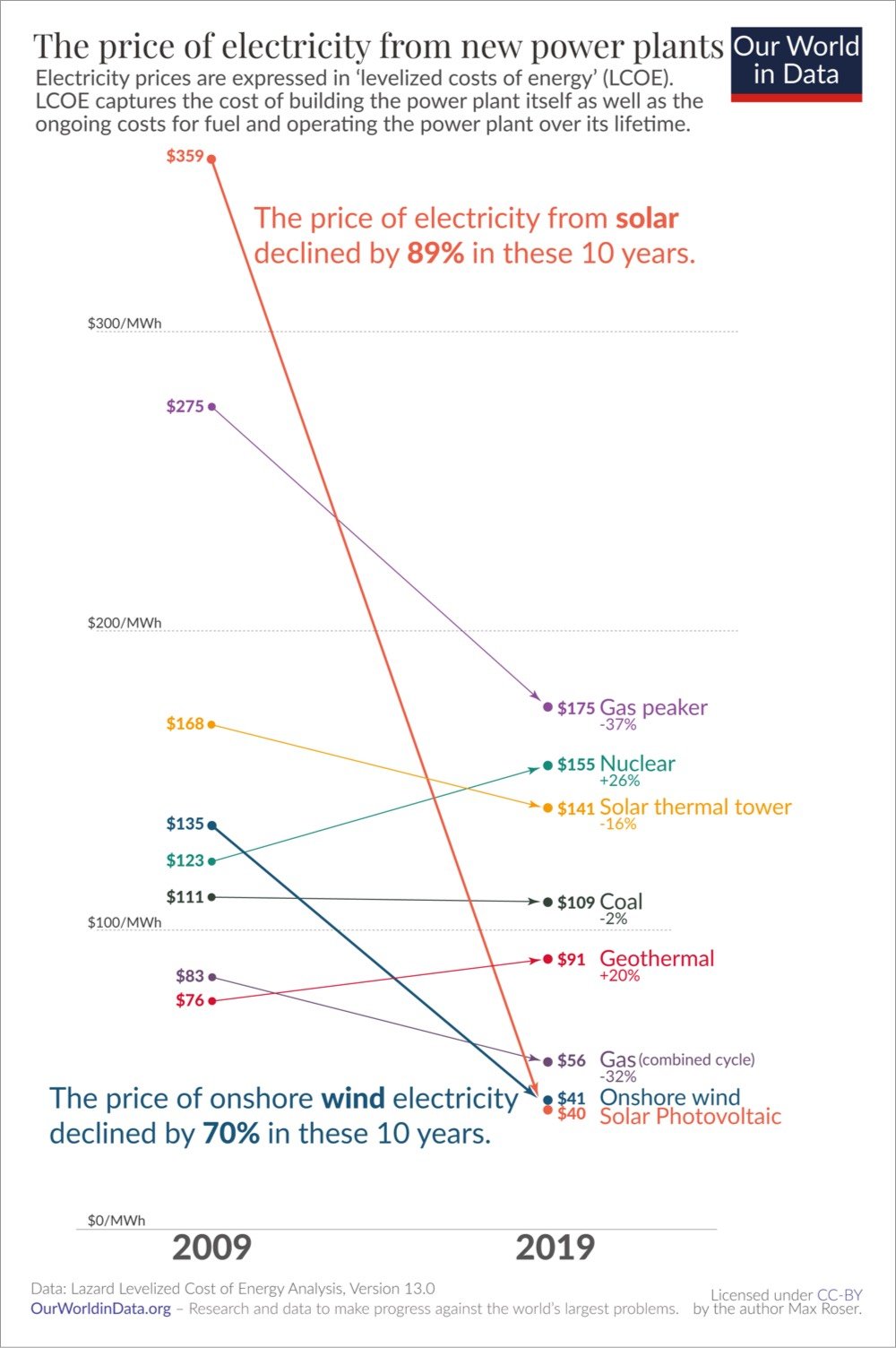
Electricity from utility-scale solar photovoltaics cost $359 per MWh in 2009. Within just one decade the price declined by 89% and the relative price flipped: the electricity price that you need to charge to break even with the new average coal plant is now much higher than what you can offer your customers when you build a wind or solar plant.
It’s hard to overstate what a rare achievement these rapid price changes represent. Imagine if some other good had fallen in price as rapidly as renewable electricity: Imagine you’d found a great place to live back in 2009 and at the time you thought it’d be worth paying $3590 in rent for it. If housing had then seen the price decline that we’ve seen for solar it would have meant that by 2019 you’d pay just $400 for the same place.
The rest of the page is worth a read as well. One reason why the cost of solar is falling so quickly is that the technology is following a similar exponential curve to computer chips, which provide more speed and power every year for less money, an observation called Wright’s Law:
If you want to know what the future looks like one of the most useful questions to ask is which technologies follow Wright’s Law and which do not.
Most technologies obviously do not follow Wright’s Law — the prices of bicycles, fridges, or coal power plants do not decline exponentially as we produce more of them. But those which do follow Wright’s Law — like computers, solar PV, and batteries — are the ones to look out for. They might initially only be found in very niche applications, but a few decades later they are everywhere.
If you are unaware that technology follows Wright’s Law you can get your predictions very wrong. At the dawn of the computer age in 1943 IBM president Thomas Watson famously said “I think there is a world market for maybe five computers.” At the price point of computers at the time that was perhaps perfectly true, but what he didn’t foresee was how rapidly the price of computers would fall. From its initial niche when there was perhaps truly only demand for five computers they expanded to more and more applications and the virtuous cycle meant that the price of computers declined further and further. The exponential progress of computers expanded their use from a tiny niche to the defining technology of our time.
Solar modules are on the same trajectory, as we’ve seen before. At the price of solar modules in the 1950s it would have sounded quite reasonable to say, “I think there is a world market for maybe five solar modules.” But as a prediction for the future this statement too would have been ridiculously wrong.
From the NY Times, The 25 Greatest Actors of the 21st Century (So Far), including Michael B. Jordan, Saoirse Ronan, Viola Davis, Keanu Reeves, and Daniel Day-Lewis. Would love to see a companion list of 25 obvious omissions.
Paul Ford interprets the Salesforce press release about the company’s purchase of Slack. “The raw hot synergy coming off this paragraph could merge lead into gold.”
I raised my kids on Pixar – and it has ruined classic cinema for them. “The 13-year-old’s counterpoint, incidentally, is that the kids are OK and it is adults who have been ruined by Game of Thrones.”
Science Gave us a Vaccine. Now to Turn That Into Vaccinations…
In an incredible effort, science has provided the world with what looks like an incredibly effective vaccine for Covid-19. For Stat, Helen Braswell writes about the challenges of turning that vaccine into vaccinations. In the US, despite heroic work from individuals and individual groups, our public health system has proved unequal to the challenge of addressing the pandemic, and we’re now turning, in part, to that system to distribute and administer the vaccines, as well as to educate the public and drum up support for vaccination. The people that we’re counting on are public officials and healthcare workers worn out from what is essentially one 9-month-long wave of illness, hospitalizations, and death across the country. Misinformation and skepticism of science and government has sowed “justified distrust” about vaccines in many people:
Concern about the vaccines, however, cuts across ethnic and socioeconomic groups. President Trump’s overt efforts to pressure the FDA to issue EUAs before the Nov. 3 election — before the vaccine trials were finished — has deepened the sense of unease. The CDC’s early pandemic testing fiasco, coupled with its sidelining by the Trump administration, has eroded its standing as a trusted source of information.
Alison Buttenheim, an associate professor of nursing and health policy at the University of Pennsylvania, refers to the current situation as a perfect storm of “justified distrust.”
“People who don’t think twice about vaccinating their kids totally on time, who get their flu shot every year, are in the sort of, ‘Hmmm. Might wait six months on this one,’” Buttenheim, who works on vaccine acceptance, told STAT. “I’ve heard people say, ‘I’ll get the European one,’” she said, adding other people have said they would get vaccinated after Anthony Fauci, director of the National Institute of Allergy and Infectious Diseases, gets vaccinated.
And it’s not just the general public. A recent survey of 2,000 doctors and nurses in New Jersey found that 60% of doctors planned to take a Covid vaccine, but only 40% of nurses intended to, Health Commissioner Judith Persichilli said in a recent “60 Minutes” segment about Operation Warp Speed.
Fauci, along with other respected public health officials and workers, should get vaccinated live on CNN. Stream it on YouTube and Twitch. It won’t convert the anti-vax, anti-mask, QAnon wingnuts (nothing will) but if you can at least get healthcare workers and at-risk folks on board, it would be time well spent.
But that’s only one small piece of the puzzle. Braswell’s piece is long and comprehensive look at the challenges regarding the Covid-19 vaccines and is worth reading all the way through.
Detailed Forensic Reconstruction of the Beirut Port Explosions
On August 4, 2020, materials stored in a warehouse in Beirut, Lebanon caught on fire and then exploded multiple times. More than 200 people were killed, 6,500 injured, and around 300,000 residents were left homeless. Using photos and videos shot of the incident as well as other materials, a company called Forensic Architecture built a 3D model of the warehouse (inside and out), the fires, and the explosions. They cleverly used the unique second-to-second shape of the smoke plumes to sync up various bits of video shot from different vantage points.
We collected and examined images and videos taken by witnesses of the blast and shared on different platforms online. Using details about the smoke, fires, and explosions, we were able to geolocate each piece of footage and calculate the camera’s cone of vision. We places the cameras in the open source 3D model of the city , which we had adjusted to match the necessary precision. This helped us to identify the precise location of the source of the smoke plume within Warehouse 12 in each frame of each footage.
It’s a fascinating analysis. After going through more than 9 minutes of explanation of what they learned about the placement of materials (including highly explosive ammonium nitrate, tires, and fireworks) inside the warehouse from smoke colors, interior videos, and warehouse manifests, the narrator says simply:
From an engineering perspective, this is the spacial layout of a make-shift bomb on the scale of a warehouse, awaiting detonation.
The video is also available in Arabic. They’ve made the 3D files of the warehouse, the smoke plumes, and the port — as well as the source media used in their analysis — freely available for download on GitHub. (thx to several people who sent this in)
How Your COVID-Flooded Hospital Will Triage. In California: “Doctors recommended not to try saving those already dying.”
Syllabus for a Harvard class on Transgender Rights and the Law. “How does American law treat transgender, genderfluid, nonbinary, agender, and gender-nonconforming people?”
Stan Lee: “Fuck” Is the “Most Useful Word in the English Language”
This is a lovely little animated video made from a recording of Stan Lee where he declares that the f-word is “probable the most useful word in the English language”. I found this via Josh Jones’ post at Open Culture, who shares some more Stan Lee tidbits.
Learn Some Black American Sign Language
After a video Nakia Smith did with her grandfather went viral, Netflix asked her to explain what Black American Sign Language is, how it came about, and how it differs from American Sign Language.
Black American Sign Language is a dialect of American Sign Language. It’s still a language. It was developed by Black deaf people in the 1800s and 1900s during segregation. For reference, the first American school for the deaf was created in 1817, but only started admitting Black students in 1952. So as a result, Black communities had a different means of language socialization and BASL was born.
Smith demonstrates a few BASL signs that differ from ASL signs and you can see more of those differences in the video w/ her grandfather, who is also deaf.
For more information, you can check out Smith’s TikTok, Wikipedia, and a documentary film called Signing Black in America.
Update: There was also a book about BASL published this year: The Hidden Treasure of Black ASL (Bookshop.org). The book includes 10 companion videos on YouTube.
“52 Things I Learned in 2020”
Every year around this time, Tom Whitwell shares a list of 52 things he’s learned over the course of the year, complete with references so you can drill down into each one. Here’s 2020’s version — fascinating as usual. A few favorites:
3. The hold music you hear when you phone Octopus Energy is personalised to your customer account: it’s a number one record from the year you were 14. [Clem Cowton]
18. 10% of the GDP of Nepal comes from people climbing Mount Everest. [Zachary Crockett]
30. In Warsaw’s Gruba Kaśka water plant there are eight clams with sensors attached to their shells. If the clams close because they don’t like the taste of the water, the city’s supply is automatically shut off. [Judita K]
44. A micromort is a one-in-a-million chance of death. Just being alive is about 24 micromorts per day, skydiving is 8 micromorts per jump. [Matt Webb]
52. British clowns register their unique makeup patterns by having them hand painted onto chicken eggs. The eggs are then stored either at the Holy Trinity Church in Dalston or at Wookey Hole caves in Somerset. [Dave Fagundes & Aaron Perzanowski]
You can check out the rest here.
Japan’s govt is subsidizing 80-100% of wages due to Covid-19. Norway: up to 90%. Italy: 80%. The US: 0%. We’re killing people, destroying businesses, and bankrupting folks because, god forbid, we can’t possibly just give people money!
Vanity Fair Interviews Billie Eilish for a Fourth Consecutive Year
For the fourth year in a row, Vanity Fair interviewed teen pop star Billie Eilish on where she is in her life, what she’s learned, where she sees herself in the future, how her work is progressing, and how her answers from previous years hold up. (Past interviews: 2019, 2018.) This year is obviously different because of the pandemic and hits differently because of it.
I still marvel that Vanity Fair embarked on this project with this particular person. They could have chosen any number of up-and-coming 2017 pop singer/songwriters and they got lucky with the one who went supernova and won multiple Grammys.

Socials & More