
Tales of wedding photographers in the time of Covid. “I’ve been in hotel ballrooms inside and it’s been packed like sardines and everyone’s having a great time. No one’s wearing masks.”

Advertise here with Carbon Ads
This site is made possible by member support. 💞
Big thanks to Arcustech for hosting the site and offering amazing tech support.
When you buy through links on kottke.org, I may earn an affiliate commission. Thanks for supporting the site!
kottke.org. home of fine hypertext products since 1998.
Beloved by 86.47% of the web.
Entries for December 2020
Unsettling Photographs


Some unsettling/weird/funny photos from @thundergirl_xtal on Instagram. They have a separate account just for nails/hands. (via swissmiss)
A division of the CDC is developing standards for face mask filtration effectiveness. Great, but where was this in April or May?
Virus levels are high in the US so gathering is dangerous right now. But with effective vaccines arriving and treatment improving, there is genuine hope. So, a suggestion from @zeynep: hold off on gatherings for a few months to keep everyone safe.
The Millennium Camera, a Pinhole Camera with a Thousand-Year Exposure Time

Critic, artist, and experimental philosopher Jonathon Keats has installed pinhole cameras in three locations around the United States — Amherst College, Arizona State University, and Lake Tahoe — that are designed to take 1000-year-long exposures of their surroundings.
I don’t plan to be here in a thousand years, but for those of you who are, what you’ll see if all goes well is not an image of a single landscape, but rather an image of change within that landscape over that very long period of time. How is that possible? To address the question at a technical level, I built the camera based on archaeological and art-historical research. The casing of the camera is made out of copper. Archaeologists know what happens to copper: it will take on a patina, and the oxidation creates a sort of protective surface that will preserve the integrity of the camera as an object, which is intentionally very simple and very small. The pinhole can’t be allowed to oxidize at all, so that is pierced through a sheet of hardened twenty-four-carat gold, and gold will not corrode. This provides integrity over the next thousand years for the means by which the image is focused.
The image is focused onto the back of the camera, which is not paper in this case. Instead it is oil paint. The pigment that I chose is a paint called rose madder. The madder root has a red color that was very much valued in antiquity, but is the bane of any conservator today. Examples of paintings from the Renaissance show that it’s not very light-fast. It is a fugitive color. And the so-called “inherent vice” of it becomes a virtue in the case of a camera like this, because we are causing it to fade.
A prototype of the camera is pictured above. It will be interesting to see to what extent the final product is averaged out — when you’re dealing with 1000 years, you have to reckon with the motion blur of even seemingly stationary objects. (via @zander)
The interesting/unfortunate thing about Tom Cruise yelling at his Mission Impossible crew for not following Covid-19 guidelines is that Cruise’s pictured mask is vented. When he exhales, he unsafely spreads unfiltered air to those around him.
My pal Jessamyn noticed that Vermont’s fleet of snowplows are unnamed, so she’s soliciting some good names on Twitter. So far, I like Bernie Sander, How Now Brown Plow, Maplow Syrup, and Charles Vermontgomery Burns.
How to Self-Rescue If You Fall Through Thin Ice
In this video, Kenton Whitman explains how to survive a fall through ice on a frozen lake or river.
The explanation could have been tighter and more engaging, but it gets really interesting around the 6:40 mark when Whitman ventures out onto some ice and falls through it to demonstrate the self-rescue technique (and he’s not wearing a wetsuit). Watching him relax to mitigate the cold shock response in realtime is spellbinding. His calmness really drives home that if you don’t panic and think clearly, you actually have a lot of time and energy to get yourself out of trouble. From the Four Phases of Cold Water Immersion:
While it varies with water temperature and body mass, it can take 30 minutes or more for most adults to become even mildly hypothermic in ice water. Knowing this is vitally important in a survival situation, since people would be far less likely to panic if they knew that hypothermia would not occur quickly and that they have some time to make good decisions and actions to save themselves.
Oh and don’t miss when Whitman gets back into the water so that you can see him climb out from another camera angle. Don’t try this at home, kids.
This is really fun: Blob Opera. “Play four voices with the help of machine learning.”
Ghosts of Segregation, the Vestigial Architecture of America’s Racism


Ghosts of Segregation is a project by photographer Rich Frishman with the goal of documenting the “the vestiges of America’s racism evident in the built environment, hidden in plain sight: Schools for ‘colored’ children, theatre entrances and restrooms for ‘colored people,’ lynching sites, juke joints, jails, hotels and bus stations.” The top photo above is of a segregation wall in a restaurant in Texas photographed in 2017:
This partition was constructed in the early 20th Century to keep people of different races apart. It is decorated with an original pre-1929 Dr. Pepper logo. At the time of its construction (circa 1906) only Caucasian customers were allowed to sit in the front of the saloon. All Hispanic, Asian and African-American customers had to sit behind the wall. When the saloon was remodeled and re-opened in 2014 the wall, no longer used for its original purpose, was retained as a historical reminder. It has recently been demolished.
The bottom photo shows the “colored entrance” for a movie theater in Texas:
The enigmatic door atop the stairway on the south side of the Texan Theater, long locked and largely overlooked, is the “colored entrance,” a vestige of Jim Crow-era segregation. In Kilgore, Texas, the term “colored” extended to anyone not Caucasian, including Hispanics and the occasional Asian.
Also included in the project are photos of WWII internment camps (where persons of Japanese ancestry were held during WWII, many of them American citizens), the US/Mexico border wall, and the Stonewall Inn in NYC. You can view the photos here as well as a few more in the NY Times.
Debunking false claims about Covid-19 deaths. “A larger share of Americans died in the 1st 9 months of 2020 than in any of past 50 yrs” and (after cancer & heart disease) Covid-19 was the 3rd leading cause of death in the US this year.
The Best Book Cover Designs of 2020


Well, what an unprecedented year that was! *sigh* 2020 is not a great year for ledes, so let’s skip right to the chase: many books were published this year and some of them had great covers. Lit Hub has the best roundup, with a selection of 89 covers chosen by book cover designers. Mark Sinclair’s ten selections for Creative Review are excellent as well. Electric Lit and Book Riot shared their cover picks as well.
I chose a few of my favorites and shared them above. From top to bottom: Zo by Xander Miller designed by Janet Hansen, the UK cover for Night. Sleep. Death. The Stars. by Joyce Carol Oates designed by Jamie Keenan (the US cover for comparison), Anger by Barbara H. Rosenwein designed by Alex Kirby, Uncanny Valley by Anna Wiener designed by Rodrigo Corral, and Verge by Lidia Yuknavitch designed by Rachel Willey. Looking at great work like this always gets my “maybe I should have been a book cover designer” juices flowing…
See also The Best Books of 2020.
Update: Oh good, the annual list from The Casual Optimist is here: Notable Book Covers of 2020. A cover that he highlighted that I particularly liked is from Michael Nylan’s translation of The Art of War by Sun Tzu designed by Jaya Miceli.

The NY Times list of The Best Book Covers of 2020 is out as well.
Sometimes Choreography Involves Goalkeeping**
I’ve featured the work of choreographer Yoann Bourgeois on kottke.org before — his work gets performers moving on rotating stages and dropping onto trampolines. A 2019 performance choreographed by Bourgeois based on an unfinished Mozart piece sort of combines his previous performances, with dancers dropping into a slippery ramp that slides them onto a rotating platform.
As you might expect, getting gravity and centripetal force to play well together requires some experimentation — Bourgeois recently shared a rehearsal blooper where he catches one of his performers before they go whizzing off the stage into the orchestra.
You can watch more behind-the-scenes footage of this performance in this video:
** Goalkeeping definitely involves choreography.
Unendurable Line
For Design Ah by Daihei Shibata, Unendurable Line is a short film about sudden changes due to “thresholds hidden in everyday life”. The choral accompaniment to this is delightful.
See also Shibata’s Unexpected Outcome. If you’re in the US, you can watch 60 full episodes of Design Ah on THIRTEEN.
The Pfizer & Moderna Covid-19 vaccine results indicate that a single dose might be highly effective in curbing infection. Here @zeynep muses about the pros (getting more ppl vaccinated quicker) and cons (not enough data yet) of single dosing.
The Art of Traditional Japanese Wood Joinery
This video is three minutes and nine seconds of pure precision — welcome to the world of Japanese wood joinery. Carpenter Dylan Iwakuni wordlessly demonstrates taking two or more pieces of wood and (improbably, impossibly) making them one. Seriously, I am gobsmacked at how exactly these bits of wood fit together.
If you enjoyed that, you may want to check out another of Iwakuni’s videos, Making the “Impossible Joint”.
(via colossal & the kid should see this)
Beer Can Pinhole Camera Takes Longest Exposure Photograph Ever

This pinhole solargraph, taken using a beer can pinhole camera over a period of eight years and one month, is thought to be the longest exposure image ever made. The photo shows the path of the Sun across the sky over that time period, almost 3000 trails in all. Regina Valkenborgh set the camera up in 2012 and then forgot about it; it was found by someone else this year. Said Valkenborgh of the project:
“It was a stroke of luck that the picture was left untouched, to be saved by David after all these years. I had tried this technique a couple of times at the Observatory before, but the photographs were often ruined by moisture and the photographic paper curled up. I hadn’t intended to capture an exposure for this length of time and to my surprise, it had survived. It could be one of, if not the, longest exposures in existence.”
If you want to make your own solargraph (it doesn’t have to go for 8 years…), check out the instructions here.
Austin Kleon on The Vampire Test, “a simple way to know who you should let in and out of your life”.
For a new project, Roxane Gay is looking for nonfiction essays from emerging writers. Pays $2000/story. Details here.
Recommendation: The Audiobook for Barack Obama’s A Promised Land
I read both of the excerpts from A Promised Land, Barack Obama’s memoir of his time in the White House: I’m Not Yet Ready to Abandon the Possibility of America from The Atlantic and A President Looks Back on His Toughest Fight in the New Yorker. I have also been listening to the audiobook version, read by Obama himself, over the last few days and if you’re at all interested in this book, I would suggest going with the audiobook. Here’s an excerpt of Obama reading the preface (and several more of other parts of the book):
Not that there’s anything wrong with the written version, but the audiobook conveys more context and information. Much of the time, Obama writes like he talks, so listening to him read his own writing is like sitting across the dinner table from him as he tells you about how he became President. You can hear which parts of the book he really cares about and which parts are in there just to bridge gaps. He does impressions — of Desmond Tutu and his Kenyan relatives — and inflects words in other languages in the manner of Alex Trebek. He jokes around and gets serious. You can hear how frustrated he was, and continues to be, with Republican obstructionism. I’m only a few chapters in so far, but it will be interesting to hear his voice when he talks about the aspects of his Presidency that people believe didn’t live up to his lofty goals and visions. You really get the sense when listening to him that, unlike many politicians, he actually cares about helping people — or if you’re cynical, that he’s best-in-class at faking it; either way it’s fascinating to hear and make up your own mind.
You can listen to Obama read A Promised Land at Amazon or Libro.fm.
Susan Orlean on why she reads mostly on the Kindle. Same here. If paper books were the only option, I’d probably end up reading only one book a year, at the beach in July.
Ted Lasso, a Model for the Nurturing Modern Man
Have you watched Ted Lasso? If not, you should — it’s probably my favorite TV thing of 2020. (It’s ok if you don’t care for sports. It’s not about sports.) Maureen Ryan’s excellent review of the series gets at why people are finding it so compelling.
A few weeks ago, I stumbled across this 2016 essay by Nora Samaran, who later expanded it into a slim but transfixing book called Turn This World Inside Out. It addresses a number of persistent questions I’ve had with lucid, thoughtful prose.
As Samaran puts it, “the men I know who are exceptionally nurturing lovers, fathers, coworkers, close friends to their friends, who know how to make people feel safe, have almost no outlets through which to learn or share this hardwon skill with other men…. Meanwhile, the men I know who are kind, goodhearted people, but who are earlier on in growing into their own models for self-love and learning how to comfort and nurture others, have no men to ask. … The answer to all of these difficulties is to openly discuss nurturance: how it looks, how it feels, how men can learn to practice it from the men who already know how.”
Ryan argues that Ted Lasso is an outlet that models the type of nurturing that Samaran is talking about.
Ted Lasso does a lot of things well — I adore the budding friendship between Rebecca and marketing whiz Keeley (Juno Temple) — but one of the things it explores wisely and well is what it looks like when men engage in (sorry for using these dreadful words) nurturing behaviors.
It’s a sprightly, well-constructed, enjoyable comedy about sports, sure, but it’s also about men who — like the many good men I have known (even in Hollywood!) — take responsibility for the example they set, for their emotions and for the actions they take. Ted Lasso will remain deeply valuable into next year and beyond, because it is also about a bunch of very different people who display fulfilling, conscientious confidence and leadership — not the bullying, toxic, arrogant, violent, condescending domination that has, in this country, has too often masqueraded as “leadership” and “confidence.” In evolving and supporting each other through those changes, these characters form friendships and communities that are truly meaningful.
Watching the show and reading this, I can’t help but think of another person who modeled kindness, goodheartedness, and nurturing male behaviors on TV for decades: Fred Rogers. (See, for instance, soaking in a kiddie pool with François Clemmons.) Ted Lasso co-creators & co-stars Jason Sudeikis and Brendan Hunt are right around my age; I’d be shocked if one or both of them didn’t watch a bunch of Mister Rogers’ Neighborhood growing up like I did. The two shows are obviously very different but Rogers’ brand of radical empathy is all over Ted Lasso. As I’ve grown more conscious over the past decade about the type of person I want to be in the world and the type of example I want to set for my kids, Rogers has been a guiding light and I’m happy to add Ted Lasso to the list as well.
Update: I forgot to add: another aspect I appreciate about the show is it demonstrates how you can be competitive without being toxic. Lasso is a very competitive guy who cares about winning, but he goes about it in a constructive way, not a destructive way. It’s the kind of energy their mom and I are always trying to impart to our kids, who are both competitive (albeit in pretty different ways).
See also Building Belonging at Summer Camp.
The first Covid-19 vaccinations in the US were administered this morning in Queens. Only 11 months after the first diagnosed case in the country. What an amazing achievement.
Lego Version of Hokusai’s Iconic The Great Wave off Kanagawa
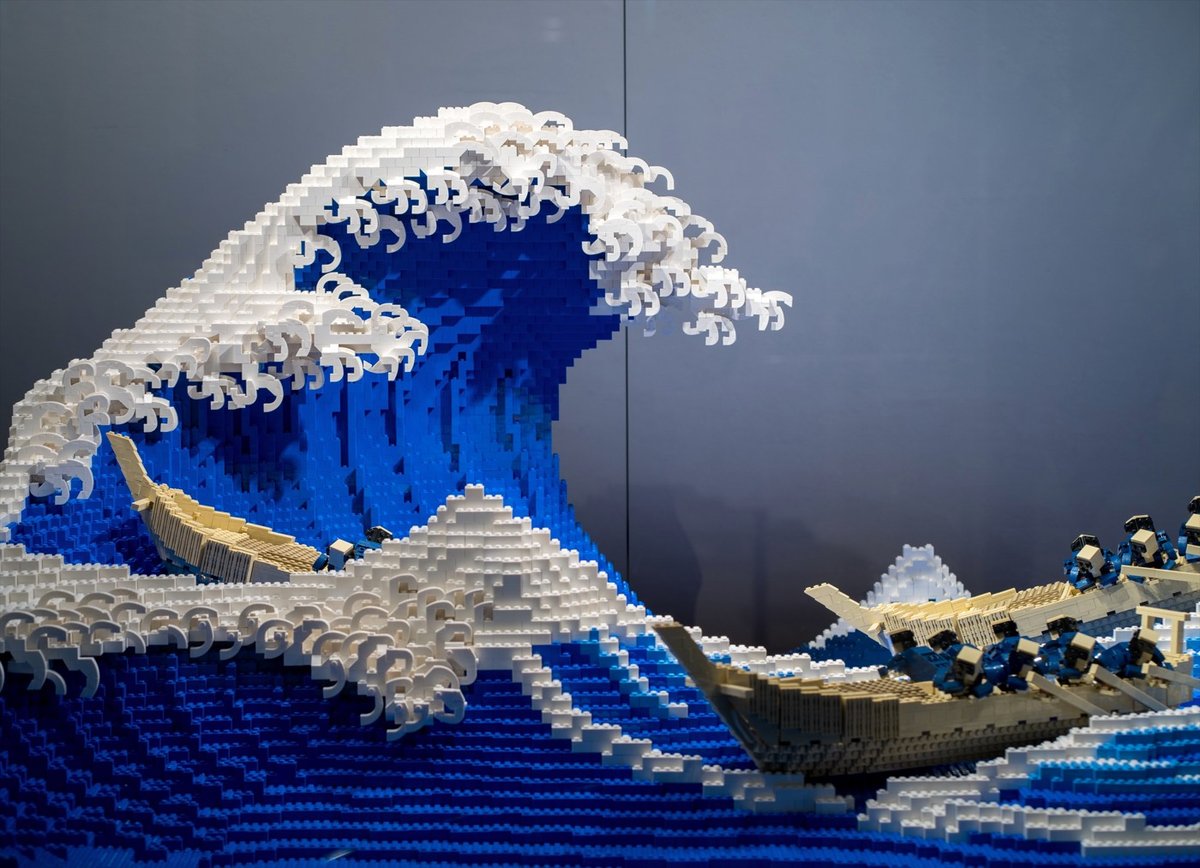

Jumpei Mitsui, the youngest-ever Lego Certified Professional, has created a Lego version of Hokusai’s iconic woodblock print, The Great Wave off Kanagawa. The Great Wave is perhaps the most recognizable (and most covered) Japanese artwork in the world. Mitsui’s Lego rendering is composed of 50,000 pieces and took 400 hours to build. From Spoon & Tamago:
In ensuring that his 3D lego replica not only payed homage to the original but also captured the dynamics of crashing waves, Mitsui says he read several academic papers on giant wave formations, as well as spent hours on YouTube watching video of waves.
You can check out the Lego Great Wave in person at the Hankyu Brick Museum in Osaka.
A Marvelous Marble Machine for Making Music
For the past four years, Martin Molin of the “folktronica” band Wintergatan has been building a marble machine that the band can use to make music. He’s documenting the entire build on YouTube in a long series of videos (149 and counting). The most recent videos show Molin’s test of the machine with thousands of marbles and his tweaking to get things juuuust right. In the one above, he makes several adjustments from failures observed from his last test and then runs 30,000 marbles through the machine.
These videos are long, so you’d be forgiven for skipping to the end just to see the machine in action, but Molin is really enthusiastic — obsessed in the best way — and is great at showing his work. People really digging into things, especially tangible mechanical things, and bringing us along for the ride is always interesting. (thx, sippey)
“Spready Mercury” and Other Scottish Snow Plow Names
This is a map showing the real-time location of Scotland’s fleet of snow plows (which they call “road gritters”). As Jackie Sojico discovered, Scotland names their plows and some of them are hilarious.
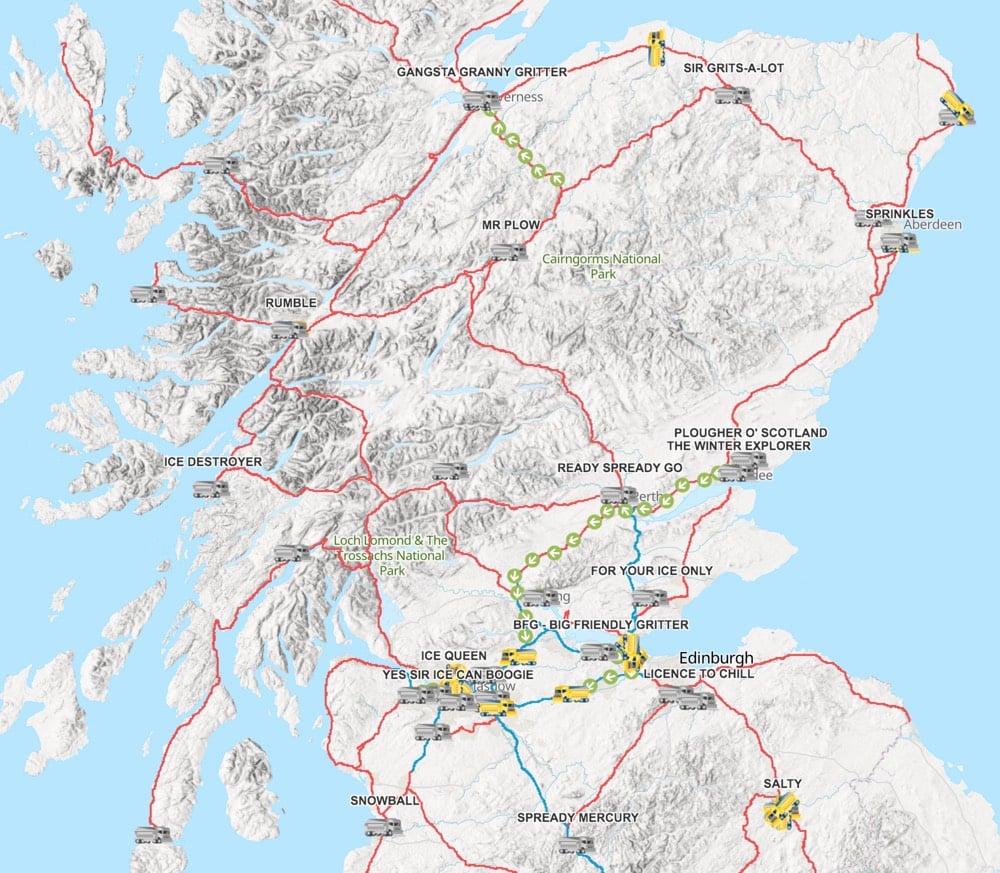
Some of the plows are named things like Sprinkles or Salty but there are also Gangsta Granny Gritter, Mr Plow, Spready Mercury, License to Chill, Ready Spready Go, and Gritney Spears. A possibly out-of-date list of plow names shared on Twitter includes Darth Spreader, Gritty Gritty Bang Bang, and Snowbegone Kenobi.
Plows elsewhere in the UK are also given interesting names: Basil Salty, David Plowie, Freezy Rider, and Roger Spreaderer. (thx, meg)
Identical Strangers
With almost 8 billion people in the world, chances are pretty good that everyone has a doppelgänger somewhere out there. Finding My Twin Stranger is a short documentary that follows researchers from the Department of Twin Research at St Thomas’ Hospital as they look for the most identical strangers — people who aren’t biological twins but sure look like they do.
In this documentary, we follow people as they track down their twin stranger across the globe and meet for the first time. They get to know one another and find out about each other’s lives and whether there are any other similarities. While the pairs get to know each other, they are also undergoing a series of tests by the twin-experts at St Thomas’ Hospital. These include measuring similarities of facial features using the latest 3D scanning technology, 2D facial recognition analysis and DNA ancestry testing.
The experts then get 100 people to rate the similarities from photos from most alike to least alike. Taking all of the results into consideration, the twin-experts will then reveal which pair is the most identical.
You can use the site Twin Strangers to find your own doppelgänger — you can see some of their matches here and on Instagram.
See also the fascinating 2018 documentary Three Identical Strangers and Identical Twins Who Look Nothing Alike.
Watch a Chicken Embryo Grow in a Transparent “Egg”
If you crack a fertilized chicken egg into a transparent container — in this case, plain old kitchen plastic wrap — and incubate it, you can observe the embryo as it develops and eventually “hatches” into a chick, heartbeat and all. The process takes about 21 days from start to finish.
The Northern Lights Photographer of the Year for 2020


Capture the Atlas has collected some of the best aurora borealis and aurora australis photos taken this year in their 2020 Northern Lights Photographer of the Year competition. I’ve highlighted two photos from the competition above, by Ben Maze & Nico Rinaldi respectively. Maze’s photo, of the aurora australis in Tasmania, is stunning — one of the best astronomy photos I have ever seen. Here’s how he captured it:
Captured in this image is a trifecta of astronomical phenomena that made for some of the best astrophotography conditions one can witness in Australia, namely, the setting Milky Way galactic core, zodiacal light, and of course, the elusive Aurora Australis. On top of this, a sparkling display of oceanic bioluminescence adorned the crashing waves, adding the cherry on top to what was already a breathtaking experience.
Having been out of reception and civilization for over a day, fellow photographer Luke Tscharke and I had no idea the aurora would strike on this night. We’d just heard rumors of a potential solar storm. We could barely contain our excitement when the lights first showed up on our camera’s screens. We later realized we were in the best place on the entire continent to witness the rare show, with Lion Rock being on the southernmost cape of Tasmania and much more cloud-free than the rest of the state at the time.
The colors that our cameras picked up were incredible, too. Rather than the classic green, the display ranged from yellow and orange to pink and purple. When I’d captured enough frames that I was happy with, I simply stood by my camera with my head tilted towards the sky, occasionally swirling my hand around in the sparkling water by my feet. I’m forever grateful for moments in nature like this that show us the true wonders of our planet.
The aurora, the Milky Way, zodiacal light, and bioluminescence all in one image — what a magical conjunction. You can check out the rest of the winners here.
“The worst people imaginable are dining out, study finds.” Tipping is down, sexual harassment is up, and staff are being asked by patrons to “take off your mask so I know how much to tip you”.
Socials & More