

An online museum of WinAmp skins

Advertise here with Carbon Ads
This site is made possible by member support. 💞
Big thanks to Arcustech for hosting the site and offering amazing tech support.
When you buy through links on kottke.org, I may earn an affiliate commission. Thanks for supporting the site!
kottke.org. home of fine hypertext products since 1998.
Beloved by 86.47% of the web.
Entries for September 2020
Mario Kart Live: Home Circuit
As a huge fan of Mario Kart (and a relatively recent owner of a Switch), this looks absolutely amazing (if it works smoothly). In Mario Kart Live: Home Circuit, you race a physical kart (against other peoples’ physical karts if you want) through your actual house, controlling it via onscreen AR on your Nintendo Switch (the onscreen view comes from a tiny camera mounted on the kart). Here’s what Nintendo says about it:
Created in partnership with Velan Studios, Mario Kart Live: Home Circuit brings the fun of the Mario Kart series into the real world by using a Nintendo Switch or Nintendo Switch Lite system to race against opponents using a physical Kart. The physical Kart responds to boosts in-game and in the real world, stops when hit with an item and can be affected in different ways depending on the race. Players place gates to create a custom course layout in their home, where the only limit is their imagination. Race against Koopalings in Grand Prix, unlock a variety of course customizations and costumes for Mario or Luigi, and play with up to four players in local multiplayer mode.
Watch the trailer above…it does look totally cool.
Rick Steves’ The Story of Fascism
The Story of Fascism is an hour-long TV special from travel guru Rick Steves about the history of fascism in Europe, from its post-WWI rise in Italy and Germany to the defeat of the fascist powers in WWII to efforts by modern-day right-wing ideologues to revive it.
We’ll trace fascism’s history from its roots in the turbulent aftermath of World War I, when masses of angry people rose up, to the rise of charismatic leaders who manipulated that anger, the totalitarian societies they built, and the brutal measures they used to enforce their ideology. We’ll see the horrific consequences: genocide and total war.
Because Steves hosts a travel show, they visit some of the places where this history played out, including Nuremberg, Auschwitz, and Rome, talk to historians and tour guides, and discuss fascist and anti-fascist art, including Picasso’s Guernica.
The combination of the weighty subject matter and Steves’ jaunty TV voice is a bit jarring at first, but this packs a lot of information and context into an hour. There are obviously parallels throughout to contemporary leaders and their tactics, but check out Benito Mussolini’s mannerisms and facial expressions starting at 11:05 and see if they remind you of the current inhabitant of the White House. (via open culture)
LIGO has detected a surprising event: the collision of two black holes that are each too big to have formed by the collapse of a star. “The black holes in this event aren’t supposed to exist!”
COVID-19 Can Wreck Your Heart, Even if You Haven’t Had Any Symptoms. This will probably lead to many premature deaths over the next several decades.
Browse Through 72 Years of Ikea Catalogs


Ikea has uploaded scans of all 72 years of their annual catalogs, from 1950 to 2021, to their online museum. (The company’s optimism that there will be a 2021 is heartening.) An entertaining time machine of Scandinavian design trends.
Very excited that my pal Brian Bartels’ book, The United States of Cocktails, is coming out next week! “This book includes more than 100 recipes alongside spirited analysis of each state’s unique contributions to cocktail culture.”
Eric Godal’s Anti-Fascist Illustrations Updated for 2020
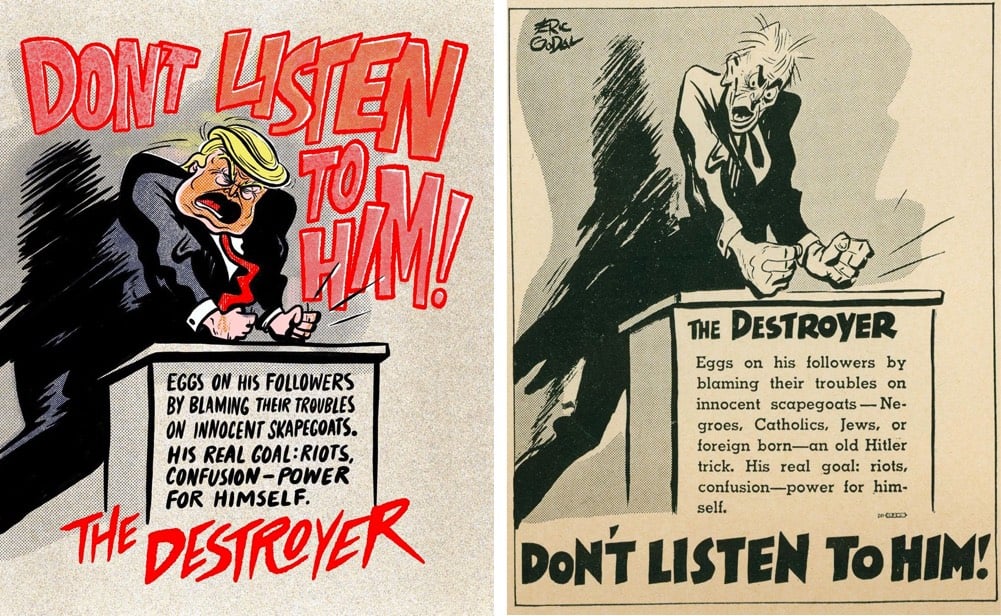

In the 1930s and 40s, artist Eric Godal drew some anti-fascist political cartoons that urged people not to listen to right-wing authoritarians who want to destroy and pillage society for their own ends. Godal, a German Jew, had escaped the clutches of Nazi Germany in the 30s and labored to warn America and the world about the fate of the Jews in Europe.1
Illustrator Chris Piascik has updated Godal’s drawings for 2020 to feature our own corrupt crackpot wannabe dictator. Calling Donald Trump a fascist is hardly controversial these days — he clearly is. What his supporters need to reckon with is: are they?
Godal’s mother was able to get out of Germany on a boat but was denied entry to the United States as a refugee by the Roosevelt administration. She was sent back and eventually murdered in a Nazi death camp.↩
Back in March, police in Rochester, NY murdered Daniel Prude. They put a hood over his head and suffocated him until he laid lifeless in the street. DEFUND THE POLICE. We don’t need armed men showing up to deal with mental health crises!
“Some cops give their friends and family union-issued ‘courtesy cards’ to help get them out of minor infractions. The cards embody everything wrong with modern policing.” Every time I read about these cards, I get more angry.
Grief and Witness in a Pandemic Ravaged Country
For Vanity Fair, novelist Jesmyn Ward writes about losing her husband just before the pandemic descended on America. She begins:
My Beloved died in January. He was a foot taller than me and had large, beautiful dark eyes and dexterous, kind hands. He fixed me breakfast and pots of loose-leaf tea every morning. He cried at both of our children’s births, silently, tears glazing his face. Before I drove our children to school in the pale dawn light, he would put both hands on the top of his head and dance in the driveway to make the kids laugh. He was funny, quick-witted, and could inspire the kind of laughter that cramped my whole torso.
It’s not long, but make some time for this one.
Thinking About Pandemic Risk: “All Our Behavior Adds Up”
This short article by Dr. Aaron Carroll about Covid-19 and risk is excellent. I want to quote the entire thing here, punctuated only by increasingly emphatic YESes and THISes, but I will refrain. Somewhat.
Too many view protective measures as all or nothing: Either we do everything, or we might as well do none. That’s wrong. Instead, we need to see that all our behavior adds up.
Each decision we make to reduce risk helps. Each time we wear a mask, we’re throwing some safety on the pile. Each time we socialize outside instead of inside, we’re throwing some safety on the pile. Each time we stay six feet away instead of sitting closer together, we’re throwing some safety on the pile. Each time we wash our hands, eat apart and don’t spend time in large gatherings of people, we’re adding to the pile.
If the pile gets big enough, we as a society can keep this thing in check.
The article was published before today’s news that three PSG players — Neymar, Angel Di Maria, and Leandro Paredes — have tested positive for Covid-19 after returning from a vacation on Ibiza, but this could have easily been written in response:
To keep the pile big enough, though, we need to be willing to trade some activities for others. If people want to play on a sports team, for instance, they should consider giving something up to do so. Increasing their risk by participating in a group activity should prompt them to reduce their risk the rest of the time.
But we aren’t very good at discussing trade-offs. We want it all. We want to eat in restaurants, crowd into houses, go to work and celebrate occasions en masse.
We could choose to engage in just some of those things. We could decide to get a massage or get our nails done or have a haircut — instead of demanding that all of these and more be available to us simultaneously.
And this is just generally true:
If Americans were willing to invest in bigger-picture solutions, we could all have nicer things.
And this. This. THIS!! (sorry) THISSSSS!!!!:::
Instead of asking why we can’t do certain activities, we might consider what we’re willing to give up to do them more safely. Even better, we might even consider what we’re willing to give up so others can do them, too.
Go on, read the whole thing.
A Map of the Sounds from Forests and Woodlands Around the World
A site called Sounds of the Forest is collecting sounds from forests and woodland areas around the world and presenting them on a world map.

We are collecting the sounds of woodlands and forests from all around the world, creating a growing soundmap bringing together aural tones and textures from the world’s woodlands.
The sounds form an open source library, to be used by anyone to listen to and create from.
Here are a few of the sounds that they’ve collected.
See also the work of Gordon Hempton, who is trying to capture the sounds of the very few places left in the world without human noise. (via moss & fog)
David Blaine Floated into the Sky with a Bunch of Helium Balloons Like the House in “Up”
Earlier today, illusionist and “endurance performer” David Blaine grabbed onto a bunch of big helium balloons and floated into the sky.
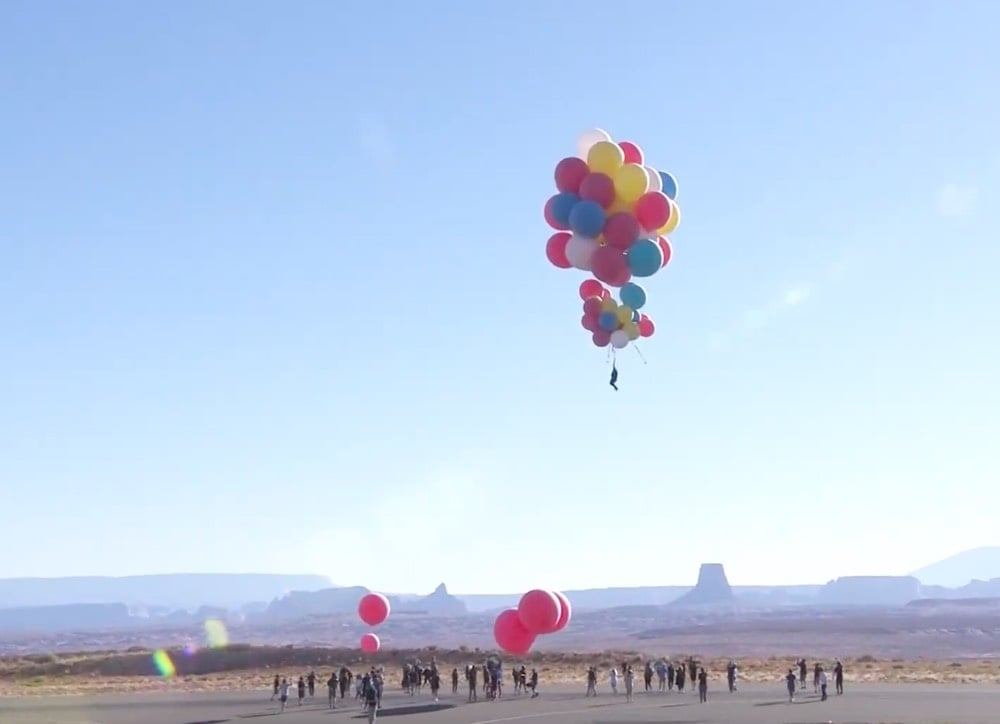
Over the next 50 minutes, he rose to an altitude of almost 25,000 feet before letting go and skydiving/parachuting safely to the ground. The video embedded above is a livestream of the event — liftoff takes place a couple of minutes after the 2-hour mark.
Buddhist Monk and Makeup Artist Kodo Nishimura

Meet Kodo Nishimura, a Buddhist monk and makeup artist. Nishimura, who is gender fluid and uses he/him pronouns, struggled with his peers’ rigid concepts about gender as a teen in Japan, but found greater acceptance and a career in NYC before deciding to return to Japan to train as a monk, just as his parents had before him. As you might imagine for someone with one foot in two very different cultures, it has been difficult for Nishimura to simultaneously navigate both of those worlds and their attendant expectations.
For the next two years, Nishimura lived a double life: an openly gay makeup artist when he was in NYC and a closeted Buddhist monk trainee when he was in Japan. “I didn’t want the impression of other monks to be degraded because of me,” he recalls. It wasn’t until confiding in his master that Nishimura realized the futility of his concerns. His master expressed: “The most important message of our denomination [Pure Land Buddhism] is to let people know that we can all be saved regardless of our sexuality, gender or fashion preferences.”
You can check out more about Nishimura on his website or on Instagram. (via spoon & tamago)
Update: Thanks to Caroline and @anatsuno for some language-related feedback on this post. I added that Nishimura explicitly uses he/him pronouns and clarified that he “is gender fluid” and not just “identifies as gender fluid”.
Great piece by Elamin Abdelmahmoud: Why Chadwick Boseman’s Death Hurts So Much. “To concern yourself with who your heroes are is to construct a story about who you are. Boseman transformed himself into a portal for these questions.”
Netflix is doing a TV series based on The Three-Body Problem book series. David Benioff and D.B. Weiss (Game of Thrones) and True Blood’s Alexander Woo will direct. Author Liu Cixin and translator Ken Liu will serve as consulting producers.
The Dynamic Treetop Kingdoms of the Weaver Ants
In their third video of their ant trilogy (see also The World War of the Ants and The Billion Ant Mega Colony and the Biggest War on Earth), Kurzgesagt goes up into the treetops to tell us about the weaver ants.
Deep in tropical jungles lie floating kingdoms ruled by beautiful and deadly masters: They are sort of the high elves of the ant kingdoms: Talented architects that create castles and city states. But they are also fierce and expansionist warriors and their kingdoms are ensnared in a never ending war for survival. Oecophylla weaver ants.
The nests that weaver ants build out of leaves and silk from larve (that the ants use as “tiny cute glue guns”) are incredible. Since Kurzgesagt is animated, I went looking for some actual footage of weaver ants doing their thing. Here’s a clip from BBC Earth:
I found this video via The Kid Should See This, who explains that a mango orchard in Thailand uses the ants to keep pests away without using chemical pesticides:
In this mango orchard in Northern Thailand, weaver ants are nurtured so they can thrive and protect the harvest. The ants hunt the pests that would eat the mangoes, eliminating any need to use harmful chemical pesticides. The farmer creates strategic highways of red string to connect the weaver ants to new trees, expanding where they forage.
You can also watch this documentary on Australian weaver ants and this video from AntsCanada (whose videos always have amazing narration) to learn more about weaver ants.
Radioactive Diamond Batteries That Last for Thousands of Years
A pair of researchers from the University of Bristol have formed a company called Arkenlight to try to make diamond batteries out of nuclear waste that can potentially power devices for thousands of years. The betavoltaic batteries work by releasing beta radiation, which excites semiconductor material to produce electricity. These types of batteries don’t put out much power — they can’t replace your iPhone battery for example — but they do their thing for a loooong time.
Arkenlight is focused on creating batteries that have a diamond-like structure out of irradiated graphite, which is quite common.
But that’s where a radioactive isotope called carbon-14 may be able to help. Best known for its role in radiocarbon dating, which allows archaeologists to estimate the age of ancient artifacts, it can provide a boost to nuclear batteries because it can function both as a radioactive source and a semiconductor. It also has a half-life of 5,700 years, which means a carbon-14 nuclear battery could, in principle, power an electronic device for longer than humans have had written language.
I mean, it’s little more than a theory at this point so maybe it won’t be feasible after all, but what a brilliant idea: combining the radioactive source and the semiconductor (thereby upping the efficiency) and using nuclear waste to build the whole thing. Science at its most poetically useful. (via geoff manaugh)
MIT’s New Online Science Course About the Pandemic & SARS-CoV-2 Is Free & Open to the Public
MIT’s biology department is offering a new online class this fall called COVID-19, SARS-CoV-2 and the Pandemic. The class will be led by Richard Young and Facundo Batista and will include guest lectures by several leading authorities on Covid-19, coronaviruses, epidemiology, and immune systems like Anthony Fauci, Michael Mina, and Akiko Iwasaki. Here’s the course description and syllabus.
Lectures by leading experts on the fundamentals of coronavirus and host cell biology, immunology, epidemiology, clinical disease, and vaccine and therapeutic development.

The first class is today, Sept 1st, at 11:30am ET and meets on Tuesday through December 8. Lectures are via live video but will be archived if you miss a class. There’s no homework or outside reading (it’s just the lectures), no pre-requisites needed, and it’s a 1-credit pass/fail exploratory course, so despite the source and subject matter, it should be fairly accessible. I’m taking the course and will let you know how it goes! (thx, meg)
Update: Here’s an archive of the first lecture by Bruce Walker of the Ragon Institute.
I am an unabashed fan of Noah Kalina’s chickens (and Marcel the rooster!), so of course I immediately bought Tiny Flock, a book of photographs he’s taken of his flock.
Socials & More