Entries for August 2020
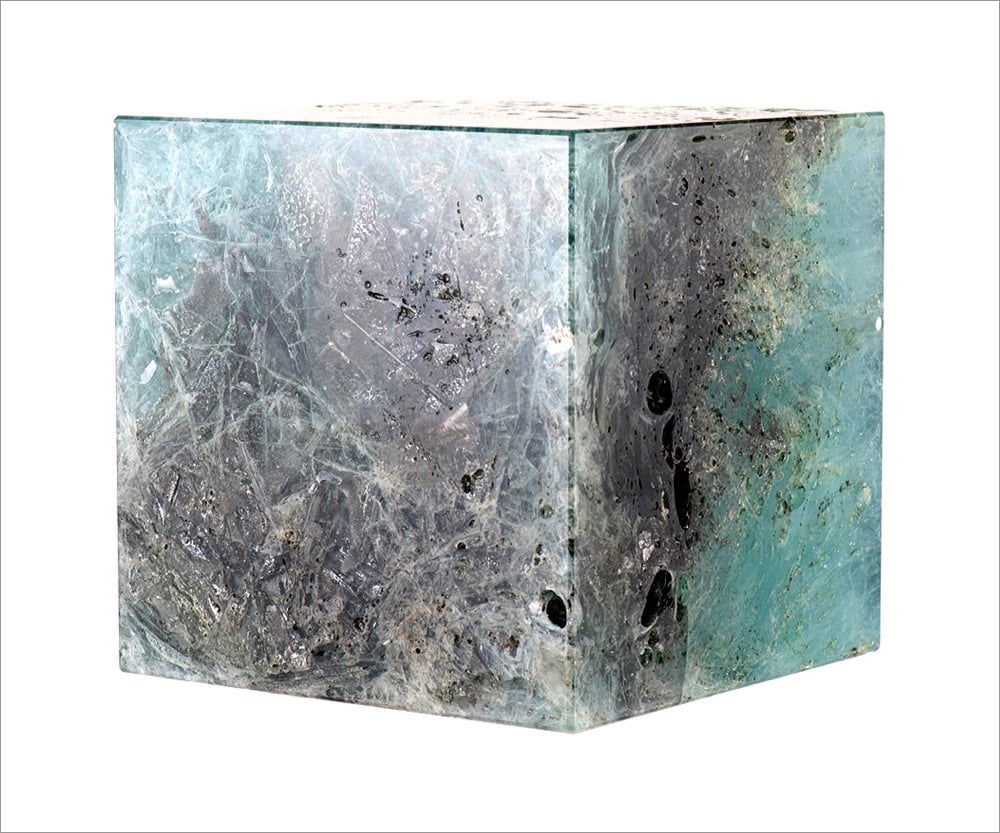

When the world’s first atomic weapon exploded in New Mexico in July 1945, the energy from the blast formed a new mineral called trinitite from the desert sand. For his 2015 Trinity Cube project, artist Trevor Paglen took irradiated glass gathered from the area around where the Fukushima Daiichi nuclear disaster occurred in 2011 and combined it with trinitite to form a blue cube. He then installed the cube in the Fukushima Exclusion Zone to continue to be irradiated.
The artwork will be viewable by the public when the Exclusion Zone opens again, anytime between 3 and 30,000 years from the present.
From Harvard Business Review, An Interview with Janelle Monáe. “[My job at Office Depot] was getting in the way of my focusing on what I needed to do as an artist. When they fired me, I had no excuse. I had to go all in on my career.”
I have a bit of a thing for kooky covers of AC/DC’s Thunderstruck — see Thunderstruck on the bagpipes and on a washing machine — so I was plum tickled to find this ukulele cover today:
That’s from a Brazilian duo called Overdriver Duo, who have also done GNR’s Sweet Child O’ Mine, Nirvana’s Smells Like Teen Spirit (on a Frozen-branded uke!), and Every Breath You Take by The Police. (via open culture)
In the Atlantic, Ed Yong checks back in with the long-haulers, people who are still experiencing Covid-19 symptoms months after their initial infection. (Read his previous article from early June.)
Lauren Nichols has been sick with COVID-19 since March 10, shortly before Tom Hanks announced his diagnosis and the NBA temporarily canceled its season. She has lived through one month of hand tremors, three of fever, and four of night sweats. When we spoke on day 150, she was on her fifth month of gastrointestinal problems and severe morning nausea. She still has extreme fatigue, bulging veins, excessive bruising, an erratic heartbeat, short-term memory loss, gynecological problems, sensitivity to light and sounds, and brain fog. Even writing an email can be hard, she told me, “because the words I think I’m writing are not the words coming out.” She wakes up gasping for air twice a month. It still hurts to inhale.
As Yong says in a thread about the article: “The pandemic is going to create a large wave of chronically disabled people.” Once again for the people in the back: this is not just the flu. The flu does not incapacitate otherwise healthy people like this. I know at least two long-haulers personally and am astounded on a daily basis by how casually some Americans continue to regard Covid-19.
More than 90 percent of long-haulers whom Putrino has worked with also have “post-exertional malaise,” in which even mild bouts of physical or mental exertion can trigger a severe physiological crash. “We’re talking about walking up a flight of stairs and being out of commission for two days,” Putrino said. This is the defining symptom of myalgic encephalomyelitis, or chronic fatigue syndrome. For decades, people with ME/CFS have endured the same gendered gaslighting that long-haulers are now experiencing. They’re painfully familiar with both medical neglect and a perplexing portfolio of symptoms.
You can read Seabiscuit author Laura Hillenbrand’s excellent article on her chronic fatigue syndrome diagnosis and how difficult it is for people with chronic conditions like this to get the right diagnosis and to get family and friends to believe what’s going on.
Also, Yong should win all the awards this year for his pandemic coverage. It has been simply outstanding.
The Case of the Top Secret iPod. “I have a special assignment for you. Your boss doesn’t know about it. You’ll help two engineers from the US Department of Energy build a special iPod. Report only to me.”
Hi folks, I’ve got some exciting news today. The newest addition to kottke.org’s tiny media empire debuted yesterday: the Kottke Ride Home podcast. It’s a bloggy daily podcast featuring some of the day’s most interesting news and links in just 15 minutes, and you can subscribe to it on Apple Podcasts or wherever you listen to your podcasts (more options). The cool thing is that the podcast is very much its own thing with its own engaging host. It’s not a recap of the site in audio form, but instead is a whole different crop of news & information from the Kottke.org Media Universe (the KMU lol).
Here’s the first episode of Kottke Ride Home, featuring segments on the 100th anniversary of women’s suffrage in America, AI-assisted MRI scans that are up to 4X faster, and the “Lost Colony” of English settlers from 1587:
Ok, now that you’ve returned from subscribing, let me tell you about the show and how it came about.
I’ve been toying with the idea of doing a podcast for awhile now1 — they’re the hot thing, etc. — but I could never get myself interested enough to make it happen as a host/interviewer. But I know a lot of you love podcasts, so the notion remained simmering on a back burner. Knowing of these podcast aspirations, my pal Brian McCullough recently approached me about collaborating on a podcast.
Brian is a fellow old school internet person, host of the Internet History Podcast (for which he interviewed me in 2018), and author of the 2018 book, How the Internet Happened: From Netscape to the iPhone. He’s now running a podcast startup called Ride Home Media that’s focused on delivering short daily news podcasts about a variety of different subjects — some of you might be familiar with their flagship podcast TechMeme Ride Home, which they’ve been publishing since March 2018. Brian told me a podcast version of kottke.org has been on his bucket list for quite awhile, so that’s what we’re doing.
Kottke Ride Home is hosted & curated by writer/speaker/YouTuber Jackson Bird, whose TED Talk How to talk (and listen) to transgender people has been viewed more than 1.6 million times. For the past few months, Jackson’s been hosting Good News Ride Home — “In just 15 minutes, the coolest stuff that happened in the world today. Science, progress, life-hacks, memes, exciting art and hope.” — which will seamlessly shift into Kottke Ride Home with nary a disruption to what he’s already been doing.1 I’ve been listening to the show for the past few weeks and am excited to partner with Jackson to bring the best of the internet to you.
The podcast and the site will operate independently from each other but will obviously cover the same sorts of things. Like I said above, the show won’t be a recap of kottke.org posts; it’s designed to complement the site, to scratch that kottke.org itch when you’re in podcast-listening mode. But like when the Jeffersons showed up on the Fresh Prince of Bel-Air, there will undoubtably be things that make their way from the podcast to the site and vice versa.
Ok, that’s the skinny. You’ll be hearing more from me about the show in the coming days, but for now, check out Kottke Ride Home wherever you listen to podcasts.
P.S. Since it’s a new show — or rather a show with a new name — it will take some time for the name and artwork to propagate across the various podcast networks. You can find the show on the major services/apps using the subscribe button here, but here are some direct links: Apple Podcasts, Spotify, Google Podcasts, RSS, Overcast, Castro, Pocket Casts, and Luminary.
This is a short but mesmerizing clip of a performance of choreographer Yoann Bourgeois’ “Celui qui tombe” (He who falls) in which six performers move about a spinning platform. The spinning allows them to run without appearing to go anywhere and lean at seemingly impossible angles without Michael Jackson’s patented Smooth Criminal shoes. From a review in the Guardian:
Lowered into a horizontal position, this structure begins to revolve, slowly at first, then faster. Subjected to increasing centrifugal force, the dancers cluster together, their bodies inclining inwards at ever more acute angles. Individuals depart the group and make exploratory sorties, circling the platform as if battling against a great wind.
(Brief science interlude: my high school physics teacher told us never to use “centrifugal force” instead of “centripetal force” because it wasn’t actually a thing. More on that here.)
Anyway, it’s an amazing physical performance to watch. I’ve featured Bourgeois’ choreography on the site before: The Mechanics of History and A Relaxing Acrobatic Performance to Debussy’s Clair de Lune — both use trampolines to create illusions that mess with the viewer’s intuitions about gravity.
An oral history of the “steamed hams” scene from The Simpsons. “Aurora borealis?! At this time of year? At this time of day? In this part of the country? Localized entirely within your kitchen?”



Inspired by the charts on Robinhood and Yahoo Finance, Gladys Orteza is turning the charts of notable stocks into landscape artworks, inserting references to the company into the art. The Ford chart at the top has a truck, the Tesla chart features a rocket (a reference to SpaceX), and the Disney one includes the twin suns of Tatooine & a Jawa Sandcrawler.
Reminds me of Michael Najjar’s High Altitude series (stock market charts represented by jagged Andean mountain peaks) and Jill Pelto turning climate change graphs into art. (via waxy)
Tim Wu on the case for banning TikTok. “China keeps a closed and censorial internet economy at home while its products enjoy full access to open markets abroad. The asymmetry is unfair and ought no longer be tolerated.”
Researchers have demonstrated that they can make a working 3D-printed copy of a key just by listening to how the key sounds when inserted into a lock. And you don’t need a fancy mic — a smartphone or smart doorbell will do nicely if you can get it close enough to the lock.
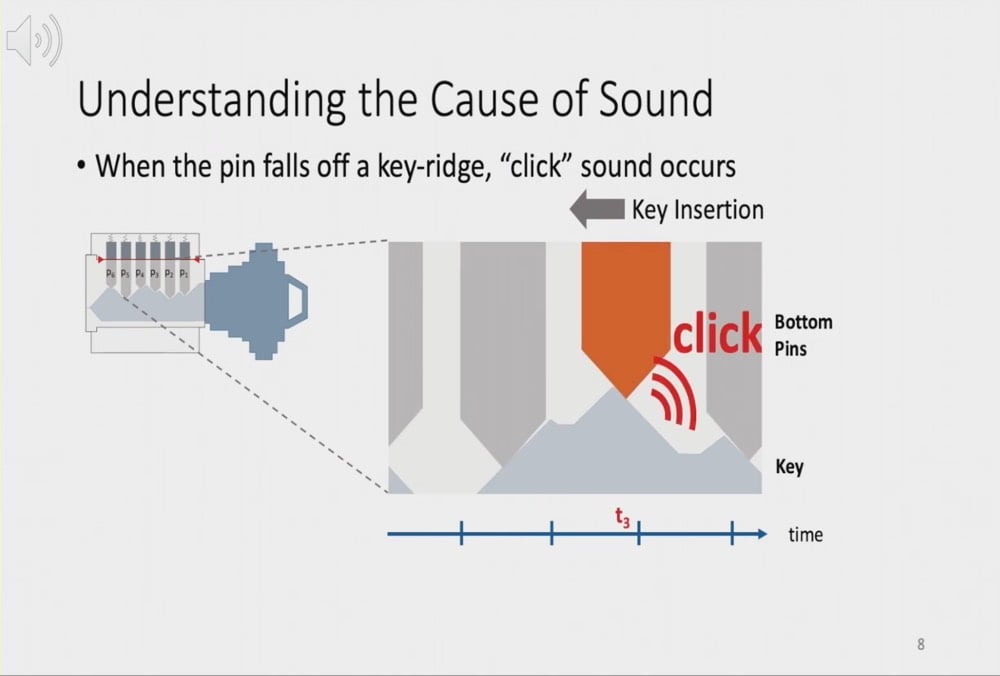
The next time you unlock your front door, it might be worth trying to insert your key as quietly as possible; researchers have discovered that the sound of your key being inserted into the lock gives attackers all they need to make a working copy of your front door key.
It sounds unlikely, but security researchers say they have proven that the series of audible, metallic clicks made as a key penetrates a lock can now be deciphered by signal processing software to reveal the precise shape of the sequence of ridges on the key’s shaft. Knowing this (the actual cut of your key), a working copy of it can then be three-dimensionally (3D) printed.
How Soundarya Ramesh and her team accomplished this is a fascinating read.
Once they have a key-insertion audio file, SpiKey’s inference software gets to work filtering the signal to reveal the strong, metallic clicks as key ridges hit the lock’s pins [and you can hear those filtered clicks online here]. These clicks are vital to the inference analysis: the time between them allows the SpiKey software to compute the key’s inter-ridge distances and what locksmiths call the “bitting depth” of those ridges: basically, how deeply they cut into the key shaft, or where they plateau out. If a key is inserted at a nonconstant speed, the analysis can be ruined, but the software can compensate for small speed variations.
The result of all this is that SpiKey software outputs the three most likely key designs that will fit the lock used in the audio file, reducing the potential search space from 330,000 keys to just three. “Given that the profile of the key is publicly available for commonly used [pin-tumbler lock] keys, we can 3D-print the keys for the inferred bitting codes, one of which will unlock the door,” says Ramesh.
Here’s Ramesh presenting her research at a conference back in March.
This reminded me of a couple of things. If you have a photo of a key, you can make a copy of it. And if you record high speed video of objects like plants or potato chip bags, you can use the observed vibrations to reconstruct the sound near those objects. All these secrets lying out in the open, just waiting for clever technologies to hoover them up. (via @nicolatwilley)
This book looks fascinating: What Can a Body Do?: How We Meet the Built World. “What might assistance based on the body’s stunning capacity for adaptation – rather than a rigid insistence on ‘normalcy’ – look like?”
In her impassioned speech on the first night of the Democratic National Convention, Michelle Obama made her case for Americans to come together and vote Donald Trump out of office. In her remarks, she zeroed in on his incompetence, his total lack of empathy for anyone but himself, and his desire for division.
So let me be as honest and clear as I possibly can. Donald Trump is the wrong president for our country. He has had more than enough time to prove that he can do the job, but he is clearly in over his head. He cannot meet this moment. He simply cannot be who we need him to be for us. It is what it is.
Now, I understand that my message won’t be heard by some people. We live in a nation that is deeply divided, and I am a black woman speaking at the Democratic convention. But enough of you know me by now. You know that I tell you exactly what I’m feeling. You know I hate politics. But you also know that I care about this nation. You know how much I care about all of our children.
So if you take one thing from my words tonight, it is this: if you think things cannot possibly get worse, trust me, they can, and they will if we don’t make a change in this election. If we have any hope of ending this chaos, we have got to vote for Joe Biden like our lives depend on it.
And voting this year means putting in some extra work so that our votes count:
But this is not the time to withhold our votes in protest or play games with candidates who have no chance of winning. We have got to vote like we did in 2008 and 2012. We’ve got to show up with the same level of passion and hope for Joe Biden. We’ve got to vote early, in person if we can. We’ve got to request our mail-in ballots right now, tonight, and send them back immediately and follow up to make sure they’re received. And then, make sure our friends and families do the same.
We have got to grab our comfortable shoes, put on our masks, pack a brown-bag dinner and maybe breakfast too, because we’ve got to be willing to stand in line all night if we have to.
You can read the entire transcript of her speech or watch it above. It’s worth your time.
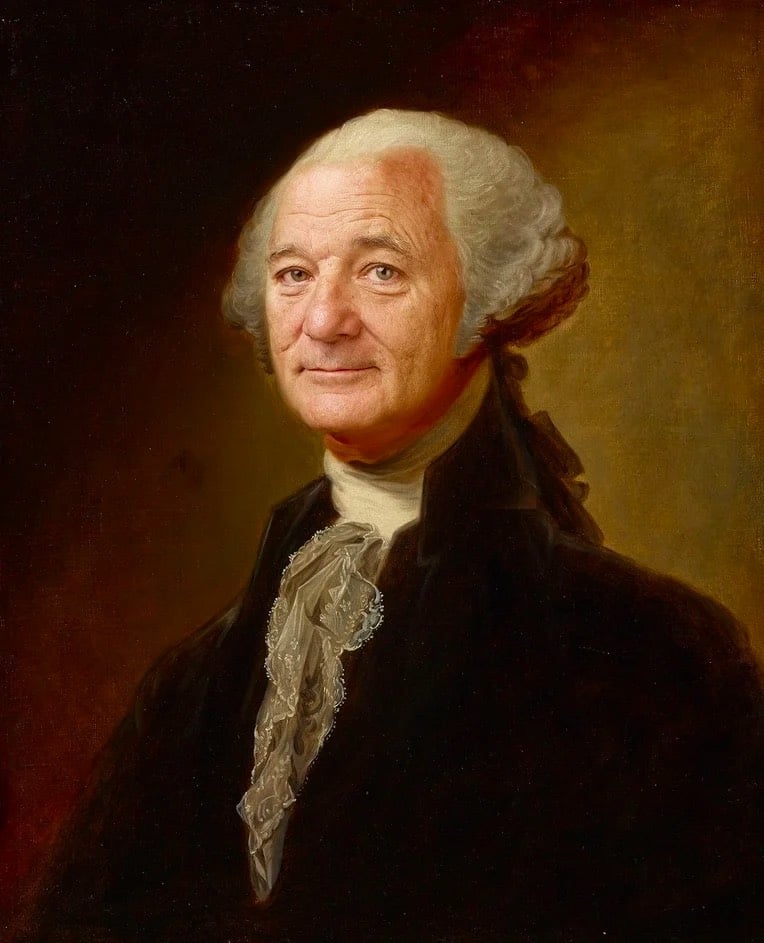

These photoshopped images of Bill Murray by Eddy Torigoe are silly and perfect. The George Washington and American Gothic are uncanny; the Napoleon one is quite good too. (via moss & fog)

The Black Music History Library is a list of resources (books, articles, podcasts, films, etc.) about the Black origins of popular and traditional music. From the about page:
There are many notable archives doing similar work, yet it isn’t uncommon for some to have a limited view of Black music — one which fuels US-centrism and a preference for vernacular music traditions. This collection considers the term “Black music” more widely, as it aims to address any instances in which Black participation led to the creation or innovation of music across the diaspora. Plainly speaking, that means just about every genre will be included here.
Black artists have often been minimized or omitted entirely when it comes to the discussion, practice, and research of many forms of music. This library seeks to correct that. It is time to reframe Black music history as foundational to American music history, Latinx music history, and popular music history at large.
The library was created by music journalist Jenzia Burgos after her Instagram slideshow went viral back in June, demonstrating a need for a more comprehensive resource. In a thread announcing the site, Burgos envisions the site as a “living library” that will shift and grow with reader contributions — you can send in resources via this form. (via @tedgioia)


Roland Miller, a long-time photographer of space exploration projects, and Italian astronaut Paolo Nespoli has teamed up to produce a book of photographs of the interior of the International Space Station. According to a profile of the project from Colossal, Miller used interior views of the ISS on Google Earth to stage shots, which would then be executed by Nespoli in space. Nespoli, an engineer, also built a stabilizing rig for the camera.
Because the ISS was in a weightless environment with fluctuating light, many of the images astronauts typically capture utilize a flash, which Miller, who generally photographs using a very low shutter speed, wanted to avoid. “The first problem you run into is you can’t use a tripod in space because it just floats away, and the station itself is going 17,500 miles an hour. Just because of the size and the speed, there’s a harmonic vibration to it,” he notes. To combat the constant quivering, Nespoli constructed a stabilizing bipod and shot about 135 images with a high shutter speed, before sending the shots to Miller for aesthetic editing.
You can get a copy of the book (or prints) by backing the project on Kickstarter.
Alright, Alright, Alright: The Oral History of Richard Linklater’s Dazed and Confused. “This wasn’t the kind of movie everybody liked, but it was the kind of movie certain people loved, with an intensity that felt personal.” Due out Nov 17.
MoMA has published a two-minute film from 1902 of a German suspended railway called the Wuppertal Schwebebahn. It presents an almost drone-like view of a German city at the beginning of the 20th century, in contrast to the ground-based and stationary films that were far more common in that era. The film is also extremely crisp and clear because it was shot in 68mm:
The Flying Train depicts a ride on a suspended railway. The footage is almost as impressive as the feat of engineering it captures. For many years our curators believed our Mutoscope rolls were slightly shrunken 70mm film, but they were actually shot on Biograph’s proprietary 68mm stock. Formats like Biograph’s 68mm and Fox’s 70mm Grandeur are of particular interest to researchers visiting the Film Study Center because the large image area affords stunning visual clarity and quality, especially compared to the more standard 35mm or 16mm stocks.
My favorite bit is the kid on the swing at about the 25 second mark — a casual unstaged moment that allows the viewer to imagine themselves in that place and time, almost 120 years ago.
And as the latest instance in a trend that I am increasingly irritated by, this film was immediately run through an AI program to upscale it to 4K, stabilize it, and colorize it. The result is….. I don’t know, cheesy? It just looks worse than the original, which is so vivid to begin with. And the added sound is distracting. But the worst thing is that this “restored” video has almost twice the views as the original. *shakes fist at cloud*
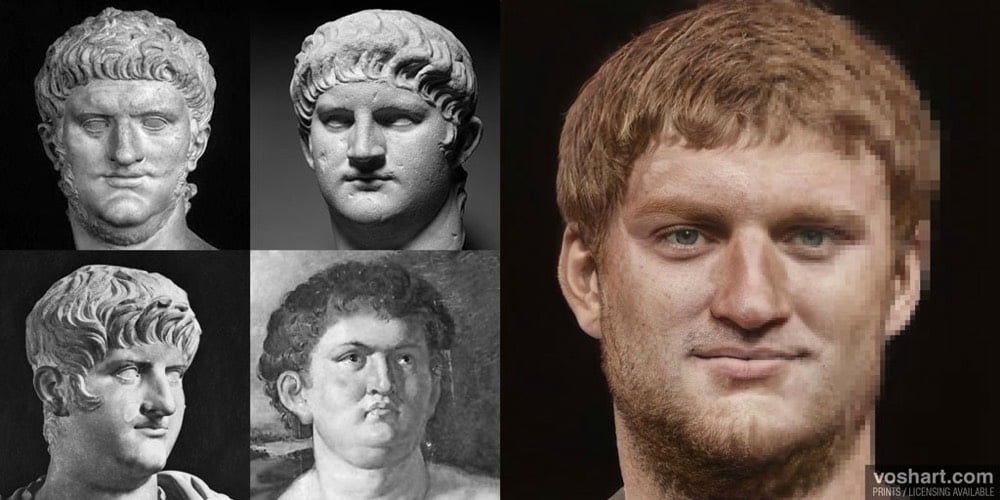

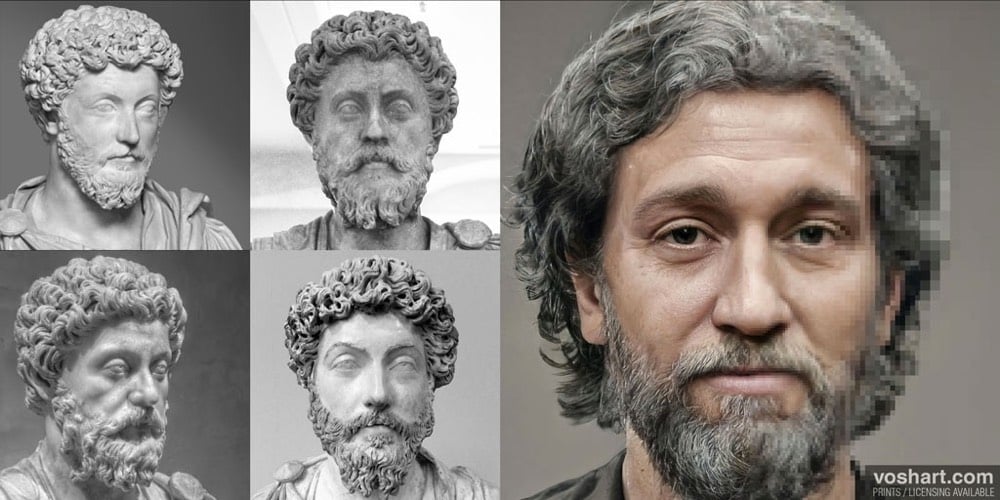
For his Roman Emperor Project, Daniel Voshart (whose day job includes making VR sets for Star Trek: Discovery) used a neural-net tool and images of 800 sculptures to create photorealistic portraits of every Roman emperor from 27 BCE to 285 ACE. From the introduction to the project:
Artistic interpretations are, by their nature, more art than science but I’ve made an effort to cross-reference their appearance (hair, eyes, ethnicity etc.) to historical texts and coinage. I’ve striven to age them according to the year of death — their appearance prior to any major illness.
My goal was not to romanticize emperors or make them seem heroic. In choosing bust / sculptures, my approach was to favor the bust that was made when the emperor was alive. Otherwise, I favored the bust made with the greatest craftsmanship and where the emperor was stereotypically uglier — my pet theory being that artists were likely trying to flatter their subjects.
Some emperors (latter dynasties, short reigns) did not have surviving busts. For this, I researched multiple coin depictions, family tree and birthplaces. Sometimes I created my own composites.
You can buy a print featuring the likenesses of all 54 emperors on Etsy.
See also Hand-Sculpted Archaeological Reconstructions of Ancient Faces and The Myth of Whiteness in Classical Sculpture.

Another fine Nancy comic from Olivia Jaimes. This isn’t the first time Jaimes has messed with time & space and self-reference in her comics.
We Will Pay for Our Summer Vacations With Winter Lockdowns. “The rise in infections in Europe seems particularly linked to activities like barhopping, clubbing and partying among younger people…”
From Ted Chiang’s collection of stories, Exhalation, comes Anxiety Is the Dizziness of Freedom, published online for the first time. In the story, devices called “prisms” allow people to talk to their alternate reality selves, but only for a limited time.
Every prism — the name was a near acronym of the original designation, “Plaga interworld signaling mechanism” — had two LEDs, one red and one blue. When a prism was activated, a quantum measurement was performed inside the device, with two possible outcomes of equal probability: one outcome was indicated by the red LED lighting up, while the other was indicated by the blue one. From that moment forward, the prism allowed information transfer between two branches of the universal wave function. In colloquial terms, the prism created two newly divergent timelines, one in which the red LED lit up and one in which the blue one did, and it allowed communication between the two.
I read Exhalation several months ago; every story was fantastic, but this was one of my favorites.

An anonymous USPS employee has written about the recent changes at the Post Office since new Postmaster General Louis DeJoy (“a lifelong Republican, a Trump mega-donor/fundraiser, and a high ranking RNC official”) took over and has set about gutting it from the inside.
All of the potential angles for corruption make DeJoy’s aims pretty tough to figure out. He’s a small market conservative from the private sector running a massive government agency. He’s a Trump ally running the agency responsible for ballots during an election year. He also has a direct financial interest in seeing us fail. Take your pick. You’re probably right no matter what. And judging by the chaos he’s unleashed into USPS in just his first two months, “all of the above” might be your best bet.
See, up until just two months ago, every letter carrier, clerk, mail handler, truck driver, etc, worked under one pretty simple philosophy: every piece, every address, every day. Everyone in the chain of custody for mail made sure every piece got as far along in the system as it could, and if it made it to my hands, in my office, it was getting delivered. That’s how I’ve done it for my career, how the guys who have been doing it for forty years have always done it, and that’s literally how Ben Fucking Franklin’s guys did it. You can almost hear Aaron Sorkin’s orgasm as he punches up the Bradley Whitford speech about the majesty of it all.
But two months ago is also when that abruptly stopped. After a couple hundred years, it just…stopped. On the ground floor, there’s a lot of arguing about who is ordering what, and what’s going to be permanent, and what’s going to be a trial run, but at the end of the day, the result is obvious: I go into my job, every single morning, and don’t deliver hundreds of pieces of available mail that used to get delivered. The only reason given is some vague nonsense about “operational efficiency” and “cost savings.”
And this was written before reports of sorting machines being removed without explanation ahead of a presumed huge surge of election-related mail. I think we should actually be pretty alarmed by this. Here’s Jamelle Bouie on Trump’s election night strategy (and how to counter it: vote in person):
There’s no mystery about what President Trump intends to do if he holds a lead on election night in November. He’s practically broadcasting it.
First, he’ll claim victory. Then, having spent most of the year denouncing vote-by-mail as corrupt, fraudulent and prone to abuse, he’ll demand that authorities stop counting mail-in and absentee ballots. He’ll have teams of lawyers challenging counts and ballots across the country.
He also seems to be counting on having the advantage of mail slowdowns, engineered by the recently installed Postmaster General Louis DeJoy. Fewer pickups and deliveries could mean more late-arriving ballots and a better shot at dismissing votes before they’re even opened, especially if the campaign has successfully sued to block states from extending deadlines. We might even see a Brooks Brothers riot or two, where well-heeled Republican operatives stage angry and voluble protests against ballot counts and recounts.
(via waxy)
On Tuesday, Joe Biden announced that Senator Kamala Harris would be his vice-presidential running mate. The campaign was quickly updated to include a new Biden-Harris logo designed by Hoefler&Co. in collaboration with Biden campaign advisor Robyn Kanner:
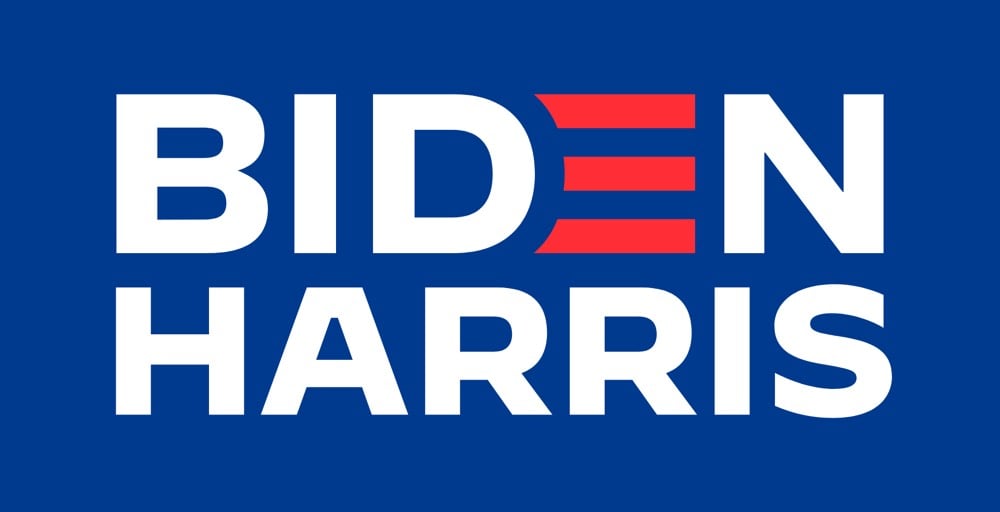
But the designer of the logo wasn’t told who the running mate would be beforehand, so how did the campaign get it out so quickly? According to Jonathan Hoefler, the design team designed a whole collection of logos for potential candidates gleaned from reading the media tea leaves.
A consequential decision at an unpredictable time, conducted under absolute secrecy, poses an interesting dilemma to the typographer: how do you create a logo without knowing for certain what the words will say? Logos, after all, are meaningfully informed by the shapes of their letters, and a logo designed for an eisenhower will hardly work for a taft. The solution, naturally, involves the absurd application of brute force: you just design all the logos you can think of, based on whatever public information you can gather. Every credible suggestion spotted in an op-ed was added to the list that we designers maintained, and not once did the campaign even hint at a preference for one name over another.
I would love to see some of those alternate designs (Biden-Warren!), but there’s no way in hell they’ll ever see the light of day, especially before the election.
Update: Several designers weigh in on the new logo. I love Debbie Millman’s take:
I never, ever thought I’d say this after a lifetime in professional branding, but on the spectrum of good branding versus effective branding, I’d say at this point it is irrelevant. Frankly, the Biden-Harris logo could have been scribbled on a napkin and I’d be happy. Trump’s brand is beyond repair and is now more dangerous than ever. The soul of our country is at stake.
That logos don’t matter that much (unless they are either great or horrible) is probably true more often than designers and branding folks would care to admit.
Ice cream maker Good Humor has teamed up with legendary rapper/musician RZA to produce a new ice cream truck jingle to replace the ubiquitous “Turkey in the Straw”, a tune that gained popularity as a minstrel song with racist lyrics.
“Turkey in the Straw” is one of the most iconic ice cream truck jingles today. However, many people don’t realize that this familiar tune has racist roots.
Turkey in the Straw’s melody originated from British and Irish folk songs, which had no racial connotations. But the song itself was first performed (and gained popularity) in American minstrel shows in the 1800s. Some songs using its same melody contained highly offensive, racist lyrics.
Throughout the 19th century, minstrel songs like Turkey in the Straw were commonly played in ice cream parlors, and later, adapted as ice cream truck jingles.
While these associations of “Turkey in the Straw” are not the only part of its legacy, it is undeniable that this melody conjures memories of its racist iterations.
RZA explains the story behind the new jingle:
And from a press release:
To create an original jingle, The RZA drew inspiration from his own childhood memories of chasing after the ice cream truck in his neighborhood. The track borrows from traditional ice cream truck music and adds jazz and hip-hop elements. Expect trap drumbeats, some old-school bells that reference Good Humor’s original ice cream trucks, and a distinct RZA hook that you will not be able to get out of your head.
Here’s the full jingle:
Song of the Summer 2020? I could totally see Drake or whoever sampling this for an end-of-the-summer ice cream anthem.
Apple just booted Fortnite from the App Store. Epic Games is one of many companies now protesting Apple’s exorbitant 30% cut of App Store revenues.
The British Museum contains hundreds of contested items, the spoils of the British Empire’s reach (and smash n’ grab) across the globe. Some of the museum’s most popular and prized items are included: the Parthenon Marbles, the Rosetta Stone, and the Benin Bronzes. The countries from which these artifacts were taken are increasingly asking for their return.
Some of the world’s greatest cultural and historical treasures are housed in London’s British Museum, and a significant number of them were taken during Britain’s centuries-long imperial rule. In recent years, many of the countries missing their cultural heritage have been asking for some of these items back.
Benin City in Nigeria is one of those places. They’ve been calling for the return of the Benin Bronzes, hundreds of artifacts looted in 1897 when British soldiers embarked a punitive expedition to Benin. Many are now housed in the British Museum.
And it’s just the beginning. As the world reckons with the damage inflicted during Europe’s colonial global takeover, the calls for these items to be returned are getting louder and louder.
See also this piece from the NY Times: This Art Was Looted 123 Years Ago. Will It Ever Be Returned?
Newer posts
Older posts




Socials & More