Entries for March 2020
When America wants to know how bad things are in a crisis, they look not to the President or FEMA, they look to Waffle House.
The “Waffle House Index,” first coined by Federal Emergency Management Agency Director W. Craig Fugate, is based on the extent of operations and service at the restaurant following a storm and indicates how prepared a business is in case of a natural disaster.
For example, if a Waffle House store is open and offering a full menu, the index is green. If it is open but serving from a limited menu, it’s yellow. When the location has been forced to close, the index is red. Because Waffle House is well prepared for disasters, Kouvelis said, it’s rare for the index to hit red. For example, the Joplin, Mo., Waffle House survived the tornado and remained open.
At last count (as of 10:42am on 3/25), 418 Waffle House restaurants across the country were closed, an unprecedented event. The remainder, from what I can gather from social media and news reports, are operating on a carry-out basis only. Kudos to them for doing the right thing in trying to keep their employees and patrons safe.
A prescient article from 2018: The Next Pandemic Will Be Arriving Shortly. “As a result, in 2018, it is impossible to reconcile the redirection of funds away from preparing for pandemics with these realities on the ground.”
Today’s must-read is What I Learned When My Husband Got Sick With Coronavirus by NY Times editor Jessica Lustig. If you’re on the fence about whether COVID-19 is worth all this fuss, Lustig’s account of caring for her gravely ill husband in a Brooklyn apartment while trying to keep herself and their daughter from getting sick should help straighten out your thinking.
Now we live in a world in which I have planned with his doctor which emergency room we should head to if T suddenly gets worse, a world in which I am suddenly afraid we won’t have enough of the few things tempering the raging fever and soaking sweats and severe aches wracking him — the Advil and Tylenol that the doctors advise us to layer, one after the other, and that I scroll through websites searching for, seeing “out of stock” again and again. We are living inside the news stories of testing, quarantine, shortages and the disease’s progression. A friend scours the nearby stores and drops off a bunch of bodega packets of Tylenol. Another finds a bottle at a more remote pharmacy and drops it off, a golden prize I treasure against the feverish nights to come.
His doctor calls three days later to say the test is positive. I find T lying on his side, reading an article about the surge in confirmed cases in New York State. He is reading stories of people being hospitalized, people being put on ventilators to breathe, people dying, sick with the same virus that is attacking him from the inside now.
This is a rough read, no doubt about it. I started crying at the part about his father’s sweater.
The latest issue of the @kottke newsletter just went out. I’m feeling a little fragile today – I hope that intro isn’t too rough.
An Arizona couple tried to self-medicate after watching Trump suggest an untested treatment on TV. The husband died, the wife is in critical care. Millions more deaths to come if this administration continues on its present course.


Using live feed webcams, Noah Kalina is “travelling” around the world photographing places. From top to bottom, Piazza San Marco in Venice, Italy, Times Square in NYC, Huntington Beach, CA, and Bourbon Street in New Orleans. Here’s St. Peter’s Square in Vatican City from just a few minutes ago — it’s completely deserted.
Thinking that some people might need high quality entertainment while shut inside due to the COVID-19 pandemic, filmmaker Gary Hustwit is streaming his films online for free, one film per week. First up (from Mar 17-24) is Helvetica, his documentary on typography and graphic design. Here’s the trailer:
Click through to watch the whole film. (via daring fireball)
Back in late December, a new comet called Comet ATLAS (or C/2019 Y4) was discovered by a robotic astronomical survey on the lookout for objects that may strike the Earth. Don’t worry, Comet ATLAS isn’t going to hit us, but it has a chance to put on quite a show.1 It didn’t seem like much at first, but since its discovery Comet ATLAS has gotten brighter much faster than scientists have expected.
When astronomers first spotted Comet ATLAS in December, it was in Ursa Major and was an exceedingly faint object, close to 20th magnitude. That’s about 398,000 times dimmer than stars that are on the threshold of naked-eye visibility. At the time, it was 273 million miles (439 million kilometers) from the sun.
But comets typically brighten as they approach the sun, and at its closest, on May 31, Comet ATLAS will be just 23.5 million miles (37.8 million km) from the sun. Such a prodigious change in solar distance would typically cause a comet to increase in luminosity by almost 11 magnitudes, enough to make ATLAS easily visible in a small telescope or a pair of good binoculars, although quite frankly nothing really to write home about.
Except, since its discovery, the comet has been brightening at an almost unprecedented speed. As of March 17, ATLAS was already magnitude +8.5, over 600 times brighter than forecast. As a result, great expectations are buzzing for this icy lump of cosmic detritus, with hopes it could become a stupendously bright object by the end of May.
But the brightening could also be a sign that the comet is ejecting a lot of material because it’s burning itself out, so grain of salt. But if keeps brightening at a good pace, it could be visible during the day in the northern hemisphere.
If Atlas manages to remain intact, some in the field have suggested it could grow from magnitude +1 to possibly -5. At the brightest extreme, it could be visible even during the day.
The location of the comet is also notable-unlike more recent comets, it will be best viewed in the Northern Hemisphere.
Chuck Ayoub recently captured the comet arcing across the night sky with his backyard astrophotography rig:
Oh I hope Comet ATLAS can keep it together. I vividly remember going outside in rural Wisconsin darkness to see the tail of Comet Hyakutake stretch halfway across the sky. One of the most amazing things I’ve ever seen.
Update: It looks as though Comet ATLAS will not be dazzling naked-eye observers later this spring — the comet seems to have broken into 3 or 4 pieces as it nears the Sun.

Health experts who have fought pandemics lay out how COVID-19 could be stopped in the US. “Americans must be persuaded to stay home, they said, and a system put in place to isolate the infected and care for them outside the home.”
Like many of you, I’ve been wondering about COVID-19 & food safety. Is it safe to eat takeout prepared by your local restaurant? To answer that and many other questions, Kenji Lopez-Alt has compiled a comprehensive guide to food safety and coronavirus for Serious Eats. Kenji is the most fastidious and exacting food person I know — how could you think otherwise after having read The Food Lab? — so I take his thoughts and research on this very seriously.
Even so, plenty of folks — myself included — have been confused or curious about the safety of allowing restaurants to continue preparing and serving food. Is it actually safe? Should I reheat the food when I get it home? Is it better to support local businesses by ordering food, or am I only putting workers and delivery people at risk? And if I’m cooking my own food, what guidelines should I follow?
To answer these questions, I referenced dozens of articles and scientific reports and enlisted the help of Ben Chapman, a food safety specialist from the North Carolina State University and cohost of Risky or Not and Food Safety Talk.
Let’s get right to the nitty gritty:
Q: Can I get COVID-19 from touching or eating contaminated food?
According to multiple health and safety organizations worldwide, including the CDC, the USDA, and the European Food Safety Authority, there is currently no evidence that COVID-19 has spread through food or food packaging. Previous coronavirus epidemics likewise showed no evidence of having been spread through food or packaging.
Be sure to read on for answers to questions like “Are we going to run out of food?” and “Am I more likely to get COVID-19 from take-out, delivery, or cooking at home?”
The FDA has a coronavirus safety page on their website as well.
Unlike foodborne gastrointestinal (GI) viruses like norovirus and hepatitis A that often make people ill through contaminated food, SARS-CoV-2, which causes COVID-19, is a virus that causes respiratory illness. Foodborne exposure to this virus is not known to be a route of transmission.
In a piece from March 14, Amanda Mull talked with epidemiologist Stephen Morse from Columbia University about food safety:
Even if the person preparing it is sick, he told me via email, “cooked foods are unlikely to be a concern unless they get contaminated after cooking.” He granted that “a salad, if someone sneezes on it, might possibly be some risk,” but as long as the food is handled properly, he said, “there should be very little risk.”
And Don Schaffner, a professor in the food science department at Rutgers, has been posting information on food safety & COVID-19 on Twitter.
Even if a sick worker sneezed on my food (I know that’s gross), my risk of contracting COVID-19 from it are very low.
First it’s important to realize that this is a respiratory illness as far as we know. The biggest risk is being around sick people who are shedding the virus when they sneeze or cough.
Even if the virus did get onto food, we’re going to put that food in our mouth and swallow it so the virus will end up in our stomach. Our stomachs have a low pH which would likely in activate the virus.
Hey folks, just wanted to check in on a few things this morning. I hope you are staying healthy and kind.
1. I spent some time this weekend on the Quick Links infrastructure. (Quick Links are posted to the @kottke Twitter acct and displayed on the front page of the site, right under the most recent post.) There is now a public archive of the Quick Links available here. (If you’re a kottke.org member, you’ve had access to this for months now.) I also started periodically pushing the Quick Links into kottke.org’s RSS feed (yes, ppl still use RSS…at least tens of thousands of them by my count).
2. After a hiatus, I have restarted kottke.org’s newsletter. It was previously a weekly affair, but due to quick moving pandemic news and information, I’m now trying to publish a couple times a week at least. Click here to subscribe.
3. If you’re a regular reader, you’ve noticed that about two weeks ago, I abruptly switched to covering the COVID-19 pandemic almost exclusively. Aside from 9/11, kottke.org has never been focused on a single topic like this, but I believed it was important to get the word out about how infectious diseases spread and how seriously we should be taking this. (VERY SERIOUSLY.) I still believe that. But the site will likely start wandering back towards other topics this week, at least a little bit. This crisis is hitting all of us in many different ways — some are sick, some are bored, some are terrified, some are out there on the front lines saving lives. I hope it’s possible to keep all of those folks (and their different realities & needs) in our minds & hearts while still finding moments of connection to other kinds of human interests and obsessions.
Thanks for reading.
Audible is offering free books for kids while schools are closed. Titles include Winnie the Pooh, Anne of Green Gables, The Jungle Book, and Brave New World.
Some people feel helpless & anxious.
Some people are bored.
Some people are self-quarantined alone and are lonely.
Some people are realizing that After will be very different from Before.
Some people are really enjoying this extra time with their kids and will miss it when it’s over.
Some people just got off their 12th double shift in a row at the hospital and can’t hug their family.
Some people visited their favorite restaurant for the last time and didn’t realize it.
Some people have died from COVID-19.
Some people can’t stop reading the news.
Some people cannot afford soap.
Some people are learning how to bake bread.
Some people are working from home while simultaneously trying to homeschool their kids.
Some people are single parents trying to work from home while simultaneously trying to homeschool their kids.
Some people are living paycheck to paycheck and the next one will not arrive.
Some people are unfit to be President.
Some people left the city for their home in the country.
Some people can’t go to the grocery store because they’re at risk.
Some people lost their jobs.
Some people can’t sleep.
Some people are watching free opera online.
Some people have been quarantined for weeks.
Some people can’t work remotely.
Some people have contracted COVID-19 and don’t know it yet.
Some people can’t concentrate on their work because of anxiety.
Some people can’t afford their rent next month.
Some people are still gathering in large groups.
Some people are keeping the rest of us alive at significant personal risk.
Some people didn’t buy enough hand sanitizer.
Some people bought too much hand sanitizer.
Some people are missing their therapist.
Some people can’t go to work but are still being paid by their employers. For now.
Some people are mainly concerned about what to watch next on Netflix.
Some people are volunteering.
Some people are going to lose their business.
Some people are realizing that teachers are amazing.
Some people are ordering takeout from local restaurants.
Some people would really just like a hug.
Some people can’t convince their elderly parents to take this seriously.
Some people are worried about their 401K.
Some people have never had a 401K.
Some people will face increased abuse at home.
Some people are going to get sick or injured and will have a harder time getting medical care.
Some people can’t buy the food they need because the WIC-eligible stuff is sold out.
Some people won’t stop partying.
Some people lost their childcare.
Some people are doing everything they can to remain calm and hopeful and it’s not working.
Some people are watching Outbreak & Contagion and playing Pandemic.
Some people don’t know what they’re going to do.
Some people are overwhelmed with advice on how to work from home.
Some people are drinking or eating too much.
Some people are thinking about after.
Some people are upset because they can’t travel.
Some people are horny.
Some people are planning for a larger garden this year.
Some people won’t see their families for months.
Some people are logging off to stay grounded.
Some people can’t see the light at the end of the tunnel.
Some people will realize they need to split with their partner.
Some people are singing Imagine.
Some people aren’t on this list.
These are all based on the experiences of real people drawn from news stories, social media, and friends. Take heart: you are not the only person experiencing what you are going through. But be mindful: not everyone is having the same experience you are. Ultimately though, we are all in this together.
The first lines of classic novels rewritten for social distancing. “It is a truth universally acknowledged, that a single man in possession of a good fortune, must be hoarding toilet paper.”
Space Shuttle thermal tiles conduct heat so poorly that after being in a 2200 °F oven for hours, you can pick them up with your bare hands only seconds after they come out, still glowing hot.
On March 10, Tomas Pueyo published a widely read and praised article called Coronavirus: Why You Must Act Now. Yesterday, in the wake of the Imperial College paper and the criticism of it, Pueyo has published a second article: Coronavirus: The Hammer and the Dance. I urge you to read it — it’s sobering yet hopeful. A summary:
Strong coronavirus measures today should only last a few weeks, there shouldn’t be a big peak of infections afterwards, and it can all be done for a reasonable cost to society, saving millions of lives along the way. If we don’t take these measures, tens of millions will be infected, many will die, along with anybody else that requires intensive care, because the healthcare system will have collapsed.
As the title indicates, Pueyo and his collaborators are suggesting an approach that combines initial aggressive action followed by a longer period of efficient vigilance. First comes the Hammer — we use aggressive measures for weeks, giving our healthcare system time to ramp up & scientists time to research the hell out of this thing and for the world’s testing capability to get up to speed.
And then we Dance.
If you hammer the coronavirus, within a few weeks you’ve controlled it and you’re in much better shape to address it. Now comes the longer-term effort to keep this virus contained until there’s a vaccine.
This is probably the single biggest, most important mistake people make when thinking about this stage: they think it will keep them home for months. This is not the case at all. In fact, it is likely that our lives will go back to close to normal.
But, here’s how the Dance works:
How come South Korea, Singapore, Taiwan and Japan have had cases for a long time, in the case of South Korea thousands of them, and yet they’re not locked down home?
In this video, the South Korea Foreign Minister explains how her country did it. It was pretty simple: efficient testing, efficient tracing, travel bans, efficient isolating and efficient quarantining.
That way, most people aren’t locked down, just those who need to be — the sick, the people who have been with those who have gotten sick, etc. Most people can go back to work, back to fairly normal routines.
I call the months-long period between the Hammer and a vaccine the Dance because it won’t be a period during which measures are always the same harsh ones. Some regions will see outbreaks again, others won’t for long periods of time. Depending on how cases evolve, we will need to tighten up social distancing measures or we will be able to release them. That is the dance of R: a dance of measures between getting our lives back on track and spreading the disease, one of economy vs. healthcare.
This piece in the Atlantic, This Is How We Can Beat the Coronavirus by Aaron E. Carroll & Ashish Jha, advocates for essentially the same approach.
We can create a third path. We can decide to meet this challenge head on. It is absolutely within our capacity to do so. We could develop tests that are fast, reliable, and ubiquitous. If we screen everyone, and do so regularly, we can let most people return to a more normal life. We can reopen schools and places where people gather. If we can be assured that the people who congregate aren’t infectious, they can socialize.
We can build health-care facilities that do rapid screening and care for people who are infected, apart from those who are not. This will prevent transmission from one sick person to another in hospitals and other healthcare facilities. We can even commit to housing infected people apart from their healthy family members, to prevent transmission in households.
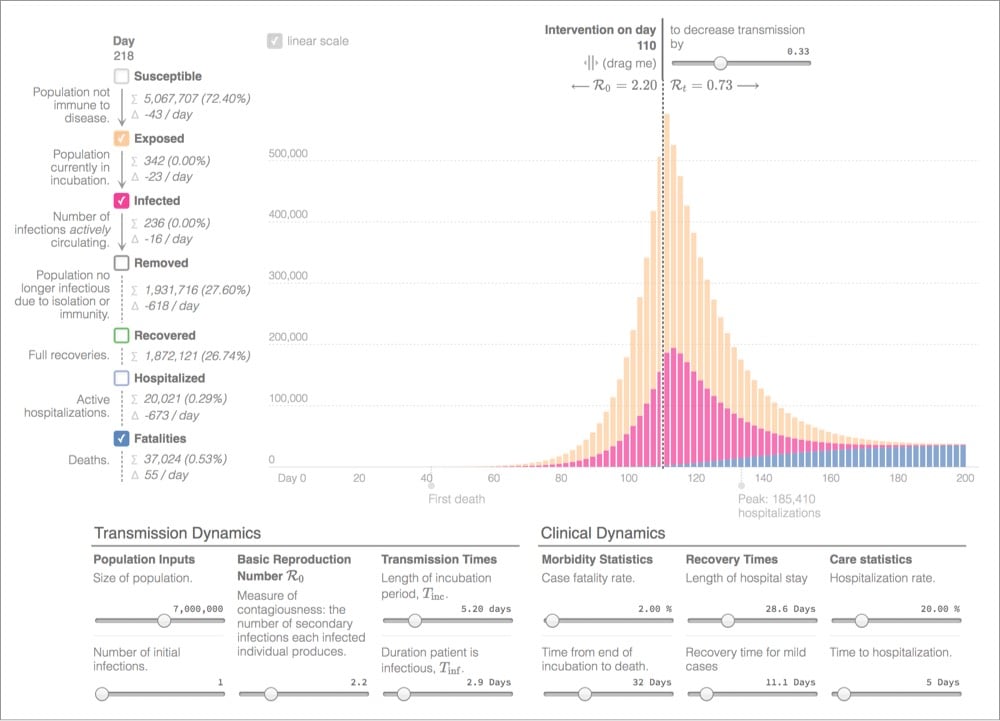
By manipulating values like R0, incubation time, and hospitalization rate with this this epidemic graphing calculator, you really get a sense of how effective early intervention and aggressive measures can be in curbing infection & saving lives in an exponential crisis like the COVID-19 pandemic.
Steven Heller is right – this is an awful magazine cover by New York magazine. The wrong tone at the wrong time. Ad/marketing/media folks need to rethink these “attention at all costs” strategies.
From Lynn Ungar, a poem called Pandemic. “What if you thought of it / as the Jews consider the Sabbath– / the most sacred of times?”
I don’t know if they specifically had this in mind when making it, but this video from Vox about the importance of hand washing with soap to kill coronavirus is very kid-friendly. From my pals at the excellent The Kid Should See This
Wash your hands for 20 seconds with soap and water. This is the very best way to kill viruses like coronavirus. But why? What’s happening on our hands when we use soap and water? And why do we have to wash with soap for 20 seconds? Why not ten?
The glow-in-the-dark explanation of the 20-second rule was extremely convincing.
See also How to Wash Your Hands Properly and Washing Your Hands Is Important Because Soap “Absolutely Annihilates” Coronavirus. (via tksst)
Update: Mark Rober did an experiment with a powder that glows under UV and can be transferred from surface to surface (or hand to surface). You can see the germs spreading from person to person and all over that classroom. Yikes.
This morning Kurzgesagt released their video about COVID-19 that they’ve been working on for a week, and it is excellent, particularly the first part where they explain exactly what the SARS-CoV-2 virus does to a human body and why it can be so dangerous. I hadn’t heard that described before, especially in such relatively simple terms.
The virus has not caused too much damage yet, but corona is now going to release a real beast on you: your own immune system. The immune system, while there to protect you, can actually be pretty dangerous to yourself and needs tight regulation. And as immune cells pour into the lungs to fight the virus, corona infects some of them and creates confusion. Cells have neither ears nor eyes — they communicate mostly via tiny information proteins called cytokines — nearly every important immune reaction is controlled by them. Corona causes infected immune cells to overreact and yell bloody murder. In a sense, it puts the immune system into a fighting frenzy and sends way more soldiers than it should, wasting its resources and causing damage.
Kurzgesagt always provides a list of scientific sources used to produce their videos, and the one for this video is particularly extensive and they are going to keep it updated.
Update: For more information on the coronavirus itself, SARS-CoV-2, see Ed Yong’s piece in the Atlantic and How the Coronavirus Could Take Over Your Body (Before You Ever Feel It) from New York magazine.
We might have to make do with virtual travel for awhile. You can check out 30 UNESCO World Heritage Sites (Taj Mahal, Dolomites, Stonehenge) using Google Earth.
One of the key shortages in areas overwhelmed by COVID-19 patients (like Italy) is ventilators in hospitals. COVID-19 is a respiratory illness and respirators are essential in treating patients with acute symptoms. In the US and other countries, experts are warning of ventilator shortages and manufacturers say it will be difficult to ramp up production quickly enough to meet demand. So healthcare providers are looking for other solutions.
One potential solution is modifying ventilators to work for more than one person at a time. Based on feasibility research published in 2006, the simple technique uses inexpensive parts that hospitals already have on hand to modify machines to work with 4 patients at a time (with important caveats). One of the authors of that research paper, Dr. Charlene Babcock, explains how to hack the ventilators in this video:
Some notes from the video:
- The initial study used test lungs (not actual humans)
- You need to make sure the lung size and resistance of all four patients hooked up to a single ventilator are the same. No mixing adults and kids, for instance.
- Make sure the ventilator tubes leading to and from the patients are all the same length.
- This technique has been used successfully in the field, during the aftermath of the 2017 Las Vegas shooting.
- They did not investigate cross-contamination effects, so you have to make sure all the patients connected to one machine are COVID-19 patients in order to mitigate the risk.
In closing, Babcock says:
Now here’s my disclaimer. This is off-label use of the ventilator. The ventilator is made for one person and I’m using it here in a simulation of four patients. I always hope that you would never need to use it in this way, but you can never predict what’s going to happen in a disaster. And if it was me and I had four patients and they all needed intubation and I only had one ventilator, I would simply have a shared discussion meeting with all four families and say “I could pick one to live or we could try to have all four live”. But this is clearly off-label and likely would only be used in dire circumstance, which we may see with COVID-19.
Other people are working on designing and deploying open source ventilators and ventilators made from parts of other machines. All this reminds me of that scene in Apollo 13 where NASA engineers design a modified CO2 scrubber using only parts available on the spacecraft. A similar “failure is not an option” spirit might be called for in this case as well.
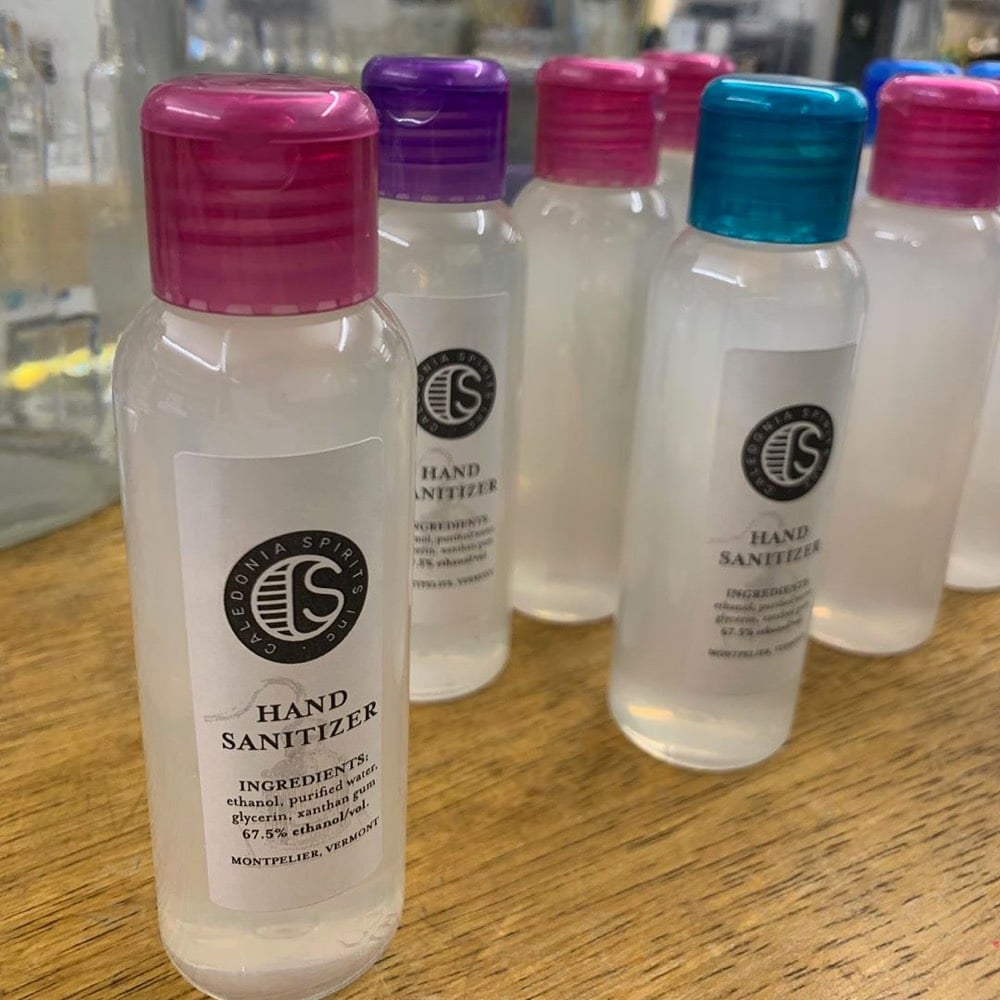
Hand sanitizer, a necessary tool in the fight against the COVID-19 pandemic, has been difficult to come by in stores the past few weeks (or months, depending on your location). Last night, I read in a local email newsletter here in Vermont that Mad River Distillers is producing hand sanitizer and giving it away for free to local residents. They’ve set up two pick-up stations for today — it’s BYOB and limited to 6oz per person. Earlier this week, workers at Barr Hill’s closed distillery made hand sanitizer and distributed it to local food shelves. Green Mountain Distillers and Smuggler’s Notch Distillery have also begun producing hand sanitizer.
These Vermont companies join dozens of other distilleries around the country (and world) that have started using high proof alcohol to produce hand sanitizer that meets the CDC’s recommendation of 60% ethanol needed to inactivate the virus that causes COVID-19: Texas, Alabama, Florida, Connecticut, Arkansas, Pennsylvania, Illinois, Oregon, and many more. From Bloomberg:
Basic recipes include aloe vera for moisturizing; distilleries will also add the botanicals or flavorings from their signature spirits as a twist. Portland, Ore.-based Shine Distillery & Grill isn’t treating its formula like a trade secret. “I have fielded some calls from Seattle and suggested they contact their local distilleries to tell them what we are doing,” says general manager Ryan Ruelos. “Because any distillery can do it.”
The one thing they cannot do, though, is sell their sanitizers: Sales of distilled spirits are strictly regulated by the government and could jeopardize business licenses. Instead, distilleries are giving them away to customers who come through their doors. In some cases, such as at Psychopomp Microdistillery in Bristol, England, donations from customers who take the sanitizer are being given to charity.
Around the world, alcohol is often used in toasts that relate to health: the Irish “sláinte” (health), the Mexican Spanish “salud” (to health), the Russian “vashe zdorov’ye” (to your health), the Persian “be salamati” (good health), and the Hindi “achchee sehat” (good health). These distillery-produced hand sanitizers are a toast of health from them to us, and I am very grateful for it.
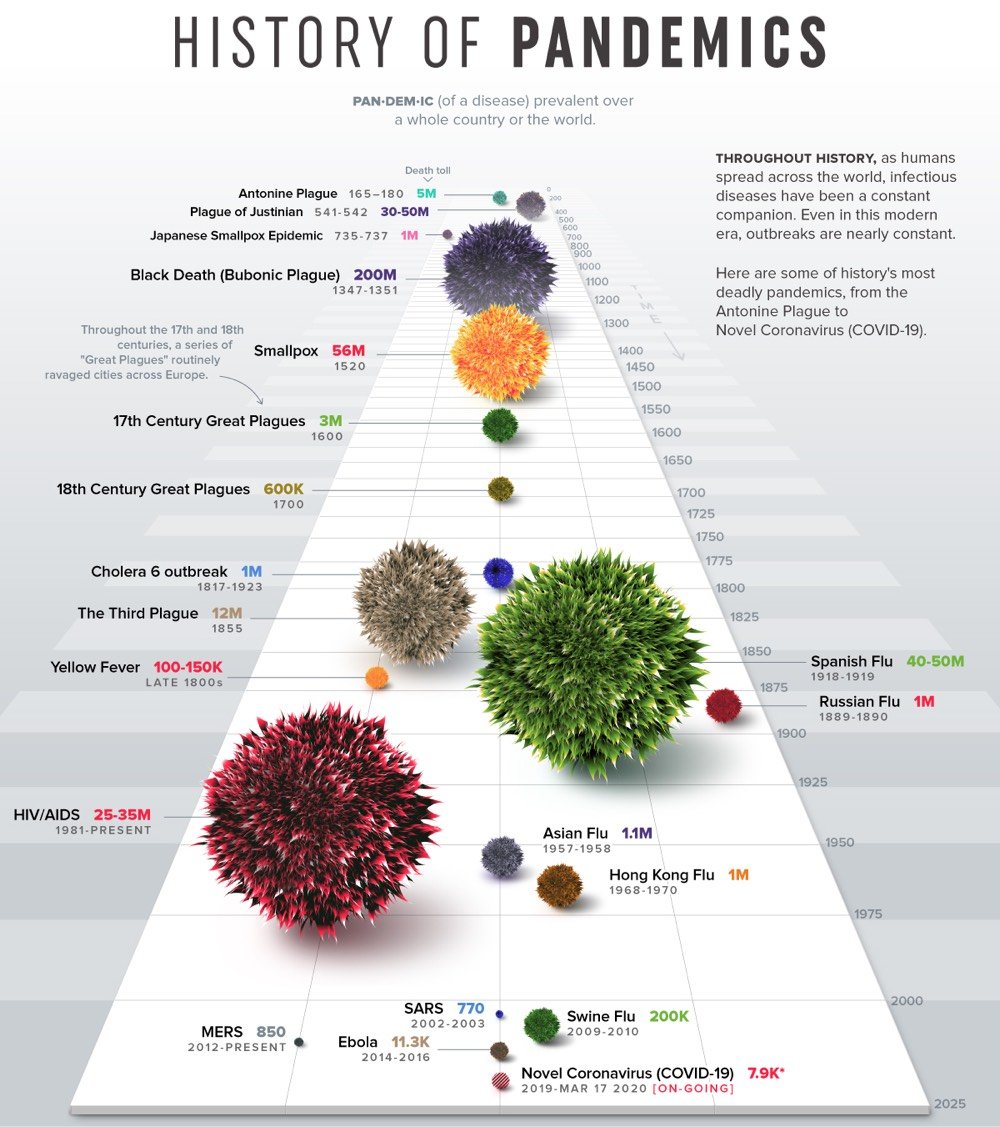
From Nicholas LePan, Visualizing the History of Pandemics.
The practice of quarantine began during the 14th century, in an effort to protect coastal cities from plague epidemics. Cautious port authorities required ships arriving in Venice from infected ports to sit at anchor for 40 days before landing — the origin of the word quarantine from the Italian “quaranta giorni”, or 40 days.
One of the first instances of relying on geography and statistical analysis was in mid-19th century London, during a cholera outbreak. In 1854, Dr. John Snow came to the conclusion that cholera was spreading via tainted water and decided to display neighborhood mortality data directly on a map. This method revealed a cluster of cases around a specific pump from which people were drawing their water from.
While the interactions created through trade and urban life play a pivotal role, it is also the virulent nature of particular diseases that indicate the trajectory of a pandemic.
One of my big takeaways from the Tracking Infectiousness section of the piece is: holy shit, look at how contagious measles is! An R0 of 16! (The common flu is about 1.5 and ebola is 2.0.) And people want to keep their children from getting vaccinated for this?!
The Washington Post made this short video that shows how Fox News personalities were talking about the COVID-19 pandemic a week or two ago — it’s a Democrat hoax!! — compared to their more recent coverage that aligns closer with the truth.
For weeks, some of Fox News’s most popular hosts downplayed the threat of the coronavirus, characterizing it as a conspiracy by media organizations and Democrats to undermine President Trump.
Fox News personalities such as Sean Hannity and Laura Ingraham accused the news media of whipping up “mass hysteria” and being “panic pushers.” Fox Business host Trish Regan called the alleged media-Democratic alliance “yet another attempt to impeach the president.”
It has never been more plain that Fox News is not journalism but conservative propaganda. They, along with Trump, some conservative members of Congress, and conservative talk radio, were just straight up lying, misleading the public, and peddling conspiracy theories until it became overwhelmingly clear that this is a serious situation, as experts had been saying for weeks. The video shows completely contradictory statements made by the same people days apart; as Andrew Kaczynski says, “what a damning indictment”. I’ll go further than that: Fox News endangered the lives of Americans with their false and misleading coverage. People will suffer and die unnecessarily because of it.
I’d urge you to show this to your red state relatives and ask them to defend Fox News as journalism, but I don’t think it will actually do any good. The whole point of propaganda is to deprive people of, as Hannah Arendt puts it, the “capacity to think and to judge”.
The moment we no longer have a free press, anything can happen. What makes it possible for a totalitarian or any other dictatorship to rule is that people are not informed; how can you have an opinion if you are not informed? If everybody always lies to you, the consequence is not that you believe the lies, but rather that nobody believes anything any longer. This is because lies, by their very nature, have to be changed, and a lying government has constantly to rewrite its own history. On the receiving end you get not only one lie-a lie which you could go on for the rest of your days-but you get a great number of lies, depending on how the political wind blows. And a people that no longer can believe anything cannot make up its mind. It is deprived not only of its capacity to act but also of its capacity to think and to judge. And with such a people you can then do what you please.
Newer posts
Older posts




Socials & More