



“Is there a biochemical reason that extreme weather makes us happy?”

Advertise here with Carbon Ads
This site is made possible by member support. 💞
Big thanks to Arcustech for hosting the site and offering amazing tech support.
When you buy through links on kottke.org, I may earn an affiliate commission. Thanks for supporting the site!
kottke.org. home of fine hypertext products since 1998.
Beloved by 86.47% of the web.
Entries for September 2019
The Server Bone Is Connected to the DNS Bone…

Some of you may have noticed that kottke.org was unavailable for more than 36 hours on Thursday and Friday last week. That’s the longest stretch of downtime for the site since… well, probably ever. That sucks and I’m sorry. Here’s (briefly) what happened:
On Thursday morning, my domain registrar (Dotster) locked access to the kottke.org domain after they couldn’t reach me at the email address listed, which was an address from when I registered the domain 20+ years ago that I haven’t used since before Obama was President. Seeing as the business address listed on the account was also 20 years old, verification via documents was not going to work either (and that process was going to take days to unfold). Their first-line support people were confused about how to even proceed — “this is a very unusual situation…” It was at this point where I started wondering (ok, freaking out) if I was ever going to get my domain name back. How do I prove that I am who I was 20 years ago?1
Eventually — and I say “eventually” because I missed a voicemail that I thought was one of 3-5 spam voicemails I get every weekday — I was connected (via Twitter) to Winston Wolf’s team at Dotster, the folks who could actually do something for me. After some back and forth and several verifications, they unlocked the domain and the site came back up on Friday afternoon. And then I collapsed into a puddle of whatever chemicals are released from your body after a massively stressful event.
To be clear, not keeping the information on my domain up-to-date was my fault. (The info on my Dotster account was current though, but not the same thing apparently.) And I appreciate Dotster’s efforts in helping me regain access to my domain and ensuring that no one was trying to social engineer it away from me. But locking access like that to a domain name that’s had a single owner since its initial registration and has been paid for by the same credit card for more than 10 years (and was prepaid until 2022) seems overzealous. The sudden need for domain verification was not triggered by some fishy activity on my account but by an internal Dotster process and keeping the site offline until it was resolved was excessive and I’m still not happy about it. Sure, don’t allow changes or transfers until it’s verified, but turning off a domain that’s paid for and been happily humming along without changes for literal decades is just not right.
Ok. Anyway, that’s what happened. All my information is now updated so it shouldn’t happen again. *fingers crossed* I’d like to thank Mike at Dotster, Greg Knauss (kottke.org’s tech godfather), and the fantastically speedy support folks at Arcustech for their help in diagnosing and fixing the problem. I also want to apologize to everyone who financially supports the site through a membership. Guaranteed uptime for the site was not explicitly part of the arrangement, but I still take any outages seriously. Part of what I imagine the appeal of the site to be is that it’s always here, with URLs that don’t change and a regular publishing schedule, year after year. As of Friday afternoon, we’re on a new uptime streak that will hopefully last a long while.
-jason
A reader called this “the ‘never step in the same river twice’ security conundrum”. Love a Heraclitus reference.↩
So @kottke is still down (sorry!) but I suddenly remembered I have a newsletter. So here’s my recent media diet (incl. American Factory, Fiasco, and Do the Right Thing).
Out next week: Permanent Record, a memoir from Edward Snowden. “Six years later, Snowden reveals for the very first time how he helped to build this system and why he was moved to expose it.”
Yosemite’s Rainbow Waterfall
The light and the wind happened to be just right for Greg Harlow to catch this rainbow emanating from upper portion of Yosemite Falls. Beautiful. The 21-second time lapse version of the video makes the falls look like a rainbow flame:
It’s astounding enough that perfect curves of color appear in the sky after rainstorms, but could you imagine seeing a waterfall rainbow like this happen in real life? My head would have exploded. (via the kid should see this)
First Look: 2019 Wildlife Photographer of the Year


The Natural History Museum has released a sneak preview of the Wildlife Photographer of the Year competition for 2019, sharing several “Highly Commended” photos from the exhibition.
Photo credits: Peter Haygarth (top) and Thomas P Peschak (bottom).
Motivated Reasoning and Tribal Loyalty in Politics
For years, researchers have identified a link between a person’s “moral foundations” and their political views. In a piece for The Atlantic, Olga Khazan summarized it like so:
According to the researchers who invented the quiz, the issues that most concern political liberals tend to fall under the category of “individualizing” moral foundations, which have more to do with personal standards: care versus harm and fairness versus cheating. Political conservatives, meanwhile, tend to be more concerned about group-focused “binding” foundations: loyalty versus betrayal, authority versus subversion, and disgust versus purity. If loyalty is extremely important to you, the research suggests, you might care deeply about supporting the troops, and therefore you might be more likely to be politically conservative.
She then goes on to describe the results of a new study that suggest that maybe our morals are determined by our political affiliation and not the other way around.
In a series of analyses published recently in the American Journal of Political Science, the three researchers found that people’s moral codes don’t cause or predict their political ideology; instead, people’s ideology appears to predict their answers on the moral-foundations questionnaire. As Peter Hatemi, one of the study’s authors and a political-science professor at Pennsylvania State University, puts it: “We will switch our moral compass depending on how it fits with what we believe politically.”
This could explain how the Republicans’ opinion of Russia changed so quickly in the wake of allegations that Donald Trump colluded in Russia’s meddling in the 2016 election, the Republican flip-flop on climate change, the evangelical Christian embrace of the most immoral President in recent history, and the leftward swing of many Democratic Party members, following their most visible politicians (Bernie, Warren, AOC) & most vocal supporters away from Obama’s centrism.
An Octopus that “Billows Like a Circus Tent”
A team of researchers exploring about a mile beneath the surface of the Pacific Ocean ran across this graceful octopus that put on a show for them.
Dancing at a depth of around 1,600 meters (5,250 feet), this elegant octopus measures an estimated 1.3 m (4.2 ft) across and entertained our watch team for more than five minutes.
“It’s really putting on a show for us,” said a researcher as the cephalopod made its way toward Hercules’ camera, expanding its billowing arms like a circus tent blowing in the wind. Experts believe the octopus belongs to Cirroteuthidae, a family of cirrate octopuses, but the exact species is unknown.
IKEA halts a 3000-person game of hide-and-seek in one of its stores. Police and store employees were “stopping everyone who ‘looks like they are here for a game of hide and seek’”.
A Forest Grows on an Austrian Soccer Pitch
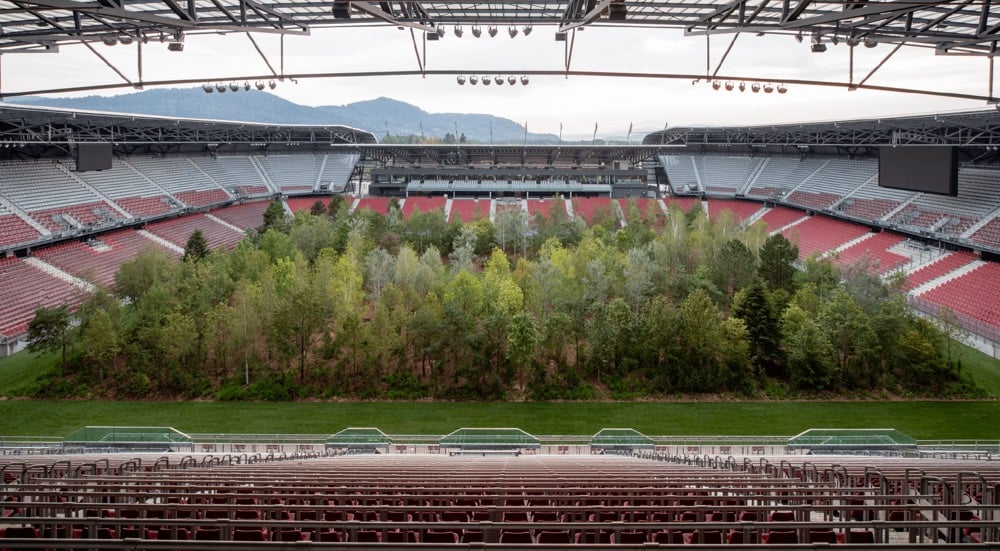
For Forest — The Unending Attraction of Nature is an art installation from Klaus Littmann that features a forest made up of 300 trees in the middle of a soccer stadium in Klagenfurt, Austria.
Using 300 trees, some of which weigh up to six tonnes, landscape architect Enzo Enea will cover the entire playing field with a mixed forest characteristic of Central Europe.
From the grandstands, visitors can admire the spectacle of the trees day and night (from 10am until 10pm). Admission is free. A sight that is as unfamiliar as it is fascinating and bound to stir up a range of emotions and reactions! Depending on the time of day (or night), the trees will constitute a constantly changing landscape that is shaped by the weather as well as the autumnal turning of the leaves. The installation is a clever play on our emotions when faced with what should be a familiar sight, placed in an entirely different context. With this monumental work of art, Littmann challenges our perception of nature and sharpens our awareness of the future relation between nature and humankind.
The project also sees itself as a warning: One day, we might have to admire the remnants of nature in specially assigned spaces, as is already the case with zoo animals.
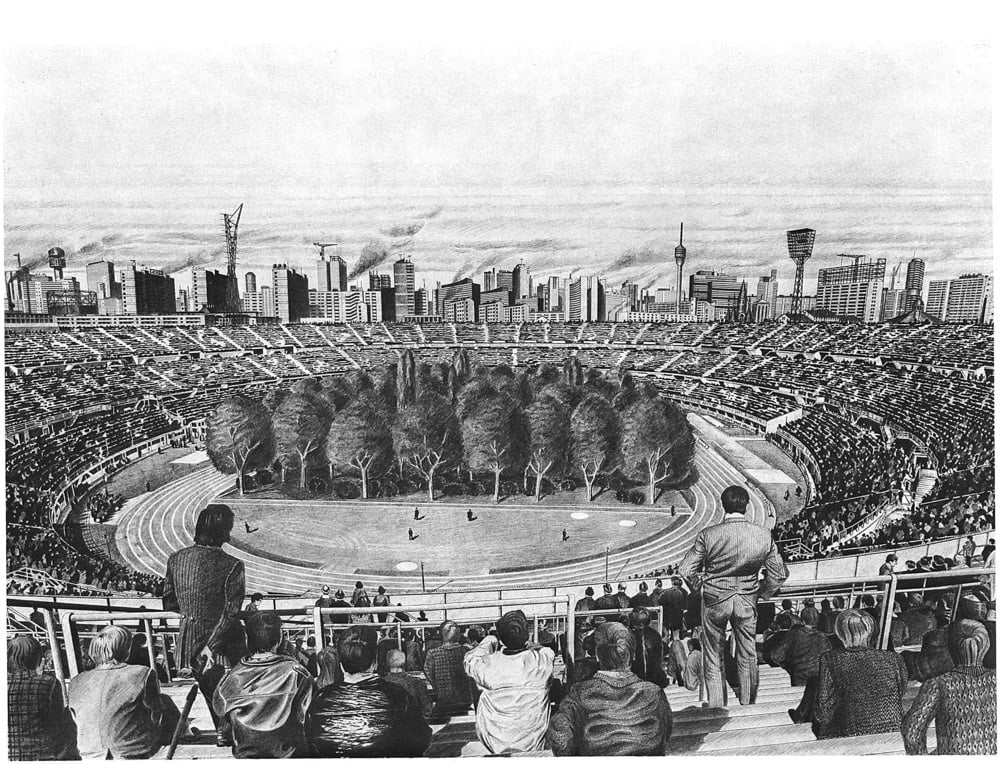
Littmann modeled the project on a 1970 drawing by Max Peintner.
I didn’t think much of this project from just the photos, but this short video really highlights the darkly comedic experience of having to go to a soccer stadium to look at nature — not to experience nature, but to sit in a moulded plastic seat a few hundred feet away from nature to look and cheer but not to touch or walk around in.
I would love to see this in person. For Forest is on view until late October.
Treasures in the Trash
Treasures in the Trash is a short film by Nicolas Heller about former NYC sanitation worker Nelson Molina, who started (and still maintains) an unofficial museum of more than 45,000 objects that people have thrown out over the last few decades.
The History of Europe, Every Year from 400 BCE to the Present
This video is an animated history of the shifting borders of Europe from 400 BCE to the present. This is a very nation-centric view of European history (and I would mute the music and use your own soundtrack), but it’s still worth a look.
The Atlantic introduces a digital subscription; five free articles a month and then you hit the paywall. Another one bites the dust. I’m gonna run out of places to freely link to soon…
How to Be an Antiracist
Historian Ibram X. Kendi first crossed my radar as a frequent contributor on the podcast series Seeing White (which I loved and urge you all to listen to). Kendi’s new book, How to Be an Antiracist, looks like one we all should be reading this fall.
Antiracism is a transformative concept that reorients and reenergizes the conversation about racism — and, even more fundamentally, points us toward liberating new ways of thinking about ourselves and each other. At its core, racism is a powerful system that creates false hierarchies of human value; its warped logic extends beyond race, from the way we regard people of different ethnicities or skin colors to the way we treat people of different sexes, gender identities, and body types. Racism intersects with class and culture and geography and even changes the way we see and value ourselves. In How to Be an Antiracist, Kendi takes readers through a widening circle of antiracist ideas — from the most basic concepts to visionary possibilities — that will help readers see all forms of racism clearly, understand their poisonous consequences, and work to oppose them in our systems and in ourselves.
In a NY Times review, Jeffrey Stewart called the book “a 21st-century manual of racial ethics”.
Kendi is on a mission to push those of us who believe we are not racists to become something else: antiracists, who support ideas and policies affirming that “the racial groups are equals in all their apparent differences — that there is nothing right or wrong with any racial group.” For Kendi, the founding director of the Antiracist Research and Policy Center at American University, there are no nonracists; there are only racists — people who allow racist ideas to proliferate without opposition — and antiracists, those who expose and eradicate such ideas wherever they encounter them.
Human composting is now legal in Washington. “The bodies decomposed after about four weeks, producing about one cubic yard of soil per person.”
“My Dead Dad’s Porno Tapes”
Filmmaker Charlie Tyrell’s father passed away when Charlie was in film school. Feeling like he never really knew his father all that well, he went through his stuff after he died, looking for clues as to who he really was. His tools, his police uniform, his cancer diagnosis. Charlie made a short film about his dad: My Dead Dad’s Porno Tapes.
We hold onto our loved ones when they pass. Objects can become talismans, and memories become mythic. Some objects become sacred for no reason and are just as impenetrable as the people who left them. I came to a conclusion during my process: You can’t take it with you, but you can pass it on.
The tapes mentioned in the title don’t feature all that much in the film; it’s actually about family secrets, breaking a generational cycle of abuse, and parenting. In talking about her husband’s difficulty connecting with his children, Charlie’s mom says: “you bring what you know to parenting”. As someone who often struggles as a parent, that line hit me hard. From a post I wrote a few years ago:
I worry about my children, about my relationships with them. I worry about being a good parent, about being a good parenting partner with their mom. How much of me do I really want to impart to them? I want them to be better than me, but I can’t tell them or show them how to do that because I’m me. I took my best shot at being better and me is all I came up with. What if I’m just giving them the bad parts, without even realizing it?
And from Madeline Miller’s Circe:
Two children he had had and he had not seen either clearly. But perhaps no parent can truly see their child. When we look we see only the mirror of our own faults.
The Surprising Grace & Power of a Slow Motion Pigeon Take-off
In this slow motion video clip from a BBC program called Secrets of Bones, you can see how a pigeon takes off so quickly. Pigeons can accelerate from 0 to 60 mph in about 2 seconds, straight up from the ground. A look at its skeleton reveals short, thick bones, an absolute necessity for an animal generating that much power in such a short time. (via the kid should see this, back from its summer hiatus)
50 States of True Crime. “Every state has an infamous crime — and a book about it.”
Who are some famous women you learned to like after recognizing societal misogyny? E.g. Monica Lewinsky, Lorena Bobbitt, Yoko Ono, Sinead O’Connor…
Woven Photo Collages
For her O.P.P. series, Heather Oelklaus weaves together strips of cut-up prints to form new scenes.


In the series O.P.P. (Other People’s Photography), hand woven silver gelatin and inkjet prints survey stereotypical and nostalgic notions. Found photographs from US Army wives’ gatherings and Hollywood film stills are woven together to reconstruct new narratives. The expressive gaze within these staged photographs breaks through the picture’s surface as if to confront the viewer. These sophisticated slices of history illustrate an era of inclusion and exclusion while leaving the viewer to compare present day relationships.
The Comet
Director Christian Stangl and composer Wolfgang Stangl used millions of photos (that’s right, millions!) taken by the ESA’s Rosetta spacecraft of Comet 67P/Churyumov-Gerasimenko to make this short video that makes the mission feel like sci-fi a la Alien or District 9.
Happy 150th Birthday, Periodic Table!
Bloomberg Businessweek dedicated their entire Sept 2, 2019 issue to the periodic table (it’s 150 years old this year) and the elements it contains. From the introductory essay:
Over the past century and a half, but particularly since World War II, scientists and engineers have learned to treat the periodic table like a banquet table-a bountiful spread from which to pluck what they need. There’s scandium in bicycle frames, tin (stannous fluoride) in toothpaste, tungsten in catheters, and arsenic in some computer chips. We are well past the Stone Age, the Bronze Age, and the Iron Age, and into the Everything Age, because almost every entry on the periodic table is being put to some kind of use in today’s economy (excluding synthetic elements that are costly to make and highly radioactive, such as einsteinium).
Cellphones exemplify the complexification. The first ones in the 1980s “were the size of a shoebox and consisted of 25 to 30 elements,” Larry Meinert, U.S. Geological Survey deputy associate director for energy and minerals, said in 2017. “Today, they fit in your pocket or on your wrist and are made from about 75 different elements, almost three-quarters of the periodic table.” That may include tantalum from Rwanda, potassium from Belarus, silver from Mexico, tin from Myanmar, carbon from India, and germanium from China.
Scrolling down on the main story page will take you on a modern-day tour of the periodic table from the lightest elements (hydrogen, helium, lithium) to the heavier ones (uranium, polonium) to some fake ones (adamantium, unobtanium, feminum).
Pixar’s AI Spiders
As I mentioned in a post about my west coast roadtrip, one of the things I heard about during my visit to Pixar was their AI spiders. For Toy Story 4, the production team wanted to add some dusty ambiance to the antique store in the form of cobwebs.
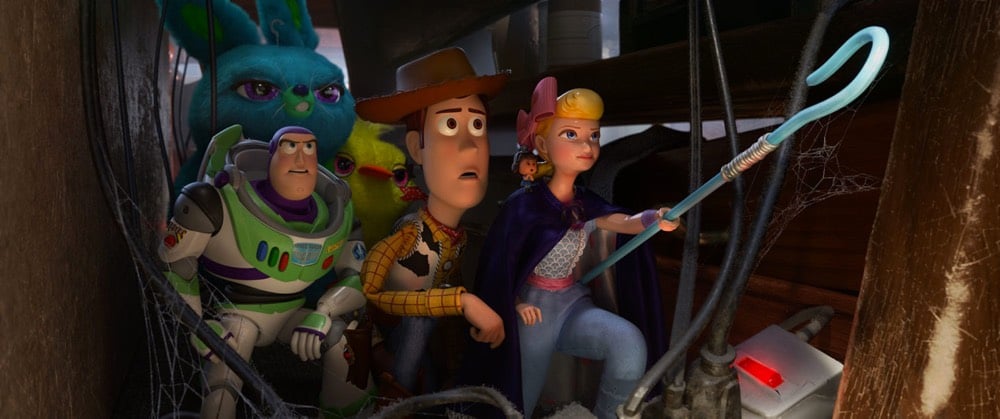
Rather than having to painstakingly create the webs by hand as they’d done in the past, technical director Hosuk Chang created a swarm of AI spiders that could weave the webs just like a real spider would.
We actually saw the AI spiders in action and it was jaw-dropping to see something so simple, yet so technically amazing to create realistic backgrounds elements like cobwebs. The spiders appeared as red dots that would weave their way between two wood elements just like a real spider would.
All the animators had to do is tell the spiders where the cobwebs needed to be.
“He guided the spiders to where he wanted them to build cobwebs, and they’d do the job for us. And when you see those cobwebs overlaid on the rest of the scene, it gives the audience the sense that this place has been here for a while.” Without that program, animators would have had to make the webs one strand at a time, which would have taken several months. “You have to tell the spider where the connection points of the cobweb should go,” Jordan says, “but then it does the rest.”
Chang and his colleague David Luoh presented a paper about the spiders (and dust) at SIGGRAPH ‘19 in late July (which is unfortunately behind a paywall).
Some tips from my pal Matt that make remote work easier. “Your local library is like a coworking space, but free.”
Nine Things a Woman Couldn’t Do in 1971 in America
Twitter user @WPCelebration recently compiled a list of nine activities and rights denied to women in America in 1971, just 48 years ago. The list includes:
- A woman couldn’t get a credit card in her own name. They often needed a man to co-sign for a card. The Equal Credit Opportunity Act put a stop to this discrimination in 1974.
- Until the Pregnancy Discrimination Act of 1978, women could be fired for getting pregnant (or not hired if they were pregnant). Despite the act, pregnancy discrimination continues today.
- Women couldn’t attend certain Ivy League schools. Harvard did not fully admit women into its undergraduate program until 1977, Dartmouth took until 1972, and Columbia waited until 1983.
- In some states, women couldn’t say “no” to sex with their husbands. In 1993, the last two states (Oklahoma and North Carolina) withdrew their marital rape exemptions. But even today, several states treat marital rape as a lesser offense with smaller penalties compared to non-marital rape.
- Until a 1972 Supreme Court case, unmarried women in some states were prohibited from purchasing birth control pills.
Ms magazine published a similar list back in 2013 that also included the difficulty in getting a divorce without cause and obtain a safe & legal abortion in all 50 states. Bustle talked to several women about what discrimination was like before many of these changes took place.
I was denied a job in 1970 because I was newly pregnant. They actually had a question on the application regarding the date of your last menstrual period. Also, with my second child in 1974, they were not required to hold your position while you were on maternity leave, and I was told that my job was no longer open and I had to file for unemployment.
As a reminder, women only gained the right to vote in America fewer than 100 years ago.
The 25 Most Important Characters of the Past 25 Years
I love cross-disciplinary lists like this: The 25 Most Important Characters of the Past 25 Years.
We polled critics and other culture obsessives from Slate and beyond to assemble an enormous master list of influential characters. They were animated and live-action, wizard and Muggle, human and avian, fictional and based on actual persons, living and dead. They came from movies, books, TV series, video games, tweets, podcasts, comics, songs, and (in a surprise to us) more than one musical. Reflecting our franchise-driven time, many of them came from many of those media at once. The only rule was that they must have originated in a work of culture sometime in the past quarter-century, which meant no Simpsons or hobbits or diner-dwelling New Yorkers who argue about nothing. Then we ruthlessly winnowed down the list to the most crucial of those characters, the ones who have left an outsize mark on our planet circa 2019, to assemble this new pantheon.

Many of my favorite characters made it on there: Thomas Cromwell from Hilary Mantel’s Wolf Hall & Bring Up the Bodies; Omar Little from The Wire; Tracy Flick from Election; and Hermione Granger from Harry Potter, a much more inspired pick than the titular hero for reasons I’ve already articulated. The full list is worth a read.
25 TV Shows That Should Have Ended Sooner. Some I agree with (Lost, Arrested Development, The Office) and some I do not (Mad Men, Girls).
How Much Better Does an Expensive Piano Sound Than a Cheap One?
YouTuber Lord Vinheteiro recently played the same pair of tunes on six different pianos, ranging from a $499 used upright to a $112,000 Steinway to a $2.5 million Steinway grand piano that’s tacky af. Which one sounds the best?
I’m not sure that you get the full effect and nuance of the super luxe pianos after the audio has passed through YouTube’s audio compression and whatever phone or computer speaker or headphones you’ve got going, but the more expensive pianos sound better than the lower-end ones for sure. I would have appreciated a medley at the end that repeatedly cycled through all six of the recordings to better hear the differences.
Solar powered crystalline nets can harvest water from even the driest desert air. But can they be made cheap enough and at sufficient scale to really help?
How a 30-Minute Commute Has Shaped Centuries of Cities
Twenty-five years ago, physicist Cesare Marchetti argued that people, on average, tend to keep their commutes to about an hour a day, round-trip. For Citylab, Jonathan English looks at how this inclination has interacted with advances in transportation to affect how cities grow and evolve. For instance, walking and travel by horse kept cities to an effective diameter of a few miles, allowing their density to grow over many centuries.
Sure enough, most cities from the ancients to the Industrial Revolution did not grow much bigger than a two-mile diameter. Their core areas were often even smaller, though some of the poor lived in settlements outside the city gates. Ancient Rome packed as many as a million people into an area a little more than two miles in diameter. Medieval Paris stretched about two miles from the Bastille to the Louvre, Vienna’s Innere Stadt measures only one mile in diameter, and the historic City of London is nicknamed the “Square Mile” for a reason. Beijing’s walls enclosed an inner city about three miles in diameter; into the 20th century, that still made up most of the developed area.
Rail, streetcars, bicycles, subways, and cars followed, each increasing the amount of distance from a city’s center that could be reached within Marchetti’s time limit.
The car on the expressway enabled large numbers of people to travel long distances on a day-to-day basis. Instead of small railroad suburbs, where housing was restricted to a short radius around stations, drivers spread out across suburbs could now commute 20 miles in 30 minutes. If the streetcar city covered 50 square miles, the 40-mile-diameter expressway city could cover over 1,250 square miles.*
Why Is Picasso’s Guernica So Shocking?
Guernica is one of Pablo Picasso’s greatest masterpieces, and, like a lot of his other work, can be difficult to decipher. The painting is obviously anti-war, anti-fascist, and pro-Spain, but beyond that, art scholars have been puzzling over details for decades. In this TED-Ed video, Iseult Gillespie offers a short tour of the painting and its history. You might find this piece (and the list of works cited at the bottom) useful as well.
However, Picasso declared the inspiration for the painting was the aftermath of the 1937 attack of the Spanish town Guernica. On market day April 26, 1937, the citizens of Guernica gathered for their customary shopping and socializing; unfortunately, German war planes descended upon the town. The Nazis bombed Guernica and killed 1600 people; fires burned for three days and destroyed the town. Picasso captured the “la douleur et la mort” or “pain and death” of the aftermath. Yet, Picasso maintained his place that he did not assign meaning to the individual images. Nonetheless, this large-scale monochromatic painting encourages the inner critic to react, deconstruct, and create their own dialogue.
This account of the bombing shows how bloodthirsty and ruthless the Nazis were in 1937.
Besides celebrating the Führer’s birthday, the attack on Guernica served as a tactical military and aeronautical experiment to test the Luftwaffe’s ability to annihilate an entire city and crush the morale of its people. The Condor Legion’s chief of staff, Colonel Wolfram von Richthofen, painstakingly devised the operation to maximize human casualties, and above all deaths. A brief initial bombing at 4:30 PM drove much of the population into air-raid shelters. When Guernica’s citizens emerged from these shelters to rescue the wounded, a second, longer wave of bombing began, trapping them in the town center from which there was no escape. Low-flying planes strafed the streets with machine-gun fire. Those who had managed to survive were incinerated by the flames or asphyxiated by the lack of oxygen. Three hours of coordinated air strikes leveled the city and killed over 1,500 civilians. In his war diary, Richthofen described the operation as “absolutely fabulous!…a complete technical success.” The Führer was so thrilled that, two years later, he ordered Richthofen to employ the same bombing techniques, on an infinitely greater scale, to lay waste to Warsaw, thereby setting off World War II.
With that sort of casual brutality, it’s no wonder Picasso was still livid about it years later:
In occupied Paris, a Gestapo officer who had barged his way into Picasso’s apartment pointed at a photo of the mural, Guernica, asking: “Did you do that?” “No,” Picasso replied, “you did”, his wit fizzing with the anger that animates the piece.
(via open culture)


The NYC DOT Aug 2019 Mobility Report. One interesting finding: weekday trips under 2 miles in Midtown are faster and (much) cheaper on a Citi Bike than in a taxi.
Socials & More