Entries for September 2019
A short and compelling video from Greta Thunberg and George Monbiot about how we can harness nature to help repair our broken climate.
There is a magic machine that sucks carbon out of the air, costs very little, and builds itself. It’s called a tree.
Their approach to how we can do that is “protect, restore, and fund”.
That means protecting tropical forests that are being cut down at the rate of 30 football pitches a minute, she said, restoring the large areas of the planet that have been damaged and stopping the funding of things that destroy nature and instead paying for activities that help it.
You can find out more about natural climate solutions here. From an open letter signed by Thunberg, Monbiot, Margaret Atwood, Michael Mann, Bill McKibben, Brian Eno, and others:
By defending, restoring and re-establishing forests, peatlands, mangroves, salt marshes, natural seabeds and other crucial ecosystems, very large amounts of carbon can be removed from the air and stored. At the same time, the protection and restoration of these ecosystems can help to minimise a sixth great extinction, while enhancing local people’s resilience against climate disaster. Defending the living world and defending the climate are, in many cases, one and the same.
(via the kid should see this)
You may remember my many posts about trials rider Danny MacAskill over the past decade (including Parkour On a Bicycle). Well, the new generation is coming up and in this video, Fabio Wibmer very kindly shows us around his native Austria, flipping, twisting, and flying off every conceivable obstacle. My favorite bit is either the escalator (~1:30) or the vehicular transfers (~5:10).
Gunmaker Colt has suspended production of assault rifles for the civilian market. Assault rifles for the civilian market. Assault. Civilians. That this was ever a “market” in the first place is ludicrous.
Video of Arcade Fire playing in NYC for the first time in 2004. “I think there were more people on stage than in the audience.”
In Why Every CEO Needs to Think Like a Hacker, Stalker, or White Nationalist, Rob Walker argues that products should be designed with their worst potential users in mind.
“Red teaming” (creating a group with an explicitly adversarial role, to challenge an organization’s strategy or structures) happens in military and intelligence contexts, and even in tech design, when the underlying issue is security or fending off hackers. Maybe big digital-centric companies, and small ones that aspire to scale, need a variation that’s not about fending off direct adversaries. Imagine instead a sort of Black Mirror Department, devoted to nothing but figuring out how the product can be abused — and thus how to minimize malign misuse.
You may not be particularly into the yo-yo, but any expert’s explanation of their particular skill or craft is fascinating. In this video for Wired, world yo-yo champion Gentry Stein explains the sport, shares some basic moves, and shows off his most difficult tricks. I used to yo-yo a bit — nothing like what Stein does in that video though — and watching him makes me want to buy one of these professional yo-yos and practice up.
A profile of climate activist Greta Thunberg by David Wallace-Wells. “She was the Joan of Arc of climate change, commanding a global army of teenage activists numbering in the millions and waging a rhetorical war against her elders.”
Tops is a short film from 1969 by legendary designers/filmmakers Charles & Ray Eames that showcases spinning toys from all over the world. The music is by composer Elmer Bernstein, who scored films like The Magnificent Seven, The Great Escape, and Ghostbusters. I don’t know about you, but I began to feel a little dizzy about halfway through watching this. (via design observer)
For Real Life magazine, Drew Austin writes about wireless headphones and their potential effect on the public sphere if many people start wearing them. The bit that particularly caught my eye was the subtitle of the piece:
Wireless headphones are augmented reality devices.
And further down the page:
Much as phones have enabled and concretized the always-on nature of everyday life, introducing the constant interpenetration of physical and digital space to individual experience, wireless earbuds facilitate a deeper integration, an “always in” existence that we need never interrupt by looking down at a screen. Their aural interface means we don’t have to awkwardly switch attention back and forth between IRL and a screen as though the two are starkly separated. Instead, we can seem to occupy both seamlessly, an experience that other augmented-reality devices, like Google Glass, have promised with varying degrees of success.
I bought some AirPods several months ago thinking I was getting wireless headphones, but very quickly realized they were actually an augmented-reality wearable computer. In my media diet post from May, I called them “the first real VR/AR device that feels seamless”. Like regular wired earbuds or even over-the-ear Bluetooth headphones, AirPods provide an audio track layered over the real world, but they’re so light and let just the right amount of ambient sound in that you barely notice you’re wearing them — it just sounds like whatever you’re listening to is playing in your head, automagically. It feels, at least to me, like a totally different and far more immersive experience. Wearable computing still seems like a futuristic thing a few years away, but with AirPods and the Apple Watch, it’s solidly here right now.
P.S. In Dan Hon’s latest newsletter, he writes:
Given current phone/camera trends (or, I should say, current camera/phone trends), the Star Trek: TNG combadge is unrealistic because by the 24th century it’d be more like 99.9998% camera and 0.0002% phone.
The natural ancestor of the combadge seems more like AirPods than the iPhone. But the likelihood of AirPods 6.0 having a tiny camera embedded in it for, say, the facial recognition of whoever you’re speaking with (a la Miranda Priestly’s assistants in The Devil Wears Prada) or text-to-speech for whatever you’re looking at (signs, books, menus) seems quite high.
The Uffington White Horse is a prehistoric monument that’s been around since the late Bronze Age, some 3000 years ago. Situated on a hill in the South of England and measuring 360 feet long, the horse is made of deep trenches filled with white chalk and is easily visible in the satellite view on Google Maps.

So cool. Here’s the truly amazing thing though: the horse requires regular maintenance or erosion and grass growing over the chalk will obscure the figure. Which means that the inhabitants of this area have continuously cleaned and maintained the horse — through changes in religion, king, climate, and empire — for 30 centuries.
It’s chalking day, a cleaning ritual that has happened here regularly for three millennia. Hammers, buckets of chalk and kneepads are handed out and everyone is allocated an area. The chalkers kneel and smash the chalk to a paste, whitening the stony pathways in the grass inch by inch. “It’s the world’s largest coloring between the lines,” says George Buce, one of the participants.
Chalking or “scouring” the horse was already an ancient custom when antiquarian Francis Wise wrote about it in 1736. “The ceremony of scouring the Horse, from time immemorial, has been solemnized by a numerous concourse of people from all the villages roundabout,” he wrote.
In the past, thousands of people would come for the scouring, holding a fair in the circle of a prehistoric fort nearby. These days it’s a quieter event. The only sounds are the wind, distant birdsong and the thumping of hammers on the chalk that can be felt through the feet.
The maintenance may have actually been the point of the horse:
From the start the horse would have required regular upkeep to stay visible. It might seem strange that the horse’s creators chose such an unstable form for their monument, but archaeologists believe this could have been intentional. A chalk hill figure requires a social group to maintain it, and it could be that today’s cleaning is an echo of an early ritual gathering that was part of the horse’s original function.
A group from the Long Now Foundation recently went to help out with the chalking of the horse and the trip report touches on the importance of upkeep to the infrastructure that our society depends on:
Though it requires considerably less resources to maintain, and is more symbolic than functional, the Uffington White Horse nonetheless offers a lesson in maintaining the infrastructure of cities today. “As humans, we are historically biased against maintenance,” Smith said in her Long Now lecture. “And yet that is exactly what infrastructure needs.”
When infrastructure becomes symbolic to a built environment, it is more likely to be maintained. Smith gave the example of San Francisco’s Golden Gate Bridge to illustrate this point. Much like the White Horse, the Golden Gate Bridge undergoes a willing and regular form of maintenance. “Somewhere between five to ten thousand gallons of paint a year, and thirty painters, are dedicated to keeping the Golden Gate Bridge golden,” Smith said.
(via @veganstraightedge)
I love this advice from Jenny Odell (author of How to Do Nothing: Resisting the Attention Economy):
I can’t give my students more time in their lives; but what I try to do is change the way they think about and value it in the first place. My class typically includes students who aren’t art majors, some of whom may never have made art before. I give them the same advice every quarter: Leave yourself twice as much time as you think you need for a project, knowing that half of that may not look like “making” anything at all. There is no Soylent version of thought and reflection — creativity is unpredictable, and it simply takes time.
(via austin kleon)
Even on my busiest day, I will drop everything to watch a video of pencils being made. (I am a particular sucker for sharpening pencils by belt sander.) Blame Mister Rogers and Sesame Street probably, even though they focused on crayons. Here’s a look at how Faber-Castell makes their pencils.
For a more comprehensive and less slickly produced look at how pencils are made, check out this tour of the Derwent Pencil Factory, which opened a new, more efficient facility a few years back but is still located quite near where the first graphite pencil was invented.
A detail that jumped out at me from this video is that Derwent pencils are tested for color and consistency against a group of over 1000 standard pencils, some of which date back to 1937 and are nothing more than tiny nubs now.
In going back through the archive, I realized that pencils are a bit of a thing on the site. And so, a new tag is born: check out all the kottke.org posts about pencils. (thx, jamie)
The internet is 97% hilarious animals and today we have the best of the best. The finalists for the 2019 Comedy Wildlife Photography Awards have been announced. Among them are this well-timed shot of a bird who’s really hauling:

A small chimp kicking back at his desk after a hard day at work:

And then there’s this dramatic fellow:

You can check out the rest of the finalists on the website. (via digg)
Update: See also this enraptured squirrel smelling a yellow flower.

A fellow by the name of David who goes by PixelDanc3r made this animated map of the United States in the style of 16-bit video game graphics; it seems like the most direct inspiration is the overworld map in Super Mario World. He’s done similar maps of Brazil, Venezuela, and his home country of Argentina. You can check out more of his pixel creations on Instagram and DeviantArt. (via the morning news)
A list of major world cities and their signature films. NYC: Do the Right Thing. Berlin: Wings of Desire. Rio de Janeiro: City of God. Paris: The 400 Blows. Hong Kong: Hard Boiled.
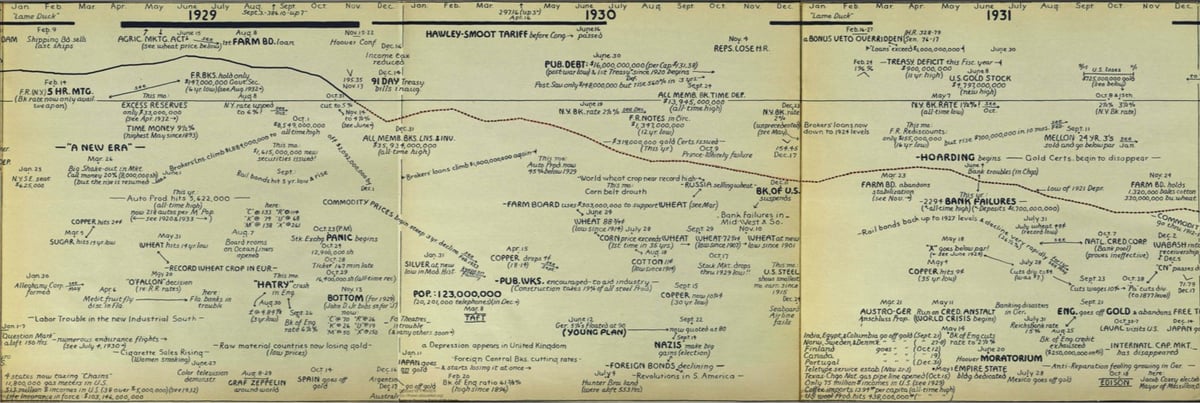
In 1936, former director of research at the Cleveland Federal Reserve L. Merle Hostetler published 75 Yrs. of American Finance, a hand-drawn chart of the economic health of the US from 1861 to 1935. The chart, which is horizontally oriented, shows a trending business activity index (which measures productivity) along with other financial data, indicates when Congress is in session, lists notable news events, and shows the high and low of the DJIA (starting in 1898). The graphic at the top shows Hostetler’s chart from 1929-1931, aka the beginning of the Great Depression.
The copy of this chart hosted by the St. Louis Fed goes to 1938…it must have been updated at some point. Also, if you go into the “»” menu in the upper-right corner of the in-page document viewer, you can set it to “horizontal scrolling” for easier viewing. (thx, andy)
Update: Philip Bump made a horizontally scrolling B&W version of Hostetler’s chart. This is a lot easier to navigate than St. Louis Fed version.
For their series The Director’s Chair, Studio Binder pulls together interviews with notable filmmakers to shine some light on how they make their films. In the latest installment, Wes Anderson explains how he writes and directs his uniquely stylistic movies.
The video covers five main points about his approach:
1. Pull from your past.
2. Build a world.
3. Focus on precision & symmetry.
4. Find your spark.
5. Just go shoot.
(#5 is a bit of a head-scratcher. Anderson is pretty much the opposite of a “just go shoot” filmmaker. But I suppose he did have to start somewhere…)
Using 2020 census estimates, a series of six maps and the accompanying article from William H. Frey at the Brookings Institution show how the racial makeup on the United States is expected to have changed since the last census in 2010.

Hispanics and Asian Americans are the fastest-growing racial minority groups nationally, increasing by 18.6% and 27.4%, respectively, from 2010 to 2018. There is also a growing dispersion of both groups to new destinations, which tend to lie further afield than the familiar large metro areas.
In 1990, 39% of all U.S. Hispanics resided in just four metro areas: Los Angeles, New York, Miami, and Chicago. In 2018, 39% of U.S. Hispanics resided in seven metro areas, with Houston, Riverside, Calif., and Dallas added to the list (and each eclipsing Chicago in size). And beyond these, Hispanic growth is high in areas with smaller Hispanic settlements in all parts of the country.


Augustus Sherman worked as a registry clerk for the immigration station on Ellis Island from 1892 to 1925. Sherman was also an amateur photographer and while he worked, he took portraits of some of the immigrants that passed through Ellis Island, many dressed in traditional garb.
These images of people wearing their folk costumes were taken by amateur photographer Augustus Sherman who worked as the Chief Registry Clerk on Ellis Island from 1892 until 1925. The people in the photographs were most likely detainees who were waiting for money, travel tickets or someone to come and collect them from the island. In 1907, the photographs were published in National Geographic, and they were also hung on the walls of the lower Manhattan headquarters of the federal Immigration Service.
A selection of the photographs are housed by the NYPL (also on Flickr).
A report on inequality from the Bill & Melinda Gates Foundation. “Where you are born is more predictive of your future than any other factor.”
When something dark and ominous happens onscreen, there’s a good chance that the action is accompanied by a four-note snippet from the dies irae, a 13th-century Gregorian chant used at funerals. It shows up in The Lion King, The Good Place, Lord of the Rings, and It’s a Wonderful Life. This Vox video explores how this “shorthand for something grim” went from chant to Hollywood.
Think back to some of the most dramatic scenes in film history — from The Lion King, The Shining, It’s a Wonderful Life. Besides being sad or scary, they have something else in common: the dies irae. “Dies irae” translates from Latin to “Day of Wrath” — it’s a 13th-century Gregorian chant describing the day Catholics believe God will judge the living and the dead and send them to heaven or hell. And it was sung during one specific mass: funerals.
Alex Ludwig from the Berklee School of Music made a supercut of over 30 films that use dies irae.
Upcoming children’s book from amazing illustrator/designer Jessica Hische: Tomorrow I’ll Be Kind. “Tomorrow I’ll be everything I strive to be each day, and even when it’s difficult, I’ll work to find a way.”

Just a reminder that the Global Climate Strike begins this Friday, September 20. A coalition of young activists led by Greta Thunberg is calling on all of us to walk out of our schools and jobs to demand political and corporate action on the Earth’s climate crisis.
Once again our voices are being heard on the streets, but it is not just up to us.
We feel a lot of adults haven’t quite understood that we young people won’t hold off the climate crisis ourselves. Sorry, if this is inconvenient for you. But this is not a single-generation job. It’s humanity’s job. We young people can contribute to a larger fight and that can make a huge difference.
So this is our invitation to you. Starting on Friday 20 September we will kick start a week of climate action with worldwide strikes for the climate. We’re asking you to step up alongside us. There are many different plans underway in different parts of the world for adults to join together and step up and out of your comfort zone for our climate. Let’s all join together; with our neighbours, co-workers, friends, family and go out on to the streets to make our voices heard and make this a turning point in our history.
kottke.org will be joining the Digital Climate Strike on Friday; the site won’t be available that day. If you’d like to participate in the strike, there are plenty of resources available here.
For their latest video, Kurzgesagt takes a typically informative journey from the surface of the ocean all the way down to the deepest spot on Earth, Challenger Deep.
In the segment about marine snow — decaying matter and feces that falls from the resource-rich sliver of ocean near the surface to provide the thin sustenance for the entire rest of the ocean — I couldn’t help but think about trickle-down economics.
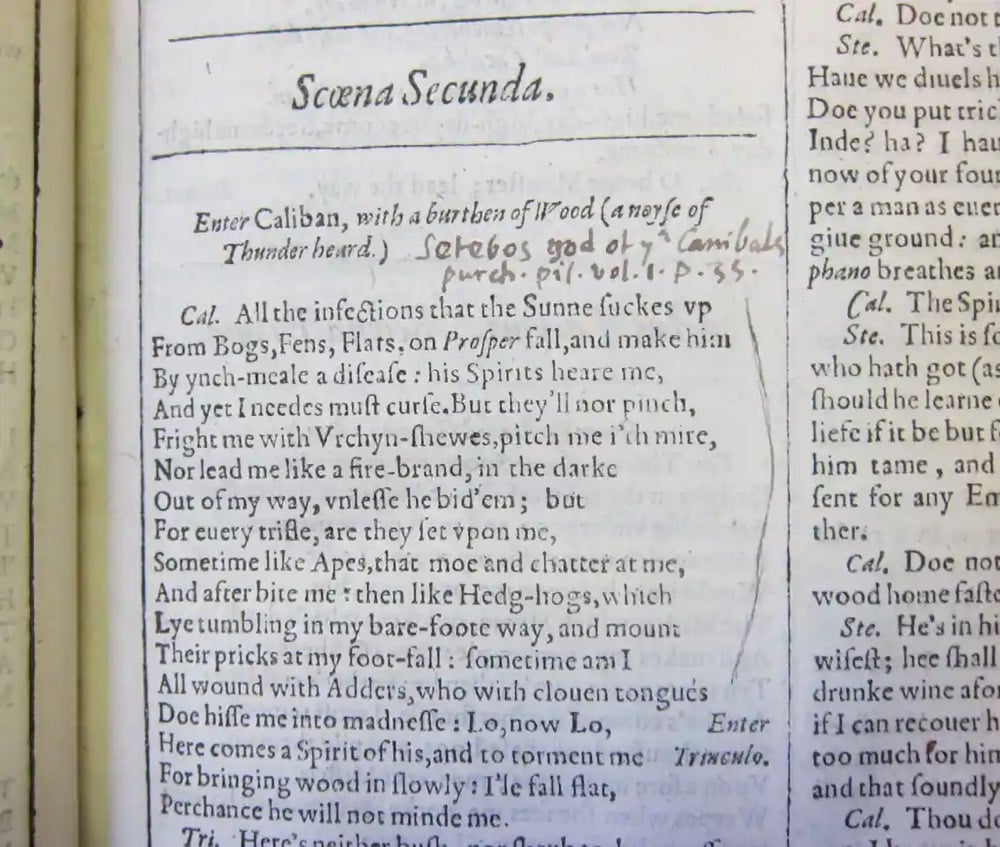
Based on handwriting analysis, Jason Scott-Warren, the Director of the Cambridge Centre for Material Texts, has discovered that a copy of Shakespeare’s First Folio from 1623 was owned by John Milton, author of Paradise Lost, who annotated it with copious notes.
It’s always annoying when someone tries to claim that they’ve discovered a lost literary artefact. I was myself a little bit brutal when, five years ago, we were treated to the supposed rediscovery of Shakespeare’s dictionary. In this as in other cases, there’s usually a lot of wishful thinking, plus copious spinning of the evidence to make it seem plausible, and elision of anything that doesn’t seem to fit. However, I’m going to make my own unwise pronouncement on the basis of just a few hours of research. I’m going to claim to have identified John Milton’s copy of the Shakespeare First Folio of 1623.
There already seems to be a consensus developing that Scott-Warren’s analysis rings true.
But he soon found that other scholars were agreeing with him. “Not only does this hand look like Milton’s, but it behaves like Milton’s writing elsewhere does, doing exactly the things Milton does when he annotates books, and using exactly the same marks,” said Dr Will Poole at New College Oxford. “Shakespeare is our most famous writer, and the poet John Milton was his most famous younger contemporary. It was, until a few days ago, simply too much to hope that Milton’s own copy of Shakespeare might have survived — and yet the evidence here so far is persuasive. This may be one of the most important literary discoveries of modern times.”
(via open culture)
Writer Rachel Monroe recently shared a bunch of “odd synonyms for ‘died’” that her mother collects from obituaries. Here’s an excerpt from her charmingly handwritten notes:

Among the highlights:
- snuck out of this world
- welcomed as Heaven’s newest biker angel
- entered into eternal celebration
- is joyfully singing with Jesus
- finished with gratitude her human experience
(via @tedgioia)
French economist Thomas Piketty has come out with a new book. The 1200-page Capital and Ideology is a followup to Capital in the 21st Century, a surprise bestseller when it was released a few years ago. The book just came out in French (English readers will need to wait until March) so details are still sparse, but The Guardian has a short preview.
Among the proposals in the book are that employees should have 50% of the seats on company boards; that the voting power of even the largest shareholders should be capped at 10%; much higher taxes on property, rising to 90% for the largest estates; a lump sum capital allocation of €120,000 (just over £107,000) to everyone when they reach 25; and an individualised carbon tax calculated by a personalised card that would track each person’s contribution to global heating.
In an interview with the French weekly news magazine L’Obs, Piketty made no apologies for the impact his ideas would have on the stock market. He said: “[Yes], it will also affect the price of real estate that is crazy in Paris, and it will allow new social groups to become owners and shareholders.”
Branko Milanovic, an expert on global inequality, has written an early review.
This part of the book looks empirically at the reasons that left-wing, or social democratic parties have gradually transformed themselves from being the parties of the less-educated and poorer classes to become the parties of the educated and affluent middle and upper-middle classes. To a large extent, traditionally left parties have changed because their original social-democratic agenda was so successful in opening up education and high-income possibilities to the people who in the 1950s and 1960s came from modest backgrounds. These people, the “winners” of social democracy, continued voting for left-wing parties but their interests and worldview were no longer the same as that of their (less-educated) parents. The parties’ internal social structure thus changed — the product of their own political and social success. In Piketty’s terms, they became the parties of the “Brahmin left” (La gauche Brahmane), as opposed to the conservative right-wing parties, which remained the parties of the “merchant right” (La droite marchande).
To simplify, the elite became divided between the educated “Brahmins” and the more commercially-minded “investors,” or capitalists. This development, however, left the people who failed to experience upward educational and income mobility unrepresented, and those people are the ones that feed the current “populist” wave. Quite extraordinarily, Piketty shows the education and income shifts of left-wing parties’ voters using very similar long-term data from all major developed democracies (and India). The fact that the story is so consistent across countries lends an almost uncanny plausibility to his hypothesis.
Kirk Weddle took the iconic photograph of the underwater baby for the cover of Nirvana’s breakthrough album Nevermind. On his website, he describes the shoot and the process that resulted in the final photo. Before the baby went into the water, Weddle used a doll to get the lighting and focus right.

Once I felt I had the framing, light, and exposure dialed in; the parents slipped the child into the water. I took seven frames on the first pass and four frames on the second. As expected, the baby started to cry, this had been the babies first time underwater, and we wrapped the shoot. The dollar bill and the fishhook were stripped in in post.
The baby’s name was Spencer Elden, who has recreated the underwater scene more than once as an adult. He’s even got a tattoo that says “Nevermind” on his chest.

(via life is so beautiful)
Brett Kavanaugh lied under oath to cover up criminal acts. Of course he should be impeached and removed from the Supreme Court.

SmokyMountains.com is back this year with their best-of-web foliage prediction map. Here in Vermont, things are starting to look a little rusty out there, but it appears I have at least a few more days to pretend that it’s still summer. Right? RIGHT?!
The Best Things To Do In New York City. “Get really angry at the subway. End up somewhere you didn’t intend to go. Yell out loud in public in a subway station without realizing you did; discover that nobody cares.”
For some of his latest street art, Portuguese graffiti artist Vile has been creating optical illusions of his name “cut” into the walls of buildings.

That’s just spray paint he’s using…that effect is quite good, no? Here’s another one:

And here’s how that wall looked before:

You can see Vile’s most recent work on Instagram.
Newer posts
Older posts





Socials & More