
Reminder that @kottke’s newsletter, Noticing, is published every week and recaps the best of the site’s posts and quicklinks. This week’s edition is here:

Advertise here with Carbon Ads
This site is made possible by member support. 💞
Big thanks to Arcustech for hosting the site and offering amazing tech support.
When you buy through links on kottke.org, I may earn an affiliate commission. Thanks for supporting the site!
kottke.org. home of fine hypertext products since 1998.
Beloved by 86.47% of the web.
Entries for December 2018
The Importance of Food in Howl’s Moving Castle
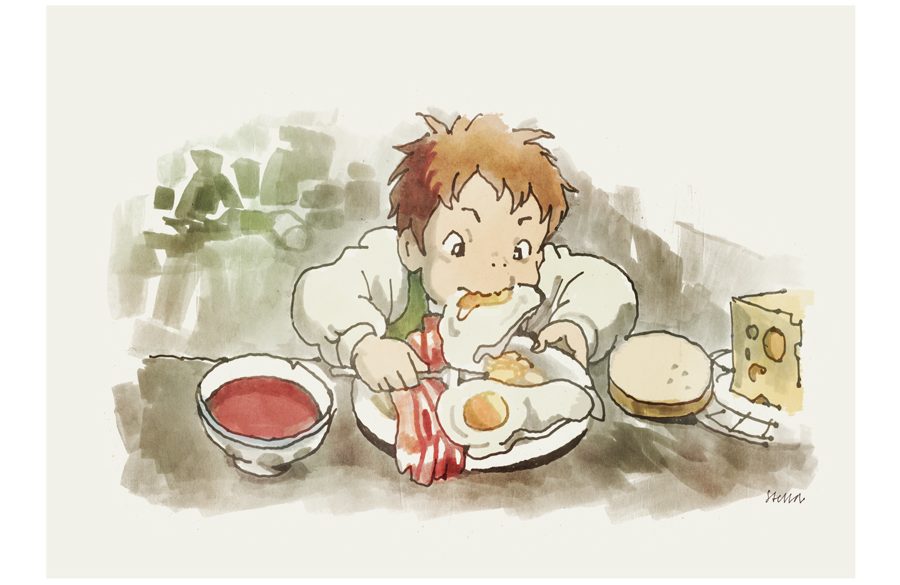
Howl’s Moving Castle by Hayao Miyazaki is one of my favorites if not my very favorite movie. I’ve written about it here before at some length. I use pictures from it as my Twitter background, as my login prompts on both of my computers, and my pinned tweet is a quote about the film and its simple-yet-allegorical applicability to understanding your own life and psyche.
One aspect of HMC I haven’t touched on here, but is essential to understanding the film and its appeal, is the importance of food in the film. Luckily, Sarah Welch-Larson at Bright Wall/Dark Room has you covered.
First, there’s this remarkably concise and comprehensive survey of food in the Miyazaki-verse:
In Studio Ghibli movies, food is a feast for the eyes. Nearly every one of Hayao Miyazaki’s films includes a memorable shot of food, some more extravagant than others. A monk stirring a pot of soup on a cold night in Princess Mononoke. A herring pie, golden and steaming, fresh from the oven, in Kiki’s Delivery Service. Ramen noodles piled with toppings in Ponyo. Piles of roasted meat and dumplings spilling across the counter of an enchanted restaurant in Spirited Away. Even the Miyazaki films that don’t focus so heavily on food still allow their characters a chance to pause and eat. Nausicaä stops for a moment to eat a small bag of nuts as the world falls apart around her. Porco Rosso eats spaghetti bolognese as he hides out from the Italian authorities. Extravagant or simple, quick or languorous, the shots of food in Miyazaki films all tempt the senses.
Then this close reading of food and its themes in Howl:
In Howl’s Moving Castle, food is more than just a necessity. It sustains life, in every sense of the phrase: it helps a body hold skin and sinew together, and acts as an expression of love and care. We get the sense that Howl is a good person from the way he prepares breakfast. He has a sure hand, and a light touch. He might be flighty, but he cares enough to put together a well-cooked breakfast big enough for everyone in the room, including Sophie the interloper.
Food is also an expression of identity. Howl’s cooking is simple and elegant, but feels like a feast. The bacon is thick and crackling, and the eggs are perfect, cooked sunny-side-up with not a single yolk broken. Sophie’s own choices of food are plain and practical, like her, but that doesn’t make them any less valuable than the more extravagant examples of food we see in other Miyazaki films. Her bread and cheese look just as tasty as Howl’s bacon and eggs, and they’re likely just as satisfying. Calcifer, too, needs to eat, despite being a supernatural creature. He stuffs logs into his mouth, one by one, every time he needs to move the castle. When he isn’t active, he’s still perpetually consuming wood, albeit at a slower pace; fire is a hungry creature, and will go out if it is not fed.
Hunger in Howl is twofold: it can be the desire to be sustained, and it can be the desire to possess. This second desire takes the form of gluttony, and it is a destructive force. While he’s out in his wanderings, Howl comes across battles between the two rival countries. He refuses to fight, but he can’t stay away; the war is encroaching. Other wizards who swore loyalty to the king take part in these battles, and on more than one occasion, Howl is chased through the skies by the “hack wizards” who turned themselves into monsters in service of the war. They’re horrible half-lizard, half-dragonfly things, all oily skin and gaping mouths full of sharp teeth, open as if ready to devour. Miyazaki’s war imagery tends toward images of devouring, but the action of eating here is neither life-giving nor sustaining. War is gluttony, a force that needs to mindlessly consume until there is nothing left.
And this remarkable conclusion:
The kitchen is said to be the heart of a home, and Howl’s kitchen was empty until Sophie talked her way in to clean it. Food and love are both life-sustaining forces, but only when held lightly, without thought of possession or ownership. Sophie saves Howl without a thought for her own happiness, and, in return, Howl loves her back of his own free will. Neither takes what the other is not willing to give. Their love is neither greedy nor ravenous, but rather a hunger for food that sustains and leaves the hungry satiated.
I’m convinced: food, and the overlapping and contradictory economies of food, are the keys to this movie! This puts it up with Babette’s Feast as my favorite movies about food, love, and community. Thank you, Sarah, for helping me appreciate this remarkable film in a whole new way.
(Thanks too to @nandelabra for pointing this my way.)
Climate Change Is Stealing Our Children’s Futures
On Wednesday, 15-year-old Swedish climate activist Greta Thunberg addressed the UN plenary meeting at the COP24 climate talks in Poland. In it, she blasted world and business leaders for their political inaction on climate change, calling them immature (italics mine).
But to do that, we have to speak clearly, no matter how uncomfortable that may be. You only speak of green eternal economic growth because you are too scared of being unpopular. You only talk about moving forward with the same bad ideas that got us into this mess, even when the only sensible thing to do is pull the emergency brake. You are not mature enough to tell it like it is. Even that burden you leave to us children.
But I don’t care about being popular. I care about climate justice and the living planet. Our civilization is being sacrificed for the opportunity of a very small number of people to continue making enormous amounts of money. Our biosphere is being sacrificed so that rich people in countries like mine can live in luxury. It is the sufferings of the many which pay for the luxuries of the few.
The year 2078, I will celebrate my 75th birthday. If I have children, maybe they will spend that day with me. Maybe they will ask me about you. Maybe they will ask why you didn’t do anything while there still was time to act. You say you love your children above all else, and yet you are stealing their future in front of their very eyes.
“You are not mature enough to tell it like it is. Even that burden you leave to us children.” Damn. Thunberg has been leading school strikes for climate justice in Sweden and is calling for worldwide strikes in schools today. She recently gave a talk at TEDxStockholm about her climate activism.
In October, Masha Gessen profiled Thunberg for the New Yorker.
Thunberg developed her special interest in climate change when she was nine years old and in the third grade. “They were always talking about how we should turn off lights, save water, not throw out food,” she told me. “I asked why and they explained about climate change. And I thought this was very strange. If humans could really change the climate, everyone would be talking about it and people wouldn’t be talking about anything else. But this wasn’t happening.” Turnberg has an uncanny ability to concentrate, which she also attributes to her autism. “I can do the same thing for hours,” she said. Or, as it turns out, for years. She began researching climate change and has stayed on the topic for six years. She has stopped eating meat and buying anything that is not absolutely necessary. In 2015, she stopped flying on airplanes, and a year later, her mother followed suit, giving up an international performing career. The family has installed solar batteries and has started growing their own vegetables on an allotment outside the city. To meet me in central Stockholm, Thunberg and her father rode their bikes for about half an hour; the family has an electric car that they use only when necessary.
Update: Thunberg does not mince words. At a lunchtime panel at Davos (featuring Bono and Jane Goodall), she told the room:
Some people say that the climate crisis is something that we all have created. But that is not true, because if everyone is guilty then no one is to blame. And someone is to blame. Some people, some companies, some decision makers in particular have known exactly what priceless values they have been sacrificing to continue making unimaginable amounts of money. And I think many of you here today belong to that group of people.
An oral history of Emmett Otter’s Jug Band Christmas! I love this movie so much. “RIVERBOTTOM NIGHTMARE BAND!”
Sondra Locke died last month. What a bummer…she was a great actress and garbage human Clint Eastwood blackballed her out of a career.
The Official Kottke.org Music Playlist

Two weeks ago, I wrote about the mini-phenomenon of book playlists — music playlists designed to accompany new books, as a kind of disembodied soundtrack. Then last week, in the newsletter, I wondered out loud what songs would be on a Kottke.org playlist, and asked you, the readers, for help figuring that out. Jason amplified the call on Twitter, and we were off and running.
So, for the past week, I took the advice that came in, reached out to a few musically-minded Kottke readers that I trust, and trolled the “music” tag on the site to get some more ideas. (I was tempted to include some Kenny G, but ultimately passed.) And here it is:
Update: (Ben Samuels-Kalow made an Apple Music version of this playlist, if that’s your jam.)
It’s almost exactly two hours long, or about the length of a double album. (Disc 2 would start with Coltrane’s “Giant Steps.”) Daft Punk, John Cale, Johnny Cash, The Strokes, Nina Simone, and The Echelon Effect all came from reader suggestions. So did Tom Misch and Carmody (!), an artist with whom I’d only had passing acquaintance, but turned out to deliver one of my favorite songs in the mix. Thanks to E.A. Gordon, Olga Nunes, David Gagne, Dan McCue, and Michael Ashbridge for their invaluable help putting this together. (Seriously, Mr. Ashbridge: Nina Simone’s cover of “Isn’t It A Pity” might be the best song I’ve ever heard.)
The rest of the contributions came out of my own head, after doing a lot of reading of the site. Readers will spot some of their favorite tags in the titles, which happen to correspond to magnificent songs: “The Moon” by The Microphones, or “Maps” by Yeah Yeah Yeahs, or “Photograph” by Weezer. (Somewhere my college friends are laughing at me for putting Weezer on a playlist.) “Blogging” by Wire was frankly a no-brainer based on the title alone, but I’m pleased it’s such a good, pointed song. I wanted to include one Philip Glass song and one Radiohead song, and I think I picked some good ones. And if you listen to the rest of the songs, you’ll see plenty of Kottke-esque themes and moods reflected in the lyrics. But it’s a playlist that I made, which means it has plenty of hip-hop and indie rock, some jazz and instrumental numbers, and a Dionne Warwick song.
One thing I hope is clear from this playlist: I love Kottke.org. This is a love letter. And the way Paul Westerberg sings about Alex Chilton is how I feel about Jason. He’s my guy. And I hope he finds something in this that reflects his personality and sensibilities, from his infinite capacity for wonder and his meticulous sense of taste to — and I was surprised by how much this seemed to naturally creep in — that midwestern, A Charlie Brown Christmas mood of introverted melancholy that lies behind all of that other-directed wonder. Not all of these songs are happy songs, but they are songs that find joy in the universe. And that’s deeper and richer than a giddy, booster-ish hayride. After all, as Dionne sings, loneliness remembers what happiness forgets.
I love listening to this music, and I hope you do too. A little early Christmas present from your friends here at what I will always think is the best blog in the world.
How to Be an Artist
From Jerry Saltz, failed artist and art critic for New York Magazine, a list of 33 rules on how to be a successful artist.
Lesson 3: Feel Free to Imitate. We all start as copycats, people who make pastiches of other people’s work. Fine! Do that. However, when you do this, focus, start to feel the sense of possibility in making all these things your own — even when the ideas, tools, and moves come from other artists. Whenever you make anything, think of yourself as entering a gigantic stadium filled with ideas, avenues, ways, means, and materials. And possibilities. Make these things yours. This is your house now.
And on the other side of the same coin:
Lesson 12: Know What You Hate. It is probably you. Make a list of three artists whose work you despise. Make a list of five things about each artist that you do not like; be as specific as possible. Often there’s something about what these artists do that you share. Really think about this.
The 2018 Movie Trailer Mashup: One Big Trailer to Rule Them All
Sleepy Skunk took audio and footage from dozens of trailers of movies that came out in 2018 and mashed them together into one mega movie trailer. And it’s actually coherent! Or at least as coherent as trailers for blockbuster movies typically are. I dunno, I’d watch this movie.
Money lenders in China are requesting nude photos as collateral for loans, e.g. “we’ll show these to your family & friends if you don’t pay us back”
Typewriter Maps

Daniel Huffman dug his dad’s old typewriter out of the basement and used it to type out a map of the major rivers draining into Lake Michigan.
The final product has various interesting smudges where the paper accidentally contacted the ribbon. In particular, I noticed that typing in red always produced a faint black “shadow” a couple of lines above. When the slug hit the red part of the ribbon, a small portion of it would lightly hit the black portion of the ribbon, too. Later on, I started holding scrap paper over my map in order to prevent this, so that the black shadow would go on the scrap.
In sum: my typewriter is not a precision instrument. This makes it a somewhat uncomfortable-feeling tool for a detail-oriented designer like me. I like being able to zoom in to 64,000% in Illustrator and correct errors that are small enough that no human eye could possibly ever see them. But, there’s something attractive about the organic messiness of the typewriter.
He experimented with a couple of other maps as well: a shaded relief map of Africa and a contour relief map of the Great Lakes.
See also An Atlas for the Blind.
What Was Inside the Glowing Briefcase in Pulp Fiction?
Before I started making my own web pages, I spent a not-insignificant amount of my time on the Internet trawling the alt.fan.tarantino newsgroup for bits of knowledge about Quentin Tarantino, Pulp Fiction, and Reservoir Dogs. A big topic of discussion back then was speculation about the contents of the briefcase that Jules and Vincent were tasked to retrieve for Marsellus Wallace. Was it gold? Diamonds? Wallace’s soul? No one knew and Tarantino wasn’t telling. It was the most compelling MacGuffin since Hitchcock himself.
Now, after nearly 25 years, we finally learn what was in the briefcase:
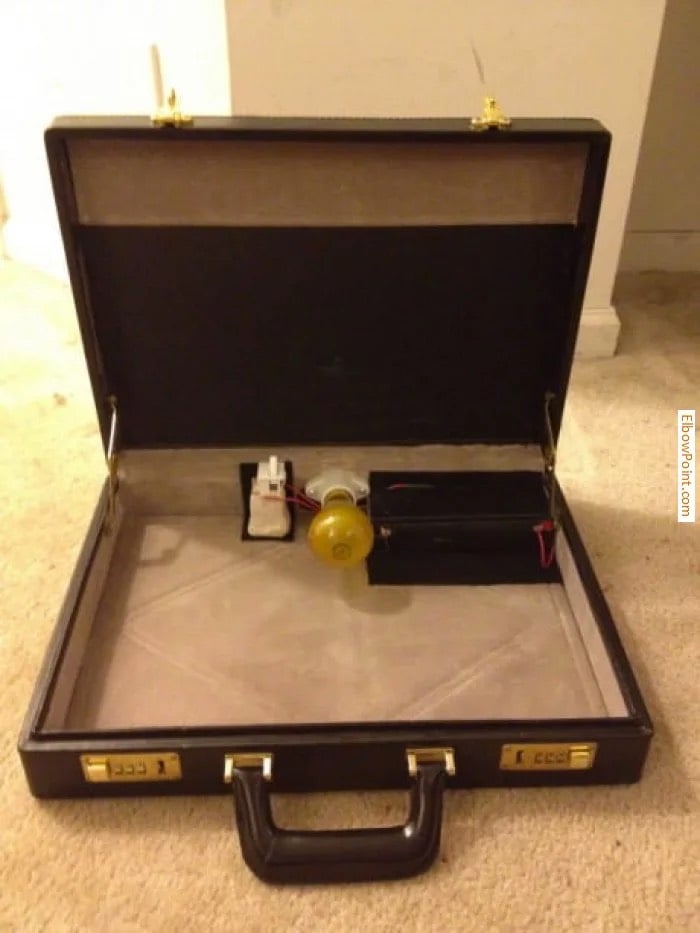
If you’d like to make one of your own, just follow these instructions.
If you want a Bad Motherfucker wallet just like Jules’, here you go.
The Explorer and The Hermit
In a piece called I’m the Food Expert But My Kids Love My Husband’s Cooking, Amanda Hesser talks about food, tradition, and the differing cooking styles between her and her husband Tad. When she was younger, Hesser’s approach was to experiment relentlessly with her cooking, moving from one new dish to the next. But her husband took a different approach:
One of my other nicknames for Tad is Mr. Efficiency. He obsesses over the shortest route to a destination, orders everything in bulk, is always on time, writes thank-you notes within a day, and absolutely detests standing in line. Especially for food.
When it came to cooking, Tad was characteristically economical. Once we had our kids and our schedules went haywire, he set about mastering a handful of dishes he could pull off on a moment’s notice: fish tacos, pasta alla vodka, and Daddy’s pasta.
Mr. Efficiency…that could be totally be me. I do occasionally enjoy trying to find new stuff to cook, but their mom is way more adventurous in cooking for the kids. I always come back to my go-tos of caldo verde, taco salad, smoky corn chowder, the world’s best pancakes, burgers, and even the occasional tater tot hotdish.
But Hesser’s approach to cooking has shifted towards the familiar in recent years after noticing the downside to always pushing the boundaries:
Meanwhile, I continued to roam and experiment, rarely making the same dish twice. I enjoy the hunt for a new great recipe, the push for something better. But it comes at a cost; cooking new things is more stressful because the unknowns are many. Tad would chat with the kids while making his pasta; I would cook distracted, with my nose in a recipe. Even after focused cooking, things don’t always work out well, and no one around the table is happy. And it’s hard to expect anyone to build an emotional connection to a dish if they’re only seeing it a few times.
I am really feeling that tension between novelty and stability lately, and not just when it comes to food. Sometimes I feel like I’m two different people. The Explorer craves new experiences, finds routine boring, and wants to learn new things or he’ll feel brain-dead. The Hermit needs the stability of a comfortable routine, finds exploring exhausting, and doesn’t want to have to think about what’s next all the time. Should I go to my favorite restaurant or try a new place? Regarding travel…should I re-experience somewhere I’ve been before or head somewhere new? (For my last trip, I did both: a repeat trip to Berlin with a short stay in Istanbul after.) There are certain types of books, movies, and TV shows I like to watch — their reliability is comforting but when I do venture from those paths, the results can be very rewarding and horizon-expanding. Should I spend time with old friends or work on some new relationships?
The part of my life in which I’m feeling this most acutely is in my work. Editing kottke.org is a constant exercise in balancing the familiar with the new. My approach is: “here’s something you haven’t seen before but packaged in a familiar way” and then do that 9-to-5, day-in and day-out, 52 weeks a year. I bury you (and myself) in novelty, but in a clockwork fashion.1 I never know what I’m going to find on a particular day and you never know what you’re going to read, but by the end of the day, every single weekday, there is (I hope!) an interesting, entertaining, thought-provoking, and awe-inspiring collection of things to explore.
But even though I enjoy editing the site and learn about a lot of new things along the way, the work itself sometimes isn’t that challenging. There’s a lot of repetition, sitting in a chair, and willpower — not insignificant things when trying to accomplish something — but it increasingly feels like I’m on autopilot creatively. Has the site gotten better in the last 5 years? I think so. But have I? What creative boundaries have I pushed along the way? In what ways could kottke.org be better or different that would provide new challenges for me? Don’t worry, I’m not going anywhere anytime soon, but my desire to “roam and experiment” (as Hesser puts it) has been on the rise lately for sure.
When I think about how I approach my work on the site, two references come to mind: 1) the Dunkin Donuts guy (“time to make the donuts”), and 2) what the doctor in Gattaca says about regularity of Ethan Hawke’s character’s heartbeat while exercising (“Jerome, Jerome, the metronome.”). ↩
Putting a British Scissors Company Back Together
In 2014, I shared a short film by Shaun Bloodworth called The Putter about Cliff Denton, a master scissors craftsman for a company called Ernest Wright & Sons.
A person who makes scissors by hand is called a putter, short for putter togetherer. The Putter is a four-minute silent film by Shaun Bloodworth that shows putter Cliff Denton making scissors.
The film went viral and the once-struggling company was inundated with orders and launched a very successful Kickstarter campaign for a special pair of kitchen scissors. But as I wrote in a sad update back in June, the company was struggling and on the verge of collapse:
Under new leadership, the company vowed to carry on and fulfill all of the Kickstarter orders, but a message to Kickstarter backers yesterday revealed the company was deep in debt and would be “going into receivership”. It also revealed that Wright had taken his own life.
In late October, a story on the company’s web site called Keeping the Heritage Alive revealed that a pair of Dutch entrepreneurs, Paul Jacobs and Jan Bart, have purchased the company with an eye towards investing in the workshop and its workers while keeping the mission the same.
When we acquired the assets of the company, there had been decades of decline and recent tragedy. The machinery was in neglect and although the workers had done all they could to keep the ship afloat, the heritage was slipping away.
To make sure that Ernest Wright continues to manufacture quality, handmade scissors, we’ve invested heavily in the workshop. By researching how to improve production, new machinery has been introduced that salutes the heritage and skill of our Putters. We’re working hard to keep the craft alive. Cliff Denton and Eric Stones, each with over 60 years worth of experience, are currently passing on their knowledge to new apprentices.
This seems like a really good outcome for the company, its employees, and the city of Sheffield. Now go buy some scissors.
Which US cities have the most unpredictable weather? Places like Rapid City, Billings, and Kansas City. (San Diego & Phoenix are among the most predictable.)
Email Love Letters to Trees
You might remember this 2015 Atlantic piece about what happened when Melbourne gave each of the city’s trees its own email address for reporting arboreal problems: people started writing love letters to the trees.
“My dearest Ulmus,” the message began.
“As I was leaving St. Mary’s College today I was struck, not by a branch, but by your radiant beauty. You must get these messages all the time. You’re such an attractive tree.”
This is an excerpt of a letter someone wrote to a green-leaf elm, one of thousands of messages in an ongoing correspondence between the people of Melbourne, Australia, and the city’s trees.
More than three years later, people are still writing. ABC News has collected some of the most interesting emails and presented them alongside photos of the trees they’re directed to.

Another admirer wrote to a Moreton Bay Fig tree:
You are beautiful. Sometimes I sit or walk under you and feel happier.
I love the way the light looks through your leaves and how your branches come down so low and wide it is almost as if you are trying to hug me. It is nice to have you so close, I should try to visit more often.
Bao, a Heartwarming Short Film from Pixar
Bao, a short film by Domee Shi, was shown in front of The Incredibles 2 at theaters this past summer.
In “Bao,” an aging Chinese mom suffering from empty nest syndrome gets another chance at motherhood when one of her dumplings springs to life as a lively, giggly dumpling boy. Mom excitedly welcomes this new bundle of joy into her life, but Dumpling starts growing up fast, and Mom must come to the bittersweet revelation that nothing stays cute and small forever. This short film from Pixar Animation Studios and director Domee Shi explores the ups and downs of the parent-child relationship through the colorful, rich, and tasty lens of the Chinese immigrant community in Canada.
Pixar recently posted the entire short online on Twitter so you can watch it if you missed it in theaters.
Heartwarming moments are meant to be shared. Bring home behind-the-scenes, exclusive footage from Bao and 10 other critically-acclaimed shorts when you get the Pixar Short Films Collection: Volume 3 on Digital, @Movies_Anywhere, and Blu-ray today: https://t.co/aNv3akp3OZ pic.twitter.com/hpnroh4xtm
— Disney•Pixar (@DisneyPixar) November 23, 2018
Shi, who is developing a full-length feature for Pixar, did an interview with the LA Times about her inspiration for Bao and its portrayal of the Chinese immigrant experience.
We also brought my mom in twice to do dumpling-making classes for the whole crew. That was really fun research because we actually filmed her hands kneading the dough and making the wrappers, and that was used as reference for the opening shots of the short.
How Ansel Adams took one of his most famous photos, “Moonrise, Hernandez, New Mexico”. He couldn’t find his light meter so he did a seat-of-his-pants exposure time calculation based on the Moon’s luminosity.
Paul Romer got married Monday morning and later that day accepted the 2018 Nobel Prize for economics
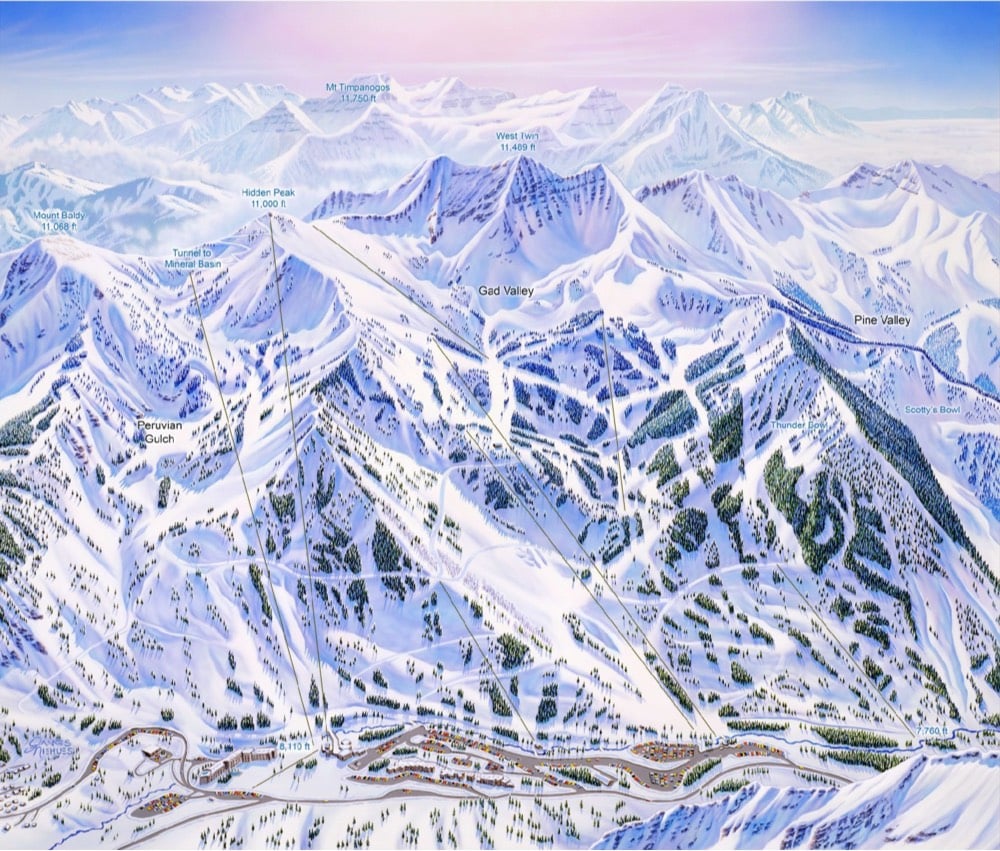
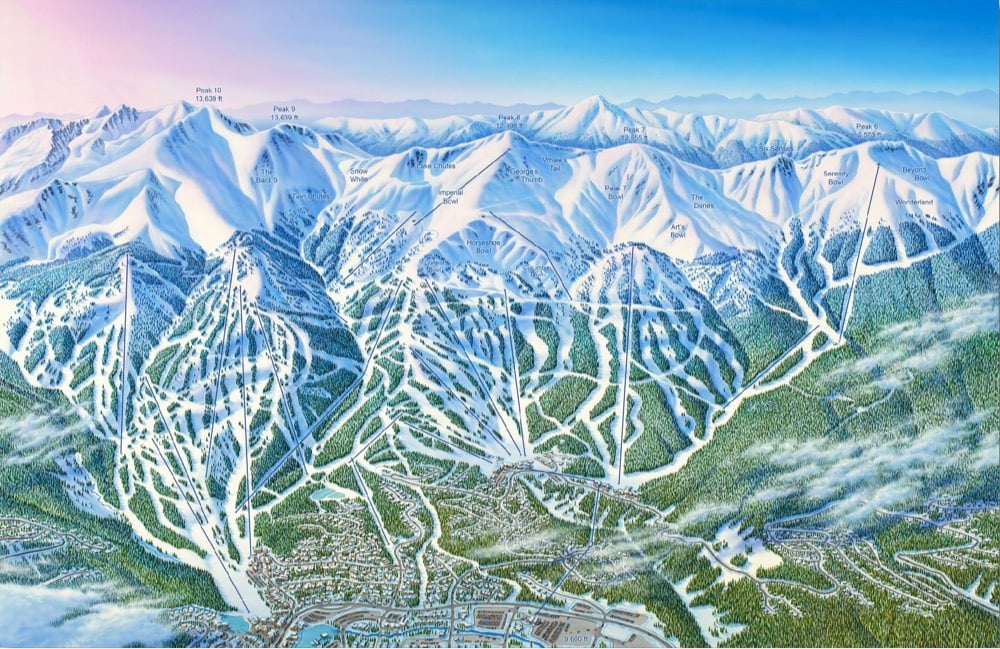
James Niehues: The Man Behind the Map
I’ve you’ve ever skied or snowboarded in the US, Canada, or many other spots around the world, chances are you’ve used a ski map painted by James Niehues. He’s hand-painted almost 200 trail maps for places like Alta, Vail, Big Sky, Okemo, and Mammoth.
Ski Magazine regularly ranks the Top 50 resorts in North America. Jim has hand painted 45 of them. His tools of choice are a camera, a notepad, a paintbrush and a canvas. Every painstaking detail — peaks, cliffs, trees and shadows — is painted by hand. Jim’s large and beautiful paintings have helped generations of skiers navigate and capture the unique character of each mountain. He has had more impact on the image and feel of skiing than almost anyone, yet few people know his name.
With the help of a small team, Niehues is publishing a hardcover coffee table book featuring all of his work along with a series of prints. Here are a couple of the maps that will be in the book:
Watch How Hermit Crabs All Line Up to Exchange Their Shells
Hermit crabs use the scavenged shells of other animals as their homes. As the crabs grow, they periodically need to upgrade their housing to bigger shells. When a new shell appears on the beach, the cramped crabs will form a orderly queue nearby and then change shells all at once, with each crab moving into the next biggest shell just abandoned by its former occupant. This is possibly the most British thing I’ve ever seen an animal do…and the David Attenborough narration is the icing on top.
Wes Anderson’s Rushmore came out 20 years ago today. Still one of my all-time favorite movies.
Flying Alongside Migrating Birds in an Ultralight
For more than 20 years, Christian Moullec has been flying with migratory birds in his ultralight aircraft. He raises birds of vulnerable species on his farm and then when it’s time for them to migrate, he shows them how, guiding them along safe migration paths. To support his conservation efforts, Moullec takes paying passengers up with him to fly among the birds. What a magical experience!
My passengers come from all over the world and are all kinds of people, especially Europeans. The flight inspires in me a huge respect for nature and I can communicate this respect to my passengers. There are also people with disabilities and those who want to experience a great time in the sky with the birds before leaving this world. It is an overwhelming spiritual experience. The most beautiful thing is to fly in the heavens with the angels that are the birds.
When watching the video, it’s difficult to look away from the birds, moving with a powerful grace through the air, but don’t miss the absolute joy and astonishment on the faces of Moullec’s passengers. This is going right on my bucket list.
See also The Kid Should See This on Moullec’s efforts, the 2011 documentary Earthflight that features Moullec, and Winged Migration, a 2001 nature film that features lots of stunning flying-with-birds footage. (via @tcarmody)
A List of Weird Facts
Helmed by someone with a knack for asking good questions & telling interesting stories and followed by nearly 100,000 people who have fascinating tales to tell, Nicole Cliffe’s Twitter account is an internet gem. Last night, Cliffe tweeted “Tell me your fav weird fact” and the replies kept me busy for quite awhile. Here are a few of my favorites:
“The low German (plauttdeutch) word for vacuum is Huulbessen. Literally translated it means Screaming Broom.” -@JayelleMo
“From the time it was discovered until now, Pluto hasn’t completed a single orbit. And it won’t for another 160 years.” -@TylerMoody
“Male giraffes will headbutt female giraffes in the bladder in order to make them pee, so that they can smell their urine and determine if the females are in heat.” -@anannabananacan
“Al Gore and Tommy Lee Jones were college roommates” -@msmessica
“The sound you think of Bald Eagles making is actually the screech of a Red Tailed Hawk. Eagles sound kind of like seagulls and that couldn’t stand, so they’ve been dubbed over forever.” -@Alison_Claire
“My grandfather grew up on coastal Maine, and said when he was a kid (1920s Maine at this point) the rich kids brought peanut butter and jelly sandwiches to school and the poor kids brought lobster, since the lobstermen couldn’t afford to buy their kids peanut butter and jelly.” -@sgtjanedoe
“Samuel Beckett drove Andre the Giant to school sometimes.” -@WinchMD
“One of the foods with the highest amounts of naturally occurring umami (natural MSG) is BREAST MILK!!!!!!!!!!!!!!” -@CiaoSamin
My weird fact would be that cabbage, kale, broccoli, brussels sprouts, kohlrabi, collard greens, and cauliflower are all the same species of plant.
The Winners of the Information Is Beautiful Awards for 2018
Since 2012, Information Is Beautiful has picked the best data visualizations of the year. Here are the winners of the 2018 Awards, which includes the team at Northeastern University & National Geographic for their Simulated Dendrochronology of U.S. Immigration 1790-2016 project.
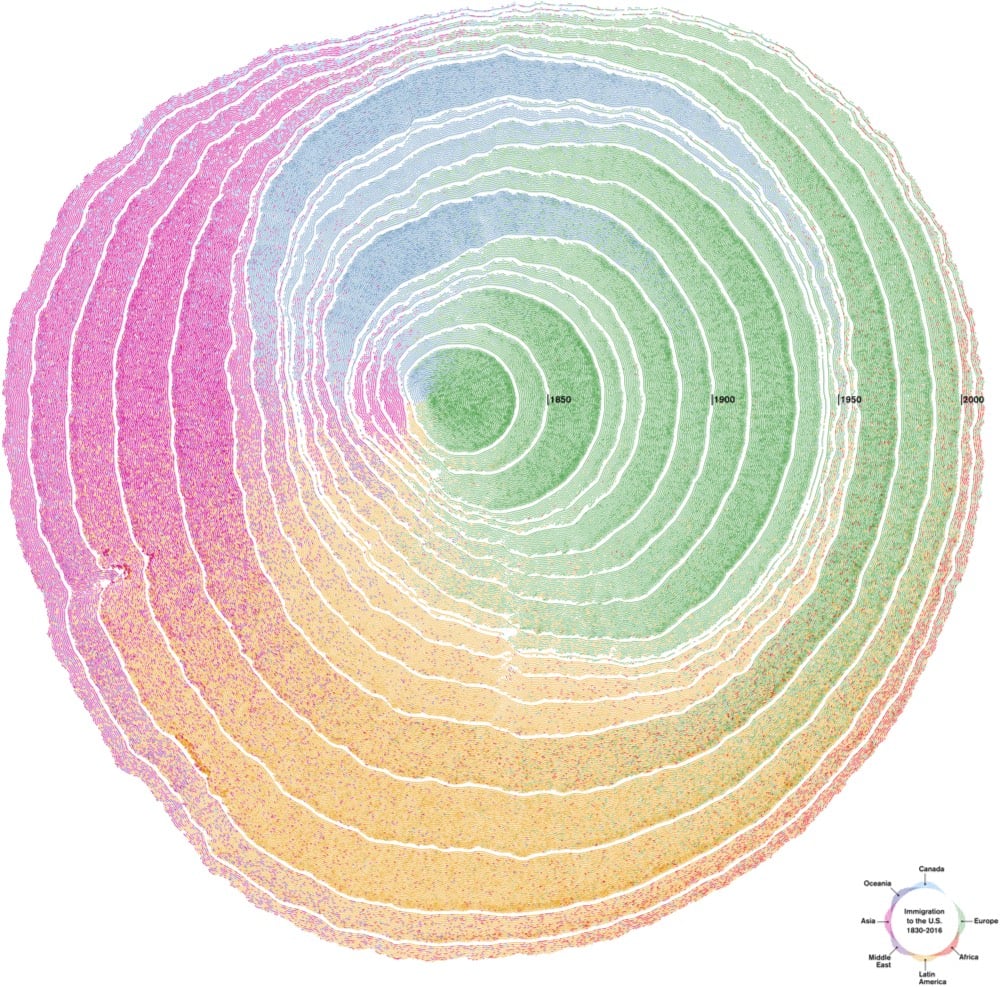
Nature has its own ways of organizing information: organisms grow and register information from the environment. This is particularly notable in trees, which, through their rings, tell the story of their growth. Drawing on this phenomenon as a visual metaphor, the United States can be envisioned as a tree, with shapes and growing patterns influenced by immigration. The nation, the tree, is hundreds of years old, and its cells are made out of immigrants. As time passes, the cells are deposited in decennial rings that capture waves of immigration.
A deserving winner in the “Most Beautiful” category. Here’s an animated view of US immigration’s “tree rings”:
Little-known computer pioneer Evelyn Berezin built & sold the first computerized word processor. She died recently aged 93.
What makes Paris look like Paris? According to a visual algorithm that studied Google Street View images: “doors, balconies, windows with railings, street signs and special Parisian lampposts”.
The Cube Rule of Food, the Grand Unified Theory of Food Identification
On the internet, a fierce debate rages. Are hot dogs sandwiches? Are Pop-Tarts ravioli? Is sushi toast? Into the fracas steps @phosphatide with their brilliant Cube Rule of Food. The idea is that you can fit all food into one of seven categories based on where the starch in a dish is positioned:

For example, enchiladas, falafel wraps, and pigs in a blanket are all sushi because the starch covers four sides of the cube like so:

Likewise, pizza is toast, a quesadilla is a sandwich, a hot dog is a taco, key lime pie is a quiche, and a burrito is a calzone.
The zero-eth category is a salad, i.e. anything that doesn’t include starch (like a steak) or in which the starch is distributed throughout the dish (like fried rice, spaghetti, and soup (“a wet salad”)).
Remembering Anthony Bourdain, The Last Curious Man
For GQ, Drew Magary talked to the family, friends, and coworkers of Anthony Bourdain for this piece on the life of the late chef/traveler/writer/explorer/whatever. Here’s how he got his big writing break, which led to so much else:
David Remnick (editor in chief, ‘The New Yorker’): My wife came home one day, and she said, “Look. There’s a really nice woman at the newspaper. Her son is a writer. She wanted you to take a look at his work,” which seemed…adorable, right? A mother’s ambition for a son. I took this manuscript out of its yellow envelope, not expecting much. I started to read. It was about a young cook, working at a pretty average steak-and-frites place on lower Park Avenue. I called this guy up on the phone. He answered it in his kitchen. I said, “I’d like to publish this work of yours in The New Yorker. I hope that’s okay.” That was the beginning of Anthony Bourdain being published. I don’t know if there’s any way to put this other than to say he invented himself as a writer, as a public personality. It was all there.
Prior to becoming the best-ever host of a travel show, he’d actually traveled very little internationally (only France and Japan) and his first go of it wasn’t successful:
Tenaglia: Japan was a fucking disaster.
Chris Collins (co-founder, ZPZ): The mistakes were very clear. He did not engage with us. He would not acknowledge our presence and that we were there working together.
Tenaglia: I think he was thinking, “Great! I just got a free ride to all these countries.”
Collins: It was a ruse. It was, I’m gonna double dip here. I’m going to be able to get paid to go make something, and I’m going to write articles.
Tenaglia: We would go back to the hotel and say, “We are so screwed.”
But it turns out this inexperienced traveler & newbie TV host was the exact right person for the job.
He came alive, because those frames of reference were starting to pop. His sudden inclination was to turn and share that with us. You could sense this excitement, like, “Holy crap, I’m actually on the ground in a location that I have studied, that I know, that I have references to.” You know, Apocalypse Now, Heart of Darkness, Graham Greene, the Vietnam War. He was percolating with an excitement that was very genuine.
My only complaint about this piece is the length…I would have happily read on for hours.
Paula Froelich (author, journalist): I’ll never forget laughing my ass off because he was obsessed with my dog, who’s a small dachshund. He’d always walk my dog, and he was so tall and the dog was so long and short, they would look like this movable L.
Love in the Modern Age
Girl meets boy in the workplace, circa 2018. This should be a movie.
We were online content moderators taking down nude photos. All day, we sorted through thousands of photos and messages flagged as inappropriate on a meet-up app. We sat nearby, but our office had a strict no-talking rule, so our relationship began in silence as we sent each other funny things we found via Gchat. This led to more messaging until one day we grew tired of talking about nudes and decided to see each other naked instead.
That’s a story by Kristine Murawski from a relatively new feature at the NY Times, Tiny Love Stories. There are only three other installments so far…it’ll take you about 5 minutes to read through them all.
Culture Is Not Always Popular: Fifteen Years of Design Observer. Love that cover.
Greenland, Land of Unending Ice
Swiss nature photographer Stefan Forster has been visiting Greenland for eight years, documenting the ice, glaciers, icebergs, and wildlife of this “magical country”. For his latest video, Greenland - The Land of Unending Ice, he visited several parts of the country to witness a glacier calving, icebergs from above, the aurora borealis, and a changing landscape.
Today quiet and untouched places are becoming more and more rare. On my first visit to Greenland, I was fascinated by the incredible power of nature that can be felt everywhere. But during the last years things have changed. The amount of icebergs is increasing savagely. Glaciers I’m visiting every year are retreating not meters but kilometers a year and the unending amount of ice seems to be endless. There is nothing more beautiful than an iceberg — everyone is unique and the light reflecting from its surface is magical. It’s sad how close beauty and decay can be seen in an iceberg.
A new study published in Nature says that Greenland’s ice sheet is melting at its fastest rate in 350 years.
“From a historical perspective, today’s melt rates are off the charts,” Sarah Das, a glaciologist at Woods Hole Oceanographic Institution and co-author of the new study, said in a statement. “We found a 50 percent increase in total ice sheet meltwater runoff versus the start of the industrial era, and a 30 percent increase since the 20th century alone.”
Forster also ran into an interesting technical problem while using his drones to capture video:
But the hardest thing of flying in Greenland is the fact, that every 2-3 minutes the difference between the magnetic north and the geographic north (which are not the same place — especially so far north) causing a fatal p-gps flight error and the drone is flying away (also the camera’s horizon).
Hear the First Sounds Ever Recorded on Mars
NASA’s InSight mission recently landed on Mars and like other missions before it, the lander is a equipped with a camera and has sent back some pictures of the red planet. But InSight is also carrying a couple of instruments that made it possible to record something no human has ever experienced: what Mars sounds like:
InSight’s air pressure sensor recording the sound of the wind directly and the seismometer recorded the sounds of the lander’s solar panels vibrating as Martian winds blew across them.
Two very sensitive sensors on the spacecraft detected these wind vibrations: an air pressure sensor inside the lander and a seismometer sitting on the lander’s deck, awaiting deployment by InSight’s robotic arm. The two instruments recorded the wind noise in different ways. The air pressure sensor, part of the Auxiliary Payload Sensor Subsystem (APSS), which will collect meteorological data, recorded these air vibrations directly. The seismometer recorded lander vibrations caused by the wind moving over the spacecraft’s solar panels, which are each 7 feet (2.2 meters) in diameter and stick out from the sides of the lander like a giant pair of ears.
The sounds are best heard with a good pair of headphones.
Love Letters to Mars

Rebecca Boyle is one of my favorite science writers. In two recent pieces, she takes on our nearest, most Earth-like neighbor, Mars. The first is about a team of scientists doing research on extremophiles in South America.
The Atacama Desert stretches 600 miles south from the Peruvian border, nestled between the Pacific Cordillera and the Andes, “a cross extended over Chile,” in the words of the Chilean poet Raúl Zurita. Some parts of it are so devoid of life that their microbe-per-inch count can compete with near-sterile hospital surgical suites. Some areas of the Atacama, Earth’s driest nonpolar desert and the oldest desert anywhere, have been rainless for at least 23 million years, and maybe as long as 40 million years. Carbon cycling happens on timescales of thousands of years, comparable to Antarctic permafrost and places deep within Earth’s crust; the Atacama contains some of the most lifeless soils on the planet. The Atacama is one reason that Chile has become a haven for astrobiologists and astronomers: Its pristine dark skies offer an unparalleled view of the stars, and its depleted desert offers a peerless lab for studying the dry limits of life, including how life might survive among those stars. And honestly, it just looks a lot like Mars. It is the closest that these astrobiologists will ever get to the planet that occupies their grant proposals and their imaginations.
I’m neither an astrobiologist nor a professional astronomer, but I spend a lot of time thinking about Mars. I keep tabs on the robots spread across its surface and in its orbit, and sometimes I check their nightly photo downloads. The Atacama is not a giant leap from the Mars of my mind. As I drove up the coast, I found the view so much more like Mars than Earth. There are no palm trees or tourists or bleating gulls. There is nothing but brown, tumbling tanly down the hills, darkening to chocolate inside shadowy ravines and runnels, bleaching to an impoverished shade of cardboard, and crumbling into fine white beach before being swallowed by the cobalt hues of sea and sky. With no trees or succulents or even a blade of grass—not a smidge of green—the only disruption in the brown is a strip of asphalt, Ruta 1. With my cruise control set and David Bowie blaring, I pictured myself driving through Meridiani Planum, a vast equatorial Martian plain, en route to visit the Opportunity rover. The only reminders of other humans were the grim commemorations of car-wreck victims: Almost every mile of Ruta 1 is marked with roadside shrines to the dead…
Salar Grande was once a coastal inlet, much like today’s San Francisco Bay. It dried up between 1.8 and 5.3 million years ago, leaving behind a salt flat between 225 and 300 feet thick. The salar is therefore an analogue for the last time Mars was habitable, after Mars’ oceans, if there were any, dried up, when Martian ecosystems became concentrated in smaller places. And, like Mars itself, the Atacama is a glimpse into Earth’s own future. One day, billions of years from now, all of Earth may resemble this parched land of fissures and knobs, after our own oceans boil away, after the last trees fall, after the algae are all that is left of us.
“In the beginning,” Davila said, “there was bacteria. And at the end, there will be bacteria.”
The second piece is literally a letter, written to the Curiosity Rover that’s explored the red planet since 2012.
I think of you often. For much of this year, I saw Mars shining red in the window right above my computer. It was nice, like keeping an eye on you. And when I went to Mars earlier this year—actually the Atacama, a desert at the bottom of this world—the landscape made me think of you a lot. It made me grateful for the Mars you gave me, the Mars of my mind. Even more than your forebears did, you helped me understand why Mars stands out among the planets.
Earth’s other neighbors are interesting, sure. Jupiter is a peach-and-tan inkwell stirred with gothic darkness. Saturn and its orrery of moons trace feverish circles, as if brushed onto the void by the painter Kandinsky. Uranus and Neptune are the plain Christmas ornaments I hang next to the ornate ones, just to make the tree seem less busy. Mercury is a purple version of the moon, and Venus is a blast-furnace hellscape.
But Mars, little red Mars—it’s just like home. When you gaze out on the Murray Buttes, I see my Rocky Mountains.
That Mars — so like our world, yet so unlike it. Like a lover who understands and compliments us through similarity amid difference. It may be in the distance, but it is next.
And its visitors, like Curiosity, are already our friends:
I admire Juno’s photos of Jupiter and Cassini’s photos of Saturn, sure, but I don’t see the spacecraft in those images. And that means I don’t see myself. My connection to Mars comes from seeing you there. Seeing the terrain as you see it, that’s wonderful—but seeing you seeing it, feeling the photographer’s undeniable presence, is transformative.
Update: Boyle wrote a coda to her two pieces on Mars today for Last Word on Nothing. It’s Earth-focused, but then again, Earth is a very strange planet too:
At one point, after a couple hours of driving south, I needed a break. I needed to smell the ocean, mere feet to my right. I pulled over to the shoulder, parked my silver SUV on the sand, and walked a few feet. I was completely on my own. I saw nothing alive—no gull, no driver, no seaweed, no plant. I stared at the Pacific and felt my chest tighten. I was thousands of miles from my family, and I have never felt more alone.
The ocean was loud, dashing against dark rocks, and within a minute I felt like its rhythm was a part of me. It was going to swallow me and the sun was going to drive me mad. I strained to see anything else alive, some sign that I was still on Earth, but I saw nothing but sand and blue.
I squinted for a minute. The entire planet looks like this, from a great distance. From the Moon, you can make out the continents, patches of brown and green beneath a light frosting of clouds. But the general impression of Earth is one of blue and white. Ocean and sky. Our blue marble.
I listened to the Pacific and took a step forward. I was on Earth. I was so lucky to be here. So goddamn lucky I suddenly wanted to scream. Do you know how rare it is to have a planet covered in water? How precious it is to get out of the car, walk a few feet, and touch the ocean? It was the deep blue of my daughter’s eyes. This water is flowing through me, through her, through all of us here, together. Is this enlightenment? I thought to myself. I don’t know enough about Buddhism.
It was hard to get back in the car after that. But I feared that if I didn’t, the Pacific would rise up and consume me, swallow me whole before I had a chance to tell anyone I saw it. I had to tell her what I saw.
The Incans didn’t write, but they had a powerful, intricate culture that counted (and maybe, recorded history and told stories?) using an intricate series of knots in cords that we’re only beginning to understand
Michelle Obama’s Becoming, Reviewed

Isabel Wilkerson, writing for The New York Times, has the definitive review of Michelle Obama’s juggernaut of a book:
One of the great gifts of Obama’s book is her loving and frank bearing-witness to the lived experiences of the black working class, the invisible people who don’t make the evening news and whom not enough of us choose to see. She recreates the dailiness of African-American life — the grass-mowing, bid-whist-playing, double-Dutch-jumping, choir-practicing, waiting-on-the-bus and clock-punching of the ordinary black people who surrounded her growing up. They are the bedrock of a political party that has all too often appeared to take their votes for granted in the party’s seeming wistfulness for their white equivalents (for whom the term “working class” has come to stand in public discourse).
Like many Americans, Obama’s parents made do with what they had and poured their energy into their children, who they hoped would fulfill the families’ as yet unrealized aspirations. The parents bought them a set of Encyclopaedia Britannica and insisted on proper diction. They went on Sunday drives to a richer neighborhood known as Pill Hill (after the number of black doctors living there) in her father’s Buick Electra, looking at houses they could only dream of. Michelle’s father suffered from multiple sclerosis, a degenerative disease, and his beloved Buick gave him mobility that his legs alone could not. He never complained and rarely spoke of his condition, she says, but it was a daily consideration. “Our family was not just punctual,” she writes. “We arrived early to everything.” This was in part to allow time for any contingency, given her father’s declining strength, a habit that instilled in her the value of planning and vigilance in one’s life. Her mother kept their cramped apartment in such good order that years later Obama would remember how it smelled: “It’s because of my mother that still to this day I catch the scent of Pine-Sol and automatically feel better about life”…
We see her father’s diminishing health and his uncompromising work ethic. At one point, he used a motorized scooter to get from boiler to boiler. “In 26 years, he hadn’t missed a single shift,” she writes. We feel her heartbreak as she loses her father to the disease he refused to let define him. By then, Obama was a grown woman, grieving and even more appreciative of her parents’ sacrifices for her sake. Her parents had never taken trips to the beach or gone out to dinner. They didn’t own a house until Aunt Robbie bequeathed them hers when Michelle was halfway through college. “We were their investment, me and Craig,” she writes. “Everything went into us.”
It also includes a tidy capsule of her and Barack’s unusual, unlikely-yet-inevitable courtship:
How their office relationship turned into a quick-moving romance that summer, how the box-checking pragmatist warmed to the loose-limbed free spirit, is a delight to read, even though, or perhaps because, we know the outcome. His cerebral intensity was clear from the start. One night, soon after they had become a couple, she woke to find him staring at the ceiling, apparently troubled. She wondered if their new relationship was on his mind, or perhaps the death of his father. “‘Hey, what are you thinking about over there?’ I whispered. He turned to look at me, his smile a little sheepish. ‘Oh,’ he said. ‘I was just thinking about income inequality.’”
He struck her as a visionary with no material interests. The first time she visited him in Cambridge during the long-distance phase of their young relationship, he picked her up in a “snub-nosed, banana-yellow Datsun” with a “four-inch hole in the floor” and a tendency to spasm “violently before settling into a loud, sustained juddering.” She knew then that “life with Barack would never be dull,” she writes. “It would be some version of banana yellow and slightly hair-raising.”
And her lack of interest in politics:
After a series of unlikely events, among them scandals forcing one opponent after another to drop out of the race, Barack won. Michelle, against the advice of a veteran Senate wife, chose not to move their family to Washington. “None of this had been my choice in the first place,” she writes of the stress of being a politician’s wife and managing a household while her husband commuted from the capital when he could. “I didn’t care about the politics per se, but I didn’t want to screw it up.” When Barack began mulling a run for the White House and consulting trusted advisers, “there was one conversation he avoided having,” she writes, “and that was with me. He knew, of course, how I felt.”
This was where their temperaments and upbringing were at odds. She wanted the kind of family stability she had grown up with. “Barack had always had his eyes on some far-off horizon, on his notion of the world as it should be,” she writes. “Just for once, I wanted him to be content with life as it was.” By then, they had been through five campaigns in 11 years. “Each one had put a little dent in my soul and also in our marriage,” she writes. Bottom line: She didn’t want him to run for president, especially not then. They talked about it over and over. She agreed to support him, she writes, because “I loved him and had faith in what he could do.” Speaking in London in early December, she was more candid, saying “deep down” she believed “there’s no way he’s going to win. And we can just sort of get this out of the way. … That was my whole plan.”
Funny story! Barack Obama won the nomination and then the Presidency, becoming the first black President of the United States and winning two terms, thrusting Michelle into a role she never wanted but seemed to be made for.
As a young girl, she had modest aspirations: a family, a dog and “a house that had stairs in it — two floors for one family.” She had grown up in a 900-square-foot attic apartment. Now, at the end of Inauguration Day, she was the first lady, moving into a home with “132 rooms, 35 bathrooms and 28 fireplaces spread out over six floors,” and a staff of ushers, florists, housekeepers, butlers and attendants for her every need. Three military valets oversaw the president’s closet. “You see how neat I am now?” he said to her one day. She had seen, she said, smiling back, “and you get no credit for any of it.”
It’s a shame that Michelle dislikes politics so much. I think if she chose, she could be an even better President than her husband. And I liked him a lot.
At BuzzFeed, Anne Helen Petersen sings the praises of one of my all-time favorite kids’ shows, Square One Television. Especially good are her reflections on the show’s best segment, MATHNET
Socials & More