

The 10 Horniest Men in Literature. “1. Nino Sarratore – The Neapolitan novels by Elena Ferrante”

Advertise here with Carbon Ads
This site is made possible by member support. 💞
Big thanks to Arcustech for hosting the site and offering amazing tech support.
When you buy through links on kottke.org, I may earn an affiliate commission. Thanks for supporting the site!
kottke.org. home of fine hypertext products since 1998.
Beloved by 86.47% of the web.
Entries for July 2018
Anthony Bourdain on travel, luxury, the Despot’s Club, and more
Back in February, Maria Bustillos was set to interview Anthony Bourdain and she figured she’d get about 15 minutes of his highly scheduled time. Instead, the pair spent two-and-a-half hours chatting about anything and everything and the result is this great dialogue, one of the last extensive interviews Bourdain gave before he died in early June.
I like the idea of inspiring or encouraging people to get a passport and go have their own adventures. I’m a little worried when I bump into people, and it happens a lot — “We went to Vietnam, and we went to all the places you went.” Okay that’s great, because I like those people and I like that noodle lady, and I’m glad they’re getting the business, and it pleases me to think that they’re getting all these American visitors now.
But on the other hand, you know, I much prefer people who just showed up in Paris and found their own way without any particular itinerary, who left themselves open to things happening. To mistakes. To mistakes, because that’s the most important part of travel. The shit you didn’t plan for, and being able to adapt and receive that information in a useful way instead of saying, like, “Oh, goddamnit, they ran out of tickets at the Vatican!” or whatever, “That line at the Eiffel Tower is you know, six hours!” and then sulk for the rest of the day.
On my recent trip, I had some things that I wanted to see but largely ended up playing it by ear. And that thing about the mistakes…that hits really really close to home. I also loved his recontextualization of luxury:
I do find that my happiest moments on the road are not standing on the balcony of a really nice hotel. That’s a sort of bittersweet — if not melancholy — alienating experience, at best. My happiest moments on the road are always off-camera, generally with my crew, coming back from shooting a scene and finding ourselves in this sort of absurdly beautiful moment, you know, laying on a flatbed on those things that go on the railroad track, with a putt-putt motor, goin’ across like, the rice paddies in Cambodia with headphones on… this is luxury, because I could never have imagined having the freedom or the ability to find myself in such a place, looking at such things.
To sit alone or with a few friends, half-drunk under a full moon, you just understand how lucky you are; it’s a story you can’t tell. It’s a story you almost by definition, can’t share. I’ve learned in real time to look at those things and realize: I just had a really good moment.
Luxury as freedom of time, place, and companions. Read the whole thing…lots of great stuff in there. Like: he gave away all the royalties to Kitchen Confidential to “various deserving people”.
Seven bits of advice from Kurt Vonnegut to people living 100 years in the future
In 1988, at the behest of Volkswagen, author Kurt Vonnegut wrote a letter of advice to people living on Earth 100 years in the future. In it, he urged people to live more in harmony with the natural world through these seven steps:
The sort of leaders we need now are not those who promise ultimate victory over Nature through perseverance in living as we do right now, but those with the courage and intelligence to present to the world what appears to be Nature’s stern but reasonable surrender terms:
1. Reduce and stabilize your population.
2. Stop poisoning the air, the water, and the topsoil.
3. Stop preparing for war and start dealing with your real problems.
4. Teach your kids, and yourselves, too, while you’re at it, how to inhabit a small planet without helping to kill it.
5. Stop thinking science can fix anything if you give it a trillion dollars.
6. Stop thinking your grandchildren will be OK no matter how wasteful or destructive you may be, since they can go to a nice new planet on a spaceship. That is really mean, and stupid.
7. And so on. Or else.
(via open culture)
America’s ramen obsession
The latest video in the New Yorker’s Annals of Obsession tracks the transformation of ramen from a cheapo dorm room food to current culinary obsession showing no signs of abating. I ate the cheap ramen in college, dined at David Chang’s Momofuku Noodle Bar early on, and might pick ramen as my death-bed food,1 so I guess this video was pretty much made for me. Honestly the toughest part about where I live right now is the 2-hour roundtrip drive to eat ramen.
The hyperrealistic drawings by this 11-year-old Nigerian artist are incredible
Kareem Waris Olamilekan is 11 years old and makes very realistic drawings like these of his friends, family, and other faces he runs across (like Rihanna):


Olamilekan, who goes by Waspa on Instagram, is inspired by Michelangelo and fellow Nigeria artist Arinze Stanley Egbengwu and is a full-on prodigy in my book. BBC recently did a one-minute video look at Olamilekan’s work:
Which came first, bread or farming?
Based on the available archaeological evidence, researchers had assumed that bread and agriculture developed around the same time. But a recent find in Jordan of a 14,500-year-old flatbread indicates that bread was first made some 4000 years before agriculture was invented.
No matter how you slice it, the discovery detailed on Monday shows that hunter-gatherers in the Eastern Mediterranean achieved the cultural milestone of bread-making far earlier than previously known, more than 4,000 years before plant cultivation took root.
The flatbread, likely unleavened and somewhat resembling pita bread, was fashioned from wild cereals such as barley, einkorn or oats, as well as tubers from an aquatic papyrus relative, that had been ground into flour.
And now researchers are wondering, did the invention of bread drive the invention agriculture?
“We now have to assess whether there was a relationship between bread production and the origins of agriculture,” Arranz-Otaegui said. “It is possible that bread may have provided an incentive for people to take up plant cultivation and farming, if it became a desirable or much-sought-after food.”
University of Copenhagen archeologist and study co-author Tobias Richter pointed to the nutritional implications of adding bread to the diet. “Bread provides us with an important source of carbohydrates and nutrients, including B vitamins, iron and magnesium, as well as fibre,” Richter said.
Some Reflections on My Roadtrip Across the Western United States
Last week, I stood in the middle of the caldera of a supervolcano, walked on rocks billions of years old, and traveled back in time simply by driving down a mountain. I looked a bison in the eye at five yards. I witnessed the final resting place of a 12 million-year-old fossilized horse buried in volcanic ash. I saw a rainbow emerging from a mighty thundercloud — powerful with a little bit of tender. I talked civilly with red hatters in red states and found some common ground at least. I drove across the western United States, from Iowa to Oregon, over the course of 10 days. Here is some of what I saw and learned.
Biggest surprise of the trip, part 1: The Bighorn Mountains and The Bighorn National Forest. I had planned to just drive though, up and over, on my way to Yellowstone, but I ended up stopping here for quite a while. The Bighorns aren’t as spectacular as Yellowstone or some of the other parks, but it’s a hell of a lot less crowded. I’d go back and spend a few days here easy.
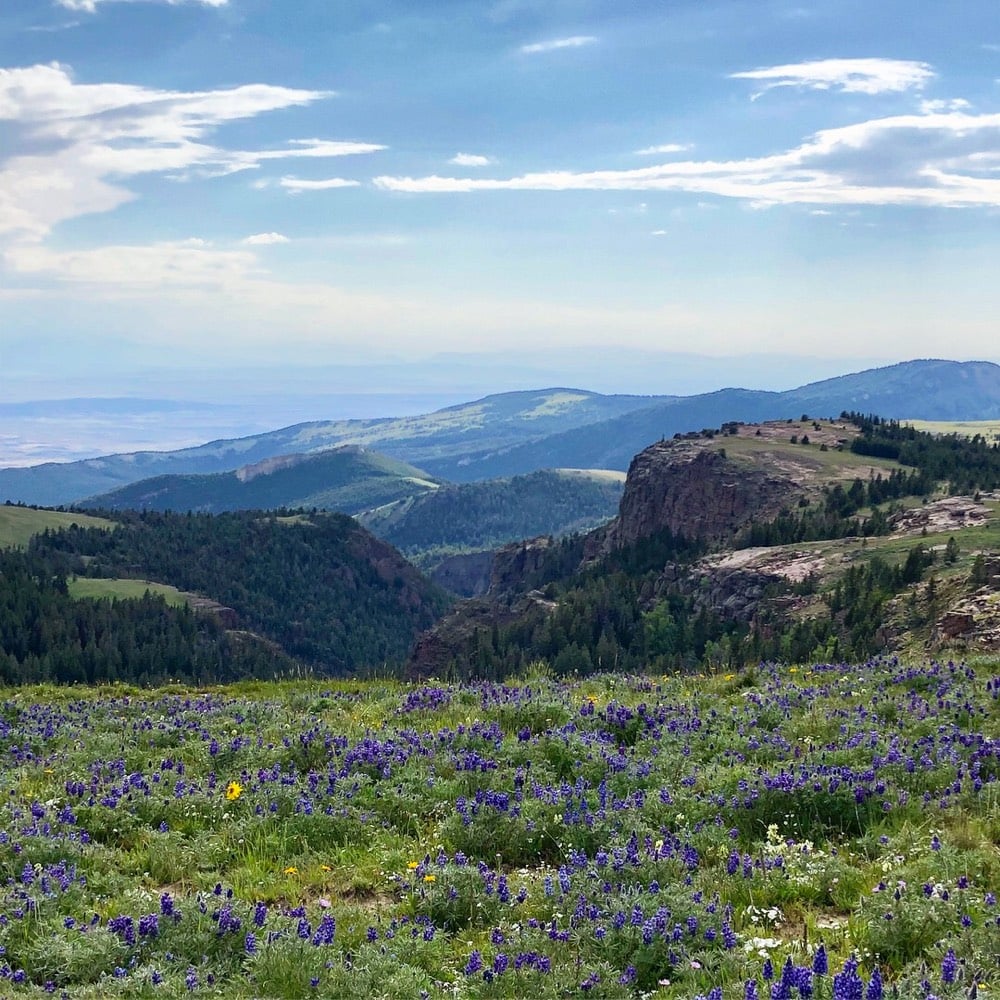
Surprisingly, despite spending 57 hours in the car, I was not bored a single minute of my trip. I marveled at the landscape, played music, and thought. I thought a lot. I expected to listen to a bunch of audiobooks but only managed to finish one I was most of the way through and the first third of another…the landscape was just too distracting most of the time. My experience leads me to believe I might be a good candidate for a solo Mars mission (aside from the one-way thing).
Animals seen on my trip, a partial list: rabbits, prairie dogs, antelope, ducks, geese, pelicans, pheasants, a moose, a wolf, elk, bison, deer, and a bunch of birds I couldn’t identify. The prairie dogs sat near their holes peeping at each other…it was really cute. The moose was a juvenile male in Yellowstone who looked lost & confused; he trotted alongside the road for a bit, then swam across the river and took off into the woods. I was apprehensive about not seeing a bison on my trip, but I shouldn’t have worried…Yellowstone was lousy with ‘em. Pro tip: bring a good pair of binoculars, possibly left over from eclipse-watching.
Yellowstone was one of the highlights (with a caveat that I’ll get to in a second). A single park containing all these different landscapes, from volcanic wastelands to mountain peaks to verdant river valleys to evergreen forests to grasslands…it’s a geographic marvel. But here’s the but: it’s also really crowded in the summer. At times, it felt like a nature mall, with herds of consumers moving from the bison shop to the geyser store. Reminded me a bit of my experience at the Louvre, itself a wonderful place too crowded to enjoy.
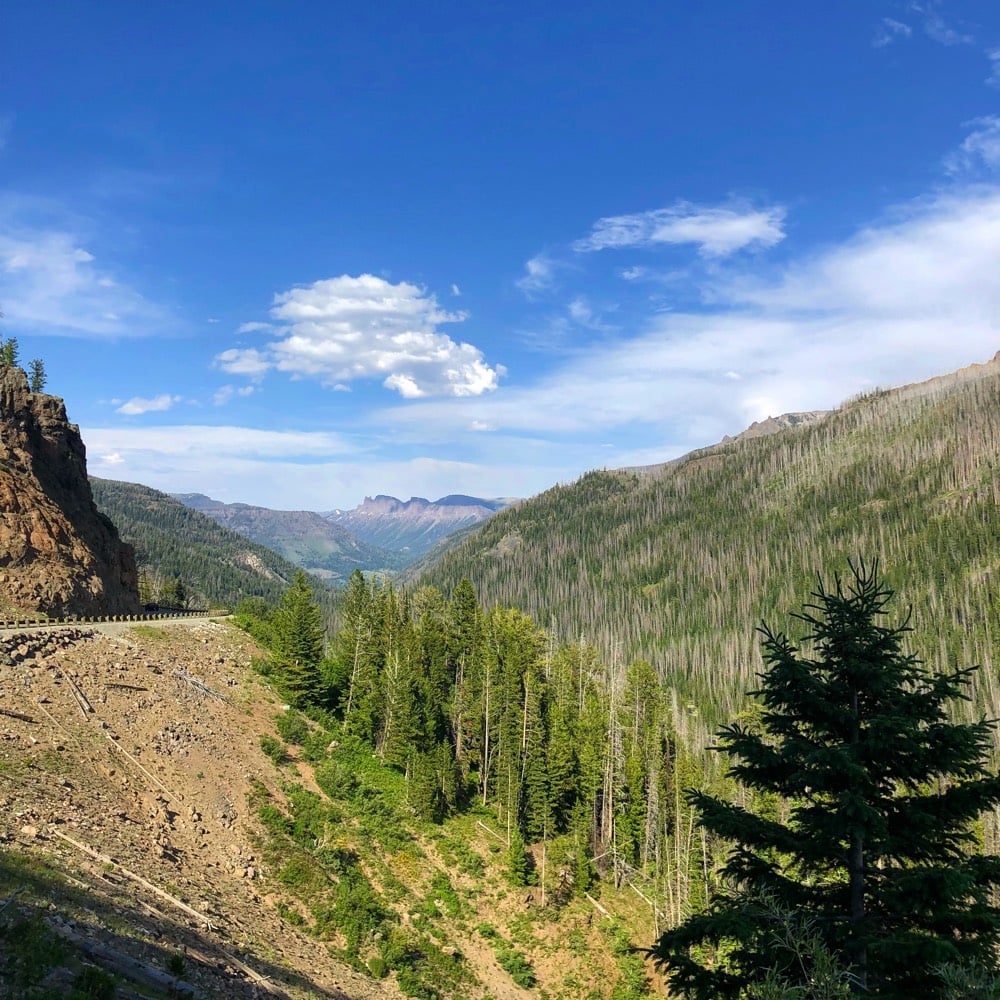
Final roadtrip stats: 2748 miles driven in 10 days and a total of 57 hours in the car. 718 photos and videos taken. I visited seven states — Iowa, Nebraska, South Dakota, Wyoming, Montana, Idaho, and Oregon — and spent at least one night in each save Idaho. Lowest point: 810’. Highest point: 11,070’.
Somewhere west of the Missouri River, which separates Iowa & Missouri from Nebraska & Kansas, the dominance in the eastern US of human activity & organization gives way to geology and geography. Even in the sparser areas of the Midwest, you look down from an airplane and see the Jefferson grid: square parcels of land, each with a group of buildings contained somewhere within it. Further west, hills and mountains and volcanoes and rivers and streams and forests and plains dominate the landscape and how people move within it. The West is not yet tamed, not by a long shot, and acknowledging this goes a long way toward understanding the people who live here.
Biggest surprise of the trip, part 2: High altitude wildflower meadows. When I stopped my car at a scenic overlook at 9400’ in the Bighorn Mountains and saw a path down a gentle slope through a meadow of wildflowers growing very close to the ground, I didn’t think a whole lot about it. Pretty scene, right? I grabbed my daypack from the car and as soon as I stepped down onto the path and into the meadow, this amazing smell sent me reeling. For 20 minutes, I walked in an olfactory daze to the crest of the next hill and back. OMG, what an amazing sensation…a definite high-water mark.
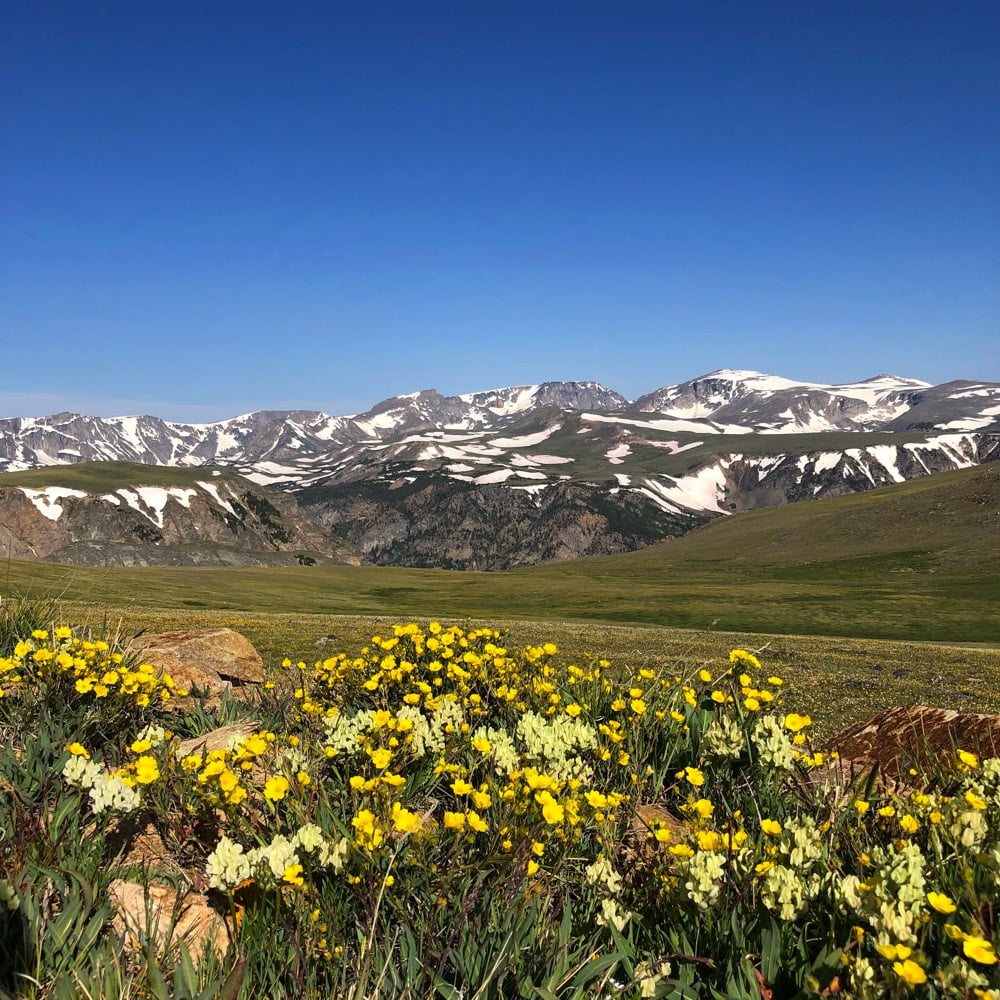
The speed limit on the freeways in South Dakota, Wyoming, Montana, and Idaho was 80 mph. On some rural undivided two-lane highways, the limit was still 70 mph, which I found astounding. But the lanes and the shoulders were way wider than in Vermont, the roads flatter and straighter, and traffic was few and far between most of the time. Still, even just that little extra speed really cuts down on drivers’ potential reaction times.
I had high hopes for the Badlands, and it lived up to the hype. Magnificent desolation, accessible, and not super crowded. I could (and probably should) have spent a couple of days there easy.
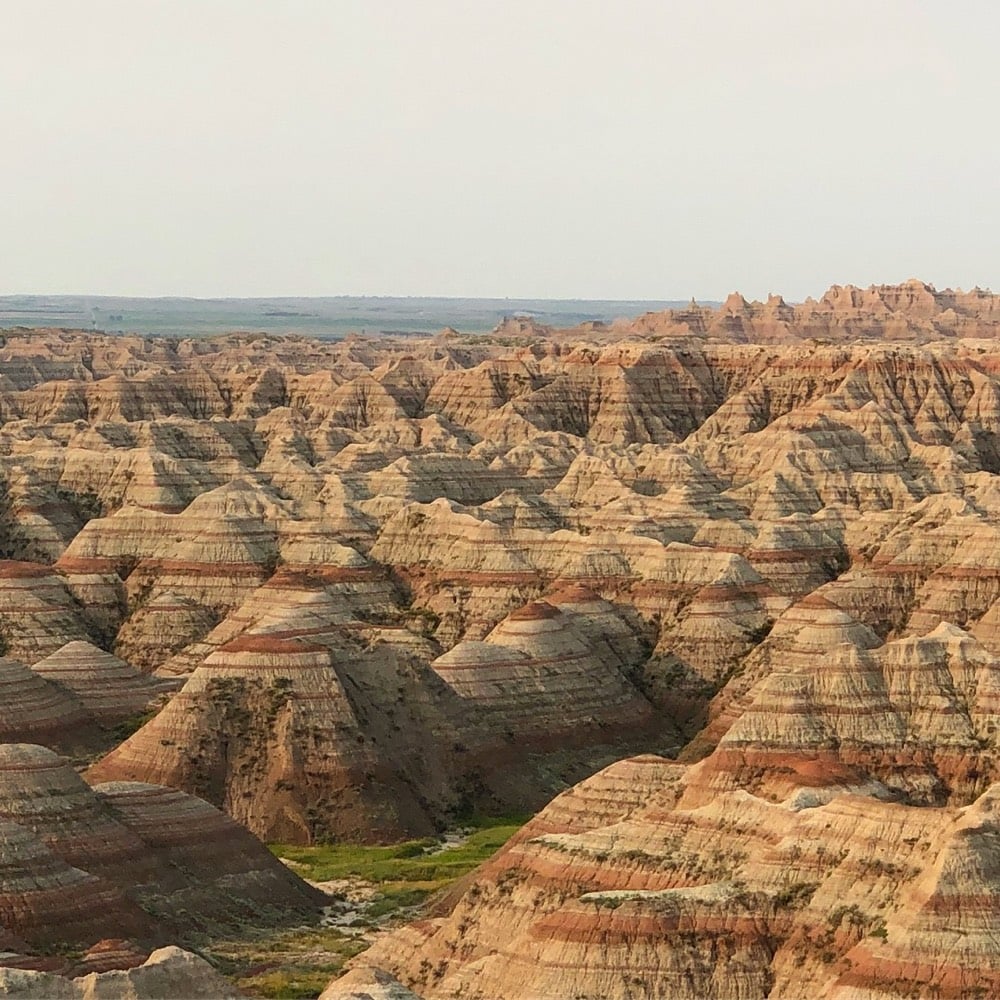
Food was not a highlight or a focus of this trip, mostly because I didn’t spend a tremendous amount of time seeking out good places to eat. I had some Thai lettuce wraps w/ bison in SD that were pretty good, some just-fine sushi in Missoula, and a delicious tostada scramble in Rhododendron, OR. Maybe the best thing I ate was a homemade breakfast burrito I bought at a gas station in Red Lodge, Montana. It was a struggle to find non-meat things to eat — I’m not a vegetarian, but man cannot subsist on burgers & hot dogs & steaks & BBQ for a week and a half w/o GI discomfort. With some notable exceptions, food in the US is more homogenous than ever…you can get anything almost anywhere.
Biggest surprise of the trip, part 3: The hosts at the B&B I stayed at in Wyoming advised me to enter Yellowstone via the Beartooth Highway and I am so glad I took their advice. The 68-mile drive was called “the most beautiful drive in America” by former CBS correspondant Charles Kuralt and he might be right. At the top of the pass, you drive just short of 11,000’ above sea level; I climbed above the 11K mark for a stunning 360° view of the entire area. Reader, I may have done the arms-wide-on-the-bow-of-the-Titanic gesture on top of a rock at the top of the world…no apologies.
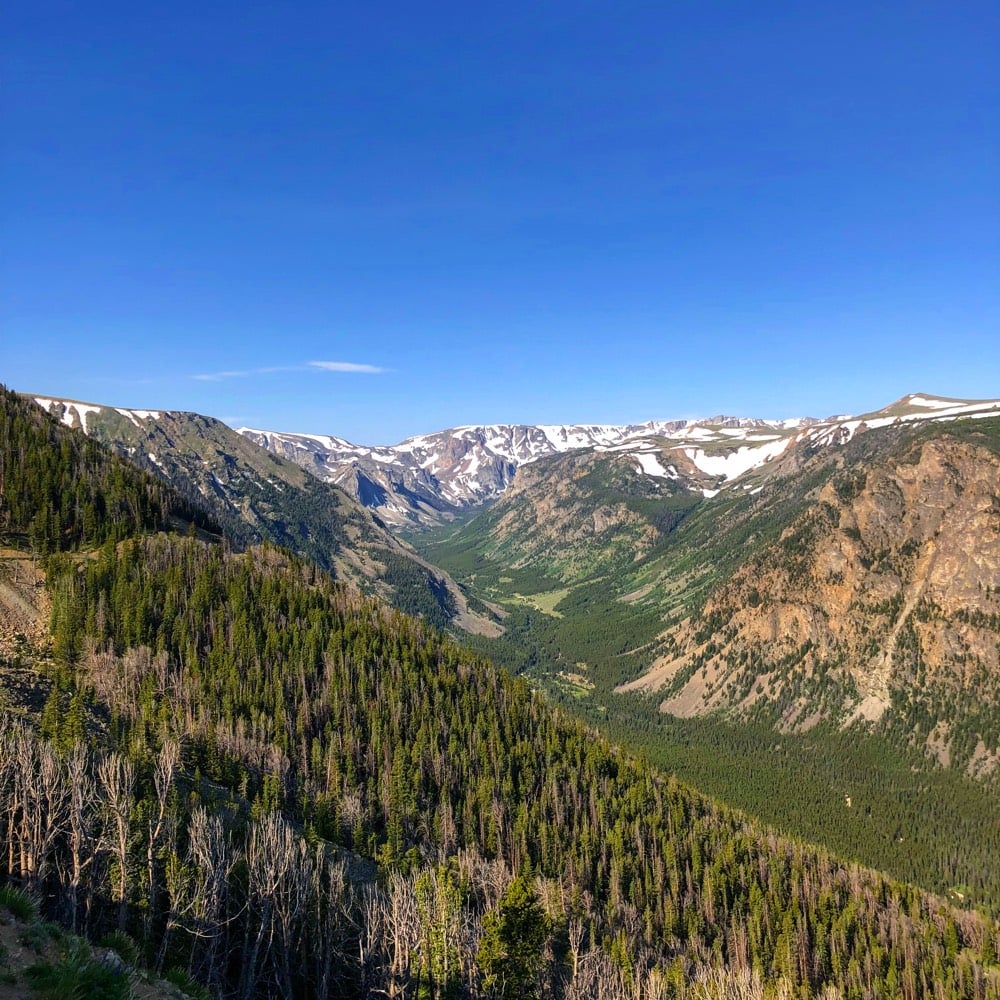
About 5 minutes after I checked into my B&B near Cody, WY, I looked out my window to see a rain cloud off in the distance with a rainbow coming out of it. Chuckling, I asked my host if that was a common occurence around here. “Pretty much,” he replied, “especially with climate change.” A life-long resident of the area, he went on to explain that it rains a lot more there now than “20-30 years ago”. “See all that grass out there? It’s supposed to be brown this time of year.”
Several people told me before my trip that Devils Tower was worth the effort, but as I spotted it off in the distance on my approach, I had my doubts. But as it got closer, I realized they’d all been right. Totally crazy geological thing worth seeing in the flesh.

At a gas station in southern South Dakota, a man noticed the Texas plates on my rental car and asked, “What’s the price of gas in Texas these days?” I explained my situation, and he said, “I’m from Texas originally and I can tell by your accent that you ain’t. What’re ya doing in this godforsaken country?”
In Wyoming, I stayed less than a mile from the Heart Mountain Relocation Center, a WWII Japanese American confinement site. From 1942 to 1945, this concentration camp held almost 14,000 people, making it the third-largest town in Wyoming at the time. The majority were American citizens and had done nothing wrong and committed no crimes…they were put there for being of Japanese heritage. I regret that my plans didn’t allow for a visit; if I’d had known beforehand that it was going to be so close, I would have made the time, given our present administration’s treatment of its Muslim citizens and asylum seekers from Central and South America. As Faulkner said, “The past is never dead. It’s not even past.”
I saw some cool thunderstorms:
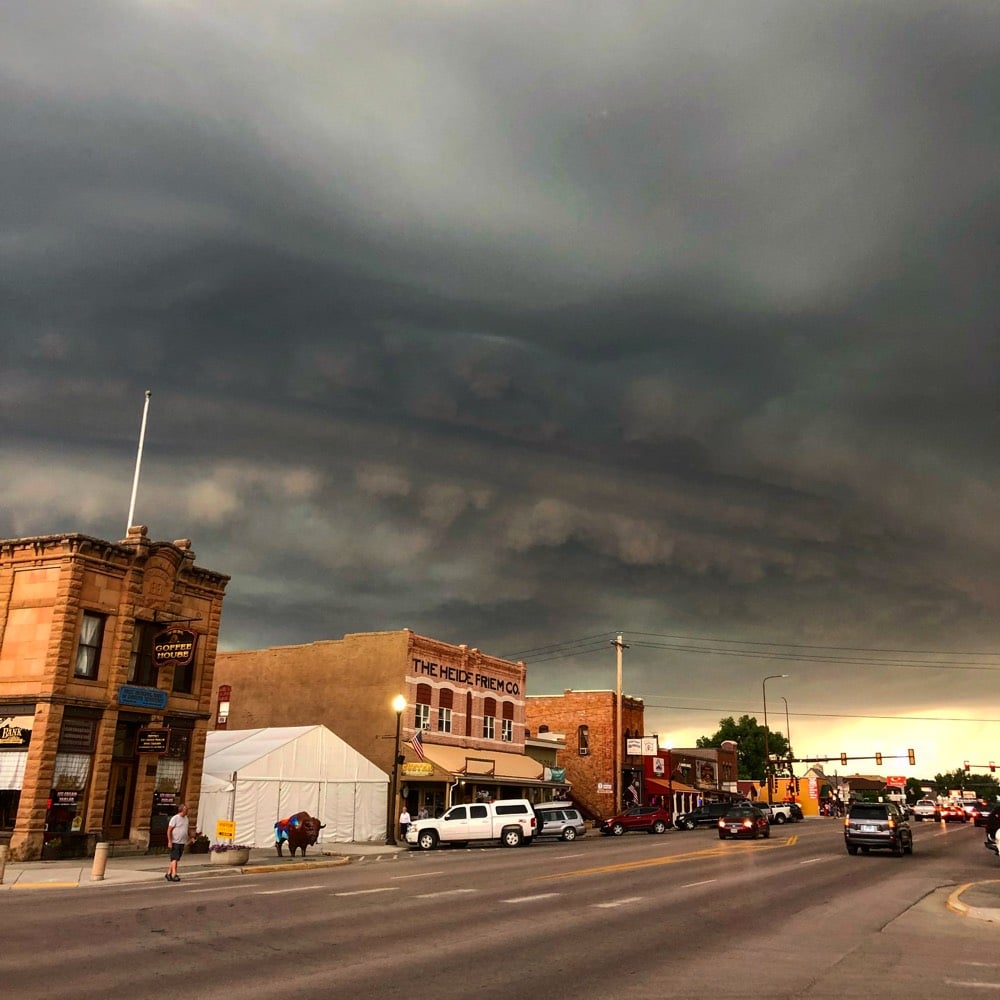
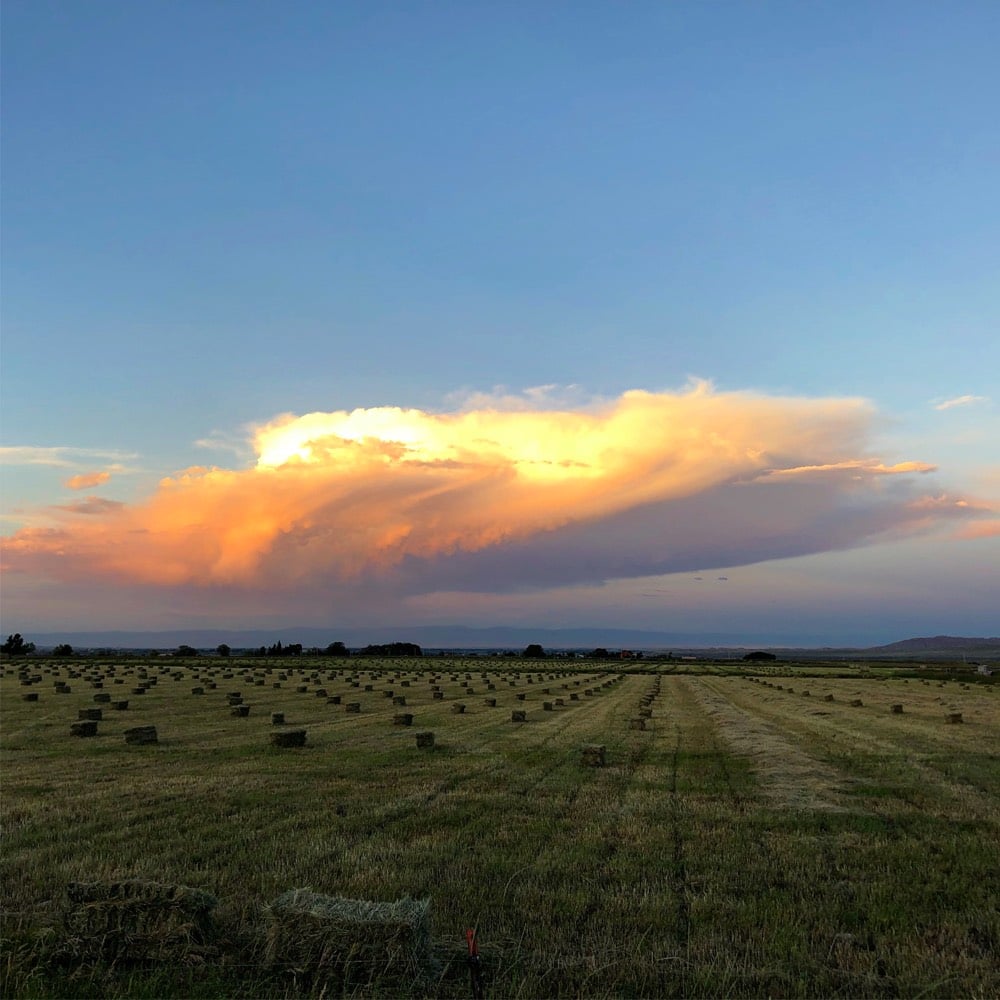
If I had a time machine, I would tell myself from two weeks ago to skip Mt Rushmore, Wind Cave, and the volcanic stuff in Yellowstone. And perhaps Wall Drug. I also would have opted to fly out of Salt Lake City instead of Portland, OR to give me more time to explore Montana and Wyoming…the trip ended up having too much driving and not enough being out in nature.
You can see more photos from my trip on Instagram and in this saved Instagram Story. I feel very lucky to have had the time and resources to take this trip. It definitely took me out of my comfort zone in both good ways and bad — the journey definitely wasn’t all sunshine and lollipops, despite what my photos might indicate. To many of us, it seems like a perilous time in our nation’s history, with many debts, old and new, coming due in rapid-fire succession. Doing this roadtrip reminded me of many great things about this country & the people who live in it and gave me the time & space to ponder how I fit into the puzzle, without the din of the news and social media. If you can manage it, I encourage you all to do the same, even if it’s just visiting someplace close that you’ve never been to: get out there and see the world and visit with its people. This world is all we have, and the more we see of it, the better we can make it.
Open offices result in less collaboration among employees
In a recent study called The impact of the ‘open’ workspace on human collaboration, a pair of researchers tracked the digital and real life interactions of workers at a company that shifted to an open office plan before and after the shift. Here were the two key findings of the study:
Contrary to what’s predicted by the sociological literature, the 52 participants studied spent 72% less time interacting face-to-face after the shift to an open office layout. To make these numbers concrete: In the 15 days before the office redesign, participants accumulated an average of around 5.8 hours of face-to-face interaction per person per day. After the switch to the open layout, the same participants dropped to around 1.7 hours of face-to-face interaction per day.
At the same time, the shift to an open office significantly increased digital communication. After the redesign, participants sent 56% more emails (and were cc’d 41% more times), and the number of IM messages sent increased by 67%.
That’s a pretty dramatic shift…and productivity suffered. The authors theorized that the lack of physical boundaries in the open office made constructing social barriers necessary.
Like social insects which swarm within functionally-determined zones ‘partitioned’ by spatial boundaries (e.g. hives, nests or schools), human beings — despite their greater cognitive abilities — may also require boundaries to constrain their interactions, thereby reducing the potential for overload, distraction, bias, myopia and other symptoms of bounded rationality.
This jibes with my experience working in open offices. For almost 10 years, I worked in an open office plan at Buzzfeed. In the beginning, when there were just a few of us, the level of IRL interaction was high. But as the number of people in the office increased past a certain point, people spent more and more time at their desks, headphones on, ignoring everything but their screens. And yet companies keep doubling down on this…
2018 Amazon Prime Day deals
It’s Prime Day! Or is it tomorrow? Prime Day, a holiday invented by Amazon to sell stuff in the lull between Memorial Day and Labor Day, now stretches a full 36 hours, so…Happy Prime Day And A Half? Doesn’t quite roll off the tongue. Anyway, if you are an Amazon Prime member (or want to sign up for a 30-trial), there are some good deals to be had if your life doesn’t have enough stuff in it.
- The Kindle Paperwhite, the device on which I read almost all of my books, is on sale for only $80. The regular Kindle is just $50.
- This 50-inch 4K TV with built-in Fire TV (voice control via Alexa & access to Netflix, Prime Video, Hulu, HBO, etc. w/ subscriptions) is an absurd $290. I wish the economics of healthcare worked like that of consumer electronics…having a baby would cost about $5.
- The Echo, Amazon’s flagship wifi speaker w/ voice control via Alexa, is $70 while the smaller Echo Dot is just $30.
- The Anova sous vide cooker is $109 (45% off). I’ve been using my Anova more and more over the past few months and it’s really upped my game. The last round of steaks I cooked (and then finished on the grill) were right up there with any I’ve had at a restaurant.
- Whoa, this littleBits kit is only $40 (60% off). My kids love their littleBits sets.
- Hold the phone! One of my favorite items on Amazon that shows up on my gift guide each year, the 55-gallon drum of personal lubricant (a bargain at $1,468.80), has some competition all of a sudden. This 55-gallon drum of lube is only $475 while this one is even cheaper…only $378. When is Wirecutter going to issue a buy recommendation in this critical category?!
Maybe I’ll add some more deals later…or you can check here yourself in the meantime.
Update: Some more deals:
- The 6-quart Instant Pot is only $60.
- If you buy a $25 gift card, you get $5 extra when using the code “GCPRIME18”.
- 4TB external hard drive for $80. 4TB was probably more than the total amount of hard drive storage in every single computer when I was a kid.
- Want to start a podcast? The Yeti is a great microphone on sale for $90.
- I just bought this electric toothbrush…$30 w/ coupon.
P.S. You may also wish to know that Amazon workers in Europe are on strike today, protesting poor working conditions.
Amazon workers primarily in German, Poland, and Spain are participating, with union representatives alleging Amazon has been working to freeze salaries, reduce medical leave pay rates, and strip other rights from its warehouse workforce.
The geography of the US is weirder than you think
Americans generally have a skewed view of their country’s place in the world, both metaphorically and geographically speaking. For instance, the US state closest to Africa is… Maine? And Minneapolis is as far north as Venice, Italy.
They didn’t cover my favorite US geographical oddity though: what’s the northernmost state in the contiguous 48 states? Unless you know it by rote, the answer will probably be surprising to you.
Tenements, Towers & Trash: An Unconventional Illustrated History of New York City
I really like these drawings of NYC with a historical bent by illustrator and “amateur historian” Julia Wertz.


They’re from a book Wertz wrote & illustrated called Tenements, Towers & Trash: An Unconventional Illustrated History of New York City. Gothamist recently interviewed Wertz about the book and her work.
Q: Bob Dylan (and my boss, Jake Dobkin) both like to exclaim that “nostalgia is death.” Which probably says more about them, and their own particularly complex relationships with nostalgia, than anything else. But do you think of yourself as a nostalgic person? How does nostalgia play into your appreciation of the urban landscape?
A: I understand what people mean by that expression, but it categorizes nostalgia in too simple a way. Nostalgia is like an intoxicant — in moderation it can be a rewarding experience, but if abused/overused, it becomes toxic. To indulge in nostalgia is to romanticize the past and stop living in the present. This could be totally fine for short periods of time, just a nice way to remember a pleasant time you experienced, but if it becomes a way of thinking, it ruins the present because there’s no way the present moment can compare to a fabricated, romanticized version past. Nostalgia has a way of erasing the shitty parts of reality. Like when people are nostalgic for, say, NYC in the 1800’s — the horse and buggies, the handmade shop signs, the elaborate suits and dresses — they’re forgetting (or perhaps never knew) that the city then was a filthy cesspool of trash and sewage, disease was rampant, and the clothing was insufferably hot and restrictive, and sometimes even deadly for women cooking with open flame.
Wes Anderson & Juman Malouf are curating an exhibition at the Kunsthistorisches Museum in Vienna called “The Spitzmaus Mummy in a Coffin and Other Treasures”. Opens in November.
Michael Ian Black on why cruises are cool. “For the cost of a good hotel room, you get a mostly-all-inclusive break from our whirling hyper-culture.”
I really liked season 2 of The Handmaid’s Tale, but this criticism has merit. “This isn’t a feminist rallying cry or a cathartic airing of grievances, it’s just a fandom.”
“I Know What Incarceration Does to Families. It Happened to Mine.” Michiko Kakutani on her family’s imprisonment in a WWII Japanese internment camp.
Kylie Jenner started a cosmetics company two years ago that’s worth nearly $800 million now (based on revenues). She’s 20 years old & owns 100% of the company.
Barack Obama’s 2018 Summer Reading List
President Obama is heading to Africa this week for the first time since he left office. In preparation, he shared a recommended summer reading list that’s heavy on African authors. Here’s the full list:
Things Fall Apart by Chinua Achebe
A true classic of world literature, this novel paints a picture of traditional society wrestling with the arrival of foreign influence, from Christian missionaries to British colonialism. A masterpiece that has inspired generations of writers in Nigeria, across Africa, and around the world.A Grain of Wheat by Ngugi wa Thiong’o
A chronicle of the events leading up to Kenya’s independence, and a compelling story of how the transformative events of history weigh on individual lives and relationships.Long Walk to Freedom by Nelson Mandela
Mandela’s life was one of the epic stories of the 20th century. This definitive memoir traces the arc of his life from a small village, to his years as a revolutionary, to his long imprisonment, and ultimately his ascension to unifying President, leader, and global icon. Essential reading for anyone who wants to understand history — and then go out and change it.Americanah by Chimamanda Ngozi Adichie
From one of the world’s great contemporary writers comes the story of two Nigerians making their way in the U.S. and the UK, raising universal questions of race and belonging, the overseas experience for the African diaspora, and the search for identity and a home.The Return by Hisham Matar
A beautifully-written memoir that skillfully balances a graceful guide through Libya’s recent history with the author’s dogged quest to find his father who disappeared in Gaddafi’s prisons.The World As It Is by Ben Rhodes
It’s true, Ben does not have African blood running through his veins. But few others so closely see the world through my eyes like he can. Ben’s one of the few who’ve been with me since that first presidential campaign. His memoir is one of the smartest reflections I’ve seen as to how we approached foreign policy, and one of the most compelling stories I’ve seen about what it’s actually like to serve the American people for eight years in the White House.
One of the books on my summer reading list is The Book of Forgiving: The Fourfold Path for Healing Ourselves and Our World by Desmond Tutu & Mpho Tutu, recommended to me by a reader a few months ago.
Each of us has a deep need to forgive and to be forgiven. After much reflection on the process of forgiveness, Tutu has seen that there are four important steps to healing: Admitting the wrong and acknowledging the harm; Telling one’s story and witnessing the anguish; Asking for forgiveness and granting forgiveness; and renewing or releasing the relationship. Forgiveness is hard work. Sometimes it even feels like an impossible task. But it is only through walking this fourfold path that Tutu says we can free ourselves of the endless and unyielding cycle of pain and retribution.
Making Amazon Alexa respond to sign language using AI
Using a JavaScript machine learning package called TensorFlow.js, Abhishek Singh built a program that learned how to translate sign language into verbal speech that an Amazon Alexa can understand. “If voice is the future of computing,” he signs, “what about those who cannot [hear and speak]?”
See also how AirPods + the new Live Listen feature “could revolutionize what it means to be hard of hearing”.
How Trajan became the go-to typeface for movie posters
In the early 90s, a digital typeface designed in the 80s — but based on the letterforms used in a Roman column completed in 113 AD — became the go-to typeface for movie poster designers. (Reminder: everything is a remix.) It was used on posters for movies like The Bodyguard, Crouching Tiger Hidden Dragon, Children of Men, and Quiz Show. This Vox video details the rise of the Trajan typeface in movie poster design and why its not used that often by big movies anymore.
The original Mac OS Control Panel done in cross-stitch

iOS programmer Glenda Adams made a cross-stitch embroidery of the original Control Panel for the Macintosh. Lots of parallels between designing cross-stitch patterns and pixel drawings & fonts. For instance, check out designer Susan Kare’s drawings for some of the original Mac OS icons and compare them to cross-stitch patterns. (P.S. Check out that date…)
See also this Lego Macintosh.
Manually pixelated food


Art director Yuni Yoshida has created these pixelated food photos by manually cutting up the foods in question into little cubes. Love these.
See also censored fruit.
Winners of National Geographic Travel Photographer of the Year competition for 2018


National Geographic recently announced the winners of the Travel Photographer of the Year contest for 2018. You can look at the winners here and the people’s choice awards here.
You can also download the winning images as wallpaper for your computer, phone, or tablet.
The US national anthem is terrible (unless it’s sung by Whitney Houston). “No one with a normal esophagus can sing it without screaming.”
A movie adaptation of Sapiens is coming
Ridley Scott and Asif Kapadia are working on a film adaptation of Yuval Noah Harari’s Sapiens: A Brief History of Humankind. Scott (Blade Runner, Gladiator, Alien) is producing while Kapadia (the excellent documentaries Amy & Senna) will direct. Harari, you’ll recall, is a Prophet and states in Sapiens that the Agricultural Revolution is “history’s biggest fraud”.
Rather than heralding a new era of easy living, the Agricultural Revolution left farmers with lives generally more difficult and less satisfying than those of foragers. Hunter-gatherers spent their time in more stimulating and varied ways, and were less in danger of starvation and disease. The Agricultural Revolution certainly enlarged the sum total of food at the disposal of humankind, but the extra food did not translate into a better diet or more leisure. Rather, it translated into population explosions and pampered elites. The average farmer worked harder than the average forager, and got a worse diet in return. The Agricultural Revolution was history’s biggest fraud.
At any given time in their lives, people have two dozen regular haunts. It’s like a Dunbar number for places rather than people.
Headline of the year? “How Noisy Males Control the Gnu’s Cycle”
Some great commentary about the meaning of the movie Casablanca. “Casablanca came out in 1942 … Real refugees from the Nazis, afraid for their lives, watched this movie and took heart.”
Socials & More