
Secret Life of an Autistic Stripper. “I’ve always had trouble reading social cues, but in the strip club, where rules and roles are crystal clear, I finally learned to connect.”

Advertise here with Carbon Ads
This site is made possible by member support. 💞
Big thanks to Arcustech for hosting the site and offering amazing tech support.
When you buy through links on kottke.org, I may earn an affiliate commission. Thanks for supporting the site!
kottke.org. home of fine hypertext products since 1998.
Beloved by 86.47% of the web.
Entries for July 2018
A new book from David Grann about a polar journey gone wrong: The White Darkness
Author and New Yorker writer David Grann is out with a new book in the fall: The White Darkness. The book tells the story of polar explorer Henry Worsley, who attempted to duplicate the polar voyages of Ernest Shackleton, and is based on a long NYer piece written by Grann earlier this year.

The man felt like a speck in the frozen nothingness. Every direction he turned, he could see ice stretching to the edge of the Earth: white ice and blue ice, glacial-ice tongues and ice wedges. There were no living creatures in sight. Not a bear or even a bird. Nothing but him.
It was hard to breathe, and each time he exhaled the moisture froze on his face: a chandelier of crystals hung from his beard; his eyebrows were encased like preserved specimens; his eyelashes cracked when he blinked. Get wet and you die, he often reminded himself. The temperature was nearly minus forty degrees Fahrenheit, and it felt far colder because of the wind, which sometimes whipped icy particles into a blinding cloud, making him so disoriented that he toppled over, his bones rattling against the ground.
The story has also been optioned for a movie, joining Grann’s previous book, Killers of the Flower Moon, which is being adapted by Martin Scorsese & Leonardo DiCaprio.
Film and Furniture, a Site About the Decor in Movies
On Film and Furniture, you’ll find info about the production and set designers of films & TV shows and features about the furniture and wallpaper in Phantom Thread, the Parr’s massive new home in Incredibles 2 (Pixar listed the place on Zillow), and some of the cooler items from Blade Runner 2049.

They also have a store from which you can buy items from your favorite movies: whiskey tumblers from Blade Runner, a sofa from Ex Machina, lounge chairs from 2001: A Space Odyssey, and, of course, the Overlook Hotel rug from The Shining. (thx to several ppl who sent this in)
A map of the most lewd-sounding town names in each state. Who’s up for a roadtrip from Short Pump, VA to Dickshooter, ID?
What if you detonated a nuclear bomb in the Marianas Trench?
In response to a dumb viral video with almost 20 million views that suggests detonating a powerful nuclear device at the bottom of the ocean would unleash global chaos, Kurzgesagt provides a counterpoint using, you know, science. This was also an early What If? query:
The bubble grows to about a kilometer across in a couple of seconds. The water above bulges up, though only slightly, over a large area. Then the pressure from that six miles of water overhead causes it to collapse. Within a dozen or so seconds, the bubble shrinks to a minimum size, then ‘bounces’ back, expanding outward again.
It goes through three or four cycles of this collapse and expansion before disintegrating into, in the words of the 1996 report, “a mass of turbulent warm water and explosion debris.” According to the report, as a result of such a deep-water closed bubble creation and dissipation, “no wave of any consequence will be generated.”
An orchestral take on Ibiza club hits
Gosh, I don’t know what micro-fraction of regular readers are going to be interested in this, but I sure was! In 2015, DJ Pete Tong and the Heritage Orchestra (under director Jules Buckley) collaborated on a performance of a bunch of Ibiza club hits from the likes of Moby, Fatboy Slim, Orbital, Brainbug, and Daft Punk. Here’s a Spotify playlist of the songs they covered.
Did I get goosebumps when the violins started in on Robert Miles’ Children? Possibly! Some of this stuff was the soundtrack to my web design work & play in the late 90s. kottke.org circa 1999 was at least 20% Fatboy Slim, Orbital, BT, Robert Miles, The Orb, and Daft Punk.
Update: And here’s an album of the performance itself on Spotify as well as a subsequent album featuring different club tracks. Tong and the orchestra are also touring the show around England, Ireland, and Scotland.
Ta-Nehisi Coates Is Leaving The Atlantic. “I want to be a writer, I’m not a symbol of what The Atlantic wants to do or whatever.”
Using weeds, pests, and invasive species to make sustainable sushi
At Miya’s Sushi in New Haven, CT, chef owner Bun Lai makes sustainable sushi using invasive species and other typically overlooked ingredients.
By collecting invasive seafood on shell-fishing beds, we are basically providing a free weeding service… We hope that this will do a few things. First of all, it could potentially curb the dominance of invasive species in the ecosystem. Secondly, it would provide the seafood industry a greater supply of native seafood and reduce the stresses on those populations already fished. Finally, we hope that it would encourage greater balance in the inter-regenerative relationship between man and the oceans. If we were to have thirty Miya’s in thirty different places, each one would have a slightly different menu, each reflecting the problems of its local universe.
Take a look at the current menu…there are entire sections dedicated to dishes made from invasive species (like Kentucky silver carp, Japanese knotweed, and Florida lionfish) and sustainable seafood.
How to see kung fu films
In this video, MoMA film curator La Frances Hui gives us a very quick and informative overview of what to look for when watching kung fu and martial arts films. Aside from Jackie Chan & more recent stuff like Crouching Tiger & Hero, I’ve never been super into martial arts movies, but after watching this, I’m excited to watch some of Lau Kar-leung’s films, particularly The 36th Chamber of Shaolin (which is currently streaming on Amazon Prime). Lau also directed and did the fight choreography for Drunken Master II, a favorite of mine that I haven’t seen in awhile.
A thagomizer is an arrangement of spikes on the tail of a Stegosaurus. The term was coined by Gary Larson in a Far Side cartoon and is now used by actual paleontologists. And why not, it’s a perfectly cromulent word!
This AI Makes High-Quality Slow Motion Videos from Regular 30 fps Video
NVIDIA trained a deep learning framework to take videos filmed at 30 fps and turn them into slow motion videos at the equivalent of 240 or even 480 fps. Even though the system is guessing on the content in the extra frames, the final results look amazingly sharp and lifelike.
“There are many memorable moments in your life that you might want to record with a camera in slow-motion because they are hard to see clearly with your eyes: the first time a baby walks, a difficult skateboard trick, a dog catching a ball,” the researchers wrote in the research paper. “While it is possible to take 240-frame-per-second videos with a cell phone, recording everything at high frame rates is impractical, as it requires large memories and is power-intensive for mobile devices,” the team explained.
With this new research, users can slow down their recordings after taking them.
Using this technique and what Peter Jackson’s team is doing with WWI footage, it would be interesting to clean up and slow down all sorts of archival footage (like the Zapruder film, just to choose one obvious example).
The weird and wonderful American roadtrip with John Margolies


For more than 30 years beginning in the 1960s, photographer John Margolies criss-crossed the USA documenting the roadside architecture of a pre-corporate America, taking photos of diners, weird sculptures, mini golf courses, and signs that don’t exist anymore in great numbers.
Before the advent of corporate communications and architectural uniformity, America’s built environment was a free-form landscape of individual expression. Signs, artifacts, and even buildings ranged from playful to eccentric, from deliciously cartoonish to quasipsychedelic. Photographer John Margolies spent over three decades and drove more than 100,000 miles documenting these fascinating and endearingly artisanal examples of roadside advertising and fantasy structures, a fast-fading aspect of Americana.
In addition to publishing his work in a book, Margolies released his images into the public domain. The Library of Congress has posted over 11,000 of his photos online, a treasure trove of 60s & 70s Americana. Good luck spending less than 30 minutes poking around in there…
What does sleep do?

Sleep may be the most important everyday phenomenon that we understand the least well. It’s like the oceans; it’s everywhere, but we’ve only explored the surfaces. But scientists are still working to establish better knowledge of what sleep does, how it works, and why every animal does it (and needs to do it). National Geographic has a very pretty and pretty thorough summary of the latest theories of sleep scientists on what we do when we fall asleep.
The waking brain is optimized for collecting external stimuli, the sleeping brain for consolidating the information that’s been collected. At night, that is, we switch from recording to editing, a change that can be measured on the molecular scale. We’re not just rotely filing our thoughts—the sleeping brain actively curates which memories to keep and which to toss.
It doesn’t necessarily choose wisely. Sleep reinforces our memory so powerfully—not just in stage 2, where we spend about half our sleeping time, but throughout the looping voyage of the night—that it might be best, for example, if exhausted soldiers returning from harrowing missions did not go directly to bed. To forestall post-traumatic stress disorder, the soldiers should remain awake for six to eight hours, according to neuroscientist Gina Poe at the University of California, Los Angeles. Research by her and others suggests that sleeping soon after a major event, before some of the ordeal is mentally resolved, is more likely to turn the experience into long-term memories.
It’s basically a maintenance cycle. At deeper levels of sleep, we’re literally cleaning away waste products of waking life in the brain.
Good sleep likely also reduces one’s risk of developing dementia. A study done in mice by Maiken Nedergaard at the University of Rochester, in New York, suggests that while we’re awake, our neurons are packed tightly together, but when we’re asleep, some brain cells deflate by 60 percent, widening the spaces between them. These intercellular spaces are dumping grounds for the cells’ metabolic waste—notably a substance called beta-amyloid, which disrupts communication between neurons and is closely linked to Alzheimer’s. Only during sleep can spinal fluid slosh like detergent through these broader hallways of our brain, washing beta-amyloid away.
Dreams, too, reflect this heightened activity of the brain, but it’s unclear whether dreams themselves are a kind of harmless aftereffect or whether they perform a key function at reinforcing memory.
Lately, I’ve been fascinated by my own dreams, not least because reality has so often been disappointing. One recurring theme has been universities: libraries, offices, classrooms, campuses, over and over again. This isn’t terribly surprising: I spent a shade less than half my life, and most of my adult life, either going to school or working at one. But it’s difficult to make sense of. Do I miss the security/adventure of those times? Am I consolidating those memories to make room for new ones? Is an oracular entity trying to convince me to go back to school? I’m not sure. But understanding that SOMEthing is going on is a kind of balm that’s useful to me in ways I can’t totally articulate.
How to ask a favor
Some very useful advice from Valet magazine (which I confess I don’t read — thanks Yuri Victor!) on how to ask for a favor. It’s step by step and super simple:
- Be direct with your request;
- Give your reason why;
- Provide an opportunity for escape.
This last step, in particular, is nicely articulated:
This is really just good manners and keeps your relationship in good standing. It shows the other person you respect their time and that this isn’t a guilt trip. When you ask a favor, always offer the other person the opportunity to easily and graciously decline. End your request with something like, “I understand if you can’t do this now,” or “Please don’t feel obligated, if you aren’t comfortable with this.” Say this and mean it. Because a favor you aren’t able to refuse isn’t a favor at all. It’s an order or a command.
You can embroider this with lots of detail specific to the kind of behavior you’re asking for, but the core here is pretty spot-on. There’s also a nice bit of advice for folks granting a favor, that basically boils down to “do it or don’t do it, but don’t be a jerk about it.”
The history of the BBC Radiophonic Workshop
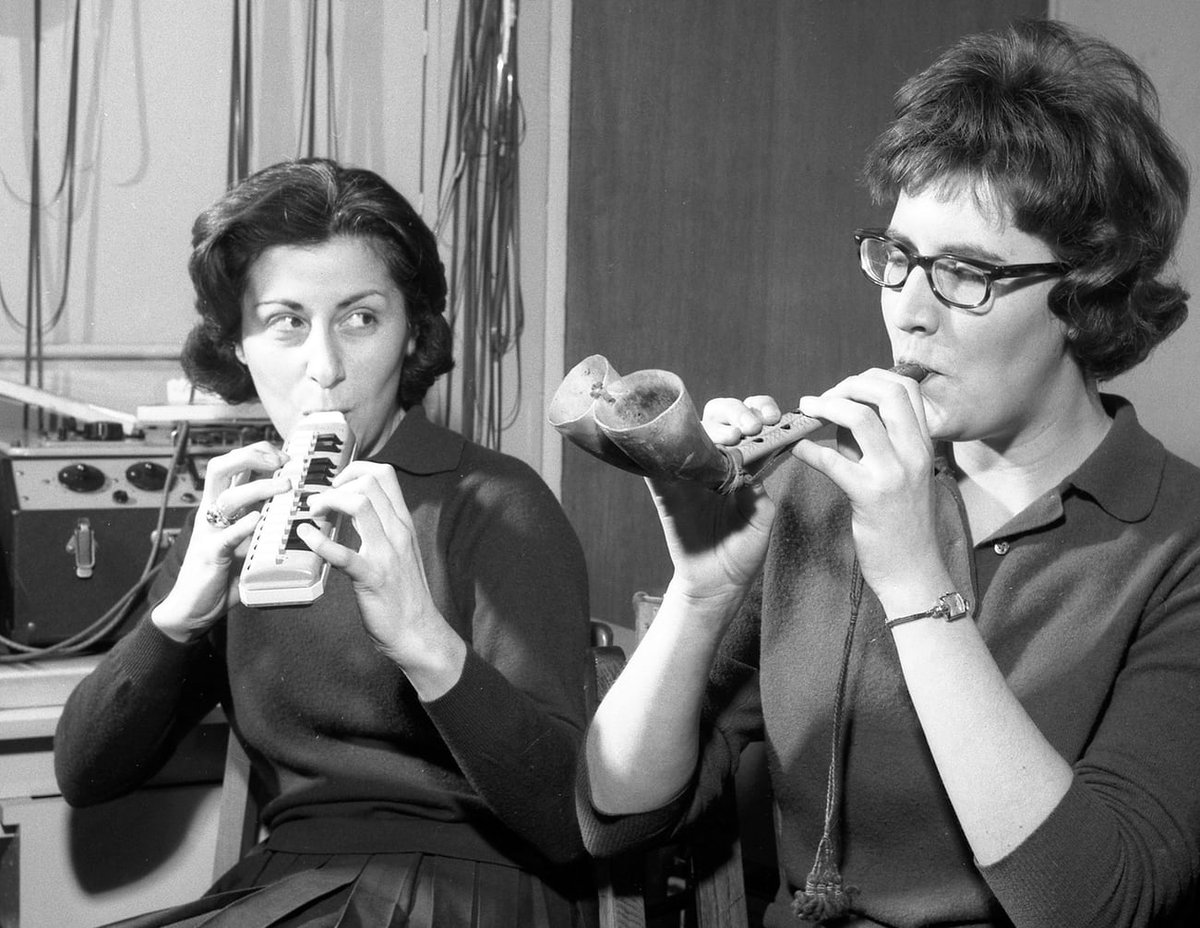
I am a sucker for high-tech analog art: magnetic tape, early wireless, punch cards, film and vinyl, the telephone, telegraph, and typewriter, and electricity before the transformation of digital technology. Consequently, and unsurprisingly, I love the BBC Radiophonic Workshop, and was delighted to read an article on its history from The Guardian.
Radiophonics owes everything to the invention of the tape recorder. Once you could capture sound, using a workable material, you could play with it: slow it down until it thundered, feed it back on itself until it shrieked and echoed, or simply slice bits out. However extreme these experiments became, there was always something eerily familiar to the ear, because they were made from real objects or events.
The term “radiophonic” came about because these mutated everyday sounds were put to the service of radio. “It is a new sound,” said the BBC, “suggestive of emotion, sensation, mood, rather than the literal moaning of the wind or the opening of a door.” Such things are now so easily achieved with digital technology that it’s hard to grasp how laborious - and groundbreaking - this all was.
The piece, riffing on a new book by does a nice job of eschewing undue nostalgia while digging into some of the Workshop’s most famous work — Doctor Who, The Hitchhiker’s Guide to the Galaxy — while also pointing out that most of the work was on simple education programs (which nevertheless introduced whole generations to new sonic possibilities). It restores the place of the many women who came through the workshop, including the inventive Delia Derbyshire, who played a huge role even as they often couldn’t get jobs at record studios or elsewhere in the recording industry.
My only complaint: it’s too darn short. I gotta read a book or something.
Trump’s Tax Cut Hasn’t Done Anything for Workers. “Wages were supposed to rise. Instead, they’ve fallen.”
Live TV coverage of the Apollo 11 landing and Moon walk
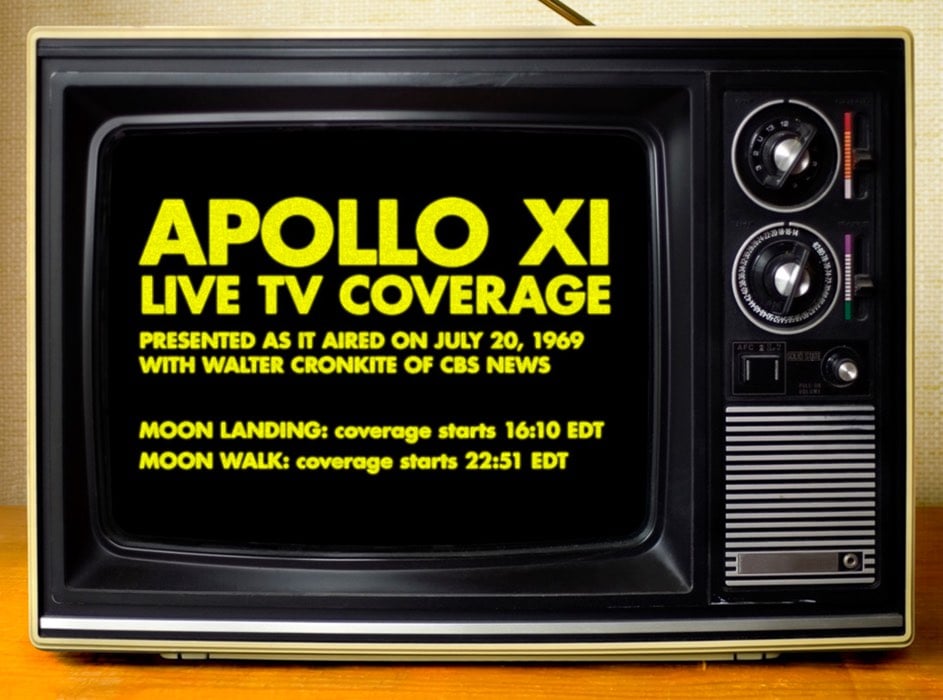
In May 1961, President John F. Kennedy stood before Congress and said:
I believe that this nation should commit itself to achieving the goal, before this decade is out, of landing a man on the moon and returning him safely to the earth.
A little more than 8 years later, it was done. On July 20, 1969, 49 years ago today, Neil Armstrong and Buzz Aldrin landed on the Moon, took a walk, and returned safely to Earth a few days later. And the whole thing was broadcast live on television screens around the world.
For the 40th anniversary of the landing in 2009, I put together a page where you can watch the original CBS News coverage of Walter Cronkite reporting on the Moon landing and the first Moon walk, synced to the present-day time. Just open this page in your browser and the coverage will start playing at the proper time. Here’s the schedule (all times EDT):
4:10:30 pm: Moon landing broadcast starts
4:17:40 pm: Lunar module lands on the Moon
4:20:15 pm: Break in coverage
10:51:27 pm: Moon walk broadcast starts
10:56:15 pm: First step on Moon
11:51:30 pm: Nixon speaks to the Eagle crew
12:00:30 am: Broadcast end (on July 21)
You can add these yearly recurring events to your calendar: Moon landing & Moon walk.
Here’s what I wrote when I launched the project, which is one of my favorite things I’ve ever done online:
If you’ve never seen this coverage, I urge you to watch at least the landing segment (~10 min.) and the first 10-20 minutes of the Moon walk. I hope that with the old time TV display and poor YouTube quality, you get a small sense of how someone 40 years ago might have experienced it. I’ve watched the whole thing a couple of times while putting this together and I’m struck by two things: 1) how it’s almost more amazing that hundreds of millions of people watched the first Moon walk *live* on TV than it is that they got to the Moon in the first place, and 2) that pretty much the sole purpose of the Apollo 11 Moon walk was to photograph it and broadcast it live back to Earth.
I’ve been listening to the audiobook of Andrew Chaikin’s account of the Apollo program, A Man on the Moon, and the chapter about Apollo 11’s Moon landing was riveting.1 I’ve watched the TV footage & listened to the recordings dozens of times and I was still on the edge of my seat, sweating the landing alongside Armstrong and Aldrin. And sweating they were…at least Armstrong was. Take a look at his heart rate during the landing; it peaked at 150 beats per minute at landing (note: the “1000 ft altitude” is mislabeled, it should be “100 ft”):
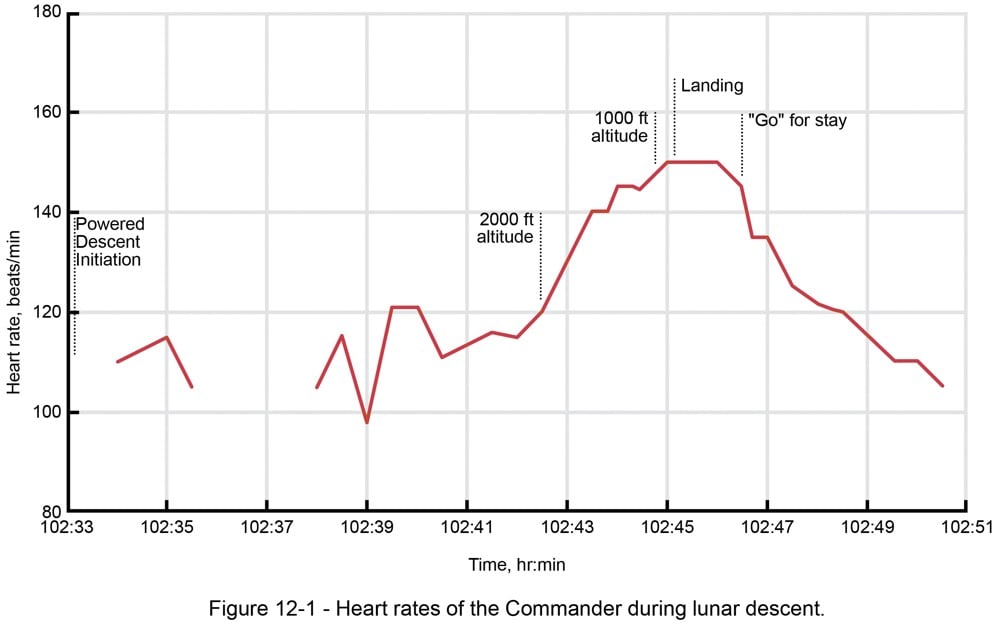
For reference, Armstrong’s resting heart rate was around 60 bpm. There are a couple of other interesting things about this chart. The first is the two minutes of missing data starting around 102:36. They were supposed to be 10 minutes from landing on the Moon and instead their link to Mission Control in Houston kept cutting out. Then there were the intermittent 1201 and 1202 program alarms, which neither the LM crew nor Houston had encountered in any of the training simulations. At the sign of the first alarm at 102:38:26, Armstrong’s heart rate actually appears to drop. And then, as the alarms continue throughout the sequence along with Houston’s assurances that the alarm is nothing to worry about, Armstrong’s heart rate stays steady.
Right around the 2000 feet mark, Armstrong realizes that he needs to maneuver around a crater and some rocks on the surface to reach a flat landing spot and his heart rate steadily rises until it plateaus at the landing. At the time, he thought he’d landed with less than 30 seconds of fuel remaining. That Neil Armstrong was able to keep his cool with unknown alarms going off while avoiding craters and boulders with very little fuel remaining and his heart rate spiking while skimming over the surface OF THE FREAKING MOON doing something no one had ever done before is one of the most totally cold-blooded & badass things anyone has ever done. Damn, I get goosebumps just reading about it!
Update: The landing broadcast just aired and I wanted to explain a little about what you saw (you can relive it here).
The shots of the Moon you see during the landing broadcast are animations…there is obviously no camera on the Moon watching the LM descend to the surface. There was a camera recording the landing from the LM but that footage was not released until later. This is in contrast to the footage you’ll see later on the Moon walk broadcast…that footage was piped in live to TV screens all over the world as it happened.
The radio voices you hear are mostly Mission Control in Houston (specifically Apollo astronaut Charlie Duke, who acted as the spacecraft communicator for this mission) and Buzz Aldrin, whose job during the landing was to keep an eye on the LM’s altitude and speed — you can hear him calling it out, “3 1/2 down, 220 feet, 13 forward.” Armstrong doesn’t say a whole lot…he’s busy flying and furiously searching for a suitable landing site. But it’s Armstrong that says after they land, “Houston, Tranquility Base here. The Eagle has landed.”. Note the change in call sign from “Eagle” to “Tranquility Base”. :)
Two things to listen for on the broadcast: the 1201/1202 program alarms I mentioned above and two quick callouts by Charlie Duke about the remaining fuel towards the end: “60 seconds” and “30 seconds”. Armstrong is taking all this information in through his earpiece — the 1202s, the altitude and speed from Aldrin, and the remaining fuel — and using it to figure out where to land.
The CBS animation shows the fake LM landing on the fake Moon before the actual landing — when Buzz says “contact light” and then “engine stop”. The animation was based on the scheduled landing time and evidently couldn’t be adjusted. The scheduled time was overshot because of the crater and boulders situation mentioned above.
Cronkite was joined on the program by former astronaut Wally Schirra. When Armstrong signaled they’d landed, Schirra can be seen dabbing his eyes and Cronkite looks a little misty as well as he rubs his hands together.
The book is read by Bronson Pinchot, who played Balki Bartokomous on the 80s sitcom Perfect Strangers. He is a fantastic audiobook narrator.↩
The last working fore-edge painter in the world
This is a short video profile of Martin Frost, who might be the last remaining professional fore-edge painter in the world.
Dating back centuries, the delicate art form places intricate scenes on the side of books, cheekily hidden beneath gold gilded pages. The beautiful paintings are only visible to the trained eye, but once you unlock the secret, you’ll find pure magic.
I love the two-way paintings…you fan the book’s pages out one way it depicts one scene and if you fan them out the other, you get another scene.
We should be building cities for people, not cars
Devon Zuegel says that our cities and the people who live in them would be much better off if we designed them around people and not cars.
Unfortunately, America’s inherited infrastructure is more like the old Embarcadero Highway than the boulevard that replaced it. Urban planners spent the 20th century building cities for cars, not people, and alternatives to driving have been systemically undervalued. This legacy has resulted in substandard health outcomes, missed economic opportunities, and a shortage of affordable housing.
We can’t wait around for another earthquake to reverse generations of bad policy. Luckily, it doesn’t require a natural disaster to begin reshaping our infrastructure. Small changes can have an outsized impact in expanding alternatives for how people move around. Rebuilding our infrastructure to enable walking, cycling, and mass transit would bring health and economic benefits that far outweigh its price tag.
People who live in rural areas more or less need their own cars in order to do anything, but private cars in cities are much less necessary. Cities should optimize for buses, subways, cyclists, and pedestrians — they get people to where they’re going without all the outsized infrastructure, waste, and pollution. *repeatedly sticks pin into voodoo doll of Robert Moses*
Update: Alissa Walker writing for Curbed: Don’t ban scooters. Redesign streets. (because there’s still too much space allocated to cars).
Market Street offers a glimpse of how contemporary U.S. cities might be edging towards that shared-street mentality (a proposal to completely ban private cars from the street was ahead of its time). But it also illustrates something else — if you give people ample space to move at a safe speed using the mode of their choice, anyone can use the street.
All over the country, city leaders are spending their summers devoting careful thought to the number of rentable e-bikes that can be deployed on streets at once, where electric scooters might be parked, and how dockless companies should be punished for violating these terms. Just this week, the National Association of City Transportation Officials, which collates best practices from its 62 member cities, released draft guidelines around the regulation of “small vehicles.”
Yet largely absent from these decisions — at least the public-facing ones — are how cities plan to quickly and dramatically reconfigure their streets to allow people to actually use anything but a car.
Winners of the 2018 Audubon Photography Awards


The National Audubon Society has announced the winners of their ninth annual photography contest. The winning photos, which “evoke the splendor, resilience, and ingenuity of birdlife”, were drawn from over 8000 entries from all over the US and Canada.
The photos above are a great grey owl by Steve Mattheis, a long-tailed tit by Diana Rebman, and a flock of cobalt-winged parakeets by Liron Gertsman. Gertsman swept the youth category with the winning image and both honorable mentions. Here’s what he had to say about the parakeets:
Three days in a row I waited in a blind near a clay lick that Cobalt-winged Parakeets and other birds of the Amazon frequent. When hundreds of the birds finally descended from the tree canopy to the mineral-rich forest floor on the third morning, I was ready. I used a slow shutter speed to accentuate the blues in their wings. I don’t think I’ll ever forget the sight of the birds or the deafening roar of parakeet chatter.
A list of the top 100 photos is available here. (via in focus)
Watch Eloma Simpson Barnes channel Martin Luther King Jr. in a thrilling oration
On Twitter this morning, Craig Mod asked:
What’s the best conference talk/public speech you’ve seen? Topic can be anything. Just the most engaging talk you’ve been present for?
And bonus points: Is there any one particular speaker who’s so good you make an effort to see?
I’ve been to a lot of conferences and seen some very engaging speakers, but the one that sticks out most in my mind is Eloma Simpson Barnes’ performance of a Martin Luther King Jr. speech at PopTech in 2004 (audio-only here).
Her oration is actually a combination of excerpts from two King speeches: his address at the Great Walk to Freedom in Detroit in June 1963 and his Drum Major Instinct sermon given at Atlanta’s Ebenezer Baptist Church in February 1968. King’s Detroit address is notable for being a test run of sorts for his I Have a Dream speech in Washington D.C. two months later. If you look at the Detroit transcript, you’ll notice some familiar words:
And so this afternoon, I have a dream. (Go ahead) It is a dream deeply rooted in the American dream.
I have a dream that one day, right down in Georgia and Mississippi and Alabama, the sons of former slaves and the sons of former slave owners will be able to live together as brothers.
I have a dream this afternoon (I have a dream) that one day, [Applause] one day little white children and little Negro children will be able to join hands as brothers and sisters.
In the Drum Major Instinct sermon given two months to the day before his assassination, King told the congregation what he wanted to be said about him at his funeral:
I’d like somebody to mention that day that Martin Luther King, Jr., tried to give his life serving others.
I’d like for somebody to say that day that Martin Luther King, Jr., tried to love somebody.
I want you to say that day that I tried to be right on the war question.
I want you to be able to say that day that I did try to feed the hungry.
And I want you to be able to say that day that I did try in my life to clothe those who were naked.
I want you to say on that day that I did try in my life to visit those who were in prison.
I want you to say that I tried to love and serve humanity.
Some of the power of Barnes’ performance is lost in the video, particularly when audio from King’s actual speeches are available online, but sitting in the audience listening to her thundering away in that familiar cadence was thrilling. I can’t imagine how it must have felt to experience the real thing.
Peter Jackson is remastering old WWI film footage
Working with the 14-18 NOW project, Peter Jackson is making a film about the experience of the soldiers fighting in World War I. As part of the process, Jackson and his special effects team (who have worked on the LOTR films, etc.) have been remastering and reimagining film footage from the collection of the Imperial War Museums. Here’s Jackson talking about the project and showing some of the remastered video:
The footage has been stabilized, the grain and scratches cleaned up, and the pace slowed down to from comedic to lifelike. Jackson’s also planning on using colorization to make the people in that old footage seem as contemporary as possible. Here are some split-screen stills comparing the old footage with the remastered video:


The finished product will be shown in theaters and schools around the UK in the fall and also on the BBC. (via open culture)
Chance the Rapper bought the Chicagoist website and announced it in a new song. “I bought the Chicagoist just to run you racist bitches outta bidness.”
Gmorning, Gnight!, a book of affirmations from Lin-Manuel Miranda

On Twitter, Hamilton creator Lin-Manuel Miranda often begins and ends his days by posting affirmations for his fans & readers. Stuff like:
Good night. Your mind is yours alone and you decide who and what gets in. Draw the curtains. Make yourself at home.
Good morning. Do NOT get stuck in the comments section of life today. Make, do, create the things. Let others tussle it out. Vamos!
Gnight. Don’t forget to look up your work & let real life in. It makes your work better.
Good morning. You are perfectly cast in your life. I can’t imagine anyone but you in the role. Go play.
Miranda has collaborated with illustrator Jonny Sun on a collection of this inspirational tweets called Gmorning, Gnight!: Little Pep Talks for Me & You. It’s out in October, but you can pre-order it now. It doesn’t fit the theme but I hope they found a way to fit this all-time Hall of Fame tweet in there.
I just saw Jaws for the first time. AMA.
Everyone has that one obviously great and popular movie that they haven’t seen yet for no good reason. Mine is Jaws. Or at least it was. Last night, I finally watched it. What an experience to get to witness the invention of the blockbuster movie and the storytelling gifts of a young Steven Spielberg already approaching full strength.
In this video, Julian Palmer analyzes the beach scene in Jaws and explains what makes it so effective. He compares Spielberg’s filmmaking to Alfred Hitchcock’s and the parallels are apt.
I think the reason why Spielberg is so popular with audiences is because he is so adept at putting the viewer through the ringer. He doesn’t just objectively play out a scene, he engages the viewer directly and makes them experience the same emotions as his characters.
(video via @veganstraightedge)
Remembering the girls of the Leesburg Stockade
In Georgia in 1963, 15 African-American girls aged 12 to 15 were arrested for trying to buy movie tickets at the whites-only theater entrance. They were arrested and held without charge for up to 45 days, their parents unaware of their whereabouts.
Instead of forming a line to enter from the back alley as was customary, the marchers attempted to purchase tickets at the front entrance. Law enforcement soon arrived and viciously attacked and arrested the girls. Never formally charged, they were jailed in squalid conditions for forty-five days in the Leesburg Stockade, a Civil War era structure situated in the back woods of Leesburg, Georgia. Only twenty miles away, parents had no knowledge of where authorities were holding their children. Nor were parents aware of their inhumane treatment.

Sickening. And to top it off, their parents each had to pay a $2 boarding fee when the girls were finally released. The Leesburg Stockade incident is a timely reminder that tyrants in America on the wrong side of justice have often separated children from their parents for political leverage. It wasn’t right then, and it’s not right now.
Why do people go crazy for sports? Sports fans whose teams win experience almost the same surge of feel-good brain chemicals as the athletes do.
The Constructive-Destructive Axis
In his biography of Apple founder Steve Jobs, Walter Isaacson reports on some comments Jobs made over dinner to News Corp’s Rupert Murdoch about Fox News in 2010.
In return for speaking at the retreat, Jobs got Murdoch to hear him out on Fox News, which he believed was destructive, harmful to the nation, and a blot on Murdoch’s reputation. “You’re blowing it with Fox News,” Jobs told him over dinner. “The axis today is not liberal and conservative, the axis is constructive-destructive, and you’ve cast your lot with the destructive people. Fox has become an incredibly destructive force in our society. You can be better, and this is going to be your legacy if you’re not careful.” Jobs said he thought Murdoch did not really like how far Fox had gone. “Rupert’s a builder, not a tearer-downer,” he said. “I’ve had some meetings with James, and I think he agrees with me. I can just tell.”
Such an insightful comment by Jobs. As John Gruber notes:
This line from Jobs — “The axis today is not liberal and conservative, the axis is constructive-destructive” — is truly the best summary of Trumpism I’ve seen.
It’s been eight years since that conversation and the Republican Party & their voters have doubled down in destroying opportunities for people (particularly those with little power), driven by the likes of Fox News. This destruction will be felt for generations to come.
An entomologist rates ant emojis

An entomologist rates the ant emoji from a number of services including Facebook, Apple, Microsoft, and Twitter. You can check out more reviews here.
A lost 1956 screenplay by Stanley Kubrick was recently uncovered. It’s adapted from a Stefan Zweig novella and is finished enough to “be completed by film-makers today”.
When you do a DNA test and find out your dad is not your father
Sarah Zhang writes about a support group on Facebook for people who have discovered surprising parentage through DNA testing.
Lisa, 44, admits she is still trying to go of that anger. She had always felt out of place in her family. Her hair — which she always straightened — was naturally fine and curly, her skin dark. “People would think I’m Hispanic, and would speak Spanish to me on the street,” she says. So when an DNA test in 2015 revealed her biological father was likely African American, it clicked into place. But her mom denied it. “She wouldn’t answer me. She would change the subject,” recalls Lisa. When she kept pressing, her mother broke down, saying it would destroy the family and that her dad — the man she grew up with — would kill her. She refused to say anything else about Lisa’s biological father.
I’ve written about this before (here and here) and reading these stories never gets any less heartbreaking. Back in 2010, I shared this:
I know someone who adopted a baby and they have never told her that she’s adopted and don’t plan to (she’s now in her 20s). When DNA testing becomes commonplace in another 5-15 years, I wonder how long that secret will last and what her reaction will be.
DNA testing confirms what we should have known all along: family is more than what biology says it is. Families already look quite differently than they did 40-50 years ago and they will continue to shift in the future, MAGA be damned.
Socials & More