



This car has a shield that slides down over the license plate to avoid paying tolls

Advertise here with Carbon Ads
This site is made possible by member support. 💞
Big thanks to Arcustech for hosting the site and offering amazing tech support.
When you buy through links on kottke.org, I may earn an affiliate commission. Thanks for supporting the site!
kottke.org. home of fine hypertext products since 1998.
Beloved by 86.47% of the web.
Entries for June 2018
The 14 Habits of Highly Miserable People
In Here Are the 14 Habits of Highly Miserable People, Cloe Madanes gives us some advice at how to succeed at self-sabotage (or, really, how to avoid it).
5. Attribute bad intentions. Whenever you can, attribute the worst possible intentions to your partner, friends, and coworkers. Take any innocent remark and turn it into an insult or attempt to humiliate you. For example, if someone asks, “How did you like such and such movie?” you should immediately think, He’s trying to humiliate me by proving that I didn’t understand the movie, or He’s preparing to tell me that I have poor taste in movies. The idea is to always expect the worst from people. If someone is late to meet you for dinner, while you wait for them, remind yourself of all the other times the person was late, and tell yourself that he or she is doing this deliberately to slight you. Make sure that by the time the person arrives, you’re either seething or so despondent that the evening is ruined. If the person asks what’s wrong, don’t say a word: let him or her suffer.
See also seven helpful tips on how to be miserable.
The Blind Skateboarder
Dan Mancina has lost 95% of his eyesight but that hasn’t kept him from skating. Red Bull has an interview with Mancina, who stopped skating for a couple of years after he went blind, thinking that it wasn’t something a blind person would or could do.
There wasn’t a defining moment that changed my mind as to what a blind person was, but the day I started to build that bench sort of started it, and sparked this passion and stoked this urge to skate again.
Seeing how people responded to that, that’s the shit I was searching for. To see me not as a blind person, but as a normal person, a skater.
Ever since I was seven, that’s who I was. I am a skateboarder, I just lost it for a while. I bought into people’s ideas of me and what a blind person is, and really I should’ve been searching for who I was and what I wanted to do.
People who are really good at something talk about doing it “by feel” or being able to do it “in their sleep”. Mancina’s skating ability is a good reminder that after you pass a certain threshold of expertise, so much of athleticism is just your body’s ability to unconsciously perform.
You can watch more of Mancina’s skating on his Instagram account.
A Sad Update About a Scissors Maker that Went Viral
Back in 2014, a lovely short film by Shaun Bloodworth called The Putter went viral. The film shows Cliff Denton making scissors for Ernest Wright & Sons. Denton works for the company as a putter, short for putter togetherer.
Before the film, business at the firm was so slow that staff were only working two days a week. When the video took off online, the company received two years’ worth of orders in a single day. Two years later in June 2016, the company launched a Kickstarter campaign for a throwback pair of kitchen scissors and ended up making four times their goal from more than 3600 backers.
Outwardly, this seemed to be one of those stories about how an old school company found a new audience and a second chance on the internet. But internally the company was struggling, hamstrung by a series of setbacks. Problems with design and machining the new scissors model delayed production for a year and two key employees, including putter Cliff Denton, were off the job due to illness. Shaun Bloodworth, the filmmaker, died waiting for a liver transplant. And then in February 2018, the news broke that Nick Wright, the company’s managing director, had died suddenly.
Under new leadership, the company vowed to carry on and fulfill all of the Kickstarter orders, but a message to Kickstarter backers yesterday revealed the company was deep in debt and would be “going into receivership”. It also revealed that Wright had taken his own life. Here’s the full message from Pam Addy, the current managing director of Ernest Wright & Sons. (Note: this includes a portion of a final letter written by Wright before he died.)
Hello everyone, this is Pam.
Following the death of Nick Wright, who took his own life in February, myself and the rest of the Ernest Wright team have endeavored to honour all you Kickstarter backers who pledged money for the Kutrite design of kitchen scissors. Unfortunately, only now am I aware of the extent of the business debt incurred prior to my taking over as Director on March 22 2018, so it is with great sadness I announce that Ernest Wright & Son Ltd will be going into receivership.
If you have not received your goods, you will be contacted by the Insolvency Practitioner in due course. Following advice from them, if you paid by Credit Card you may wish to contact your card provider, to see whether they will refund you the money paid.
Nick wrote a final letter. In this letter were personal messages including one to Kickstarter people:
“I tried so hard, this was no scam, I just could not make it happen. Too much pressure, not enough resource or time. I am so very genuinely sorry to you all.”
What a sad situation for Wright’s family and the company. It’s tempting to want to draw conclusions between the finances, the campaign, and Wright’s death, but we don’t actually know much about the situation. But I do think this highlights the potential disconnects between mental health & business, publicity & success, and success & happiness. The internet can seem so intimate but ultimately it’s a thin view of an individual’s or company’s reality. (thx, dawn)
Update: The company’s fortunes are looking up after a pair of Dutch entrepreneurs bought it. More here.
There’s no scientific or genetic basis for race
Elizabeth Kolbert writing for National Geographic: There’s No Scientific Basis for Race — It’s a Made-Up Label.
“What the genetics shows is that mixture and displacement have happened again and again and that our pictures of past ‘racial structures’ are almost always wrong,” says David Reich, a Harvard University paleogeneticist whose new book on the subject is called Who We Are and How We Got Here. There are no fixed traits associated with specific geographic locations, Reich says, because as often as isolation has created differences among populations, migration and mixing have blurred or erased them.
She also observes that there’s more diversity in Africa than all the other continents combined (which is what happens when the rest of the world’s population is based on a relatively small population that left Africa 60,000 years ago).
How I Broke, and Botched, the Brandon Teena Story. “The original writer of the Village Voice story that inspired “Boys Don’t Cry” looks back on her reporting - and the huge error she still regrets”
Trailer for Creed II. Creed vs Drago, Round II.
Koko the gorilla has died at the age of 46. She learned to understand more than 1000 modified ASL signs and 2000 words of spoken English.
What the uncharted territories of outer space might look like…
Harkening back to when visual effects teams used colorful liquids & chemicals to simulate space travel for films like 2001, Helios uses those same techniques to visualize “what the uncharted territories of outer space might look like”.
Helios considers what the uncharted territories of outer space might look like. It was created as a passion project in my basement studio using various liquids and chemicals. It is staged as an audiovisual stimulus inspired by the aesthetics of vintage NASA space travel.
Having spent my entire childhood in an area lacking both basic infrastructure and light pollution, I developed an escapist obsession for watching the night sky and contemplating. I would constantly get on people’s nerves asking: “What do the limits of the universe look like? And what’s behind that?”
Here’s a look at the process behind the video, along with some high-resolution screencaps.
Forty-Five Things I Learned in the Gulag
Russian writer Varlam Shalamov spent 15 years, from 1937 to 1951, in a Soviet gulag (forced labor camp) for engaging in “counter-revolutionary Trotskyist activities”. He wrote a book of short fiction about his experience called Kolyma Stories. He also wrote down 45 things he learned while in the gulag.
1. The extreme fragility of human culture, civilization. A man becomes a beast in three weeks, given heavy labor, cold, hunger, and beatings.
15. I realized that one can live on anger.
17. I understood why people do not live on hope — there isn’t any hope. Nor can they survive by means of free will — what free will is there? They live by instinct, a feeling of self-preservation, on the same basis as a tree, a stone, an animal.
26. I realized that you can achieve a great deal-time in the hospital, a transfer-but only by risking your life, taking beatings, enduring solitary confinement in ice.
30. I discovered that the world should be divided not into good and bad people but into cowards and non-cowards. Ninety-five percent of cowards are capable of the vilest things, lethal things, at the mildest threat.
44. I understood that moving from the condition of a prisoner to the condition of a free man is very difficult, almost impossible without a long period of amortization.
What If This Were Enough?, a new book of essays from the “whip-smart and profanely funny” Heather Havrilesky
What made the Nazis possible? Why didn’t anyone stop them?
With an eye on the current political situations in the US, Turkey, Russia, and China, Cass Sunstein reviews three books that shed light on how the Nazis came to power in Germany in the 1930s: They Thought They Were Free: The Germans, 1933-45 by Milton Mayer, Broken Lives: How Ordinary Germans Experienced the Twentieth Century by Konrad Jarausch, and Defying Hitler by Sebastian Haffner.
Mayer’s book was published in 1955 and consisted of post-war interviews with normal German people (janitor, baker, teacher) who had been Nazi party members. Their recollection of what had happened differed somewhat from the rest of the world’s.
When Mayer returned home, he was afraid for his own country. He felt “that it was not German Man that I had met, but Man,” and that under the right conditions, he could well have turned out as his German friends did. He learned that Nazism took over Germany not “by subversion from within, but with a whoop and a holler.” Many Germans “wanted it; they got it; and they liked it.”
Mayer’s most stunning conclusion is that with one partial exception (the teacher), none of his subjects “saw Nazism as we — you and I — saw it in any respect.” Where most of us understand Nazism as a form of tyranny, Mayer’s subjects “did not know before 1933 that Nazism was evil. They did not know between 1933 and 1945 that it was evil. And they do not know it now.” Seven years after the war, they looked back on the period from 1933 to 1939 as the best time of their lives.
They also denied the Holocaust had happened. They didn’t see it because their lives were just fine (up until the war started).
Mayer suggests that even when tyrannical governments do horrific things, outsiders tend to exaggerate their effects on the actual experiences of most citizens, who focus on their own lives and “the sights which meet them in their daily rounds.” Nazism made things better for the people Mayer interviewed, not (as many think) because it restored some lost national pride but because it improved daily life. Germans had jobs and better housing. They were able to vacation in Norway or Spain through the “Strength Through Joy” program. Fewer people were hungry or cold, and the sick were more likely to receive treatment. The blessings of the New Order, as it was called, seemed to be enjoyed by “everybody.”
This reminded me of how ISIS improved the lives of many in Iraq & Syria by fixing electrical problems, regularly collecting garbage, and focusing on law & order. The quotes around “everybody” in the last line of that paragraph also reminded me of the criticism1 directed at people like Steven Pinker, Bill Gates, or Hans Rosling who insist the world is getting better. Better for whom? Everybody?
See also the Sunstein-edited Can It Happen Here?: Authoritarianism in America.
It’s interesting that this post was deleted from the TED blog. I wonder why?↩
A good look at the scale of the SpaceX rockets compared to more familiar objects. The Falcon 9 landing legs are *massive*.
Dancing in movies
A supercut montage of dance scenes from over 300 movies (like School of Rock, The Wizard of Oz, Footloose, Dances With Wolves, West Side Story, and Straight Outta Compton). A full list of the movies represented is available here.
How the Koch Brothers Are Killing Public Transit Projects Around the Country. Systematically weakening government & public infrastructure in the name of lower taxes.
Juneteenth is an American holiday that commemorates the abolition of slavery in Texas. “In many ways, Juneteenth represents how freedom and justice in the US has always been delayed for black people.”
The insides of everyday items, animated
On Tinker Fridays, industrial designer dina Amin takes apart an item and makes a playful stop motion animation out of its parts.
I spent 2016 taking products that people decided to throw away apart and showing people (not the ones who threw away those products, but others on Instagram) what’s inside and transformed all the pieces to lil creatures by the magical power of stop motion.
You can find more of Amin’s work on her website, YouTube, Vimeo, and Instagram. (thx, samira)
These Oklahoma teachers are now permanently on strike
Earlier this year, 30,000 teachers in Oklahoma walked out of their classrooms to protest teacher pay and education budget cuts. The walkout ended after nine days with the teachers’ goals partially met. Vice News talked to 18 Oklahoma teachers about why they’ve decided to quit teaching after this year, essentially making their walkouts permanent.
Eric Weingartner worked two side jobs in addition to his role as a full-time 4th grade teacher to make ends meet. Chemistry teacher Becky Smith’s monthly paycheck rose just $300 in sixteen years. Aimee Elmquist spent her own money to stock her biology classroom. Mary West did the same for high school art.
One of the biggest realizations I’ve had in the past few years is that while Americans talk a lot about the importance of children and education, those things actually are not that important to us. You can see it in how we approach our educational system and you can see it in how we our government uses the abuse of children to attempt to curb immigration with relatively little outcry. You can see it in our governance…the people we elect do what’s best for voters, not for future voters. The enthusiasm of hobbyists and desire of gun companies keep our children attending school in fear. Healthcare costs are soaring and coverage for children isn’t guaranteed. Our parental leave policies, maternity care, and all-around treatment of mothers & women in the workplace lags behind other so-called “developed” countries. Children are a priority for the US? Yeah, no.
TANK, a 2-minute visual homage to 80s vector arcade games (and Tron)
TANK is a short animation by Stu Maschwitz that’s based on the look of vector arcade games from the 80s like Battlezone, Tempest, Asteroids, and Star Wars. And a sprinkling of Tron for good measure.
If you’re interested in how the video was made, Maschwitz did a 20-minute making of video that’s actually really interesting. I don’t know why I said “actually” there…I love watching how creative people make things. Maybe because the length is daunting? Anyway, how he reverse engineers this style using a modern visual effects software package is worth watching…the attention to detail is *kisses fingers*.
The way I made TANK is a little crazy. I made it entirely in Adobe After Effects, with equal parts animation elbow grease and nerdy expressions madness. This video is part behind-the-scenes, part After Effects tutorial, and part therapy session.
Maschwitz also shared some of assets & software he used, including an After Effects template you can use to make your own vector animations.
See also recreating the Asteroids arcade game with a laser. (thx, ben)
How people from different countries count money
In this video, 70 people from 70 different countries from all over the world show how they count money in their respective countries. Fascinating and more than a little mesmerizing after a while. I wonder why these different techniques developed the way that they did… (via digg)
How to blow cool-looking bubbles. TIL that top bubble blowers have a proprietary soap mixture that needs to be adjusted to the local environment (humidity, air quality, etc.)
NYC is boring
In The Death of a Once Great City Kevin Baker argues that the current affluence of NYC has made the city “unremarkable” and “boring”.
New York has been my home for more than forty years, from the year after the city’s supposed nadir in 1975, when it nearly went bankrupt. I have seen all the periods of boom and bust since, almost all of them related to the “paper economy” of finance and real estate speculation that took over the city long before it did the rest of the nation. But I have never seen what is going on now: the systematic, wholesale transformation of New York into a reserve of the obscenely wealthy and the barely here — a place increasingly devoid of the idiosyncrasy, the complexity, the opportunity, and the roiling excitement that make a city great.
As New York enters the third decade of the twenty-first century, it is in imminent danger of becoming something it has never been before: unremarkable. It is approaching a state where it is no longer a significant cultural entity but the world’s largest gated community, with a few cupcake shops here and there. For the first time in its history, New York is, well, boring.
A colorfully illustrated Cold War-era desk calendar


All through the 1980s, a disgruntled Department of Defense analyst adorned his daily desk calendar with all sorts of illustrations and commentary on the news.
The majority of the entries focus on domestic politics and international affairs, providing (with the exception of 1988) a day-by-day view of the Reagan Administration and the waning years of the Cold War. It all seems to be here: the end of the Iran hostage crisis, the invasion of Afghanistan, Poland’s Solidarity movement, supply-side economics, and the Space Shuttle, to name just a few, along with hundreds of lesser-known events all but forgotten today except by scholars.
What a wonderful piece of folk art. (via the paris review)
Those grainy Moon photos from the 60s? The actual high-res images looked so much better.
In 1966 and 1967, NASA sent five spacecraft to orbit the Moon to take high-resolution photos to aid in finding a good landing spot for the Apollo missions. NASA released some photos to the public and they were extremely grainy and low resolution because they didn’t want the Soviet Union to know the capabilities of US spy satellites. Here’s a comparison to what the public saw at the time versus how the photos actually looked:
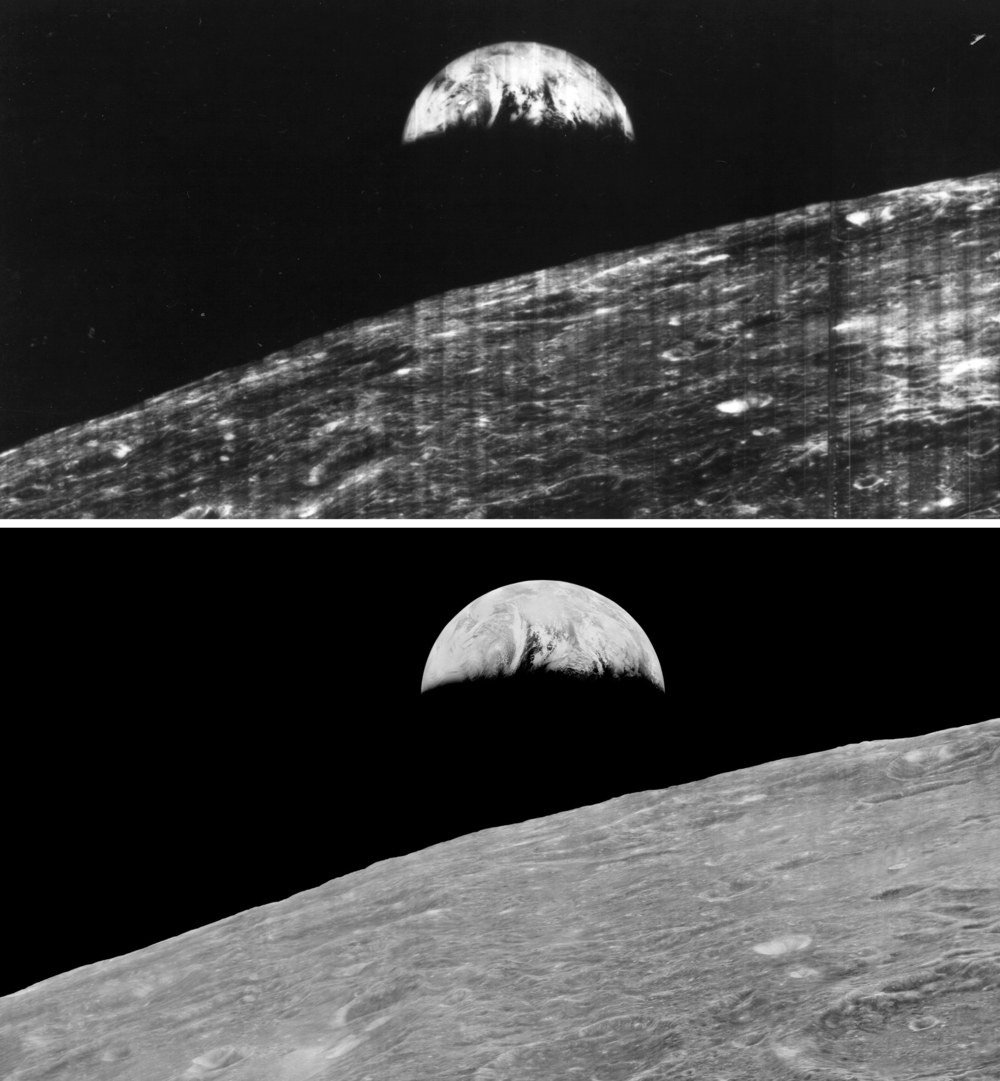
The Lunar Orbiters never returned to Earth with the imagery. Instead, the Orbiter developed the 70mm film (yes film) and then raster scanned the negatives with a 5 micron spot (200 lines/mm resolution) and beamed the data back to Earth using lossless analog compression, which was yet to actually be patented by anyone. Three ground stations on earth, one of which was in Madrid, another in Australia and the other in California recieved the signals and recorded them. The transmissions were recorded on to magnetic tape. The tapes needed Ampex FR-900 drives to read them, a refrigerator sized device that cost $300,000 to buy new in the 1960’s.
The high-res photos were only revealed in 2008, after a volunteer restoration effort undertaken in an abandoned McDonald’s nicknamed McMoon.
They were huge files, even by today’s standards. One of the later images can be as big as 2GB on a modern PC, with photos on top resolution DSLRs only being in the region of 10MB you can see how big these images are. One engineer said you could blow the images up to the size of a billboard without losing any quality. When the initial NASA engineers printed off these images, they had to hang them in a church because they were so big. The below images show some idea of the scale of these images. Each individual image when printed out was 1.58m by 0.4m.
You can view a collection of some of the images here.
A Voronoi diagram for the world’s airports. “Each region is closer to a particular airport than any other.”
Iceland’s goalkeeper directed a TV commercial for the World Cup
The Iceland men’s soccer team is nearly impossible not to root for in this World Cup. They are the smallest nation by population ever to qualify for a World Cup. Their coach is a dentist and still maintains his hometown dental practice. The Skol chant done by the team’s fans is a great addition to the collection of international soccer chants & songs. All great underdog stuff.
Adding to that, their goalkeeper Hannes Thor Halldórsson is a former film director who, until four years ago, pursued soccer as a second job. In anticipation for the World Cup, Halldórsson stepped back into his old job to direct a commercial for Coca-Cola featuring the Icelandic men’s national team and the Skol chant.
Pretty good for a keeper. Is this the best commercial ever made by someone who has also kept clean sheets against both Lionel Messi and Cristiano Ronaldo?
America’s inhumane child separation policy & our border concentration camps

No use sugar-coating it: the federal government of the United States of America now has a policy of taking children away from their families when they attempt to enter the US to request political asylum from violence & hardship in their native countries. These children and their parents are placed into concentration camps. The government is doing this as a deterrent for further immigration and for political leverage.
But Mr. Miller has expressed none of the president’s misgivings. “No nation can have the policy that whole classes of people are immune from immigration law or enforcement,” he said during an interview in his West Wing office this past week. “It was a simple decision by the administration to have a zero tolerance policy for illegal entry, period. The message is that no one is exempt from immigration law.”
Texas Monthly interviewed Anne Chandler, the director of a nonprofit that focuses on helping immigrant women and children. She spoke about what the zero tolerance policy means:
TM: So, just so I make sure I understand: the parents come in and say, “We’re persecuted” or give some reason for asylum. They come in. And then their child or children are taken away and they’re in lockup for at least six weeks away from the kids and often don’t know where the kids are. Is that what’s happening under zero tolerance?
AC: So the idea of zero tolerance under the stated policy is that we don’t care why you’re afraid. We don’t care if it’s religion, political, gangs, anything. For all asylum seekers, you are going to be put in jail, in a detention center, and you’re going to have your children taken away from you. That’s the policy.
Children and their parents are being held in private jails1 built and operated at the US government’s behest.
Colleagues at a government-contracted shelter in Arizona had a specific request for Antar Davidson when three Brazilian migrant children arrived: “Tell them they can’t hug.”
Davidson, 32, is of Brazilian descent and speaks Portuguese. He said the siblings — ages 16, 10 and 6 — were distraught after being separated from their parents at the border. The children were “huddled together, tears streaming down their faces,” he said.
Officials had told them their parents were “lost,” which they interpreted to mean dead. Davidson said he told the children he didn’t know where their parents were, but that they had to be strong.
“The 16-year-old, he looks at me and says, ‘How?’” Davidson said. As he watched the youth cry, he thought, “This is not healthy.”
Yesterday, some reporters were allowed a brief look inside one of these jails in Texas:
Inside an old warehouse in South Texas, hundreds of children wait in a series of cages created by metal fencing. One cage had 20 children inside. Scattered about are bottles of water, bags of chips and large foil sheets intended to serve as blankets.
One teenager told an advocate who visited that she was helping care for a young child she didn’t know because the child’s aunt was somewhere else in the facility. She said she had to show others in her cell how to change the girl’s diaper.
The traumatic effects of being kept away from parents are deep and long lasting. Dell Cameron shares his story of being separated from his parents as a child.
The trauma came from being separated from parents, who I knew were out there, and when I saw them, would tell me they were doing everything to get me home. But it took years. Hope is what I lost as a child. It was destroyed by the state.
When on occasion my dad was allowed to visit, watching him leave utterly destroyed me. I mean, I’d fly into insanity. I would pick up things and smash windows once his truck drove around the corner. Then I’d be punished, very harshly.
When I was 10 or 11 I got out. I was in custody for damn, most of my childhood. It was impossible to acclimate. I didn’t fit anywhere. I had no comprehension of freedom, as my dad’s step kids understood it. I didn’t understand I could walk outside without permission… for months
When this Guatemalan woman and her son tried to enter the United States, they were separated and she was sent back to Guatemala while her 8-year-old son remains in one of the camps in the US. This is going to do unimaginable harm to this child, not to mention to his mother and everyone else in the family.
They’d had a plan: Elsa Johana Ortiz Enriquez packed up what little she had in Guatemala and traveled across Mexico with her 8-year-old son, Anthony. In a group, they rafted across the Rio Grande into Texas. From there they intended to join her boyfriend, Edgar, who had found a construction job in the United States.
Except it all went wrong. The Border Patrol was waiting as they made their way from the border on May 26, and soon mother and son were in a teeming detention center in southern Texas. The next part unfolded so swiftly that, even now, Ms. Ortiz cannot grasp it: Anthony was sent to a shelter for migrant children. And she was put on a plane back to Guatemala.
“I am completely devastated,” Ms. Ortiz, 25, said in one of a series of video interviews last week from her family home in Guatemala. Her eyes swollen from weeping and her voice subdued, she said she had no idea when or how she would see her son again.
As the federal government continues to separate families as part of a stepped-up enforcement program against those who cross the border illegally, the authorities say that parents are not supposed to be deported without their children. But immigration lawyers say that has happened in several cases. And the separations can be traumatic for parents who now have no clear path to recovering their children.
Vermont Congressman Peter Welch recently visited a “processing facility” (the scare quotes are his) and declared it to be “nothing short of a prison”.
I just exited a border patrol “processing facility” known as the “icebox.” It is nothing short of a prison.
I saw chain link cages full of unaccompanied children. They sat on metal benches and stared straight ahead silently
And I met a woman named Reina who was being extorted in Guatemala. She traveled 14 days with her 13 year old daughter and turned herself in at the border for asylum.
She hasn’t seen her daughter in two days and didn’t know where she was. No one had told her that her daughter had been taken to a shelter.
Today, the United Nations high commissioner for human rights called for the US to stop the practice of separating children from parents.
The United Nations’ top human rights official on Monday entered the mounting furor over the Trump administration’s policy of separating undocumented immigrant children from their parents, calling for an immediate halt to a practice he condemned as abuse.
United States immigration authorities have detained almost 2,000 children in the past six weeks, which may cause them irreparable harm with lifelong consequences, said Zeid Ra’ad al-Hussein, the United Nations high commissioner for human rights.
He cited anobservation by the president of the American Association of Pediatrics that locking the children up separately from their parents constituted “government-sanctioned child abuse.”
“The thought that any state would seek to deter parents by inflicting such abuse on children is unconscionable,” Mr. al-Hussein said.
If you’re feeling helpless and powerless about this (and I admit that I very much do), Slate and The Cut have listed some ways that you can help the families and children involved and fight for a more humane policy for those seeking a better life here in America.
Photo above by Getty photographer John Moore.
Update: From ProPublica, Listen to Children Who’ve Just Been Separated From Their Parents at the Border.
The desperate sobbing of 10 Central American children, separated from their parents one day last week by immigration authorities at the border, makes for excruciating listening. Many of them sound like they’re crying so hard, they can barely breathe. They scream “Mami” and “Papá” over and over again, as if those are the only words they know.
The baritone voice of a Border Patrol agent booms above the crying. “Well, we have an orchestra here,” he jokes. “What’s missing is a conductor.”
Holy hell.
Update: Drs. Margaret Sheridan and Charles Nelson writing for the NY Times about a study they conducted that shows how adversely family separation affects children.
As members of a team of researchers who have investigated the impact of separating children from their parents during early childhood, we were struck by another aspect of this news: In an effort to increase security, the Trump administration has hit upon a policy that we know is actually likely to increase delinquency and criminality among these children in the future. While trying to protect American citizens, the administration may be placing them in greater jeopardy.
If we have learned nothing else in the past 50 years of research on child development, it is that children do best in families and that violating this norm has terrible effects.
Update: It’s important to note that after this post was written last year, it was learned that the little girl depicted in the photo above was not separated from her mother.
Shortly after the cover was released, reports showed that Yanela was never separated from her mother at all. In February 2019, Moore reconnected with Sandra and Yanela, who were living together in the Washington DC area as they awaited a date for their immigration court date.
It is equally important to note that the girl and her mother were detained in three different camps for 18 days by US immigration authorities and that many children in Yanela’s position were not so lucky (because, perhaps, the spotlight on them was less bright).
Many news organizations are using the words “facility” or “shelter” but that terminology implies that people are free to leave, which they are not, and this definitely isn’t sheltering. These are jails and concentration camps (so says a women who wrote a history of concentration camps) and I will refer to them as such. Language is important.↩
I am not in favor of capital punishment or punitive justice but Stephen Miller is really really really testing my convictions right now. What a repugnant human being.
The chimeras of the NYC subway
The NYC subway is home to many interesting characters and creatures but perhaps none as delightfully weird as Matthew Grabelsky’s straphanger chimeras.



(via colossal)
New Dark Age: Technology and the End of the Future
Artist, writer, and thinker James Bridle is an interesting fellow. He coined the term New Aesthetic in 2011. Dronestagram was a three-year project where he posted satellite photos of drone strike locations to social media. He built a trap for self-driving cars. Last year, he wrote a widely read essay on how YouTube’s recommendation algorithms are being used “systematically frighten, traumatise, and abuse children, automatically and at scale”.
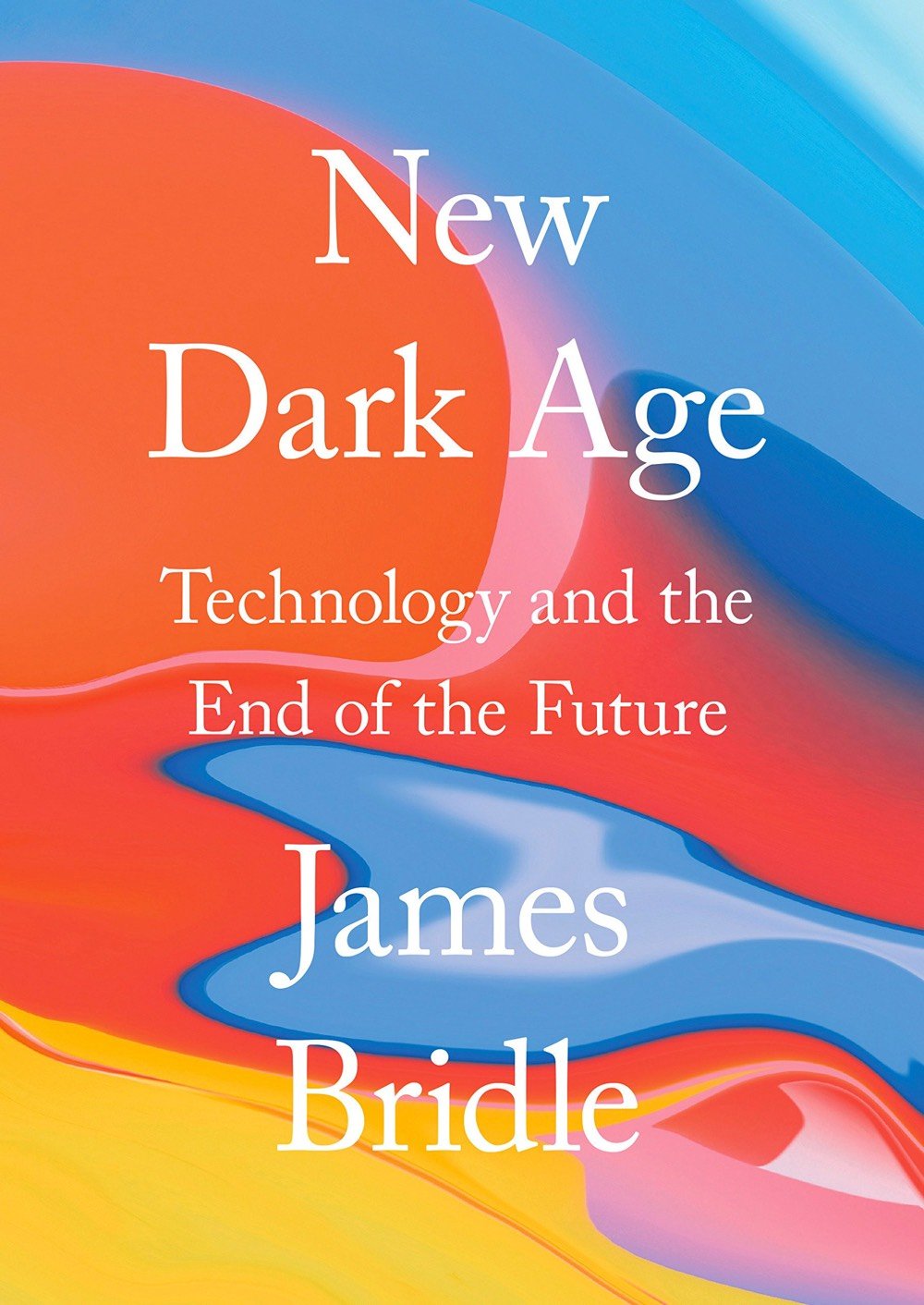
In his forthcoming book, Bridle argues that we’re living in a New Dark Age, where it’s not so much the lack of information as too much information that’s the issue.
In actual fact, we are lost in a sea of information, increasingly divided by fundamentalism, simplistic narratives, conspiracy theories, and post-factual politics. Meanwhile, those in power use our lack of understanding to further their own interests. Despite the accessibility of information, we’re living in a new Dark Age.
From rogue financial systems to shopping algorithms, from artificial intelligence to state secrecy, we no longer understand how our world is governed or presented to us. The media is filled with unverifiable speculation, much of it generated by anonymous software, while companies dominate their employees through surveillance and the threat of automation.
As I wrote recently, “we’re under a constant denial-of-service attack on our ability to think and reason”.
Update: The Guardian has an extended excerpt of Bridle’s book.
Today the cloud is the central metaphor of the internet: a global system of great power and energy that nevertheless retains the aura of something numinous, almost impossible to grasp. We work in it; we store and retrieve stuff from it; it is something we experience all the time without really understanding what it is. But there’s a problem with this metaphor: the cloud is not some magical faraway place, made of water vapour and radio waves, where everything just works. It is a physical infrastructure consisting of phone lines, fibre optics, satellites, cables on the ocean floor, and vast warehouses filled with computers, which consume huge amounts of water and energy. Absorbed into the cloud are many of the previously weighty edifices of the civic sphere: the places where we shop, bank, socialise, borrow books and vote. Thus obscured, they are rendered less visible and less amenable to critique, investigation, preservation and regulation.
The Confederacy lives on in several official US state flags
According to Whose Heritage?, a report by the Southern Poverty Law Center on public symbols of the Confederacy, progress over the past two years on removing statues, flags, and other symbols from public places has been slow.
The 2015 massacre of nine African Americans at the historic “Mother Emanuel” church in Charleston sparked a nationwide movement to remove Confederate monuments, flags and other symbols from the public square, and to rename schools, parks, roads and other public works that pay homage to the Confederacy. Yet, today, the vast majority of these emblems remain in place.
In this updated edition of the 2016 report Whose Heritage?, the SPLC identifies 110 Confederate symbols that have been removed since the Charleston attack — and 1,728 that still stand.
Still very much standing, for instance, the Mount Rushmore of the Confederacy in Georgia, a massive stone carving featuring Jefferson Davis, Robert E. Lee and Thomas “Stonewall” Jackson.
And perhaps even worse, not represented on this map are Confederate symbols that are part of the official identities of many Southern states. Did you know Mississippi’s official state flag still contains the Confederate battle flag?

As of the 2010 Census, ~37% of Mississippi’s population is African American and due to the relative youth of the state’s African Americans and the wealth of the state’s whites (who are able to send their kids to private school), most of the state’s public schools are majority black. That percentage would be much higher had not so many African Americans left the state during the Great Migration. The pledge to this flag, which is taught in public schools, reads “I salute the flag of Mississippi and the sovereign state for which it stands with pride in her history and achievements and with confidence in her future under the guidance of Almighty God.” Could you imagine being the descendant of a former slave being made to pledge allegiance to a symbol used by people who fought a war to deny the personhood of your ancestors?
Mississippi’s flag contains the most familiar reference to the Confederacy, but many other state flags have Confederate references. Georgia’s flag contained the Confederate battle flag from 1956 to 2003 and the current flag is modeled after the first national flag of the Confederacy. The flags of Florida and Alabama contain St. Andrew’s Crosses, thought to be references to the stars and bars of Confederate battle flag. The Arkansas state flag contains four stars on a white background, one of which represents the Confederacy, along with a deconstructed stars and bars pattern. North Carolina’s flag is based on a design adopted shortly after the state seceded from the United States. Residents of many states can also get official state license plates with Confederate symbols on them and some state seals have Confederate references.
Lots of progress still to go on that journey towards a post-racial America I guess…
Update: A new Confederate monument was just erected last week near Mobile, Alabama. Here’s what the plaque says about the Confederacy:
The northern Union aggressively prosecuted its war to subjugate the Confederate States. Union forces continued invading and waging war in the field, on cities, and on homesteads in the Confederacy causing more American deaths in both countries than the combined totalitarian regimes of the twentieth century. About two-thirds of these deaths were Union military sent to kill Confederate Americans. The Union’s army was about 3 times larger and it possessed about 20 times the industrial arms capacity of the CSA. It succeeded in militarily prevailing over the Confederate forces after four years. The last major land battle occurred in April of 1865 here and at Ft. Blakeley. The elected government of the CSA was scattered, the American States of that country occupied by northern forces, and the citizens’ rights suppressed.
In April 1865, the Union President was shot watching a comedy play in his capitol of Washington City — almost exactly four years after he sent his warships into the CSA initiating the War Between the States. The Confederacy’s President was seized and imprisoned in May 1865 after he had to flee his capitol of Richmond, Virginia, due to the approach of invading Union forces.
For many, the Civil War never quite ended.
Are we completely fucked because of climate change?
In a review of William T. Vollman’s Carbon Ideologies, a two-volume set of books that the review calls “the Infinite Jest of climate books”, Wen Stephenson succinctly answers a question about our climate that is on many people’s minds: Are we completely fucked because of climate change?
Yes, of course, we’re fucked. (Though it’s important to specify the “we” in this formulation, because the global poor, the disenfranchised, the young, and the yet-to-be-born are certifiably far more fucked than such affluent, white, middle-aged Americans as Vollmann and myself.) But here’s the thing: with climate change as with so much else, all fuckedness is relative. Climate catastrophe is not a binary win or lose, solution or no-solution, fucked or not-fucked situation. Just how fucked we/they will be — that is, what kind of civilization, or any sort of social justice, will be possible in the coming centuries or decades — depends on many things, including all sorts of historic, built-in systemic injustices we know all too well, and any number of contingencies we can’t foresee. But most of all it depends on what we do right now, in our lifetimes. And by that I mean: what we do politically, not only on climate but across the board, because large-scale political action — the kind that moves whole countries and economies in ways commensurate with the scale and urgency of the situation — has always been the only thing that matters here. (I really don’t care about your personal carbon footprint. I mean, please do try to lower it, because that’s a good thing to do, but fussing and guilt-tripping over one’s individual contribution to climate change is neither an intellectually nor a morally serious response to a global systemic crisis. That this still needs to be said in 2018 is, to say the least, somewhat disappointing.)
I got this via Robinson Meyer, who calls it “as good an answer as I’ve seen”.
Socials & More