Entries for November 2017
Steven Soderbergh’s latest project, Mosaic, takes two forms. The first is a free iOS app that contains an interactive miniseries with over seven hours of footage that you can move through in the style of Choose Your Own Adventure, with “DVD extras” built right into the story. Mosaic will also air in a more conventional linear form on HBO in January. Both versions star Sharon Stone, Beau Bridges, and Garrett Hedlund. Wired has the story of how Mosaic came to be.
Where they ended up was a smartphone-enabled story, developed and released by Silver’s company PodOp, that lets viewers decide which way they want to be told Mosaic’s tale of a children’s book author, played by Sharon Stone, who turns up dead in the idyllic ski haven of Park City, Utah. After watching each segment — some only a few minutes, some as long as a standard television episode — viewers are given options for whose point of view they want to follow and where they want to go next. Those who want to be completest and watch both options before moving on can do so, those who want to race to find out whodunit can do that too. Because each node, filmed by Soderbergh himself, feels like a TV show, launching Mosaic can be akin to sneaking a quick show on Netflix while commuting to work or waiting on a friend; but because it’s long story that’s easily flipped through, it can also enjoyed like the pulpy crime novel on your nightstand, something you chip away at a little bit at a time before bed. It’s concept isn’t wholly original — Soderbergh himself notes that “branching narrative has been around a long time” (the most obvious analogue is a Choose Your Own Adventure book, but Soderbergh cringes at that analogy) — but that it finds a way to appeal to both fans of interactive storytelling, and people who just want to watch some decent TV.
Matt Zoller Seitz also interviewed Soderbergh about the app/show for Vulture. It’s a really good interview (not surprising with Seitz at the helm); they inevitably got into the question of Hollywood and abuse of power:
MZS: Do you believe that in order to make memorable art, you have to be disturbed in some way?
SS: Not at all.
MZS: That’s what’s often raised as a defense of Roman Polanski, Mel Gibson, and others.
SS: No, I don’t believe that at all. It takes a lot of energy to be an asshole. The people I admire most just aren’t interested in things that take away from their ability to make stuff. The people I really respect, and that I’ve met who fit this definition, have a sense of grace about them, because they know that there is no evolving and there is no wisdom without humility.
You can’t get better if you behave in a way that shuts people off. You can’t! You don’t have all the ideas necessary to solve something. You don’t! I’m sure if you spoke to Harvey in his heyday and said to him what I just said to you, he would believe that he accomplished all that he had because of the way he behaved.
MZS: Meaning, like a bully.
SS: Yes, and I would argue instead, “You’re 50 percent of what you could have been, because of the way you behave.” Ultimately, there is a large group of people who are talented, who you want to be in business with, but who won’t be in business with you. I don’t know how you view that as being your best self, or the best version of your business, but I’m really curious to see going forward what changes.
A few years ago, in a forest just outside of Oslo, 1000 trees were planted. In 2114, after a century of growth, the trees will be cut down and made into paper for an anthology of books. Meet the Future Library, an artwork by Katie Paterson.
Between now and then, one writer every year will contribute a text, with the writings held in trust, unpublished, until the year 2114. Tending the forest and ensuring its preservation for the one hundred year duration of the artwork finds a conceptual counterpoint in the invitation extended to each writer: to conceive and produce a work in the hopes of finding a receptive reader in an unknown future.
The first three writers to contribute texts are Margaret Atwood, David Mitchell, and Icelandic novelist Sjón. Atwood said of her participation:
How strange it is to think of my own voice — silent by then for a long time — suddenly being awakened, after a hundred years. What is the first thing that voice will say, as a not-yet-embodied hand draws it out of its container and opens it to the first page?
See also the John Malkovich movie that no one will see for 100 years. The Future Library also has something in common with the (possibly apocryphal) story of the grove of oak trees specifically planted to replace the massive ceiling beams in the dining hall at Oxford hundreds of years in the future. Stewart Brand told the story in the TV adaptation of How Buildings Learn.
One of the Junior Fellows stuck his neck out and suggested that there might be some worthy oaks on the College lands. These colleges are endowed with pieces of land scattered across the country which are run by a college Forester. They called in the College Forester, who of course had not been near the college itself for some years, and asked him if there were any oaks for possible use.
He pulled his forelock and said, “Well sirs, we was wonderin’ when you’d be askin’.”
Upon further inquiry it was discovered that when the College was founded, a grove of oaks had been planted to replace the beams in the dining hall when they became beetly, because oak beams always become beetly in the end. This plan had been passed down from one Forester to the next for over five hundred years saying “You don’t cut them oaks. Them’s for the College Hall.”
Update: Karl Ove Knausgaard has become the 6th contributor to the library. (via @tedgioia)

Hilary Dugan is a limnologist, which means she studies inland bodies of water like rivers, streams, lakes, ponds, and marshland. Specifically she studies lakes:
As a limnologist, I study how terrestrial and atmospheric changes, such as warming air temperatures or land use patterns, alter biogeochemical fluxes and aquatic processes in lakes.
Right now, Dugan is in Antarctica on a research trip to Lake Vanda, where she took this amazing photo of the 12-ft sheet of black ice covering the lake. (She also took a video of herself walking on the ice.) Beautiful.
Lake Vanda sounds fascinating btw: three thermal layers of water that don’t mix (the bottom layer is a toasty 73 °F) and it’s one of the saltiest bodies of water in the world, more than 10 times saltier than seawater (although very little of that salt is contained in the upper layers). The lake is also home to the The Royal Lake Vanda Swim Club, a largely abandoned tradition of skinny dipping in the lake when the ice melts enough to permit it.
Cory Doctorow was an early adopter of the lifehacking lifestyle and toolkit, including David Allen’s book, Getting Things Done.
Allen’s book is a fantastic and inspiring read. The core of his philosophy is to recognize that there are more things in the world that you want to do than you could do, and that, in the absence of a deliberate approach to this conundrum, you are likely to default to doing things that are easy to scratch off your to-do list, which are also the most trivial. After a lifetime of this, you’ll have accomplished a lot of very little.
Allen counsels deliberate, mindful prioritization of this list, jettisoning things on the basis that they are less satisfying or important than the other things you’d like to do - even if those other things are harder, more time consuming and less likely to result in a satisfying chance to scratch an item off the list.
After living and working this way for more than a decade, Doctorow reports that there’s a conflict between the optimization of your time via getting things done and the sort of experimental playtime you often need to do creative work.
The corollary of this is that it gets much, much harder to winnow out activities over time. Anything I remove from the Jenga stack of my day disturbs the whole tower.
And that means that undertaking new things, speculative things that have no proven value to any of the domains where I work (let alone all of them) has gotten progressively harder, even as I’ve grown more productive. Optimization is a form of calcification.
Quinn Norton wrote an essay called Against Productivity in which she moves to Puerto Rico to focus on working productively but ends up goofing off and discovering a new career & life path in the process.
I visited with new friends, and tooled around on the net (albeit always at 2G speeds). I watched rain fall. I cooked. I considered the shape of the buildings a lot, and looked after cats periodically. I walked to old forts and lookouts. At one point I took pictures of doors for no reason I could discern. I berated myself for being unproductive, for wasting this precious time I’d set aside to put my professional life together. I spent hours anxious to craft my time to be quantitatively better for writing. Then it all collapsed, and the only habit I fell into was depressive empty afternoons when I was alone with the cats and the rain. But I also, and wholly by accident, thought the thoughts that would take my career and life in a new and unimagined direction.
I was chatting with a friend on the phone today about a talk we’re doing together in a couple weeks and she brought up the same issue, unprompted. She’s a naturally productive person who finds herself with some free time, yet she’s finding it difficult to not stay busy, even though she knows she needs the mind-wandering time to replenish her creative reserves. I struggle with the same thing. I get more done in less time than I ever have, but sometimes I feel like there’s nothing creative about my work anymore. Sure, I make the doughnuts every day but am not inventing the cronut. How do you accomplish your work but also leave ample time for letting your creative mind off the leash?

A Tapestry of Time and Terrain is a map from the USGS that shows the topology and ages of rock underneath the surface of the United States. The age scale on the right is difficult to read unless you download the full 45Mb PDF version, but it goes from Precambrian (2.6 billion years ago) at the bottom to more-or-less the present day at the top.
Through computer processing and enhancement, we have brought together two existing images of the lower 48 states of the United States (U.S.) into a single digital tapestry. Woven into the fabric of this new map are data from previous U.S. Geological Survey (USGS) maps that depict the topography and geology of the United States in separate formats. The resulting composite is the most detailed and accurate portrait of the U.S. land surface and the ages of its underlying rock formations yet displayed in the same image. The new map resembles traditional 3-D perspective drawings of landscapes with the addition of a fourth dimension, geologic time, which is shown in color. This union of topographic texture with the patterns defined by units of geologic time creates a visual synthesis that has escaped most prior attempts to combine shaded relief with a second characteristic shown by color, commonly height above sea level (already implicit in the shaded relief). In mutually enhancing the landscape and its underlying temporal structure, this digital tapestry outlines the geologic story of continental collision and break-up, mountain-building, river erosion and deposition, ice-cap glaciation, volcanism, and other events and processes that have shaped the region over the last 2.6 billion years.
(via @robgmacfarlane)
Nature has amassed 3.8 billion years of R&D on how to engineer and design things and systems. So when designers are looking at how to solve problems, they should pay closer attention to how the evolutionary process dealt with similar situations. For example, an engineer working on a redesign of the Japanese bullet train used his birdwatching knowledge to borrow design elements from birds like a kingfisher, an owl, and a penguin.
Japan’s Shinkansen doesn’t look like your typical train. With its long and pointed nose, it can reach top speeds up to 150-200 miles per hour.
It didn’t always look like this. Earlier models were rounder and louder, often suffering from the phenomenon of “tunnel boom,” where deafening compressed air would rush out of a tunnel after a train rushed in. But a moment of inspiration from engineer and birdwatcher Eiji Nakatsu led the system to be redesigned based on the aerodynamics of three species of birds.
I love the idea of the Shinkansen as a chimerical creature constructed from the bodies of three very different types of birds. (via the kid should see this)
The Giant Magellan Telescope, currently under construction at the University of Arizona’s Mirror Lab, will be one of the first of a new class of telescopes called Extremely Large Telescopes. The process involved in fashioning the telescope’s seven massive mirrors is fascinating. This is one of those articles littered with mind-boggling statements at every turn. Such as:
“We want the telescope to be limited by fundamental physics — the wavelength of light and the diameter of the mirror — not the irregularities on the mirror’s surface,” says optical scientist Buddy Martin, who oversees the lab’s grinding and polishing operations. By “irregularities,” he’s talking about defects bigger than 20 nanometers — about the size of a small virus. But when the mirror comes out of the mold, its imperfections can measure a millimeter or more.
Precision of 20 nanometers on something more than 27 feet in diameter and weighing 17 tons? That’s almost unbelievable. In this video, Dr. Wendy Freedman, former chair of the board of directors for the GMT project, puts it this way:
The surface of this mirror is so smooth that if we took this 27-foot mirror and then spread it out, from coast-to-coast in the United States, east to west coast, the height of the tallest mountain on that mirror would be about 1/2 an inch. That’s how smooth this mirror is.
You need that level of smoothness if you’re going to achieve better vision than the Hubble:
With a resolving power 10 times that of the Hubble Space Telescope, the GMT is designed to capture and focus photons emanating from galaxies and black holes at the fringes of the universe, study the formation of stars and the worlds that orbit them, and search for traces of life in the atmospheres of habitable-zone planets.
The telescope has a price tag of $1 billion and should be operational within the the next five years in Chile.
Kurzgesagt takes a look at three possible areas of research that may help people live longer and healthier: senescent cells, NAD+, and stem cells. The distinction articulated early on in the video between optimizing for human lifespan versus increasing human healthspan seems particularly important in this search for a cure for aging.
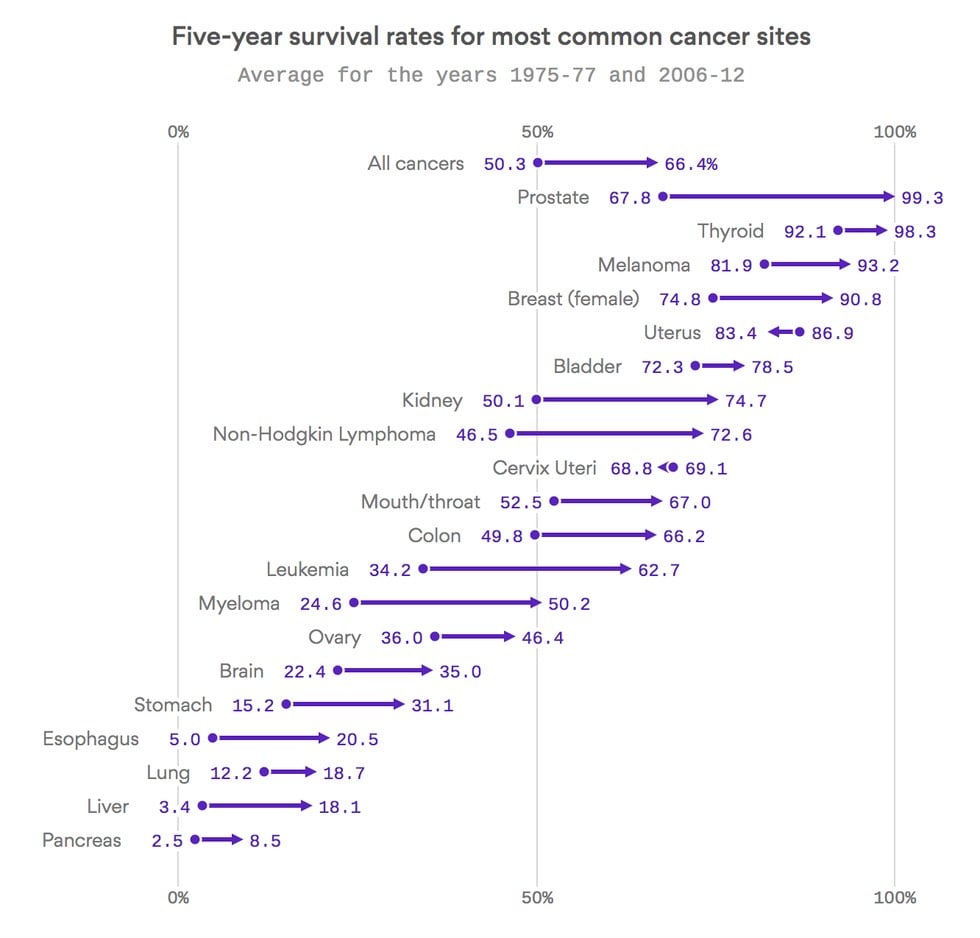
According to a study published in March 2017 in the Journal of the National Cancer Institute, cancer death rates continue to fall across most cancer types. From 2010 to 2014 (the most recent year that statistical data is available), overall death rates decreased by 1.8%.
Overall cancer death rates from 2010 to 2014 decreased by 1.8% (95% confidence interval [CI] = -1.8% to -1.8%) per year in men, by 1.4% (95% CI = -1.4% to -1.3%) per year in women, and by 1.6% (95% CI = -2.0% to -1.3%) per year in children. Death rates decreased for 11 of the 16 most common cancer types in men and for 13 of the 18 most common cancer types in women, including lung, colorectal, female breast, and prostate, whereas death rates increased for liver (men and women), pancreas (men), brain (men), and uterine cancers.
But the trends are much clearer when you look at progress over a longer time period. As this graph from Axios shows, the five-year survival rates for most common types of cancer have increased quite significantly in the past 30-40 years. Survival rates from all cancers increased by 16% and jumped 26% and almost 29% for non-Hodkin lymphoma and leukemia respectively. If you have prostate or thyroid cancer, you’re almost guaranteed to survive 5 years at this point and the female breast cancer survival rate is up to almost 91%. (via @Atul_Gawande)
Directed by Steven Spielberg, The Post is a historical drama about The Washington Post’s publication of The Pentagon Papers in 1971.
Steven Spielberg directs Meryl Streep and Tom Hanks in The Post, a thrilling drama about the unlikely partnership between The Washington Post’s Katharine Graham (Streep), the first female publisher of a major American newspaper, and editor Ben Bradlee (Hanks), as they race to catch up with The New York Times to expose a massive cover-up of government secrets that spanned three decades and four U.S. Presidents. The two must overcome their differences as they risk their careers — and their very freedom — to help bring long-buried truths to light.
The Post marks the first time Meryl Streep, Tom Hanks and Steven Spielberg have collaborated on a project.
The film comes out in December.

In 2013, polar adventurer Ben Saunders, along with his partner Tarka L’Herpiniere, set out from the coast of Antarctica to ski to the South Pole and back again, unsupported (meaning they carried all their food and supplies with them). They completed the 1800-mile journey in just over three months, but fell short of doing it unsupported.
This year, Saunders is back in Antarctica by himself, attempting the first solo, unsupported, unassisted crossing of the continent in the Trans-Antarctic Solo expedition. The really cool part: he’s blogging the whole trip. He’s already completed day one of the 1,024-mile journey, consisting of a short little 45-minute jaunt to set up his tent before hitting it in earnest on day two. Good luck, Ben! I’ll be following along on the blog, via Twitter & Instagram, and tracking your progress on this map.
Update: A bittersweet update from Ben today (12/28/2017). After 52 days and 650 miles, he’s reached the South Pole. But he’s also not embarking on the return leg of the journey, thereby ending his expedition. A further explanation will come — it’s likely his journey was taking much longer than he had food for — but what I wrote when his last expedition ended prematurely holds:
Adventure is never about battling the environment or elements or whatever. It’s always a struggle with the self. And as this battle reached a fevered pitch, Ben and Tarka were not found wanting. Calling for resupply, and thereby giving up on one of the major goals of this expedition 10 years in the making, was probably the hardest thing Ben has ever had to do in his entire life. But he did it, for his family, his loved ones, and his teammate. Ben, Tarka, I’m proud of you. Thank you for letting us follow along on your journey, for showing us what is humanly possible, and for the reminder that pushing the boundaries is never about how far you can tow a sled but about what you do when confronted with the no-win scenario: beating yourself.
Congratulations, Ben!
Designed by Teun van der Zalm, Nebulae is a computer generated nebula set to atmospheric music by Lee Rosevere. Worth seeking out a large screen for viewing. Several of van der Zalm’s other videos are equally beautiful variations on the same theme.
In her book The Sixth Extinction, Elizabeth Kolbert warns that we are in the midst of the Earth’s sixth mass extinction of life, this time caused by humans.
Over the last half a billion years, there have been five mass extinctions, when the diversity of life on earth suddenly and dramatically contracted. Scientists around the world are currently monitoring the sixth extinction, predicted to be the most devastating extinction event since the asteroid impact that wiped out the dinosaurs. This time around, the cataclysm is us.
This is a mainstream view of humanity’s effect on the Earth flora and fauna…for evidence, you don’t need to look any further than all of the large mammal species that have gone extinct or are endangered because of human activity.
A more controversial take is offered by Chris Thomas in his recent book, Inheritors of the Earth: How Nature Is Thriving in an Age of Extinction. Thomas allows that there’s a “mini mass extinction” happening, but he also argues that the extreme evolutionary pressure brought by our increasing dominance of our planet’s ecosystems will result in a “sixth mass genesis”, a dramatic increase in the Earth’s biodiversity.
Human cities and mass agriculture have created new places for enterprising animals and plants to live, and our activities have stimulated evolutionary change in virtually every population of living species. Most remarkably, Thomas shows, humans may well have raised the rate at which new species are formed to the highest level in the history of our planet.
Drawing on the success stories of diverse species, from the ochre-colored comma butterfly to the New Zealand pukeko, Thomas overturns the accepted story of declining biodiversity on Earth. In so doing, he questions why we resist new forms of life, and why we see ourselves as unnatural. Ultimately, he suggests that if life on Earth can recover from the asteroid that killed off the dinosaurs, it can survive the onslaughts of the technological age.
Vox’s Ferris Jabr recently interviewed Thomas about his views. When asked about the “sixth mass genesis”, Thomas answered:
The history of life on Earth is a history of extinctions and ecological failures, but it is also a story of formation of new forms and spread of those new forms around the world. The net result has been a gain in diversity. In the human era we are seeing great losses, but we are also seeing all these biological gains of new animals and plants spreading around the world, new hybrids coming into existence. I am not saying there is yet a balance between the two. I accept the losses, but it is also scientifically, and in terms of our human attitudes to nature, extremely interesting to contemplate the gains simultaneously.
If the processes that are going on at the moment continue for a very long time, it is my expectation that the number of species on Earth will grow enormously. We are moving species of existing animals and plants back and forth across the world, so that they are all arriving in new geographic regions. We know when species have done this in the ancient past, they have turned into new species in those different regions. If you fast-forward a million years or a few million years, all of these introduced species that leave surviving descendants will have turned into new species. And that is going to generate many more species. We have effectively created a massive species generator.
That certainly does put an interesting spin on extinction and invasive species.
Writer and artist James Bridle has noticed that something is wrong on the internet. Specifically, algorithmically chosen and produced content is taking over more and more of the internet, including what your young children are watching on YouTube.
Someone or something or some combination of people and things is using YouTube to systematically frighten, traumatise, and abuse children, automatically and at scale, and it forces me to question my own beliefs about the internet, at every level.
By his own admission, there doesn’t seem to be anything egregiously wrong or upsetting about many of the examples Bridle uses. I mean, have you read Grimm’s fairy tales? Some of them are really dark and/or weird, like Black Mirror for children. But the effect in the aggregate is huge, resulting in what he asserts is a system of abuse in which Google is complicit, a technology fueled by advertising and weaponized against its users:
The architecture they have built to extract the maximum revenue from online video is being hacked by persons unknown to abuse children, perhaps not even deliberately, but at a massive scale. I believe they have an absolute responsibility to deal with this, just as they have a responsibility to deal with the radicalisation of (mostly) young (mostly) men via extremist videos — of any political persuasion. They have so far showed absolutely no inclination to do this, which is in itself despicable. However, a huge part of my troubled response to this issue is that I have no idea how they can respond without shutting down the service itself, and most systems which resemble it. We have built a world which operates at scale, where human oversight is simply impossible, and no manner of inhuman oversight will counter most of the examples I’ve used in this essay. The asides I’ve kept in parentheses throughout, if expanded upon, would allow one with minimal effort to rewrite everything I’ve said, with very little effort, to be not about child abuse, but about white nationalism, about violent religious ideologies, about fake news, about climate denialism, about 9/11 conspiracies.
Drawing from David Wittenberg’s book, Time Travel: The Popular Philosophy of Narrative, as a guide, Evan Puschak goes in search of the origins of time travel in fiction. Along the way, he connects Charles Darwin’s work on evolution to the largely forgotten genre of utopian romance novels to the depiction of time travel in modern sci-fi.
P.S. While I was in France, I met up with Evan for lunch (we happened to be in Paris at the same time). We’d never met before, and it was really strange hearing the voice of one of my favorite YouTube channels coming out of an actual person.
Netflix has released the trailer for season two of The Crown, a historical drama about the rule of Queen Elizabeth II. The excellent Claire Foy returns as Elizabeth. The release date is December 8th. The Crown was TV’s most pleasant surprise last year. I watched with the expectation of another Downton Abbey (which would have been fine) but was rewarded with unexpectedly fine dialogue, acting, and drama…particularly the scenes featuring Elizabeth with her sister and with Churchill (played superbly by John Lithgow). Really looking forward to this second season.
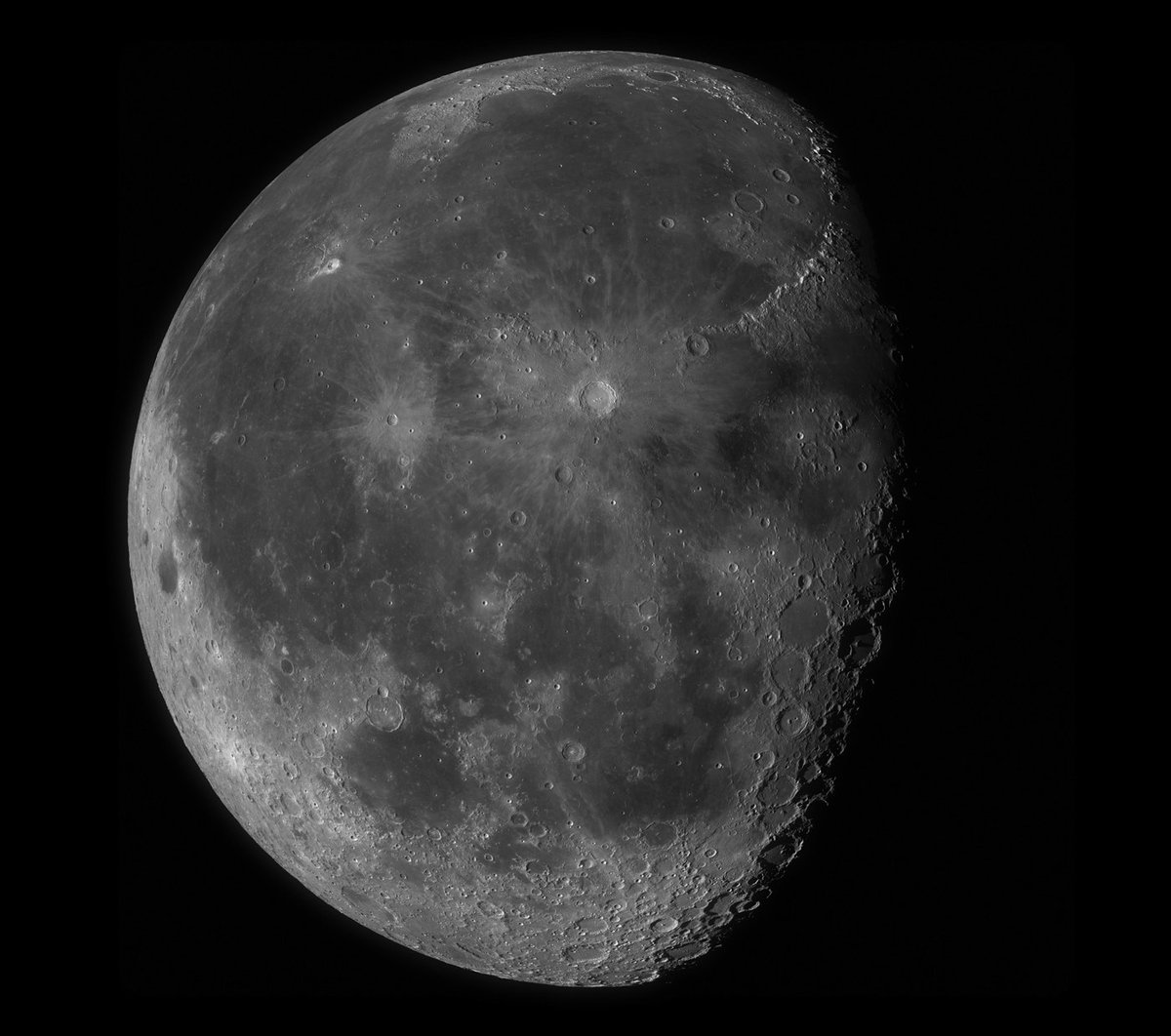
Seán Doran used images from the Lunar Reconnaissance Orbiter to create this 100-megapixel image of the Moon (full 10000x10000 pixel image here). Phil Plait explains how Doran made the image:
LRO WAC images have a resolution of about 100 meters per pixel over a swath of about 60 km of lunar surface (using what’s called the pushbroom technique, similar to how a flatbed scanner works). They are usually taken straight down, toward the spacecraft nadir (the opposite of the zenith). To get the correct perspective for the Moon as a globe, Doran took the images, along with altimeter data, and mapped them onto a sphere. That way features near the edge look foreshortened, as they really do when you look at the entire Moon. He also used Apollo images to make sure things lined up. So the image isn’t exactly scientifically rigorous, but it is certainly spectacular.
The image is also available at Gigapan for easier exploration.
This short documentary from The Atlantic features Tania Georgelas, who was in Syria with her husband (the highest-ranking American member of ISIS) until she began to fear for the safety of her children and her husband left her.
Just a few years ago, Tania Georgelas was living in Syria and married to John Georgelas, who would become the most influential American member of ISIS. Together, they traveled the globe, befriending jihadis and grooming their children to become “assassins.” But after ten years of living on the run, Tania began to fear for her family’s safety. That’s when she says her husband abandoned her “to become the next Osama bin Laden.”
What a fascinating situation. I had many complicated and conflicting feelings watching it. I imagine it might make some feel angry & disgusted and make others feel hopeful…and everything in-between.
Update: Abigail Pesta wrote a long piece for Texas Monthly about Georgelas (who now goes by the name “Tania Joya”).
To add to her anxiety, her husband began talking about wanting to move to Syria, where a civil war had begun. “He felt like he had to go and help Syria. It’s a Muslim’s duty to help your family. I felt for the Syrians. They are wonderful people, but I didn’t want to bring my boys to a war zone. They were children. It wasn’t their fight.” As her brawls with her husband escalated, he became physically abusive, and she wanted out. “It came to a point where I told him, ‘I don’t love you anymore.’ I felt suffocated. I would say, ‘One of us is going to need to die.’ He would say, ‘I could break your neck.’” One night, she put a pillow over his head in bed. He woke up and forced her off. “I didn’t really think I’d kill him,” she said. “It was more of a cry for help.”
(thx, jesse)
I got an iPhone X on Friday and have been using it all weekend. Here are some of my initial thoughts about it, some of which will likely change after more use and reflection. As an hors d’oeuvre, Apple’s guided tour of iPhone X’s new features and capabilities:
In some ways, the setup process has been streamlined. Soon after turning on the iPhone X, it asked to use my nearby iPhone 7 to transfer its settings. The verification step for this used a cool swirling blue pattern on the X that I had to view with my old phone’s camera…the iTunes visualizer is finally coming in handy.
In other ways, the setup process could still use some work. Anticipating afternoon delivery of the X, I’d backed up my iPhone 7 that morning. When it came time to set up the X using that backup, it failed…iTunes said the backup was not compatible. It didn’t specify why but I had a hunch: my 7 had iOS 11.1 installed but the X had an earlier version installed. I upgraded the X and the backup worked. Less savvy users are going to be completely lost here and Apple should fix it.
The X is slightly thicker and heavier than the 7. With the larger screen area, the iPhone is no longer a one-handed device for me in many situations. This might be a dealbreaker for me.
Haven’t used the “wireless” charging yet. Just added this $25 charging pad to my shopping cart though, so I’ll get to try it out in a couple of days.
Animoji is the “Ewoks in Return of the Jedi” feature of the iPhone X. After the novelty wears off, approximately no one will use it.
I don’t like the notch. It looks idiotic. I’ll probably get used to it. I don’t care for the display’s rounded corners either. If you look at the apps that have been updated for the X, many of them don’t make use of the bottom 1/4” of the display because of the rounded corners. I feel like there’s an optical dissonance happening where I see the edge-to-edge display and think, “wow, massive display” but really the bottom slice of the screen and the two weird bunny ears at the top are not actually that useful. (Pls don’t email me about the utility of the bunny ears for the time, network, & battery display and the tradeoffs involving the camera placement, etc. “You’ve gotta put those somewhere!” I am aware.) Call me old-fashioned, but I want all my screens to be rectangles with square corners.
Face ID works great for me. I had a week of stubble on my face for the initial scan and it still worked after I shaved. It worked with glasses on. (My Ray-Ban sunglasses: no.) It worked with a baseball cap on. It worked in the dark…like a really dark room. It worked in a dark room with my glasses on. It worked with my head rested on my hand with pretty much half my face covered (this one surprised me when I realized what had just happened).
Thank god the home button is gone. So far, Face ID + swiping up is a superior interaction 99% of the time. It’s quicker and you don’t have to think about it. App switching is super simple now…just swipe left/right on the bottom of the screen. Relearning the new Home-less Siri, screenshot, and power-off interactions isn’t that hard.
A note on Face ID security, from Apple’s Face ID Security Guide:
The probability that a random person the population could look at your iPhone X and unlock it using Face ID is approximately 1 in 1,000,000 (versus 1 in 50,000 for Touch ID).
I hadn’t read about the 1 in 50,000 for Touch ID…that seems really high.
The TrueDepth camera is fun for taking new kinds of selfies. (I wonder…can someone take that video and make an animatronic face that can be used to break into my phone?)
Everything on this phone happens instantly…or somehow faster than instantly. It would be fun to use the first iPhone (which seemed really fast at the time) just to compare how blazing this this really is. And I wonder…will the X feel as slow in 10 years as that first phone feels today? It doesn’t seem as though it could get much faster…
The OLED screen is beautiful. I mainly use my phone to read Twitter and my email, so I’m not sure I need this beautiful new screen, but damn your tweets look good!
The camera quality remains the key advantage of the iPhone…they’re just so far ahead of everyone else here.
Update: The reviewers at DxOMark disagree with me on the camera quality. They place the Google Pixel 2 ahead of the iPhone X for image quality and a few other Android phones aren’t far behind.
Like many of you, I read the news of a single person killing at least 26 people in Sutherland Springs, Texas yesterday. While this is an outrageous and horrifying event, it isn’t surprising or shocking in any way in a country where more than 33,000 people die from gun violence each year and guns that can fire dozens of rounds a minute are perfectly legal.
America is a stuck in a Groundhog Day loop of gun violence. We’ll keep waking up, stuck in the same reality of oppression, carnage, and ruined lives until we can figure out how to effect meaningful change. I’ve collected some articles here about America’s dysfunctional relationship with guns, most of which I’ve shared before. Change is possible — there are good reasons to control the ownership of guns and control has a high likelihood of success — but how will our country find the political will to make it happen?
An armed society is not a free society:
Arendt offers two points that are salient to our thinking about guns: for one, they insert a hierarchy of some kind, but fundamental nonetheless, and thereby undermine equality. But furthermore, guns pose a monumental challenge to freedom, and particular, the liberty that is the hallmark of any democracy worthy of the name — that is, freedom of speech. Guns do communicate, after all, but in a way that is contrary to free speech aspirations: for, guns chasten speech.
This becomes clear if only you pry a little more deeply into the N.R.A.’s logic behind an armed society. An armed society is polite, by their thinking, precisely because guns would compel everyone to tamp down eccentric behavior, and refrain from actions that might seem threatening. The suggestion is that guns liberally interspersed throughout society would cause us all to walk gingerly — not make any sudden, unexpected moves — and watch what we say, how we act, whom we might offend.
We’re sacrificing America’s children to “our great god Gun”:
Read again those lines, with recent images seared into our brains — “besmeared with blood” and “parents’ tears.” They give the real meaning of what happened at Sandy Hook Elementary School Friday morning. That horror cannot be blamed just on one unhinged person. It was the sacrifice we as a culture made, and continually make, to our demonic god. We guarantee that crazed man after crazed man will have a flood of killing power readily supplied him. We have to make that offering, out of devotion to our Moloch, our god. The gun is our Moloch. We sacrifice children to him daily — sometimes, as at Sandy Hook, by directly throwing them into the fire-hose of bullets from our protected private killing machines, sometimes by blighting our children’s lives by the death of a parent, a schoolmate, a teacher, a protector. Sometimes this is done by mass killings (eight this year), sometimes by private offerings to the god (thousands this year).
The gun is not a mere tool, a bit of technology, a political issue, a point of debate. It is an object of reverence. Devotion to it precludes interruption with the sacrifices it entails. Like most gods, it does what it will, and cannot be questioned. Its acolytes think it is capable only of good things. It guarantees life and safety and freedom. It even guarantees law. Law grows from it. Then how can law question it?
Roger Ebert on the media’s coverage of mass shootings:
Let me tell you a story. The day after Columbine, I was interviewed for the Tom Brokaw news program. The reporter had been assigned a theory and was seeking sound bites to support it. “Wouldn’t you say,” she asked, “that killings like this are influenced by violent movies?” No, I said, I wouldn’t say that. “But what about ‘Basketball Diaries’?” she asked. “Doesn’t that have a scene of a boy walking into a school with a machine gun?” The obscure 1995 Leonardo Di Caprio movie did indeed have a brief fantasy scene of that nature, I said, but the movie failed at the box office (it grossed only $2.5 million), and it’s unlikely the Columbine killers saw it.
The reporter looked disappointed, so I offered her my theory. “Events like this,” I said, “if they are influenced by anything, are influenced by news programs like your own. When an unbalanced kid walks into a school and starts shooting, it becomes a major media event. Cable news drops ordinary programming and goes around the clock with it. The story is assigned a logo and a theme song; these two kids were packaged as the Trench Coat Mafia. The message is clear to other disturbed kids around the country: If I shoot up my school, I can be famous. The TV will talk about nothing else but me. Experts will try to figure out what I was thinking. The kids and teachers at school will see they shouldn’t have messed with me. I’ll go out in a blaze of glory.”
In short, I said, events like Columbine are influenced far less by violent movies than by CNN, the NBC Nightly News and all the other news media, who glorify the killers in the guise of “explaining” them. I commended the policy at the Sun-Times, where our editor said the paper would no longer feature school killings on Page 1. The reporter thanked me and turned off the camera. Of course the interview was never used. They found plenty of talking heads to condemn violent movies, and everybody was happy.
Jill Lepore on the United States of Guns:
There are nearly three hundred million privately owned firearms in the United States: a hundred and six million handguns, a hundred and five million rifles, and eighty-three million shotguns. That works out to about one gun for every American. The gun that T. J. Lane brought to Chardon High School belonged to his uncle, who had bought it in 2010, at a gun shop. Both of Lane’s parents had been arrested on charges of domestic violence over the years. Lane found the gun in his grandfather’s barn.
The United States is the country with the highest rate of civilian gun ownership in the world. (The second highest is Yemen, where the rate is nevertheless only half that of the U.S.) No civilian population is more powerfully armed. Most Americans do not, however, own guns, because three-quarters of people with guns own two or more. According to the General Social Survey, conducted by the National Policy Opinion Center at the University of Chicago, the prevalence of gun ownership has declined steadily in the past few decades. In 1973, there were guns in roughly one in two households in the United States; in 2010, one in three. In 1980, nearly one in three Americans owned a gun; in 2010, that figure had dropped to one in five.
A Land Without Guns: How Japan Has Virtually Eliminated Shooting Deaths:
The only guns that Japanese citizens can legally buy and use are shotguns and air rifles, and it’s not easy to do. The process is detailed in David Kopel’s landmark study on Japanese gun control, published in the 1993 Asia Pacific Law Review, still cited as current. (Kopel, no left-wing loony, is a member of the National Rifle Association and once wrote in National Review that looser gun control laws could have stopped Adolf Hitler.)
To get a gun in Japan, first, you have to attend an all-day class and pass a written test, which are held only once per month. You also must take and pass a shooting range class. Then, head over to a hospital for a mental test and drug test (Japan is unusual in that potential gun owners must affirmatively prove their mental fitness), which you’ll file with the police. Finally, pass a rigorous background check for any criminal record or association with criminal or extremist groups, and you will be the proud new owner of your shotgun or air rifle. Just don’t forget to provide police with documentation on the specific location of the gun in your home, as well as the ammo, both of which must be locked and stored separately. And remember to have the police inspect the gun once per year and to re-take the class and exam every three years.
Australia’s gun laws stopped mass shootings and reduced homicides, study finds:
From 1979 to 1996, the average annual rate of total non-firearm suicide and homicide deaths was rising at 2.1% per year. Since then, the average annual rate of total non-firearm suicide and homicide deaths has been declining by 1.4%, with the researchers concluding there was no evidence of murderers moving to other methods, and that the same was true for suicide.
The average decline in total firearm deaths accelerated significantly, from a 3% decline annually before the reforms to a 5% decline afterwards, the study found.
In the 18 years to 1996, Australia experienced 13 fatal mass shootings in which 104 victims were killed and at least another 52 were wounded. There have been no fatal mass shootings since that time, with the study defining a mass shooting as having at least five victims.
From The Onion, ‘No Way To Prevent This,’ Says Only Nation Where This Regularly Happens:
At press time, residents of the only economically advanced nation in the world where roughly two mass shootings have occurred every month for the past eight years were referring to themselves and their situation as “helpless.”
But America is not Australia or Japan. As Dan Hodges said on Twitter:
In retrospect Sandy Hook marked the end of the US gun control debate. Once America decided killing children was bearable, it was over.
I hate to leave it on that note, but Hodges’ words ring with the awful truth that all those lives and our diminished freedom & equality are somehow worth it to the United States as a society.

Written by Robert Macfarlane and illustrated by Jackie Morris, The Lost Words is a collection of words related to the natural world that are fading from our children’s minds as the “wild childhood” disappears from western society.
All over the country, there are words disappearing from children’s lives. These are the words of the natural world — Dandelion, Otter, Bramble and Acorn, all gone. The rich landscape of wild imagination and wild play is rapidly fading from our children’s minds.The Lost Words stands against the disappearance of wild childhood. It is a joyful celebration of nature words and the natural world they invoke.
In this video dedicated to JP Auclair, who did the original street skiing video many years ago, Tom Wallisch bombs down the streets of Nelson, British Columbia, doing rail slides, jumping off of roofs, laying sparks across the pavement, and flipping over parked cars. My son is a budding free skier…I can’t decide if I need to show this to him immediately or keep it from him so he doesn’t get any crazy, dangerous ideas. (via @RichardWestenra)
Using a number of hand-drawn diagrams, minutephysics goes over the various types of time travel featured in books and movies like Primer, Harry Potter, Back to the Future, and Looper. The video covers free will, do-overs, alternate timelines, multiple selves, time machines within time machines, and many other things.

Jonathan Harris recently shared his picks for his personal top 10 works of non-fiction. His list includes a couple that would go on my list (the Eames’ Powers of Ten and Godfrey Reggio’s Koyaanisqatsi) as well as all of YouTube (surely that’s cheating a bit!) and one that I’d never heard of before, the Ten Ox Herding Pictures (shown above).
As a way of introduction, here are the famous “Ox-Herding Pictures,” composed by a 12th-century Chinese monk, describing the stages of practice leading to the Buddhist notion of enlightenment (and my favorite top-ten list of all time).
(via @amandahesser)


Last year, Taschen re-released a new edition of a surrealist cookbook originally written by the artist Salvador Dali back in the 70s. The quirky book was a hit, so now the company is re-releasing another of Dali’s food-related books, a guide to wine called The Wines of Gala.
A Dalinian take on pleasures of the grape and a coveted collectible, the book sets out to organize wines “according to the sensations they create in our very depths.” Through eclectic metrics like production method, weight, and color, the book presents wines of the world in such innovative, Dal’iesque groupings as “Wines of Frivolity,” “Wines of the Impossible,” and “Wines of Light.”
Accompanying the fanciful wine advice are more than 140 illustrations by Dali. Punch reviewed the original book a couple years ago.
Of the more than 140 illustrations by the artist, most are reprinted sketches and details from earlier paintings; of the original pieces made for the book, many were produced by slightly altering the work of other artists, adding touches like the aforementioned torso drawers and penis-wine bottle spout, which were appended to a traditional nude by Bouguereau, a 19th-century French Academy painter.
(via colossal)
Quick reviews of some things I’ve read, seen, heard, and experienced in the past two weeks or so. I recently took a trip to France to visit friends and log some time in one of my favorite places on Earth, so this particular media diet is heavy on Parisian museums and food. If you take nothing else away from this post, avoid The Louvre and watch The Handmaid’s Tale at the earliest opportunity.
Dial M for Murder. This Hitchcock film, with its relatively low stakes and filmed mostly in one room, is more suspenseful and thrilling than any of the “the world/galaxy/universe is in peril” movies out today. (A-)
Musée des Arts et Métiers. Before ~1950, you could look at a machine and pretty much know what it did and how it worked. After the invention of the digital computer, everything is an inscrutable black box. (A)
Manon des Sources. This movie feels much older than it is. (B+)
Marconi. The chef from my favorite NYC restaurant recently opened this place in Montreal. Best meal I had during my trip (Paris included). (A)
The Big Sick. It may have been a little predictable, but I really liked this movie. Lots of heart. (B+)
Le Chateaubriand. The skate tartar and a dessert with a smoked cream were the highlights, but the whole experience was top-notch and chill. (A-)
Candelaria. You will never feel cooler in Paris than having an excellent cocktail in a bar behind a hidden door in the back of a taqueria. (A-)
Musée Picasso. Not much else to say about Picasso at this point, is there? That creep can roll, man. (A-)
Women in Physics. My daughter is pretty interested in science and scientists (she’s a particular fan of Marie Curie), so books that highlight women scientists can always be found around our house. (B)
Café de Flore. You will never feel cooler in Paris than sitting outside at Café de Flore at night, reading a book, and drinking a Negroni as Hemingway might have done in the 20s. (Tho Hemingway probably didn’t have a Kindle.) (A-)
Stacked. I recently rediscovered this hour-long mix by Royal Sapien. The two-ish minutes starting at 32:00 are sublime IMO. (A-)
The Devil in the White City. A gripping tale of architecture and serial killing. Chicago 1893 is definitely one of my hypothetical time travel destinations. (A)
Sainte-Chapelle. My favorite church in Paris. Literally jaw-dropping, worth the €10 entry fee. (A)
Rough Night. I will watch anything with Kate McKinnon in it. But… (B-)
Balanchine / Teshigawara / Bausch. An amazing building. (I got to go backstage!) The third act of this ballet was flat-out amazing. (B+)
The Louvre. The best-known works are underwhelming and the rest of this massive museum is overwhelming. The massive crowds, constant photo-taking, and selfies make it difficult to actually look at the art. Should have skipped it. (C)
100 Pounds of Popcorn. Forgettable kids book. (C-)
Kubo and the Two Strings. A fun thing to do is tell someone halfway through that it’s stop motion animated. (A-)
Musée d’Orsay. The building and the art it contains elevate each other. Probably the best big museum in Paris. (A-)
The Handmaid’s Tale. This is both a not-implausible future of the United States and a metaphor for how many women and LGBT+ folks feel about how our society treats them. Excellent, a must-watch. (A)
Musée de l’Orangerie. Two rooms of huge Monet Waterlilies? Yes, please. (A-)
Brasserie Lipp. The steak frites was so-so, but the people watching from my table near the entrance was fascinating. You’ll never feel cooler…etc. etc. (B+)
Monograph by Chris Ware. This thing is *huge* (like it weighs almost 9 pounds) and beautiful. (A-)
D3 Traveller. I bought this on sale, but even so it was an epic splurge for me. Now that I’ve been on 4-5 trips with it, I can say I love love love this bag. Will likely last a lifetime. (A)
Blade Runner 2049. Rewatch, this time on a smaller screen. Despite its flaws, I definitely like this more than the original. (A-)


For Topic, photographer Daniella Zalcman went to Ohio to document high school sports teams using names and mascots that refer to Native Americans.
Outside of professional sports, words and names referring to indigenous Americans abound: there are high-school teams and squads called the Redskins, Redmen, Big Reds, Braves, Warriors, Chieftains, Indians, Savages, Squaws, Apaches, Mohawks, and Seminoles. Many of them are in the state of Ohio, which, some reports say, has over 60 high-school mascots with names considered to be slurs. (It’s worth considering the cost of “tradition”: a 2014 report by the Center for American Progress found links between these team names and the lowered self-esteem-and increased suicide rates-of young Native Americans.)
OMG, this is super nerdy and I am so here for it. Like it says on the tin, this is the scene where Principal Skinner has Superintendent Chalmers over to dinner for “steamed hams” presented as if it were a Guitar Hero song. (via @andymcmillan)
Artificial intelligence programs are getting really good at generating high-resolution faces of people who don’t actually exist. In this effort by NVIDIA, they were able to generate hundreds of photos of celebrities that don’t actually exist but look real, even under scrutiny. Here’s a video illustrating the technique…the virtual images begin at 0:38.
And here’s an entire hour of fake celebrity faces, morphing from one to the next:
I’m sure this won’t be too difficult to extend to video in the near future. Combine it with something like Lyrebird and you’ve got yourself, say, a entirely fake Democratic candidate for the House who says racist things or the fake leader of a fake new ISIS splinter group who vows to target only women at abortion clinics around the US. (via interconnected)


Victoria Villasana uses yarn to augment b&w photos of iconic people (Marilyn Monroe, Nina Simone, Frida Kahlo) to create these wonderful artistic portraits. When framed, her artwork spills out onto walls and tables:

Newer posts
Older posts



Socials & More