



Advertise here with Carbon Ads
This site is made possible by member support. 💞
Big thanks to Arcustech for hosting the site and offering amazing tech support.
When you buy through links on kottke.org, I may earn an affiliate commission. Thanks for supporting the site!
kottke.org. home of fine hypertext products since 1998.
Beloved by 86.47% of the web.
Entries for November 2017
The first asteroid from outside our solar system pays us a visit

Back in October, the solar system welcomed a visitor from interstellar space…the first interstellar asteroid ever detected.
Astronomers have confirmed that an object that recently passed by our planet is from outside our Solar System — the first interstellar asteroid that’s ever been observed. And it doesn’t look like any object we’ve ever seen in our cosmic neighborhood before.
Follow-up observations, detailed today in Nature, have found that the asteroid is dark and reddish, similar to the objects in the outer Solar System. It doesn’t have any gas or dust surrounding it, like comets do, and it’s stretched long and skinny, looking a bit like an oddly shaped pen. It’s thought to be about a quarter-mile long, and about 10 times longer than it is wide. That makes it unlike any asteroids seen in our Solar System, none of which are so elongated.
Here’s a video of the asteroid’s path through the solar system:
Um, folks…that looks like a rocket. How do we know this “asteroid” isn’t actually an ancient alien ship that’s become encrusted with rock over millions of years? Or an ancient weapon gone awry? We’ve all seen the first Star Trek movie, right? (I am only a little bit kidding about this.)
Update: Scientists — or at least one scientist who has a billionaire’s ear — think that’s there’s something a little odd about Oumuamua, so they’re going to check it for radio signals. Spoiler: they’re not going to find any, but wouldn’t it be fun if they did!?
Update: They listened and did not find any radio signals coming from Oumuamua.
Update: As of October 2018, here’s what we know about Oumuamua.
A few months later, another collaboration found that ‘Oumuamua wasn’t just being pulled by the sun’s gravity. Instead, it was being slightly accelerated by an unseen force, which they argued could only be attributed to comet “outgassing” acting like a thruster. With this additional information, the case appeared to be closed. “Interstellar asteroid is really a comet,” read the headline of a press release put out by the European Space Agency.
Classical music scores as colorful data visualizations
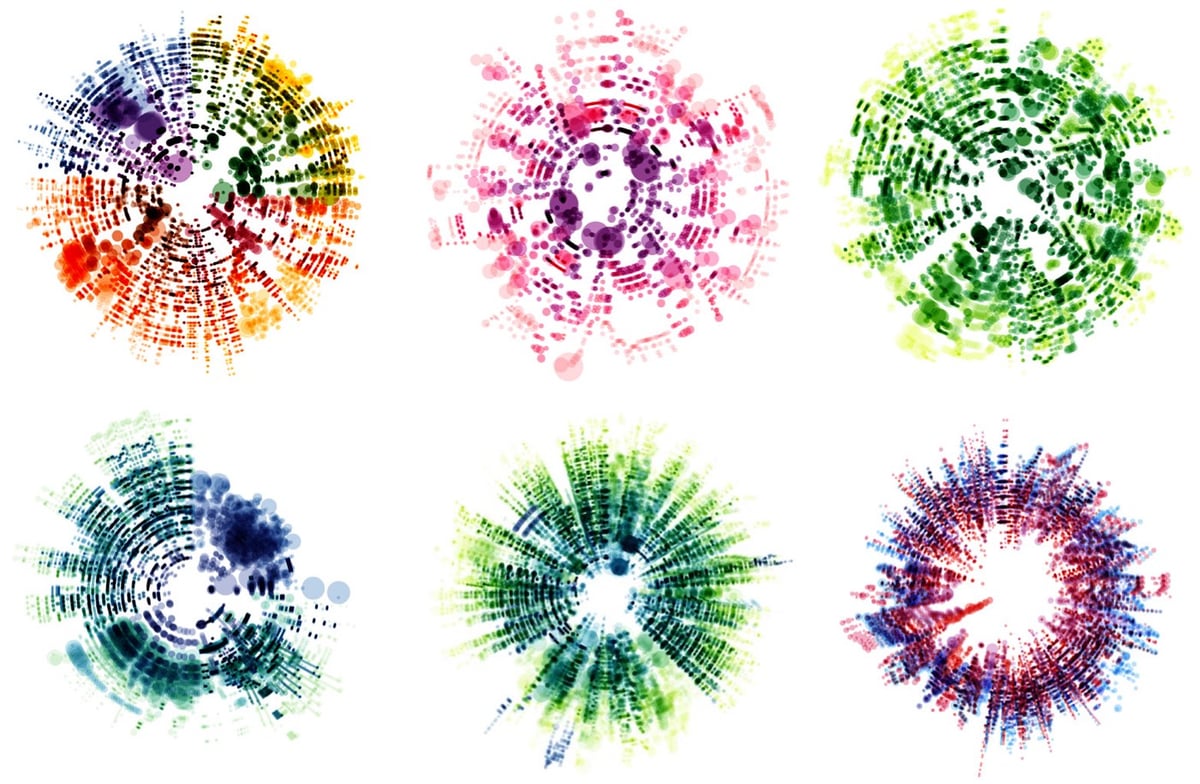
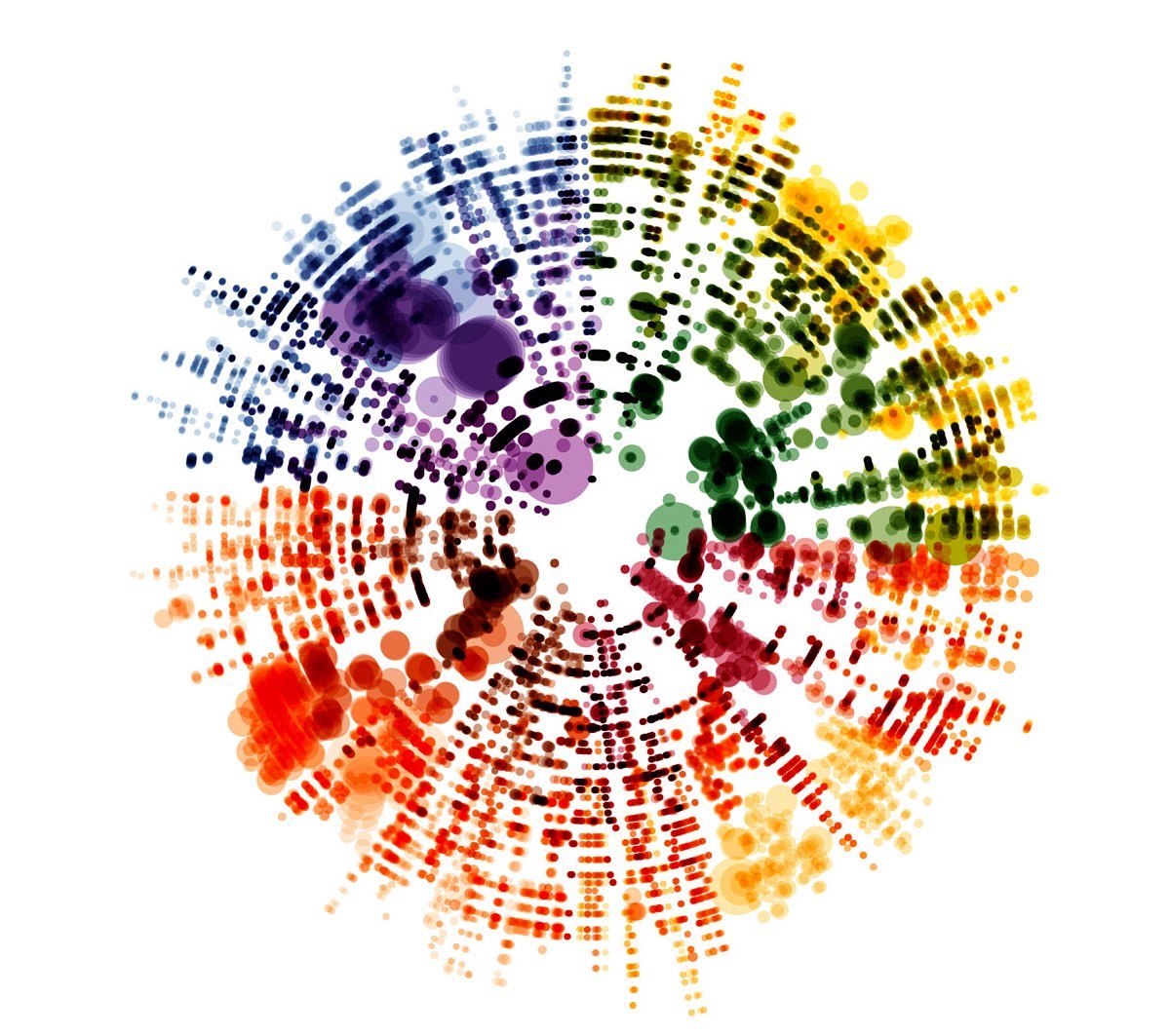
Nicholas Rougeux, who describes himself as a “designer, data geek, fractal nut”, designed a process to turn musical scores into ultra-colorful images. He outlined his process here.
Rougeux also made video versions where you can see the visualizations form as the songs play. Here’s Vivaldi’s The Four Seasons:
The global exercise heatmap

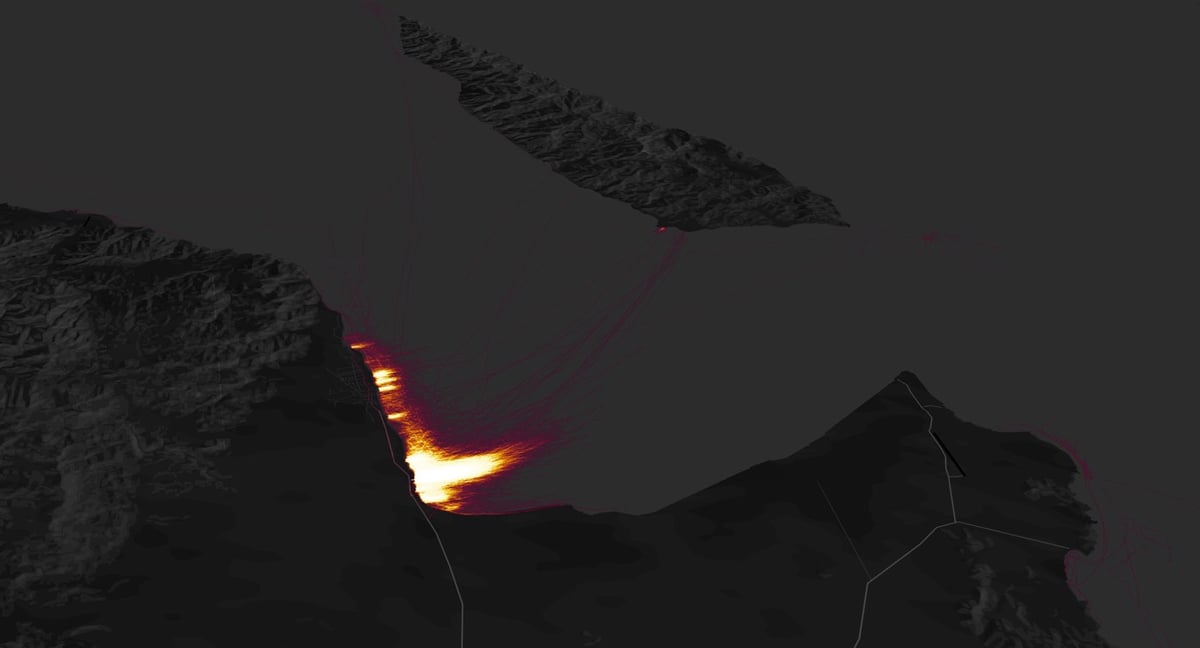
Strava, makers of apps that allow people to track and share their athletic activities, have released a global heatmap, a visualization of the humanity’s collective athletic activities. In a recent blog post, the company highlighted some of the most interesting spots on the map, which was created using 27 billion miles of data representing over 200,000 years of hiking, biking, running, skiing, and other sporting activity. Pictured above are the ski areas near Salt Lake City and kiteboarding in Baja, Mexico.
The Periodic Table of Endangered Elements

Until recently, humanity has treated the Earth as an infinite resource. As the Earth’s population has exploded over the past century however, we’ve learned in many different ways that that’s untrue. We’ve overfished the ocean, pumped too much carbon into the atmosphere and oceans, driven thousands of species into extinction, and terraformed much of the planet’s land. This periodic table produced by the American Chemical Society shows that there are also 44 chemical elements that will face supply limitations in the coming decades. Among those under a “serious threat in the next 100 years” are silver, helium, zinc, and gallium. Robert Silverberg wrote about The Death of Gallium back in 2008:
Gallium’s atomic number is 31. It’s a blue-white metal first discovered in 1831, and has certain unusual properties, like a very low melting point and an unwillingness to oxidize, that make it useful as a coating for optical mirrors, a liquid seal in strongly heated apparatus, and a substitute for mercury in ultraviolet lamps. It’s also quite important in making the liquid-crystal displays used in flat-screen television sets and computer monitors.
As it happens, we are building a lot of flat-screen TV sets and computer monitors these days. Gallium is thought to make up 0.0015 percent of the Earth’s crust and there are no concentrated supplies of it. We get it by extracting it from zinc or aluminum ore or by smelting the dust of furnace flues. Dr. Reller says that by 2017 or so there’ll be none left to use. Indium, another endangered element-number 49 in the periodic table-is similar to gallium in many ways, has many of the same uses (plus some others-it’s a gasoline additive, for example, and a component of the control rods used in nuclear reactors) and is being consumed much faster than we are finding it. Dr. Reller gives it about another decade. Hafnium, element 72, is in only slightly better shape. There aren’t any hafnium mines around; it lurks hidden in minute quantities in minerals that contain zirconium, from which it is extracted by a complicated process that would take me three or four pages to explain. We use a lot of it in computer chips and, like indium, in the control rods of nuclear reactors, but the problem is that we don’t have a lot of it. Dr. Reller thinks it’ll be gone somewhere around 2017. Even zinc, commonplace old zinc that is alloyed with copper to make brass, and which the United States used for ordinary one-cent coins when copper was in short supply in World War II, has a Reller extinction date of 2037. (How does a novel called The Death of Brass grab you?)
Zinc was never rare. We mine millions of tons a year of it. But the supply is finite and the demand is infinite, and that’s bad news. Even copper, as I noted above, is deemed to be at risk. We humans move to and fro upon the earth, gobbling up everything in sight, and some things aren’t replaceable.
As with many such predictions, the 2017 dates didn’t pan out, but the point that these resources are finite still holds. Eventually, we will run out.
Teaser trailer for Incredibles 2
I’m posting this mostly for my son. We were talking about this movie the other day and he remembered exactly where we were and what we were doing when I first told him Pixar was making an Incredibles sequel. Like it was the Moon landing or JFK getting shot.
Cutaway illustration of a film camera reveals iconic movie scenes

This might be Dorothy’s best print yet: a cutaway view of the Arriflex 35 IIC camera used extensively by directors like Stanley Kubrick but the guts of the camera has been replaced with some of the most iconic movies scenes of all time. The full print contains 60 scenes, but even in the small excerpt above, you can see The Wizard of Oz, Dr. Strangelove, The Empire Strikes Back, Forrest Gump, and The Godfather.
A mesmerizing animation of the repeating elements of a medieval cathedral
I barely know how to describe this so maybe you should just watch it. Animator Ismael Sanz-Pena took a single image of a medieval cathedral and used the facade’s repeating elements to find the movement within, kind of like a zoetrope. (Ok, I guess that’s a pretty good description. I still think you should just watch it though.) See also Sanz-Pena’s earlier attempts of the same effect. (via colossal)
How today’s animals would look if drawn like dinosaurs
It’s difficult to know how a particular animal might have looked if you only use its skeleton as a guide. For example, we used to think dinosaurs were mostly scaly like lizards until evidence was uncovered that many kinds of dinosaur were more birdlike with feathers.
Artist C.M. Kosemen, in his book All Yesterdays: Unique and Speculative Views of Dinosaurs and Other Prehistoric Animals, illustrated some present-day animals like many dinosaurs are typically drawn, based only on their skeletons.
Most serious paleoart bases itself on the detailed findings of paleontologists, who can work for weeks or even years compiling the most accurate descriptions of ancient life they can, based on fossil remains. But Kosemen says that many dinosaur illustrations should take more cues from animals living today. Our world is full of unique animals that have squat fatty bodies, with all kinds of soft tissue features that are unlikely to have survived in fossils, such as pouches, wattles, or skin flaps. “There could even be forms that no one has imagined,” says Kosemen. “For example there could plant-eating dinosaurs that had pangolin or armadillo-like armor that wasn’t preserved in the fossil. There could also be dinosaurs with porcupine-type quills.”
Here are Kosemen’s drawings of a baboon and swans:


Another pair of merging black holes found by LIGO. Amazing how quickly this became a normal occurence.
OMG, Boston Dynamics’ Atlas robot can do an f-ing BACKFLIP!
So, the jumping from box to box seemed cool. Hey, robot parkour! It seemed awfully agile for something that looks like it weighs quite a bit, but ok. But the casual gymnastics about 20 seconds in broke my brain. Holy. Crap.
Podfasters: Meet the People Who Listen to Podcasts at Super-Fast Speeds (up to 3X!!) I recently listened to an audiobook at 1.25X and it was almost too fast for me
Emergence: how many stupid things become smart together
A nice overview of emergence by Kurzgesagt. I continue to find the concept of emergence endlessly fascinating — order from disorder, complexity from simplicity, more is different. As a society, we tend to underestimate how much emergence plays a role in why things happen the way they do and are therefore often wrong-footed in our analysis and response.
For a good primer on emergence and other related phenomena, check out Steven Johnson’s Emergence: The Connected Lives of Ants, Brains, Cities, and Software.
The top 10 bestselling Kindle books of all time
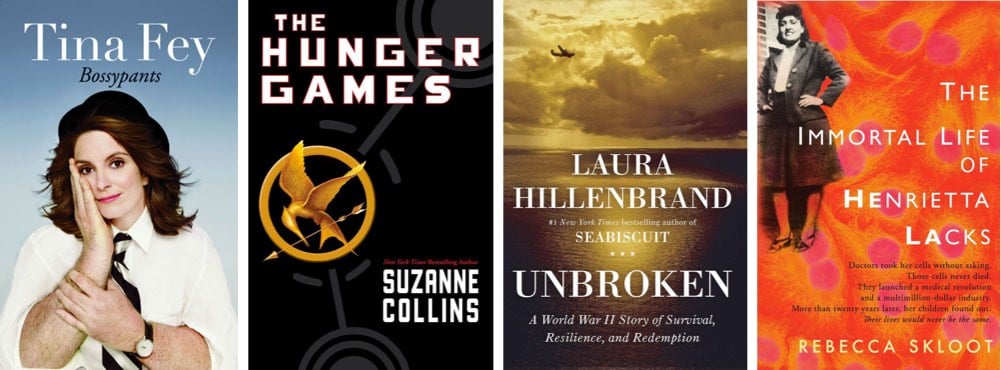
The Kindle debuted 10 years ago this month and Amazon marked its anniversary with top 10 lists of the bestselling fiction and nonfiction books for the device. The fiction list is fairly predictable (I’ll get to it in a moment), but the nonfiction list is a little more interesting in spots:
1. Unbroken: A World War II Story of Survival, Resilience, and Redemption by Laura Hillenbrand
2. Heaven is for Real: A Little Boy’s Astounding Story of His Trip to Heaven and Back by Todd Burpo, Sonja Burpo, and Lynn Vincent
3. Wild by Cheryl Strayed
4. The Boys in the Boat: Nine Americans and Their Epic Quest for Gold at the 1936 Berlin Olympics by Daniel James Brown
5. Steve Jobs by Walter Isaacson
6. The 5 Love Languages: The Secret to Love that Lasts by Gary Chapman
7. Bossypants by Tina Fey
8. American Sniper by Chris Kyle, Scott McEwen, and Jim DeFelice
9. The 7 Habits of Highly Effective People by Stephen R. Covey
10. The Immortal Life of Henrietta Lacks by Rebecca Skloot
It’s really nice to see The Immortal Life of Henrietta Lacks on there…I would not have guessed that one, although with HBO and Oprah involved, perhaps I should have. Here’s the fiction list, dominated by Shades of Grey and Katniss Everdeen.
1. Fifty Shades of Grey by E L James
2. The Hunger Games by Suzanne Collins
3. Catching Fire by Suzanne Collins
4. Mockingjay by Suzanne Collins
5. Fifty Shades Darker by E L James
6. Fifty Shades Freed by E L James
7. Gone Girl by Gillian Flynn
8. The Girl on the Train by Paula Hawkins
9. The Help by Katherine Stockett
10. The Fault in our Stars by John Green
There are some fine books on both lists, but looking at them, you get an inkling of why the IRL Amazon stores are a bit lackluster.
Can It Happen Here?: Authoritarianism in America. (I’m going to go with “clearly, yes”.)
The Road Movie, a feature-length compilation of Russian dashcam videos
The Road Movie, out in theaters in January, consists of nothing but videos taken from Russian dashboard cameras. There are car accidents, animal hijinks, fistfights, high/drunk people, meteors, and fires. The trailer is really entertaining…I’m curious to see the entire film to see how it’s stitched into something resembling a narrative that can sustain a viewer’s attention for more than 20 minutes.
Monster thunderstorm supercell in Montana

This photo of a storm supercell in Montana taken by Ryan Wunsch? Wowza. I can see why people get hooked on chasing these storms about western North America…I’d love to see something like that in person. (via @meredithfrost)
For its 25th anniversary, a remastered Automatic for the People by REM. Includes 2 hours of live and demo tracks.
The populism of Amazon’s real-world bookstores
Voracious reader Tyler Cowen recently visited an Amazon Store for the first time and posted some impressions.
1. It is a poorly designed store for me, most of all because it does not emphasize new releases. I feel I am familiar with a lot of older titles, or I went through a more or less rational process of deciding not to become familiar with them. Their current popularity, as measured say by Amazon rankings, does not cause me to reassess those judgments. For me, aggregate Amazon popularity has no real predictive power, except perhaps I don’t want to buy books everyone liked. “A really smart person says to consider this again,” however, would revise my prior estimates.
6. I consider myself quite pro-Amazon, still to me it feels dystopic when an attractive young saleswoman says so cheerily to (some) customers: “Thank you for being Prime!”
Some of his observations match those of other reviewers from when the store opened back in May. On my last trip to NYC, I visited the same store as Cowen (also for the first time) and it didn’t change my opinion about the visibility of the data in the store:
Other bookstores have books arranged according to best-seller lists, store-specific best-sellers, and staff recommendations, but I’ve never seen any store layout so extensively informed by data and where they tell you so much about why you’re seeing each item. Grocery store item placement is very data driven, but they don’t tell you why you’re seeing a display of Coke at the end of the aisle or why the produce is typically right at the entrance. It’ll be interesting to see if Amazon’s approach works or if people will be turned off by shopping inside a product database, a dehumanizing feeling Frommer hints at with “a collection of books that feels blandly standard” when compared to human curated selections at smaller bookstores.
Walking around, I half-expected to see SQL queries accompanying some of the displays — “SELECT * FROM books WHERE rating > 4.8 AND pub_year = 2017 ORDER BY number_sold”. Amazon definitely needs to figure out how to get a little weird into their stores, a little of the human touch. Toning down the data talk would help. A more casual typeface might work too — not Comic Sans but perhaps something at least approaching handwritten? They’ve got so so much data about how people buy books…they just need to be more clever about how they slice and dice it. Maybe look for books that exhibit the Napoleon Dynamite Problem? Find people with interesting wishlists?
Ultimately, I didn’t buy anything either.
Physics lessons using simple homemade marble tracks
Bruce Yeany teaches physical science to 8th graders in Annville, PA and he is very enthusiastic about it. On his popular Homemade Science YouTube channel, Yeany highlights all sorts of physics experiments and demonstrations without using any special equipment. In one of his latest videos, he shares a bunch of marble tracks that he’s built to demonstrate motion and momentum.
The “identical track race” starting at 1:43 might blow your noodle a little bit unless you’re familiar with Galileo’s pendulum research. (via digg)
Join me in supporting Tim Carmody’s writing on Patreon?
Over the past few years of doing kottke.org, I’ve been lucky enough (with your support) to be able to take some time off now and again to relax, spend time with my family, and recharge the batteries. My vacations are also a chance to introduce different voices and perspectives to the site in the form of guest editors. For my last few absences, Tim Carmody has stepped into the guest editor role and has done an incredible job. It’s a win-win…I get some time off and the site improves while I’m gone. Most recently, he organized the creation of a time capsule for the internet and wrote an amazing collection of posts about love letters and time machines.
If you enjoy and appreciate what Tim does here (and elsewhere), I hope you’ll join me in supporting his independent “rogue writing” efforts on Patreon.
Can I tell you a secret?
I don’t know what my work is any more.
Or rather: I don’t know what to call it. Not anything that makes sense.
There was a time when that would have been a very easy question to answer. I’m a reporter who writes about the intersection of technology and media. Or: I’m a scholar who studies the history of comparative media and the stories we tell about it going back forever. Or: I’m a blogger who’s trying to figure out what the liberal arts are in a networked age.
I think all of those things are still true, but how and where I’m doing them have changed. I don’t have a university job like I used to at Penn. I don’t have a regular gig at a fancy magazine like Wired or The Verge (or Newsweek or National Geographic or The Atlantic or the few dozen other places I’ve written). I don’t even have a sweet collective blog like Snarkmarket or The Message to call home.
Like a lot of us, I’m adrift, a planet flung out of its orbit into some other new system: strange, unfamiliar, ready at any moment to collide with another planet and make something new.
So that’s what I am. A rogue writer trying to put things together again and figure them out. I’m using all the tools I can find to do it: anything I can learn, anything I can leverage.
I’m proud that kottke.org has been a frequent venue for Tim’s writing, but the web could use more of it and I’m happy to support him in that effort.
P.S. Tim and I are also plotting how he can contribute more regularly here. No promises, but stay tuned!
Jimmy Iovine and most bomb record in the solar system
While preparing for a conference talk/conversation I’m doing in Amsterdam this weekend, I was reading about the Golden Record that NASA sent along as a potential greeting from Earth to alien civilizations who might run across the Voyager probes in interstellar space millions of years from now. For the 40th anniversary of the Voyager launches, science writer Timothy Ferris (author of the Pulitzer-nominated Coming of Age in the Milky Way) wrote about the production of the Record for the New Yorker.
In the winter of 1976, Carl was visiting with me and my fiancee at the time, Ann Druyan, and asked whether we’d help him create a plaque or something of the sort for Voyager. We immediately agreed. Soon, he and one of his colleagues at Cornell, Frank Drake, had decided on a record. By the time nasa approved the idea, we had less than six months to put it together, so we had to move fast. Ann began gathering material for a sonic description of Earth’s history. Linda Salzman Sagan, Carl’s wife at the time, went to work recording samples of human voices speaking in many different languages. The space artist Jon Lomberg rounded up photographs, a method having been found to encode them into the record’s grooves. I produced the record, which meant overseeing the technical side of things. We all worked on selecting the music.
Carl Sagan was project director, Ann Druyan the creative director, and Ferris produced the Record. And the sound engineer for the Golden Record? I was surprised to learn: none other than Jimmy Iovine, who was recommended to Ferris by John Lennon.
I sought to recruit John Lennon, of the Beatles, for the project, but tax considerations obliged him to leave the country. Lennon did help us, though, in two ways. First, he recommended that we use his engineer, Jimmy Iovine, who brought energy and expertise to the studio. (Jimmy later became famous as a rock and hip-hop producer and record-company executive.)
Lennon, Springsteen, Tom Petty, Patti Smith, Stevie Nicks, Interscope, Dre, Snoop, Death Row Records, Eminem, Lady Gaga, Beats By Dre, Apple, *and* The Golden Record? Iovine is like the record industry’s Forrest Gump or something. How was this not in The Defiant Ones?
Why the Movies Are So Obsessed With Capes. “Simply put, there are a lot of capes in Star Wars.”
How Facebook Figures Out Everyone You’ve Ever Met. Creeeeeeepy.
Envisioning Chemistry, Beautifully Stunning Videos of Chemical Reactions and Processes
As a follow-up to Beautiful Chemistry, the Beauty of Science and the Chinese Chemical Society have teamed up to showcase the natural beauty of chemical reactions in Envisioning Chemistry.
To achieve this goal, we took two approaches. The first was the artistic approach, in which we used chemical reactions as an essential element in the film media, together with music and editing, to explore the new possibility of film-making. The second was the technical approach, in which we took advantages of the state-of-the-art photography equipment, including high-resolution microscopes, infrared thermal imaging cameras, high-speed cameras, and 4K Ultra HD cameras, to reveal beauty of chemical reactions like never before.
You’ll notice while watching some of these videos how alive these reactions look and how common the growing/branching structures of crystals & skeletons & trees & circulatory systems are in nature, on all scales.
What did 17th century food taste like?

Can art history help us understand how food tasted in the 1600s? Not really, but it can shed some light on what people cooked and what kinds of foods were available.
What can we learn about how people ate in the seventeenth century? And even if we can piece together historical recipes, can we ever really know what their food tasted like?
This might seem like a relatively unimportant question. For one thing, the senses of other people are always going to be, at some level, unknowable, because they are so deeply subjective. Not only can I not know what Velazquez’s fried eggs tasted like three hundred years ago, I arguably can’t know what my neighbor’s taste like. And why does the question matter, anyway? A very clear case can be made for the importance of the history of medicine and disease, or the histories of slavery, global commerce, warfare, and social change.
By comparison, the taste of food doesn’t seem to have the same stature. Fried eggs don’t change the course of history.
Maybe fried eggs don’t, but spices did. Coffee beans did. Cacao beans, potatoes, and tomatoes did. Europe was in such a hurry to upgrade the flavor of its bland, rotten food that it colonized most of the world, waged wars, enslaved millions, and invented the multinational corporation.
See also Tom Standage’s An Edible History of Humanity and Charles Mann’s 1493. (via @robinsloan)
How generative music works
From software developer and writer Tero Parviainen, an interactive presentation on how generative music works. (Roughly speaking, generative music is “about making music by designing systems that make music”.)
The presentation includes many examples — Terry Riley’s In C, Brian Eno’s recent app, Listen to Wikipedia, Steve Reich’s work, neural nets for generating music — and a few interactive generative music toys you can play around with. (via waxy)
Entrepreneurship, inequity, and throwing darts at the carnival
In a reply to an article called Entrepreneurs Aren’t A Special Breed — They’re Mostly Rich Kids, Hacker News commenter notacoward wrote:
Entrepreneurship is like one of those carnival games where you throw darts or something.
Middle class kids can afford one throw. Most miss. A few hit the target and get a small prize. A very few hit the center bullseye and get a bigger prize. Rags to riches! The American Dream lives on.
Rich kids can afford many throws. If they want to, they can try over and over and over again until they hit something and feel good about themselves. Some keep going until they hit the center bullseye, then they give speeches or write blog posts about “meritocracy” and the salutary effects of hard work.
Poor kids aren’t visiting the carnival. They’re the ones working it.
That’s a pretty succinct summary of the “born on third base and thinks they hit a triple” effect…and it doesn’t just apply to entrepreneurship or being rich.
Update: In response to Forbes’ most recent 30 Under 30 feature, Helen Rosner replied:
My take is: all 30 Under 30 lists should include disclosure of parental assets
Wallpapers for iPhone X that hide the notch. Includes Sketch & Photoshop templates so I made my own. (Still don’t like the notch.)
Elevator scenes in movies debunked & fact-checked
How realistic are the elevator scenes in movies? Cinefix enlists the help of elevator technician John Holzer to fact-check and debunk scenes featuring elevators from movies like Die Hard, Willy Wonka & the Chocolate Factory, and Speed. True true: there’s actually an elevator now that can travel sideways, a la the Wonkavator.
Google’s impractical voice experiments
Google has launched a series of voice experiments that work with Google Home and also in the browser. For example, Mystery Animal is a 20 questions style game in which you attempt to guess the identity of a particular animal. Here’s how it works:
Another of the experiments, MixLab, helps you make music with simple voice commands (“add a club beat”, etc.). The experiments use AI to understand what people are asking them.
Nicole He, who worked on Mystery Animal and another experiment called Story Speaker, explains why it’s an interesting time to be goofing around with voice technology.
Talking out loud to computers has always felt more science fiction than real life. But speech recognition technology has come a long way, and developers are now making lots of useful things with voice devices. These days, you can speak out loud and have your lights turn on, or your favorite music played, or the news read to you.
That’s all nice and good, but there’s something clearly missing: the weird stuff. We should make things for voice technology that aren’t just practical. We should make things that are way more creative and bizarre. Things that are more provocative and expressive, or whimsical and delightful.
We’re in what I’m going to call The 1996 Web Design Era of voice technology. The web was created for something practical (sharing information between scientists), but it didn’t take very long for people to come up with strange and creative things to do with it.
I am terrible at 20 questions, so of course Mystery Animal stumped me. My last guess was “are you a zebra?” when the animal was actually a panda bear.
These conjoined twins can share each other’s thoughts & vision
Tatiana and Krista Hogan are conjoined twins. But not only that, they are joined at the head, an extremely rare occurence that’s resulted in the girls sharing parts of their brains with each other.
Neurological studies have stunned the doctors. Tatiana can see out of both of Krista’s eyes, while Krista can only see out of one of Tatiana’s. They also share the senses of touch and taste and the connection even extends to motor control. Tatiana controls 3 arms and a leg, while Krista controls 3 legs and an arm.
Amazingly, the girls say they also know one another’s thoughts without needing to speak. “We talk in our heads” is how they describe it.
Despite their unique connection, the twins remain two distinct people. Tatiana is talkative, outgoing and high-strung, while Krista is quieter, more relaxed and loves to joke. But she has a temper and can be aggressive if she doesn’t get her way.
When they were little, they used to try to pull their heads apart. Their mother always told them they were stuck, so they would have to work things out. But as they’ve gotten older and the frustrations mount, they still fight. As they freely admit, some days they don’t like being together. “She’s annoying,” says Tatiana, who promptly gives her twin a reassuring hug.
That’s from a writeup of a CBC documentary about a year in the twins’ lives. The doc is only viewable in Canada, but there are several clips that anyone can watch.
Vacationland: True Stories from Painful Beaches by John Hodgman

John Hodgman, formerly of The Daily Show and those Apple commercials, is out with a memoir of his middle-aged wanderings through New England called Vacationland.
Disarmed of falsehood, he was left only with the awful truth: John Hodgman is an older white male monster with bad facial hair, wandering like a privileged Sasquatch through three wildernesses: the hills of Western Massachusetts where he spent much of his youth; the painful beaches of Maine that want to kill him (and some day will); and the metaphoric haunted forest of middle age that connects them.
Vacationland collects these real life wanderings, and through them you learn of the horror of freshwater clams, the evolutionary purpose of the mustache, and which animals to keep as pets and which to kill with traps and poison. There is also some advice on how to react when the people of coastal Maine try to sacrifice you to their strange god.
Some of this hits remarkably close to the bone:
Though wildly, Hodgmaniacally funny as usual, it is also a poignant and sincere account of one human facing his forties, those years when men in particular must stop pretending to be the children of bright potential they were and settle into the failing bodies of the wiser, weird dads that they are.
I don’t know about wiser, but weird dad with a failing body is pretty much right on the money. And I love that cover by Aaron James Draplin. *kisses fingers*
Mirror, a short story of similar objects
A snack-sized video look at objects which have similar shapes, like a soft-serve ice cream cone and a compact fluorescent light bulb, a giraffe and a light pole, and an Oreo cookie and a manhole cover. (via colossal)
“How Picasso Bled the Women in His Life for Art”

From Cody Delistraty in the Paris Review, a timely article on Pablo Picasso, his artwork, and how he treated the women in his life (spoiler alert: quite poorly).
Sixteen years ago, Marina Picasso, one of Pablo Picasso’s granddaughters, became the first family member to go public about how much her family had suffered under the artist’s narcissism. “No one in my family ever managed to escape from the stranglehold of this genius,” she wrote in her memoir, Picasso: My Grandfather. “He needed blood to sign each of his paintings: my father’s blood, my brother’s, my mother’s, my grandmother’s, and mine. He needed the blood of those who loved him.”
After Jacqueline Roque, Picasso’s second wife, barred much of the family from the artist’s funeral, the family fell fully to pieces: Pablito, Picasso’s grandson, drank a bottle of bleach and died; Paulo, Picasso’s son, died of deadly alcoholism born of depression. Marie-Therese Walter, Picasso’s young lover between his first wife, Olga Khokhlova, and his next mistress, Dora Maar, later hanged herself; even Roque eventually fatally shot herself.”Women are machines for suffering,” Picasso told Francoise Gilot, his mistress after Maar. After they embarked on their affair when he was sixty-one and she was twenty-one, he warned Gilot of his feelings once more: “For me there are only two kinds of women: goddesses and doormats.”
At the same time, his granddaughter has curated a show in Paris of Picasso’s art celebrating his relationship with his daughter Maya.
Diana Widmaier-Picasso, who is the daughter of Maya Widmaier-Picasso and Pierre Widmaier, a shipping magnate, and the granddaughter of Picasso and Marie-Therese, curated the exhibition. She is well aware of the usual misanthropic, misogynistic characterizations of Picasso. “He’s a man of metamorphoses,” she tells me carefully in Paris, a few days before the vernissage of her exhibition. “A complex person to grasp.”
When I was in Paris recently, I went to the Picasso Museum, where one of the exhibitions showcased his art from 1932, the artist’s “année érotique”. The Guardian described the show thusly:
Achim Borchardt-Hume, the gallery’s director of exhibitions and co-curator of the 2018 show, said the challenge facing curators was: “How can you get close to Picasso as an artist and a person? How can you get beyond the myth?”
Their answer was to focus on one period in Picasso’s long life. They chose 1932, a time called Picasso’s “year of wonders”.
It was a year when he cemented his superstar status as the world’s most influential living artist, producing some of his greatest works of art and staging his first retrospective, which he curated. It was also a year when his passion for Walter almost boiled over.
Picasso was 45 when, in 1927, he spotted the 17-year-old Walter as she exited a Paris Metro station. He approached her, grabbed her arm and declared: “I’m Picasso! You and I are going to do great things together.”
At this point, the quality of the art is undeniable but so too is Picasso’s treatment of women: he beat them, verbally and emotionally abused them, cheated endlessly on his wives, and entered into at least one sexual relationship with a girl under the age of consent (though with the permission of her parents it seems). He chewed women up for his art and then left them to die, literally. A small aspect of all of the allegations that have come out recently (Weinstein, Spacey, Louis CK, Roy Moore, Matthew Weiner, Charlie Sheen, Jeffrey Tambor, Dustin Hoffman, Leon Wieseltier, and — never forget! — fucking Trump) is the collective realization (mostly on the part of men…women have been aware) that not only has massive chunks of our culture been created by specific men who abuse women but also that so-called “Western culture” in its entirety has been marked and in many ways defined by systemic and institutionalized misogyny that has chewed up women for art and discarded them en masse. Never mind your fave is problematic…the whole damn culture is problematic. This aspect of the creation of culture has been largely written out of history, but going forward, it’s going to be important to write it back in.
Socials & More