Entries for March 2016
This is really NSFW but also really ROFL: Comedy Central’s Not Safe with Nikki Glaser took Jerry Seinfeld’s Comedians in Cars Getting Coffee and mixed it with Clayton Cubitt’s Hysterical Literature project to create the magical Comedians Sitting on Vibrators Getting Coffee. I laughed at this until I was red in the face.

The Booker and Dax Cocktail Cube is a plastic cube you put into your cocktail shaker to simulate a big ice cube and achieve “awesome texturizing effects” for your cocktails.
One year in front of a large audience I ran a test intended to prove that big ice cubes were all show. I shook with different types of ice and dumped the drinks into graduated cylinders to measure the amount of foam the shaking had produced. To my surprise, and embarrassment, the large cube had a positive, repeatable effect on foam quantity. I don’t know why the big cube does a better job, it just does.
I’m not sure my homemade cocktail game is quite good enough to be worrying about texture at this point, but yours might be.

Randall Munroe has made a map of the United States with all of the states in different places but still retaining the same general shape. Particularly clever is the Michigan/Maryland combo to recreate the Bay Area.
Chef Joshua Smookler took a hunk of waygu steak and dry-aged it for a ridiculous 400 days. No surprise, it tasted like “funk”.
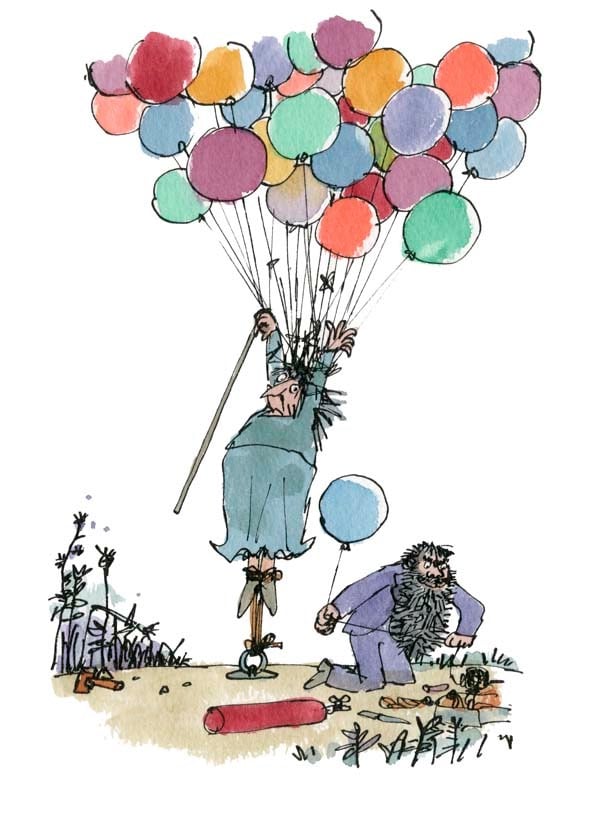
If you’ve read a book like Danny the Champion of the World or Charlie and the Chocolate Factory, you have seen the work of illustrator Quentin Blake.
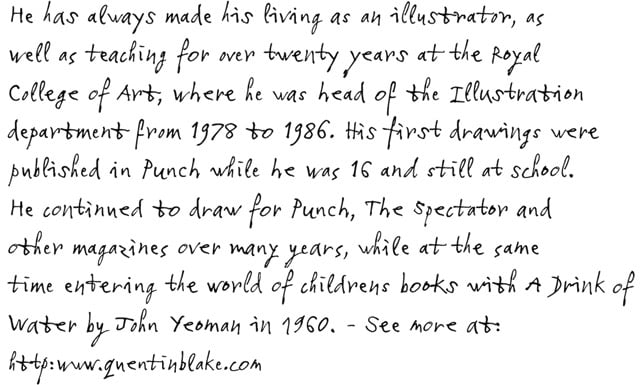
Type foundry Monotype have created a typeface from Blake’s distinctive handwriting. Each letter has four variants so the text looks more random, like actual handwriting:
The Coen brothers’ Fargo was released 20 years ago and to celebrate, Cinefix has a video about seven things you (probably) didn’t know about Fargo. The movie, not the city. There are probably way more than seven things you don’t know about Fargo, North Dakota.
Fun fact: I was living in WI near the MN border when Fargo came out and remember all the Minnesotans complaining about the accents. While I won’t say the accents were entirely accurate, all you had to do was turn on the MN State hockey tournament on channel 9 and listen to the announcers for a few minutes to confirm that they weren’t all that far off. (See also the 2016 Minnesota State High School All Hockey Hair Team. Uff da.)

Prison Ramen is a cookbook of instant ramen recipes from prison inmates and celebrities (Samuel L. Jackson wrote the foreword).
Instant ramen is a ubiquitous food, beloved by anyone looking for a cheap, tasty bite-including prisoners, who buy it at the commissary and use it as the building block for all sorts of meals. Think of this as a unique cookbook of ramen hacks. Here’s Ramen Goulash. Black Bean Ramen. Onion Tortilla Ramen Soup. The Jailhouse Hole Burrito. Orange Porkies — chili ramen plus white rice plus 1/2 bag of pork skins plus orange-flavored punch. Ramen Nuggets. Slash’s J-Walking Ramen (with scallions, Sriracha hot sauce, and minced pork).
(via @marcprecipice)
The Japanese satellite Himawari caught yesterday’s total solar eclipse as it moved across the Pacific Ocean.
Update: @paulmison sent along some better views of the eclipse: here and here. I tried to find a better YouTube embed, but no dice. This one, taken of the eclipse in Micronesia, is pretty amazing though…you can see the solar flares coming off the surface of the Sun as it reaches totality. Holy shit, I’m getting excited for Eclipsathon 2017!
Chef’s Table, the excellent Netflix show by filmmaker David Gelb (Jiro Dreams of Sushi), which I like to think of as Other Chefs Dreams of Other Foods, is coming back with three additional seasons.
“The idea was to do a series about chefs with a really cinematic quality.” As Gelb has said before, the BBC’s Planet Earth was his visual inspiration. With one season behind him, Gelb now has a process. “The hardest thing is to choose the chefs… choosing chefs that are at the absolute top of their field, are dynamic story tellers, have interesting stories in their personal lives,” he explains. He asks a lot of questions: “What are the epiphanies that made them want to be a chef? How do their cooking and personal lives intersect?”
And then from a practical perspective, do they have the time and will to commit to this shoot? “We shoot two weeks very intensively, and they have to be willing to give us their time. Finally it’s about how do we balance the chefs, how do we make it so each story is different, so that the different stories complement each other. While each film can stand alone, together they should form a greater whole.”
Among the chefs to be featured are Grant Achatz, Ivan Orkin,1 and Michel Troisgros. If you’re curious about season 1 (trailer), the Francis Mallmann and Massimo Bottura episodes are the ones to watch.
Update: The trailer for the second season is out. May 27th!
I said at the end of last season that I wasn’t going to watch this show anymore but as I am a waffling coward, I of course am going to watch it. Not that I probably won’t regret it! Anyway, looks good I guess? Better than reading any of the books at any rate.
First contact with an alien civilization will be a momentous event in the history of Earth. Unless the other civilization is kind of a dick. Tim Urban didn’t quite cover this scenario in his post about the Fermi Paradox.
Gordon Ramsay shows us how to chop an onion, cook rice, debone a fish, cook pasta, and sharpen a knife. We’ve been watching a lot of Gordon Ramsay videos at our house recently. My daughter’s class is studying how restaurants work1 — they’re operating a real restaurant in their classroom today — so she’s been really curious about food.
On a recent weekend when it was just the two of us, we watched Ramsay cook his soft-scrambled eggs (and then made them the next morning), which sent us down a rabbit hole of beef wellington, tacos, turkey, and donuts. If you’ve only ever seen him yelling at mediocre chefs and restaurant owners on TV, you should give his cooking videos a try…he’s a super engaging chef that gets you excited about food and cooking.
Evan Puschak of Nerdwriter fame asked an interesting question on Twitter yesterday:
It’s 2006. You’re DJing a club. You have a 2016 iPod. What song do you put on to make everyone go nuts?
Puschak compiled the responses into a Spotify playlist:
What would you pick? It depends on what sort of club you’re talking about but in general, for maximum impact, it would have to be instantly catchy but also with adventurous production that sounds like it’s from the future (in a way that, say, Uptown Funk doesn’t).
There are spoilers galore in Cinefix’s look at the best ever plot twists in movies, sorted into categories including It Was All a Dream, Not Dead, and Unexpectedly Bad.
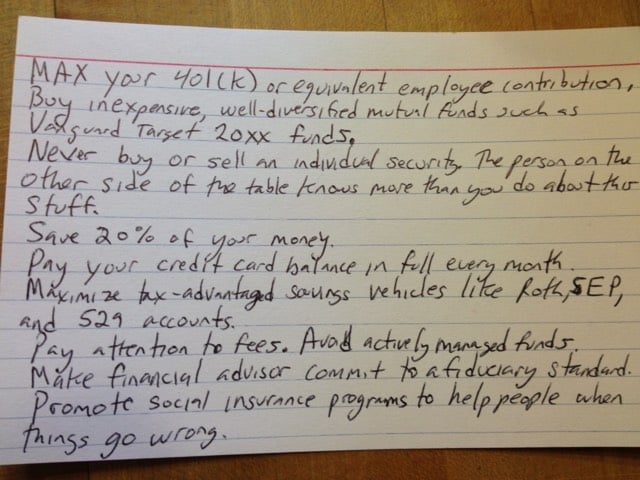
The Index Card is a new book by Helaine Olen and Harold Pollack about simple advice for personal finance. The idea for the book came about when Pollack jotted down financial advice that works for almost everyone on a 4x6 index card.
Now, Pollack teams up with Olen to explain why the ten simple rules of the index card outperform more complicated financial strategies. Inside is an easy-to-follow action plan that works in good times and bad, giving you the tools, knowledge, and confidence to seize control of your financial life.
I learned about their book from a piece by Oliver Burkeman on why complex questions can have simple answers.
But there’s a powerful truth here, which is that people dispensing financial advice are even less neutral than we realise. We’re good at spotting the obvious conflicts of interest: of course mortgage providers always think it’s a great time to buy a house; of course the sharp-suited guys from SpeedyMoola.co.uk think their payday loans are good value. But it’s more difficult to see that everyone offering advice has a deeper vested interest: they need you to believe things are complex enough to make their assistance worthwhile. It’s hard to make a living as a financial adviser by handing clients an index card and telling them never to return; and those stock-tipping columns in newspapers would be dull if all they ever said was “ignore stock tips”. Yes, the world of finance is complex, but it doesn’t follow that you need a complex strategy to navigate it.
There’s no reason to assume this situation only occurs with money, either. The human body is another staggeringly complex system, but based on current science, Michael Pollan’s seven-word guidance — “Eat food, not too much, mostly plants” — is probably wiser than all other diets.
Burkeman wrote one of my favorite books from the past year, The Antidote: Happiness for People Who Can’t Stand Positive Thinking.
In Star Trek, do you die every time you use the transporter? How would you know if you did or didn’t? I love the Ship of Theseus vs Cutty Sark comparison.
Update: See also John Weldon’s animated short To Be from The National Film Board of Canada and philosopher Derek Parfit’s Reasons and Persons. From the Wikipedia entry on the latter:
Part 3 argues for a reductive account of personal identity; rather than accepting the claim that our existence is a deep, significant fact about the world, Parfit’s account of personal identity is like this:
At time 1, there is a person. At a later time 2, there is a person. These people seem to be the same person. Indeed, these people share memories and personality traits. But there are no further facts in the world that make them the same person.
Parfit’s argument for this position relies on our intuitions regarding thought experiments such as teleportation, the fission and fusion of persons, gradual replacement of the matter in one’s brain, gradual alteration of one’s psychology, and so on. For example, Parfit asks the reader to imagine entering a “teletransporter,” a machine that puts you to sleep, then destroys you, breaking you down into atoms, copying the information and relaying it to Mars at the speed of light. On Mars, another machine re-creates you (from local stores of carbon, hydrogen, and so on), each atom in exactly the same relative position. Parfit poses the question of whether or not the teletransporter is a method of travel — is the person on Mars the same person as the person who entered the teletransporter on Earth? Certainly, when waking up on Mars, you would feel like being you, you would remember entering the teletransporter in order to travel to Mars, you would even feel the cut on your upper lip from shaving this morning.
Then the teleporter is upgraded. The teletransporter on Earth is modified to not destroy the person who enters it, but instead it can simply make infinite replicas, all of whom would claim to remember entering the teletransporter on Earth in the first place.
(via @DailyNousEditor & marko)
Update: But maybe you can build a Star Trek transporter with built-in no-cloning rules using quantum teleportation.
Private Mose Triplett was 19 when the Civil War ended in 1865. Later in life, he married a woman 50 years younger than him and, in 1930, they had a daughter Irene. Irene Triplett is now in her mid-eighties and gets a monthly benefit check from US Department of Veterans Affairs for her father’s service so many years before.
Eric Shinseki, the secretary of Veterans Affairs, often cites President Abraham Lincoln’s call, in his second inaugural address, for Americans “to care for him who shall have borne the battle and for his widow and his orphan.”
“The promises of President Abraham Lincoln are being delivered, 150 years later, by President Barack Obama, ” Secretary Shinseki said in a speech last fall. “And the same will be true 100 years from now-the promises of this president will be delivered by a future president, as yet unborn.”
A declaration of war sets in motion expenditures that can span centuries, whether the veterans themselves were heroes, cowards or something in between.
This story is from 2014, but I looked for Triplett’s obituary and found nothing, so I’m assuming she’s still alive and collecting that pension. See also The Great Span. (via @mikekarlesky)
Update: As of August 2017, Triplett was still alive and collecting the pension.
From Duel in 1971 to this year’s The BFG, Steven Spielberg has made 30 feature-length movies. This short video features one iconic scene from each one in chronological order. Interesting to note that Spielberg has used Janusz Kamiński as his director of photography for every film since Schindler’s List, a film that marked a new phase of his career. 1
Some friends were playing a game recently: name your favorite Tom Cruise movie and your least favorite Tom Hanks movie.2 I thought it would be fun to play a similar game with Spielberg standing in for Hanks but I can’t really think of who the other director would be… Who is the directorial equivalent of Tom Cruise? Respected, huge box office, but is more sizzle than substance. Michael Bay? James Cameron? Roland Emmerich? One of these guys?
Not to be outdone by the recent New Yorker piece on cheating in bridge, FiveThirtyEight has written about allegations of plagiarism by a prominent crossword puzzle editor. Much like in the pro bridge case, an online repository of games has led to people uncovering inconsistencies in dozens of Timothy Parker’s crossword puzzles that would not have been otherwise noticed.
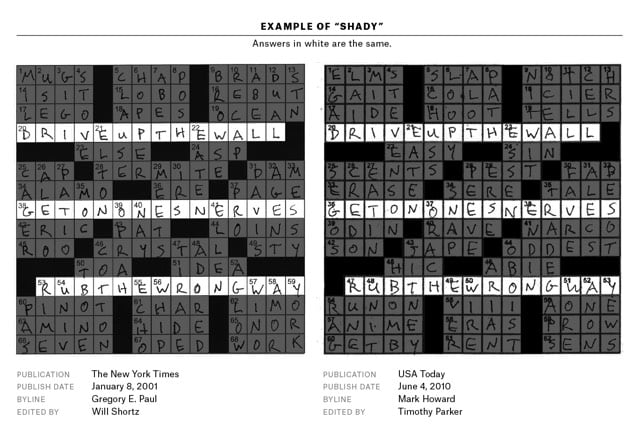
There are two types of Parker’s puzzle duplications that the database has laid bare: what I’m calling the “shady” and the “shoddy.” The shady are puzzles that appeared in Universal or USA Today with themes and theme answers identical to puzzles published earlier and in separate, unrelated publications, most often The New York Times and occasionally the Los Angeles Times and Chicago Tribune. In every such case I saw - roughly 100 cases - the theme answers were in identical locations within the grid, and in many cases, the later puzzle also replicated the earlier puzzle’s grid and some of its clues.
(via waxy)
Ray Tomlinson, who implemented the first email system on the ARPANET (the Internet’s precursor) and decided on the @ symbol for use in email addresses, died on Saturday at the age of 74. From his biography at the Internet Hall of Fame:
Tomlinson’s email program brought about a complete revolution, fundamentally changing the way people communicate, including the way businesses, from huge corporations to tiny mom-and-pop shops, operate and the way millions of people shop, bank, and keep in touch with friends and family, whether they are across town or across oceans. Today, tens of millions of email-enabled devices are in use every day. Email remains the most popular application, with over a billion and a half users spanning the globe and communicating across the traditional barriers of time and space.
John Hofsess helped eight people die and just before he died late last month at an assisted death facility in Switzerland, he wrote this piece.
I was horrified anew in 1999 when the gifted conductor Georg Tintner, who was dying from a rare form of melanoma, jumped from the balcony of his 11th-floor apartment in Halifax to end his agony. Many Canadians would hear such news, shake their heads, utter a few sympathetic platitudes and move on. But I couldn’t just sit back and wring my hands. That year, I went from advocating for assisted suicides to facilitating them. Let’s not mince words: I killed people who wanted to die.
(via nextdraft)
Just by watching how characters are introduced in movies, you can learn who’s important, what someone is thinking, the film’s theme, or a character’s flaws.
From a new video series by Eater featuring “culinary-minded individuals who are hard at work perfecting their crafts”, sushi chef David Bouhadana visits a sushi apprentice honing her skills in NYC.
With the homemade telescope in his backyard observatory, amateur astronomer Gary Hug has discovered over 300 asteroids.
I’ve pretty much stopped watching science and engineering TV shows because their information density is often so low. Mythbusters is no exception, but this clever YouTube channel helpfully edits the 44-minute episodes down to a svelte and info-packed 2-5 minutes. (via digg)

Gear Patrol collected a number of coffee cups from coffee shops around NYC. Prices for a small cup ranged from $1 to $4.50. I’m guessing the latter was not 4.5 times tastier than the former. (via @mccanner)
Players in the top ranks of the world’s professional bridge organizations have been caught cheating and the evidence is on YouTube.
On deals in which Fisher and Schwartz ended up as declarer and dummy, they cleared away the tray and the board in the usual manner. But when they were defending-meaning that one of them would make the opening lead-they were wildly inconsistent. Sometimes Fisher would remove the tray, and sometimes Schwartz would, and sometimes they would leave it on the table. Furthermore, they placed the duplicate board in a number of different positions — each of which, it turns out, conveyed a particular meaning. “If Lotan wanted a spade lead, he put the board in the middle and pushed it all the way to the other side,” Weinstein said. If he wanted a heart, he put it to the right. Diamond, over here. Club, here. No preference, here.”
Here’s a video showing what Fisher and Schwartz were doing:
Once you see it, it’s obvious they’re cheating.
What an odd seeming game when played at the professional level, BTW. Players seated so they can’t see their teammates. Information is passed through bidding, but only through signals that everyone is aware of. And some available information you can use and some you can’t:
Expert poker players often take advantage of a skill they call table feel: an ability to read the facial expressions and other unconscious “tells” exhibited by their opponents. Bridge players rely on table feel, too, but in bridge not all tells can be exploited legally by all players. If one of my opponents hesitates during the bidding or the play, I’m allowed to draw conclusions from the hesitation — but if my partner hesitates I’m not. What’s more, if I seem to have taken advantage of information that I wasn’t authorized to know, my opponents can summon the tournament director and seek an adjusted result for the hand we just played. Principled players do their best to ignore their partner and play at a consistent tempo, in order to avoid exchanging unauthorized information — and, if they do end up noticing something they shouldn’t have noticed, they go out of their way not to exploit it.
As the story goes on to say, there are technological fixes that would curtail the cheating, but would get rid of the actual cards in a card game. Why not get rid of the humans as well and just run games as computer simulations? Again, odd game. (via @pomeranian99)
Paul Feig is your director; Melissa McCarthy, Kristen Wiig, Kate McKinnon, Leslie Jones are your Ghostbusters; and NYC is the backdrop. I hope the movie is better than the trailer.
Update: A second trailer is out:
I love the concept, the cast, and the director. I want this to be good. But I’m just not feeling it from these trailers.
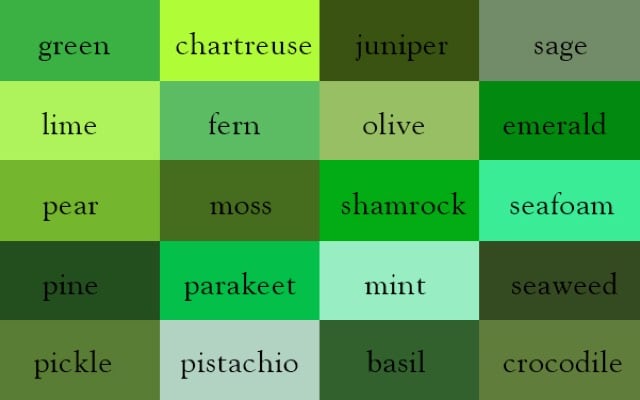
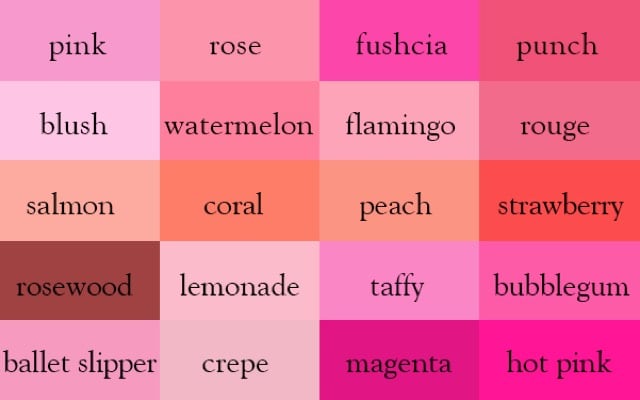
Designer and author Ingrid Sundberg collects the names of colors and has compiled them into a color thesaurus.

In 1982, photographer Barbara Davatz took photographs of 12 pairs of people. In 1988, she photographed them again. Same thing in 1997. And in 2014. A new book, As Time Goes By, collects all those photos in one place.
Their ranks have swelled over the years, with the addition of 14 children and even some grandchildren in the meantime, so the project now covers three generations. Other themes have long since been added to the original one of self-presentation. Without revealing any specific personal information, the series narrate a wide array of changes — physical, biographical and sartorial — over time. They tell of separations, of aging and loss, of the growth of families and the inheritance of family traits. But also of current urban society in each period.
See also many other “Passage of Time” photo projects and the Up Series. (via swiss miss)
One of the video’s main points:
It’s not that America has much more crime. It’s that crime in the US is much more lethal.
Similar to a sentiment I tweeted out a few months ago:
Easy access to guns turns bad moods, bad politics, bad religion, bad brain chemistry, and bad ideas into murder.
(via @atul_gawande)
Hmm. I… Hmm. Up until Wall-E, Finding Nemo was my favorite Pixar film. And…I’m not sure about this. (via trailer town)
This fantastic short video from Anthony Cerniello shows a person imperceptibly aging from youth to old age.
The idea was that something is happening but you can’t see it but you can feel it, like aging itself.
I would love to know how this was done. Benjamin Button-esque FX, I would imagine.
Update: Oh hey, luckily for me, this blogger named Jason Kottke posted this video more than two years ago and noted how the video was made.
Anthony Cerniello took photos of similar-looking family members at a reunion, from the youngest to the oldest, and edited them together in a video to create a nearly seamless portrait of a person aging in only a few minutes.
I think I’ll have to subscribe to this fella’s site. (via @jniemasik)


After nearly a year in space, astronaut Scott Kelly and cosmonaut Mikhail Kornienko will return from the ISS to Earth. During his stay in space, Kelly took hundreds of photographs and posted them to his Twitter account. You can view all the photos here or a selection of the best ones chosen by In Focus’ Alan Taylor.
In their latest video, Kurzgesagt tackles the War on Drugs. The Stop the Harm website, which they mention at the end of the video, says this about the failed efforts to curb drug use:
The global drug policy system is well and truly broken. Despite aiming to ‘protect’ people from drugs, its punitive approach has instead increased the harms of these substances, punishing and demonizing the people and communities most impacted by them. This punishment has disproportionately impacted people and communities of color, indigenous peoples, and the economically marginalized, while stoking public health crises by restricting access to essential medicines and exacerbating the spread of HIV, hepatitis C, and other blood borne viruses.
Not all of them are direct adaptations, but a number of the movies up for Oscars this year were based on books (or otherwise have book versions). We’ve already talked about The Revenant, The Martian, and The Big Short — collectively henceforth known, along with The Danish Girl, as The The Media1 — but I was unaware that Bridge of Spies and Carol were both based on books (Strangers on a Bridge and The Price of Salt, or Carol respectively). As for best picture winner Spotlight, the Boston Globe’s investigative team wrote a book about the events that inspired the movie, Betrayal: The Crisis in the Catholic Church.
Mad Max, Star Wars, and Ex Machina have gotten all the VX press this year, but the special effects in Carol are off the chain, yo! I had no idea Andy Serkis played Rooney Mara’s character in certain heavy VX scenes.
Newer posts
Older posts





Socials & More