Entries for March 2014
As Pi Day approaches, it time for a refresher course, courtesy of Steven Strogatz, on what pi actually means and how you can visualize calculating it. It’s all about rearranging the pieces of a circle in a calculus-ish sort of way:

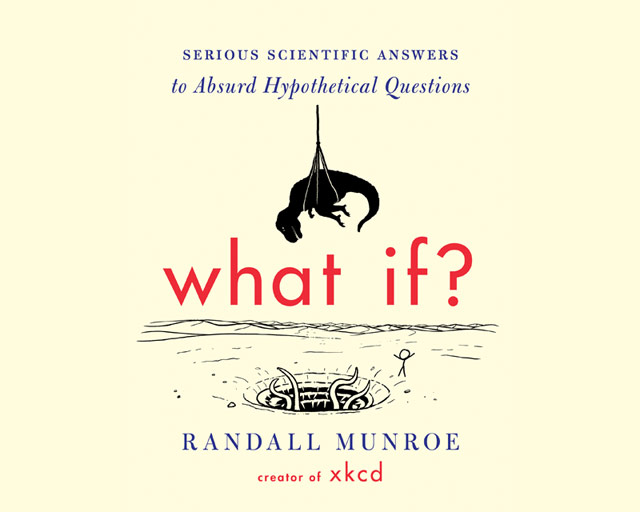
Fantastic…Randall Munroe is turning his What If? web series into a book. Munroe explains:
As I’ve sifted through the letters submitted to What If every week, I’ve occasionally set aside particularly neat questions that I wanted to spend a little more time on. This book features my answers to those questions, along with revised and updated versions of some of my favorite articles from the site. (I’m also including my personal list of the weirdest questions people have submitted.)
Update: What If? the book is now out. Phil Plait has a rave review.
Look, I answer questions for a living, too, and Randall is really, really good at this. He finds weird little scientific ways to answer the questions, but it’s his extrapolations that kill me. I laughed a lot reading this book. Even better: I learned stuff reading this book. And you will too.
Oh hello Grand Budapest Hotel soundtrack on Rdio. Alexandre Desplat. It’s a goooood morning.
Also available for download on Amazon or iTunes if that’s your thing.
Last year (spoilers!), CERN confirmed the discovery of the Higgs boson. Physicist-turned-filmmaker Mark Levinson has made a film about the search for the so-called God Particle. Particle Fever follows a group of scientists through the process of discovery and the construction of the mega-machine that discovered the Higgs, the Large Hadron Collider. Here’s a trailer:
Two additional data points: the movie is holding a 95% rating on Rotten Tomatoes and legendary sound designer and editor Walter Murch edited the film. Particle Fever is showing at Film Forum in New York until March 20. (thx, james)

The heath hen was once so plentiful in New England that servants bargained with employers not to be served heath hen for food more than two or three days a week. Due to over-hunting, the heath hen went extinct in 1932. But recently, a film of the bird made circa 1918 was discovered and digitized. The Boston Globe has a short clip of the film.
“I had heard about this film through various channels off and on through the years. It had gotten to the point where it was almost apocryphal in my mind” said Petersen, director of the Massachusetts Important Bird Areas program for Mass Audubon. “Nobody knew where it was, nobody had ever seen it, but I was aware it existed. It was like the holy grail.”
No one seems to quite remember the date, but some years ago two canisters containing brittle, aging film that was at risk of spontaneous combustion were found stored at the state’s Division of Fisheries and Wildlife. Aging tape with the words “heath hen” was its only label. One canister was sent off to the Smithsonian Institution, recalled Ellie Horwitz, who discovered the film sometime in the middle of her 34-year tenure at the agency. The other canister presented a dilemma because the film was in such terrible condition it might disintegrate.
“It was iffy whether the film could be viewed. And if it could be viewed, chances were we could view it one time, and the question is what are you going to do in that one time,” said Horwitz, who retired in 2011. “We had one shot at it; we thought the thing to do was to digitize it.”
For the show’s 10th anniversary, a video essay about Deadwood, perhaps the best three-season show that’ll ever be. Written and produced by Matt Zoller Seitz for RogerEbert.com.
Deadwood the series is a whole heck of a lot of things, in no particular order. And it’s that “in no particular order” part that makes it so rich.
(via @djacobs)
What the what?! Hunter S. Thompson was in an Apple Macintosh commercial? Check it out:
)
(via @brillhart)

From Typographica, a list of their favorite typefaces from 2013. As you’ll see, good type design is happening all over the globe.
As evidence of that diversity, the 53 typefaces selected from 2013 were created by designers from at least 20 countries. […] This new phase of globalization and democratization of the font market began in earnest about a decade ago, propelled by newly accessible digital tools, online commerce, and post-graduate education in type design. It is a sea change. For centuries, places like Argentina, Brazil, Croatia, Lebanon, and New Zealand were vastly underrepresented in a type design community that was dominated by western Europe and North America. (And this only goes for Latin-based type. The burgeoning production of fonts in other scripts tells another fascinating story.) We will have much more detail about these changes in an upcoming report by Ruxandra Duru on the current state of typefounding around the world.
One that caught my eye is Clear Sans.
A track called Computerized featuring Jay Z rapping over Daft Punk beats has surfaced. Take a listen:
I agree with Drew Millard’s take that this is an old unreleased track from the Tron Legacy / The Blueprint 3 days.
First, this isn’t an original Daft Punk instrumental; that keyboard line is a loop from the song “Son of Flynn” off of Daft Punk’s score for Tron: Legacy. From there, literally anyone-like, even me in GarageBand-could loop that, throw some drums in there, get a vocoder plugin and sing “computeriiiiiized” into it.
From there, let’s analyze Jay Z’s lyrics, which include the line, “I got an iTouch but I can’t feel,” and also a reference to Hov Jobs’ BlackBerry. Judging from the dated technology iHova is talking about on here, this is probably old as fuck.
The World Wide Web turns 25 this year…the “vague but exciting” proposal on which the Web is based was sent to his boss at CERN by Tim Berners-Lee on March 10, 1989.
In the following quarter-century, the Web has changed the world in ways that I never could have imagined. There have been many exciting advances. It has generated billions of dollars in economic growth, turned data into the gold of the 21st century, unleashed innovation in education and healthcare, whittled away geographic and social boundaries, revolutionised the media, and forced a reinvention of politics in many countries by enabling constant two-way dialogue between the rulers and the ruled.
There are a few principles which allowed the web, as a platform, to support such growth. By design, the Web is universal, royalty-free, open and decentralised. Thousands of people worked together to build the early Web in an amazing, non-national spirit of collaboration; tens of thousands more invented the applications and services that make it so useful to us today, and there is still room for each one of us to create new things on and through the Web. This is for everyone.
My friend David Galbraith continues his lonely quest to recognize and preserve the room in which the Web was invented (which is not where CERN officially recognizes it was invented.)
I wrote to Tim Berners-Lee after exploring CERN looking for the location where the web was invented. His replies regarding the exact locations are below.
There is a plaque in a corridor in building 2, but no specific offices are indicated and there is some ambiguity as to what happened where, in building 31. Thomas Madsen-Mygdal has a gallery showing locations in building 31 and 513, but there are very few places on the web documenting these places. I took photos of the plaque, such as the one here, with Creative Commons licenses, so that they could be used elsewhere.
The reason I’m interested in this is that recognizing the exact places involved in the birth of the web is a celebration of knowledge itself rather than belief, opinion or allegiance, both politically and spiritually neutral and something that everyone can potentially enjoy and feel a part of.
Secondly, many places of lesser importance are very carefully preserved. The place where the web was invented is arguably the most important place in 2 millennia of Swiss history and of global historical importance.
I was hoping one of the items on the anniversary site’s list of 25 things you probably didn’t know about the Web was that the Web was technically invented in France and not Switzerland, as Galbraith uncovered during his conversations with TBL.
On Friday, I mentioned listening to Nirvana with my kids. In January, Thomas Beller wrote a post for the New Yorker about introducing his two-year-old son to Nirvana.
Everything was going along fine in our living room until the song got to the break-the low, murky part-at which point Alexander called out to me, “Daddy! It’s scary!”
Nirvana’s music, in its anguish and energy, is scary. “Nevermind” is scary. But the break in “Drain You” is especially scary. I either had to turn it off or find a way to make this work. I didn’t want to turn it off. Instead, I turned it down an infinitesimal amount and addressed my son’s concerns.
“Alexander,” I said, bending over to talk near his face. “This is the part where they are in the swamp. The water is dark and murky, and the trees are low. They’re walking through the wet mud in the dark underbrush of the swamp.”
He looked at me with wide eyes. The colored lights added to the discotheque-meets-haunted-house mood. I worried that he would have nightmares, and that I would rue the night I played “Drain You.” People would shake their heads and say, “What were you thinking?”
“Right now, it’s very dark, but they are trying to find their way out of the swamp,” I continued.
That’s some top-notch parenting there. (via @futurerocklgnds)
They’re changing the SAT and the New Yorker’s Cora Frazier has a rundown of some of the modifications made to better reflect “skills they need to succeed in college and afterward”.
11. Improving sentences. You receive the following text message: “You’re an animal.” This is an autocorrection of:
(a) “You’re almost at Ludlow.”
(b) “Young Leo DiCaprio.”
(c) “Do we need eggs?”
(d) No autocorrection.
Tatia Pilieva asked 20 strangers to kiss for the first time and filmed it. The result is surprisingly sweet.
The father of the Sandy Hook killer searches for answers.
Any variation on what I did and how my relationship was had to be good, because no outcome could be worse. You can’t get any more evil. How much do I beat up on myself about the fact that he’s my son? A lot.
The 2014 Winter Paralympics opened in Sochi, Russia a few days ago. In Focus has some photos from the early competitions.

The competition runs through March 16th. The best way to watch in the US is on NBC Sports Network…they’re showing 52 hours of programming from the Games over the next two weeks.
Fit To Print is a Tumblr blog tracking the sometimes absurd instances of profanity avoidance in the NY Times. Like so:
Mr. Lee blasted a dictionary’s worth of unprintable words at developers who fluff gritty neighborhoods with glossy names (“East Williamsburg” for Bushwick, for instance), and at the “Christopher Columbus syndrome” of gentrifiers who were sweeping into the largely black neighborhood of his youth with little regard for “a culture that’s been laid down for generations.”
I have already been on record about the Times’ dumbass profanity policy, especially when it gets in the way of actually performing journalism.
Update: Language expert Jesse Sheidlower in a NY Times opinion piece:
When language can play such a hot-button role in our society, what we need is more reporting, not less. Some publications have loosened the restraints. The New Yorker has noticeably done so, British and Australian newspapers often print offensive words in full, and The Economist’s style guide reads: “if you do use swear words, spell them out in full, without asterisks or other coynesses.”
I had forgotten the Coens were turning Fargo into a FX TV series. But time has ground onward steadily and lo, the series is set to premiere in April. Here are a whole set of teaser trailers:
Billy Bob Thornton, Martin Freeman, Colin Hanks, Bob Odenkirk, Oliver Platt? Could be good. (via devour)
If you missed it last night as I did, the new version of Cosmos is now available on Hulu (probably US-only unless you’re clever).
The reviews are good so far.
A master chef from a Hokkaido sushi restaurant shows how to make dashimaki tamago, a Japanese rolled omelette.
Watching people who are good at what they do never gets old. (via swiss miss)
When Owen Suskind was three, a switch flipped within him and he went from a typical chatty rambunctious three-year-old to autistic.
I had just started a job as The Wall Street Journal’s national affairs reporter. My wife, Cornelia, a former journalist, was home with him — a new story every day, a new horror. He could barely use a sippy cup, though he’d long ago graduated to a big-boy cup. He wove about like someone walking with his eyes shut. “It doesn’t make sense,” I’d say at night. “You don’t grow backward.” Had he been injured somehow when he was out of our sight, banged his head, swallowed something poisonous? It was like searching for clues to a kidnapping.
After visits to several doctors, we first heard the word “autism.” Later, it would be fine-tuned to “regressive autism,” now affecting roughly a third of children with the disorder. Unlike the kids born with it, this group seems typical until somewhere between 18 and 36 months — then they vanish. Some never get their speech back. Families stop watching those early videos, their child waving to the camera. Too painful. That child’s gone.
But a tenuous connection remained between Owen and his pre-autistic self: Disney movies. And through them, Owen slowly learns how to communicate with the outside world again.
So we join him upstairs, all of us, on a cold and rainy Saturday afternoon in November 1994. Owen is already on the bed, oblivious to our arrival, murmuring gibberish…. “Juicervose, juicervose.” It is something we’ve been hearing for the past few weeks. Cornelia thinks maybe he wants more juice; but no, he refuses the sippy cup. “The Little Mermaid” is playing as we settle in, propping up pillows. We’ve all seen it at least a dozen times, but it’s at one of the best parts: where Ursula the sea witch, an acerbic diva, sings her song of villainy, “Poor Unfortunate Souls,” to the selfish mermaid, Ariel, setting up the part in which Ursula will turn Ariel into a human, allowing her to seek out the handsome prince, in exchange for her voice.
When the song is over, Owen lifts the remote. Hits rewind.
“Come on, Owen, just let it play!” Walt moans. But Owen goes back just 20 seconds or so, to the song’s next-to-last stanza, with Ursula shouting:
Go ahead — make your choice!
I’m a very busy woman, and I haven’t got all day.
It won’t cost much, just your voice!
He does it again. Stop. Rewind. Play. And one more time. On the fourth pass, Cornelia whispers, “It’s not ‘juice.’ ” I barely hear her. “What?” “It’s not ‘juice.’ It’s ‘just’ … ‘just your voice’!”
I grab Owen by the shoulders. “Just your voice! Is that what you’re saying?!”
He looks right at me, our first real eye contact in a year. “Juicervose! Juicervose! Juicervose!”
Walt starts to shout, “Owen’s talking again!” A mermaid lost her voice in a moment of transformation. So did this silent boy. “Juicervose! Juicervose! Juicervose!” Owen keeps saying it, watching us shout and cheer. And then we’re up, all of us, bouncing on the bed. Owen, too, singing it over and over — “Juicervose!” — as Cornelia, tears beginning to fall, whispers softly, “Thank God, he’s in there.”
This is the best thing I’ve read in a month, so so heartbreaking and amazing. Just pre-ordered the book…can’t wait to read the full version.
An excerpt from a biography on Kurt Cobain about how he and Courtney Love met.
Already infamous in Portland, Love was holding court in a booth when she saw Kurt walk by a few minutes before his band was set to appear onstage. Courtney was wearing a red polka-dot dress. “You look like Dave Pirner,” she said to him, meaning the remark to sound like a small insult, but also a flirt. Kurt did look a bit like Pirner, the lead singer of Soul Asylum, as his hair had grown long and tangled — he washed it just once a week, and then only with bar soap. Kurt responded with a flirt of his own: He grabbed Courtney and wrestled her to the ground.
I was listening to some music with the kids the other day and Ollie saw the cover for Nevermind in my iTunes and asked, “hey Daddy, what’s that one with the floating baby?” So we played some songs and tried to explain what that album had meant to so many people, but I didn’t do it justice. How do you explain culture shifts to kindergarten-age children? “Everything was the same as it was before, except that everything was different. Does that make sense?” In the end, I pulled a power-dad move and said, “I guess you just had to be there.” ¯\_(ツ)_/¯
If you’re reading this site, you’ll probably like watching Charlie Rose interview Bill Murray for nearly an hour. The whole thing is available on Hulu (US only):
The video is recent too: Feb 9, 2014. A clip is available on YouTube…check out that leather vest!
And from a different interview with Murray, we learn that everyone has been drinking champagne incorrectly. Here’s the Murray method:
I learned how to drink champagne a while ago. But the way I like to drink champagne is I like to make what we call a Montana Cooler, where you buy a case of champagne and you take all the bottles out, and you take all the cardboard out, and you put a garbage bag inside of it, then you put all the bottles back in and then you cover it with ice, and then you wrap it up and you close it. And that will keep it all cold for a weekend and you can drink every single bottle. And the way I like to drink it in a big pint glass with ice. I fill it with ice and I pour the champagne in it, because champagne can never be too cold. And the problem people have with champagne is they drink it and they crash with it, because the sugar content is so high and you get really dehydrated. But if you can get the ice in it, you can drink it supremely cold and at the same time you’re getting the melting ice, so it’s like a hydration level, and you can stay at this great level for a whole weekend. You don’t want to crash. You want to keep that buzz, that bling, that smile.
Buzz on, you crazy diamond!
Denis Medri illustrates scenes from Star Wars as if Luke, Leia, Han, and the rest of the gang were teenagers in an 80s movie like Back to the Future, Karate Kid, or Breakfast Club.
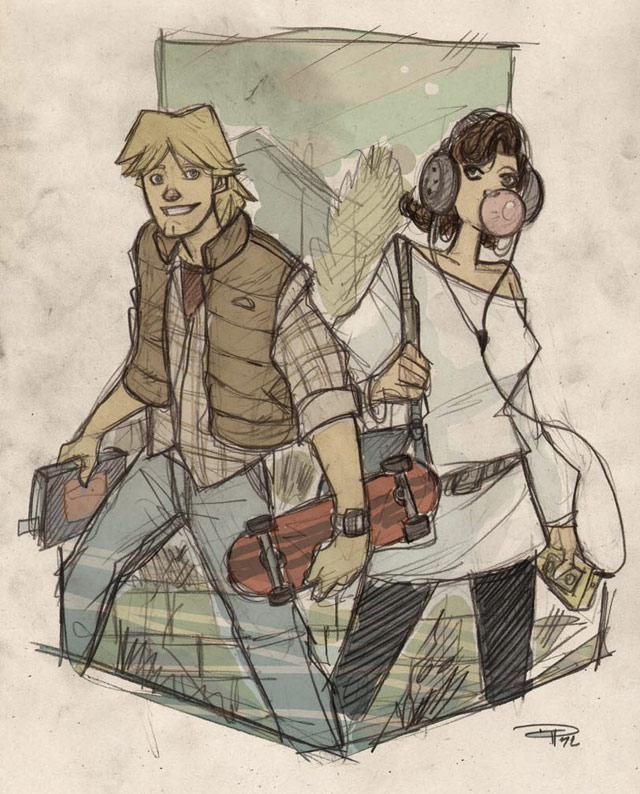
Great Scott, the Force is strong in these two.
A beautifully shot short film about mountains, how they form, how they age, and how they die.

Been reading Crabtree with the kids lately and they really like it. Reminds me of Richard Scarry’s books a bit…lots of different and often humorous objects to discover on each page.
Alfred Crabtree has lost his false teeth. But don’t worry, he’ll find them if he can just get his things organized! Alfred’s world is cluttered with surprising objects. Some are very uncommon, and some are probably not where they ought to be. There are a lot of pencils and small yapping dogs.
And who knew McSweeney’s made children’s books?
Ok quiet down, we’re going to science right now. (That’s right, I verbed “science”.) If you take a long chain of beads, put them in a jar, and then throw one end of the bead chain out, the rest of the beads will follow *and* this bead fountain will magically rise up into the air over the lip of the glass.
As the guy’s face in the video shows, this is deeply perplexing. For an explanation, slow motion video, and a demonstration of a preposterously high chain fountain, check this video from the NY Times out:
The fountain, said Dr. Biggins, which he had never seen before the video, was “surprisingly complicated.” The chain was moving faster than gravity would account for, and they realized that something had to be pushing the chain up from the container in which it was held.
A key to understanding the phenomenon, Dr. Biggins said, is that mathematically, a chain can be thought of as a series of connected rods.
When you pick up one end of a rod, he said, two things happen. One end goes up, and the other end goes down, or tries to. But if the downward force is stopped by the pile of chain beneath it, there is a kind of kickback, and the rod, or link, is pushed upward. That is what makes the chain rise.
People had assumed that the name of the secretive creator of Bitcoin, Satoshi Nakamoto, was a pseudonym designed to protect his anonymity. Newsweek’s Leah McGrath Goodman tracked down a man who could be the Bitcoin founder and discovered that his real name is…Satoshi Nakamoto.
Two police officers from the Temple City, Calif., sheriff’s department flank him, looking puzzled. “So, what is it you want to ask this man about?” one of them asks me. “He thinks if he talks to you he’s going to get into trouble.”
“I don’t think he’s in any trouble,” I say. “I would like to ask him about Bitcoin. This man is Satoshi Nakamoto.”
“What?” The police officer balks. “This is the guy who created Bitcoin? It looks like he’s living a pretty humble life.”
I’d come here to try to find out more about Nakamoto and his humble life. It seemed ludicrous that the man credited with inventing Bitcoin - the world’s most wildly successful digital currency, with transactions of nearly $500 million a day at its peak - would retreat to Los Angeles’s San Bernardino foothills, hole up in the family home and leave his estimated $400 million of Bitcoin riches untouched. It seemed similarly implausible that Nakamoto’s first response to my knocking at his door would be to call the cops. Now face to face, with two police officers as witnesses, Nakamoto’s responses to my questions about Bitcoin were careful but revealing.
Tacitly acknowledging his role in the Bitcoin project, he looks down, staring at the pavement and categorically refuses to answer questions.
“I am no longer involved in that and I cannot discuss it,” he says, dismissing all further queries with a swat of his left hand. “It’s been turned over to other people. They are in charge of it now. I no longer have any connection.”
Nice bit of sleuthing by Goodman. But given the interest around Bitcoin, it’s amazing that it took this long, even with Nakamoto’s first name change.
Update: The subject of Newsweek’s story now denies he was the creator of Bitcoin.
A group of marine biologists that has been recently studying mesopelagic fish (“fish that live between 100 and 1000m below the surface”) believes that 95% of fish biomass is unknown to humans. Marine dark matter. The problem lies with how fish have traditionally been counted and the enhanced visual and pressure senses of these fish.
He says most mesopelagic species tend to feed near the surface at night, and move to deeper layers in the daytime to avoid birds.
They have large eyes to see in the dim light, and also enhanced pressure-sensitivity.
“They are able to detect nets from at least five metres and avoid them,” he says.
“Because the fish are very skilled at avoiding nets, every previous attempt to quantify them in terms of biomass that fishing nets have delivered are very low estimates.
“So instead of different nets what we used were acoustics… sonar and echo sounders.”
A not-so-difficult prediction to make is that humans will find a way to catch these wary creatures, we’ll eat most of them, and then we’ll be back to where we are now: the world’s oceans running low on fish. (via @daveg)

The folks behind Cabin Porn are making a book with photography by Noah Kalina. Outstanding.
In his post about 1990s web development techniques, Zach Holman praises the 1-pixel transparent GIF.
1x1.gif should have won a fucking Grammy. Or a Pulitzer. Or Most Improved, Third Grade Gym Class or something. It’s the most important achievement in computer science since the linked list. It’s not the future we deserved, but it’s the future we needed (until the box model fucked it all up).
Given all of the awards Holman desires to present, I’m surprised he didn’t mention the inventor of the spacer GIF, David Siegel. Siegel was perhaps the first celebrity web designer — well, a celebrity among web designers anyway. He dispensed opinionated design knowledge from his personal homepage and used the High Five award to showcase his idea of cutting edge web design. (Fun fact: Siegel’s own site was the first High Five award winner.)

Somewhere along the way, Siegel came up with the idea of using a 1x1 pixel transparent GIF to introduce whitespace on web pages. The file size was very small but you could scale it up visually using the height and width attributes of the ![]() tag and use it hundreds of times on a site because it was cached by the browser the first time it loaded.
tag and use it hundreds of times on a site because it was cached by the browser the first time it loaded.
Popularized in the pages of his web design book, Creating Killer Web Sites, Siegel’s spacer GIF was completely non-standard and hacky but had the great advantages of 1) giving designers superb control over a site’s design and 2) working more or less the same in every graphical browser. The designers of the time weren’t content to wait around for the SGML nerds at W3C to figure out better ways of displaying web pages, so when Siegel pulled this beautiful kludge out of his pocket, everyone quickly adopted the technique. For years the spacer GIF dominated web design, for better and for worse. So yeah, maybe Siegel does deserve a Grammy or something.
Superb short documentary from Grantland about a perfect 18-hole game of mini golf:
(via @torrez)
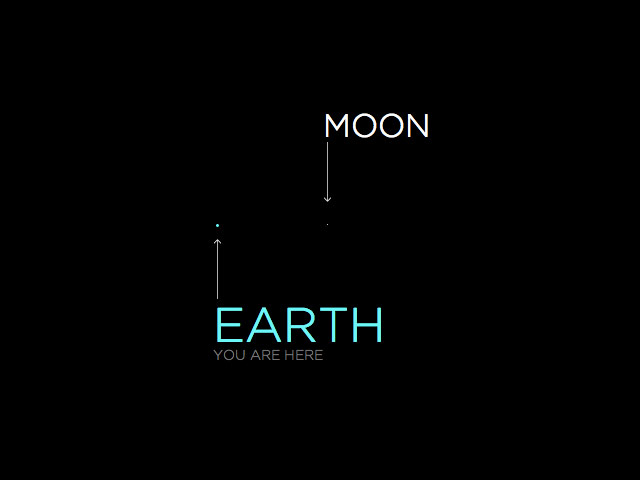
Nice visualization of the solar system; the Moon is one pixel across and everything else is scaled to that, including the distances between planets. Get ready to scroll. A lot.
It would be neat to do this with a plutonium atom or something. Related: typographically speaking, what’s the point size of the Moon?
It’s only around 30 seconds long, but this video showing a standard web maps interface paired with satellite video is pretty mindblowing:
This quick shot by Skybox’s SkySat-1 shows multiple planes landing at Beijing Capital International Airport (PEK) airport in Beijing on December 30, 2013. You can easily see a large plane landing on the runway at right. Using the video’s timestamp and public flight logs, Bruno identified this plane as Air China Limited flight 1310, a wide-body Airbus 330 flying from Guangzhou to Beijing. Operating as a codeshare, that flight was also listed as Shenzhen Airlines 1310, United Airlines 7564, SAS 9510, Austrian 8010 and Lufthansa 7283.
I remember when satellite photography first became available in online maps; this feels similarly jawdropping. Gonna be more difficult to stitch video together into seamless interfaces than still images, but once it happens, it’ll prove quite useful.
Raffi Khatchadourian’s long piece on the construction of the International Thermonuclear Experimental Reactor (ITER) is at once fascinating (for science reasons) and depressing (for political/bureaucratic reasons). Fusion reactors hold incredible promise:
But if it is truly possible to bottle up a star, and to do so economically, the technology could solve the world’s energy problems for the next thirty million years, and help save the planet from environmental catastrophe. Hydrogen, a primordial element, is the most abundant atom in the universe, a potential fuel that poses little risk of scarcity. Eventually, physicists hope, commercial reactors modelled on iter will be built, too-generating terawatts of power with no carbon, virtually no pollution, and scant radioactive waste. The reactor would run on no more than seawater and lithium. It would never melt down. It would realize a yearning, as old as the story of Prometheus, to bring the light of the heavens to Earth, and bend it to humanity’s will. iter, in Latin, means “the way.”
But ITER is a collaborative effort between 35 different countries, which means the project is political, slow, and expensive.
For the machine’s creators, this process-sparking and controlling a self-sustaining synthetic star-will be the culmination of decades of preparation, billions of dollars’ worth of investment, and immeasurable ingenuity, misdirection, recalibration, infighting, heartache, and ridicule. Few engineering feats can compare, in scale, in technical complexity, in ambition or hubris. Even the iter organization, a makeshift scientific United Nations, assembled eight years ago to construct the machine, is unprecedented. Thirty-five countries, representing more than half the world’s population, are invested in the project, which is so complex to finance that it requires its own currency: the iter Unit of Account.
No one knows iter’s true cost, which may be incalculable, but estimates have been rising steadily, and a conservative figure rests at twenty billion dollars — a sum that makes iter the most expensive scientific instrument on Earth.
I wonder what the project would look like if, say, Google or Apple were to take the reins instead. In that context, it’s only $20 billion to build a tiny Sun on the Earth. Facebook just paid $19 billion for WhatsApp, Apple has a whopping $158.8 billion in cash, and Google & Microsoft both have more than $50 billion in cash. Google in particular, which is making a self-driving car and has been buying up robots by the company-full recently, might want their own tiny star.
But back to reality, the circumstances of ITER’s international construction consortium reminded me of the building of The Machine in Carl Sagan’s Contact. In the book, the countries of the world work together to make a machine of unknown function from plans beamed to them from an alien intelligence, which results in the development of several new lucrative life-enhancing technologies and generally unites humanity. In Sagan’s view, that’s the power of science. Hopefully the ITER can work through its difficulties to achieve something similar.
Great book cover design alert:
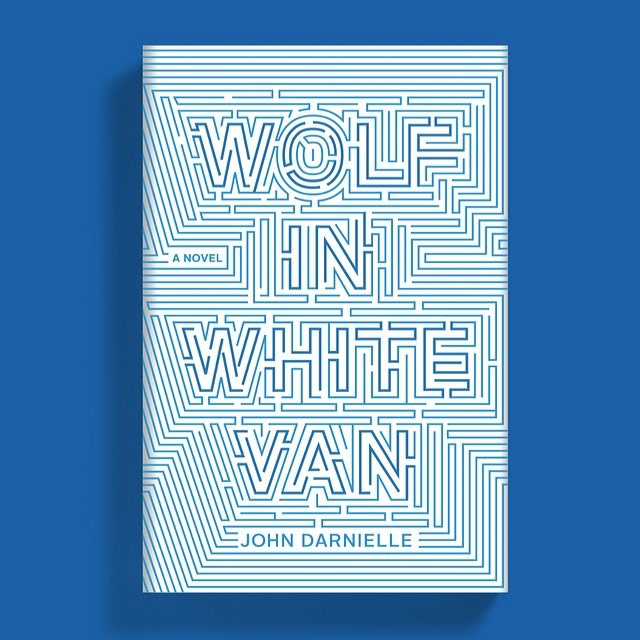
The book is the forthcoming Wolf in White Van by John Darnielle. Cover art direction by Rodrigo Corral, designed by Timothy Goodman. (via @robinsloan)
Jesse Hill made a music video for Beyonce’s Drunk in Love entirely out of emoji. Fantastic work.
Fist Eggplant! Poo! Surfbort! Oh man, that was fun.
Three years ago, Kayla Montgomery was diagnosed with multiple sclerosis. Faced with the prospect of being confined to a wheelchair someday, Montgomery, one of the slower runners on her high school cross country team, told her coach she was short on time and wanted to run faster. Now she’s one of the fastest runners in the country and perhaps the MS has something to do with it.
Kayla Montgomery, 18, was found to have multiple sclerosis three years ago. Defying most logic, she has gone on to become one of the fastest young distance runners in the country — one who cannot stay on her feet after crossing the finish line.
Because M.S. blocks nerve signals from Montgomery’s legs to her brain, particularly as her body temperature increases, she can move at steady speeds that cause other runners pain she cannot sense, creating the peculiar circumstance in which the symptoms of a disease might confer an athletic advantage.
But intense exercise can also trigger weakness and instability; as Montgomery goes numb in races, she can continue moving forward as if on autopilot, but any disruption, like stopping, makes her lose control.
“When I finish, it feels like there’s nothing underneath me,” Montgomery said. “I start out feeling normal and then my legs gradually go numb. I’ve trained myself to think about other things while I race, to get through. But when I break the motion, I can’t control them and I fall.”
Montgomery’s story reminds me of ultra-endurance racer Jure Robic, particularly this bit in a NY Times profile:
Researchers, however, have long noted a link between neurological disorders and athletic potential. In the late 1800’s, the pioneering French doctor Philippe Tissie observed that phobias and epilepsy could be beneficial for athletic training. A few decades later, the German surgeon August Bier measured the spontaneous long jump of a mentally disturbed patient, noting that it compared favorably to the existing world record. These types of exertions seemed to defy the notion of built-in muscular limits and, Bier noted, were made possible by “powerful mental stimuli and the simultaneous elimination of inhibitions.”
Questions about the muscle-centered model came up again in 1989 when Canadian researchers published the results of an experiment called Operation Everest II, in which athletes did heavy exercise in altitude chambers. The athletes reached exhaustion despite the fact that their lactic-acid concentrations remained comfortably low. Fatigue, it seemed, might be caused by something else.
In 1999, three physiologists from the University of Cape Town Medical School in South Africa took the next step. They worked a group of cyclists to exhaustion during a 62-mile laboratory ride and measured, via electrodes, the percentage of leg muscles they were using at the fatigue limit. If standard theories were true, they reasoned, the body should recruit more muscle fibers as it approached exhaustion — a natural compensation for tired, weakening muscles.
Instead, the researchers observed the opposite result. As the riders approached complete fatigue, the percentage of active muscle fibers decreased, until they were using only about 30 percent. Even as the athletes felt they were giving their all, the reality was that more of their muscles were at rest. Was the brain purposely holding back the body?
“It was as if the brain was playing a trick on the body, to save it,” says Timothy Noakes, head of the Cape Town group. “Which makes a lot of sense, if you think about it. In fatigue, it only feels like we’re going to die. The actual physiological risks that fatigue represents are essentially trivial.”
Update: While still in middle school, thirteen-year-old Amaris Tyynismaa is putting up some of the best distance running times in the country against high school competition. And she does it in spite of, or perhaps, because of battling with Tourette syndrome since she was a little girl.
Some athletes with TS attribute near-magical powers to their condition. Tim Howard, the goalkeeper of last year’s U.S. World Cup soccer team, says that TS has given him vision and reflexes that other players simply don’t have. Famed physician Oliver Sacks once wrote about a ping-pong player whose abnormal quickness and ability to knock back unreturnable shots, he believed, had to be connected to TS. One reason is that people with Tourette’s also tend to have Obsessive Compulsive Disorder (Amaris included). They need to repeat behaviors-whether it’s preventing balls from going into the net or running improbably long distances-until they do it just right. “I’m not saying it’s a good thing to have,” Sacks told a reporter last year, “but if one has Tourette’s, there are advantages.” New research out of the University of Nottingham shows that the brains of TS patients are physically different from everyone else’s, transformed by years of operating under much greater than normal resistance and better at controlling the body.
Neurologists at the Tourette Syndrome Association aren’t quite ready to embrace a connection between TS and superior athleticism. They are more comfortable saying that people with TS often see their symptoms subside when they’re playing sports or otherwise engaged in something that focuses their attention away from the urge to tic.
Soccer quieted the noise in Amaris’ head. After taking up the game, she began to tic less off the field. She did better in school. She talked more. Actually, she talked a lot, like she does now. In her last game in England, she scored three goals and the other kids lifted her up on their shoulders and carried her around. She would have had a major problem with that just months before-too many germs-but she loved it.

Have you ever wanted to taste Kanye West’s meat? Then what is wrong with you and what is wrong with these people?!?! They want to take tissue samples from celebrities like James Franco, Kanye, and Jennifer Lawrence and make artisanal salami out of them.
It all starts with your favorite celebrities, and a quick biopsy to obtain tissue samples. Isolating muscle stem cells, we grow celebrity meat in our proprietary bioreactors. In the tradition of Italian cured meats, we dry, age, and spice our product into fine charcuterie.
Note: BiteLabs might be completely fake. But fake is the new real so… nope, this is just fake.
Hold onto yer butts, you can use the computer interface from Jurassic Park right in your web browser.
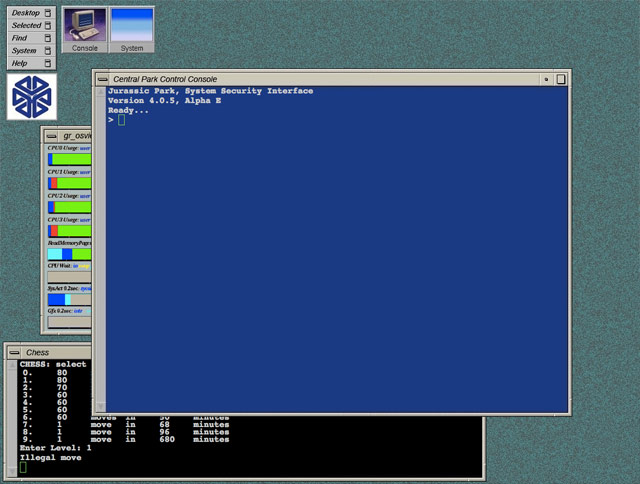
It may look a little confusing but just remember: this is a Unix system and you know this.
In his own words, Wes Anderson explains different aspects of his visual style.
Nicely edited together by Nelson Carvajal at Way Too Indie.
I keep waiting to get sick of seeing photos of huge flocks of birds flying around like they share a brain, but it hasn’t happened. Alan Taylor has collected a bunch of starling murmuration photos at In Focus.

They’re even better in motion.
From The Avant/Garde Diaries comes a brief lesson in Japanese sword fighting from master kendo sensei Shozo Kato.
Western beauty is radiance, majesty, grandness and broadness. In comparison, eastern beauty is desolateness. Humility. Hidden beauty.
Somehow — science? magic? pelican snacks? — someone found a way to affix a GoPro camera to a pelican’s beak and the view of him flying around a lake in Tanzania is pretty awesome.
(via devour)
I have to admit, this alternate Harry Potter ending would have been pretty great.
Harry Potter would, forever, be The Boy Who Lived.
Newer posts





Socials & More