

Dubstep tap dancing
“TapTronic is a progressive fusion of Irish dance and electronic music.” Dancing starts at 40 seconds.
(via The Daily What)

This site is made possible by member support. 💞
Big thanks to Arcustech for hosting the site and offering amazing tech support.
When you buy through links on kottke.org, I may earn an affiliate commission. Thanks for supporting the site!
kottke.org. home of fine hypertext products since 1998.
Beloved by 86.47% of the web.
“TapTronic is a progressive fusion of Irish dance and electronic music.” Dancing starts at 40 seconds.
(via The Daily What)
Still one of my favorite internet things: The case of the 500-mile email.
I was working in a job running the campus email system some years ago when I got a call from the chairman of the statistics department.
“We’re having a problem sending email out of the department.”
“What’s the problem?” I asked.
“We can’t send mail more than 500 miles,” the chairman explained.
I choked on my latte. “Come again?”
“We can’t send mail farther than 500 miles from here,” he repeated. “A little bit more, actually. Call it 520 miles. But no farther.”
“Um… Email really doesn’t work that way, generally,” I said, trying to keep panic out of my voice. One doesn’t display panic when speaking to a department chairman, even of a relatively impoverished department like statistics. “What makes you think you can’t send mail more than 500 miles?”
“It’s not what I *think*,” the chairman replied testily. “You see, when we first noticed this happening, a few days ago—”
“You waited a few DAYS?” I interrupted, a tremor tinging my voice. “And you couldn’t send email this whole time?”
“We could send email. Just not more than—”
“—500 miles, yes,” I finished for him, “I got that. But why didn’t you call earlier?”
“Well, we hadn’t collected enough data to be sure of what was going on until just now.” Right. This is the chairman of *statistics*. “Anyway, I asked one of the geostatisticians to look into it—”
“Geostatisticians…”
“—yes, and she’s produced a map showing the radius within which we can send email to be slightly more than 500 miles. There are a number of destinations within that radius that we can’t reach, either, or reach sporadically, but we can never email farther than this radius.”
Here’s a FAQ that addresses some of the questions the more technically inclined among you may have about this story.

From illustrator Gemma Correll. Check out the rest of her stuff, including gangsta wrap and emotional baggage.
This looks like a potentially interesting book from Felice Frankel: Visual Strategies (at Amazon).
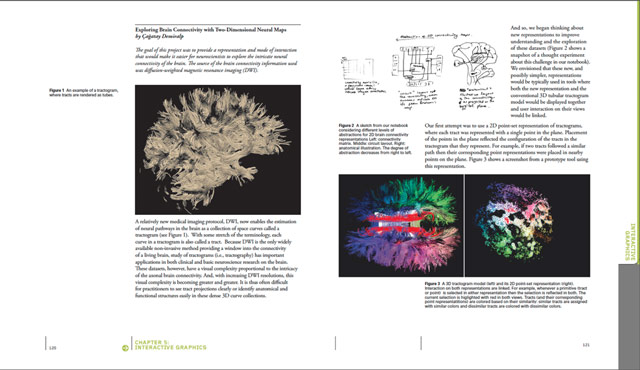
Any scientist or engineer who communicates research results will immediately recognize this practical handbook as an indispensable tool. The guide sets out clear strategies and offers abundant examples to assist researchers-even those with no previous design training-with creating effective visual graphics for use in multiple contexts, including journal submissions, grant proposals, conference posters, or presentations.
Visual communicator Felice Frankel and systems biologist Angela DePace, along with experts in various fields, demonstrate how small changes can vastly improve the success of a graphic image. They dissect individual graphics, show why some work while others don’t, and suggest specific improvements. The book includes analyses of graphics that have appeared in such journals as Science, Nature, Annual Reviews, Cell, PNAS, and the New England Journal of Medicine, as well as an insightful personal conversation with designer Stefan Sagmeister and narratives by prominent researchers and animators.
From twenty years ago, Stephen Hawking reviews the film version of A Brief History of Time.
I have been fortunate in the director of the film, Errol Morris. He is a man of integrity, with a feeling for the issues. It would have been all too easy to have someone who would have concentrated on the more sensational aspects of my private life, and my medical condition, and who would have treated the science in a superficial way. A friend of mine, who has had several television programmes based on his work, was envious of how the scientific ideas came through on the film.
(via @errolmorris)
For some visually impaired folks, the iPhone has been nothing short of revolutionary.
For the visually impaired community, the introduction of the iPhone in 2007 seemed at first like a disaster — the standard-bearer of a new generation of smartphones was based on touch screens that had no physical differentiation. It was a flat piece of glass. But soon enough, word started to spread: The iPhone came with a built-in accessibility feature. Still, members of the community were hesitant.
But no more. For its fans and advocates in the visually-impaired community, the iPhone has turned out to be one of the most revolutionary developments since the invention of Braille. That the iPhone and its world of apps have transformed the lives of its visually impaired users may seem counter-intuitive — but their impact is striking.
See also Austin Seraphin’s account of the first week he spent using an iPhone.
The other night, however, a very amazing thing happened. I downloaded an app called Color Identifier. It uses the iPhone’s camera, and speaks names of colors. It must use a table, because each color has an identifier made up of 6 hexadecimal digits. This puts the total at 16777216 colors, and I believe it. Some of them have very surreal names, such as Atomic Orange, Cosmic, Hippie Green, Opium, and Black-White. These names in combination with what feels like a rise in serotonin levels makes for a very psychedelic experience.
I have never experienced this before in my life. I can see some light and color, but just in blurs, and objects don’t really have a color, just light sources. When I first tried it at three o’clock in the morning, I couldn’t figure out why it just reported black. After realizing that the screen curtain also disables the camera, I turned it off, but it still have very dark colors. Then I remembered that you actually need light to see, and it probably couldn’t see much at night. I thought about light sources, and my interview I did for Get Lamp. First, I saw one of my beautiful salt lamps in its various shades of orange, another with its pink and rose colors, and the third kind in glowing pink and red.. I felt stunned.
(via NextDraft)
George Dvorsky details five possible scientific explanations for Westeros’ seasons of unpredictable length. A “wobbly planetary tilt” is one possible reason:
In the episode “The Kingsroad,” we learn that Westeros has at least one moon. It’s very possible, therefore, that they have a very small or distant moon, that is causing a variable tilt in their planet’s rotational axis.
It’s interesting to note that, according to legend, Westeros used to have two moons, but “one wandered too close to the sun and it cracked from the heat” pouring out a thousand thousand dragons. Well, dragons aside, it’s conceivable that some kind of cataclysmic celestial event could have wiped out their second moon, which would have thrown their planet’s rotational axis out of whack.
In June 2009, an Air France flight from Rio de Janeiro disappeared without a trace. The disappearance turned crash and the questions started: how did a state-of-the-art plane go down so suddenly and who was to blame? The plane’s black boxes were finally recovered after two years of searching and there’s a case to be made that the design of the cockpit controls may be at least partially responsible for the crash.
The official report by French accident investigators is due in a month and seems likely to echo provisional verdicts suggesting human error. There is no doubt that at least one of AF447’s pilots made a fatal and sustained mistake, and the airline must bear responsibility for the actions of its crew. It will be a grievous blow for Air France, perhaps more damaging than the Concorde disaster of July 2000.
But there is another, worrying implication that the Telegraph can disclose for the first time: that the errors committed by the pilot doing the flying were not corrected by his more experienced colleagues because they did not know he was behaving in a manner bound to induce a stall. And the reason for that fatal lack of awareness lies partly in the design of the control stick - the “side stick” - used in all Airbus cockpits.
Stephen King is rich, wants to pay more federal taxes, and is pretty pissed off about it.
Mitt Romney has said, in effect, “I’m rich and I don’t apologize for it.” Nobody wants you to, Mitt. What some of us want — those who aren’t blinded by a lot of bullshit persiflage thrown up to mask the idea that rich folks want to keep their damn money — is for you to acknowledge that you couldn’t have made it in America without America. That you were fortunate enough to be born in a country where upward mobility is possible (a subject upon which Barack Obama can speak with the authority of experience), but where the channels making such upward mobility possible are being increasingly clogged. That it’s not fair to ask the middle class to assume a disproportionate amount of the tax burden. Not fair? It’s un-fucking-American is what it is. I don’t want you to apologize for being rich; I want you to acknowledge that in America, we all should have to pay our fair share. That our civics classes never taught us that being American means that — sorry, kiddies-you’re on your own. That those who have received much must be obligated to pay — not to give, not to “cut a check and shut up,” in Governor Christie’s words, but to pay — in the same proportion. That’s called stepping up and not whining about it. That’s called patriotism, a word the Tea Partiers love to throw around as long as it doesn’t cost their beloved rich folks any money.
Tom Scocca wonders why recipe writers don’t tell the truth about how long caramelizing onions really takes.
Onions do not caramelize in five or 10 minutes. They never have, they never will-yet recipe writers have never stopped pretending that they will. I went on Twitter and said so, rudely, using CAPS LOCK. A chorus of frustrated cooks responded in kind (“That’s on some bullshit. You want caramelized onions? Stir for 45 minutes”).
As long as I’ve been cooking, I’ve been reading various versions of this lie, over and over. Here’s Madhur Jaffrey, from her otherwise reliable Indian Cooking, explaining how to do the onions for rogan josh: “Stir and fry for about 5 minutes or until the onions turn a medium-brown colour.” The Boston Globe, on preparing pearl onions for coq au vin: “Add the onions and cook, stirring often, for 5 minutes or until golden.” The Washington Post, on potato-green bean soup: “Add the onion and cook for 8 to 10 minutes, stirring occasionally, until golden brown.”
Ski Safari is an iOS game that’s kind of a cross between Tiny Wings and CycloManiacs…which is to say that I love love love it. Here’s my high score, about which I’m very ashamed and proud at the same time:

(via @gavinpurcell)
chartsandthings is a behind-the-scenes look at how the infographic sausage is made at the NY Times.
Stephen Walt wonders how US policy might have been different over the past 20 years if realists (as opposed to the neocons or liberal interventionists) had been in charge.
#2: No “Global War on Terror.” If realists had been in charge after 9/11, they would have launched a focused effort to destroy al Qaeda. Realists backed the war against the Taliban in Afghanistan, and a realist approach to the post-9/11 threat environment would have focused laser-like on al Qaeda and other terrorist groups that were a direct threat to the United States. But realists would have treated them like criminals rather than as “enemy combatants” and would not have identified all terrorist groups as enemies of the United States. And as noted above, realists would not have included “rogue states” like Iran, Iraq, and North Korea (the infamous “axis of evil”) in the broader “war on terror.” Needless to say, with realists in charge, the infamous 2002 National Security Strategy calling for preventive war would never have been written.
Muthu Alagappan used topological data analysis to group NBA players into thirteen different player types, including Role-Playing Ball-Handler, Paint Protector, All-NBA 1st Team, and One-of-a-Kind.

For Sight & Sound magazine, Roger Ebert came up with his picks for ten best films ever.
“Citizen Kane” speaks for itself. “2001: A Space Odyssey” is likewise a stand-along monument, a great visionary leap, unsurpassed in its vision of man and the universe. It was a statement that came at a time which now looks something like the peak of humanity’s technological optimism. Many would choose “Taxi Driver” as Scorsese’s greatest film, but I believe “Raging Bull” is his best and most personal, a film he says in some ways saved his life. It is the greatest cinematic expression of the torture of jealousy — his “Othello.”
(via df)
86-year-old Brendon Grimshaw has lived alone on a tiny island in the Seychelles since 1962. He bought it for £8000 and has spent those years introducing trees and 120 giant tortoises back to the island.
(via ★interesting-links)
Socials & More