



How to use a paper towel
In the spirit of conservation, Joe Smith shows us how to use a paper towel properly.
(via df)

This site is made possible by member support. 💞
Big thanks to Arcustech for hosting the site and offering amazing tech support.
When you buy through links on kottke.org, I may earn an affiliate commission. Thanks for supporting the site!
kottke.org. home of fine hypertext products since 1998.
Beloved by 86.47% of the web.
In the spirit of conservation, Joe Smith shows us how to use a paper towel properly.
(via df)
Justin Bieber recently had his 18th birthday so GQ sent Drew Magary to make him a man. It didn’t quite go as planned, but here are the 8 best parts of the story.
Harrell is an incredibly nice man who looks like a black version of Johnny Depp’s Willy Wonka, so I was happy to sit around and stare at his hair for a while.
If someone asks you if you’d like to punch Justin Bieber in the face, the answer is yes.
His voice is so high, it sounds like a ringtone.
No one can be normal living under the circumstances that constitute daily life for Justin Bieber.
We talk music, and he mentions his love for pre-“Black Album” Metallica—”One,” “Fade to Black.” “Those are my jams,” he says.
“I’m 18 years old and I’m a swaggy adult!” he yells. “Come on, swaggy bros!”
His flow is slower than prostate cancer.
And he surely knows what it’s like to be hated by people who’ve never met you. Unlike Kardashian, though, Bieber is legitimately talented.
The new Vanilla Ice hairdo is puzzling…why would Bieber want to go anywhere near that one-hit wonder flame out mess?
Tadao Cern sets people up in front of powerful fans and takes their pictures. Instant fun house:

Many more of Cern’s photos are available on Facebook. (via colossal)
I’ve seen skateboarding dogs, but I’ve never seen a skateboarding shadow before. The video feels like a dream sequence in a movie, a movie where some evil wizard turns the boys of Dogtown into shadows.
Aaron Sorkin recently gave the commencement address at Syracuse University.
Make no mistake about it, you are dumb. You’re a group of incredibly well-educated dumb people. I was there. We all were there. You’re barely functional. There are some screw-ups headed your way. I wish I could tell you that there was a trick to avoiding the screw-ups, but the screw-ups, they’re a-coming for ya. It’s a combination of life being unpredictable, and you being super dumb.
But also, this:
Don’t ever forget that you’re a citizen of this world, and there are things you can do to lift the human spirit, things that are easy, things that are free, things that you can do every day. Civility, respect, kindness, character. You’re too good for schadenfreude, you’re too good for gossip and snark, you’re too good for intolerance — and since you’re walking into the middle of a presidential election, it’s worth mentioning that you’re too good to think people who disagree with you are your enemy.
A bunch of cute kids review Bangarang by Skrillex.
What is dupstep?
I’ve never heard of that.
Daddy loves dubstep.
A couple of the kids were asked what “the drop” meant:
I think the drop is when you drop being sensible.
When it gets really quiet and then it gets really really really loud. BANG!
(via ★interesting)
Austin Seraphin, who you may remember from his review of the iPhone, recently learned how to use echolocation to navigate his physical environment in a new way.
We started out in the hallway outside of my condo. They turned an old school into lofts, so the hallways and stairwells look and sound like a school. He had me walk down the hallway without touching the walls by using echolocation. Just to make it clear: echolocation does not normally replace the use of a cane, but for this exercise I did not use a cane. I could hear the hard surfaces, and gradually the walls came into focus. I could actually do it. The walls provided the shoreline, and I could actually see them on either side and keep in the center.
I began to understand that this required a whole new way of thinking. Justin gave constant instruction to help me learn. “Scan left. Scan right. Now scan straight ahead. You have to start thinking like a sighted person.” In deed, the muscles in the back of my neck would start to hurt because I did not need to move my head as much before. Now the direction of my gaze actually meant something.
We then journeyed to the stairwell. Now I would really begin to understand what thinking like a sighted person really meant. I scanned left, and saw a set of stairs going up like I had in my loft. I scanned right, and saw a set of stairs going down, which made sense. I scanned up, and saw something extend above and going back. What the hell? It took a minute to realize with Justin’s help that I saw the set of steps above me on another stairway. I had never experienced that kind of vivid three dimensional emersion before. My brain flipped.
See also Daniel Kish and Ben Underwood. (via waxy)
The person who made Wes Anderson From Above and Tarantino From Below has put together a supercut of distinct sounds from Darren Aronofsky’s films.
(via ★interesting)
Using a video game metaphor, John Scalzi explains straight white male privilege for those straight white males who get hung up on the word “privilege”.
Dudes. Imagine life here in the US — or indeed, pretty much anywhere in the Western world — is a massive role playing game, like World of Warcraft except appallingly mundane, where most quests involve the acquisition of money, cell phones and donuts, although not always at the same time. Let’s call it The Real World. You have installed The Real World on your computer and are about to start playing, but first you go to the settings tab to bind your keys, fiddle with your defaults, and choose the difficulty setting for the game. Got it?
Okay: In the role playing game known as The Real World, “Straight White Male” is the lowest difficulty setting there is.
You can lose playing on the lowest difficulty setting. The lowest difficulty setting is still the easiest setting to win on. The player who plays on the “Gay Minority Female” setting? Hardcore.
Facebook’s going public in a few days and will finally get a real valuation attached to it. During a 2009 Burger King promotion that doled out free Whoppers for deleting some of your Facebook friends, I estimated Facebook’s valuation at about $1.8 billion.
What BK has unwittingly done here is provide a way to determine the valuation of Facebook. Let’s assume that the majority of Facebook’s value comes from the connections between their users. From Facebook’s statistics page, we learn that the site has 150 million users and the average user has 100 friends. Each friendship is requires the assent of both friends so really each user can, on average, only end half of their friendships. The price of a Whopper is approximately $2.40. That means that each user’s friendships is worth around 5 Whoppers, or $12. Do the math and:
$12/user X 150M users = $1.8 billion valuation for Facebook
At the time, Facebook’s estimated worth was anywhere between $9-15 billion, about an order of magnitude more than the company’s 2009 Whopper valuation. According to the company’s Key Facts page, Facebook has 901 million monthly active users as of the end of March 2012. Doing the math again:
$12/user X 901M users = $10.8 billion valuation for Facebook
Right now, the price range for the IPO is $34-38 a share which would put the company’s overall valuation at $104 billion, the same order of magnitude more than the current Whopper valuation.
Now, I’m no economist, but that’s a lot of hamburgers.
In this short film by Sarah Klein and Tom Mason, Ken Burns shares his thoughtful perspective on what makes a good story.
Abraham Lincoln wins the Civil War and then he decides he’s got enough time to go to the theatre. That’s a good story. When Thomas Jefferson said “we hold these truths to be self-evident, that all men are created equal”, he owned a hundred human beings and never saw the hypocrisy, never saw the contradiction, and more importantly never saw fit in his lifetime to free any one of them. That’s a good story.
Over at the Atlantic, Kasia Cieplak-Mayr von Baldegg has an interview with the filmmakers.
Dear Leader meets Sim City orig. from Jun 03, 2010
When life gives you graffiti, make money orig. from May 14, 2012
How Pixar almost deleted Toy Story 2 orig. from May 14, 2012
* Q: Wha? A: These previously published entries have been updated with new information in the last 24 hours. You can find past updates here.
Antonin Scalia once said that no one had ever been executed in the US for a crime they didn’t commit. Well, the Columbia Human Rights Law Review is devoting its entire spring issue to the case of Carlos DeLuna, who was executed by the state of Texas in 1989 for the murder of Wanda Lopez. Their investigation reveals that another Carlos, Carlos Hernandez, actually committed the murder.
Many other glaring discrepancies also stand out in the DeLuna case. He was put on death row largely on the eyewitness testimony of one man, Kevan Baker, who had seen the fight inside the Shamrock and watched the attacker flee the scene.
Yet when Baker was interviewed 20 years later, he said that he hadn’t been that sure about the identification as he had trouble telling one Hispanic person apart from another.
Then there was the crime-scene investigation. Detectives failed to carry out or bungled basic forensic procedures that might have revealed information about the killer. No blood samples were collected and tested for the culprit’s blood type.
Fingerprinting was so badly handled that no useable fingerprints were taken. None of the items found on the floor of the Shamrock - a cigarette stub, chewing gum, a button, comb and beer cans - were forensically examined for saliva or blood.
There was no scraping of the victim’s fingernails for traces of the attacker’s skin. When Liebman and his students studied digitally enhanced copies of crime scene photographs, they were amazed to find the footprint from a man’s shoe imprinted in a pool of Lopez’s blood on the floor - yet no effort was made to measure it.
“There it was,” says Liebman. “The murderer had left his calling card at the scene, but it was never used.”
Even the murder weapon, the knife, was not properly examined, though it was covered in blood and flesh.
Other photographs show Lopez’s blood splattered up to three feet high on the walls of the Shamrock counter. Yet when DeLuna’s clothes and shoes were tested for traces of blood, not a single microscopic drop was found. The prosecution said it must have been washed away by the rain.
Awful. See also Cameron Todd Willingham.
From Mat Honan at Gizmodo, an account of how Yahoo bought Flickr and then frittered away all its potential.
Because Flickr wasn’t as profitable as some of the other bigger properties, like Yahoo Mail or Yahoo Sports, it wasn’t given the resources that were dedicated to other products. That meant it had to spend its resources on integration, rather than innovation. Which made it harder to attract new users, which meant it couldn’t make as much money, which meant (full circle) it didn’t get more resources. And so it goes.
As a result of being resource-starved, Flickr quit planting the anchors it needed to climb ever higher. It missed the boat on local, on real time, on mobile, and even ultimately on social-the field it pioneered. And so, it never became the Flickr of video; YouTube snagged that ring. It never became the Flickr of people, which was of course Facebook. It remained the Flickr of photos. At least, until Instagram came along.
From former call girl blogger Belle de Jour, a guide on how to publish online and maintain your anonymity.
You will need an email address to do things like register for blog accounts, Facebook, Twitter, and more. This email will have to be something entirely separate from your “real” email addresses. There are a lot of free options out there, but be aware that sending an email from many of them also sends information in the headers that could help identify you.
When I started blogging, I set up an email address for the blog with Hotmail. Don’t do this. Someone quickly pointed out the headers revealed where I worked (a very large place with lots of people and even more computers, but still more information than I was comfortable with). They suggested I use Hushmail instead, which I still use. Hushmail has a free option (though the inbox allocation is modest), strips out headers, and worked for me.
(thx, fred)
This time lapse covers more than 1000 years and shows the shifting national borders of Europe.
There’s also a slowed-down version that shows the year and some annotation of events. (via ★interesting)
Update: The originals got taken down but the company responsible for the historical mapping software put up similar versions that I’ve embedded/linked above. But the new versions are worse and not quite so fantastic. Why is that always the case? (thx, andrew)
As a tribute to Adam Yauch of the Beastie Boys, James Winters and his family made this parody of the video Sabotage with kids playing all the roles.
Charming, although I might have gone with squirt guns instead of the more realistic item.
(via @moth)
You know those Dude Perfect guys who have admirably made a job out of their ability to make viral basketball trick shots? Here are some guys doing it with vinyl LPs.
(via Dangerous Minds)
Last week, graffiti “artist” Kidult painted the word ART in pink paint all over the Marc Jacobs store in Soho. The store’s staff cleaned it up, but not before snapping a photo of it and dubbing it Art by Art Jacobs. And then, in an awesome twist, Marc Jacobs put the photo on a tshirt and offered it for sale: $689 or $9 less if you want it signed by the “artist”. The Observer’s Foster Kamer has the story.
Jacobs, in this situation, has made one hell of a commentary about the absurd commoditization that some street art has yielded, and how easily ostensibly subversive art can actually be subverted, facile as it so often is, and it may be the best take on the matter since Exit Through The Gift Shop.
I’m going to pay for those quotation marks with lots of email and tweets, aren’t I?
Update: Kidult has answered back with a tshirt of his own that pictures the “artist” tagging the store. $10.

This is one of a pair of cow shoes worn by moonshiners during Prohibition to hide their tracks from prohibition agents. From a 1922 edition of The Evening Independent:
A new method of evading prohibition agents was revealed here today by A.L. Allen, state prohibition enforcement director, who displayed what he called a “cow shoe” as the latest thing front the haunts of moonshiners.
The cow shoe is a strip of metal to which is tacked a wooden block carved to resemble the hoof of a cow, which may be strapped to the human foot. A man shod with a pair of them would leave a trail resembling that of a cow.
The shoe found was picked up near Port Tampa where a still was located some time ago. It will be sent to the prohibition department at Washington. Officers believe the inventor got his idea from a Sherlock Holmes story in which the villain shod his horse with shoes the imprint of which resembled those of a cow’s hoof.
I think I saw a woman wearing a pair of these on 6th Ave last week. (via nyer photo booth)
From Steven Heller and Veronique Vienne, a book about 100 Ideas that Changed Graphic Design. Maria Popova has a preview at The Atlantic.
From how rub-on lettering democratized design by fueling the DIY movement and engaging people who knew nothing about typography to how the concept of the “teenager” was invented after World War II as a new market for advertisers, many of the ideas are mother-of-invention parables. Together, they converge into a cohesive meditation on the fundamental mechanism of graphic design — to draw a narrative with a point of view, and then construct that narrative through the design process and experience.
Prochronism analyzes word usage in shows like Mad Men and Downton Abbey to hunt down anachronisms…like “a callback for” and “pay phone” from a recent episode of Mad Men.

The big one from the charts: Megan gets “a callback for” an audition. This is, the data says, a candidate for the worst anachronism of the season. The word “callback” is about 100x more common by the 1990s, and “callback for” is even worse. The OED doesn’t have any examples of a theater-oriented use of “callback” until the 1970s; although I bet one could find some examples somewhere earlier in the New York theater scene, that may not save it. It wouldn’t really suite Megan’s generally dilettantish attitude towards the theater, or the office staff’s lack of knowledge of it, for them to be so au courant. “call-back” and “call back” don’t seem much more likely.
(via waxy)
Taken from the Studio Stories series included on the Blu-ray versions of Toy Story 1 & 2, here’s a short story about how Toy Story 2 was almost erased before the film could be rendered for theaters.
Woody’s hat disappeared. And then his boots disappeared. And then as we kept checking, he disappeared entirely. Woody’s gone.
(via tested)
Update: Over at Quora, Oren Jacob (the guy in the video) explains in more detail what happened.
First, it wasn’t multiple terabytes of information. Neither all the rendered frames, nor all the data necessary to render those frames in animation, model, shaders, set, and lighting data files was that size back then.
A week prior to driving across the bridge in a last ditch attempt to recover the show (depicted pretty accurately in the video above) we had restored the film from backups within 48 hours of the /bin/rm -r -f *, run some validation tests, rendered frames, somehow got good pictures back and no errors, and invited the crew back to start working. It took another several days of the entire crew working on that initial restoral to really understand that the restoral was, in fact, incomplete and corrupt. Ack. At that point, we sent everyone home again and had the come-to-Jesus meeting where we all collectively realized that our backup software wasn’t dishing up errors properly (a full disk situation was masking them, if my memory serves), our validation software also wasn’t dishing up errors properly (that was written very hastily, and without a clean state to start from, was missing several important error conditions), and several other factors were compounding our lack of concrete, verifiable information.
The only prospect then was to roll back about 2 months to the last full backup that we thought might work. In that meeting, Galyn mentioned she might have a copy at her house. So we went home to get that machine, and you can watch the video for how that went…
Up until 2007, Kodak operated a small nuclear reactor that contained 3.5 pounds of weapons-grade highly enriched uranium.
The Democrat and Chronicle learned of the facility when an employee happened to mention it to a reporter a few months ago.
The recent silence was by design. Detailed information about nuclear power plants and other entities with radioactive material has been restricted since the 2001 terrorist attacks.
Nuclear non-proliferation experts express surprise that an industrial manufacturer like Eastman Kodak had had weapons-grade uranium, especially in a post-9/11 world.
“I’ve never heard of it at Kodak,” said Miles Pomper, senior research associate at the Center for Nonproliferation Studies in Washington. “It’s such an odd situation because private companies just don’t have this material.”
(via @kdawson)
From British Council film, a short film from 1945 that shows how a bicycle is designed and manufactured.
(via stellar)
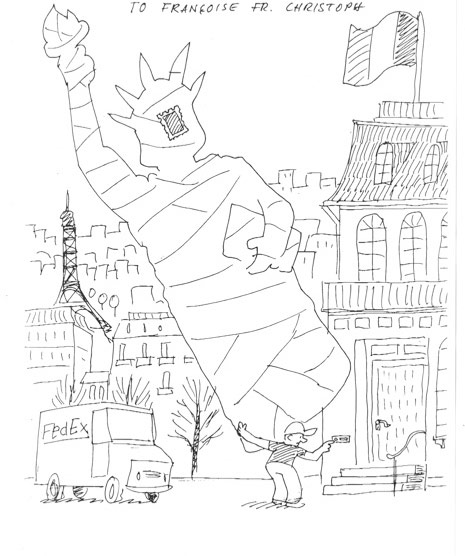
Blown Covers is a new book that details the illustrations that never made it to the front cover of the New Yorker. At Imprint, Michael Silverberg interviews Françoise Mouly, the book’s author and the New Yorker’s art editor since 1993, and shares some of best rejected covers. I like this one by Christoph Niemann showing the attempted return of the Statue of Liberty to France:
“Think of me as your priest,” she told one of them. Mouly, who cofounded the avant-garde comics anthology RAW with her husband, Art Spiegelman, asks the artists she works with — Barry Blitt, Christoph Niemann, Ana Juan, R. Crumb — not to hold back anything in their cover sketches. If that means the occasional pedophilia gag or Holocaust joke finds its way to her desk, she’s fine with that. Tasteless humor and failed setups are an essential part of the process. “Sometimes something is too provocative or too sexist or too racist,” Mouly says, “but it will inspire a line of thinking that will help develop an image that is publishable.”
Turns out that “real” buttermilk, aka the byproduct of making butter, hasn’t been common for almost a century…today it’s been almost entirely replaced by cultured buttermilk.
So how did that buttermilk, the original buttermilk, turn into the thick, sour, yogurty beverage I sampled at Threadgill’s? The confusion surrounding this drink dates back to the 18th century or before. Until the age of refrigeration, milk soured quickly in the kitchen, and most butter ended up being made from the slightly spoiled stuff. As a result, some historical sources use the word buttermilk in the Laura Ingalls Wilder sense, to describe the byproduct of butter-making; others use it to describe butter-making’s standard ingredient at the time-milk that had gone sour from sitting around too long. To make matters more confusing, the butter-byproduct kind of buttermilk could be either “sour,” if you started out with the off milk that was itself sometimes called buttermilk, or “sweet,” if you started out with fresh cream (like Laura’s mom did). So, prior to the 20th century, buttermilk could refer to at least three different categories of beverage: regular old milk that had gone sour; the sour byproduct of churning sour milk or cream into butter; and the “sweet” byproduct of churning fresh milk or cream into butter.
We occasionally get the real stuff for making the world’s best pancakes and it definitely makes a difference.
Taxi Driver reimagineered to portray Travis Bickle as obsessed with Mickey Mouse.
(via waxy)
A group photograph of MGM’s stars and starlets under contract, taken for the studio’s 20th anniversary in 1943.
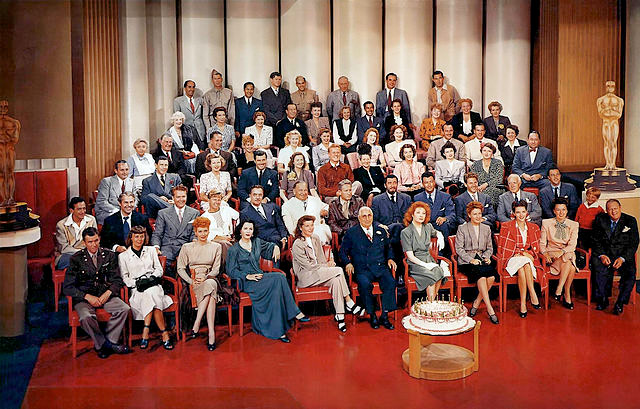
The full-size photo is available at Mlkshk or at Wikipedia for stargazing. Here’s who’s in the photo:
Front Row: James Stewart, Margaret Sullavan, Lucille Ball, Hedy Lamarr, Katharine Hepburn, Louis B Mayer, Greer Garson, Irene Dunne, Susan Peters, Ginny Simms, Lionel Barrymore
Second Row: Harry James, Brian Donlevy, Red Skelton, Mickey Rooney, William Powell, Wallace Beery, Spencer Tracy, Walter Pidgeon, Robert Taylor, Pierre Aumont, Lewis Stone, Gene Kelly, Jackie Jenkins
Third Row: Tommy Dorsey, George Murphy, Jean Rogers, James Craig, Donna Reed, Van Johnson, Fay Bainter, Marsha Hunt, Ruth Hussey, Marjorie Main, Robert Benchley
Fourth Row: Dame May Whitty, Reginald Owen, Keenan Wynn, Diana Lewis, Marilyn Maxwell, Esther Williams, Ann Richards, Marta Linden, Lee Bowman, Richard Carlson, Mary Astor
Fifth Row: Blanche Ring, Sara Haden, Fay Holden, Bert Lahr, Frances Gifford, June Allyson, Richard Whorf, Frances Rafferty, Spring Byington, Connie Gilchrist, Gladys Cooper
Sixth Row:
Ben Blue, Chill Wills, Keye Luke, Barry Nelson, Desi Arnaz, Henry O’Neill, Bob Crosby, Rags Ragland
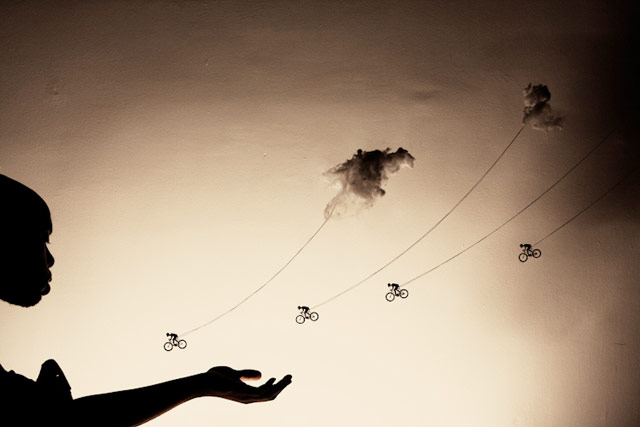
Not sure if these are straight photos or digital composites or whatever, but I like the images from Paul Octavious’ Puffin Clouds series.
(via @itscolossal)
A profile of Yvon Chouinard, the founder of Patagonia and an unlikely business guru.
Then he looked at everything Patagonia made, shipped or processed, and resolved to do it all more responsibly. He changed materials, switching in 1996 from conventional to organic cotton-despite the fact that it initially tripled his supply costs-because it was less harmful to the environment. He created fleece jackets made entirely from recycled soda bottles. He vowed to create products durable enough and timeless enough that people could replace them less often, reducing waste. He put “The Footprint Chronicles” up on Patagonia’s website, exhaustively cataloging the environmental damage done by his own company. He now takes responsibility for every item Patagonia has ever made — promising either to replace it if the customer is dissatisfied, repair it (for a reasonable fee), help resell it (Patagonia facilitates exchanges of used clothes on its website), or recycle it when at last it’s no longer wearable.
Posting this partially for my wife, who is a life-long Patagonia customer.
At McSweeney’s, John Peck whips up some bandwiches.
Bjork: Sliced narwhal, mustard, whole wheat bread.
Grateful Dead: Lemon verbena sorbet, peanut butter, clarified hemp butter, deep-fried brownie bites, M&Ms, stale focaccia.
Sex Pistols: Deep-fried Frank Sinatra LP, Russian mustard, spackle, tacks, stale rye bread.
John Cage: Silence, warmth, indirect sunlight, the memory of lettuce, the idea of bread.
The Jimi Hendrix Experience: Bacon-double cheeseburger, mescaline pesto, sourdough bread.
Lorena Galliot came to NYC from France and didn’t know what a hipster was. So she took to the streets of Williamsburg to find out.
(thx, phillip)
Having recently published a book about Paris, France, Rosecrans Baldwin visited a number of towns named Paris around the US to see how Americans perceive the French here in 2012. Here’s part one of his report.
The survey has eight questions ranging from general opinions to particular trivia. For example, “Whose side was France on during the American Revolutionary War?”
Sixty-six percent of respondents get it right: our side. Twenty percent are wrong. Incorrect answers include “the British,” “England,” “the opposite side,” and, oddly, “the French.” Other responses: “History was not my class in school — I hate it,” and “I am averse.” My favorite comes from a gas station attendant in Lexington, Ky., who writes: “I refuse to answer the rest of this survey. I love the French language. I have had many French friends.”
One guy in a parking lot outside a Dallas strip club says, “This has got to be a trick question.” And there’s another person, at Phoenix Sky Harbor International Airport, who will ask me, “You mean our American Revolutionary War?” Which appears to be a general concern — of the 55 people, at least 10 ask me to which American Revolution I am referring. Two people say, “But we didn’t have a revolution.”
The Morning News is serializing the other parts of this story all this month but you can get the whole thing right now on the Kindle.
From Food52, a round-up of ten different kinds of salt you might run across in recipes, including table salt, fleur de sel, and Himalayan salt.
Hand-mined from ancient sea salt deposits from the Khewra Salt Mine in Pakistan, Himalayan salt is rich in minerals and believed to be one of the purest salts available — hence its frequent use in spa treatments. It ranges in color from pure white to shades of pink and deep red. Hand cut into slabs, Himalayan salt is frequently used as a surface for serving food. Due to their ability to hold a specific temperature for an extended period of time, these slabs can be used for anything from serving cold ice cream to cooking fish, meats, and vegetables. Himalayan salt can also be used as a cooking or finishing salt. Or use it to rim the edge of a glass for a warm-weather cocktail.
Writing for New York magazine, Henry Blodget explains how a young startup founder and college dropout became the CEO of a soon-to-be $100 billion company.
When talking about Zuckerberg’s most valuable personality trait, a colleague jokingly invokes the famous Stanford marshmallow tests, in which researchers found a correlation between a young child’s ability to delay gratification — devour one treat right away, or wait and be rewarded with two — with high achievement later in life. If Zuckerberg had been one of the Stanford scientists’ subjects, the colleague jokes, Facebook would never have been created: He’d still be sitting in a room somewhere, not eating marshmallows.
Abraham Lincoln invented Facebook orig. from May 08, 2012
Yogurt gives mice bigger balls orig. from May 07, 2012
* Q: Wha? A: These previously published entries have been updated with new information in the last 24 hours. You can find past updates here.
[Ed note: read the update below…this is likely definitely a hoax.] Intrigued by a possible connection between PT Barnum and Abe Lincoln, Nate St. Pierre travelled to the Lincoln Museum in Springfield, IL. Once there, he stumbled upon something called The Springfield Gazette, a personal newspaper made by Lincoln that is eerily similar to Facebook.
The whole Springfield Gazette was one sheet of paper, and it was all about Lincoln. Only him. Other people only came into the document in conjunction with how he experienced life at that moment. If you look at the Gazette picture above, you can see his portrait in the upper left-hand corner. See how the column of text under him is cut off on the left side? Stupid scanned picture, I know, ugh. But just to the left of his picture, and above that column of text, is a little box. And in that box you see three things: his name, his address, and his profession (attorney).
The first column underneath his picture contains a bunch of short blurbs about what’s going on in his life at the moment - work he recently did, some books the family bought, and the new games his boys made up. In the next three columns he shares a quote he likes, two poems, and a short story about the Pilgrim Fathers. I don’t know where he got them, but they’re obviously copied from somewhere. In the last three columns he tells the story of his day at the circus and tiny little story about his current life on the prairie.
Put all that together on one page and tell me what it looks like to you. Profile picture. Personal information. Status updates. Copied and shared material. A few longer posts. Looks like something we see every day, doesn’t it?
Lincoln even tried to patent the idea.
Lincoln was requesting a patent for “The Gazette,” a system to “keep People aware of Others in the Town.” He laid out a plan where every town would have its own Gazette, named after the town itself. He listed the Springfield Gazette as his Visual Appendix, an example of the system he was talking about. Lincoln was proposing that each town build a centrally located collection of documents where “every Man may have his own page, where he might discuss his Family, his Work, and his Various Endeavors.”
He went on to propose that “each Man may decide if he shall make his page Available to the entire Town, or only to those with whom he has established Family or Friendship.” Evidently there was to be someone overseeing this collection of documents, and he would somehow know which pages anyone could look at, and which ones only certain people could see (it wasn’t quite clear in the application). Lincoln stated that these documents could be updated “at any time deemed Fit or Necessary,” so that anyone in town could know what was going on in their friends’ lives “without being Present in Body.”
Man, I hope this isn’t a hoax…it’s almost too perfect. Also, queue Jesse Eisenberg saying “Abe, if you had invented Facebook, you would have invented Facebook”. (via @gavinpurcell)
Update: Ok, I’m willing to call hoax on this one based on two things. 1) The first non-engraved photograph reproduced in a newspaper was in 1880, 35 years after the Springfield Gazette was alledgedly produced. 2) The Library of Congress says that the photograph pictured in the Gazette was taken in 1846 or 1847, a year or two after the publication date. That and the low-res “I couldn’t take proper photos of them” images pretty much convinces me.
Update: And the proof…the original Springfield Gazette sans Lincoln. (via @zempf)
On the Friday after Thanksgiving in 1962, George Wright and another man walked into a gas station in NJ with the intention of robbing its owner, Walter Patterson. After a scuffle, Wright’s associate shot Patterson, wounding him severely enough he would die two days later. Ten years later, after escaping from jail, Wright helped hijack an airplane with 86 passengers, ransomed the passengers for $1 million, flew to Algeria, and disappeared for 40 years. Last year he was arrested in Portugal.
This profile in GQ by Michael Finkel is sympathetic, but fascinating. Wright is described as a positive member of the community, a man rehabilitated, which is supposed to be the purpose of prison. And yet, he’s never paid for his crimes. If pressed, I’d have to say I agree with how it ended up playing out.
During my flight back from Portugal, I try to sort out how I feel about Wright. I’m troubled, of course, by the gas-station crime—even if it wasn’t his gun that fired, he still let an innocent man die. He never called for help. Still, he was a teenager at the time. You can no longer use youthful rashness as an excuse when you’re 29, brandishing a loaded weapon on an airplane and holding more than ninety people hostage. That incident could’ve easily ended in disaster. Wright is fortunate it did not. And I am not entirely sure there aren’t other crimes—crimes for which Wright wasn’t caught. He may still have secrets inside him. We’ll never know.
(via Long Reads)
Wooooo! The Hood Internet has just released the sixth installment of their Mixtape series. You can listen to the whole thing here:
or download it here. Their five previous Mixtapes are some of the most-played music in my collection…I’m listening to volume five right now actually.
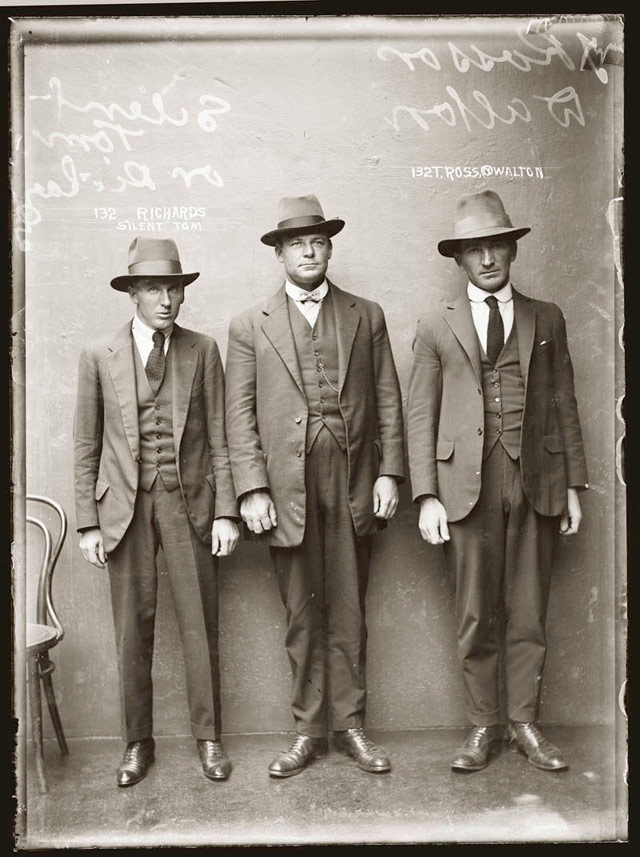
A collection of vintage mugshots from the 1920s. Crime used to be a lot more civilized.
(thx, david)
Matt Yglesias argues that because of the way copyright is viewed by the public and interpreted by lawmakers and the courts, making an album like The Beastie Boys’ Paul’s Boutique would be nearly impossible today.
The death on Friday of Adam Yauch, best known as the Beastie Boys’ MCA, surely sent many of us back to old albums we may not have heard for a while. And anyone who threw on Paul’s Boutique, the Boys’ best album, was surely struck by the sense that they don’t make records like that anymore. That’s not just because tastes and styles have changed. The entire album is based on lavish sampling of other recordings. “Shake Your Rump,” which leads Slate’s #MCATracks playlist, features samples of 14 songs by 12 separate artists. In all, the album is thought to have as many as 300 total samples. The sampling gave Paul’s Boutique a sound that remains almost as distinctive today as it was when it was released in 1989.
Perhaps the main reason-and certainly the saddest reason-that it still sounds distinctive is that a rapidly shifting legal and economic landscape made it essentially impossible to repeat.
If you watch to the end, Gabe Brooks bunny hops over a soccer goal. A small one, but still, how high is the highest soccer goal you’ve ever bunny hopped over?
Remember the Ice T line, “So much cash gotta keep it in Hefty bags?” These Florida brothers, illicit pill mill operators the both of them, had so much cash they had to keep it in Hefty bags, yes, but they also had so much cash they burned the $1 bills as punishment for not being $5, $10, or $20 bills. Business tip: If you have so much money you are literally burning cash, you need to take another look at operations. Chris and Jeff George are now in jail after their prescription pill empire was shut down by prosecutors.
The cash piled up despite the brothers’ free-spending ways. Jeff George bought a monster truck, multiple Lamborghinis and a Mercedes Saks 5th Avenue Edition. There were only five of those cars made, and George liked his so much that when he totaled it, he bought himself another, according to a friend.Jeff George assembled a small navy, including a 36-foot racing vessel, a 39-foot sports boat and two yachts, 38 and 55 feet in length. He also bought the shopping plaza housing his favorite strip club. The purchases were a convenient way to launder money, according to the indictment.
At the end of the article, it says the physicians associated with the Georges’ operation were among the top purchasers of oxycodone, and that their demise “played a major role in reversing both local and national trends of rapidly increasing painkiller abuse.” I would love to see numbers backing that, as well as the impact on pharmaceutical company profits.
(via @delfuego)
In a thoughtful piece, Jason Pontin discusses the evolving sense among magazine publishers that native apps might not be as amazing for them as originally thought. To my nose, there is the faintest whiff of sour grapes (really just a whiff), that readers did not respond as expected, and that Apple took a cut of sales. For the most part, though, the challenges illustrated in this piece are challenges faced by anyone trying to sell content. What’s the best way to use new technology to build and sustain an audience?
Pontin’s solution for now?
Last fall, we moved all the editorial in our apps, including the magazine, into a simple RSS feed in a river of news. We dumped the digital replica. Now we’re redesigning Technologyreview.com, which we made entirely free for use, and we’ll follow the Financial Times in using HTML5, so that a reader will see Web pages optimized for any device, whether a desktop or laptop computer, a tablet, or a smart phone. Then we’ll kill our apps, too.
In describing the costs associated with creating the app, Pontin uses the phrase, “untold expense of spirit,” which is just a gorgeous bit of writing.
In studying yogurt’s effects on obesity in mice, a team of MIT scientists discovered several unanticipated results. Basically, yogurt turned these mice into Kanye. Science is weird.

First, the scientists noticed that the yogurt-eating mice were incredibly shiny. Using both traditional histology techniques and cosmetic rating scales, the researchers showed that these animals had 10 times the active follicle density of other mice, resulting in luxuriantly silky fur.
Then the researchers spotted something particular about the males: they projected their testes outward, which endowed them with a certain “mouse swagger,” Erdman says. On measuring the males, they found that the testicles of the yogurt consumers were about 5 percent heavier than those of mice fed typical diets alone and around 15 percent heavier than those of junk-eating males.
More important, that masculinity pays off. In mating experiments, yogurt-eating males inseminated their partners faster and produced more offspring than control mice. Conversely, females that ate the yogurt diets gave birth to larger litters and weaned those pups with greater success. Reflecting on their unpublished results, Erdman and Alm think that the probiotic microbes in the yogurt help to make the animals leaner and healthier, which indirectly improves sexual machismo.
‘Mouse swagger’
Update: Illustration by Chris Piascik.
This 10 minute film charmed the hell out of me a couple weeks ago.
Throughout it’s its history, American Airlines has offered a variety of all-you-can-fly passes allowing unlimited first-class travel for life. Several people bought these passes, and actually used them, and when American started realizing how much the top users of AAirpass were costing the airline, American looked for ways to revoke the passes.
In one 25-day span this year, Joyce flew round trip to London 16 times, flights that would retail for more than $125,000. He didn’t pay a dime.In July 2004, for example, Rothstein flew 18 times, visiting Nova Scotia, New York, Miami, London, Los Angeles, Maine, Denver and Fort Lauderdale, Fla., some of them several times over. The complexity of such itineraries would stump most travelers; happily for AAirpass holders, American provided elite agents able to solve the toughest booking puzzles.
(via @mikeindustries)
I was away from the computer for most of yesterday, which is a good thing, because I don’t think I would have been able to handle people on Twitter even lightheartedly joking about MCA passing away yesterday. I don’t know if that happened, and I doubt I’ll go look for it. (PS, this is Aaron writing.)
My connection to the Beastie Boys hasn’t been as strong in the last…ten years or so, but before that, I cared about them as much as any band I’ve loved, I’m talking top 5 ever. My fandom path was out of order: Licensed to Ill to Check Your Head to Paul’s Boutique, because PB was over my head when it came out. I remember 7 of us leaving high school early, squeezing into one of those boxy Volvo sedans, to go to Newbury Comics to buy Ill Communication. The 7 of us each buying our own CD. I remember being in charge of getting tickets for friends to the Beastie Boys/Roots show in Worcester in 10th Grade, not getting a ticket for Ally, and Ally not speaking to me for 2 full years. I remember sitting up in the stands for that show until pretty much everyone jumped down onto the floor past the helpless guards. I remember being super angry at a friend whose puppy bit a hole in my Check Yo Head shirt in 8th grade, thinking I wouldn’t be able to wear it anymore. I remember this shirt being my first tshirt ever to fall apart, to literally wear out, from being worn too much 15 years later.
The thing that always fascinated me about the Beastie Boys was their transformation from punk rockers to party rappers to the less easily described, but amazing, place where they ended up.
Here are some other remembrances from around the web:
-A very good Sasha Frere-Jones in the New Yorker:
And this is the Yauch people remember: a man who could say he was sorry and not feel lessened by it; a man living within the principles of Buddhism and committed to broadening awareness of the political situation in Tibet; and a genuinely quiet person who had become more likely to make a joke at his own expense than anyone else’s. Yauch’s is one of the voices that can signify hip-hop within three syllables—rough, low, and strained. He got a lot done with that voice.
Yauch was the leader. A small part of that was aesthetics; the premature graying hair, the permanent rasp. But it was also evident that the morality tale of the Beastie Boys — three genius New York City smartasses who grew out of Budweiser-crushing caricatures into three endlessly curious, wholeheartedly decent adults — was best represented by Yauch.
-The obituary on BeastieBoys.com does a good job rounding up the Beasties myriad credits:
With fellow members Michael “Mike D” Diamond and Adam “Adrock” Horovitz, Beastie Boys would go on to sell over 40 million records, release four #1 albums-including the first hip hop album ever to top the Billboard 200, the band’s 1986 debut full length, Licensed To Ill-win three Grammys, and the MTV Video Vanguard Lifetime Achievement award. Last month Beastie Boys were inducted into the Rock & Roll Hall of Fame, with Diamond and Horovitz reading an acceptance speech on behalf of Yauch, who was unable to attend.
-Molly Ringwald: “Being on tour with the Beastie Boys & Run DMC in the 80s. Guys were all stand-up gentlemen, tho I’m sure they feared I was the band’s Yoko.”
-MCA in a 2008 interview about his film company, Oscilloscope Pictures: “Yeah, I could see doing this for a long time.”
-All of Twitter’s trending topics were Beastie Boys related for a time yesterday.
-From a good round up of musicians responding to the news, Chuck D:
Last night, I took a 14 hour flight to Sydney, Australia from LA, embarking on PE’s 80th tour in 25 years. I just landed to 65 texts with the news. Adam and the Boys put us on out first tour 25 years and 79 tours ago. They were essential to our beginning, middle and today. Adam especially was unbelievable in our support from then ‘til now, even allowing me to induct them into the Rock and Roll Hall of Fame. I consider myself a strong man and my father says be prepared to lose many in your post-50 path of life. Still, I’m a bit teary-eyed leaving this plane.
-Plus Andrew WK, “MCA PARTY HARD FOREVER.” and Ghostface Killah, “My condolences to Adam “MCA” Yauch Family & the Beastie Boys. My brothers & I felt that pain before as well. Sad Day.”
-170 Beastie Boys references explained.
-A memory from David Jacobs:
I drove a lot of famous musicians and speakers to & from the Cleveland airport over my college career, but I literally lost my head driving Adam Yauch down 480 back to Oberlin. The rented minivan we were driving was swerving in traffic so much that Adam reached from the back seat and put his hands on my shoulders: “It’s OK! Drive man, drive!”
-Anil Dash, “One of the most profound things the Beasties and MCA did was show us how people can evolve, from silly boys to serious artists.”
The Beastie Boys were kind enough to spread the love to us on their second go round in 95. (86?s license to ill was brilliant albeit perceived novelty masterpiece, their followups 89?s paul’s boutique & 91?s check your head were necessary sacrifice/build destroy exercises that RARELY work in entertainment (they traded in quick fast teen bop stardom in for rebuilding a credible fan base that would prove loyal til the very end). so once again they defied the odds in 94 with ill communication and wound up back where they started from: Stadiums.
This could go on and on, but this is what I read this morning, via most of the folks I follow on Stellar.
This looks like an interesting new book from Taschen, Information Graphics (buy at Amazon).
Our everyday lives are filled with a massive flow of information that we must interpret in order to understand the world we live in. Considering this complex variety of data floating around us, sometimes the best — or even only — way to communicate is visually. This unique book presents a fascinating historical perspective on the subject, highlighting the work of the masters of the profession who have created a number of breakthroughs that have changed the way we communicate. Information Graphics has been conceived and designed not just for designers or graphics professionals, but for anyone interested in the history and practice of communicating visually.
The in-depth introductory section, illustrated with over 60 images (each accompanied by an explanatory caption), features essays by Sandra Rendgen, Paolo Ciuccarelli, Richard Saul Wurman, and Simon Rogers; looking back all the way to primitive cave paintings as a means of communication, this introductory section gives readers an excellent overview of the subject. The second part of the book is entirely dedicated to contemporary works by the current most renowned professionals, presenting 200 graphics projects, with over 400 examples — each with a fact sheet and an explanation of methods and objectives — divided into chapters by the subjects Location, Time, Category, and Hierarchy.


Socials & More