littleBits are tiny circuitboards that you can stick together with magnets to make little electronic machines.
Just as Legos allow you to create complex structures with very little engineering knowledge, littleBits are simple, intuitive, space-sensitive blocks that make prototyping with sophisticated electronics a matter of snapping small magnets together. With a growing number of available modules, littleBits aims to move electronics from late stages of the design process to its earliest ones, and from the hands of experts, to those of artists, makers and designers.
The Baseball Card Movie is a nice nine-minute film that introduces the viewer to a world where adults pay up to $500 for a pack of cards (aka cardboard crack) and act very superstitiously about opening them.
He once made it a practice to buy his own autographed baseball cards on eBay; when asked why he bought them at auction for high prices rather than acquiring unsigned cards and signing them himself, Zito replied, “Because they’re authenticated.”
Possibly apocryphal but Zito would likely have a difficult time selling self-signed cards because they’re not authenticated.
Noodling is the practice of catching catfish by letting them latch onto your arm.
To begin, a noodler goes underwater to depths ranging from only a few feet to up to twenty feet, placing his hand inside a discovered catfish hole. If all goes as planned, the catfish will swim forward and latch onto the fisherman’s hand, usually as a defensive maneuver in order to try to escape the hole. If the fish is particularly large, the noodler can hook the head around its gills.
This video captures some noodling fishermen in action.
There have been many funny product reviews posted at Amazon — perhaps the first was John E. Fracisco’s 2000 review of The Story About Ping — but these reviews of a gallon of whole milk are funn…no, wait, I laughed so hard at the reviews that milk came squirting out my nose. (How’s *that* for layered narrative! Bam!)
Option 1: Two tickets to Tuesday night, June 30, Mariners at Yanks, cost for just the tickets, $5,000.
Option 2: Two round-trip airline tickets to Seattle, Friday, Aug. 14, return Sunday the 16th, rental car for three days, two-night double occupancy stay in four-star hotel, two top tickets to both the Saturday and Sunday Yanks-Mariners games, two best-restaurant-in-town dinners for two. Total cost, $2,800. Plus-frequent flyer miles.
We are continuously crossing the best trading rats with each other in order to breed specialists in various markets for our clients. The second generation of top traders usually shows a much better performance compared to their parents.
Right now, the top trading rats are advising long positions on Exxon, UBS, and Caterpillar.
From primitive animists to the legends of the first gods, battling like irrational cloud-inhabiting humans over the cosmos, Wright tells the story of how war and trade, technology and human interaction slowly exposed humans to the gods of others. How this awareness led to the Jewish innovation of a hidden and universal God, how the cosmopolitan early Christians, in order to market their doctrines more successfully, universalised and sanitised this Jewish God in turn, and how Islam equally included a civilising universalism despite its doctrinal rigidity and founding violence.
For all the advances and wonders of our global era, Christians, Jews, and Muslims seem ever more locked in mortal combat. But history suggests a happier outcome for the Peoples of the Book. As technological evolution has brought communities, nations, and faiths into closer contact, it is the prophets of tolerance and love that have prospered, along with the religions they represent. Is globalization, in fact, God’s will?
I loved two of Wright’s previous books, The Moral Animal and especially Nonzero. (via marginal revolution)
Dan Baum was a staff writer for The New Yorker for a time. In 2007, the magazine didn’t renew his contract and he’s currently explaining why (from his perspective) on Twitter (archived here). It’s maddening to read the whole story 140 characters at a time but it’s pretty interesting inside-baseball stuff, where baseball = professional writing. Here are some of the highlights so far (he’s not quite done yet).
First, a little about the job of New Yorker staff writer. “Staff writer” is a bit of a misnomer, as you’re not an employee, but rather a contractor. So there’s no health insurance, no 401K, and most of all, no guarantee of a job beyond one year. My gig was a straight dollars-for-words arrangement: 30,000 words a year for $90,000. And the contract was year-to-year. Every September, I was up for review. Turns out, all New Yorker writers work this way, even the bigfeet. It’s Just the way the New Yorker chooses to behave. It shows no loyalty to its writers, yet expects full fealty in return. It gets away with it, because writing for the New Yorker is the ne plus ultra of journalism gigs. Like everybody, I loved it.
Some early advice from his editor on how to structure a story:
“Think about trying a process story,” he said, using a term I’d never heard. “It’s a New Yorker standard,” he went on. “You simply deconstruct a process for the reader. John McPhee was the master. It makes for a simple structure.”
More editorial advice:
Great piece of New Yorker advice: “This is the New Yorker, so you can use any narrative structure you like,” he said. “Just know that when I get it, I’m going to take it apart and make it all chronological.” Telling a story in strict chronological order turned out to be a fabulous discipline. It made the story easy to write, and may be why New Yorker stories are so easy to read. Of course, the magazine does run everything through the deflavorizer, following Samuel Johnson’s immortal advice: “Read what you have written, and when you come across a passage you think is particularly fine, strike it out.”
On the magazine’s legendary fact-checkers:
The editing is as superb as you’d imagine. And it’s lovely to have all the time and resources you need. I particularly liked the fact-checkers, who go way beyond getting names spelled right and actually do a lot of reporting. More than once, the fact-checkers uncovered information I hadn’t had, found crucial sources I hadn’t interviewed. It’s like having a team of back-up reporters.
Non-fiction frequently calls for a strong individual voice, and occasionally the use of the first person, so double bylines often aren’t practical. Dan most often does the legwork of reporting the story — the travel and the phone calls — with Margaret acting as bureau chief: “Ask this.” “Don’t forget that.” “Go back to him tomorrow.” Dan then writes the first draft.
On second thought, perhaps it’s not that unconventional at all. Since Meg and I started going out nine years ago, we’ve collaborated on several projects without shared credit; I provided much advice related to Blogger, Kinja, and Megnut and she’s always operating behind the scenes here at kottke.org.
Reading two-week-old 13-page New Yorker articles about Rwanda probably isn’t your favorite thing to do, but if you’re a subscriber, I’d urge you to check out Philip Gourevitch’s fascinating article about what’s been happening in Rwanda in the fifteen years since the genocide. It’s a complicated situation (boldface mine):
On the fifteenth anniversary of the genocide, Rwanda is one of the safest and most orderly countries in Africa. Since 1994, per-capita gross domestic prduct has nearly tripled, even as the population has increased by nearly twenty-five per cent, to more than ten million. There is national health insurance, and a steadily improving education system. […] Most of the prisoners accused or convicted of genocide have been released. The death penalty has been abolished. And Rwanda is the only nation where hundred of thousands of people who took part in mass murder live intermingled at every level of society with the families of their victims.
Like I said, complicated. This is the best thing I’ve read in the New Yorker in a long while.
Update: As We Forgive is a documentary film about the Rwandan reconciliation.
Can survivors truly forgive the killers who destroyed their families? Can the government expect this from its people? And can the church, which failed at moral leadership during the genocide, fit into the process of reconciliation today? In As We Forgive, director Laura Waters Hinson and narrator Mia Farrow explore these topics through the lives of four neighbors once caught in opposite tides of a genocidal bloodbath, and their extraordinary journey from death to life through forgiveness.
McQuarrie says only after finishing the film and preparing to do press interviews about it did he and Singer realize they both had completely different conceptions about the plot.
“I pulled Bryan aside the night before press began and I said, ‘We need to get our stories straight because people are starting to ask what happened and what didn’t,’ ” recalls McQuarrie. “And we got into the biggest argument we’ve ever had in our lives.”
He continues: “One of us believed that the story was all lies, peppered with little bits of the truth. And the other one believed it was all true, peppered with tiny, little lies. … We each thought we were making a movie that was completely different from what the other one thought.”
I always assumed that Verbal was telling the truth the whole time, in the cavalier the-truth-can’t-hurt-me manner of the movie master criminal. (thx, dave)
[1] What’s the statute of limitations on spoiler warnings? The Usual Suspects is fourteen years old; surely everyone who wanted to see it has seen it by now. ↩
Live on NASA TV right now: the launch of the Space Shuttle Atlantis, tasked to repair the Hubble telescope. Looks like if the weather holds, lift-off is around 2:01pm. (via @noahkalina)
Punch-Out is coming to the Wii (@ Amazon)…the teaser commercial features Isiah Whitlock, Jr., who played Clay Davis on The Wire, as Little Mac’s trainer. It’s worth watching to hear Whitlock’s comparison of comebacks and yo-yos. (thx, rob)
Woody Allen + Larry David + the process for making a feature-length film - all but about 2 minutes of the footage = the trailer for Whatever Works.
An eccentric New Yorker played by Larry David abandons his upper class life to lead a more bohemian existence. He meets a young girl from the south and her family and no two people seem to get along in the entanglements that follow. This is a comedy also starring Ed Begley Jr., Patricia Clarkson, Conleth Hill, Michael McKean, Evan Rachel Wood, and a number of other amusing types.
[Note: spoilers.] Bones did it for me. As soon as he sat down next to Kirk on the shuttle, I was hooked. Loved Star Trek, wanted to go again as soon we got out.
J.J. Abrams did something kinda crazy with the film though. He took the entire Star Trek canon and tossed it out the window. Because of the whole time travel thing, the events that occurred in The Original Series, The Next Generation, Voyager, DS9, and the previous 10 movies will not happen. Which means that in terms of sequels to this film, the slate is pretty much clean for Abrams or whomever he passes it off to.
Well. Almost. Events in this alternate timeline unfold differently but the same. Even though the USS Kelvin was destroyed with Kirk’s father aboard, Kirk and the rest of the gang somehow all still end up on the Enterprise. But the destruction of an entire planet and 6 billion people should have a somewhat larger effect going forward.
Also worth noting is how the time travel in Trek compares with that on Lost, a show Abrams co-created and currently executive produces. On Lost (so far), the universe is deterministic: no matter who travels when, not much changes. Time travel can affect little details here and there, but the big events unfold the same way each time and every character remembers events unfolding in the same way, no matter when they are on the timeline. Star Trek’s universe is not that way; characters before time travel events remember events unfolding differently. According to the older Spock, the Romulan ship going back in time changed things. Kirk knew his dad, Vulcan wasn’t sucked into a black hole, etc.
And yeah, we do hear ships whoosh as they go to warp and all that, but that’s what we expect to hear, having evolved in an atmosphere which whooshes when things fly past us. I’d prefer that we hear nothing, but I accept that as a filmmaker’s prerogative to make the audience comfortable.
But I’ll add that for years I have complained about sounds in space, saying that done correctly, making things silent can add drama. That sentiment was proven here; the sudden silence as we leave the ship and fly into space with the doomed crewmember is really eerie and unsettling.
“Star Trek” was an early manifestation of our contemporary absorption with the pop culture of the past. The show’s creator, Gene Roddenberry, was a gifted hack writer for TV Westerns like “Have Gun, Will Travel” and cop shows like “Highway Patrol,” and “Star Trek,” though set in a nominally stylized future, was essentially a Western cop show. In fact, Roddenberry pitched the series to NBC as “Wagon Train” to the stars; and, as Captain Kirk noted in his log, the ship would venture out on “patrol,” cruising the galaxy like a city beat.
According to Doble, you can haggle pretty much anywhere — from Macy’s to Kmart to your local supermarket — but, he suggests, your best bets are hotel rooms, bulk purchases, big-ticket items, anything marked down or damaged, floor models, used items or open packages. In those situations, says Doble, “It’s almost crazy not to bargain.” After all, merely asking for a better price — on, say, an appliance — can save you hundreds of dollars.
3. The Usual Suspects. Considered the best twist ending by many people, it was hard to put this so far down at #3. I’ve seen a couple people put this crime thriller starring Kevin Spacey on “Worst Twist Endings” lists, but those people are just idiots wanting to sound smarter and more sophisticated than everyone else.
I honestly didn’t think my head would fit into it. But it did, and now I can’t get it out. In addition to my extensive knowledge of the ancient Near East, I am blessed with a near-inexplicable touch-typing ability, so, if you will, picture me sitting at the computer with a pot on my head that dates from roughly the time when the Hittites invented iron-forged weapons. Or, to put it in more familiar terms, the pot on my head was about 400 years old when Troy was sacked.
The result, after much whacking, is, I think, compelling, but you’ll have to see for yourself. The general idea it that the history of subway ridership tells a story about the history of a neighborhood that is much richer than the overall trend. An example, below, shows the wild comeback of inner Williamsburg, and how the growth decays at each successive stop away from Manhattan on the L train.
Science fiction often holds a mirror up to contemporary culture, critiquing its practices, politics, and mores. So, too, with Romulan ale. Because of the United Federation of Planets’ standoff with the Romulan Empire, the drink is illegal within the Federation — much like Cuban cigars are in the U.S. But like the captains of industry of today, captains of starships indulge in this vice.
Oddly, my only complaint is that (somehow) his piece isn’t long enough. Adam, you didn’t even get in to “Tea. Earl Grey. Hot.” (thx, alaina)
The most common reason for bad lecturing isn’t phobia; it’s that professors don’t value the craft enough to hone their skills. Use such individuals as negative role models. Think of the most boring lecturer you’ve ever encountered. Do the opposite!
Made of This is a three part series from The Economist’s More Intelligent Life magazine in which people are asked about early memories that shaped the rest of their lives. Part one, part two, part three.
I must have been around seven or eight. My mother, a dancer, was — and is — very bright. And I very clearly remember her saying: “What you see as red is not necessarily what I see as red.” I of course said: “But red is the colour of a cherry and tomatoes.” And she said, “Yes, but you don’t know what I’m experiencing when I look at a cherry or tomatoes.” It immediately fascinated me, that things weren’t obvious. It was really exciting.
This is perhaps what the world would look like if human vision could perceive all of an object’s possible quantum mechanical states at the same time. (via today and tomorrow)
It may be subtle, but it’s the kind of thing that reduces the overall apparent quality of your work, the stuff that marks out your work as being standard (read: mediocre) or exceptional. If you feel you shouldn’t get precious about such things, perhaps graphic design isn’t your thing.
Free running is like parkour except that the former is more expressive than the latter. Whereas parkour is the efficient movement through space, free running adds acrobatic flair for aesthetic purposes. One of the more talented practictioners of free running is Levi Meeuwenberg; here’s a demo reel he made of his stunts.
However, by bending and rolling, the time of impact can be increased to as much as 0.3 or 0.4 seconds. By decreasing his velocity over this extended period of time, the force is substantially reduced. Applying the above calculation with an acceleration time of 0.4 seconds we now get Fground = 2000 N (460 pounds). It’s still a significant force but as you can see in the video quite manageable for someone with the proper skill, strength and technique.
The 8-Bit Fatalities project presents the abstract killing in pixelated video games (Pac-Man eating the ghosts, Dig Dug blowing up his enemies) as realistic illustrations.
Despite the title of this list, several of these housing projects were designed by some of the world’s most famous architects and lauded at the time. The undeniable squalor of 19th Century slums combined with modernism to produce and attempt to clean things up and create a crystalline utopia. The end result was often an anti-septic vision of hell, a place devoid of organic spaces and evolved social interaction.
1. Make your boss aware of all your recent accomplishments at work.
2. Butter up your boss with compliments.
3. Tell your boss you’d be willing to accept a pay cut to keep your job.
During a discussion with friends the other day, someone wondered, “Who doesn’t like The Wire?” The show is easily one of a handful of shows considered the best ever and even those who feel that The Wire is overrated still don’t dislike it. But someone’s gotta hate it, right?
In the spirit of Cynical-C’s excellent You Can’t Please Everyone series, I went to Amazon and looked for bad reviews of The Wire season one DVD. There were six one-star reviews and four two-star reviews (versus 190 five-star reviews). Three of those were customer service complaints and one read like a five-star review that was accidentially mis-rated; here are parts of the remaining reviews:
I have watched 6 episodes of Season 1 and have desperately tried to get into The Wire. Despite the hype, and all the trendies saying what a mahhvellous show it is, actually it is pretty dull. Boring characters, little conflict, confusing scripts, same stuff repeated ad nauseam. Frankly, the lives of petty drug dealers in Baltimore don’t do it for me, and not do the cops who are a pretty unattractive bunch with few dramatic qualities. I know that Prison Break was appallingly acted but at least it had a story line. The Wire is like an improvisation at one of those let it all hang out stage schools which never produces particularly great actors.
I had 1000’s of hours of viewing movies, television series, and television programming behind me before I sat down to watch this series on DVD, season one, the box in my hand. I was very dissapointed. This series stinks. I watched only episode 1, and have the experience and perception to know that it won’t get any better. […] If watching cheap white trash and cheap black trash destroy themselves and probably each other interests you, this is for you. I have a better way to spend my evenings. I experience enough negativity in the world on a daily basis, that I don’t have to put it in my dvd player after dinner for it to “entertain” me.
I really disliked this show, i watched the entire first season in two days, i only did so because i was waiting for it to become interesting. After so many glowing reviews, i could not belive how just plain awful this show turned out to be. I would rather watch reruns of Barney Miller, you get the same effect of watching the Wire except with slightly more enjoyment. I know it’s not The Shield and it’s not supposed to be but i implore you to purchase that series if you want to enjoy a television experience.
I got the Wire because I thought I was missing the boat on ‘the best show on TV’. Well…I must be missing something because after watching 5 episodes I don’t get it. I kept thinking it was going to get better..not that it was bad…it just wasn’t that interesting. The only reason I kept watching was to see Idris Elba who plays Stringer Bell cause he is a cutie!
Perhaps it is in the office where the show falters the most, sometimes having camera shots zoom in on a person for three seconds at a time while they are thinking about nothing. Then there is the whole thing with the detective using a typewriter. Okay, did I miss something? Is this 2008 or 1978 people?? High Profile crime unit using typewriters, sure I buy it and a bag of that counterfeit money they had in the first episode.
I tried it sober; perhaps I should have tried it drunk. Ham acting, cliched backdrops (pole-dancing was an idea already on its last legs before The Sopranos ran it into the ground) and dialogue which may possibly be realistic but certainly is dull. I labored manfully through the whole first episode. I shall not torment myself with a second.
If Barney Miller is more your speed, season one of that show is also available on Amazon with reviews almost as good as The Wire’s.
No, wait: The most amazing thing is that I have often gone into B&H to purchase a specific product, only to be talked into something cheaper. For example, once I went in to buy a field video monitor to use for some interviews I was conducting. I expected to pay $600 until the salesperson said, “Why don’t you just get one of these cheap consumer portable DVD players? They have video inputs, they work just as well, and they’re under $100.” This was no accident. “The entire premise of our store is based upon your ability to come in, touch, feel, experiment, ask, and discuss your needs without sales pressure,” B&H’s website says.
Re: Circuit City, I’d wager that many of the businesses that have gone under so far have not done so because of the poor economy but because they were poor or unsustainable businesses. (via @anildash)
The trailer for District 9 looks interesting. I particularly like the way the alien’s face is pixelated out in the interview, both for privacy in the world of the film and to not spoil the reveal for movie goers.
Amazon indeed announces a Kindle with a larger screen: the Kindle DX. Available for pre-order now for $490, release date is sometime this summer.
Update: During the press event announcing the new device, Jeff Bezos said that for books that have Kindle editions, the Kindle version accounts for 35% of the sales. 35%!! Also, Merlin Mann would like you to know that if you buy a Kindle through the above link (this link right here, if you’re confused), I get a little money from Amazon. Although I’m not even sure how Merlin can tell what’s going on way down here from so far up on his horse.
The crime rate today is equal to what it was back in 1970. In the ’70s and ’80s, crime was climbing. It peaked around 1993, and since then it’s been going down. If you were a child in the ’70s or the ’80s and were allowed to go visit your friend down the block, or ride your bike to the library, or play in the park without your parents accompanying you, your children are no less safe than you were. But it feels so completely different, and we’re told that it’s completely different, and frankly, when I tell people that it’s the same, nobody believes me. We’re living in really safe times, and it’s hard to believe.
I can’t remember where I heard this little story recently but the gist is that a family originally from somewhere in Africa but now living in the United States went back home for a visit. In this particular country, the kids all leave the house at 6am and don’t return until dinnertime. They get up, pack a lunch, and they’re just gone. And the kid from the family living in the US didn’t do this…he couldn’t really do much without his parents and hung around them the whole time, which the other kids thought was weird.
This chart plots time spent eating per day vs. the national obesity rate for several developed nations. If you’d asked me what the chart might look like before I viewed it, I would not have guessed that higher obesity rates correlate with shorter eating times. The US has the highest national obesity rate on the chart and are the third fastest eaters.
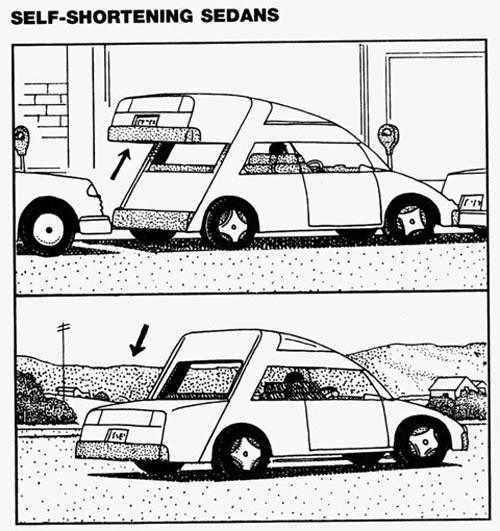
In Johnson’s oeuvre, nothing gets to exist if it doesn’t have at least two functions: the skylight uses solar energy to cook the dinner, for instance, and the exercise bike operates the washing machine (cleaning clothes and toning the wearer’s muscles simultaneously).
Johnson’s other inventions include the Nod Office, Toilets for Immodest Times, self-shortening cars, and the Bike Vest.
“I just don’t know what to do,” Carmichael says to the camera. “No way of communicating with anyone. No way of making water.” His voice rises with resentment. “I have no water! That’s it. I have no water. If you don’t have water, you don’t have life.”
The two comments following the story are also interesting. One is from a member of a Canadian team who broke the speed record a few days after Carmichael’s attempt ended.
At the New Yorker Summit, Google’s Dan Reicher mentioned the company’s PowerMeter, an upcoming product/service that will measure household power use.
Google PowerMeter, now in prototype, will receive information from utility smart meters and energy management devices and provide anyone who signs up access to her home electricity consumption right on her iGoogle homepage. The graph below shows how someone could use this information to figure out how much energy is used by different household activites.
The behavioral sociology of measuring energy usage is simple: the more you know about how much energy you’re using, the less you use. Just getting the information cuts most people’s energy usage by somewhere between 5% and 15%, while people with high electricity bills (like me) find it much easier to isolate exactly what is causing those bills and can then work out how best to reduce them through upgrading appliances or replacing incandescent bulbs with CFLs or any number of other routes to energy efficiency.
I’ve been to quite a few conferences and almost without exception, the best speakers and presenters are people who are actually doing things in the trenches…not the folks who write books about them. The engaging and whip smart Geoffrey Canada outlined the four factors he uses to achieve success with his organization in educating kids in Harlem.
1. We have to tackle everything at the same time. Small programs touching unconnected parts of kids lives aren’t that effective.
2. They start working with kids from birth and stay with them until they graduate from college. If they don’t let them get behind, later superhero-type interventions (which don’t often work) are not needed.
3. Scale is important. If you work with lots of kids, their collective action reinforces itself with little further effort.
4. Accountability and evaluation is needed. Canada said that if bad teachers aren’t teaching the kids, they should be fired.
Canada also cautioned about complacency in business. He said that businesses, left to their own devices, find comfortable resting places without periodically refreshing their values and goals.
The big themes of the day so far are confidence and experts: should we and do we have confidence in the experts? Malcolm Gladwell kicked off the morning with a talk about overconfidence. He talked about the three types of failure possible in a situation like the financial crisis:
1. Institutional failure. The regulators and regulations were not sufficient.
2. Cognitive failure. The bankers weren’t smart enough and got in over their heads.
3. Psychological failure. The bankers were overconfident and failed to recognize the direness of their situation.
Gladwell argued that the financial crisis was caused largely by overconfidence, which has two key effects. One is that people become miscalibrated. They think that the predictions that they are making are actually a lot better than they are. Secondly, there’s an illusion of control problem in which people think they have control over things that are impossible to control. Fixing the situation will be hard because overconfidence is a useful trait to possess and experts are hard to purge from systems (they’re the experts!).
[Experts talking about how experts are wrong! My brain is seizing up.]
Next up were Nassim Taleb and Robert Shiller. Shiller believes that confidence drives the economy and that macroeconomics is flawed because there’s no humanity in it. Taleb was very quotable and the most full of doom of all the panelists so far. He doesn’t like economists. Like wants them gone from the world, or to at least marginalize their effects so that their opinions and decisions don’t affect the lives of normal people. In talking about why this crisis is different than similar situations in the past, he argued that globalization, the Internet, and the efficiency of global financial markets has created an environment where very large and very quick collective movements of money are possible in a way that wasn’t before. Taleb had the last word: “people who crashed the plane, you don’t give them a new plane”.
The panel moderated by Suroweicki was a little odd. Two out of the three panelists kept repeating in reference to the solution to the very complex financial crisis: “this isn’t that complicated”. There has also been a undercurrent to the discussion so far that the goal of any solution to the financial crisis is to get the economy back to where it was. I’m with Taleb on this one: where we were wasn’t very good, why do we want to go back.
With a new President in office, our country is in a period of immense challenges, from unprecedented economic tumult to a worldwide environmental crisis. With more at stake than at any time in recent memory, we are compelled to put forward new solutions and new thinking. In this spirit, The New Yorker Summit: The Next 100 Days will gather economic heavyweights and national-policy voices to look at the formative days of the new Administration, and to explore what lies ahead in the next hundred days.
Unless you’re an especially careful reader of kottke.org, you probably don’t realize that I update old posts on a regular basis with material (mostly) contributed by readers. Here are several recent examples:
But they’re a pain in the ass to read…and you have to scroll down the front page looking for the boldface “Update:”. Updates also don’t show up in RSS properly. In order to make these valuable contributions more visible (and to encourage myself to update posts more often), I’ll be making a daily post to the site that collects these updates in one place. Expect to see them on the site and in the feed later in the week.
The mechanism itself has barely changed for a century: although some more recent models incorporate GPS and other technologies, the mechanical key-based watchclock system is still in wide usage, with many buildings still employing the same keys and the same clockwork devices they’ve used since the 1940s. It’s a genuine example of an “if it aint broke, don’t fix it” kind of technology.







Socials & More