



24-hour trip to NYC
A lovely and “surprisingly moving” video of a day in NYC, shot entirely on an iPhone. (via lonelysandwich)

This site is made possible by member support. 💞
Big thanks to Arcustech for hosting the site and offering amazing tech support.
When you buy through links on kottke.org, I may earn an affiliate commission. Thanks for supporting the site!
kottke.org. home of fine hypertext products since 1998.
Beloved by 86.47% of the web.
A lovely and “surprisingly moving” video of a day in NYC, shot entirely on an iPhone. (via lonelysandwich)
New for the 2008 NFL season: the NFL TV distribution maps that tell you which football games are going to be broadcast is which parts of the country. They’re using zoomable Google Maps this year…here’s what a typical coverage map looks like:
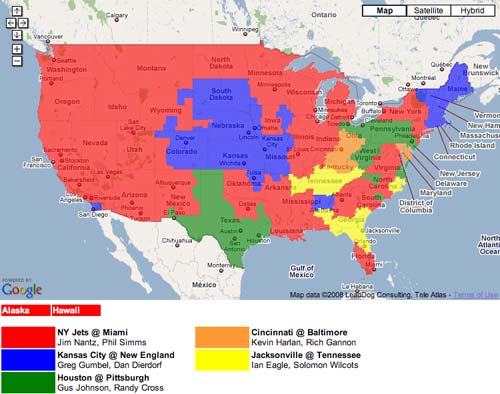
During football season in a TV market like NYC, which is dominated by coverage of two local teams (Giants and Jets), this is an essential tool for determining if you’re actually gonna get to watch the game you want to on Sunday.
Update: There’s an interview on Yahoo with the guy that runs the site, J.P. Kirby.
A profile of Alec Baldwin by Ian Parker for the New Yorker.
He recalled a day, a few years ago, when he was driving through L.A., saw a car run a red light, smash into another car, and keep moving. Baldwin gave chase and, eventually, blocked the culprit in a cul-de-sac. Before the police arrived, the driver got out of his car — “Typical drug-addict, alcoholic, fuckhead look on his face. He was, ‘O.K., what? What? You’re chasing me. What?’ This nineteen-year-old kid, his eyes blazing. I’m thinking, I’m going to come over there and knock your teeth down your fucking throat just because you’re asking me ‘What?’ You know what, you little fuck? I saw you. I’m a pretty liberal person, but my liberalness comes from what the government should be doing with its excess of wealth. That doesn’t mean I’m not a law-and-order person. I’m the kind of person — you catch the kid who’s drunk and high and he almost killed a girl, let’s take him in and beat the shit out of him for a couple of hours. Then he’ll learn.” He laughed. “I believe that!”
Things I have enjoyed Alec Baldwin in:
The Hunt for Red October
Glengarry Glen Ross
The Departed
The Royal Tenenbaums
The Aviator
But what firmly installs Baldwin onto my list of favorite actors of all time is his many Saturday Night Live appearances. Watching Schweddy Balls and Inside the Actors Studio (with Baldwin as Charles Nelson Reilly) still brings tears of howling laughter to my eyes. I gotta bump 30 Rock to the top of my viewing queue.
The Hidden Radio has no obvious controls…unless you count that the radio *is* the controls…it “has either no user interface…or…is all user interface”.

The volume is controlled by lifting the lid of the radio (which also reveals the speaker). Tuning is done by twisting the lid. Absurdly clever. (via monoscope)
Before the iPhone 3G came out in July, I did a quick price survey on the 1st generation iPhones being sold on eBay.
A quick search reveals that used & unlocked 8Gb iPhones are going for ~$400 and 16Gb for upwards of $500, with never-opened phones going for even more.
After the 3G came out, the prices on the old iPhone remained about the same.
I just checked eBay again and those prices are down only slightly. Never-opened unlocked iPhones are still fetching $400-500 and somewhat less for previously used phones.
BusinessWeek recently confirmed that those old phones are still selling well, demonstrating a lot of demand for iPhones that can be easily unlocked for use on networks besides AT&T in the US and elsewhere in the world.
On e-commerce site eBay, where NextWorth peddles many of its wares, a 16-GB version of the first-generation iPhone goes for about $600, and an 8-GB model in good condition commands $500. When it was new, the 16-GB phone sold for $499; the 8-GB model went for $399. Today, AT&T’s most expensive iPhone 3G model sells for $300 with a two-year service contract.
I just finished listening to this amazing episode of This American Life about two babies who were switched at birth and didn’t find out FOR MORE THAN FORTY YEARS even though one of the mothers knew all along.
On a summer day in 1951, two baby girls were born in a hospital in small-town Wisconsin. The infants were accidentally switched, and went home with the wrong families. One of the mothers realized the mistake but chose to keep quiet. Until the day, more than 40 years later, when she decided to tell both daughters what happened. How the truth changed two families’ lives — and how it didn’t.
The worst part about the whole thing is that the mother that knew, Mrs. Miller, always treated her non-biological daughter differently, like she wasn’t really a full part of the family. The Millers sound like awful people.
The R-rated trailer for Kevin Smith’s new film, Zack and Miri Make a Porno. Promising!
Michael Ruhlman has some photos of the Alinea book in the wild. Though possibly biased, he says it’s a beaut.
Grant and his partner Nick Kokonas, along with designer Martin Kastner and his wife, photographer Lara Kastner, wanted to do it on their own and so they have. Kastner, I believe a sculptor by trade, had never designed a book. His wife had never photographed a book, food or otherwise. Grant and Nick had never done a book either. And they were told by numerous publishers (in a nasally dismissive tone, Kokonas suggested) that they just didn’t have the skill or experience to do what they wanted to (“Gray pages?! You can’t do gray pages!” “You can’t sell a book like this at that price.”)
As mentioned in the post, the Alinea book is only $31.50 if you order through Amazon.
Don LaFontaine, the voice of countless movie trailers, is dead at 68. I liked this tribute from the Washington Post:
In a world of people who all have some sort of private omniscient voice-over running things inside their heads, sometimes God, sometimes Mom, and sometimes Don LaFontaine…
In a world where marketing is far more important than content…came one man…with a Voice.
Check out a brief bio video of LaFontaine with his voice in action.
Before European conquerers arrived, large areas of the Amazon River basin had been cleared away to make room for a network of towns and villages.
The findings raise big questions, says Susanna Hecht of the University of California in Los Angeles.
For starters, it forces a rethink of the long-held assumption that these parts of the Amazon were virtually empty before colonisation. What’s more, it shows that the large populations that did inhabit the region transformed the landscape.
“What we find is that what we think of as the primitive Amazon forest is not so primitive after all,” Heckenberger told New Scientist. “European colonialism wasted huge numbers of native peoples and cleared them off the land, so that the forest returned.”
I’m gonna plug 1491 again…the story above isn’t news to anyone who’s read this book, which argues that there was plenty going on in the New World before Columbus, et. al. arrived.
Footnotes, Endnotes, and Parentheticals That Cost Me Marks on My Thesis.
3 Who, although a gifted academic, is still a douche.
10. http://en.wikipedia.org/wiki/Jean-Paul_Sartre
Two t-shirts for those afflicted with seasonal affective disorder: s.a.d. t-shirt 01 and s.a.d. t-shirt 02. Both shirts feature inks that reveal hidden elements when worn in the sun or warm weather. (Psst, Hypercolor shirts are back and, yes, I’m a bit OMGWMCC about it. What, it’s not possible to buy your childhood back?) (Psst, oh my God, where’s my credit card?)
Update: For whatever reason, the site featuring those tshirts has been taken down. today and tomorrow grabbed some of the pics though.
The earliest of the three is a winged death’s head, with blank eyes and a grinning visage. Earlier versions are quite ornate, but as time passes, they become less elaborate. Sometime during the eighteenth century — the time varies according to location — the grim death’s head designs are replaced, more or less quickly, by winged cherubs. This design also goes through a gradual simplification of form with time. By the late 1700’s or early 1800’s, again depending on where you are observing, the cherubs are replaced by stones decorated with a willow tree overhanging a pedestaled urn.
Pay special attention to the graph of the popularity of each motif and the slideshow of example gravestones. (thx, peterme)
Update: A reader writes in:
In regards to your post on Gravestone Motif Analysis, I think that the most important text on the subject is still Graven Images: New England Stonecarving and its Symbols, 1650-1815 by Allen Ludwig. It was originally published in 1966, before the article that you linked to. However, Wesleyan University Press published a new edition in 2000 to help meet the rising demands of Material Culture Studies courses. Lots of helpful images and histograms showing the changing patterns of gravestones over that time period.
I *love* that the collective readership of this site knows what the definitive text on New England gravestone carving is. (big thx, fletcher)
A list of writing tips from Walter Benjamin.
Keep your pen aloof from inspiration, which it will then attract with magnetic power. The more circumspectly you delay writing down an idea, the more maturely developed it will be on surrendering itself. Speech conquers thought, but writing commands it.
I find that when I develop an idea for too long in my head, I forget most of it when I go to write it down. Once again proving that Walter Benjamin is a better man than I am.
In addition to being well-suited to web graphics, Silkscreen works equally well in cross-stitch.
I think this is a first (or a mistake): the entire issue of the latest New Yorker is available online for free. Usually they leave 5-7 articles offline so’s to get your cheap ass to the newsstand.
What if Google built something that was very much like a browser but was mainly used for searching for information. What if they built a tool that was focused on searching for answers to your questions first, and looking at web pages second. Wrap your head around that. You have search needs. You also have unique search patterns. You have ways of looking for information that are very interesting and personal. Where are the tools that help you search? You are probably thinking of search engines, like Google. But search engines are server based. Why not bring the power of the server to the desktop? There are some tools out there like this, but they aren’t complete. They also don’t have the usability and brand recognition of Google.
So, a Google browser, based on Mozilla. An easily-justified commitment to cross-platform support and outstanding user experience, based on Google’s history of honoring those tenets and the Mozilla organization’s inherent preference for them. Culturally, hiring the core members of the Mozilla dev team would be an extraordinarily easy fit. And, frankly, it’d probably require little more development resources, bandwidth, or staffing than the Pyra acquisition did.
Google could use their JavaScript expertise (in the form of Gmail ubercoder Chris Wetherell) to build Mozilla applications. Built-in blogging tools. Built-in Gmail tools. Built-in search tools. A search pane that watches what you’re browsing and suggests related pages and search queries or watches what you’re blogging and suggests related pages, news items, or emails you’ve written. Google Toolbar++. You get the idea.
All of us at Google spend much of our time working inside a browser. We search, chat, email and collaborate in a browser. And in our spare time, we shop, bank, read news and keep in touch with friends — all using a browser. Because we spend so much time online, we began seriously thinking about what kind of browser could exist if we started from scratch and built on the best elements out there. We realized that the web had evolved from mainly simple text pages to rich, interactive applications and that we needed to completely rethink the browser. What we really needed was not just a browser, but also a modern platform for web pages and applications, and that’s what we set out to build.
More on this tomorrow if motivation allows.

Socials & More