Entries for September 2008
The head IT guy for NYC is taking questions about the city’s 311 system over at the Times’ City Room blog. Here are his first set of answers. Here he talks about unusual calls they receive:
For a few examples of those we can’t … well, we’ve received calls from people wondering who won “American Idol,” or what the daily lottery numbers were. We’ve had people ask us why pets can’t be claimed on income tax returns, how many planets there are, and whether we can provide various out-of-state ZIP codes. My personal favorite is the call we received by someone asking how to boil a chicken.
T&A is not my usual schtick here, but I found these photos of brides in their underwear — most are pictured getting dressed for the ceremony — appealing for non-obvious reasons (the titillation factor here is almost zero unless you’re 12 years old). There’s something about the natural, unguarded informality of the preparation in comparison to the fussiness and solemnity of the ceremony itself…it makes the wedding part seem artificial. It’s also disturbing that all these intimate photos ended up online, likely without the consent of the undressed. Really NSFW.
Almost 4000 people have taken the best show on TV poll so now is a good time to take a look at the results. Here are the top five:
The Wire: 16%
The Simpsons: 8%
Seinfeld: 7%
Arrested Development: 7%
The West Wing: 6%
No other show got more than 4% of the total vote. As expected, The Wire topped the list1. Some notes:
- Arrested Development ranked 4th overall, way higher than I would have thought. People love this show more than the ratings and its duration (it was cancelled after 3 seasons) would indicate.
- The Sopranos was not in the top five. My feeling is that if this poll were conducted five years from now, it would rate higher…the influence this show has had on TV is only starting to be felt.
- Beavis and Butt-head beat out The Honeymooners for second-to-last place. Ralph and Alice deserve better.
- Shows I would have liked to see higher in the list: Deadwood, Sesame Street, The Sopranos.
- I love Seinfeld, but it was ranked too high. At 2%, Buffy got 2% more of the vote than I would have given it.
- Shows that some thought should be on the list: Law & Order (love the show but it defines formulaic TV), The Twilight Zone (perhaps), Doctor Who (again, love it, but nothing this cheesy can be the best show on TV), Sex and the City, Rome, Carnivale, Heroes, and The Mary Tyler Moore Show.
Thanks to everyone who voted.
[1] I got some emails saying that The Wire ranked first only because I talk about the show so much on the site. That was probably a factor, but it’s not like this is a Wire fan site or something. The poll wasn’t that scientific anyway. Run a similar poll on Perez Hilton and American Idol might have won. Or on a site that appeals to 50-somethings and some of the older shows on the list might have done better. All this poll really shows is what people who like the kinds of things I post about on kottke.org also like to watch on television. (This was also not, as someone suggested, an attempt to gather information about viewing habits for advertisers. Duh.) ↩
Ben Affleck’s status as a lightweight is hereby permanently suspended. This is a serious movie by a serious, thoughtful director. The film also fits into a theme that’s been developing around these parts lately related to switched identities: Switched at Birth, The Ghost of Bobby Dunbar, and Don Draper.
Meg bought Ollie this ball a couple of weeks ago. It’s got all the planets of the solar system on it, plus the Sun. But no Pluto. That’s right, it’s barely been two years since Pluto was demoted to dwarf planet status and the toy manufacturers have already made the adjustment.
It saddens me that Ollie has to grow up in a world where Pluto isn’t considered a planet, although I take comfort that his textbooks probably won’t be updated by the time he’s in school. In the meantime, I’ve Sharpied Pluto onto his ball.
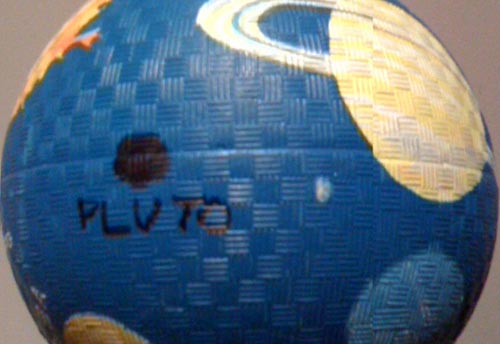
One ball at a time people, that’s how we win.
Winemaker Abe Schoener, instigator of the Scholium Project, sounds crazier than Sean Thackrey. Schoener says he makes wine by accident, through a process of trial and error, and is unapologetic about his less drinkable wines. When Eric Asimov wrote about his dislike of one of the Scholium Project’s wines, Schoener responded thusly:
“I am so sympathetic to your reaction to my wine,” he wrote. “I don’t think that you said anything unfair about it. It is a kind of behemoth.” He suggested that a roast chicken and a minimum of four people would make such a big wine more bearable.
Most winemakers tend to rival politicians in their efforts to stay on message and spin catastrophe into triumph, but Mr. Schoener freely and cheerfully discusses his failures, which made me receptive to his invitation to try some of his other wines. He makes 10 or so different wines each year, and a total of about 1,500 cases.
I had one of his wines at dinner a few months ago; it was really good. The wine shop around the corner from us sells a bunch of his stuff…time to go pick some up, I think.
London’s School of Life bills itself as “a place where you can try out a variety of cultural solutions to everyday ailments”. They offer schooling, travel holidays, bibliotherapy, expert sermons, and conversational meals.
We offer courses about the big issues of life — love, politics, work, family, play. The courses have been devised by leading authors, artists, actors and academics. They combine the experiences of a remarkable faculty with insights from great thinkers of the past, to offer you intelligent and playful ways to interpret the world, and your place within it.
Seems a bit like a secular church…all the fellowship with none of the gee-oh-dee. Here’s a short video from Monocle that explains a bit more about it. (via buzzfeed)
A list of ten things that you didn’t know about the earth. My favorite one, by far:
But what if you did dig a hole through the Earth and jump in? What would happen?
Well, you’d die (see below). But if you had some magic material coating the walls of your 13,000 km deep well, you’d have quite a trip. You’d accelerate all the way down to the center, taking about 20 minutes to get there. Then, when you passed the center, you’d start falling up for another 20 minutes, slowing the whole way. You’d just reach the surface, then you’d fall again. Assuming you evacuated the air and compensated for Coriolis forces, you’d repeat the trip over and over again, much to your enjoyment and/or terror. Actually, this would go on forever, with you bouncing up and down. I hope you remember to pack a lunch.
Note that as you fell, you accelerate all the way down, but the acceleration itself would decrease as you fell: there is less mass between you and the center of the Earth as you head down, so the acceleration due to gravity decreases as you approach the center. However, the speed with which you pass the center is considerable: about 7.7 km/sec (5 miles/second).
Fast forward to the year 2483 and we’ll probably all be using such holes to quickly travel through the earth. Spain to New Zealand in 42 minutes! New York to the middle of the Indian Ocean? 42 minutes! I also recall reading somewhere that the tunnels don’t need to run through the middle of the earth. You don’t get the free fall effect, but with the proper contraption (mag-lev tunnel train?) you’ll be pulled through the tunnel at a great speed. Does this ring anyone’s bell?
Update: A bell has rung. The tunnels described above are called chord tunnels and the travel time through the earth in a frictionless chord tunnel is always 42 minutes, even if the tunnel is only a few hundred miles long or so (say from New York to Detroit). (thx, mike)
Update: In this short Nova clip, Neil deGrasse Tyson “demonstrates” a trip through the center of the earth. (thx, michael)
I know it’s only Wednesday, but I’m going to lay ruin to your productivity for the rest of the week with this little number: Chronotron. It’s a Flash game where you and your past selves work together to complete puzzles. Just like in The Five Doctors. (Sort of.)
Steven Johnson’s new book is called The Invention of Air.
It has an organizing theme of how innovative ideas emerge and spread in a society, while integrating many different threads along the way: 18th-century London coffeehouse culture; the Adams-Jefferson letters; the origins of ecosystem science; the giant dragonflies of the Carboniferous Era; the impact of energy deposits on British political change; the discovery of the gulf stream; the Alien and Sedition acts; Jefferson’s bible; the Lunar Society; mob violence; Thomas Kuhn’s Structure of Scientific Revolutions; Ben Franklin’s kite experiment.
It’s also not, somehow, 6500 pages. I thought for sure that this was going to be some sort of long zoom book, not a book with a long zoom approach.
Another great-but-disturbing episode of This American Life: The Ghost of Bobby Dunbar.
Host Ira Glass plays the song “Mystery of the Dunbar’s Child” by Richard “Rabbit” Brown. It describes Bobby Dunbar’s disappearance and recovery and the trial of his kidnapper, all of which was front page news from 1912 to 1914. Almost a century after it happened, Bobby Dunbar’s granddaughter, Margaret Dunbar Cutright, was looking into her grandfather’s disappearance and found that the truth was actually more interesting than the legend. And a lot more troubling.
This one’s not as good as the switched at birth episode (which was amazing) but is still well worth a listen. (All this also reminds me a bit of Don Draper’s pre-Sterling Cooper life.)
Just for fun, I whipped up a little poll based on the best show(s) on TV post the other day:
What’s the best show that’s ever been on television?
There are around 30 shows on the list; please consider all the options before choosing.
Production notes: My methodology can be described as “half-assed”. I consulted a number of “best of” lists in choosing the shows — not just the ones listed in yesterday’s post — and excluded some currently airing shows on which the jury is still out (e.g. 30 Rock, Mad Men) for lack of sufficient evidence. No miniseries allowed, episodic only. My feeling is that there are still too many show on the list (there are four or maybe five real choices) but I wanted to give people options. Also, unless the list is missing something *very* obvious, I’m not looking for additions so don’t even think about Cmd-N’ing that mail message.
In exchange for publishing rights on their site, Google is offering to foot the bill for scanning the archives of any newspaper, like the NY Times and others have done.
As part of the latest initiative, Google will foot the bill to copy the archives of any newspaper publisher willing to permit the stories to be shown for free on Google’s Web site. The participating publishers will receive an unspecified portion of the revenue generated from the ads displayed next to the stories.
(via rw)
I don’t know if I’m interested in watching the show or not, but we might have a new leader in the best TV show main title sequence: True Blood. By the same folks who did the Six Feet Under titles. Perhaps NSFW. (via quips)
Update: Maybe Digital Kitchen was influenced by a documentary called Searching for the Wrong Eyed Jesus in making the True Blood titles?
Stevie Wonder performs Superstition on Sesame Street in 1972. (via sfj, who says “If I ever saw a band this good on stage, I would eat several hats and wire money to twelve senators.”)
Short film: Blow Job by Andy Warhol. Mostly SFW…it’s just the face of the recipient. Here’s some info on the film.
When Andy Warhol decided to shoot Blow Job, he rang Charles Rydell and asked him to star in it, telling him that “all he’d have to do was lie back and then about five different boys would come in and keep on blowing him until he came,” but that the film would only show his face.
Charles agreed, but when he didn’t show up for the following Sunday afternoon shoot, Andy reached him at Jerome Hill’s suite at the Algonquin and screamed into the phone “Charles! Where are you?” Charles responded: “What do you mean, where am I? You know where I am - you called me,” and Andy the said “We’ve got the camera ready and the five boys are all here, everything’s set up!” Charles’s shocked reply was: “Are you crazy? I thought you were kidding. I’d never do that!”
In 1972, Robert Frank followed The Rolling Stones on their tour of North America and made a film called Cocksucker Blues. The title referenced a song written by the band as a fuck-you to their outgoing record label. The film was never released but bootleg copies exist…and a copy has inevitably found it’s way onto YouTube in nine parts (93 minutes total).
Part one, part two, part three, part four, part five, part six, part seven, part eight, and part nine.
The quality is not very good but for hardcore Stones and music fans, it’s probably worth a look if you haven’t seen it. NSFW.
Annie Leibovitz talks about her photography and how her process has changed, from toting a single camera around to capture the rawness of the Rolling Stones to the tens (or even hundreds) of thousands of dollars that VF spends for Leibovitz to make a few photographs for the magazine.
I learned about power on that tour. About how people in an audience can lose a sense of themselves and melt into a frenzied, mindless mass. Mick and Keith had tremendous power both on and offstage. They would walk into a room like young gods. I found that my proximity to them lent me power also. A new kind of status. It didn’t have anything to do with my work. It was power by association.
I’ve been on many tour buses and at many concerts, but the best photographs I’ve made of musicians at work were done during that Rolling Stones tour. I probably spent more time on it than on any other subject. For me, the story about the pictures is about almost losing myself, and coming back, and what it means to be deeply involved in a subject. You can get amazing work, but you’ve got to be careful. The thing that saved me was that I had my camera by my side. It was there to remind me who I was and what I did. It separated me from them.
Absolutely scrumtrilescent photos of hurricanes from space. The Big Picture once again. I feel as though Alan is reaching directly into my brain and asking, “hey, what photos do you want to see next to flood you with high levels of dopamine?”
According to several TV writers, bloggers, and cultural critics, each of these is the best show on television.
The Wire
Lost
Friday Night Lights
Deadwood
30 Rock
The Daily Show
Battlestar Galactica
The Sopranos
Arrested Development
Studio 60
South Park
Veronica Mars
Six Feet Under
Hard Knocks: Training Camp with the Dallas Cowboys
The Colbert Report
Mad Men
The West Wing
Mad Men is getting the most buzz lately but The Wire is still the high-water mark (in my opinion as well as the web’s collective opinion according to Google). The Sopranos gets surprisingly little love as the top show, although its relatively weak competition back in the early 2000s perhaps means it didn’t need to be said. The quality of television for the past 3-5 years is impressive…most of the shows listed above were all on at the same time.
The Russian/Georgian conflict has proven the McDonald’s theory of war wrong. The theory stated that no two countries with McDonald’s restaurants would ever go to war with each other. (via mr)
Update: Depending on what you consider a war, the theory has been proven incorrect before. (thx, lots of folks who sent this in)
According to these unofficial rankings, 17-year-old Magnus Carlsen is the #1 chess player in the world. The Norwegian became a grandmaster at 13 and is the youngest player ever to reach #1. (via mr)
Oh, in other #1 news, Serena Williams will be the new #1 in women’s tennis after beating Jelena Jankovic in the final of the US Open. On the men’s side, world #1 Rafael Nadal lost in the semis to Andy Murray but won’t lose the top spot in the rankings.
The simple but strict rules for Road Runner cartoons.
1. Road Runner cannot harm the Coyote except by going “beep, beep”.
2. No outside force can harm the Coyote — only his own ineptitude or the failure of Acme products.
3. The Coyote could stop anytime — IF he was not a fanatic. (Repeat: “A fanatic is one who redoubles his effort when he has forgotten his aim.” — George Santayana).
4. No dialogue ever, except “beep, beep”.
5. Road Runner must stay on the road — for no other reason than that he’s a roadrunner.
6. All action must be confined to the natural environment of the two characters — the southwest American desert.
7. All tools, weapons, or mechanical conveniences must be obtained from the Acme Corporation.
8. Whenever possible, make gravity the Coyote’s greatest enemy.
9. The Coyote is always more humiliated than harmed by his failures.
10. The audience’s sympathy must remain with the Coyote.
Charles Miller argues that John Hodgman’s PC character in the Mac vs. PC commercials is like Wile E. Coyote…likable but inept. (via df)
Roger Ebert talks about how to read a movie.
This all began for me in about 1969, when I started teaching a film class in the University of Chicago’s Fine Arts program. I knew a Chicago film critic, teacher and booker named John West, who lived in a wondrous apartment filled with film prints, projectors, books, posters and stills. “You know how football coaches use a stop-action 16mm projector to study game films?” he asked me. “You can use that approach to study films. Just pause the film and think about what you see. You ought to try it with your film class.”
I did. The results were beyond my imagination. I wasn’t the teacher and my students weren’t the audience, we were all in this together. The ground rules: Anybody could call out “stop!” and discuss what we were looking at, or whatever had just occurred to them.
This article also contains the most information-rich paragraph I’ve ever read online…it’s like an entire film class in 12 lines. Fascinating stuff. One of the points is that, generally, the right side of the screen is more positive. In a later comment, Ebert adds:
In all the years with Siskel and on all the incarnations of the show, I always quietly made sure I was seated on the right. When Roeper came aboard, the producers insisted I “belonged” in “Gene’s seat.” Sentiment won over visual strategy. Did I really think it made a difference? Yes, I really did.
Also, he should do this online…post film stills and let people leave comments, discuss, etc.
Jonah Lerher on daydreaming and the human brain’s default network. Creativity, especially with regard to children, might be stifled by too little daydreaming and too much television.
After monitoring the daily schedule of the children for several months, Belton came to the conclusion that their lack of imagination was, at least in part, caused by the absence of “empty time,” or periods without any activity or sensory stimulation. She noticed that as soon as these children got even a little bit bored, they simply turned on the television: the moving images kept their minds occupied. “It was a very automatic reaction,” she says. “Television was what they did when they didn’t know what else to do.”
The problem with this habit, Belton says, is that it kept the kids from daydreaming. Because the children were rarely bored — at least, when a television was nearby — they never learned how to use their own imagination as a form of entertainment. “The capacity to daydream enables a person to fill empty time with an enjoyable activity that can be carried on anywhere,” Belton says. “But that’s a skill that requires real practice. Too many kids never get the practice.”
But television isn’t the default network that Lehrer is referring to:
Every time we slip effortlessly into a daydream, a distinct pattern of brain areas is activated, which is known as the default network. Studies show that this network is most engaged when people are performing tasks that require little conscious attention, such as routine driving on the highway or reading a tedious text. Although such mental trances are often seen as a sign of lethargy — we are staring haplessly into space — the cortex is actually very active during this default state, as numerous brain regions interact. Instead of responding to the outside world, the brain starts to contemplate its internal landscape. This is when new and creative connections are made between seemingly unrelated ideas.
If you’ve spent any time at all walking around Manhattan, you’ve likely run across Joe Ades, the English gent hawking vegetable peelers at the top of his lungs on a bit of sidewalk. An occasional part of his current routine is a laminated copy of a profile of him that Vanity Fair published in May 2006. No surprise: Ades is a character.
Mayhew and the patterers might have been surprised at just how far Joe has taken this gent thing. At the end of each day he returns with his gear to a commodious three-bedroom apartment on Park Avenue, the home that he shares with his present wife, Estelle. (In spite of the polished ways of the patterers, their typical abode was the “vagrant hovel.”) Then it’s out again for an early dinner in a style unheard of in London Labour. Six nights a week, accompanied by Estelle, he hits some of the biggest-name restaurants in town-Elio’s, Jean Georges, Milos, Centolire. He never has trouble getting a table. In the soft light his hands glow pink from the half-hour hot-water-and-nailbrush treatment he performs as part of his evening toilette.
Update: Watch Ades in action on YouTube.
I love the linear version of the Word Clock. Completely impractical but lovely.
Who would have thought ten years ago that Hollywood’s biggest action stars would be Tobey Mcguire (Spider-Man), Matt Damon (Bourne), Elijah Wood (LoTR), Christian Bale (Batman), Johnny Depp (Pirates), and maybe even Robert Downey Jr. (Iron Man)? No Stallones, Schwarzeneggers, or Van Dammes in that group.
William Drenttel opines on the all-white-male jury of an Adbusters design competition:
Nearly a decade into a new century, I believe it is unacceptable for a design organization, foundation, board of directors, magazine or other enterprise, to mount an initiative with an all male panel of judges — or, put another way, “white, native English-speaking men from the U.S., British Isles or Australia.” Such behavior is no longer acceptable and should not be tolerated by a community of designers (or any other community). Designers around the world should just say no.
COLOURlovers, the site that takes inspiration from colors in the real world to make design palettes, today has a collection of palettes inspired by some wickedly vibrant bruises.
A chart from Wired in 2005 shows how Star Wars influenced the later development of movies, games, TV programs, and the like.
The Star Wars empire has grown into one of the most fertile incubators of talent in the worlds of movies (Lucasfilm), visual effects (Industrial Light & Magic), sound (Skywalker Sound), and video games (LucasArts). Along the way, some of the original Lucas crew has gone on to become his biggest competitors.
The Flash interface is really annoying and not useful…the whole image is a better way to look at it. Very Mark Lombardi. (via vc)

Name: The Great Wall of China
Date of construction: 6th century B.C. through 16th century
Built to keep out: Invaders from the north
Status: Tourist attraction and UNESCO World Heritage Site
Little known fact: You actually can’t see it from space.

Name: The Green Wall of China
Date of construction: 2002 through ~2050
Built to keep out: The Gobi Desert
Status: Mixed
Little known fact: Prior to the Wall’s erection, the Gobi was advancing south at 3 km per year.

Name: The Great Firewall of China
Date of construction: 2002 (and even earlier) to present
Built to keep out: Ideas
Status: Trivial to circumvent but still annoying
Little known fact: Google, Yahoo, AOL, Microsoft, Skype, and MySpace all self-censor their services for use in China.
Great Wall photo by mooney47.
I could read about con men and tricksters all day.
“I could sell shit at an anti-scat party,” he says, “you have to figure out someone’s wants and needs and convince them what you have will fill their emotional void.” A con man is essentially a salesman — a remarkably good one — who excels at making people feel special and understood. A con man validates the victim’s desire to believe he has an edge on other people.
It requires avid study of psychology and body language. It’s an amazing paradox—a con man has incredible emotional insight, but without the burden of compassion. He must take an intense interest in other people, complete strangers, and work to understand them, yet remain detached and uninvested. That the plan is to cheat these people and ultimately confirm many of their fears cannot be of concern.
The particular fellow profiled in that piece has also written a book called How to Cheat at Everything.
Experiments with Guilloche patterns, those fine geometric patterns you find on European banknotes.
Banknote patterns fascinate me. I can get lost for hours in all the details, seeing how the patterns fit together, how the lettering works, the tiny security ‘flaws’ — they’re amazing. Central to banknote designs are Guilloche patterns, which can be created mechanically with a geometric lathe, or more likely these days, mathematically. The mathematical process attracted me immediately as I don’t have a geometric lathe and nor do I have anywhere to put one. I do, however, have a computer, and at the point I first started playing with the designs (mid-2004) Illustrator and Photoshop had gained the ability to be scripted.
Basketball players are more skilled than even keen observers of the game (sportswriters and coaches) when predicting whether a shot will go in the basket or not.
Not surprisingly, the players were significantly better at predicting whether or not the shot would go in. While they got it right more than two-thirds of the time, the non-playing experts (i.e., the coaches and writers) only got it right 44 percent of the time.
It’s thought that the brains of the players act as though they are actually taking the shot.
In other words, when professional basketball players watch another player take a shot, mirror neurons in their pre-motor areas might light up as if they were taking the same shot. This automatic empathy allows them to predict where the ball will end up before the ball is even in the air.
Wired is keeping a blog that details the process of writing an upcoming story on, appropriately, writer/director Charlie Kaufman.
An almost-real-time, behind-the-scenes look at the assigning, writing, editing, and designing of a Wired feature. You can see more about the design process on Wired creative director Scott Dadich’s SPD blog, The Process. This is a one-time experiment, tied solely to the Charlie Kaufman profile scheduled to run in our November 08 issue.
We will post internal e-mails, audio, video, drafts, memos, and layouts. We reserve the right to edit our posts, out of sympathy for the reader or to protect our relationships with our sources. We will not post emails with sources or reproduce communications that take place outside of Wired.
Reading through, I’m not sure I want to know how the sausage is made. With the well-established processes and tropes that magazines follow in publishing each and ever month, stuff like this has a tendency to come off as cynical and overly mechanical (e.g. the piece is already mostly written…they just need Kaufman to fill in the details). I also keep thinking…what if Kaufman reads this before his interviews take place? Is it better or worse for the finished piece that he knows their whole angle going in? (via snarkmarket)
Update: Clarification from Jason Tanz (the author of the Kaufman piece) at Wired…most of the interviews with Kaufman have already been conducted and a rough draft of the story has been completed. They wanted to be at least this far along before they posted any of these materials so as to avoid complications with the interview process. Tanz says that they hope to be “pretty close to real time [on the storyboard blog] by the end of next week”.
Christopher Hitchens is an expert on the tumbrel remark.
A tumbrel remark is an unguarded comment by an uncontrollably rich person, of such crass insensitivity that it makes the workers and peasants think of lampposts and guillotines. I can give you a few for flavor. The late queen mother, being driven in a Rolls-Royce through a stricken district of Manchester, England, said as she winced at the view, “I see no point at all in being poor.” The Duke of St. Albans once told an interviewer that an ancestor of his had lost about 50 million pounds in a foolish speculation in South African goldfields, adding after a pause, “That was a lot of money in those days.” The Duke of Devonshire, having been criticized in the London Times, announced in an annoyed and plaintive tone that he would no longer have the newspaper “in any of my houses.”
Someone please start a Tumblr of tumbrels. (via clusterflock)
Shot this video of some swing dancing in Washington Square Park while out and about the other day.
You know, typical New York stroll in the park.
Social scientist Dalton Conley on how rich people are now working longer hours than poor people in America.
This is a stunning moment in economic history: At one time we worked hard so that someday we (or our children) wouldn’t have to. Today, the more we earn, the more we work, since the opportunity cost of not working is all the greater (and since the higher we go, the more relatively deprived we feel).
In other words, when we get a raise, instead of using that hard-won money to buy “the good life,” we feel even more pressure to work since the shadow costs of not working are all the greater.
The increasing income inequality in the US is partially to blame, says Conley. Those in the middle and upper middle classes are working harder and longer, trying to keep up with the Joneses who are growing more wealthy at an even faster pace. Conley’s got a book coming out in January on the same topic called Elsewhere, USA. (via ah)
Newer posts
Older posts








Socials & More