



Grand Theft Auto, circa 1985
Commercial for the little-known version of Grand Theft Auto for the circa-1985 NES. The Tanooki Suit is the best part. (via house next door)

This site is made possible by member support. 💞
Big thanks to Arcustech for hosting the site and offering amazing tech support.
When you buy through links on kottke.org, I may earn an affiliate commission. Thanks for supporting the site!
kottke.org. home of fine hypertext products since 1998.
Beloved by 86.47% of the web.
Commercial for the little-known version of Grand Theft Auto for the circa-1985 NES. The Tanooki Suit is the best part. (via house next door)
Artist Jason Polan (he of the The Every Piece Of Art in The Museum Of Modern Art Book) is on a mission to draw every single person in New York City. If you’d like to be drawn, drop him a line on where you’ll be, and he’ll show up and sketch you.
A toolkit of abstract slides that you can use for your Powerpoint or Keynote presentation. Be cause “PEOPLE cannot COPE without some kind of visual STIMULATION”. (via bbj)
One of the interesting findings of Elizabeth Spelke’s Harvard baby brain research lab is that while babies prefer looking at pictures of people of their own race over other races, they are much more biased about language.
‘They like toys more that are associated with someone who has spoken their language. They prefer to eat foods offered to them by a native speaker compared to a speaker of a foreign language. And older children say that they want to be friends with someone who speaks in their native accent.’ Accents and vernacular, far more than race, seem to influence the people we like. ‘Children would rather be friends with someone who is from a different race and speaks with a native accent versus somebody who is their own race but speaks with a foreign accent.’
Opening tonight at Jen Bekman: Love = Love by Kent Rogowski. Rogowski takes pieces from different puzzles and assembles them into new images.
If you Google “email me”, kottke.org is the first result. This may explain all the spam I’ve been getting. (via two separate most-likely-drunken emails last night)
City Café Bakery in Kitchener, Ontario doesn’t have a cash register. Instead, they let their customers add up their own bill and put the money into a an old bus fare box. Here’s how it works:
“I liked the idea of simplifying things and … the honour system made a whole lot of sense,” Bergen says. “What irritated me about going into Tim Hortons, for example, was waiting in line for something as simple as getting a donut and a coffee. So the thought was, someone can pour his own coffee, grab his own bagel, cut it himself, throw the money in, and walk out. We don’t touch 60 per cent of the transaction.”
“Everything is rounded off to the nearest quarter with taxes included where applicable,” he says. “So every desert is $1.50 (tarts, brownies, and date squares), every pizza lunch is $5, every beverage is $1.25, every loaf of bread is $2.75 (Italian sourdough, multi-grain, and raisin bread on weekends), croissants are $1 each, and bagels are three for $2 (plain, sesame, and multi-grain).”
The bakery conducts audits every six months and Bergen says only once did things come up short.
“Our theory is that two per cent of our sales are being ripped off. ‘Ripped off’ in the sense that there are people who forget to pay or they make a mistake in paying, and then there are people who deliberately don’t pay. And every so often we have to kick somebody out that we know hasn’t been paying,” he says. “But at the same time we figure we’re being overpaid by three per cent. Some people come in and want a $2.75 loaf of bread, but they see we’re busy so they throw $3 in and walk out. Or, although we discourage tips, some people still give them to us. But because the staff is paid well (the average wage is $15.50 an hour), the tips go into the general pot.”
See also: What The Bagel Man Saw and Business lessons from the coffee and doughnut guy. (via bb)
Bill Henson’s photos of people at the opera, including a short interview with the photographer.
What I was interested in terms of Paris Opera series was that whole strange business of finding oneself with a whole lot of other people gathered in a darkened space, such as the opera, awaiting some special event. There is something quite magical about it. I’ve always found that people sitting in the dark just waiting for something is the most haunting sort of experience. It seemed to me it was a common experience, a universal thing that everyone feels, really, at some point or another.
More of Henson’s opera photos here. (via conscientious)
Curbed has some photos of the construction progress on the High Line. Compare and contrast with some photos I took in early 2004.
Over at H&FJ, the H talks about the &.
As both its function and form suggest, the ampersand is a written contraction of “et,” the Latin word for “and.” Its shape has evolved continuously since its introduction, and while some ampersands are still manifestly e-t ligatures, others merely hint at this origin, sometimes in very oblique ways.
He goes on to describe several ampersands they’ve designed for their typefaces. When designing the ampersand for Silkscreen, I came up with a solution that many continue to dislike:

If you’re logged in to Flickr, you can see it action at a more appropriate size in the “prints & more” label above a photo. The symbol is basically a capital E with a vertical line through the middle…an e-t ligature that’s really more of an overstrike. I fashioned it after the way I hand-write my ampersand, which I got from my dad’s handwriting1. I don’t know where he got it from; it’s not a common way to represent that symbol, although I did find a few instances in the list of fonts installed on my computer.
I didn’t think about this way at the time, but the odd ampersand is one of the few distinguishing features of Silkscreen. There’s only so many ways you can draw letterforms in a 5x5 pixel space so a lot of the bitmap fonts like Silkscreen end up looking very similar. The ampersand gives it a bit of needed individuality. (The 4 is the other oddish character…it’s open at the top instead of diagonally closed.)
[1] Now that I think about it, I borrowed several aspects from my dad’s handwriting. I write my 7s with a bar (to distinguish them from 1s), my 8s as two separate circles rather than a figure-eight stroke, and my 4s with the open top. Oh, and a messy signature. ↩
Longish but interesting profile of Larry Gagosian, the world’s foremost art dealer.
Gagosian attracts artists and collectors alike because he understands the intense coupling between art and money. In 2004 the top price for a painting by Takashi Murakami at auction was $624,000. Since then, Gagosian has sold Murakamis to Cohen and others, and in November one was auctioned for $2.4m. He has repeated that trick time after time. Not long after joining his stable in 2003, the painter John Currin made his auction record of $847,500; his highest price before joining Gagosian was a little over half that. Recently Adam Sender, the head of the hedge fund Exis Capital Management, reportedly sold a Currin painting through Gagosian for $1.4m. Before Glenn Brown began showing with Gagosian, in 2004, his top price at auction was $46,000; in June 2007, a painting of his made $969,000. In May, when Anselm Reyle was still represented by Gavin Brown, his work was fetching at most around $200,000 at auction. In October, after he had joined Gagosian’s stable, a work of his made nearly four times that amount
BLDGBLOG on the architecture of alpine camping gear.
Viewed architecturally, these examples of high-tech camping gear — capable of housing small groups of people on the vertical sides of cliffs, as if bolted into the sky — begin to look like something dreamed up by Archigram: nomadic, modular, and easy to assemble even in wildly non-urban circumstances. This is tactical gear for the spatial expansion of private leisure.
Don’t miss the gorgeous accompanying graphic.
The big tech/business news of the day is Yahoo’s stock “plunge” following the withdrawl of Microsoft’s takeover offer. I’m sure plunge headlines sell newspapers and all, but the more long-term story is more interesting.
On Jan 31, the day before Microsoft offered $31/share for Yahoo, YHOO was at $19.18/share (market cap: $26.4 billion) and MSFT was at $32.60/share (market cap: $303.6 billion). At the close of trading today, YHOO closed at $24.37/share (market cap: $33.5 billion) and MSFT was at $29.08/share (market cap: $270.8 billion). In other words, the Microsoft offer increased the value of Yahoo! Inc. by more than $7 billion and decreased the value of Microsoft Corporation by almost $33 billion. In still other words, in attempting to take Yahoo by force, they let an amount equal to Yahoo slip through their fingers. Why isn’t anyone writing about Yahoo’s amazing stock gains and Microsoft’s plunge?
An Australian news channel used my fake Parallels-on-an-iPhone graphic on a recent newscast. Hee. (thx, amos)
Marginal Revolution’s Tyler Cowen occasionally asks his readers to suggest topics for him to write about. Stump the polymath, as it were. I posted a suggestion that I’d been wondering about recently:
Is taking a photo or video of an event for later viewing worth it, even if it means more or less missing the event in realtime? What’s better, a lifetime of mediated viewing of my son’s first steps or a one-time in-person viewing?
and he answered it today:
If you take photos you will remember the event more vividly, if only because you have to stop and notice it. The fact that your memories will in part be “false” or constructed is besides the point; they’ll probably be false anyway. In other words, there’s no such thing as the “one-time in-person viewing,” it is all mediated viewing, one way or the other. Daniel Gilbert’s book on memory is the key source here.
I take a lot less photos than I used to — even though cameras are easier to use and carry around than ever — and prefer to experience the moment rather than fiddle with the camera. But that seems to swim against tide these days…camera irises seemingly outnumber real ones at photo-worthy events and places.
Tim at Short Schrift, propelled into ranting by an article in the NY Times about NYC’s bike lanes, opines on grandstanding, law-breaking, holier-than-thou, hypocritical bicyclists.
Bicyclists drive me nuts. In Philadelphia, as in cities across this great country, bicyclists routinely flout the law, riding on the sidewalk when it’s convenient and holding up traffic in the street whenever possible. I can count on one hand the number of times I have seen a bicyclist at a stop sign or even a red light, or wait behind a car that is correctly stopped at such an intersection. Instead, the man or woman on the bicycle will weave between parked, stopped, and moving cars to gain a fractional advantage. Yet if an automobile so much as grazes a bicycle lane, all hell breaks loose.
The Deck is a smallish ad network that handles the advertising for kottke.org, which consists of an unobtrusive high-quality advertisement in the sidebar of each page of the site. The Deck recently moved to a spiffy new domain and is no longer so smallish; the network now includes 29 sites.
Some recent additions to The Deck include Ze Frank, Chip Kidd’s Good Is Dead, FFFFOUND!, Dean Allen’s recently resurrected Textism, Clusterflock, and Aviary.
If you’d like to advertise on kottke.org and 28 other great sites, head on over to The Deck site…we’d love to have you.
Olinda is a social radio prototype comissioned by the BBC and built by Schulze & Webb.
Olinda is a prototype digital radio that has your social network built in, showing you the stations your friends are listening to. It’s customisable with modular hardware, and aims to provoke discussion on the future and design of radios for the home.
This is the second rave review I’ve read of Perfumes: The Guide.
Now there’s a book called Perfumes: The Guide, by the husband and wife team of Luca Turin and Tania Sanchez, which is not just enlightening, but beautifully written, brilliant, often very funny, and occasionally profound. In fact, it’s as vivid as any criticism I’ve come across in the last few years, and what’s more a revelation: part history, part swoon, part plaint. All of the other reading I was supposed to do was put aside while I went through it, and it took me some time to finish, in part because I was savoring it and in part because I kept stopping to copy out passages to e-mail off to friends. In the library of books both useful and delightful, it deserves a place on the shelves somewhere between Pauline Kael’s 5001 Nights at the Movies and Brillat-Savarin’s incomparable Physiology of Taste.
The first review was this New Yorker article:
The joy of Turin and Sanchez’s book, however, is their ability to write about smell in a way that manages to combine the science of the subject with the vocabulary of scent in witty, vivid descriptions of what these smells are like. Their work is, quite simply, ravishingly entertaining, and it passes the high test that their praise is even more compelling than their criticism.
Perfume is one of those things that I don’t particularly like in real life but that I really enjoy reading about.
Movie producer Brian Grazer recently interviewed candidates for a new cultural attaché, someone who would be responsible for Grazer’s ongoing cultural education, keeping him abreast of current goings-on in the news, science, music, etc.
“They have to be really resourceful,” Grazer said. “I like to meet people in dangerous organizations, and my cultural attaché finds out who that person is — who runs the Yakuza, or the Masons, or MI5.”
I am nowhere near that resourceful, but I have often thought of parleying my blogging experience into providing a similar service for individuals, doing what I do on kottke.org but on an individual basis, tailored to the needs of a specific person, or probably more usefully, a specific company. (via zach)
Mukesh Ambani, the fifth richest man in the world, is building the most expensive single family residence ever, a $2 billion — yes, BILLION — 27-story skyscraper in downtown Mumbai.
Atop six stories of parking lots, Antilla’s living quarters begin at a lobby with nine elevators, as well as several storage rooms and lounges. Down dual stairways with silver-covered railings is a large ballroom with 80% of its ceiling covered in crystal chandeliers. It features a retractable showcase for pieces of art, a mount of LCD monitors and embedded speakers, as well as stages for entertainment. The hall opens to an indoor/outdoor bar, green rooms, powder rooms and allows access to a nearby “entourage room” for security guards and assistants to relax.
Photos here. In fairness, the place sounds like a combination corporate HQ with an incorporated family living space, but still. Not noted in the article is the expensive laboratory-grade scanning electron microscope that Ambani uses to locate his teensy penis, for which the 27-story house is compensation.
The New Yorker profiles chef Grant Achatz this week. The piece focuses on his restaurant, Alinea, and the battle with tongue cancer that threatened his life, and worse to Achatz, his career and passion. The loss of his sense of taste had a bright side:
Because his ability to taste has come back over time, Achatz feels that he is understanding the sense in a new way — the way you would if you could see only in black-and-white and, one by one, colors were restored to you. He says, “When I first tasted a vanilla milkshake” — after the end of his treatment — “it tasted very sweet to me, because there’s no salt, no acid. It just tasted sweet. Now, introduce bitter, so now I’m understanding the relationship between sweet and bitter — how they work together and how they balance. And now, as salt comes back, I understand the relationship among the three components.”
In the Diner’s Journal, Pete Wells contrasts Achatz with another chef that the New Yorker recently profiled, Momofuku’s David Chang.
In March, The New Yorker published a profile of a chef who was about to open a restaurant. The chef complained about his health, worried about the future and cursed as if he had slammed his thumb in a car door.
On Monday, the magazine will publish a profile of another chef. Last year a doctor told this chef that he had advanced oral cancer and that unless he had his tongue cut out, he would be dead within a few months. According to The New Yorker, the chef reacted as if he’d just been handed a particularly challenging logic problem.
The point of the contrast is not to marginalize Chang’s problems or his reaction to them but to demonstrate what a different approach Achatz takes to kitchen work than the typical (stereotypical?) Anthony Bourdainity of the restaurant kitchen.
The NYer article includes an online companion, a slideshow of photos of the latest menu items at Alinea and chef Achatz, looking very Seth Bullock.
After Jim Lee’s turtle was hurt in an auto accident, she never regained the use of her hind legs. Instead of letting her die, Lee affixed hind wheels to her shell to help her get around. That’s right, a turtle with wheels:
After some weeks Little Bit seemed to have made a full recovery except for the use of her hind legs. So some wheels seemed to be the way to go. Some lightweight model airplane wheels on a wire frame did the trick. The removable wheels were secured by a velcro strip epoxied to her plastron. The velcro strips on the carapace were removed after four months. She was eating, drinking, and exploring all the rooms of my house. Eventually she was able to move around outside as well.
A collection of videos showing directors in cameos.
Many directors at some point in their careers have stepped out from behind the camera to act. This is typically in a smaller, cameo role, and often with varying degrees of success: sometimes they’re completely natural and sometimes they bring the film to a screeching halt. And sometimes you’d never even know they were there.
A list of 21 ways to shoot better photographs. I can hear my photographer friends snickering about the cliches on the list, but if you don’t know much about photography but are interested in learning, you could do worse than to explore some of these techniques.
Lessons from Pixar’s Brad Bird on fostering innovation in the workplace.
In my experience, the thing that has the most significant impact on a movie’s budget — but never shows up in a budget — is morale. If you have low morale, for every $1 you spend, you get about 25 cents of value. If you have high morale, for every $1 you spend, you get about $3 of value. Companies should pay much more attention to morale.
A list of responses to “The Question” asked of all kilt-wearing gentlement: What’s under your kilt?
[Part two of a recurring series…part one is here.]
Barack Obama is poised to run the first privately financed general-election presidential campaign since the mid 1970s. One reason for the move away from public funds is that Obama could raise more many than would be available to him through the public financing program. [WSJ]
According to author Clay Shirky and IBM researcher Martin Wattenberg, Wikipedia represents about 100 million hours of human thought. Compare that to 200 billion hours of television watched in the US every year. [Clay Shirky]
Over the last six decades, the real incomes of middle-class families grew twice as fast under Democratic presidents as they did under Republican presidents. The real incomes of working-poor families grew six times as fast under Democratic presidents. [NY Times]
OPEC members will take in nearly $1 trillion in income because of record crude oil prices. [Reuters @ National Post]
The starting price for a 1000-year-old olive tree is around €18,000. The trees are popular as landscpae art for wealthy homeowners, golf courses, and resorts. [WSJ]
SUV sales are down and with them, their prices. The rising cost of gas is to blame. Many dealers won’t even accept SUVs as trade-ins. [AP]
Brazilian chica nailed seven. [My inbox, unsolicited bulk email from “Johnna Laird”]
And finally, a bit of housekeeping from last week’s post. Several people wrote in to say that Bob Herbert’s statement that “roughly a third of all American high school students drop out” was entirely out of line with the actual statistics. I’m no statistician, but if you take 2005’s ~10% annual dropout rate and apply it to an incoming 9th grade class for 4 years, you end up with about 66% of the students reaching graduation…or “roughly a third” dropping out. Not sure that’s where the number came from, but it’s a possibility.
Austin Kleon makes Newspaper Blackout Poems by blacking out all but a few choice words of newspaper articles.
A Woman’s bust is the host of Romance, so Don’t deplore my fondness for It
Wonderful timelapse photos by Alexey Titarenko of “shadow” people in St. Petersburg just after the collapse of the Soviet Union. This one is stunning. (via heading east)
Craigslist posting by Rich Bigdollars (not his real last name) looking for a lady to spend some time with.
I am so rich. Goodness, gracious. My, my, my. I am so, very, very wealthy. How many dollars do I have? That’s a question only my team of ten fat accountants can answer, because they have golden calculators which I bought for them with my money. And what is on those golden calculators? Numbers. And those numbers equal the dollars in my bank accounts, which are huge.
Small world! I tweeted/Twittered/twat? a message earlier this evening that said I was in Binghamton, NY and within the hour, several people told me I should have a spiedie.
Spiedie consists of cubes of chicken and pork, but it may also be made from lamb, veal, venison or beef. The meat cubes are marinated overnight or longer (sometimes for as long as two weeks under a controlled environment) in a special spiedie marinade, then grilled carefully on spits over a charcoal pit. The freshly prepared cubes are served on soft Italian bread or a submarine roll, wood skewer and all, then drizzled with fresh marinade. The roll is used as an oven glove to grip the meat while the skewer is removed. Spiedie meat cubes can also be eaten straight off the wooden skewer or can be served in salads, stir fries, and a number of other dishes. The marinade recipe varies, usually involving olive oil, vinegar, and a variety of Italian spices and fresh mint.
I wish I’d have known about this before dinner! (thx, twitter followers)
Alan Taylor has collected the longest drives that Google Maps will give driving directions for.
It turns out there are multiple “longest drives”, because the Google Maps World is partitioned (many countries don’t support driving directions), and sometimes ferries are included, and sometimes they are not.
The longest he’s found so far is from the Aleutian Islands to the tip of Newfoundland, a distance of over 7,200 miles. You can drag the path around to make it a lot longer (more than 11,000 miles) but that’s cheating.
How to synchronize 5 metronomes. If you only watch one metronome video in your life, make it this one.
YouTube user barringer82 has posted several mini-compilations of films of different eras and directors. For instance: the 1980s, Wes Anderson, Stanley Kubrick, Paul Thomas Anderson, David Lynch, the 1990s, Quentin Tarantino, and the 1970s.
The Velocouture group on Flickr collects photographs of bicycle fashion fashion, on a bicycle. The best ones are of people who try to coordinate their outfits with their bikes. This gal is particularly fashionable. See also this NY Times slideshow.
Some say the Disney magic is back. Hit TV shows (Hannah Montana), increased revenue from movies (Enchanted), and the acquisition of Pixar are all contributing factors, but new CEO Bob Iger is getting the most credit.
Mr Iger’s management style is said by many to have unlocked Disney’s creativity. “There was already creativity inside Disney, but Bob removed the barriers to it,” says Peter Chernin, chief operating officer of News Corporation, a rival media group. “Michael Eisner was all about his own creativity,” says Stanley Gold, a former Disney board director who led a campaign to oust Mr Eisner in 2004, referring to the way in which the former boss meddled in the detail of Disney’s parks and movies. In contrast, he says, “Bob pushes creative decisions to the people below him.”
Said it before and I’ll say it again: hire good creative people, let them do their thing, and ye shall reap the benefits. And Christ, no wonder Disney was sucking so bad:
Before Mr Iger took over, Disney had a factory-like process for animation in which a business-development team came up with ideas and allocated directors to them.
Wait, wait, wait. Bob Dylan has a radio show? Yes, he does…on XM. From the May 2008 issue of Vanity Fair, a list of the topics, movies, recipes, music, etc. that Dylan discusses on the show.
Let me give you my recipe for a rum and Coca-Cola. Take a tall glass, put some ice in it, two fingers of Bombay rum, and a bottle of Coca-Cola. Shake it up well and go drink it in the sunshine!
In the magazine, an illustration tells the tale with a clever wink to a Dylan poster by Milton Glaser.
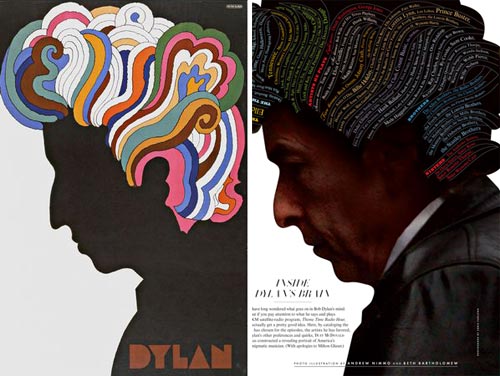
Glaser on the left, yo. (via hysterical paroxysm)
When Western Oregon senior Sara Tucholsky hit her first career home run in one of the last games of the softball season, something odd happened. She missed the bag at first and when she doubled back to touch it, her knee gave out. Her teammates were unable to help her around the bases so it looked like her only career home run would turn into a single. Then a member of the other team, a senior with knee problems of her own, said:
Excuse me, would it be OK if we carried her around and she touched each bag?
Update: Here’s an overwrought, overproduced video of the home run and its aftermath. (thx, tim)
Great 60-minute documentary on English painter Francis Bacon in six parts: one, two, three, four, five, six. The production is inventive and I’ve never seen someone answer so many seemingly penetrating questions so quickly and fluidly, save for the one he has to read off of a card produced from his pocket. (thx, dean)
Update: The program is available in one part here. (thx, marissa)
Interview with Matthew Dent, the chap who designed the fantastic new UK coinage.
There were plenty of technical issues I had to come to terms with in conjunction with the distribution of metal across the coin and the high-speed striking process. At one point I considered suggesting that half the 20 pence’s border — where it met the shield — be removed. It would have still been a rounded heptagon, only its border wouldn’t completely surround the coin. There were potential issues with this; I learnt that the distribution of metal wouldn’t be balanced, thereby possibly affecting the striking of the coins and the acceptance of them by cash machines. Oh well… this competition was a learning curve. And as someone who was unfamiliar with the technical aspects of coin manufacture - you have to ask don’t you?
(via quipsologies)
James Danziger presents a short history of subway photos, starting with photos of sleeping Japanese salarymen on trains and then moving to Walker Evans, Bruce Davidson, etc. Some of my favorite subway photos are from the Moscow subway…Stalin look-a-likes, huge guitars, and many sleeping people.
Socials & More