The forum’s members go on to speculate that the mushrooms were possibly enlarged by Papa Smurf’s magic, or perhaps just regular tiny houses built by Handy Smurf and camoflauged as mushrooms to trick outsiders.
With images by Sabine Haubitz and Stefanie Zoche of Haubitz+Zoche, the show looks at “the concrete skeletons of five-star hotel complexes” abandoned on Egypt’s Sinai Peninsula. They are resorts that never quite happened, then, with names like Sultan’s Palace and the Magic Life Imperial. This makes them “monuments to failed investment.”
1. The number of Americans in prison remains an underreported scandal, as well as the conditions they face.
7. The American culture of individual freedom is closely linked to the prevalence of mental illness and gun-based violence in this country. We can’t seem to get only the brighter side of non-conformity.
Peter Gelb, the Met’s general manager, said on Tuesday that he had asked Mr. Flórez weeks ago whether he would be prepared to repeat the aria, if the audience demanded. Mr. Fl’orez had already done so at other houses, including the Teatro alla Scala in Milan, where last year he became the first to violate an encore ban since 1933.
Mr. Flórez agreed to Mr. Gelb’s request, and the orchestra and chorus were warned. A system was established. Mr. Gelb kept an open line on the phone in his box to the stage manager. After the explosive reaction he gave the stage manager the go-ahead. The manager activated a podium light for the conductor, Marco Armiliato. Mr. Armiliato held out a questioning two fingers to Mr. Flórez. “He just smiled, and that means ‘Yes,’ ” the conductor said.
The researchers found 56% of women with the highest energy intake around the time of conception had boys, compared to just 45% among women with the lowest energy intake. The average calorie intake for women who had sons was 2,413 a day, compared to 2,283 calories a day for women who had girls. Women who had sons were also more likely to have eaten a higher quantity and wider range of nutrients, including potassium, calcium and vitamins C, E and B12. They were also more likely to have eaten breakfast cereals.
The evolutionary guess is that when times are lean, a daughter will more consistently yield descendants than a son. (thx, meg)
Golden Eagles can be up to three feet long with a wingspan of over 7 feet. Here’s a video of a Golden Eagle hunting for food, a process that involves throwing live goats off of cliffs and then scavenging the carcass. If you’re at all sensitive about seeing animals die, you really shouldn’t watch this. For everyone else, the only way this could be more fascinating is if David Attenborough were narrating. (via waxy)
The video is a condensed time lapse of screenshots over a several month period. Total physical drawing time is close to 40 hours and I’d add an equal amount of time for concept time and readying the print. A screenshot was taken every 5 seconds, which actually results in a full 18 minute video.
Here’s the trailer for Dr. Strangelove or: How I Learned to Stop Worrying and Love the Bomb.
It was done by a fellow named Pablo Ferro; it was his first movie trailer. Steven Heller writes:
After seeing Ferro’s commercials, Kubrick hired him to direct the advertising trailers and teasers for Dr. Strangelove and convinced him to resettle in London (Kubrick’s base of operations until he died there in March 1999). Ferro was inclined to be peripatetic anyway, and ever anxious to bypass already completed challenges he agreed to pull up stakes on the chance that he would get to direct a few British TV commercials, which he did. The black and white spot that Ferro designed for Dr. Strangelove employed his quick-cut technique — using as many as 125 separate images in a minute — to convey both the dark humor and the political immediacy of the film. At something akin to stroboscopic speed words and images flew across the screen to the accompaniment of loud sound effects and snippets of ironic dialog. At a time when the bomb loomed so large in the US public’s fears (remember Barry Goldwater ran for President promising to nuke China), and the polarization of left and right — east and west — was at its zenith, Ferro’s commercial was not only the boldest and most hypnotic graphic on TV, it was a sly subversive statement.
Ferro worked with Kubrick on the iconic and fantastic main titles for the film as well.
Kubrick wanted to film it all using small airplane models (doubtless prefiguring his classic space ship ballet in 2001: A Space Odyssey). Ferro dissuaded him and located the official stock footage that they used instead. Ferro further conceived the idea to fill the entire screen with lettering (which incidentally had never been done before), requiring the setting of credits at different sizes and weights, which potentially ran counter to legal contractual obligations. But Kubrick supported it regardless. On the other hand, Ferro was prepared to have the titles refined by a lettering artist, but Kubrick correctly felt that the rough hewn quality of the hand-drawn comp was more effective. So he carefully lettered the entire thing himself with a thin pen. Yet only after the film was released did he notice that one word was misspelled: “base on” instead of “based on”. Ooops!
If you want that hand-lettered look for yourself, Pablo Skinny is a font by Fargoboy that closely duplicates Ferro’s handwriting.
Ferro went on to make several well-known movie title sequences, including those for Bullitt and the original The Thomas Crown Affair but not Napoleon Dynamite. He collaborated with Kubrick once again on the trailer for A Clockwork Orange, another classic.
Update: According to this Wikipedia article, the work of Canadian avant-garde filmmaker Arthur Lipsett caught the eye of Stanley Kubrick after an Oscar nomination for his short film, Very Nice, Very Nice and, more importantly for our business here, that Kubrick directed the Strangelove trailer himself in Lipsett’s style after Lipsett refused to work with Kubrick on it:
Stanley Kubrick was one of Lipsett’s fans, and asked him to create a trailer for his upcoming movie Dr. Strangelove. Lipsett declined Kubrick’s offer. Kubrick went on to direct the trailer himself; however, Lipsett’s influence on Kubrick is clearly visible when watching the trailer.
The two are stylistically similar for sure, but Ferro is credited with having designed the main title sequence (according to the titles themselves). That passage doesn’t appear to have been derived from any particular source, so I looked for something more definitive. From a 1986 article by Lois Siegel
After his Academy Award nomination, he received a letter from British filmmaker Stanley Kubrick. The typewritten letter said, “I’m interested in having a trailer done for Dr. Strangelove.” Kubrick regarded Lipsett’s work as a landmark in cinema — a breakthrough. He was interested in involving Lipsett. This didn’t happen, but the actual trailer did reflect Lipsett’s style in Very Nice, Very Nice.
Kubrick described Very Nice, Very Nice (1961) as “one of the most imaginative and brilliant uses of the movie screen and soundtrack that I have ever seen.” Kubrick was so enthused with the film he invited Lipsett to create a trailer for Dr. Strangelove (Stanley Kubrick, 1965) an offer Lipsett refused. Stanley Kubrick, letter to Arthur Lipsett, Arthur Lipsett Collection, Cinematheque québécoise Archives, Montreal, May 31, 1962.
It’s not clear what the connection is between Lipsett’s work and the trailer that Ferro ended up producing for Strangelove, but several sources (including Heller) say that Ferro developed his quick-cut style directing commercials in the 1950s, work that would predate that of Lipsett.
Lipsett more clearly influenced the work of another prominent filmmaker, George Lucas. Lucas found inspiration in Lipsett’s 21-87 in making THX-1138 and borrowed the concept of “the Force” for the Star Wars movies. Lucas’ films are littered with references to Lipsett’s film; e.g. Princess Leia’s cell in Star Wars was in cell #2187. (thx, gordon)
In his current training, he said, he does exercises every morning in which he breathes for no more than 12 minutes over the course of an hour, and he sleeps in a hypoxic tent in his Manhattan apartment that simulates the thin air at 15,000 feet above sea level.
He has been concentrating on lowering his oxygen consumption by slowing his metabolism, partly through diet (he fasted for 18 hours before the breath-hold in the pool) and partly through relaxation. In a test by Dr. Potkin, Mr. Blaine on command quickly lowered his heart rate by 25 percent.
“David seems to have a phenomenal ability, like Buddhist monks, to control his body,” Dr. Potkin said.
The author of the piece did some breath-holding training and was able to hold his breath for almost 4 minutes after about an hour of training.
And I didn’t appreciate how much progress free divers and their coaches have made at pushing the limits of human endurance until Mr. Blaine put my time in perspective. “Houdini used to brag about going three and a half minutes underwater,” Mr. Blaine said. “Look at how easily you beat Houdini.”
MLB tracks every pitch thrown in a game using a system called PITCHf/x. You may have seen this system in action during televised games; it’s used to show the viewer where the pitch was located when it crossed the plate relative to the strike zone. On his baseball statistics blog, Josh Kalk takes these stats and lets you slice and dice them however you want.
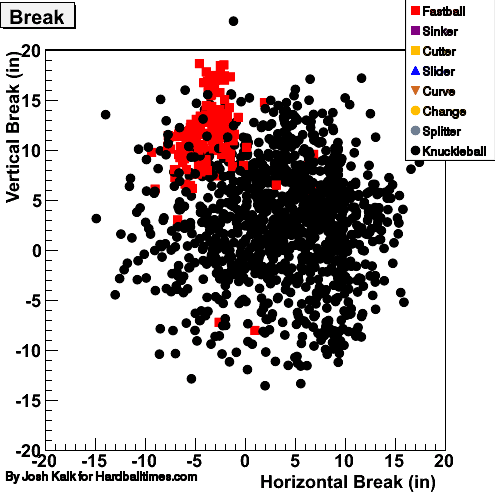
One of the most interesting statistics measured is the break of a pitch…how much up-and-down and side-to-side motion a pitched ball goes through after leaving the pitcher’s hand. The break demonstrates why the knuckleball is such a difficult pitch to hit, particularly when used in conjunction with other pitch types. Here’s a graph showing the break on knuckleballer Tim Wakefield’s pitches so far this season:
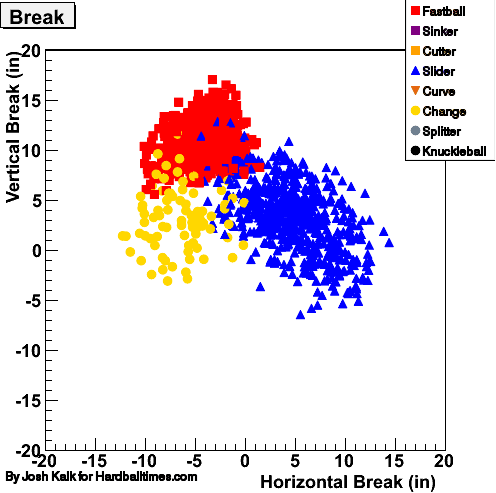
The ball is all over the place…the hitter doesn’t know where it’s going. Compare that to the break on the three different pitches thrown by fellow Red Sox player Daisuke Matsuzaka:
Now take a look at the graphs on the player cards for Wakefield and Matsuzaka. Wakefield’s pitches also have a wider range of velocities…Matsuzaka’s pitches range in speed from about 77 to 95 mph while Wakefield’s pitches range from 65 to 95 mph. And the graphs don’t even account for the multiple breaks that a knuckleball can make during a single pitch. The uncertainties of speed and break of a knuckleballer’s pitches combine to create a lot of trouble for batters…they neither know where the ball’s going nor when it’s going to arrive. (thx, fred)
P.S. So why is Wakefield not as effective as many other major league pitchers (his career stats aren’t that impressive), none of whom throw the knuckleball? One guess is that sometimes the knuckleball doesn’t break and essentially becomes a 60-65 mph meatball right down the middle of the plate, a pitch any decent hitter can put anywhere he wants.
Update: I thought that Wakefield’s upper velocity range was a little high. I’m getting a lot of feedback saying that Wakefield’s fastball is in the low 80s, not the mid-90s. Looks like we’ve got some screwy data here.
Also, another reason why knuckleballers are of limited effectiveness: it’s difficult to throw a strike on command, which can be a problem when you’re behind in the count and you have to throw your 80 mph fastball for a strike. (thx, jonathan & steve)
Sen. Jim King, R-Jacksonville, said he had a set [of Truck Nutz] on one of his vehicles, which he described as “all pimped out.” They are no more than “an expression of truckliness,” he said, although he’d acceded to his wife’s request to take them off.
“I find it shocking we’d tell people with metallic testicles on their bumpers that this is a violation,” said Sen. Steve Geller, D-Hallandale. “There’s got to be better things for us to spend time debating.”
Finding the Moon when its slim crescent is still less than about 24 hours past the New Moon phase requires careful timing and planning, a challenging project even for experienced observers. In this sighting, only about 0.8 percent of the Moon’s disk appears illuminated.
At the same time, I don’t think the cooks look at me as a real community member. I’m not that cozy paternal figure. I’m always doing different things, and it creates this atmosphere where the cooks are on the balls of their feet. They’re thinking, Where’s he going next, what’s happening next? There’s a little bit of confusion. I think that’s good. It’s hard to articulate, because you think of the kitchen as very organized; and, like I said, the more control you have, the better. But a little bit of chaos creates tension. And that creates energy and passion, and it tends to make you season something the right way or reach for something that would add this, that, or the other thing.
The other chefs are Alice Waters, Grant Achatz, and Wylie Dufresne. The one thing they all talked about is the importance of open sight lines, both between the dining room and kitchen and among the chefs in the kitchen.
CBS News report from 1975 detailing the last World Airways flight out of Da Nang near the end of the Vietnam War.
The flight was supposed be for stranded women and children but as soon as the plane landed in Da Nang, it was swamped by South Vietnamese soldiers attempting to flee the oncoming North Vietnamese forces.
There were 260 people aboard a plane which is designed to carry 105. The plane was overloaded by 20,000 pounds. The baggage compartments were loaded with people. Some of the problems during the flight included, the rear stairway remained partially extended for the entire flight, the main wheels would not retract, a hand grenade damage to one of the wings causing fuel loss, and the lower cargo doors were open. The plane had to fly at 10,000 feet because of lack of pressurization thus fuel consumption was three times greater than normal.
In the end, only 5 women and 2 or 3 children made it onboard. That’s some powerful journalism. (thx, brandon)
EXCLUSIVE!! From a mole deep inside the company comes word and vision of a new iPhone from Apple, the iPhone Mega:
In a rare comment regarding a leaked product, Steve Jobs noted that “the easy portability of the iPhone was an issue for some people; we saw a market opportunity there”.
The idea for SA is to move beyond an increasingly commoditized blog publishing software business, and into adding advertising, design, implementation, development and site optimization services to bloggers and companies.
Clusterflock’s Deron Bauman did an interview with me the other day over IM and posted an edited transcript. This seems to be the bit that everyone is pulling from the interview so I will as well:
Other times, it’s not so fun running a visible site. Some people are determined to deliberately misunderstand much of what they encounter in life. Sometimes I have a hard time realizing that that’s their problem, not mine.
Few pitchers are able to throw the knuckler, giving those who can a cult-like status. It generally requires very large fingers. As Hall of Famer Willie Stargell explained it, “Throwing a knuckleball for a strike is like throwing a butterfly with hiccups across the street into your neighbor’s mailbox”.
Yankees third baseman Wade Boggs once used the knuckleball to retire the side in an inning during a rare appearance on the mound. When he’s got his stuff working, I love watching knuckleballer Tim Wakefield pitch.
Like the lost plays of Aeschylus that were written about but did not survive themselves, no known examples of the work of Wedgwood and his circle have ever been found. But Dr. Schaaf, in looking deeper into the leaf image, realized that these legendary lost images had something else in common: their creators were all part of the close social circle of the family of Henry Bright.
“The reason that I got so excited about this was that it was the most solid, indicative collection I’ve seen,” he said. “I’m fully prepared for ‘The Leaf’ to have been made by Henry Bright, or by his father, after the 1790s. But I’ve never seen a story that fits together so neatly.”
** A photogenic drawing is a precursor to the photograph and is created by placing an object on a piece of photosensitive paper and exposing it to light.
I missed this earlier this week: physicist John Wheeler has died at the age of 96. A snippet from the NY Times obituary:
At the same time, he returned to the questions that had animated Einstein and Bohr, about the nature of reality as revealed by the strange laws of quantum mechanics. The cornerstone of that revolution was the uncertainty principle, propounded by Werner Heisenberg in 1927, which seemed to put fundamental limits on what could be known about nature, declaring, for example, that it was impossible, even in theory, to know both the velocity and the position of a subatomic particle. Knowing one destroyed the ability to measure the other. As a result, until observed, subatomic particles and events existed in a sort of cloud of possibility that Dr. Wheeler sometimes referred to as “a smoky dragon.”
This kind of thinking frustrated Einstein, who once asked Dr. Wheeler if the Moon was still there when nobody looked at it.
Wheeler recognized that physics is about ideas and the language used to express those ideas, not just mathematics and experimentation. He coined and popularized several phrases during his long career, including black hole, wormhole, and quantum foam.
The Droste effect is when a product’s packaging features the packaging itself.
At my grocery store I could only find three examples: Land O’Lakes Butter, Morton Salt and Cracker Jacks. These packages each include a picture of the package itself and are often cited by writers discussing such pop-math-arcana as recursion, strange loops, self-similarity, and fractals. This particular phenomenon, known as the “Droste effect,” is named after a 1904 package of Droste brand cocoa. The mathematical interest in these packaging illustrations is their implied infinity. If the resolution of the printing process — (and the determination and eyesight of the illustrator) — were not limiting factors, it would go on forever. A package with in a package within a package… Like Russian dolls.
A list of the top one articles by Neal Pollack about how sportswriters should stop writing about the NBA MVP race and, oh yeah, lists of stuff are dumb:
Sportswriters and pundits, on the other hand, are treating the MVP race with the gravitas of a presidential election. That’s because they make up the Electoral College. When they’re debating who’s going to win the award, they’re not really talking about who they think the best player is; they’re talking about whom they should pick as the best player. It’s the ultimate circle-jerk of sports-guy self-regard.
Stephen’s investigation combines historical detective work and a hands-on challenge. He travels to France and Germany on the trail of Johannes Gutenberg, the inventor of the printing press and early media entrepreneur. Along the way he discovers the lengths Gutenberg went to keep his project secret, explores the role of avaricious investors and unscrupulous competitors, and discovers why printing mattered so much in medieval Europe.
But to really understand the man and his machine, Stephen gets his hands dirty - assembling a team of craftsmen and helping them build a working replica of Gutenberg’s original press. He learns how to make paper the 15th-century way and works as an apprentice in a metal foundry in preparation for the experiment to put the replica press through its paces. Can Stephen’s modern-day team match the achievement of Gutenberg’s medieval craftsmen?
Here’s part one to get you started:
I haven’t had a chance to watch it yet, but it’s supposed to be really good. Oh, and if you’re thinking “who does this Fry bloke think he is going on about technology like he knows something about it”, you should check out his blog…he’s a top-notch tech blogger. (thx, dean)
RealScoop’s software analyzes statements made by public figures in audio or video and plots the results on a scale of believability that runs from believable to highly questionable.
RealScoop uses advanced emotion-based voice analysis technology to rate the believability of people’s statements.
While the preservation of food in the freezing temperatures and dry climate has been noted, bacterial decay still occurs. Besides, the World Monuments Watch describes it as one of the hundred most endangered sites in the world, and New Zealand’s Antarctic Heritage Trust (AHT) has been working in the last years to preserve it from corrosion.
These structures and the supplies contained within are almost 100 years old.
The story of a salvage team racing to save the Cougar Ace, a 55,000 ton cargo ship packed with Mazda cars valued at $103 million that nearly flipped when the ballast tanks on either side of the ship got out of balance. If the team succeeds, they get ~10% of the cargo’s value and If not, they don’t get paid…either way, someone might die.
Reed and Habib crawl along the tilted deck, periodically consulting a drawing of the ship’s internal compartments. They rap their knuckles on a piece of steel - this is the top of the low-side ballast tank. Trepte pulls out a drill and bores down. Suddenly, water erupts. The tank is already full and pressurized - water must be flowing in through a broken vent on the underwater side of the ship. It sprays furiously. They have unwittingly caused the worst thing possible: The deepest cargo hold is flooding.
In an instant, Trepte covers the hole with the tip of a finger and presses hard. The sound of gushing water abruptly stops, and the shouts and curses of the moment before echo through the hold. Salt water drips off Mazdas, and the panic the men all felt transforms into a contagious laugh.
Trepte is keeping the ship afloat with one finger.
The story includes links to video and journal entries from the salvage team.
Princeton Architectural Press is offering a most unusual publication called Materials Monthly. Each month or so, a small box arrives on your doorstep containing not just a printed magazine about architecturally interesting materials but samples of the materials themselves, including fabric swatches, tiles, wallpaper, glass, and steel. Dan Hill recently received his issue and has a nice review and unboxing.
Benoit Mandelbrot and Paola Antonelli talk about, among other things, fractals, self-similarity in architecture, algorithms that could specify the creation of entire cities, visual mathematics, and generalists.
This has been for me an extraordinary pleasure because it means a certain misuse of Euclid is dead. Now, of course, I think that Euclid is marvelous, he produced one of the masterpieces of the human mind. But it was not meant to be used as a textbook by millions of students century after century. It was meant for a very small community of mathematicians who were describing their works to one another. It’s a very complicated, very interesting book which I admire greatly. But to force beginners into a mathematics in this particular style was a decision taken by teachers and forced upon society. I don’t feel that Euclid is the way to start learning mathematics. Learning mathematics should begin by learning the geometry of mountains, of humans. In a certain sense, the geometry of…well, of Mother Nature, and also of buildings, of great architecture.
Me know. Me have problem. Me love cookies. Me tend to get out of control when me see cookies. Me know it not natural to react so strongly to cookies, but me have weakness. Me know me do wrong. Me know it isn’t normal. Me see disapproving looks. Me see stares. Me hurt inside.
- The vast majority of the recent album releases rated by Metacritic are in the “generally favorable reviews” category. A few are rated “universal acclaim” or “mixed or average reviews” and only one is “generally negative”. Compare that to the ratings for recently released movies, which are much lower on average. Do people demand higher quality from their music than movies? Or is so much music produced (compared to movies) that the only albums worth compiling reviews for are the good ones?
The newest version of Google Earth includes 3-D photorealistic buildings, sunlight (with shadows on those realistic 3-D buildings), and a Spiderman-esque swooping action. Here’s a “photo” I snapped of downtown San Francisco.








Socials & More