



Advertise here with Carbon Ads
This site is made possible by member support. 💞
Big thanks to Arcustech for hosting the site and offering amazing tech support.
When you buy through links on kottke.org, I may earn an affiliate commission. Thanks for supporting the site!
kottke.org. home of fine hypertext products since 1998.
Beloved by 86.47% of the web.
Entries for April 2020
On the surprising intimacy of virtual communication. “The unfamiliar intimacy of online classes makes the attention to each student feel more live and personalized, not less.”
Blade Runner - The Lost Cut
Of the various cuts of Blade Runner done over the years, Blade Runner - The Lost Cut is perhaps the oddest. Billed by creator Leon Chase as “a radical re-envisioning of Ridley Scott’s 1982 sci-fi classic”, this cut boldly includes footage from other films like The French Connection, Star Wars, The Jerk, and The Blues Brothers. A few of the films whose footage was used, including the Coen brothers’ Fargo, were released well after Blade Runner came out.
Daring! But does this cut go too far? Or not too far enough?
Dr. James Hamblin on why some people with Covid-19 get sicker than others. “There’s a big difference in how people handle this virus. It’s very unusual. None of this variability really fits with any other diseases we’re used to dealing with.”
A Relaxing Walk Through the Cherry Blossoms at the Brooklyn Botanic Garden
It’s unfortunate that places like the Brooklyn Botanic Garden need to be closed during this stressful time, because the cherry blossoms are in bloom right now and what a balm that would be to so many souls. Luckily, cinematographer Nic Petry was granted access to the garden a couple of weeks ago to capture a relaxing and meditative walk through the Japanese Garden.
The historic garden is one of the oldest extant Japanese gardens in the United States, and its collection of cherry cultivars was in lovely bloom during filming. Petry, a specialist in moving camera techniques, conceived the piece as a way to recreate the meditative experience of walking through the garden on a glorious, early spring day.
(via laura olin)
Update: See also Gothamist’s photos and drone video of the cherry blossoms this year.
Update: Now that more cherry trees are in blossom at the garden, they have uploaded a video of a walk through the esplanade.
Craig Mod wrote an account of his 8-day walk along the historic Ise-ji pilgrimage route. He begins: “Allow me to share what I love about a good walk in Japan…”
No Man Is an Island
From director Robert Bingaman, a video interpretation of a timely passage from John Donne’s Devotions upon Emergent Occasions, which was written by Donne in 1623 while recovering from a serious illness. The passage is from Meditation XVII and is paired in the video with images of businesses and public places emptied out by the pandemic.
No man is an island, entire of itself; every man is a piece of the continent, a part of the main. If a clod be washed away by the sea, Europe is the less, as well as if a promontory were, as well as if a manor of thy friend’s or of thine own were: any man’s death diminishes me, because I am involved in mankind, and therefore never send to know for whom the bell tolls; it tolls for thee.
A Social Distance
Using crowd-sourced clips sent in from all over the world, filmmakers Ivan Cash and Jacob Jonas made a poignant short film called A Social Distance about how things are going as people shelter in place at home.
In the self-submitted videos, people dance, play music, take us on a tour of their refrigerator, and introduce us to their pets. Edited together, these intimate moments create a synchronicity of humanity — a feeling of togetherness that’s difficult to conjure when you’re sequestered at home.
The score for the film is by Steve Hackman, who I previously featured for his mashups of pop & classical music:
Hackman, the film’s composer, wrote sheet music that he distributed to musicians across the world. When he received their recordings, Hackman combined the performances to create an original score.
See also Living Through Coronavirus Around the World. (via colossal)
Sean Woods rides around NYC during quarantine, documenting the uncomfortable silence of the city for Rolling Stone. “The city has the edge of the Seventies or Eighties — when crime and crack dominated life here.”
The Earth Day 2020 Awards, Presented by Ze Frank
In partnership with PBS Nature, Ze Frank (narrating as the Earth) presents The Earth Day 2020 Awards to a deserving group of fascinating animals, including the decorator crab (Best Dressed) and the salmon (Best Travel Story). I am upset on behalf of the planet’s plants though. WHERE ARE THE PLANTS ZE? Did a dandelion bully you as a kid or something?
See also The Atlantic’s photo essay on the 50th anniversary of Earth Day.
Selling the Imperfection of Handmade Art Paper
This short film profiles a small company in Somerset, England called Two Rivers Paper. Using water power, the company makes paper by hand for artists and designers, and they have a healthy appreciation for the unpredictability of their product.
Anything that’s made by a craftsman is imperfect. So, a hand-forged nail will be imperfect — every one will be slightly different. Handmade paper — every sheet is slightly different. So if you want perfection, if you want uniformity, then it has to be done by a machine. I often tell people that we sell imperfection, that’s what we do.
Two Rivers Paper operates one of the few remaining hand-mills in Europe.
The mill is over 400 years old and still retains much of the ancient wooden milling machinery. It’s been restored over the last 15 years to a working water-powered traditional paper mill, using a 100 year old metal wheel from Wales and an 1841 Hollander Rag-Breaker.
The wheel itself is a 10ft overshot wheel weighing two and a half tons and standing eleven foot high. In combination with the rag breaker, Two Rivers will be the only place in the UK where water power is used to make paper from old rags. Showing a continuing commitment to manufacturing using environmentally appropriate methods, a full array of solar panels were fitted to the mill roof in 2011. Electrical heating is used to gently dry our paper in the mill loft.
This short video segment from the BBC provides a closer look at how their paper is made. You can get yourself some Two Rivers paper from their online shop.
See also 700-Year-Old French Mill Still Cranking Out Handmade Paper and this short film on how marbled paper is made.
Ella Fitzgerald Masterfully Butchers “Mack the Knife”
If you listen to more than 20 seconds of any song by Ella Fitzgerald, you can instinctively tell how amazing a singer she was. But taking a closer look reveals just how special. In this episode of NPR’s Jazz Night in America, they took a look at Fitzgerald’s 1960 performance of Mack the Knife (where she forgot half the words and improvised the rest) and her talent for referencing other songs while improvising, creating live “mix tapes” of popular songs using just her voice.
By 1960, Fitzgerald had become a global sensation. That February she gave an unforgettable performance in West Berlin for an audience of thousands. On the set list was “Mack The Knife,” a huge hit first made popular by Bobby Darin and Louis Armstrong. Fitzgerald sang the song flawlessly until about halfway through, when she forgot the lyrics. But she didn’t stumble — instead, she playfully freestyled her way to the end with nonsense syllables and improvised words — the singular jazz style called scatting. This unforgettable and Grammy Award-winning performance demonstrated her masterful grace under pressure.
You can listen to her Grammy-winning version of Mack the Knife on Spotify:
I love how confidently she sings “Oh, what’s the next chorus…” — Fitzgerald belts it out like those are the right lyrics. Her self-assurance sells it. (via the kid should see this)
This Website Will Self Destruct. “You can send me messages using the form below. If I go 24 hours without receiving a message, I’ll permanently self-destruct, and everything will be wiped from my database.”
Human After All


I am not quite sure what to say about Human After All, a collaboration between photographer Jan Kriwol and digital artist Markos Kay, other than it seems like a metaphor for something these days. (via colossal)
Tracking “excess deaths” provides a more accurate picture of the toll of the Covid-19 pandemic. “In New York City, the number [of daily deaths] is now four times the normal amount.”
Where’s Waldo? in the Social Distancing Age
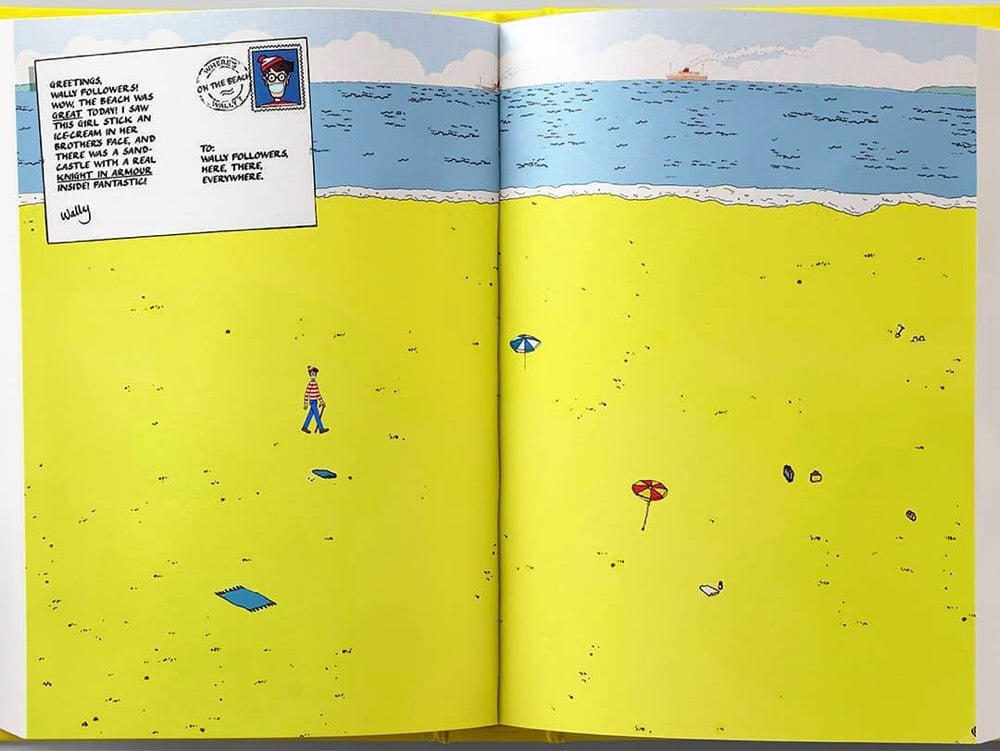
Finding Waldo is a lot easier when no one can go outside. On his Instagram, art director Pedro Mezzini reimagined Where’s Waldo for the age of social distancing. He’s even wearing a mask! See also Clay Bennett’s version.
A Virtual Performance by the Chicago Sinfonietta Orchestra
Forced to cancel performances due to the pandemic, the members of Chicago Sinfonietta (“North America’s most diverse orchestra”) gathered together via video for a lively virtual performance of Leroy Anderson’s Plink, Plank, Plunk!, which is played primarily by plucking string instruments. Tag yourself…are you bored triangle lady or clarinet banana?
Zeynep Tufekci writes about the problems with the World Health Organization. “It is also true that in the run-up to this pandemic, the WHO failed the world in many ways”, mainly because it lacks independence.
We Are Living in a Failed State. “The crisis demanded a response that was swift, rational, and collective. [The US responded with] shoddy infrastructure and a dysfunctional government whose leaders were too corrupt or stupid to head off mass suffering.”
Children’s Story Time with Michelle Obama and PBS Kids
For the next several Mondays, Michelle Obama will read a favorite children’s book in partnership with PBS Kids. The first reading (of The Gruffalo) is already in the can and archived on YouTube:
(via barry)
How We Reopen the Country: A Roadmap to Pandemic Resilience
Working under the direction of The Edmond J. Safra Center for Ethics at Harvard University, a bipartisan group of experts in public health, economics, technology, and ethics have produced a plan for a phased reopening of public life in the United States through testing, tracing, and supported isolation. The video above summarizes the plan and here’s the full plan in the form of a 56-page PDF.
“Roadmap to Pandemic Resilience: Massive Scale Testing, Tracing, and Supported Isolation (TTSI) as the Path to Pandemic Resilience for a Free Society,” lays out how a massive scale-up of testing, paired with contact tracing and supported isolation, can rebuild trust in our personal safety and re-mobilize the U.S. economy.
Among the report’s top recommendations is the need to deliver at least 5 million tests per day by early June to help ensure a safe social opening. This number will need to increase to 20 million tests per day by mid-summer to fully re-mobilize the economy.
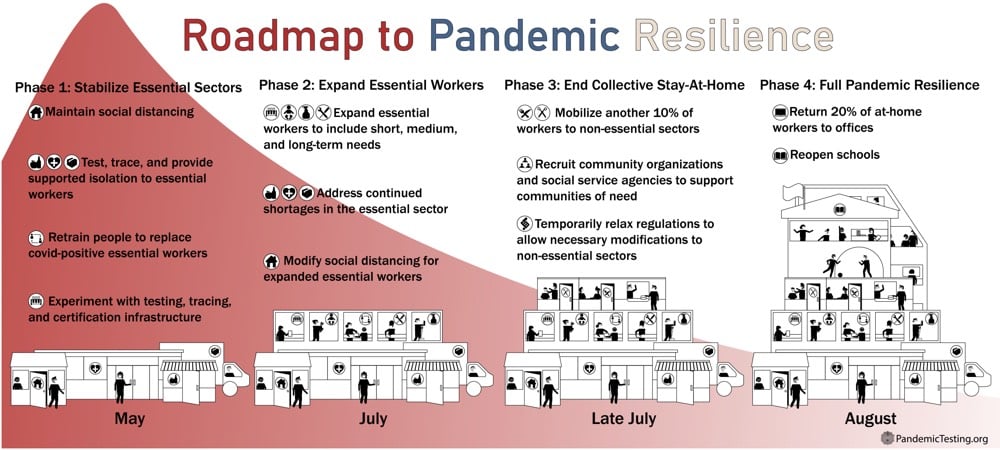
From the paper, here’s a quick overview:
What we need to do is much bigger than most people realize. We need to massively scale-up testing, contact tracing, isolation, and quarantine-together with providing the resources to make these possible for all individuals.
Broad and rapid access to testing is vital for disease monitoring, rapid public health response, and disease control.
We need to deliver 5 million tests per day by early June to deliver a safe social reopening. This number will need to increase over time (ideally by late July) to 20 million a day to fully remobilize the economy. We acknowledge that even this number may not be high enough to protect public health. In that considerably less likely eventuality, we will need to scale-up testing much further. By the time we know if we need to do that, we should be in a better position to know how to do it. In any situation, achieving these numbers depends on testing innovation.
Between now and August, we should phase in economic mobilization in sync with growth in our capacity to provide sustainable testing programs for mobilized sectors of the workforce.
The great value of this approach is that it will prevent cycles of opening up and shutting down. It allows us to steadily reopen the parts of the economy that have been shut down, protect our frontline workers, and contain the virus to levels where it can be effectively managed and treated until we can find a vaccine.
We can have bottom-up innovation and participation and top-down direction and protection at the same time; that is what our federal system is designed for.
This policy roadmap lays out how massive testing plus contact tracing plus social isolation with strong social supports, or TTSI, can rebuild trust in our personal safety and the safety of those we love. This will in turn support a renewal of mobility and mobilization of the economy. This paper is designed to educate the American public about what is emerging as a consensus national strategy.
The plan seems consistent with what economist Paul Romer has been saying — Without More Tests, America Can’t Reopen (And to make matters worse, we’re testing the wrong people) — and with the approach Hong Kong has been taking — Test and trace: lessons from Hong Kong on avoiding a coronavirus lockdown. See also the 4 plans to end social distancing, explained.
Unfortunately for this plan and for all of us, I have a feeling that the first true step in any rational plan to reopen the United States without unnecessary death and/or massive economic disruption that lasts for years is the removal of Donald Trump from office (and possibly also the end of the Republican-controlled Senate). Barring that, the ineffectual circus continues. (via @riondotnu)
South African Safaris Broadcast Live Online Twice a Day
A group in South Africa called WildEarth is broadcasting live safaris on YouTube twice a day, once at sunrise and again at sunset. The safaris take place in Greater Kruger National Park, run for about three hours each, and are archived online. Here’s a sunrise safari from last week:
Here’s their daily schedule:
The Sunrise Safari starts at 06:00 local time, which means start times of 00:00 PM ET, 21:00 PM PT, 04:00 in the UK [GMT], 05:00 in Central Europe, and 15:00 Sydney time.
The Sunset Safari starts at 15:30 CAT local time, 09:30 AM ET, 06:30 AM PT, 14:30 in the UK [BST], 15:30 in Central Europe, and 00:30 Sydney time.
Check out the safari archive for past shows and this playlist for some of the highlights. (thx, philip)
The Rolling Stones Perform “You Can’t Always Get What You Want” While Sheltering at Home
As part of the One World: Together at Home fundraiser organized by the WHO, Global Citizen, and Lady Gaga that raised $127.9 million for Covid-19 relief efforts, the members of the Rolling Stones, each in their own home, got together via video to perform You Can’t Always Get What You Want. It’s a lovely messy & spare performance and the choice of song is timely — plenty of people around the world are definitely not getting what they want right now, but hopefully we will eventually end up getting what we need.
Hong Kong (pop. 7.5M) has had only 715 confirmed cases of Covid-19 and 4 deaths as of March 31, all without the need for a lockdown. How did they do it? They followed WHO advice early and implemented vigorous test & trace protocols.
The Emerging Science of What SARS-CoV-2 Does to the Human Body
Thousands of scientific research papers on Covid-19 and SARS-CoV-2 are being published each week and with them comes a clearer picture of the virus and the disease it causes. There’s still a lot we don’t know, but this piece from Science magazine is the best synthesis of the emerging science that I have read. It details a virus that “acts like no microbe humanity has ever seen” and affects not only the lungs but also the kidneys, heart, brain, and the intestines.
As the number of confirmed cases of COVID-19 surges past 2.2 million globally and deaths surpass 150,000, clinicians and pathologists are struggling to understand the damage wrought by the coronavirus as it tears through the body. They are realizing that although the lungs are ground zero, its reach can extend to many organs including the heart and blood vessels, kidneys, gut, and brain.
“[The disease] can attack almost anything in the body with devastating consequences,” says cardiologist Harlan Krumholz of Yale University and Yale-New Haven Hospital, who is leading multiple efforts to gather clinical data on COVID-19. “Its ferocity is breathtaking and humbling.”
Understanding the rampage could help the doctors on the front lines treat the fraction of infected people who become desperately and sometimes mysteriously ill. Does a dangerous, newly observed tendency to blood clotting transform some mild cases into life-threatening emergencies? Is an overzealous immune response behind the worst cases, suggesting treatment with immune-suppressing drugs could help? What explains the startlingly low blood oxygen that some physicians are reporting in patients who nonetheless are not gasping for breath? “Taking a systems approach may be beneficial as we start thinking about therapies,” says Nilam Mangalmurti, a pulmonary intensivist at the Hospital of the University of Pennsylvania (HUP).
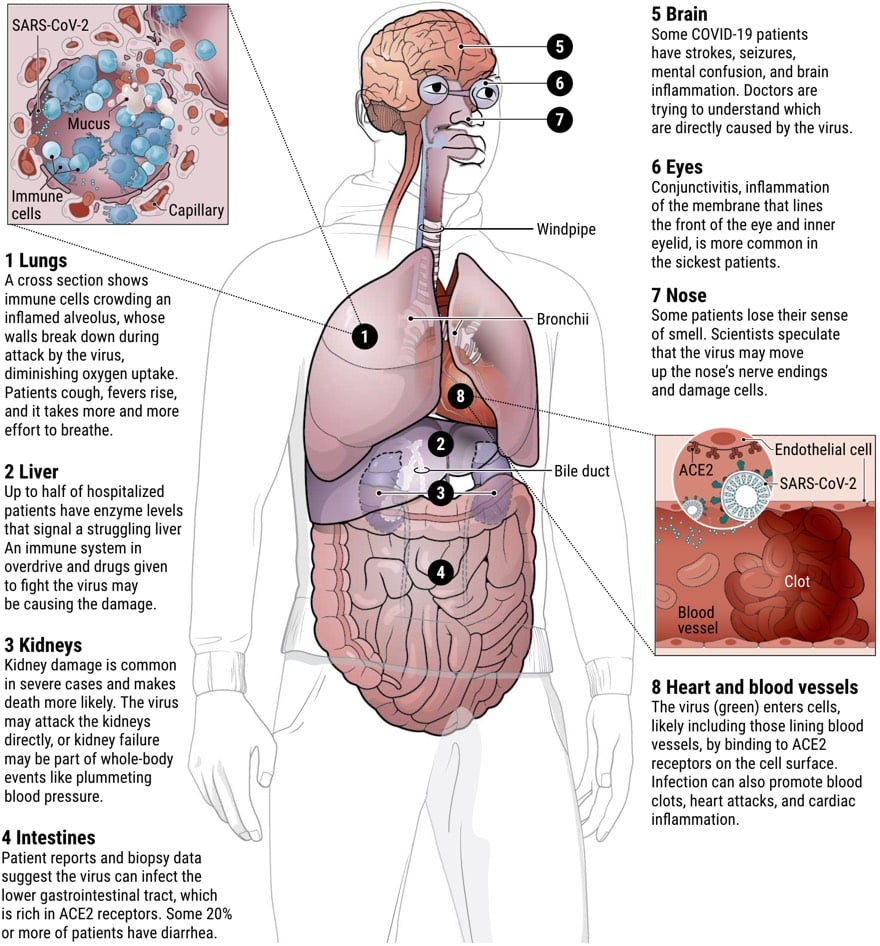
I’ve been hearing that although Covid-19’s attack begins in the lungs, it is as much a vascular disease as it is a respiratory disease — and there is some evidence emerging to support this view:
If COVID-19 targets blood vessels, that could also help explain why patients with pre-existing damage to those vessels, for example from diabetes and high blood pressure, face higher risk of serious disease. Recent Centers for Disease Control and Prevention (CDC) data on hospitalized patients in 14 U.S. states found that about one-third had chronic lung disease-but nearly as many had diabetes, and fully half had pre-existing high blood pressure.
Mangalmurti says she has been “shocked by the fact that we don’t have a huge number of asthmatics” or patients with other respiratory diseases in HUP’s ICU. “It’s very striking to us that risk factors seem to be vascular: diabetes, obesity, age, hypertension.”
What struck me most about this piece is the sheer energy of the vast network of minds bent towards understanding this thing with the hope of beating it as soon as possible. This is the scientific method at work right here, in all its urgent & messy glory.
BBC has launched a huge education initiative for students at home due to the pandemic. Guest teachers include David Attenborough, physicist Brian Cox, actress Jodie Whittaker, and footballer Sergio Agüero.
John Krasinski Hosted a Virtual Prom for the World’s Quarantined High School Students
With the help of Billie Eilish, Finneas O’Connell, the Jonas Brothers, and Chance the Rapper, John Krasinski threw a virtual prom for the nation’s high school students who are stuck at home because of the pandemic. This show is such a gift. Don’t miss Brad Pitt doing the weather report and a brief segment from the International Space Station.
Netflix Posts Dozens of Their Educational Programs on YouTube for Free
In the Before Times, Netflix let teachers stream their programming in the classroom. With schools not in sessions due to the Covid-19 pandemic, Netflix has decided to put some of their educational programming on YouTube for free (full playlist here). For instance, they’ve put all 8 episodes of David Attenborough’s nature series Our Planet online in their entirety. Here’s the first episode:
The Our Planet website also has tons of educational information for schools and kids.
13th is a feature-length documentary by Ava DuVernay about how racial inequality in America drives our high incarceration rates:
13th is currently rated 97% on Rotten Tomatoes and NY Times reviewer Manohla Dargis called it “powerful, infuriating and at times overwhelming”. Here’s a discussion guide.
Eight full episodes of the first season of Abstract: The Art of Design are also available on YouTube (discussion guide). Here’s the episode featuring illustrator Christoph Niemann:
Several episodes of Vox’s series Explained are included, like this one on the racial wealth gap:
Also included are The White Helmets & Period. End of Sentence. (which each won an Oscar for Best Documentary Short Subject) as well as Knock Down The House, the documentary on the 2018 Congressional campaigns of four women (including Alexandria Ocasio-Cortez). See the full list of included shows and the full playlist on YouTube.
The Implausible Covid-19 Movie
A few weeks ago, the Washington Post interviewed Scott Z. Burns, who wrote the screenplay for Contagion, Steven Soderbergh’s film about a bat-borne illness that starts a global pandemic. What’s most striking about the interview is how outlandish Burns finds certain aspects of the Covid-19 pandemic, so ridiculous in fact that people would find them implausible if this were a fictional story.
I would have never imagined that the movie needed a “bad guy” beyond the virus itself. It seems pretty basic that the plot should be humans united against the virus. If you were writing it now, you would have to take into account the blunders of a dishonest president and the political party that supports him. But any good studio executive would have probably told us that such a character was unbelievable and made the script more of a dark comedy than a thriller.
On Twitter, director Sarah Polley recently had a similar take.
This is the worst movie I have ever seen.
Unsurprising that this movie doesn’t work — the screenplay was a dog’s breakfast.
So much heavy handed foreshadowing. The apocalyptic footage from Wuhan, the super villain American president, the whistleblower dying, the Russia/China border closed while people still claimed it was just a flu, the warnings unheeded. Insulting to the audience’s intelligence.
And then — that most annoying of horror/disaster movie tropes — the hapless idiots walking into disaster after disaster, all of which the audience can see coming from a mile away.
The over the top details of world leaders and their wives falling ill, the far fetched idea that industrialized countries wouldn’t have proper protective gear for front line workers and ventilators. Pleeeeaaase. This movie needed a script doctor.
It’s interesting that there are certain boundaries in fiction related to the audience’s suspension of disbelief that are are routinely ignored by reality. I’m also reminded of how Margaret Atwood approached The Handmaid’s Tale and The Testaments, using only elements that have historical precedent:
The television series has respected one of the axioms of the novel: no event is allowed into it that does not have a precedent in human history.
And yet some critics consider the events from the novels and TV show to be too much, over-the-top.
Update: Ted Chiang from a recent interview:
While there has been plenty of fiction written about pandemics, I think the biggest difference between those scenarios and our reality is how poorly our government has handled it. If your goal is to dramatize the threat posed by an unknown virus, there’s no advantage in depicting the officials responding as incompetent, because that minimizes the threat; it leads the reader to conclude that the virus wouldn’t be dangerous if competent people were on the job. A pandemic story like that would be similar to what’s known as an “idiot plot,” a plot that would be resolved very quickly if your protagonist weren’t an idiot. What we’re living through is only partly a disaster novel; it’s also — and perhaps mostly — a grotesque political satire.
I am currently blazing through Exhalation (Kindle), Chiang’s collection of science & technology fables. (via @jasondh)
Marcy Learns Something New
The Short of the Week this week stars Rachel Dratch as a history teacher struggling to find a spark in her life as a widow. Fitness classes aren’t working, so Dratch’s character tries something new: a introductory class on female domination.
From the premise alone, most might think that Kennelly is using BDSM as the butt of the joke, a cheap way to trigger laughs. Yet, she subverts those expectations but steering clear of a farcical approach. Instead, she plays with different levels of sensitivity and empowerment while remaining very respectful towards every single one of her characters, sourcing the comedy elements from a more genuine place, the awkwardness and practicality of the situations Marcy finds herself in.
Dratch is great in this — yet another comedic performer who excels at more serious roles — and I found the whole thing surprisingly tender and poignant, at its core a simple story of people looking for meaning and connection in their lives.
I’d say this is NSFW, but with many of you currently working from home, perhaps that’s not really a thing right now? (via @christopherjobs)
I Went to Hogwarts for Seven Years and Did Not Learn Math or Spelling, and Now I Can’t Get a Job. “You may or may not be aware, but the economy has changed, and the need for my skills defying Lord Voldemort has lessened.”
The History of Music About Diseases
From Retro Report, a short video about how epidemics, past and present, have been represented in music. Blues musicians sang about the 1918 flu pandemic and pop stars wrote songs about HIV/AIDS.
A disease that killed tens of millions of people, more than the number who died in World War I, might not seem like a promising subject for a song, but the legendary Texas bluesman Blind Willie Johnson didn’t see it that way. In Dallas in 1928, Johnson recorded “Jesus Is Coming Soon,” an intense chronicle of the ravaging influenza pandemic of 1918-1919. In a growl that conveyed the horror of the illness, as well as its scarifying ubiquity, Johnson declared that the “great disease was mighty and the people were sick everywhere / It was an epidemic, it floated through the air.”
Other lines seem as if they could have been written yesterday: “Well, the nobles said to the people, ‘You better close your public schools / Until the events of death has ended, you better close your churches, too.’”
This made me laugh SO SO hard. Man, I needed that.
The View from the Front Lines of NYC’s Public Hospitals
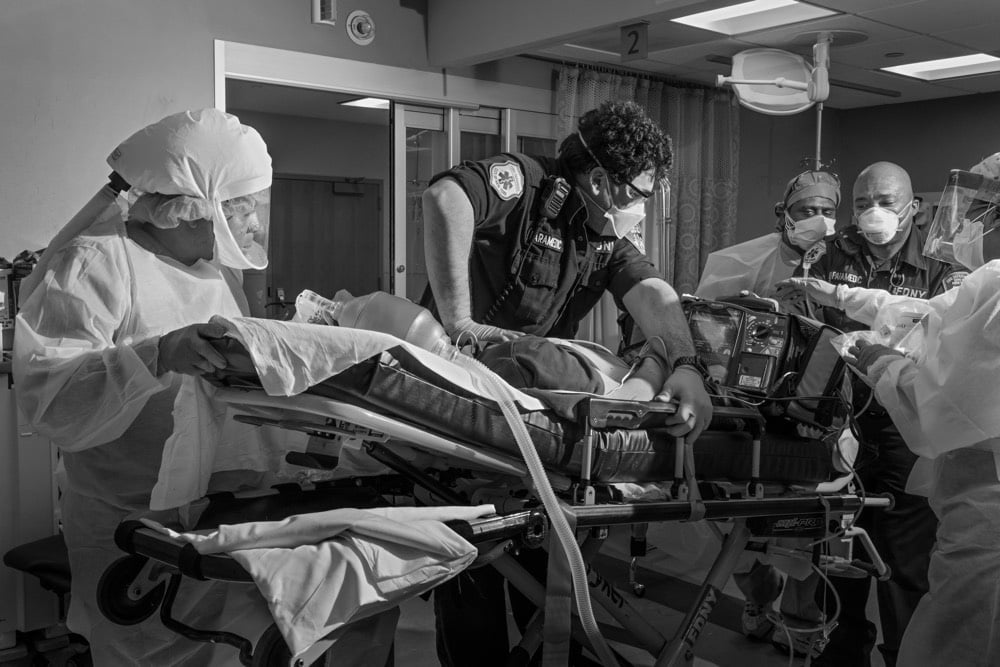
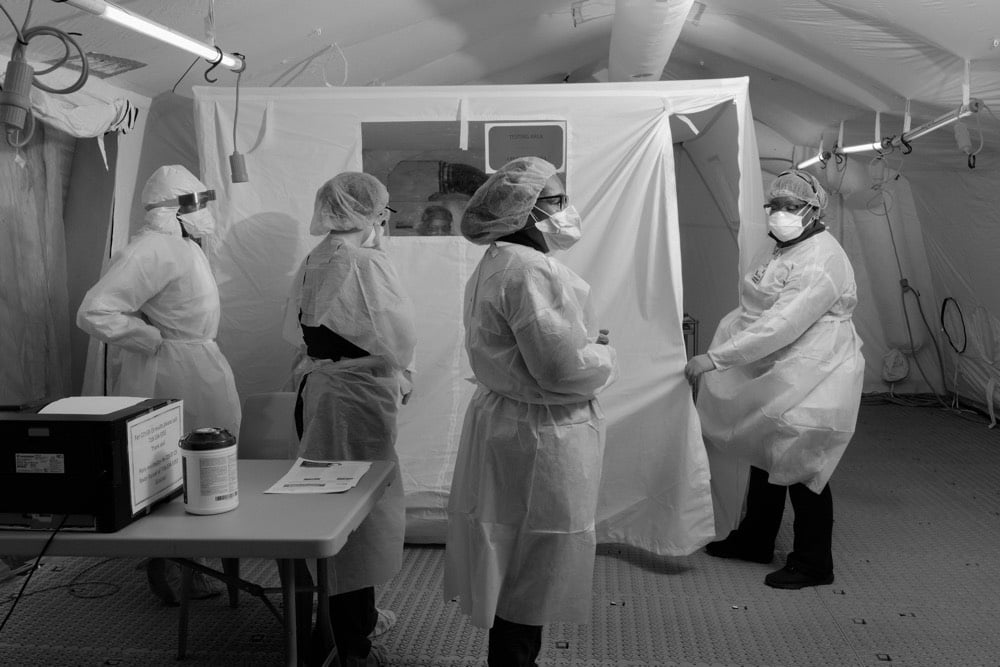
Clad in full PPE, photographer Philip Montgomery visited seven different NYC public hospitals over the course of a week for the NY Times Magazine, documenting the hospital workers’ fight against Covid-19, supply shortages, and intense working conditions.
At Elmhurst, the improvisation began as soon as the first surge of coronavirus patients started arriving in the middle of March. In order to more efficiently sift through the crowds and find the most severe cases, the staff set up a divider at the entrance. Medical workers armed with thermometers and oxygen monitors steered people with milder symptoms to a separate treatment tent. Those who were seriously ill went into critical care. Thirteen patients at the hospital died over a 24-hour stretch during the fourth week in March. A refrigerated trailer was parked behind the building to store dead bodies.
In a short behind-the-scenes video about his photos and the piece, Montgomery says “I think if the general public could stand where I was for at least 10 to 30 seconds, I think everyone would be staying home.”
From the same issue of the magazine, Dr. Helen Ouyang: I’m an E.R. Doctor in New York. None of Us Will Ever Be the Same. What initially started as an article about the situation in Italy rapidly escalates into NYC hospitals fighting those same battles.
Family members weren’t allowed into the hospital because they, too, could get infected or spread the virus to others if they themselves were sick. But Duca asked for permission from his supervisor to let the man’s wife and daughter in, just for a few minutes. “I saw his face when he looked at his wife coming inside this room,” Duca recalls. “He smiled at her. It was a fraction of a second. He had this wonderful smile.” He continues: “Then I saw that he was looking at me. He realized that there was something wrong if only his relatives were coming inside.” The man knew in that instant that he was going to die, Duca says. As the man’s breathing worsened, morphine was started. He died 12 hours later.
Read the whole thing; it’s upsetting, terrifying, and deeply humanizing. I wish Americans watched less TV news and read more — if everyone in the US read these articles, I believe the entire tone of this crisis would change and become more urgent.
Prepare for the Ultimate Gaslighting
Julio Vincent Gambuto writes that the Covid-19 pandemic has given Americans an unprecedented chance to “see ourselves and our country in the plainest of views” and that we should prepare for a coalition of powerful forces that will try to convince us that this whole thing never happened.
Until then, get ready, my friends. What is about to be unleashed on American society will be the greatest campaign ever created to get you to feel normal again. It will come from brands, it will come from government, it will even come from each other, and it will come from the left and from the right. We will do anything, spend anything, believe anything, just so we can take away how horribly uncomfortable all of this feels. And on top of that, just to turn the screw that much more, will be the one effort that’s even greater: the all-out blitz to make you believe you never saw what you saw. The air wasn’t really cleaner; those images were fake. The hospitals weren’t really a war zone; those stories were hyperbole. The numbers were not that high; the press is lying. You didn’t see people in masks standing in the rain risking their lives to vote. Not in America. You didn’t see the leader of the free world push an unproven miracle drug like a late-night infomercial salesman. That was a crisis update. You didn’t see homeless people dead on the street. You didn’t see inequality. You didn’t see indifference. You didn’t see utter failure of leadership and systems.
How to build your own Nintendo Switch at home. I might have to resort to this if Nintendo doesn’t figure out their supply issues…
Socials & More