Entries for May 2018
This is a blooper reel from Emmet Otter’s Jug-Band Christmas, a 1977 TV special produced by The Jim Henson Company. Take after take, they’re trying to roll a tiny drum out of a doorway in a very specific way and the Muppet characters get increasingly frustrated and amusing as it goes along. If the voice of the Ma character sounds familiar, that’s Frank Oz, who is also the voice of Yoda, Grover, and Bert from Sesame Street.

Everyday Arcade, which is responsible for The GOP Arcade (sample game titles include The Voter Suppression Trail and Thoughts & Prayers: The Game!), has designed a new game called MTA Country. Based on the SNES title Donkey Kong Country, the goal of MTA Country is to guide Andrew Cuomo, Bill de Blasio, and celebrity straphanger Gregg Turkin past hazards like track fires and stalled trains to their destination. That ending though… Hmm…
Phil Holland shot some aerial footage of NYC that he stitched together into a video with a resolution of 12K. That’s a 100-megapixel image, folks, “48.5 times the resolution of HD 1080p”. Holland has a writeup of the process used to capture the video, which is available at a down-sampled resolution of merely 8K. He shared several down-sampled 4K stills from the video, but I wish he would have included a 12K image as well, just to see what kind of detail is possible.
Is 12K footage of any practical use without 12K displays? My computer screen has 5K resolution, so I can’t even view 8K video or photos at full resolution, much less 12K. Does a 12K image down-sampled to 8K viewed on a 5K display look better than a 5K image on a 5K display? Better than an 8K image down-sampled to 5K on a 5K display?
Update: Cinematographer Steve Yedlin, who most recently was director of photography for The Last Jedi, did a comparison of different resolutions last year and concluded that bigger is no longer better. No Film School has a short summary of Yedlin’s findings.
The biggest takeaway for filmmakers is that we have already likely passed the point where extra resolution is noticeable to an end user. While going from standard definition to high definition was a huge leap in image quality, going from HD to UltraHD won’t even be noticeable for most users, and anything beyond that offers no benefit at all. The goal of these tests it to have technical discussions in a fashion that is understandable by laypeople, and Yedlin does a great job of that.
This is a similar conclusion to where we’ve been with smartphone and other digital cameras for awhile: megapixel count is no longer the thing that matters. (via @byBrettJohnson)
In this short video, Art House Politics goes through all of the characters in Mario Kart 8 and describes their political alignments.
Mario is just your average working class guy, like “oh get the government off my back” kinda guy. Luigi is a Republican, like a nerdy technocratic…like he cares about the debt to GDP ratio. Princess Peach: monarchist. Daisy is an environmentalist. Rosalina is a flat-earther. Tanooki Mario would only care about kink shaming. Cat Peach is alt-right, but one of those female alt-right YouTube personalities that are really popular.
Hello, it is I, once and future Kottke.org guest editor Aaron Cohen. In the years since my objectively wonderful and technically perfect stints posting skateboarding and BMX videos here, I opened an ice cream shop in Somerville, MA called Gracie’s Ice Cream. As an ice cream professional and Kottke.org alumni, I’m not qualified for much except for writing about ice cream on Kottke.org (and posting skateboarding and BMX videos which I will do again some day). Now that I’ve mentioned Kottke.org 4 times in the first paragraph per company style guide, let’s get on with the post.
At aiweirdness.com, researcher Janelle Shane trains neural networks. And, reader, as an ice cream professional, I have a very basic understanding of what “trains neural networks” means [Carmody, get in here], but Shane recently shared some ice cream flavors she created using a small dataset of ice cream flavors infected with a dataset of metal bands, along with flavors created by an Austin middle school coding class. The flavors created by the coding class are not at all metal, but when it comes to ice cream flavors, this isn’t a bad thing. Shane then took the 1600 original flavor non-metal ice cream flavor dataset and created additional flavors.

The flavors are grouped together loosely based on much they work on ice cream flavors. I figured I’d pick a couple of the flavor names and back into the recipes as if I was on a Chopped-style show where ice cream professionals are given neural network-created ice cream flavor names and asked to produce fitting ice cream flavors. I have an asterisk next to flavors I’m desperate to make this summer.
From the original list of metal ice cream flavors:
*Silence Cherry - Chocolate ice cream base with shredded cherry.
Chocolate Sin - This is almost certainly a flavor name somewhere and it’s chocolate ice cream loaded with multiple formats of chocolate - cookies, chips, cake, fudge, you name it.
*Chocolate Chocolate Blood - Chocolate Beet Pie, but ice cream.
From the students’ list, some “sweet and fun” flavors:
Honey Vanilla Happy - Vanilla ice cream with a honey swirl, rainbow sprinkles.
Oh and Cinnamon - We make a cinnamon ginger snap flavor once in a while, and I’m crushed we didn’t call it “Oh and Cinnamon.” Probably my favorite, most Gracie’s-like flavor name of this entire exercise.
From the weirder list:
Chocolate Finger - Chocolate ice cream, entire Butterfinger candy bars like you get at the rich houses on Halloween.
Crackberry Pretzel - Salty black raspberry chip with chocolate covered pretzel.
Worrying and ambiguous:
Brown Crunch - Peanut butter Heath Bar.
Sticky Crumple - Caramel and pulverized crumpets.
Cookies and Green - Easy. Cookies and Cream with green dye.
“Trendy-sounding ice cream flavors”:
Lime Cardamom - Sounds like a sorbet, to be honest.
Potato Chocolate Roasted - Sweet potato ice cream with chocolate swirl.
Chocolate Chocolate Chocolate Chocolate Road - We make a chocolate ice cream with chocolate cookie dough called Chocolate Chocolate Chocolate Chip Cookie Dough, so this isn’t much of a stretch. Just add chocolate covered almonds and we’re there.
More metal ice cream names:
*Swirl of Hell - Sweet cream ice cream with fudge, caramel, and Magic Shell swirls.
Nightham Toffee - This flavor sounds impossibly British so the flavor is an Earl Gray base with toffee bits mixed in.
In an Atlantic piece titled The World Still Spins Around Male Genius, Megan Garber writes:
The notion that the women’s stories about his behavior were somehow a nuisance, though — the notion that things would be so much simpler, macrocosmically, had they kept their experiences to themselves — remains with us. I know that because, shortly before The New Yorker published its story about Eric Schneiderman, the poet and memoirist and essayist Mary Karr published her own story on Twitter. This one was about David Foster Wallace. It was about the writer stalking her and abusing her and, in general, refusing to take no for an answer. As Karr elaborated, in one tweet that reads, in the #MeToo context, as its own form of starkly tragic poetry: “tried to buy a gun. kicked me. climbed up the side of my house at night. followed my son age 5 home from school. had to change my number twice, and he still got it. months and months it went on.”
The added tragedy of all this — kicked, climbed, son, gun, months — is the fact that Karr was not, specifically, making allegations. As Jezebel’s Whitney Kimball pointed out, “The fact that [Wallace] abused [Karr] is not a revelation; this has been documented and adopted by the literary world as one of Wallace’s character traits.” D.T. Max’s 2012 biography of Wallace, Every Love Story Is a Ghost Story, documented those abuses: Wallace, Max alleges, once pushed Karr from a vehicle. During another fight, he threw a coffee table at her. Karr, in her tweets, was merely repeating the story she has told many times before. A story that has been treated — stop me if this sounds familiar — largely as a complication to another story. In this case, the story of the romantically unruly genius of one David Foster Wallace.
You can read Karr’s thread for more stories…many more chimed in there (and elsewhere online) to share that Wallace slept with his students and was a serial womanizer.
I don’t know where to start in writing about this. But as someone who has written about his books, stories, and essays extensively for more than a decade — no writer’s work has been more important and influential to me than Wallace’s has — I think it’s important to state plainly for the record that David Foster Wallace, for a significant portion of his adult working life, was physically abusive and terrible to women.
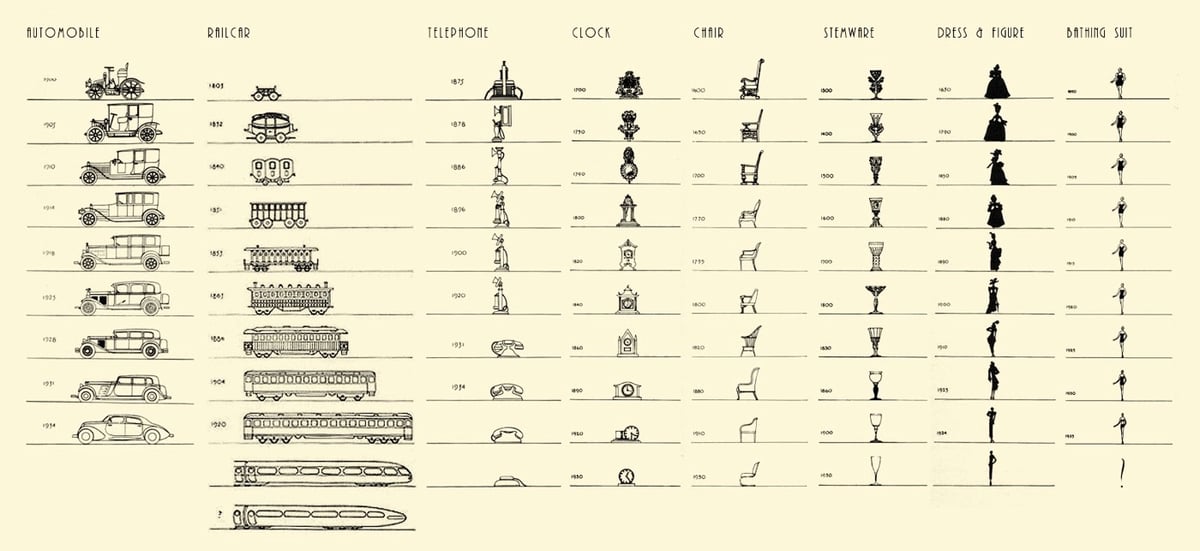
From legendary designer Raymond Loewy, a chart published in 1934 that shows the evolution in design of items such as cars, telephones, stemware, railcars, clocks, and women’s apparel. Loewy was known was “The Father of Streamlining” and these drawings very much reflect his design style. (via @michaelbierut)
Update: MacRae Linton chopped up Loewy’s chart into a proper timeline.


Illustrator Richard Wilkinson is drawing a series of insects inspired by Star Wars and other pop cultural items.
This project was born out of a fascination with collecting, cataloguing and classifying.
It draws inspiration from classic Natural History illustration but explores the subjects that we love to collect and classify from the modern world: Films, TV, Video Games, Comics, Vehicles, Sneakers, Brands etc.
The first book of the series, working title: “Arthropoda Iconicus Volume I: Insects From A Far Away Galaxy”, is a collection of insects that bear a subtle yet uncanny resemblance to characters and vehicles from the worlds favourite space opera.
You can check out more on his Instagram and a few are available as prints in his online shop. (via colossal)
I’ve been thinking about Trump’s presidency in terms of a coup to come, but Rebecca Solnit makes a compelling case for that event already being in our rear view mirror.
A lot of people are waiting for something dramatic to happen, some line to be crossed, an epic event like the firing of special counsel Robert Mueller III that will allow them to say that now we have had a coup and now we are ready to do something about it.
We already had the coup.
It happened on November 8, 2016, when an unqualified candidate won a minority victory in a corrupted election thanks in part to foreign intervention. Any time is the right time to pour into the streets and demand that it all grinds to a halt and the country change direction. The evidence that the candidate and his goons were aided by and enthusiastically collaborating with a foreign power was pretty clear before that election, and at this point, they are so entangled there isn’t really a reason to regard the born-again alt-right Republican Party and the Putin Regime as separate entities.
Update: A site called No Package Deals argues that the coup took place earlier than the 2016 election and began with the obstruction by Senate Republicans in not seating any judges, including Scalia’s replacement to the Supreme Court.
In February of 2016, after the death of Associate Justice Antonin Scalia, Mitch McConnell announced that the President no longer had the power to appoint justices to the Supreme Court, period. For some years now the President has not had the power to appoint judges, but nobody much noticed because it wasn’t the Supreme Court. The Republicans just said, Nope. Not seating your judges. End of discussion.
When McConnell said, Nope, not seating your Supreme Court justice either, we’ve already told you we’re not seating your judges, most people noticed. President Obama nominated someone anyway. McConnell stood firm: Mr. President, we have stripped that power from you. You are not going to seat any judges. Nobody did anything. The coup stood.
There’s also this little tidbit concerning Iran:
On March 9th of that same year 47 Republican members of the Senate wrote a letter denying in plain terms the President’s power to negotiate with a specific foreign power. They sent their letter to the government of Iran. Paraphrased they said, Don’t make any deals with our President, because we’ll weasel out of them as soon as he’s not looking. Iran took a chance and made the deal with the President. We will see how it comes out.
Well, it turned out pretty much like No Package Deals expected. (via @heatherhollick)
Favstar is shutting down because Twitter sucks. Oh sorry, I meant that Favstar is shutting down because Twitter indiscriminately changed their API for the 35th time and they suck.
Hot on the heels of the Yanny/Laurel audio illusion, many people shared other illusions that are just as weird and fun.
The McGurk effect pairs different mouth movements with speech, and you tend to hear different things with different mouth movements.
In this video, you hear the word for whatever object is on the screen (bill, mayo, pail) even though the audio doesn’t change:
And in this one, whichever word you focus on, “green needle” or “brainstorm”, that’s what you hear:
What all of these effects demonstrate is that there are (at least) two parts to hearing something. First, there’s the mechanical process of waves moving through the air into the ear canal, which triggers a physical chain reaction involving the ear drum, three tiny bones, and cochlear fluids. But then the brain has to interpret the signal coming from the ear and, as the examples above show, it has a lot of power in determining what is heard.
My kids and I listen to music in the car quite often (here’s our playlist, suggestions welcome) and when Daft Punk’s Get Lucky comes on, my son swears up and down that he hears the mondegreen “up all Mexican lucky” instead of “up all night to get lucky”. If I concentrate really hard, I can hear “Mexican lucky” but mostly my brain knows what the “right” lyric is…as does his brain, but it’s far more convinced of his version.
Update: On the topic of misheard lyrics to Get Lucky, there is this bit of amazingness:
(via @jaredcrookston)
Like many of you, I read the news of a single person killing at least 10 people in Santa Fe, Texas today. While this is an outrageous and horrifying event, it isn’t surprising or shocking in any way in a country where more than 33,000 people die from gun violence each year.
America is a stuck in a Groundhog Day loop of gun violence. We’ll keep waking up, stuck in the same reality of oppression, carnage, and ruined lives until we can figure out how to effect meaningful change. I’ve collected some articles here about America’s dysfunctional relationship with guns, most of which I’ve shared before. Change is possible — there are good reasons to control the ownership of guns and control has a high likelihood of success — but how will our country find the political will to make it happen?
An armed society is not a free society:
Arendt offers two points that are salient to our thinking about guns: for one, they insert a hierarchy of some kind, but fundamental nonetheless, and thereby undermine equality. But furthermore, guns pose a monumental challenge to freedom, and particular, the liberty that is the hallmark of any democracy worthy of the name — that is, freedom of speech. Guns do communicate, after all, but in a way that is contrary to free speech aspirations: for, guns chasten speech.
This becomes clear if only you pry a little more deeply into the N.R.A.’s logic behind an armed society. An armed society is polite, by their thinking, precisely because guns would compel everyone to tamp down eccentric behavior, and refrain from actions that might seem threatening. The suggestion is that guns liberally interspersed throughout society would cause us all to walk gingerly — not make any sudden, unexpected moves — and watch what we say, how we act, whom we might offend.
We’re sacrificing America’s children to “our great god Gun”:
Read again those lines, with recent images seared into our brains — “besmeared with blood” and “parents’ tears.” They give the real meaning of what happened at Sandy Hook Elementary School Friday morning. That horror cannot be blamed just on one unhinged person. It was the sacrifice we as a culture made, and continually make, to our demonic god. We guarantee that crazed man after crazed man will have a flood of killing power readily supplied him. We have to make that offering, out of devotion to our Moloch, our god. The gun is our Moloch. We sacrifice children to him daily — sometimes, as at Sandy Hook, by directly throwing them into the fire-hose of bullets from our protected private killing machines, sometimes by blighting our children’s lives by the death of a parent, a schoolmate, a teacher, a protector. Sometimes this is done by mass killings (eight this year), sometimes by private offerings to the god (thousands this year).
The gun is not a mere tool, a bit of technology, a political issue, a point of debate. It is an object of reverence. Devotion to it precludes interruption with the sacrifices it entails. Like most gods, it does what it will, and cannot be questioned. Its acolytes think it is capable only of good things. It guarantees life and safety and freedom. It even guarantees law. Law grows from it. Then how can law question it?
Roger Ebert on the media’s coverage of mass shootings:
Let me tell you a story. The day after Columbine, I was interviewed for the Tom Brokaw news program. The reporter had been assigned a theory and was seeking sound bites to support it. “Wouldn’t you say,” she asked, “that killings like this are influenced by violent movies?” No, I said, I wouldn’t say that. “But what about ‘Basketball Diaries’?” she asked. “Doesn’t that have a scene of a boy walking into a school with a machine gun?” The obscure 1995 Leonardo Di Caprio movie did indeed have a brief fantasy scene of that nature, I said, but the movie failed at the box office (it grossed only $2.5 million), and it’s unlikely the Columbine killers saw it.
The reporter looked disappointed, so I offered her my theory. “Events like this,” I said, “if they are influenced by anything, are influenced by news programs like your own. When an unbalanced kid walks into a school and starts shooting, it becomes a major media event. Cable news drops ordinary programming and goes around the clock with it. The story is assigned a logo and a theme song; these two kids were packaged as the Trench Coat Mafia. The message is clear to other disturbed kids around the country: If I shoot up my school, I can be famous. The TV will talk about nothing else but me. Experts will try to figure out what I was thinking. The kids and teachers at school will see they shouldn’t have messed with me. I’ll go out in a blaze of glory.”
In short, I said, events like Columbine are influenced far less by violent movies than by CNN, the NBC Nightly News and all the other news media, who glorify the killers in the guise of “explaining” them. I commended the policy at the Sun-Times, where our editor said the paper would no longer feature school killings on Page 1. The reporter thanked me and turned off the camera. Of course the interview was never used. They found plenty of talking heads to condemn violent movies, and everybody was happy.
Jill Lepore on the United States of Guns:
There are nearly three hundred million privately owned firearms in the United States: a hundred and six million handguns, a hundred and five million rifles, and eighty-three million shotguns. That works out to about one gun for every American. The gun that T. J. Lane brought to Chardon High School belonged to his uncle, who had bought it in 2010, at a gun shop. Both of Lane’s parents had been arrested on charges of domestic violence over the years. Lane found the gun in his grandfather’s barn.
The United States is the country with the highest rate of civilian gun ownership in the world. (The second highest is Yemen, where the rate is nevertheless only half that of the U.S.) No civilian population is more powerfully armed. Most Americans do not, however, own guns, because three-quarters of people with guns own two or more. According to the General Social Survey, conducted by the National Policy Opinion Center at the University of Chicago, the prevalence of gun ownership has declined steadily in the past few decades. In 1973, there were guns in roughly one in two households in the United States; in 2010, one in three. In 1980, nearly one in three Americans owned a gun; in 2010, that figure had dropped to one in five.
A Land Without Guns: How Japan Has Virtually Eliminated Shooting Deaths:
The only guns that Japanese citizens can legally buy and use are shotguns and air rifles, and it’s not easy to do. The process is detailed in David Kopel’s landmark study on Japanese gun control, published in the 1993 Asia Pacific Law Review, still cited as current. (Kopel, no left-wing loony, is a member of the National Rifle Association and once wrote in National Review that looser gun control laws could have stopped Adolf Hitler.)
To get a gun in Japan, first, you have to attend an all-day class and pass a written test, which are held only once per month. You also must take and pass a shooting range class. Then, head over to a hospital for a mental test and drug test (Japan is unusual in that potential gun owners must affirmatively prove their mental fitness), which you’ll file with the police. Finally, pass a rigorous background check for any criminal record or association with criminal or extremist groups, and you will be the proud new owner of your shotgun or air rifle. Just don’t forget to provide police with documentation on the specific location of the gun in your home, as well as the ammo, both of which must be locked and stored separately. And remember to have the police inspect the gun once per year and to re-take the class and exam every three years.
Australia’s gun laws stopped mass shootings and reduced homicides, study finds:
From 1979 to 1996, the average annual rate of total non-firearm suicide and homicide deaths was rising at 2.1% per year. Since then, the average annual rate of total non-firearm suicide and homicide deaths has been declining by 1.4%, with the researchers concluding there was no evidence of murderers moving to other methods, and that the same was true for suicide.
The average decline in total firearm deaths accelerated significantly, from a 3% decline annually before the reforms to a 5% decline afterwards, the study found.
In the 18 years to 1996, Australia experienced 13 fatal mass shootings in which 104 victims were killed and at least another 52 were wounded. There have been no fatal mass shootings since that time, with the study defining a mass shooting as having at least five victims.
From The Onion, ‘No Way To Prevent This,’ Says Only Nation Where This Regularly Happens:
At press time, residents of the only economically advanced nation in the world where roughly two mass shootings have occurred every month for the past eight years were referring to themselves and their situation as “helpless.”
But America is not Australia or Japan. Dan Hodges said on Twitter a few years ago:
In retrospect Sandy Hook marked the end of the US gun control debate. Once America decided killing children was bearable, it was over.
This can’t be the last word on guns in America. We have to do better than this for our children and everyone else whose lives are torn apart by guns. But right now, we are failing them miserably, and Hodges’ words ring with the awful truth that all those lives and our diminished freedom & equality are somehow worth it to the United States as a society.
What’s your author horoscope? (Mine = fellow Scorpio Margaret Atwood. My favorite writer, James Baldwin, is a Leo)
Each week (more or less), I write a newsletter for Kottke.org called Noticing that summarizes the previous week, looks for deeper connections between some of the material, and expands on one or more of the shorter quicklink posts that didn’t get the full blogpost treatment the first time around. Here’s an excerpt from this week’s newsletter, on the internet and wasted time.
…
If all art aspires to the condition of music, then all media aspires to the condition of television. Television is passive and active, shallow and comprehensive, cheap and expensive, gratuitous and mandatory — an easy way to waste time, where you can find anything you want, but it all just sort of happens to you, without frustration or interference.
Dan Nosowitz’s “I Don’t Know How To Waste Time on the Internet Anymore” strikes a chord partly because it shows how the web has become too much like TV (too much corporate control, homogeneity, amateurs playing at being professionals in all the wrong ways), but also not enough like TV (delivering easy entertainment in bingeable quantities). You can still get lost down a rabbit hole on the web, but you have to work at it, and the results aren’t as satisfying as they used to be.
A lot of this rings very true to me. Some of it is unquestionable: the bottoming out of the ad market, and everything that caused that, has made it really hard for niche, indie web sites with an unusual point of view to survive. The commercial websites and traditional publishers who colonized that space are a lot more same-y and predictable.
Social media also transforms our experience. You used to be able to come across a blog or forum post, in your RSS feed or straight up navigating in your browser, and have a relatively fresh and unmediated reaction to it. You could then share that reaction on your blog or wherever. Even the blog style favored generous blockquotes as much as it did hot takes. Now everything feels a lot more picked-over. Something like Yanny vs. Laurel, by the time you actually listen to it for yourself, you’ve seen friends scream at each other at the top of their lungs, a half-dozen quickly-manufactured memes, a dozen or so copycat posts, and five or six scientific explainers or web spelunkers who’ve traced the auditory hallucination’s journey from the web’s bowels to its front pages. All of the moves have been mapped out. There aren’t a lot of surprises any more.
Trust me: I spend most of the week looking for things that I hope will surprise and delight Kottke readers for the one day of the week I manage the site. They don’t just float to the top.
So what does this mean? Paradoxically, wasting time is now more work. You can certainly do it — the web is as full of nonsense as it ever was — but you have to look a little bit harder. You have to learn some new things. You have to find your own corners charting unmonetizable enthusiasms. It’s not just going to happen to you. You have to dig your own rabbit holes.
The other thing is that I’ve come to treasure people who are genuinely inventive and interactive on social media. Finding people who will riff with you and are skilled at interjecting weirdness and intellect is becoming more valuable, to me, than people who have the precisely titrated level of anger or the perfect bon mot at whatever new atrocity has just crossed the stream. That sort of thing is valuable, but there’s a glut of it.
Relatedly: the other other thing is that when the world sucks, the web sucks. The whole country is broken. Fun is harder to find all over. Yet somehow, we do what we can.
This charming short film (part documentary, part cartoon) explains how to use a dial telephone:
If you think about it, there are a lot of moving parts to this interface besides just using the dial! You have to know how a telephone directory works; you have to know what a dial tone, a ring, and a busy signal all indicate; plus, you have to know the etiquette and conventions of telephone conversations, all of which requires a certain amount of training. It’s certainly much easier on the user’s side to use an operator to make a telephone connection. But before computers, you can’t do that at scale. Think of all that knowledge and training, now evaporating before a new UI paradigm.
It’s a common and (on its face) rhetorical move: take something that’s happening now and map it onto the past. Better yet, take something atrocious that’s happening now and show how it maps onto something atrocious in the past, ideally affecting the very people who are now supporting the atrocities. “See?” this trope says: “what you’re doing to other people is exactly what was done to you.”
That’s the basic structure of “resistance genealogy,” as seen in clashes over immigration. “Tomi Lahren’s great-great-grandfather forged citizenship papers; Mike Pence’s family benefited from “chain migration”; James Woods’ ancestors fled famine and moved to Britain as refugees,” etc.
Rebecca Onion argues, convincingly, that this doesn’t work:
The chasm between the life and experiences of a white American, even one who’s descended from desperate immigrants of decades past, and the life of this Honduran mother is the entire point of racist anti-immigration thought. Diminishment of the human qualities of entering immigrants (“unskilled” and “unmodern” immigrants coming from “shithole” countries) reinforces the distance between the two. People who support the Trump administration’s immigration policies want fewer Honduran mothers and their 18-month-olds to enter the country. If you start from this position, nothing you hear about illiterate Germans coming to the United States in the 19th century will change your mind.
Besides underestimating racism, it flattens out history, and assumes that if people only knew more about patterns of historical racism, they might be convinced or at least shamed into changing how they talk about it. Everything we’ve seen suggests that isn’t the case.
I’m going to take this one step further and say this is a weakness in most resorts to historical and political analogies deployed as a tool to understand or persuade people about the present.
For example, consider Donald Trump saying, regarding immigrants trying to enter the United States, “these aren’t people, these are animals.” This is a disgusting thing to say and way to think — and not just because German Nazis and Rwandan perpetrators of genocide used similar language in a different context, and regardless of whether he was using it to refer to immigrants in general or members of a specific gang. It’s bad, it’s racist, it’s shitty, and you really don’t need the added leverage of the historical analogy in order to see why. But that leverage is tempting, because it shows off how much we know, it underlines the stakes, and it converts bad into ultra-bad.
This hurts me to say, because I love history and analogies both. But there’s a limit to how much they can tell us and how well they work. And playing “gotcha!” is usually well beyond the limits of both.

A new study published in Proceedings of the National Academy of Sciences analyzes deep ice cores in Greenland for traces of lead pollution in antiquity. This pollution, the scholars claim, matches the production of Roman silver coins from impure alloys from mines in what’s now modern Spain. In short, we can see Roman monetary production, and by proxy, peaks and valleys in the economy throughout the Roman world, on an extremely granular basis, captured year-by-year in arctic ice.
In 218 B.C., for instance, when Rome fought with Carthage in the Second Punic War, lead pollution appears to fall—and then it rises, abruptly, as Roman soldiers seized Carthaginian mines in southern Spain and put them to use. It also detects nonviolent events: When Rome debased its currency, reducing the amount of silver in each denarius coin in 64 A.D., lead pollution in the air fell…. When compared with other studies, research suggests that Western Europe may have seen higher lead emissions during the Pax Romana than at any time prior to the Industrial Revolution, nearly 1,800 years later.
Which is, of course, part of the lesson: one argument holds that lead pollution, both in the air, in water pipes, and other uses throughout Rome, eventually slowly poisoned and destroyed the Roman Empire, along with plagues, imperial overreach, and political dysfunction. Our civilization, however, is at least documenting its own destruction in the written record in much greater detail.
Degrees of Uncertainty is an upcoming documentary by Neil Halloran that “uses data-driven animation to explore the topic of global warming”. It’s based on this XKCD comic of A Timeline of Earth’s Average Temperature.
Halloran is a creator of the excellent The Fallen of World War II interactive documentary, so I’m looking forward to seeing what he does with the topic of climate change.

Speaking of great magazine covers, for their issue on plastic, National Geographic put artist Jorge Gamboa’s arresting plastic bag iceberg image on the cover. A simple yet powerful concept, perfectly executed.
Update: The iceberg plastic bag is not an original concept. Prior art includes a 2015 ad campaign for Tesco and a pair of stock images on Getty (date not listed). It’s unclear whether Gamboa created his image after seeing these images or if multiple people had this same idea. (via @krjohn01/status/997198395189223424)
In April 2015, Autistic Abby wrote on their Tumblr about how people mistakenly conflate two distinct definitions of “respect” when relating to and communicating with others.
Sometimes people use “respect” to mean “treating someone like a person” and sometimes they use “respect” to mean “treating someone like an authority”
and sometimes people who are used to being treated like an authority say “if you won’t respect me I won’t respect you” and they mean “if you won’t treat me like an authority I won’t treat you like a person”
and they think they’re being fair but they aren’t, and it’s not okay.
This is an amazing & astute observation and applies readily to many aspects of our current political moment, i.e. the highest status group in the US for the past two centuries (white males) experiencing a steep decline in their status relative to other groups. This effect plays out in relation to gender, race, sexual orientation, age, and class. An almost cartoonishly on-the-nose example is Trump referring to undocumented immigrants as “animals” and then whining about the press giving him a hard time. You can also see it when conservative intellectuals with abundant social standing and privilege complain that their ideas about hanging women or the innate inferiority of non-whites are being censored.
Men who abuse their partners do this…and then sometimes parlay their authoritarian frustrations & easily available assault weapons into mass shootings. There are ample examples of law enforcement — the ultimate embodiment of authority in America — treating immigrants, women, black men, etc. like less than human. A perfect example is the “incel” movement, a group of typically young, white, straight men who feel they have a right to sex and therefore treat women who won’t oblige them like garbage.
You can see it happening in smaller, everyday ways too: never trust anyone who treats restaurant servers like shit because what they’re really doing is abusing their authority as a paying customer to treat another person as subhuman.
A 10-part Netflix/ESPN documentary series on Michael Jordan and the 1990s Chicago Bulls? Sure, I will watch the hell out of that. The Bulls were my team1 when I was a kid and for me, Jordan is still the greatest basketball player of all time. Ok, I am admittedly biased and you could probably talk me into Bill Russell (all those championships), Kareem (stats, championships, longevity), or more recently, Tim Duncan (championships, longevity, consistency)…they were certainly all far more decent people than Jordan, an ultra-competitive dick, was.
But you can get out of here with your LeBrons and Steph Currys…until they start stringing together back-to-back-to-back championships, they are not in the conversation. Jordan had the stats and the championships; the Bulls were a proper dynasty. I’ll put it this way: for eight straight years in the NBA, the most intensely competitive sports league in the US, when Michael Jordan played a full season (in six of those years), his team won the NBA championship. They had it on lock. When he didn’t, they didn’t. Case closed.
(Also, I don’t want to tell the filmmakers their business, but if one of these episodes isn’t just 50 straight minutes of Jordan highlights, they’re cheating the American public.)
I’ve never watched a single second of the reality TV show Keeping Up with the Kardashians but I found Rachel Tashjian’s When a Modigliani Almost Changed the Kardashians’ Lives to be an engaging read.
Suddenly, Scott’s doubts seem to diminish. Kourtney finds him a few days later examining carpet samples and asks if they’re for his new home. He delivers a maxim we should all live by: “I look at carpet only for aviation and yachts.” When Kourtney asks why he’s “suddenly into this,” he begins screaming: “I’VE ALWAYS BEEN INTO BEING ULTRA RICH! I JUST NEVER BELIEVED IT WAS GOING TO HAPPEN THE WAY IT’S GOING TO HAPPEN!”
The tension builds to obscene absurdism. The idea that the Kardashians — who live in Calabasas, a city with a median income of $119,624, and who film each scene sprawled on pristine white couches in endless living rooms, and snacking off giant marble countertops in family room-sized kitchens — are dreaming about getting rich is almost too…rich. But then, this is the arc of American promise, regardless of how much money you have: this idea that something everyone else thinks is worthless or pointless is actually going to make you rich and famous is what has fueled 22 seasons of Antiques Roadshow, is perhaps the foundation of Southern Gothic literature, and is what makes people believe in the American dream to begin with.
In the NY Times, architect and urban designer John Massengale discusses how four European cities (London, Amsterdam, Stockholm, Copenhagen) addressed their urban traffic problems and how NYC might apply those lessons to fix its own traffic issues. Massengale shared what the Dutch learned in reconfiguring their streets:
1. When drivers slow down to 20 m.p.h. or below, they are less likely to hit people and much less likely to seriously injure or kill people if they do hit them.
2. The best way to slow cars down is to throw away all the techniques that traffic engineers developed to make traffic flow quickly.
3. When you throw out all the detritus of traffic engineering, it becomes much easier to make beautiful places where people want to walk. Bike riding becomes more pleasant and safer as well.
His four-step plan to fix traffic in Manhattan is equally simple in principle:
The next step is to adopt congestion pricing below 96th Street in Manhattan and then:
1. Decrease the number of Manhattan streets that function as transportation corridors primarily devoted to moving machines through the city.
2. Design and build Slow Zones where people actually drive slowly.
3. Make the transportation corridors that remain better urban places, with a better balance between city life and moving cars.
Seems to me a vital part of this is fixing, expanding, and subsidizing the subway system…get everyone using the subway. Better, more reliable, and cheaper public transportation = less demand for taxis and Lyfts. As Bogota mayor Enrique Peñalosa said, “A developed country is not a place where the poor have cars. It’s where the rich use public transport.”
The Ultimate Guide to Bizarre Lies Your Mom Told You. Eating bread crusts will make your hair curly?! The only one I ever got was “if you cross your eyes, they’ll stay like that”.
I’ve written before about the Shepard scale and its use by Hans Zimmer in the soundtrack for Dunkirk.
Zimmer and Dunkirk director Christopher Nolan achieved that effect by utilizing an auditory illusion called the Shepard tone, a sound that appears to infinitely rise (or fall) in pitch — the video above refers to it as “a barber’s pole of sound”.
The effect is apparent throughout the soundtrack as a seemingly never-ending crescendo. But as Ed Newton-Rex explains, Zimmer was a bit more clever in the way he used the Shepard scale in the music:
So Zimmer isn’t just using the Shepard scale to build tension. He’s using three simultaneous Shepard scales, on three different timescales, to build tension in three storylines that are moving at different paces. The bottom part represents the week of the soldiers; the middle part the day of the men on the boat; and the top part the hour of the pilots. All start in different places, but build in intensity to the same point.
In short, he’s taken the idea of the Shepard scale, and applied it to the unique structure of Dunkirk.
Cool!
For the Universe in Verse 2018 poetry event, Kelli Anderson created this wonderful papercraft stop motion animation to accompany Jane Hirshfield’s reading of her short poem, Optimism.
More and more I have come to admire resilience.
Not the simple resistance of a pillow, whose foam
returns over and over to the same shape, but the sinuous
tenacity of a tree: finding the light newly blocked on one side,
it turns in another. A blind intelligence, true.
But out of such persistence arose turtles, rivers,
mitochondria, figs — all this resinous, unretractable earth.
The music is by Zoë Keating…a song called Optimist. Here’s more on the project from Maria Popova.
Black Panther animation supervisor Daryl Sawchuk goes through some of the digital visual effects from the film, with an emphasis on the suits for Black Panther and Killmonger, both of which are extensively digital throughout the film.
I don’t know exactly when this happened, but somewhere in the past few years, the digital visual effects in these big action movies stopped looking fake to me. Either I’m less discerning about my blockbuster entertainment these days or the effects have successfully crossed the uncanny valley. Probably a bit of both. Engadget’s Devindra Hardawar disagrees, btw: ‘Black Panther’ is amazing. Why are its CG models so terrible?
You can see some more of Black Panther’s visual effects in this video and read about them in Art of VFX.
There’s a safe and effective vaccine for Lyme disease. It was pulled from the market because of anti-vaccine hysteria.
Take a listen to this short audio clip of a computerized voice speaking a single word repeated twice:
Do you hear it saying “Laurel” or “Yanny”? Opinions are mixed: some people report hearing “Laurel” and others “Yanny”. Both Vox and the NY Times took stabs at possible explanations.
Of course, in the grand tradition of internet reportage, we turned to a scientist to make this article legitimately newsworthy.
Dr. Jody Kreiman, a principal investigator at the voice perception laboratory at the University of California, Los Angeles, helpfully guessed on Tuesday afternoon that “the acoustic patterns for the utterance are midway between those for the two words.”
“The energy concentrations for Ya are similar to those for La,” she said. “N is similar to r; I is close to l.”
At first I thought the whole thing was a joke, like a circa-2018 rickroll. When I listened to the clip on my iPhone speakers and iMac speakers, I clearly heard “Yanny”. But then I plugged my headphones into my iMac and clearly heard “Laurel”. Weird! Even weirder: after unplugging my headphones and playing the clip again through my iMac speakers, I now heard “Laurel”. WTF? But then if I played it once more through the speakers, it turns back to “Yanny”. I’ve done this about 10 times and it happens this way every time: “Yanni” on speakers, “Laurel” on headphones, “Laurel” on speakers, “Yanny” on speakers. It’s like my brain remembers the “Laurel” it heard in the headphones, but only long enough to hear it exactly once through the speakers. FASCINATING.
See also the McGurk effect.
Update: Here’s a thread from psycholinguist Suzy Styles that explains what’s going on with this illusion.
In short, this #earllusion contains acoustic info from both names. ‘Yanny’ is clearer in the higher frequencies because of the clear signal for “y” sounds in F2. ‘Laurel’ is clearer in the low frequencies for F1. Play with your stereo settings and watch your brain switch tracks!
(via @wisekaren)
Update: Wired’s Louise Matsakis tracked down where the audio clip originated: a vocabulary.com definition for the word “laurel”.
On May 11, Katie Hetzel, a freshman at Flowery Branch High School in Georgia, was studying for her world literature class, where “laurel” was one of her vocabulary words. She looked it up on Vocabulary.com and played the audio. Instead of the word in front of her, she heard “yanny.”
“I asked my friends in my class and we all heard mixed things,” says Hetzel. She then posted the audio clip to her Instagram story. Soon, a senior at the same school, Fernando Castro, republished the clip to his Instagram story as a poll. “She recorded it and put it on her story then I remade the video and posted it,” Castro says. “Katie and I have been going back and forth and we both agree that we had equal credit on it.”
The audio clip in question was not constructed digitally…it was recorded by an opera singer in 2007.
“It’s an incredible story, it is a person, he is a member of the original cast of Cats on Broadway,” says Marc Tinkler, the CTO and cofounder of Vocabulary.com. He says that when the site first launched, they wanted to find individuals who had strong pronunciation, and could read words written in the international phonetic alphabet, a standardized representation of sounds in any spoken language. Many opera singers know how to read IPA, because they have to sing in languages they don’t speak.
Vocabulary.com has since added “yanny” to their site.
It’s a shame (but not surprising) that almost all of the social media coverage played up the Team Yanny vs Team Laurel aspect of this whole thing — “Which of Your Friends Is the Dumbest For Hearing ‘Yanny’” OMG CLICK HERE TO DRAG THEM ON SOCIAL — because the actual story and science are really interesting and will stay with you longer than you’ll be caught in public wearing that “team #yanny” tshirt you bought through someone’s Insta Story (swipe up!). (thx, liz)

I’m currently reading Emily Wilson’s recent translation of The Odyssey, but until I looked at this map of Odysseus’ journey, I had little idea how scenic his route home was.1 The gods were hella pissed! All this time, I’d been imagining him pinballing around amongst the Greek islands in the Aegean Sea, but the gods and fates blew Odysseus and his men to all corners of the Mediterranean Sea: Italy, Africa, and even Ibiza in Spain. That dude was LOST. (via open culture)

The New York Review is reissuing five of legendary illustrator Maira Kalman’s books for children that were originally published in the 90s. The books feature the adventures of Max the dog: Hey Willy, See the Pyramids, Swami on Rye: Max in India, Max Makes a Million, Max in Hollywood, Baby, and Ooh-la-la (Max in Love).
Kalman is a wonderful illustrator, one of my favorites. You can check out more of her work on her website.
Update: The Cut ran a long profile of Kalman by Rumaan Alam last month.
Newer posts
Older posts






Socials & More