



Advertise here with Carbon Ads
This site is made possible by member support. 💞
Big thanks to Arcustech for hosting the site and offering amazing tech support.
When you buy through links on kottke.org, I may earn an affiliate commission. Thanks for supporting the site!
kottke.org. home of fine hypertext products since 1998.
Beloved by 86.47% of the web.
Entries for May 2017
Shia LaBeouf as John McEnroe in an upcoming film about the Borg/McEnroe Wimbledon final in 1980? Ok.
A history of tea, the second most-consumed beverage in the world
From TED-ed and tea expert Shunan Teng, a short video on the history of tea, from its invention in China to its role in globalization.
Our history of tea begins with the legend of the “divine famer” Shen Nong who is credited in many ancient Chinese texts with various agricultural accomplishments. However, some scholars of ancient China now believe Shen Nong might in fact originally have referred to a group of people, living within China and utilizing particularly advanced agricultural techniques for the era. Over time this people’s knowledge of farming was canonized in the form of legends about a divine farmer who shared their name, and whose fame ultimately eclipsed their own.
The other less famous photo of Jack Ruby shooting Lee Harvey Oswald

Thread! Austin Kleon shared something he learned on Twitter yesterday: there are actually two photos of Jack Ruby about to shoot Lee Harvey Oswald taken by two different photographers. We’ve all seen the familiar one, taken by Bob Jackson:

But like Kleon, I had never seen Jack Beers’ version shown at the top of the post, taken a little more than a half-second before Jackson’s. Kleon says:
At the time, Bob Jackson was “depressed” because he didn’t have film in his camera when Kennedy was assassinated. When Beers’ superiors saw the negative they were sure he’d just won the Pulitzer. Meanwhile, Jackson’s editors asked if he’d gotten anything. Jackson’s shot captured the exact right moment, with Oswald recoiling in pain, making the face, etc. He won the Pulitzer and fame. Beers was devastated. He felt like he’d had the Pulitzer and lost it. His daughter says he never really got over his bad luck. So, you have two photographers shooting a guy who got shot — one’s career “ruined” for him, one’s made.
According to an article about the two men who took the photographs, Beers was personally acquainted with Ruby:
He loved crime stories, she says, and went on ride-alongs with the Dallas police. He also came to know a strange little man who often hung out at police headquarters, a stripclub operator named Jack Ruby.
To fatten his pocketbook, Mr. Beers even photographed some of Ruby’s “girls,” whose pictures are part of the family collection.
And Jackson was in President Kennedy’s motorcade and spotted Oswald’s rifle peeking out of a window:
And then came the first shot.
Instinctively, Mr. Jackson says he looked to where the shot was coming from — and saw a rifle protruding from a window in the east end of the sixth floor of the Texas School Book Depository. The Warren Commission concluded that Oswald fired three shots from a sniper’s perch he had constructed in that window.
But he’d used all of his film up getting crowd shots and was unable to reload quickly enough. Back to the Ruby Oswald photos:
“Out of the corner of my right eye, I saw a sudden movement … My first impression was, it was a photographer out of position or with a very short lens trying to improve his position, then the curse, ‘You son of a bitch,’ punctuated by the shot. The curse was in such an unnatural and excited voice, before it concluded I knew someone had gone berserk and was attacking Oswald.”
The sudden movement provoked Mr. Jackson, six-tenths of a second later, to snap the shutter.
“The reason Beers shot too soon, in comparison to me,” says Mr. Jackson, “is that he saw it easier and quicker than I did. Ruby was more in his vision. I had a better position because I wasn’t distracted by Ruby as much. I was still looking at Oswald’s face, and I knew I was going to shoot before whoever that was blocked my view.”
What a story. (via @austinkleon)
The Colors of Mister Rogers’ Cardigan Sweaters, 1969-2001
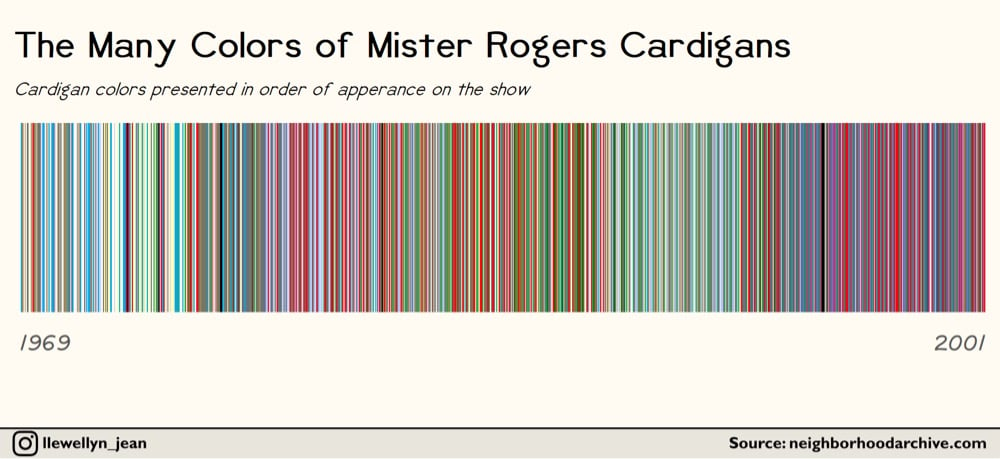
Using data from The Neighborhood Archive, Owen Phillips charted the color of every sweater Mister Rogers wore on his PBS television program from 1979 to 2001.
Some sweaters were worn once and then never again, like the neon blue cardigan Rogers wore in episode 1497. Others, like his harvest gold sweaters, were part of Rogers’ regular rotation and then disappeared. And then there were the unusual batch of black and olive green sweaters Rogers wore exclusively while filming the “Dress-Up” episodes in 1991.
Some things about the sweaters and Mister Rogers:
- His mother knit many of the sweaters. Sorry, MISTER ROGERS’ MOTHER KNIT HIS CARDIGAN SWEATERS! I have not heard a more perfect detail about anything ever. He talks about his mom and the sweaters in this video — “I guess that’s the best thing about things. They remind you of people.” (The original video is gone and I couldn’t track it down, but here’s another one of him talking about his mom’s sweaters.)
- As you can see from the visualization above, Mister Rogers’ sweaters got darker as the show progressed. I will not speculate about what that might have meant.
- The Mister Rogers Marathon on Twitch is still going.
- But if you miss the marathon, there are plenty of episodes available on Amazon Prime.
Update: Phillips updated the chart to include sweater colors all the way back to 1969. (via laura olin)
I love this story. I worked with Nick long ago & he’s exactly as described in the article. V happy for them!
My social media fast
Last week (approx. May 7-14), I stopped using social media for an entire week. I logged out of all the sites and deleted the apps from my phone. I didn’t so much as peek at Instagram, which is, with Twitter and old-school Flickr, probably my favorite online service of all time. I used Twitter as minimally as I could, for work only.1 I didn’t check in anywhere on Swarm. No Facebook. As much as I could, I didn’t use my phone. I left it at home when I went to the grocery store. I didn’t play any games on it. I left it across the room when I went to bed and when I worked.
Many people have given up social media and written about it — the digital equivalent of the “Why I’m Leaving New York” essay — but since I didn’t write about leaving New York, I’m going to do this instead.
I used to be very good about using my phone and social media appropriately. More than a decade of working on kottke.org taught me how to not be online when I wasn’t working (for the most part). I tried super hard not to use my phone at all around my kids and if I was out with friends, my phone stayed in my pocket.2
Almost a year ago, after 13+ years in the city, I moved from lower Manhattan3 to rural Vermont. It’s beautiful here. I live in a house in the country surrounded by horse pasture and there’s great skiing in the winter. The nearest town is only five minutes away by car; it has a two-screen movie theater, a handful of restaurants (none of which are typically open after 10pm), two grocery stores, but nowhere to get a proper donut, sushi, or bowl of ramen. (The nearest ramen is an hour’s drive away.) While I was writing this post yesterday afternoon, the power in my house went out and didn’t come back on for three hours, forcing a delay in publication. It’s been difficult to meet people. Folks here are nice, but they mostly remind me of the people in the small town I grew up in (aka why I moved to the city in the first place). I work from home at a desk in my bedroom and some days, the only beings I’ll talk to are Siri, my landlord’s horses, and some days, my kids and their mom.
Social media, mostly through my phone, has been an important way for me to stay connected with friends and goings on in the wider world. But lately I’d noticed an obsessiveness, an addiction really, that I didn’t like once I became fully aware of it. When I wasn’t working, I was on my phone, refreshing Instagram, Twitter, and Facebook repeatedly in an endless series, like a little old lady at Caesar’s Palace working several slot machines at the same time. And I couldn’t stop it — my phone was in my hand even when I was trying to concentrate on my kids, watching a movie, or reading a book. So, I quit for a week to see what would happen. It’s not a super-long time period, but here’s what I noticed:
- Once I’d set my mind to it, it was pretty easy to go cold turkey. Perhaps my Twitter usage and keeping up with the news for kottke.org acted as a nicotine patch, but I don’t think so. Instagram was the toughest to stay away from, but I didn’t crack once.
- As the week went on, it was more and more evident that it wasn’t so much social media as the phone that was the problem. Even now, a few days after the conclusion of my experiment, I’m leaving my phone at home when I go out or across the room when I’m doing something. I’m going to try hard to keep this up.
- Buuuut, when you have kids, there is no such thing as giving up your phone. There’s always the potential call from their school or their mom or their doctor or another parent regarding a playdate or or or. I spend enough time online at my computer for work that I could mostly do without my phone, but with kids, that’s not really an option.
- Not a single person noticed that I had stopped using social media. (Not enough to tell me anyway.) Perhaps if it had been two weeks? For me, this reinforced that social media is actually not a good way to “stay connected with friends”. Social media aggregates interactions between loved ones so that you get industrialized communication rather than personal connection. No one really notices if a particular person goes missing because they’re just one interchangeable node in a network.
- My no-social week, for a variety of reasons, was probably the shittiest week I’d had in more than a year. Total emotional mess. Being off social media didn’t make it any better, but I doubt it made it worse. Overall, it was probably a good thing I wasn’t subjecting my friends and followers to self-subtweets and emo Instagram Stories…I was already scoring enough own goals without social media’s help.
- So, what did I do instead? I wish I could say that I had loads of extra free time that I used to learn Spanish, clean my house, catch up with old friends, cook delicious meals, and finish a couple work projects. Perhaps if shittiest week ever hadn’t been happening, I would have done some of that. Still, I did end up going to bed early every night, read a couple books, and had more time for work and dealing with kid drama.
After the week was up, I greedily checked in on Instagram and Facebook to see what I had missed. Nothing much, of course. Since then, I’ve been checking them a bit less. When I am on, I’ve been faving and commenting more in an attempt to be a little more active in connecting. I unfollowed some accounts I realized I didn’t care that much about and followed others I’ve been curious to check out. Swarm I check a lot less, about once a day — there was a lot of FOMO going on when I saw friends checked in at cool places in NYC or on vacations in Europe. And I’m only checking in when I go someplace novel, just to keep a log of where I’ve been…that’s always fun to look back on.
Mostly, I’ve resolved to use my phone less. Being on my phone was my fidget spinner…this thing that I would do when there was nothing else to do or that I would use to delay going to bed or delay getting out of bed in the morning. Going forward, I’m going to be more mindful about its use. If nothing else, my hands and thumbs might start feeling better.
Yeah, I did not stop using Twitter. Ideally I would have, but Twitter is a huge source of information for this here website and I couldn’t afford to give it up without ditching work for a week, which I did not want to do because I wanted to maintain my normal schedule. But I didn’t look at Twitter on my phone, didn’t reply to or fave any tweets, muted some non-news/link accounts I follow, and limited my usage to “business hours”.↩
Still one of my favorite tweets is from Scott Simpson: “My new standard of cool: when I’m hanging out with you, I never see your phone ever ever ever.”↩
Haha, you’re getting a mini leaving NYC essay anyway. Suckers!↩
On the anniversary of the eruption of Mount St. Helens


37 years ago today, on May 18, 1980, Washington’s Mount St. Helens erupted in a blast that killed 57 people and covered a huge swath of the western US with ash and destruction. Alan Taylor, who grew up nearby and vividly remembers the eruption, shared some photos of the eruption and its aftermath at In Focus.
I was 6 when Mount St. Helens erupted and it was probably my first concrete memory of the wider world from childhood. For days and days, it was all anyone talked about at school. The next summer (or it may have been 1982), my parents, my little sister, and I embarked on a car trip west towards the Pacific from Wisconsin, which I later learned was a last hurrah family vacation before my parents divorced. We motored in a beast of a station wagon resembling The Griswold Family Truckster, and stopped at the Badlands, Mount Rushmore, Wall Drug, Rapid City, Yellowstone, and finally Seattle, where the only memory I have is of seeing the Space Needle briefly.
But the highlight of the trip was going to see Mount St. Helens. The landscape looked very much like in the second photo above, trees flattened over an ashy lunar landscape. It’s still one of the weirdest, most beautiful sights I’ve ever seen. We collected a couple of jars of ash to take home, along with some pumice stone.
Back at school in the fall, I managed a brief respite from my crippling unpopularity by showing off the ash jars and demonstrating how the pumice floated in water. A rock floating in water! But then the holes in the pumice filled with water, it slowly sank, and with it my new-found popularity. I imagine that pumice and those jars are still somewhere at my dad’s house, in a pile of something somewhere…it would be great to see them again.
Okja
In his directorial follow-up to Snowpiercer, Korean director Bong Joon-ho has teamed up once again with Tilda Swinton for Okja. The title character is a giant pig-like animal sought by a multinational corporation as a superfood. There’s more, but just watch the trailer…this looks weeeeird and good.
Oh, and it’s from Netflix, available on June 28.
Time lapse of a cloud inversion filling the Grand Canyon with an undulating vaporous ocean
Usually, the air nearest the Earth is the warmest and it gets cooler as the altitude increases. But sometimes, there’s a meteorological inversion and colder air gets trapped near the ground with a layer of warmer air on top. While working on a dark sky project, Harun Mehmedinovic shot a time lapse movie of a rare cloud inversion in the Grand Canyon, in which the entire canyon is filled nearly to the brim with fluffy clouds. (via colossal)
Entire films condensed into single photographs using ultra-long exposures


For his Photographs of Films project, Jason Shulman condenses entire movies into single photos using ultra-long exposures. Some of the resulting photos are just shape and color, but for films that use longer shots of static sets, you can make out some identifying features, as with the war room and Ripper’s office in the Dr. Strangelove still above. And the Dumbo still I could almost drop in as a new header image for kottke.org.
See also Jason Salavon’s amalgamations. (via the guardian)
Update: Kevin Ferguson has been doing the same thing with movies since 2013, prior to Shulman’s project. Ferguson addressed Shulman’s work in a piece for Hyperallergic and included a guide to making your own such images. (via @mattthomas)
Update: Some prior art from Jim Campbell as well. He made flattened versions of Psycho and Wizard of Oz in 2000 and 2001. (thx, ben)
Studying climate change with small self-contained ecosystems
Carl Zimmer reports that a team of Australian scientists have developed a useful way of studying the effects of climate change: they’re building small-scale ocean ecosystems in the lab and manipulating different variables and studying the outcomes. The approach is a middle-of-the-road effort to minimize the number of variables typically present in a real-world ecosystem like a coral reef while having the habitats be large enough to observe the effects they’re looking for without oversimplifying.
To test the effects of climate change, Dr. Nagelkerken and his colleagues manipulated the water in the pools. In three of them, the researchers raised the temperature 5 degrees - a conservative projection of how warm water off the coast of South Australia will get.
The scientists also studied the effect of the carbon dioxide that is raising the planet’s temperature.
The gas is dissolving into the oceans, making them more acidic and potentially causing harm to marine animals and plants. Yet the extra carbon dioxide can be used by algae to carry out more photosynthesis.
To measure the overall impact, Dr. Nagelkerken and his colleagues pumped the gas into three of the pools, keeping them at today’s ocean temperatures.
In three others, the researchers made both changes, heating up the water and pumping in carbon dioxide. The scientists left the remaining three pools unaltered, to serve as a baseline for measuring changes in the other nine pools.
Lunar, a short film about humankind’s journey to the Moon
Using NASA still photographs and audio from the Apollo missions, Christian Stangl created this animated collage as a dedication “to all people who believe in peaceful expansion of our borders”.
In the year 1957 the cold war expands to space. The Soviet-Union sends Sputnik as the first manmade object into earth-orbit. 2 years later Yuri Gagarin enters space as the first man in space. The so called “Space Race” seems to be decided. But in 1961 President Kennedy promised to send American Astronauts to the moon. The Apollo Project was born. A space ship had to be built that is strong enough to escape earth’s gravitation, land on the moon and bring the crew safely back to earth.
I am a total sucker for everything Moon/Apollo related. To me, putting humans on the Moon is one of the best and most inspiring things we have ever done as a species, even though it’s the poster child for the right thing done for the wrong reason.
Everything
Everything, which was created (and funded) by David OReilly over a three-year period, is a difficult game to explain. Maybe just watch the trailer and let it wash over you, as I did.
Everything is an open ended interactive experience and reality simulation game.
There is no right or wrong way to play, and each person’s game will be different.
Playing Everything involves traveling through the Universe and seeing it from different points of view, it has elements of role playing games, sandbox & simulation. The systems connecting the game are designed to create moments of peace, beauty, sadness and joy — and allow the player to do whatever they want. Everything requires no player input — it will play automatically if left unattended.
That was perhaps the most cerebral video game trailer I’ve ever seen. (The voiceover is Alan Watts, btw.) The game itself contains elements of Powers of Ten as well as Dali and 2001, with a sprinkle of Katamari Damaci.
In his review of Everything for Polygon, Colin Campbell writes:
Mostly, Everything lets you loose to be and do as you please. I enjoy making small things very large or very small and placing them in strange places. A cockroach as big as a sun. A rhino as tiny as a mote. Once I’ve collected enough things, I can become any of them at any time. Look, I am a blue whale floating through space. Someone should write a book about me.
I wheel through existence, one life-form after another. It turns out that all things are infinitely variable and also, sorta the same as one another. Size, intelligence, beauty. None of these qualities signify much.
I think of the way my youngest child plays with Lego. He makes things one into the other, improbable concoctions. His imagination is boundless. This is precisely how I play Everything.
OReilly previously worked on the game animations in Spike Jonze’s Her and Mountain, a game in which you are a mountain.
Africa is urbanizing without globalizing
This is pretty interesting. Daniel Knowles:
This is Africa’s third biggest city. At 12 million, its population is bigger than London’s. Yet it has almost no connections to the outside world. On normal days, there are only 11 international flights out of Kinshasa per day. At Heathrow, the figure is around 1,400. Apart from the airport, the only other way into this vast megacity is the rickety ferry from neighbouring Congo-Brazzaville. If you were extremely brave, you could try the road to the Atlantic Ocean. But that’s about it. Kinshasa can burn and most of the world doesn’t notice, because Kinshasa is only slightly better connected to the global economy than the North Pole.
And yet somehow it is one of the world’s fastest growing cities. Kinshasa is a particularly extreme example of how Africa is urbanising without globalising. Sixty years ago the whole of sub-Saharan Africa had no cities with a population of more than a million people. Now it has dozens.
But unlike the English peasants who moved to factory cities in the 19th century, or Chinese ones in the 20th, the people moving to African cities are not moving to new global metropolises. Africa’s urbanisation is not driven by economic growth. Instead, people are moving to miserable mega-cities, with crumbling infrastructure and corrupt political systems, and which export almost nothing. Two thirds of Africa’s urban population growth is accounted for by slums. Changing that may well be the biggest challenge facing African governments in the 21st century.
This Is How We Do It: One Day in the Lives of Seven Kids from Around the World

This Is How We Do It is a children’s book by Matt Lamothe that follows the daily lives of seven real kids from different countries around the world (Japan, Peru, Iran, Russia, India, Italy, and Uganda).
In Japan Kei plays Freeze Tag, while in Uganda Daphine likes to jump rope. But while the way they play may differ, the shared rhythm of their days — and this one world we all share — unites them. This genuine exchange provides a window into traditions that may be different from our own as well as a mirror reflecting our common experiences.
Watch the trailer. This is exactly the sort of book I love getting for my kids: it’s What Do People Do All Day plus What I Eat: Around the World in 80 Diets.
How the Internet has changed in the past 10 years
Alexis Madrigal is back at The Atlantic, where he’ll be writing about technology, science, and business. His first piece is a reflection on how the Internet has changed in the 10 years he’s been writing about it. In 2007, the Web was triumphant. But then came apps and Facebook and other semi-walled gardens:
O’Reilly’s lengthy description of the principles of Web 2.0 has become more fascinating through time. It seems to be describing a slightly parallel universe. “Hyperlinking is the foundation of the web,” O’Reilly wrote. “As users add new content, and new sites, it is bound into the structure of the web by other users discovering the content and linking to it. Much as synapses form in the brain, with associations becoming stronger through repetition or intensity, the web of connections grows organically as an output of the collective activity of all web users.”
Nowadays, (hyper)linking is an afterthought because most of the action occurs within platforms like Facebook, Twitter, Instagram, Snapchat, and messaging apps, which all have carved space out of the open web.
That strategy has made the top tech companies insanely valuable:
In mid-May of 2007, these five companies were worth $577 billion. Now, they represent $2.9 trillion worth of market value! Not so far off from the combined market cap ($2.85T) of the top 10 largest companies in the second quarter of 2007: Exxon Mobil, GE, Microsoft, Royal Dutch Shell, AT&T, Citigroup, Gazprom, BP, Toyota, and Bank of America.
In 2007, I wrote a piece (and a follow-up) about how Facebook was the new AOL and how their walled garden strategy was doomed to fail in the face of the open Web. The final paragraph of that initial post is a good example of the Web triumphalism described by Madrigal but hasn’t aged well:
As it happens, we already have a platform on which anyone can communicate and collaborate with anyone else, individuals and companies can develop applications which can interoperate with one another through open and freely available tools, protocols, and interfaces. It’s called the internet and it’s more compelling than AOL was in 1994 and Facebook in 2007. Eventually, someone will come along and turn Facebook inside-out, so that instead of custom applications running on a platform in a walled garden, applications run on the internet, out in the open, and people can tie their social network into it if they want, with privacy controls, access levels, and alter-egos galore.
The thing is, Facebook did open up…they turned themselves inside-out and crushed the small pieces loosely joined contingent. They let the Web flood in but caught the Web’s users and content creators before they could wash back out again. The final paragraph of the follow-up piece fared much better in hindsight:
At some point in the future, Facebook may well open up, rendering much of this criticism irrelevant. Their privacy controls are legendarily flexible and precise…it should be easy for them to let people expose parts of the information to anyone if they wanted to. And as Matt Webb pointed out to me in an email, there’s the possibility that Facebook turn itself inside out and be the social network bit for everyone else’s web apps. In the meantime, maybe we shouldn’t be so excited about the web’s future moving onto an intranet.
What no one saw back then, about a week after the release of the original iPhone, was how apps on smartphones would change everything. In a non-mobile world, these companies and services would still be formidable but if we were all still using laptops and desktops to access information instead of phones and tablets, I bet the open Web would have stood a better chance.
It’s not just the bees that are dying. Where have all the insects gone?
The Mister Rogers’ Neighborhood Marathon on Twitch
Streaming video site Twitch is currently showing all 886 episodes of Mr. Rogers’ Neighborhood as a PBS fundraiser.
The Mister Rogers’ Neighborhood Marathon features the most comprehensive collection of episodes available, including many that only aired once and are unavailable elsewhere online. We will be playing the episodes back to back starting at 12PM Pacific on May 15th.
I really wish Mr. Rogers were here right now. He’d know what to do.
“My Family’s Slave”
When Alex Tizon was a small child in the 60s, he moved with his family from the Phillipines to the US along with the family’s domestic servant, Lola. It was not until Tizon was nearly a teenager that he realized that Lola was not employed as a servant by his parents…she was a slave.
Her name was Eudocia Tomas Pulido. We called her Lola. She was 4 foot 11, with mocha-brown skin and almond eyes that I can still see looking into mine — my first memory. She was 18 years old when my grandfather gave her to my mother as a gift, and when my family moved to the United States, we brought her with us. No other word but slave encompassed the life she lived. Her days began before everyone else woke and ended after we went to bed. She prepared three meals a day, cleaned the house, waited on my parents, and took care of my four siblings and me. My parents never paid her, and they scolded her constantly. She wasn’t kept in leg irons, but she might as well have been. So many nights, on my way to the bathroom, I’d spot her sleeping in a corner, slumped against a mound of laundry, her fingers clutching a garment she was in the middle of folding.
An incredible and incredibly disturbing story. Heartbreaking, all the more because this sort of thing is probably more common than anyone realizes.
Update: Pulido’s 2011 obituary is worth reading (via andy).
As a teenager in the Philippines, Miss Pulido was asked to care for a young girl whose mother had died. When a relative asked Miss Pulido to always look after the girl, she gave her word.
Miss Pulido not only raised that girl, but the girl’s children and their children - cooking, cleaning and caring for three generations that came to know her as “Lola,” grandmother in her native Tagalog tongue. She asked for nothing in return, said her grandson, Alex Tizon, a former Seattle Times reporter, with whom she lived in Edmonds for nearly 12 years.
There are a few reaction threads on Twitter that are worth reading as well. Josh Shahryar:
How dare the author make excuses for his mother? She enslaved a woman for decades and used her free labor to prosper. She was a monster.
I don’t want to read about the “complexity” of the slave-owner. I don’t want to hear about her sob-story or how much she loved her children.
I am filled with nothing but anger and hatred at the vileness of the attempt by Alex Tizon to whitewash a slaveholder. No. FUCK! NO!
As I read it, I was confused by the timeline. It’s made evident teen-Alex hates the situation. But it conceals this: “My Family’s Slave is beautifully written but it doesn’t change that Alex Tizon was 40 before he did anything to improve Lola’s situation.” — @irishchickensoup
The writer is able to talk about his mother’s complicity — but not really grapple with his own. 20 years when he didn’t act.
He is in America, and talking about slavery, and he doesn’t talk about race.
He doesn’t reflect on how race and gender are used to naturalise servitude, and uses writerly sleights of hand to minimise it
“My Family’s Slave” is now trending in the Philippines, where it’s lunch time. I’m going to share a few interesting threads from Filipinos
When I first read the article, I came away convinced of this: that Tizon died not understanding Lola was his real mother.
My recent media diet
Quick reviews of some things I’ve read, seen, and heard in the past few weeks. Don’t take the letter grades too seriously (that’s just good life advice).
The Simpsons. Watched some old episodes w/ the kids. I can’t tell if they’re still any good or not because I can still recite most of the dialogue by heart. (A-)
Dr. Strangelove. Superb. (A+)
DAMN. by Kendrick Lamar. I said I wanted to listen to this more and I have. Great. (A)
Citizen Jane. Watching this at a theater a short walk from the West Village and Washington Square Park was a powerful experience. (B+)
Killers of the Flower Moon by David Grann. As good as everyone says. As a country we’ve never reckoned with what we did (and continue to do) to Native Americans and I doubt we ever will. (A-)
Pleasure by Feist. I had kinda forgotten about Feist but I will definitely remember this one. (B+)
S-Town. This didn’t go where you expected it to and it was all the better for it. Still, by the last two episodes, I’d run out of steam a little. (B+)
Nukes. Radiolab asks if there are any checks on the President ordering a nuclear strike and the answer is as terrifying as you might imagine. (B+)
True Love Waits by Christopher O’Riley & Radiohead. An old favorite. Good for when you’re feeling down. (B+)
Guardians of the Galaxy, Vol. 2. Sequels are hard. (B)
Rules for a Knight by Ethan Hawke. Mindfulness Lite, not that that’s a bad thing. (B-)
Mad Men. Still plugging away at watching this all the way through a second time. The later seasons lack a little something but it’s still great overall. (A-)
Is This It by The Strokes. Great NYC terroir. This album is all mixed up with my first few months/years in the city. (A)
Past installments of my media diets can be found here.
American Shokunin
Ryan Neil has been practicing the art of bonsai for almost 20 years. As he describes it, he’s still got a lot to learn.
Shokunin (Sho-koo-neen) is a Japanese word used to describe an individual that aspires to become a master in their particular craft or art form. Ryan Neil falls firmly into this description, as he has been practicing the art of Bonsai for nearly two decades. In this short film, we get a glimpse at the broader thinking behind a professional American Bonsai practitioner, as well as some of the inherent challenges and aspirations that come along with the pursuit for bonsai mastery in America.
It’s interesting to hear Neil talking about respecting and cultivating healthy trees while he’s ripping a branch in half with a cutting tool to create a certain aesthetic. (via @noahkalina)
Casting Remix with Ross Marquand
Have you ever wanted to see John C. Reilly play Travis Bickle in Taxi Driver? How about Ewan McGregor as Forrest Gump? Kevin Spacey as Dirty Harry? Zach Galifianakis playing Robin Williams’ character in Good Will Hunting? In this video, Ross Marquand does impressions of celebrity actors playing famous roles in movies they weren’t actually in. Though very brief, my favorite was Keanu Reeves as Jerry Maguire. Here are some more quick impressions by Marquand.
The transformative power of boredom
After bouncing out of the minor leagues in the US, Eric Thames found himself playing in a second-tier professional league in South Korea. Not knowing the language and with few other Americans on the team, Thames spent a lot of time by himself, bored. Applying himself, he started working on his approach to the game, his swing, and his patience.
He began to remedy the poor habits, the swinging-at-everything approach that had exiled him to the minors in 2013 and then the second-best pro league in Asia in 2014. With language still a barrier to working with his Dinos coaches and teammates, Thames arrived at his improved process alone. He began a practice of visualization, of imagining a pitch of a certain type, in a certain location, approaching home plate. He would balance a tablet on a counter or tabletop in his apartment and watch video of pitches, trying to decide whether to swing or lay off of them in real time with bat in hand.
“I kind of like swallowed my pride and said ‘Hey, I really want to get on base,’” Thames said.
He employed the same visualization practice behind the batting cage while teammates took swings. And he does the same practice now in the on-deck circle of major-league games, in his hotel on the road, or in pre-game cage work.
The breakout happened in 2015, his second season in South Korea. He walked (103) more than he struck out (91) and posted a .497 on-base mark and 1.288 OPS. He smashed 47 home runs.
His hard work continues to pay off. This year, Thames is back in the US, playing for the Milwaukee Brewers in the major leagues. He leads the NL in home runs, is 5th in OBP, 4th in OBPS, and 7th in walks. (thx, avi)
Quiz: Can You Tell What Makes a Good Tweet? (Wooo! 21/25!)
The Infinitely Breaking Wave
By subtly animating still photos of waves shot by Ray Collins (previously), Armand Dijcks created short looping videos of waves that never break. It’s the visual equivalent of the Shepard tone, a sound that has the illusion of a forever rising or falling pitch.
An amazingly well-preserved dinosaur found in Canada

In 2011, an excavator operator working in a Canadian mine uncovered a group of unusual looking rocks. The rocks turned out to be the remains of a dinosaur called a nodosaur that died about 110 million years ago. The nodosaur was so well preserved that it looks like a stone statue of a dinosaur instead of just fossilized remains.
The more I look at it, the more mind-boggling it becomes. Fossilized remnants of skin still cover the bumpy armor plates dotting the animal’s skull. Its right forefoot lies by its side, its five digits splayed upward. I can count the scales on its sole. Caleb Brown, a postdoctoral researcher at the museum, grins at my astonishment. “We don’t just have a skeleton,” he tells me later. “We have a dinosaur as it would have been.”
The photos are amazing…it really does look like a statue.
A world map for fossil finds

The Paleobiology Database Navigator is a world map that shows where hundreds of thousands of fossils have been found. The data is maintained by an international group of paleontologists and you can filter the map by type of fossil and when it was found. There’s even a toggle to flip back and forth between the current placement of the continents and much earlier Pangea-like configurations. (via @srikardr)
Three artists who find art in the finger smudges on device screens
Wired recently featured Tabitha Soren’s project, Surface Tension, for which she photographed the fingerprints and smudges left on the screens of devices.

The marks on the glass screens that technology users normally try to ignore or get rid of are the focal point of SURFACE TENSION. The textural conflicts in these pictures record how we now spend our lives. They’re not just grime; they’re evidence of the otherwise invisible.
In an earlier project (also, weirdly, titled Surface Tension), photographer Meggan Gould took photos of her and her husband’s smudged iPad screens.

In 2012, Evan Roth produced a series of Multi-Touch Paintings, “paintings created by performing routine tasks on multi-touch hand held computing devices”. The tasks include slide-to-unlock, playing Angry Birds level 1-1, adding two numbers with the calculator app, and typing in a username and password.
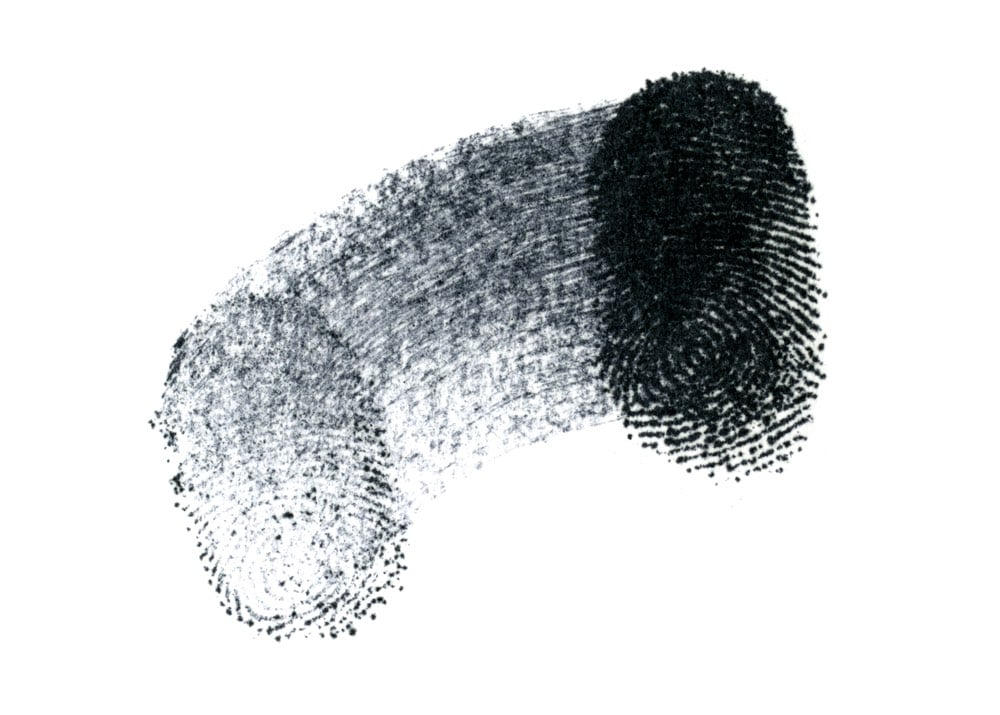

I prefer Roth’s take the most (it’s the simplest…and first) but what I like about all of these is they compress many actions over time into a single flat images, not unlike BriefCam does with surveillance videos. Simple examples of time merge media.
Socials & More