


One day only: get your official Buzzfeed “Failing Pile of Garbage” merch (integrated media af)

Advertise here with Carbon Ads
This site is made possible by member support. 💞
Big thanks to Arcustech for hosting the site and offering amazing tech support.
When you buy through links on kottke.org, I may earn an affiliate commission. Thanks for supporting the site!
kottke.org. home of fine hypertext products since 1998.
Beloved by 86.47% of the web.
Entries for January 2017
The best ending movie credits of all time
Cinefix takes a look at what makes ending credit sequences effective, the different techniques used to end movies, and picks a number of films with the best end credits.
The shape of the narratives movies tend to tell lend themselves to an emotional climax that hits right as the screen fades to black for the last time. Be it triumphant, tragic, bittersweet, or thoughtful, the most important feeling is often the last. So, wisely, one of the most common functions of the creative end title sequence is what we’re going to call the coda credits. They grab on to the final emotional note and let it ride out in a long sustain, letting the audience hold onto the final feeling and carry the echoes out with them as the credits roll.
80s covers of contemporary pop songs
A Canadian musician called TRONICBOX is taking contemporary pop songs like Katy Perry’s Firework, Baby by Justin Bieber, and Somebody I Used To Know by Gotye and remixing them so they sound like they came out in the 80s. The effect is unnerving for someone like me who grew up immersed in 80s pop music. Even though it’s impossible, I can almost remember listening to some of these songs back in my bedroom, probably taped off the radio during Casey Kasem’s top 40 countdown. Total time travel paradox nostalgia bombs. (via digg)
The greatest chess game ever played
Garry Kasparov, who is one of the top chess players ever, said that his 1999 match against Veselin Topalov was the greatest game of chess he ever played. In this video, MatoJelic goes through the game, move by move. Even if you only have a passing interest in chess, I’d recommend watching…it gets really interesting after the first 10-12 moves (which are presented without explanation) and listening to someone who is passionate about a topic is often worth it.
Also entertaining and informative was his explanation of The Game of the Century, which pitted a 13-year-old Bobby Fischer against Donald Byrne, a top-ranked American player. (via farnam street)
Silent film special effects revealed
Back in the days of silent film, directors and cinematographers had to be exceedingly clever to pull off visual effects that appeared real. There were obviously no computers so they had to rely on skewed perspectives, glass matte paintings, and double exposures. That famous clip of Harold Lloyd hanging off of a clock…here’s how that was done:

Here are several more examples. See also Disney’s multiplane camera. (via @mccanner)
What is the Great American Novel?

From Emily Temple at Literary Hub, a collection of contenders for the title of Great American Novel. The list includes everything from Moby-Dick, The Great Gatsby, and The Adventures of Huckleberry Finn to Beloved, The Brief Wondrous Life of Oscar Wao, and Infinite Jest.
Why cities are where they are
It makes sense that villages and towns would develop a short distance away from each other so that people living nearby wouldn’t have to travel far to sell their goods, bank, or go to school. But what about cities? Geography has a lot ot do with where cities are located.
If you enjoy this video but haven’t read Jared Diamond’s Guns, Germs, and Steel yet, you probably should.
Beyonce interviews Solange

Beyoncé Knowles recently interviewed her sister Solange Knowles for Interview magazine.
And, as far back as I can remember, our mother always taught us to be in control of our voice and our bodies and our work, and she showed us that through her example. If she conjured up an idea, there was not one element of that idea that she was not going to have her hand in. She was not going to hand that over to someone. And I think it’s been an interesting thing to navigate, especially watching you do the same in all aspects of your work: Society labels that a control freak, an obsessive woman, or someone who has an inability to trust her team or to empower other people to do the work, which is completely untrue. There’s no way to succeed without having a team and all of the moving parts that help bring it into life. But I do have — and I’m unafraid to say it — a very distinctive, clear vision of how I want to present myself and my body and my voice and my perspective. And who better to really tell that story than yourself?
This exchange just made me laugh out loud:
BEYONCÉ: Well, it brought tears to my eyes to hear both of our parents speak openly about some of their experiences. And what made you choose Master P to speak on the album?
SOLANGE: Well, I find a lot of similarities in Master P and our dad.
BEYONCÉ: Me, too. [laughs]
I loved the simple mic drop bio for Beyoncé at the bottom:
BEYONCÉ IS A 20-TIME GRAMMY AWARD-WINNING RECORDING ARTIST. HER SIXTH STUDIO ALBUM AND COMPANION FILM, LEMONADE, WAS RELEASED LAST YEAR.
And Beyoncé is right about Solange’s wedding photo (above), it is indeed “the dopest wedding photo of all time”. (via @caseyjohnston)
Gun control is popular and effective, so why don’t we have it?
The Upshot recently conducted a survey about 29 gun control ideas and graphed the results based on the popularity of the ideas with the American public and their potential effectiveness according to experts.

Oh, shit like this makes me SO ANGRY. I didn’t even include the bottom part of the graph because there’s nothing down there. That’s right, the majority of Americans support all sorts of different gun control tactics, especially those likely to be most effective. But a focused and organized minority of gun nuts has somehow made it impossible for any reform to happen, so things like Newtown and Orlando and Charleston and San Bernardino and Aurora and toddlers killing people with guns will just continue to happen all over the nation like it’s completely fucking normal.
“Pablo Escobar’s son is a good architect now”

Sebastian Marroquin is an architect who also happens to be the son of Colombian drug lord Pablo Escobar. Matt Shaw of The Architect’s Newspaper recently interviewed Marroquin, and it’s interesting throughout, more so than I expected.
For the first house that I built in Colombia, I didn’t even know who the client was. It was a mystery. There was a request, and they sent me the photographs, the plans, the coordinates, and everything that I needed to design the house. I never went to the place where the house is built. I don’t even know where it exists. When it was complete, they called me and I found out that the owner was one of the guys who, in 1988, put 700 kilos of dynamite in my house. It was a miracle that we survived because I was with my mom and my little sister there. It was the first car bomb in Colombia’s history. So I built the house for the guy who ruined mine.
It was a way for them to ask for forgiveness and in a way to understand us. They knew who I was from the beginning. It was weird and it was a clear opportunity and it was clear that a lot of things have changed in Colombia and that is a great example of how things have really changed now. People want to make peace.
Marroquin struggles with his father’s legacy and its effect on his career but also took obvious inspiration from Escobar’s own interest in architecture.
I believe that in a way my father was also an architect, he was very clever. He was just an architect for his own convenience. There was a Sunday my father took me to airplane fields and in the middle of the jungle, we were standing on the airfield and he asked me, “where is the airfield?” I couldn’t see it, and he said, “You are standing in it.” I couldn’t see it because I was looking at a house in the middle of the runway and there was no way the plane could land because it would crash against the house. He took a walkie-talkie and told one of his friends to move the house. It was on wheels. When the airplanes from the DEA (US Drug Enforcement Agency) were searching with satellites looking for hideouts, they couldn’t find anything because there was a house in the middle of what was a possible airfield. The planes can use it — just move the house.
That’s why he was a great architect because when you visited the house, it worked. It had the bathrooms, the shower, everything. If the police went to the house, it would function perfectly. I believe that a lot of things from architecture I learned from my father and especially places to hide. He used architecture to hide.
(via @DesignObserver)
The ABCs of Death
I know, I know. This is a car commercial and it’s morbid and at this moment in time it’s not really that funny, but it caught me at just the right time today and I laughed harder at this than I have at something in several weeks. So I guess even ad agencies are capable of enabling righteous acts (or at least inappropriately hilarious acts) these days?
A super-simple recipe for creamy mac & cheese
After tinkering in the kitchen for weeks, Kenji Lopez-Alt has discovered a super-simple recipe for macaroni & cheese that uses only three ingredients and takes about ten minutes to make.
The idea for this came from working on my recipe for cacio e pepe, the Roman pasta and cheese dish. In that recipe, I cook spaghetti in a small volume of water, using the starchy pasta water to emulsify the cheese into a creamy sauce. I wondered if the same thing would work for an American-style macaroni and cheese, using a much higher ratio of cheese to pasta and using cheddar in place of pecorino.
It didn’t quite work the first time — the high proportion of cheese caused the sauce to break and turn greasy — but with a few tweaks, I nailed it.
Need to try this soon.
I’d thought Hidden Figures was going to flop, but v pleasantly surprised to be wrong. Gonna try to see this week.
The 10th anniversary of the iPhone
Today marks the 10th anniversary of the introduction of the iPhone.
In the ten years since, iPhone has enriched the lives of people around the world with over one billion units sold. It quickly grew into a revolutionary platform for hardware, software and services integration, and inspired new products, including iPad and Apple Watch, along with millions of apps that have become essential to people’s daily lives.
You can watch Steve Jobs introduce the iPhone during the MacWorld 2007 keynote in the video above; it’s one of the best technology demos ever. Here’s my liveblog of the keynote, my thoughts from a couple of days later, and my review after getting an iPhone in June. (I also constructed a cardboard version of the phone to see how the size compared to my then-current mobile phone.)
I guess we know why iPod development has seemed a little sluggish lately. When the Zune came out two months ago, it was thought that maybe Apple was falling behind, coasting on the fumes of an aging product line, and not innovating in the portable music player space anymore. I think the iPhone puts this discussion on the back burner for now. And the Zune? The supposed iPod-killer’s bullet ricocheted off of the iPhone’s smooth buttonless interface and is heading back in the wrong direction. Rest in peace, my gentle brown friend.
It’s difficult to overstate the impact of the iPhone on the world. In just 10 short years, smartphones have completely and irreversibly changed how a large part of humanity communicates and is quickly changing how the rest will. And that all started with the iPhone. As I noted at the time, you could see a product like this coming but Apple put it all together in a way that became the blueprint, for better and for worse, for every device and mobile application that followed. Not bad for a computer that didn’t have copy/paste when it launched.
I Am Not Your Negro
This is the trailer for I Am Not Your Negro, a film that “finishes” a book that writer James Baldwin was working on when he died.
In 1979, James Baldwin wrote a letter to his literary agent describing his next project, Remember This House. The book was to be a revolutionary, personal account of the lives and successive assassinations of three of his close friends — Medgar Evers, Malcolm X and Martin Luther King, Jr.
At the time of Baldwin’s death in 1987, he left behind only thirty completed pages of his manuscript.
Now, in his incendiary new documentary, master filmmaker Raoul Peck envisions the book James Baldwin never finished. The result is a radical, up-to-the-minute examination of race in America, using Baldwin’s original words and flood of rich archival material. I Am Not Your Negro is a journey into black history that connects the past of the Civil Rights movement to the present of #BlackLivesMatter. It is a film that questions black representation in Hollywood and beyond. And, ultimately, by confronting the deeper connections between the lives and assassination of these three leaders, Baldwin and Peck have produced a work that challenges the very definition of what America stands for.
The reviews so far are uniformly positive.
I don’t know about you, but those clips of Baldwin speaking in the trailer piqued my interest, so I’m going to make some time tonight to watch some Baldwin talks, speeches, and debates on YouTube: a 1969 talk in London, a 1963 debate with Malcolm X (audio only), a 1963 panel on civil rights w/ Sidney Poitier, Harry Belafonte, Marlon Brando, and Charlton Heston, and his 1965 debate with William F. Buckley on the question “Is the American Dream at the expense of the American Negro?”
Meryl Streep on our current political moment
Last night, as she accepted a lifetime achievement award at the Golden Globes, Meryl Streep made some comments about the current political situation and about Donald Trump in particular (although she never mentioned him by name). The clip above (which may not last long on YouTube) is worth watching.
But there was one performance this year that stunned me. It sank its hooks in my heart. Not because it was good; there was nothing good about it. But it was effective and it did its job. It made its intended audience laugh, and show their teeth. It was that moment when the person asking to sit in the most respected seat in our country imitated a disabled reporter. Someone he outranked in privilege, power and the capacity to fight back. It kind of broke my heart when I saw it, and I still can’t get it out of my head, because it wasn’t in a movie. It was real life. And this instinct to humiliate, when it’s modeled by someone in the public platform, by someone powerful, it filters down into everybody’s life, because it kinda gives permission for other people to do the same thing. Disrespect invites disrespect, violence incites violence. And when the powerful use their position to bully others we all lose. OK, go on with it.
And the NY Times — in an effort to “get both sides” of the story, I guess? — ran a story that I’m not going to link to called “Donald Trump Says He’s Not Surprised by Meryl Streep’s Golden Globes Speech”. Is it newsworthy, what he thought of Streep’s remarks? Unless he agrees with her and plans to honestly reevaluate how he treats others when he speaks, I would argue it’s not at all worth printing what’s essentially a Trump press release full of bullshit. And news outlets that actually care about the truth and not just printing spin should stop doing it.
The dazzling and depressing architecture of density in megacities




I’ve featured the work of photographer Michael Wolf here before, particularly his series of photos taken in Hong Kong called Architecture of Density, photographs which capture the immense scale of the city’s apartment buildings and the smallness of the apartment they contain. Another of his projects is 100x100, interior photographs of 100 Hong Kong dwellings that measure 100 square feet or less in size. (See also Hong Kong Cage Homes.)
In this pair of videos, Wolf discusses these projects and a couple of other ones I hadn’t seen before.
In Tokyo Compression, Wolf captures the boredom and despair of Japanese train commuters, smushed into cars dampened by the heat of humanity. For Back Door, he ventured into the alleys of Hong Kong and witnessed people using the infrastructure of the city for storing, sorting, and drying all sorts of things, from after-work clothes to mops to lettuce. (via craig mod)
How to Be Productive in Terrible Times
In Productivity in Terrible Times, Eileen Webb writes about the challenges of getting things done in the face of uncertain and worrisome times and offers some strategies that might help.
When your heart is worried for your Muslim friends, and deep in your bones you’re terrified about losing access to healthcare, it’s very hard to respond graciously to an email inquiring about the latest microsite analytics numbers. “THE WORLD IS BURNING. I will have those content model updates ready by Thursday. Sincerely, and with abject terror, Eileen.”
It is not tenable to quit my job and hie off to Planned Parenthood HQ and wait for them to make use of my superior content organizing skills. It is not a good idea for you to resign from stable work that supports your family and community because you’re no longer satisfied by SQL queries.
I don’t know about you, but I have been struggling mightily with this very thing. I’ve always had difficulty believing that the work I do here is in some way important to the world and since the election, that feeling has blossomed into a profound guilt-ridden anxiety monster. I mean, who in the actual fuck cares about the new Blade Runner movie or how stamps are designed (or Jesus, the blurry ham) when our government is poised for a turn towards corruption and authoritarianism?
I have come up with some reasons why my work here does matter, at least to me, but I’m not sure they’re good ones. In the meantime, I’m pressing on because my family and I rely on my efforts here and because I hope that in some small way my work, as Webb writes, “is capable of enabling righteous acts”.
Update: Meteorologist Eric Holthaus recently shared how he copes with working on climate change day after day.
I’m starting my 11th year working on climate change, including the last 4 in daily journalism. Today I went to see a counselor about it. I’m saying this b/c I know many ppl feel deep despair about climate, especially post-election. I struggle every day. You are not alone. There are days where I literally can’t work. I’ll read a story & shut down for rest of the day. Not much helps besides exercise & time. The counselor said: “Do what you can”, which I think is simple & powerful advice. I’m going to start working a lot more on mindfulness. Despair is natural when there’s objective evidence of a shared existential problem we’re not addressing adequately. You feel alone.
I also wanted to thank those who reached out on Twitter and email about this post…I really appreciate your thoughts. One reader sent along this passage from Italo Calvino’s Invisible Cities:
The inferno of the living is not something that will be; if there is one, it is what is already here, the inferno where we live every day, that we form by being together. There are two ways to escape suffering it. The first is easy for many: accept the inferno and become such a part of it that you can no longer see it. The second is risky and demands constant vigilance and apprehension: seek and learn to recognize who and what, in the midst of inferno, are not inferno, then make them endure, give them space.
(thx, gil)
“When I talk about climate change, I don’t talk about science”
Climate change has shifted from being a scientific issue to a political issue, both because the science is settled1 and because conservatives have embraced climate denialism. As a result, when deep-sea biologist Andrew Thaler talks to people about climate change, he doesn’t talk about science. He talks to people about things like fishing:
Fishermen know that things are changing, that black bass, scup, and butterfish (an important prey species in the tuna fishery) are moving further and further north. Oystermen know that the increasingly high high tides have a negative effect on the recruitment and growth of commercial oysters. More importantly, fishing communities have records and cultural knowledge that go back centuries, and they can see from multi-generational experience that the seasons are less predictable now than in the past and that the changes taking place today are nothing like the more gradual changes of previous generations.
And flooding:
I know fishermen in Guinea living in houses that have stood for hundreds of years. Some of those houses now flood at high tide. Every high tide. They weren’t built at the water’s edge, the water’s edge came to them. I lived in the same house in Beaufort, North Carolina for ten years. When I moved in, we were high and dry. Now our street has a permanent “high water” sign. The farm I just left in coastal Virginia is inundated after heavy rains or strong tidal surges. The front fields, which once held vibrant gardens, now nurture short grass and salty soil.
And other things like farming and faith. People who aren’t scientists and have grown distrustful of them won’t be convinced by science. But they will believe stories that relate to important matters in their lives. (via @EricHolthaus)
Overwhelmingly, science says the Earth’s climate is warming quickly and humans are the cause.↩
William Steig, author of Sylvester and the Magic Pebble, wrote Shrek? How did I not know this?
Is this ham blurry or in focus?

Is this a blurry photo of some sliced ham? Or is the ham perfectly in focus? This is a gnarly optical illusion, that’s for sure. Even when I force myself to realize the photo is in focus, that ham still looks blurry. (via digg)
Beijing smog time lapse
Covering an actual time of 20 minutes, you can watch this time lapse of smog rolling into Beijing in a matter of a few seconds. The NY Times has a short piece on the video, which was filmed on January 2.
Residents have come to expect such dense air pollution in the late fall and winter, as people burn coal to heat their homes. Recently, the problem has been particularly bad, and the city has been enveloped in smog for extended periods starting in October.
Mr. Pope, writing on Twitter, pegged the air quality index, a measure of the pollution, above 400 around the time of the video. The United States government rates readings of 301 to 500 as “hazardous.”
What a disaster…and the air wasn’t that clear before the smog rolled in. I’ve been to Beijing once, back in 1995, and even though I’d love to see how the city has changed over the past 20 years, I have no interest in returning until they get their air quality under control.
Update: And it’s not just Beijing; cities around the world are struggling with pollution. Parts of London have blown through their annual 2017 emissions limits in just 5 days.
By law, hourly levels of toxic nitrogen dioxide must not be more than 200 micrograms per cubic metre (µg/m3) more than 18 times in a whole year, but late on Thursday this limit was broken on Brixton Road in Lambeth.
Many other sites across the capital will go on to break the annual limit and Putney High Street exceeded the hourly limit over 1,200 times in 2016. Oxford Street, Kings Road in Chelsea and the Strand are other known pollution hotspots.
Disney’s multiplane camera, an innovation in illusion
In a short film shot in 1957, Walt Disney described the multiplane camera, one of the many inventions and innovations his company had developed in order to produce more realistic and affecting animations. Instead of shooting single cels of animation on a single movable background, the multiplane camera could shoot several independently moving backgrounds, creating a sense of depth and perspective. A 1938 article in Popular Mechanics explained how the camera works.
Disney wanted to increase the eye value of the many paintings making up a picture by achieving a soft-focus effect on the backgrounds, illuminating the various levels of each scene individually, and separating” background from foreground, thus keeping background objects to their proper relative size.
His production crew labored for three years to perfect the novel picture-taking device to achieve these results. It consists of four vertical steel posts, each carrying a rack along which as many as eight carriages may be shifted both horizontally and vertically. On each carriage rides a frame containing a sheet of celluloid, on which is painted part of the action or background.
Resembling a printing press, the camera stands eleven feet tall and is six feet square. Made with almost micrometer precision, it permits the photographing of foreground and background cels accurately, even when the first is held firmly in place two feet from the lens and the lowest rests in its frame nine feet away. Where the script calls for the camera to “truck up” for a close-up, the lens actually remains stationary, while the various cels are moved upward. By this means, houses, trees, the moon, and any other background features, retain their relative sizes.
After being deployed on a short film as a test, the multiplane camera was used to film Snow White and the Seven Dwarfs, the first feature-length animated film. In the chapter on “Illusion” in his newest book Wonderland: How Play Made the Modern World, Steven Johnson writes that the use of the multiplane camera (along with other innovations in animation developed since the days of Steamboat Willie) had a profound effect on audiences.
All of these technical and procedural breakthroughs summed up to an artistic one: Snow White was the first animated film to feature both visual and emotional depth. It pulled at the heartstrings in a way that even live-action films had failed to do. This, more than anything, is why Snow White marks a milestone in the history of illusion. “No animated cartoon had ever looked like Snow White,” Disney’s biographer Neil Gabler writes, “and certainly none had packed its emotional wallop.” Before the film was shown to an audience, Disney and his team debated whether it might just be powerful enough to provoke tears — an implausible proposition given the shallow physical comedy that had governed every animated film to date. But when Snow White debuted at the Carthay Circle Theatre, near L.A.’s Hancock Park, on December 21, 1937, the celebrity audience was heard audibly sobbing during the final sequences where the dwarfs discover their poisoned princess and lay garlands of flowers on her. It was an experience that would be repeated a billion times over the decades to follow, but it happened there at the Carthay Circle first: a group of human beings gathered in a room and were moved to tears by hand-drawn static images flickering in the light.
In just nine years, Disney and his team had transformed a quaint illusion — the dancing mouse is whistling! — into an expressive form so vivid and realistic that it could bring people to tears. Disney and his team had created the ultimate illusion: fictional characters created by hand, etched onto celluloid, and projected at twenty-four frames per second, that were somehow so believably human that it was almost impossible not to feel empathy for them.
Interestingly, the multiplane camera also seems to be an instance of simultaneous invention (a concept also covered by Johnson in an earlier book, Where Good Ideas Come From). In addition to Disney’s multiplane camera, there were a few earlier earlier efforts and it’s unclear whether they were invented independently or how one inventor influenced another. But one thing is for certain: only Disney’s camera was deployed so skillfully and artfully that it changed cinema and our culture forever.1
Without getting into it (too much), I can’t help thinking of Pixar’s push to make Toy Story. There’s always an emphasis on the technology with Pixar, but Lasseter and the rest of them were huge animation nerds…and Walt Disney nerds in particular. They were interested in telling stories and they believed, like Disney, that developing new technologies could help them do that more effectively. Toy Story was Pixar’s Snow White and their subsequent movies (Finding Nemo, Wall-E, Ratatouille) have shown how successful they were in telling affecting stories with 3D computer animation.↩
The Calm Company. “Work claws away at life. Life has become work’s leftovers. The doggy bag.”
How Do I Explain America to My Black Son?
In November, shortly after the election, Vann Newkirk wrote an article for The Atlantic called This Is Who We Are, a reflection on racism in America.
At a gas station just outside of Rockingham, serendipity found us. As we pulled up to the pump, just there in front of our car was Mr. Confederate Plate, leaning like all villains do against the side of his car. I’m not sure who recognized whom first, but I remember the shouting match, and Mr. Confederate Flag calling my father the one name he would never answer to, looking at me and saying the same, and then pantomiming that he had a gun in the car. I remember looking around at similar flags on another truck and inside the gas station, and knowing instinctively that we were not in friendly territory. I also remember my father shaking with rage and that same hot shame as my own when he climbed back in the truck.
After another cussing fit, Vann Newkirk Sr. looked at me and said the thing that’s always stuck with me since. “This is who we are,” he told me. “Don’t forget.” And we went back down the road.
The piece was adapted into the short video above. Both are worth your time.
What are we but a fire?
An excerpt from Elisa Chavez’s poem “Revenge” in the Seattle Review of Books:
Since you mention it, I think I will start that race war.
I could’ve swung either way? But now I’m definitely spending
the next 4 years converting your daughters to lesbianism;
I’m gonna eat all your guns. Swallow them lock stock and barrel
and spit bullet casings onto the dinner table;I’ll give birth to an army of mixed-race babies.
With fathers from every continent and genders to outnumber the stars,
my legion of multiracial babies will be intersectional as fuck
and your swastikas will not be enough to save you,
This is a powerful poem, and I laughed out loud so hard to the “This is a taco truck rally and all you have is cole slaw” line.
Medium’s pivot and the inherent instability of new businesses
From this piece by Evan Williams, it sounds like Medium is still trying to figure out what it wants to be when it grows up.
So, we are shifting our resources and attention to defining a new model for writers and creators to be rewarded, based on the value they’re creating for people. And toward building a transformational product for curious humans who want to get smarter about the world every day.
It is too soon to say exactly what this will look like. This strategy is more focused but also less proven. It will require time to get it right, as well as some different skills. Which is why we are taking these steps today and saying goodbye to many talented people.
I like Medium and read thoughtful & engaging stuff on there daily, including articles by the many publications that moved their entire publishing operations to Medium and who were caught off-guard by Williams’ announcement:
As part of the strategic pivot, Medium will lay off 50 staffers and close its satellite offices in New York and Washington. It will also stop selling “Promoted Stories,” its native ad unit, and distributing revenue from those sales to publishers.
Medium’s exit from the online ad business was news to some of its publishing partners, many of whom have come to depend on the publishing platform as a key source of revenue. More than two dozen publications are members of Medium’s revenue beta program, which allows them to sell paid subscriptions to readers and to receive a cut of Medium’s native advertising revenue.
Five members of the revenue beta program told POLITICO that they did not receive any advance notice of Medium’s change in strategy before Williams’ public announcement. One publishing partner only learned about the pivot after reading an article about it on the tech news site Recode.
Over the past year, when I was thinking about how best to steward kottke.org into a financially stable future, moving to Medium was definitely an option. But never, in my mind, a very serious option. It was just too many eggs in one basket for a small publisher like me, especially when Medium is still obviously trying to figure out if they’re even in the egg-carrying business. New businesses are unstable…that’s just the way it is.1 In Silicon Valley (and in other startup-rich areas), these unstable businesses have lots of someone else’s money to throw around — which makes them appear more stable in the short term — but they cannot escape the reality of the extreme risk involved in building a new business, particularly a business that needs to grow quickly (as almost all VC-backed startups are required to do). All of which can make it difficult to enter into a business arrangement with a startup…just ask publishers working with Facebook or businesses dependent on Twitter’s API or Vine or Tumblr, not to mention the thousands of startups that have ceased to exist over the years.
With kottke.org, even though it hasn’t been easy, I’ve opted for independence and control over a potential rocketship ride. Instead of moving the site to Medium or Tumblr or focusing my activities on one social network or another, I use third-party services like The Deck, Amazon Associates, Stripe, and Memberful that plug in to the site. Small pieces loosely joined, not a monolithic solution. If necessary, I can switch any of them out for a comparable service and am therefore not as subject to any potential change in business goals by these companies. Given the news out of Medium, I’m increasingly happy that I’ve decided to do it this way (with your very kind assistance).
Update: It’s tough to hear about the small companies that put their faith in Medium and then got blindsided by their umpteenth pivot.
“Right now, we’re very concerned about the future of our site’s partnership with Medium,” said Neil Miller, the founder of pop culture site Film School Rejects. “What we were sold when we joined their platform is very different from what they’re offering as a way forward.”
“It’s almost as if Ev Williams wasn’t concerned that he was pulling out the rug from underneath publishers who had placed their trust in his vision for the future of journalism,” he said.
Update: Film School Rejects ended up jumping ship back to an independently hosted site.
Our story begins last May, when we joined the Medium platform as one of their first 12 premium publishers. This meant moving 10-years of content over to their platform, where we were promised a beautiful user experience and a way forward that would allow us to grow our business, continue to pay our writers, continue our growth as a publication, and ultimately keep FSR on the cutting edge. It was a great partnership, until Medium changed its mind about what kind of platform it wanted to be. At first, we were a part of a group of publishers that took a wait-and-see approach with Medium. As time went on, it became clear that Medium’s priorities had shifted from being a platform for independent publishers to being itself a publisher of premium, subscription-based content. As we learned more about their future plans for the now-existent Medium ‘Members Only’ program, it became clear that our site wouldn’t be able to continue to operate the way we always had.
This was an interesting side effect of their time at Medium:
When we moved to Medium, we stopped worrying about what would be popular and started focusing on what we wanted to talk about. And guess what? Readers continued to follow us. So we’re going to continue to allow our very talented team to write freely. We’ll continue to deliver passionate, thoughtful, topical, and sometimes well-marketed articles.
I’ve never been that interested in chasing clicks because The Deck (the advertising network I used for 10 years) was not strictly based on clicks or pageviews. Even so, thinking about what sorts of posts might attract more attention than others was a growing consideration for me as traffic fell off the past few years. After launching memberships back in November, I feel as though I’m slowly trending back towards caring less about attention and more about writing for myself and the members. And lo and behold, traffic is up slightly since then.
I will add that new services by large companies are unstable as well. They need to reach scale just as quickly as VC-backed startups or they don’t stick around that long or pivot to something else.↩
Are the KLF back after a 23-year absence? (I would settle for their back catalog on Spotify.)
How to put on a duvet cover
Here’s a technique for putting a comforter inside a duvet cover that involves rolling the whole thing up “like a burrito” and then two solid pieces of matter somehow pass through each other? I dunno, that is some goddamned witchcraft that defies the laws of physics and topology and is probably related to at least one of the Millennium Prize Problems. I don’t know if it’s easier than doing it the normal way1 but it certainly is more entertaining.
See also how to fold a fitted sheet and how to fold a t-shirt in two seconds.
And by “the normal way” I mean getting both top corners of the comforter in the corresponding corners of the cover, stuffing the rest of the comforter inside the cover, and giving it a couple of shakes while holding the top edge until it settles in…and not whatever infomercial-ish head-inside-the-cover shenanigans the woman was attempting in the video. Once you get this down, it doesn’t really take that long.↩
A beautiful aquarium supernova
Using mostly old-school visual effects — like ink dispersing in an aquarium and poking holes in napkins (to represent stars) — Thomas Vanz created a pretty compelling representation of a dying star going supernova.
Novae is a movie about an astronomical event that occurs during the last evolutionary stages of a massive star’s life, whose dramatic and catastrophic death is marked by one final titanic explosion called supernova.
By only using an aquarium, ink and water, this film is also an attempt to represent the giant with the small without any computed generated imagery.
As a tribute to Kubrick or Nolan’s filmography, Novae is a cosmic poem that want to introduce the viewer to the nebulae’s infinite beauty.
Vanz documented his process in these two videos, which are almost as entertaining as the finished product.
The seven stages of denial (that a robot will take your job)
From an excerpt of Kevin Kelly’s recent book, The Inevitable, a list of the Seven Stages of Robot Replacement:
1. A robot/computer cannot possibly do the tasks I do.
2. [Later.] OK, it can do a lot of those tasks, but it can’t do everything I do.
3. [Later.] OK, it can do everything I do, except it needs me when it breaks down, which is often.
4. [Later.] OK, it operates flawlessly on routine stuff, but I need to train it for new tasks.
5. [Later.] OK, OK, it can have my old boring job, because it’s obvious that was not a job that humans were meant to do.
6. [Later.] Wow, now that robots are doing my old job, my new job is much more interesting and pays more!
7. [Later.] I am so glad a robot/computer cannot possibly do what I do now.
[Repeat.]
I predict that getting to #6 will be challenging for many people.
National Geographic Infographics
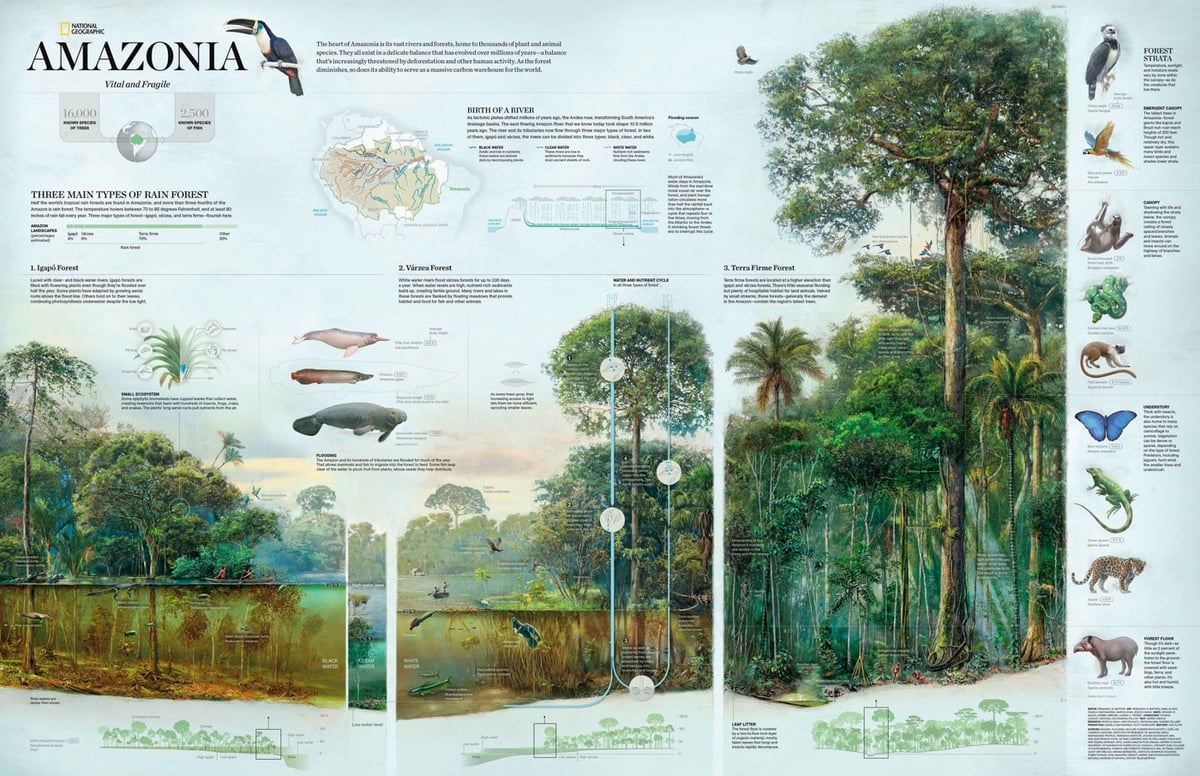

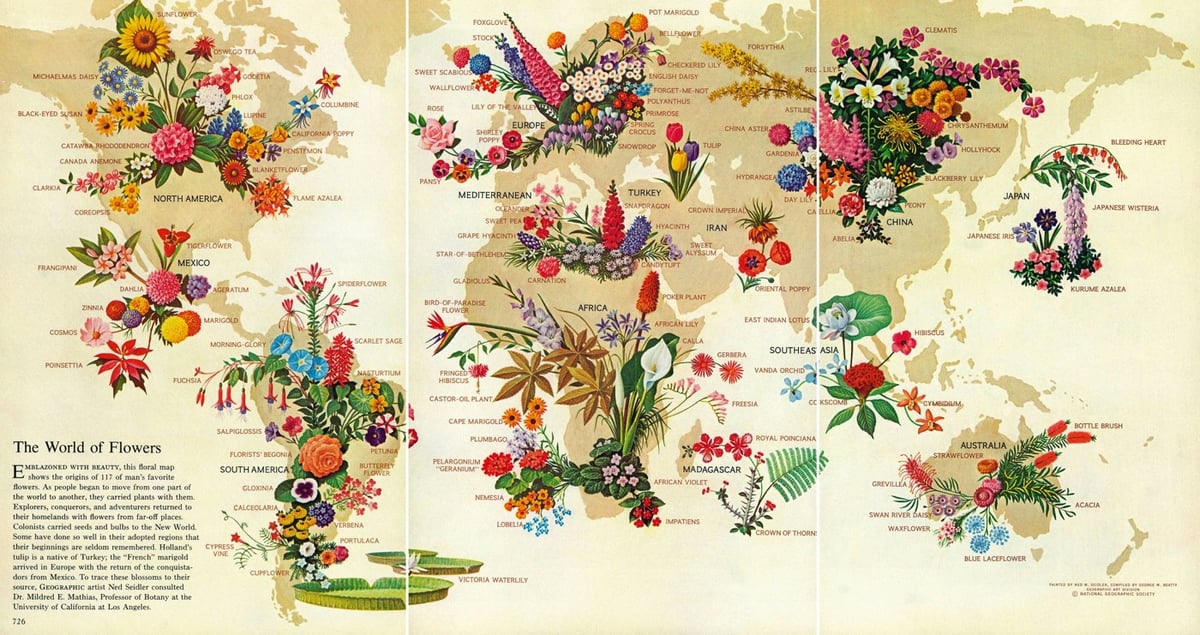
National Geographic Infographics is an anthology published by Taschen of some of the best infographics featured by National Geographic in the past 128 years.
Through seven sections — History, The Planet, Being Human, Animal World, World of Plants, Science and Technology, and Space — we encounter the rise and fall of the Roman Empire, the mysterious origins of the Easter Island statues, Cleopatra’s Alexandria and a history of Hawaiian surfboarding, all distilled in expert, accessible graphic form. We discover how our genetic patterns have been pieced together over the years or how hip-hop emerged as a cultural heavyweight; we get to grips with global warming, and explore our ever-expanding study of an ever-expanding universe.
Order from Chaos, a mesmerizing video of emergence
French visual effects artist Maxime Causeret took a track from Max Cooper’s album Emergence and created these wonderful biologically inspired patterns and interactions.
Maxime also shows us a section of animated reaction-diffusion patterns, where simple chemical feedback mechanisms can yield complex flowing bands of colour — these forms of system were originally thought up by Alan Turing, and were part of the early seeds of the field of systems biology, which seeks to simulate life with computers, in order to better understand the systems producing the complexity we see in the living world. They were also the starting point of my main research area many years ago before I got lost in music! (where I began with the question of what patterns could be produced via reaction-diffusion forms of system as opposed to gene-regulatory network controlled patterning).
There’s a blue brain coral pattern at the 1:30 mark and a neuron-ish pattern at 2:30 that I wish would go on forever. Headphones recommended, psychoactive drugs optional. (via colossal)
What scientific term or concept ought to be more widely known?
Each year, Edge has asked a group of scientists, philosophers, musicians, writers, and designers a simple but provocative question and collects the answers on their website. Past questions have included:
What do you think about machines that think? (2015)
What have you changed your mind about? Why? (2008)
What do you believe true even though you cannot prove it? (2005)
What is the most important invention in the past two thousand years? (1999)
This year, the question is: What scientific term or concept ought to be more widely known?
Of all the scientific terms or concepts that ought to be more widely known to help to clarify and inspire science-minded thinking in the general culture, none are more important than “science” itself.
Many people, even many scientists, have traditionally had a narrow view of science as controlled, replicated experiments performed in the laboratory-and as consisting quintessentially of physics, chemistry, and molecular biology. The essence of science is conveyed by its Latin etymology: scientia, meaning knowledge. The scientific method is simply that body of practices best suited for obtaining reliable knowledge.
Here are some of the responses. Alison Gopnik chose “Life History”:
“Life history” is the term biologists use to describe how organisms change over time-how long an animal lives, how long a childhood it has, how it nurtures its young, how it grows old. Human life history is weird. We have a much longer childhood than any other primate-twice as long as chimps, and that long childhood is related to our exceptional learning abilities. Fossil teeth suggest that this long childhood evolved in tandem with our big brains-we even had a longer childhood than Neanderthals. We also rapidly developed special adaptations to care for those helpless children-“pair-bonding” and “alloparents.” Fathers and unrelated kin help take care of human children, unlike our closest primate relatives.
And we developed another very unusual life history feature-post-menopausal grandmothers. The killer whale is the only other animal we know that outlives its fertility. The human lifespan was expanded at both ends-longer childhood and a longer old age. In fact, anthropologists have argued that those grandmothers were a key to the evolution of learning and culture. They were crucial for the survival of those helpless children and they also could pass on two generations worth of knowledge.
Jessica Flack chose “Coarse-Graining”:
In physics a fine-grained description of a system is a detailed description of its microscopic behavior. A coarse-grained description is one in which some of this fine detail has been smoothed over.
Coarse-graining is at the core of the second law of thermodynamics, which states that the entropy of the universe is increasing. As entropy, or randomness, increases there is a loss of structure. This simply means that some of the information we originally had about the system has become no longer useful for making predictions about the behavior of a system as a whole. To make this more concrete, think about temperature.
Temperature is the average speed of particles in a system. Temperature is a coarse-grained representation of all of the particles’ behavior — the particles in aggregate. When we know the temperature we can use it to predict the system’s future state better than we could if we actually measured the speed of individual particles. This is why coarse-graining is so important — it is incredibly useful. It gives us what is called an effective theory. An effective theory allows us to model the behavior of a system without specifying all of the underlying causes that lead to system state changes.
And physicist Nigel Goldenfeld chose “The Scientific Method” itself:
There’s a saying that there are no cultural relativists at thirty thousand feet. The laws of aerodynamics work regardless of political or social prejudices, and they are indisputably true. Yes, you can discuss to what extent they are an approximation, what are their limits of validity, do they take into account such niceties as quantum entanglement or unified field theory (of course they don’t). But the most basic scientific concept that is clearly and disturbingly missing from today’s social and political discourse is the concept that some questions have correct and clear answers. Such questions can be called “scientific” and their answers represent truth. Scientific questions are not easy to ask. Their answers can be verified by experiment or observation, and they can be used to improve your life, create jobs and technologies, save the planet. You don’t need pollsters or randomized trials to determine if a parachute works. You need an understanding of the facts of aerodynamics and the methodology to do experiments.
There are 200 more contributions from bold-faced names like Richard Dawkins, Hanna Levin, Brian Eno, Kevin Kelly, and Danny Hillis. Have fun!
Socials & More