Entries for February 2015

Franklin, the first black member of Charles Schulz’s Peanuts gang, made his debut in July 1968. His presence came about through the efforts of Los Angeles schoolteacher Harriet Glickman, who wrote Schulz several letters in the wake of Martin Luther King Jr’s assassination arguing that the inclusion of black characters in the most popular comic strip in America would be a positive thing. Here is her initial letter to Schulz:

After some back and forth between Schulz and Glickman, Franklin made his first appearance in the strip.
Franklin’s introduction was part of a five-day sequence featuring Sally tossing away Charlie Brown’s beach ball and Franklin rescuing it. In some ways, this seems an aggressive bit of integration — many American public beaches, while no longer legally segregated, were still de facto segregated at the time. In other ways, the strips suggest what might be seen today as an excess of caution; of the twenty panels of the series, Franklin is in ten panels and Sally is in eight, but never is Franklin in the same panel as the white girl. Franklin would not reappear for another two and a half months, when he came for a visit to Charlie Brown’s neighborhood. He was somewhat lighter skinned here, which seems to be less a matter of trying to make him acceptable to the readers and more a matter of cutting back on shading lines which were overpowering his facial features. Franklin’s job in this series was to react to the oddness of the neighborhood kids, and that was a precursor to what would be his primary role in the strip as a whole. Perhaps due to excessive caution, Franklin was never granted any of the sort of usual quirks that define a Peanuts character, the very sort of mistake that Glickman was warning about when she called for one of the black kids to be “a Lucy.”
His inclusion made news nationally and upset many people, particularly in the South. Schulz had a conversation with the president of the comic’s distribution company:
I remember telling Larry at the time about Franklin — he wanted me to change it, and we talked about it for a long while on the phone, and I finally sighed and said, “Well, Larry, let’s put it this way: Either you print it just the way I draw it or I quit. How’s that?”
(via @essl)
Wooper is a Robot Chicken parody of Looper, in which cartoon characters like Elmer Fudd are sent back in time to be killed because they can’t show guns in children’s cartoons anymore.
(via @gruber)


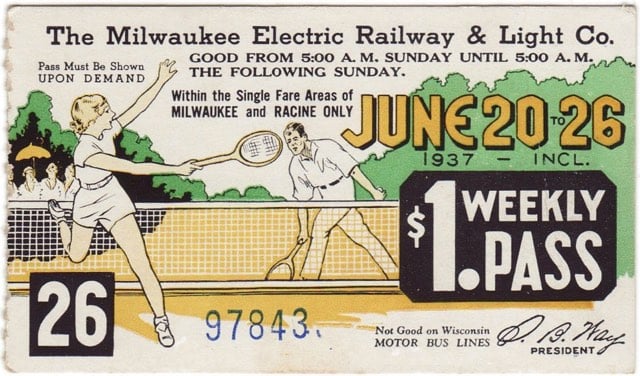
A collection of weekly bus passes from Milwaukee, WI. Years covered are 1930-1979. Was there a new design every single week? (via @slowernet)

A keyboard-controlled soundboard for Daft Punk’s Harder, Better, Faster, Stronger. See also the Beyonce Soundboardt. (via waxy)
In this persuasive video, Chris Stuckmann argues that today’s action movies are mostly bad and provides six reasons why.
His fifth point, the camerawork, drives him a little crazy.
Shakycam. Fucking shakycam. At some point, someone somewhere told Hollywood that people like incoherent incompetent camera work, blinding the audience with multiple cuts and assaulting us with nothing but a barrage of sound effects that are supposed to subconsciously tell us that something is happening on screen.
See also how to do action comedy from Every Frame a Painting and Chaos Cinema from Mattias Stork. (via devour)
From HBO and director Andrew Jarecki (Capturing the Friedmans), comes The Jinx: The Life and Deaths of Robert Durst, a six-part documentary series on reclusive millionaire Robert Durst and the three unsolved murders he is suspected of committing. The first episode aired over the weekend and is now free to watch on YouTube (in the US). A couple of reviews: The Anti-Serial and HBO’s Crime Drama ‘The Jinx’ Succeeds Where Others Fail.
David Chang is exactly right: when dining at a restaurant, often the best option is to sit at the bar.
When everyone’s so close, it changes the dining experience. Out on the floor, you’re a dickhead if you overhear a conversation and chime in. Not at the bar. You connect, trade stories, then trade bites. I’ve never shared as much food with strangers as I have at the bar. You meet great people that way — you’re part of this band of outsiders within the restaurant. And for me, that’s the best possible dining experience of all.
I almost always eat at the bar at my regular place.
After the end of World War II in Europe, homosexual prisoners of liberated concentration camps were refused reparations and some were even thrown into jail without credit for their time served in the camps. From the United States Holocaust Memorial Museum:
After the war, homosexual concentration camp prisoners were not acknowledged as victims of Nazi persecution, and reparations were refused. Under the Allied Military Government of Germany, some homosexuals were forced to serve out their terms of imprisonment, regardless of the time spent in concentration camps. The 1935 version of Paragraph 175 remained in effect in the Federal Republic (West Germany) until 1969, so that well after liberation, homosexuals continued to fear arrest and incarceration.
After 1945, it was no longer a crime to be Jewish in Germany, but homosexuality was another matter. Paragraph 175 of the German Criminal Code had been on the books since 1871. An English translation of the earliest version read simply:
Unnatural fornication, whether between persons of the male sex or of humans with beasts, is to be punished by imprisonment; a sentence of loss of civil rights may also be passed.
In Germany, homosexuality was considered a crime worthy of up to five years of imprisonment until Paragraph 175 was voided in 1994.
Update: I missed this while writing the post: Paragraph 175 was amended in 1969 to limit enforcement to engaging in homosexual acts with minors (under 21 years). (thx, eric)
Here’s a good explanation of what the One Ring from Lord of the Rings actually is and what it can do:
I transcribed a short passage from the video:
First, the ring tempts everyone (well, almost everyone) with promises that yes, this little ring can be a mighty weapon or a tool to reshape the world and gosh don’t you just look like the best guy to use it. Let’s go vanquish the powerful demigod who lives over there to get started, shall we? This is why the hobbits made great ring bearers, because they’re pretty happy with the way things are and don’t aspire to greatness. Of course, there’s Gollum, who started out as a hobbit, but all things considered, he held out pretty well for a couple hundred years. Set the ring on the desk of most men and they wouldn’t be able to finish their coffee before heading to Mordor to rule the world and do it right this time.
What’s interesting about hearing of The Ring in this focused way is how it becomes a part of Tolkien’s criticism of technology. The Ring does what every mighty bit of tech can do to its owner/user: makes them feel powerful and righteous. Look what we can do with this thing! So much! So much good! We are good therefore whatever we do with this will be good!
The contemporary idea of the tech startup is arguably the most seductive and powerful technology of the present moment, the One Ring of our times. It’s not difficult to modify a few words in the passage above to make it more current:
First, the startup tempts everyone (well, almost everyone) with promises that yes, this little company can be a mighty weapon or a tool to reshape the world and gosh don’t you just look like the best guy to use it. Let’s go disrupt the powerful middleman who lives over there to get started, shall we? This is why the nerds made great ring bearers, because they’re pretty happy with the way things are and don’t aspire to greatness. Of course, there’s Sergey and Larry, who started out as nerds, but all things considered, they held out pretty well for a decade. Set the ring on the desk of most men and they wouldn’t be able to finish their mail-order espresso before heading to Silicon Valley to rule the world and do it right this time.
Ok, haha, LOL, and all that, but it’s curious that nerds (and everyone else) shelled out billions of dollars to watch Peter Jackson’s LOTR movies in the early 2000s in the aftermath of the dot com bust. Those were dark times…the power of the startup had just been lost after Kozmo’s CEO Dave Isildur was slain by economists while delivering a single pint of Ben & Jerry’s Chubby Hubby to far reaches of the Outer Sunset and had not yet been rediscovered by Schachter, Butterfield, and Zuckerberg.
And these nerds, whose spines all tingled when Aragorn charged into the hordes of Mordor — for Frodo! — and whose eyes filled with tears when Frodo parted with Sam at the Grey Havens, came away from that movie experience siding with Boromir, Saruman, and Denethor, determined to seize that startup magic for themselves to disrupt all of the things, defeat the evil corporate middlemen, and reshape the world to be a better and more efficient place. And gosh don’t you just look like the best guy to use it?
For whatever reason, when Buzz Aldrin and Neil Armstrong left the surface of the Moon after their historic space walk, they collected “a bunch of trash that we want to take back” in a small white bag. Upon their return to Earth, Armstrong put the bag in a closet and there it sat for more than 40 years, until Armstrong’s widow discovered it shortly after his death. Among other items, the bag contained the camera that recorded The Eagle’s landing on the Moon and Armstrong’s first step, which was presumed to have been lost or left on the Moon.

As far as we know, Neil has never discussed the existence of these items and no one else has seen them in the 45 years since he returned from the Moon. (I asked James Hansen, Neil’s authorized biographer if he had mentioned the items, and he had not.) Each and every item has its own story and significance, and they are described with photographs in extraordinary detail in an addendum to the Apollo Lunar Surface Journal. But two of the items are especially timely. Both have been placed on display as part of the recently opened temporary exhibition Outside the Spacecraft: 50 Years of Extra-Vehicular Activity.
The first is the 16mm Data Acquisition Camera that was mounted in the window of the lunar module Eagle to record the historic landing and “one small step” made by Armstrong as humankind first set foot on another world.
Burning a person alive is not a new act in warfare or intimidation. Far from it. So how did the gruesome burning of a Jordanian pilot become a incident that outraged the world and possibly altered a war? It was on video. Seeing a video changes everything. The existence of video footage can determine what leads the news, what drives public opinion, and what gets lodged in our memories. It can also determine who becomes a celebrity, who gets elected, which products we purchase, and confirm again and again the dominance of the once overlooked house-cat. Whoever controls the video controls the story. And since about 2005, the person who’s controlled the video has been you. You, the cat owner. You, the aspiring singer. You, the citizen journalist. And yes, you the terror group determined to intimidate and remain at the forefront of a global conversation. From The Telegraph: How YouTube Changed the World.
If, like me, you couldn’t get it together to make it to the Matisse cut-outs show at MoMA, the NY Times has you covered with an interactive look at the show.
Arthur Ganson is a kinetic sculptor who builds “Rube Goldberg machines with existential themes”. One of his works is called Machine with Concrete, which demonstrates the magic of gear ratios
According to a piece in Make, the input shaft spins at 200 rpm, which is reduced by gearing down to 1 revolution every 2 trillion years by the time you reach the gear on the end…which is so slow that even embedding the final gear in concrete doesn’t make any difference to the machine’s operation. (via interconnected)
Brad Plumer of Vox plays around with the climate change Global Calculator and discovers, among other things, eating less beef and slowing the world’s population growth would significantly slow global warming.
The IEA scenario I started with assumed that, by mid-century, the average person will be eating 2,330 calories per day, including 220 calories of meat. It also assumes we’ll be eating more beef — that is, about 25 percent of the world’s meat will come from ruminants like cows, up from 22 percent today. Since cows produce a lot of methane, this is significant.
But what if we tweaked those assumptions? I told the calculator to assume that in 2050, the average person was only consuming 152 calories of meat per day — which is the WHO’s target for a healthy diet. I also assumed that the mix of meat stayed similar to what it was today — marginally less beef, more chicken and pork.
The result? Global greenhouse-gas emissions dropped significantly. We’re now on pace for around 2.5°C of global warming, give or take.
From the Motion Picture Editors Guild, a list of the 75 best-edited movies of all time.
As for directors, Alfred Hitchcock is the most often cited, making the list 5 times (although not placing in the top 10), and spanning 3 decades. Right behind him are Steven Spielberg and Francis Ford Coppola, both of whom made the list 4 times. Like Hitchcock, Spielberg’s pictures were released over 3 decades. Coppola’s pictures, however, were all released in the 1970s - with 2 in 1974 (the only director with 2 films in a single year). All of his pictures placed in the top 22 films, with 3 of them in the top 11. At the other end of the continuum, there were 33 years between Terrence Malick’s 2 films on the list.
Directors Stanley Kubrick and Martin Scorsese follow, with 3 films each making the cut. Tied with Malick for 2 pictures are Bob Fosse, William Friedkin, Akira Kurosawa, Christopher Nolan, Ridley Scott, Steven Soderbergh, Orson Welles and Bob Wise; all others received 1 mention.
The top ten:
1. “Raging Bull” (Thelma Schoonmaker, 1980)
2. “Citizen Kane” (Robert Wise, 1941)
3. “Apocalypse Now” (Lisa Fruchtman, Gerald B. Greenberg, Walter Murch, 1979)
4. “All That Jazz” (Alan Heim, 1979)
5. “Bonnie And Clyde” (Dede Allen, 1967)
6. “The Godfather” (William H. Reynolds, Peter Zinner, 1972)
7. “Lawrence of Arabia” (Anne V. Coates, 1962)
8. “Jaws” (Verna Fields, 1975)
9. “JFK” (Pietro Scalia, Joe Hutshing, 1991)
10. “The French Connection” (Gerald B. Greenberg, 1971)
You think of filmmaking as male dominated, but one thing I noticed about that top 10 right away: five women in the list, including three in the top five. (via hitfix)
Update: Women have been well-represented in film editing in part because the job began as menial labor.
For much of Hollywood history, there were virtually no filmmaking opportunities available to women other than screenwriting and acting — with one major exception. Women have always been welcomed — and in many quarters preferred by male directors — as film editors, or “cutters,” as they were originally known. In the early days, the job was regarded as menial labor, and it largely was. Cutters worked by hand, running film on reels with hand cranks and manually cutting and gluing together strips of it. (Moreover, they almost never received screen credit.) After the advent of the Moviola editing machine in 1924, the process became faster and easier, but was still tedious and low paying, which is why most cutters remained young, working-class women.
It was around this time that the job of cutting films became less about just maintaining proper continuity and more about being creative. The Russian films of Sergei Eisenstein introduced the concept of montage — how “colliding” separate pieces of film together could advance a storyline and manipulate viewers’ emotions — and this approach became widely discussed and imitated the world over, not least of all by some of the more enterprising female cutters in America, some of whom, like Margaret Booth, began to experiment with leftover footage on the cutting room floor and proved to be quite inventive.
More on the early history here. (via @ironicsans)
The number of earthquakes in Oklahoma has increased dramatically over the past years. There are now more measurable quakes in OK than California or Alaska. Why? Fracking.
Oklahoma recorded more than three times as many earthquakes as California in 2014 and remains well ahead in 2015. Data from the U.S. Geological Survey shows that Oklahoma had 562 earthquakes of magnitude 3.0 or greater in 2014; California had 180. As of Jan. 31, Oklahoma recorded 76 earthquakes of that magnitude, compared with California’s 10.
According to the Advanced National Seismic System global catalog, in 2014, Oklahoma even beat Alaska, the nation’s perennial leader in total earthquakes, though many small events in remote areas go unrecorded there.
From Tim Hunkin, The Secret Life of Machines is a series of drawings illustrating how everyday objects work, from fax machines to refrigerators to quartz watches.
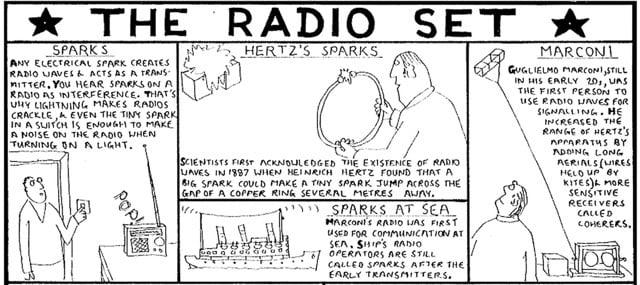
Update: The drawings are nice, but Hunkin’s real The Secret Life of Machines project is this series of videos, uploaded by some kind soul to YouTube:
(via @leftnotracks & john)
How to lose weight in four easy steps. Step 3 is difficult but really works.

Artist Aki Inomata builds fanciful new houses for hermit crabs.
Miniature windmills, churches, and even entire cities jut from the surface of her 3D-printed shells, which are modelled upon CT scans of abandoned crab shells and then recreated in transparent resin. Inomata then allows the homeless crabs to inspect the shelters at their leisure — she says “most hermit crabs don’t even glance at” them, but occasionally one of the creatures finds its dream real estate and settles in.
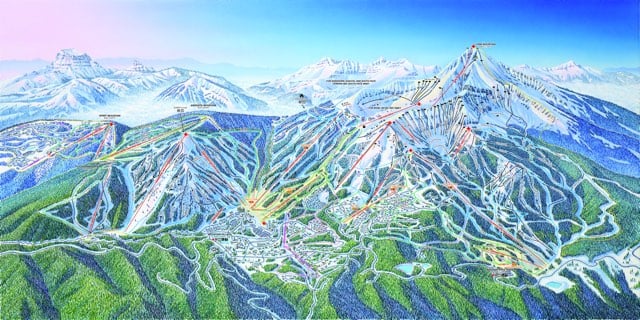
If you’ve ever noticed most ski trail maps look kinda the same, the reason is many of them have been painted by a single individual: James Niehues.
Each view is hand painted by brush and airbrush using opaque watercolor to capture the detail and variations of nature’s beauty. In many instances, distortions are necessary to bring everything into a single view. The trick is to do this without the viewer realizing that anything has been altered from the actual perspective.
Here’s a selection of his work:


Jessamyn West writes about the nuts and bolts of dealing with the death of her techie dad, including wresting control from the hidden computer controlling his house and digitally impersonating him to use his apps and cancel cable.
My dad’s retirement home was not quite so high tech but it was designed to provide a certain level of creature comforts with minimal inputs from him. Set it and forget it. An X-10 system turned most of the lights on and off on a schedule. Some of this was pretty straightforward “Turn on the porch lights after dark.” and some was a bit more esoteric “Turn off the office lights at 10 pm so that I’ll know it’s time for bed.” He knew the ruleset. I did not. I’d be working on an article or reading a book and suddenly be plunged into total darkness. I’d poke at some wall switches that would sometimes turn the lights back on.
The system was controlled by a laptop. The laptop died. I removed the hard drive to get at the config files. This project went on a lengthy To Do list and never rose to the top. The lights kept turning on and off. Over time their schedules got out of sync. The driveway lights would stay on for days. The porch lights would never come on, or turn on at 6:15 pm and then off at 6:27. Sometimes they’d just blink on and off and we’d be all “Did you see that?” My sister and I kept lists, tried to discern patterns. I pulled the switches off the walls, only to find that they were just stuck on with tape, with no actual wires underneath. Somewhere in some wall there was a transmitter sending out signals that only the lights could hear.
It’s oddly comforting that even in the digital age, our loved ones can still haunt us from their graves.
If you take the vocals from The Perfect Drug by Nine Inch Nails and match them to the beats from Taylor Swift’s Shake It Off, you get this little bit of magic:
Update: I totally forgot I’d previously featured this awesomeness: NIN’s Head Like a Hole vs. Carly Rae Jepsen’s Call Me Maybe. Also of note: Mark Romanek directed the videos for Shake It Off and The Perfect Drug. (via ★interesting, @sarahmakespics, and mark)
Writing for the New Yorker in 1936, E.B. White pens a farewell to the Model T, a gadget that defined the first quarter of the 20th century.
During my association with Model T’s, self-starters were not a prevalent accessory. They were expensive and under suspicion. Your car came equipped with a serviceable crank, and the first thing you learned was how to Get Results. It was a special trick, and until you learned it (usually from another Ford owner, but sometimes by a period of appalling experimentation) you might as well have been winding up an awning. The trick was to leave the ignition switch off, proceed to the animal’s head, pull the choke (which was a little wire protruding through the radiator), and give the crank two or three nonchalant upward lifts. Then, whistling as though thinking about something else, you would saunter back to the driver’s cabin, turn the ignition on, return to the crank, and this time, catching it on the down stroke, give it a quick spin with plenty of That. If this procedure was followed, the engine almost always responded — first with a few scattered explosions, then with a tumultuous gunfire, which you checked by racing around to the driver’s seat and retarding the throttle. Often, if the emergency brake hadn’t been pulled all the way back, the car advanced on you the instant the first explosion occurred and you would hold it back by leaning your weight against it. I can still feel my old Ford nuzzling me at the curb, as though looking for an apple in my pocket.
Aside from the obvious advantage of price, White details three compelling factors of the Model T, all of which still move car owners to purchase today: quickness, height, and customizability. The Model T was gloriously quick off the line, reaching its top speed of 45 mph, according to White, more quickly than other cars of the age. The driver sat high up in the car, on top of the gas tank, which must have given you the same mighty feeling as driving a huge-ass SUV or pickup truck. And as delivered, the Model T was just functional, leaving ample opportunity for people to add their own touches. For instance, the car didn’t come with a gas pedal (the throttle was hand-operated), speedometer, rear view mirror, or windshield wipers. (via @ftrain, who notes what a great tech blogger White was)
Free diver Guillaume Néry looks like an astronaut floating around in space in this underwater video.
See also this surrealist free diving video and Néry’s underwater base jump. (via ★interesting)

Drag and drop an MP3 onto this page and soon you’re flying over a 3D-rendered landscape made with Javascript that pulses in time to the music. (via prosthetic knowledge)
Climate change, vaccines, evolution. Why do so many reasonable people doubt science?
From the Physics arXiv Blog, a list of paradoxes in modern cosmological physics, i.e. areas where theory and observation disagree, sometimes by a whopping 120 orders of magnitude.
Perhaps the most dramatic, and potentially most important, of these paradoxes comes from the idea that the universe is expanding, one of the great successes of modern cosmology. It is based on a number of different observations.
The first is that other galaxies are all moving away from us. The evidence for this is that light from these galaxies is red-shifted. And the greater the distance, the bigger this red-shift.
Astrophysicists interpret this as evidence that more distant galaxies are travelling away from us more quickly. Indeed, the most recent evidence is that the expansion is accelerating.
What’s curious about this expansion is that space, and the vacuum associated with it, must somehow be created in this process. And yet how this can occur is not at all clear. “The creation of space is a new cosmological phenomenon, which has not been tested yet in physical laboratory,” says Baryshev.
What’s more, there is an energy associated with any given volume of the universe. If that volume increases, the inescapable conclusion is that this energy must increase as well. And yet physicists generally think that energy creation is forbidden.
Baryshev quotes the British cosmologist, Ted Harrison, on this topic: “The conclusion, whether we like it or not, is obvious: energy in the universe is not conserved,” says Harrison.
This is a problem that cosmologists are well aware of. And yet ask them about it and they shuffle their feet and stare at the ground. Clearly, any theorist who can solve this paradox will have a bright future in cosmology.
Luckily, these paradoxes are an opportunity to do some great science.
Newer posts
Older posts





Socials & More