



Rise of the museum Twitter bots
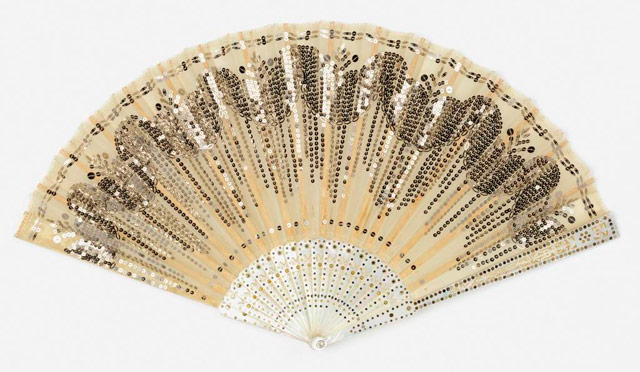
John Emerson has compiled a list of Twitter accounts that periodically tweet out images from the online collections of some of the world’s best museums, including the Met, the Tate, the Rijksmuseum, and MoMA.

This site is made possible by member support. 💞
Big thanks to Arcustech for hosting the site and offering amazing tech support.
When you buy through links on kottke.org, I may earn an affiliate commission. Thanks for supporting the site!
kottke.org. home of fine hypertext products since 1998.
Beloved by 86.47% of the web.
John Emerson has compiled a list of Twitter accounts that periodically tweet out images from the online collections of some of the world’s best museums, including the Met, the Tate, the Rijksmuseum, and MoMA.
Using Phil Fish, the person responsible for critically acclaimed indie game Fez, this video by Ian Danskin explores what it means to be internet famous, something everyone who writes/creates/posts/tweets online has experienced to some extent.
We are used to thinking of fame as something granted to a person by people with media access. The reason people hate Nickelback is because of that record contract, that Faustian bargain — they bought into it. They had to be discovered; someone had to connect them to video directors, record producers, stylists, advertisers.
This is not what fame looks like on the internet. There, fame is not something you ask for. Fame is not something you buy into. Fame happens to you.
Phil doesn’t have an agent. He doesn’t have ad executives. He doesn’t tour the country on press junkets. He doesn’t have a PR department. (Obviously.)
He talked on social media. He did interviews when invited to do them. He was invited into a documentary. People read these things as shameless self-promotion or a desperate need for attention, or both, but that’s projection — nobody knows Phil’s reasons for doing them but Phil and the people who know him personally.
Phil never asked to be famous.
We made him famous. Maybe, in part, because we found him entertaining. Maybe, in part, because we found him irritating. Largely because many of us were once sincerely excited about his game. But he became a big deal because we kept talking about him.
On the internet, celebrities are famous only to the people who talk about them, and they’re only famous because we talk about them, and then we hate them for being too famous, and make them more famous by talking about how much we hate them. Could there ever be anything more self-defeating than this?
Here’s a transcript of the video. In his post about why he decided to sell Minecraft to Microsoft, Markus Persson cites This is Phil Fish as an influence:
I was at home with a bad cold a couple of weeks ago when the internet exploded with hate against me over some kind of EULA situation that I had nothing to do with. I was confused. I didn’t understand. I tweeted this in frustration. Later on, I watched the This is Phil Fish video on YouTube and started to realize I didn’t have the connection to my fans I thought I had. I’ve become a symbol. I don’t want to be a symbol, responsible for something huge that I don’t understand, that I don’t want to work on, that keeps coming back to me. I’m not an entrepreneur. I’m not a CEO. I’m a nerdy computer programmer who likes to have opinions on Twitter.
Robin Sloan connected Persson’s post with a post by Erin Kissane on how she has curtailed her use of Twitter. Here’s one of her problems with Twitter:
The first is feeling like I’m sitting at a sidewalk cafe, speaking in a conversational voice, but having that voice projected so loudly that strangers many streets away are invited to comment on my most inconsequential statements — especially if something I say gets retweeted beyond my usual circles.
Many moons ago, I was “subculturally important” in the small pond of web designers, personal publishers, and bloggers that rose from the ashes of the dot com bust, and I was nodding along vigorously with what Danskin, Persson, and Kissane had to say. Luckily for me, I realized fairly early on that me and the Jason Kottke who published online were actually two separate people…or to use Danskin’s formulation, they were a person and a concept. (When you try to explain this to people, BTW, they think you’re a fucking narcissistic crazy person for talking about yourself in the third person. But you’re not actually talking about yourself…you’re talking about a concept the audience has created. Those who think of you as a concept particularly hate this sort of behavior.)
The person-as-concept idea is a powerful one. People ascribe all sorts of crazy stuff to you without knowing anything about the context of your actual life. I even lost real-life friends because my online actions as a person were viewed through a conceptual lens; basically: “you shouldn’t have acted in that way because of what it means for the community” or some crap like that. Eventually (and mostly unconsciously), I distanced myself from my conceptual counterpart and became much less of a presence online. I mean, I still post stuff here, on Twitter, on Instagram, and so on, but very little of it is actually personal and almost none of it is opinionated in any noteworthy way. Unlike Persson or Fish, I didn’t quit. I just got boring. Which I guess isn’t so good for business, but neither is quitting.
Anyway, I don’t know if that adds anything meaning to the conversation, just wanted to add a big “yeah, that rings true” to all of the above, particularly the video. (thx, @brillhart)
Update: From the Argentinian author Jorge Luis Borges, a short essay called “Borges and I”:
The other one, the one called Borges, is the one things happen to. I walk through the streets of Buenos Aires and stop for a moment, perhaps mechanically now, to look at the arch of an entrance hall and the grillwork on the gate; I know of Borges from the mail and see his name on a list of professors or in a biographical dictionary. I like hourglasses, maps, eighteenth-century typography, the taste of coffee and the prose of Stevenson; he shares these preferences, but in a vain way that turns them into the attributes of an actor. It would be an exaggeration to say that ours is a hostile relationship; I live, let myself go on living, so that Borges may contrive his literature, and this literature justifies me. It is no effort for me to confess that he has achieved some valid pages, but those pages cannot save me, perhaps because what is good belongs to no one, not even to him, but rather to the language and to tradition. Besides, I am destined to perish, definitively, and only some instant of myself can survive in him. Little by little, I am giving over everything to him, though I am quite aware of his perverse custom of falsifying and magnifying things.
Spinoza knew that all things long to persist in their being; the stone eternally wants to be a stone and the tiger a tiger. I shall remain in Borges, not in myself (if it is true that I am someone), but I recognize myself less in his books than in many others or in the laborious strumming of a guitar. Years ago I tried to free myself from him and went from the mythologies of the suburbs to the games with time and infinity, but those games belong to Borges now and I shall have to imagine other things. Thus my life is a flight and I lose everything and everything belongs to oblivion, or to him.
I do not know which of us has written this page.
(via @ezraball)
David Gelb, the director of Jiro Dreams of Sushi, is going to be doing a six-part documentary series for Netflix about “culinary artists”.
Chefs featured in the docu-series are: Ben Shewry (of Attica Restaurant in Melbourne, Australia), Magnus Nilsson (Fäviken in Järpen Sweden), Francis Mallmann (El Restaurante Patagonia Sur in Buenos Aires, Argentina), Niki Nakayama (N/Naka Restaurant in Los Angeles), Dan Barber (Blue Hill in New York City and Blue Hill at Stone Barns in Pocantico Hills, N.Y.) and Massimo Bottura (Osteria Francescana in Modena, Italy).
Sounds a lot like a Jiro Dreams series. Looking forward to it. (via @MattH)
Update: The trailer for this series, Chef’s Table, is now out:
That looks fantastic. Available on Netflix on April 26th.

The Climate Report from the National Audubon Society makes for sobering reading. Due to shifting climates, over 300 species of US birds are in danger of losing their habitats or even extinction within the next century. Here are the primary findings:
Of the 588 North American bird species Audubon studied, more than half are likely to be in trouble. Our models indicate that 314 species will lose more than 50 percent of their current climatic range by 2080.
Of the 314 species at risk from global warming, 126 of them are classified as climate endangered. These birds are projected to lose more than 50 percent of their current range by 2050. The other 188 species are classified as climate threatened and expected to lose more than 50 percent of their current range by 2080 if global warming continues at its current pace.
The NY Times has a piece on the Audubon Society’s findings.
“Common sense will tell you that with these kinds of findings, it’s hard to believe we won’t lose some species to extinction,” said David Yarnold, the president of the National Audubon Society. “How many? We honestly don’t know. We don’t know which ones are going to prove heroically resilient.”
Can the birds just move? “Some can and some will,” Mr. Yarnold said. “But what happens to a yellow-billed magpie in California that depends on scrub oak habitat? What happens as that bird keeps moving higher and higher and farther north and runs out of oak trees? Trees don’t fly. Birds do.”
Here are some things you can do with instant ramen aside from eating it as directed on the package, including making a grilled cheese sandwich, gnocchi (a la David Chang), and pizza.
(via devour)
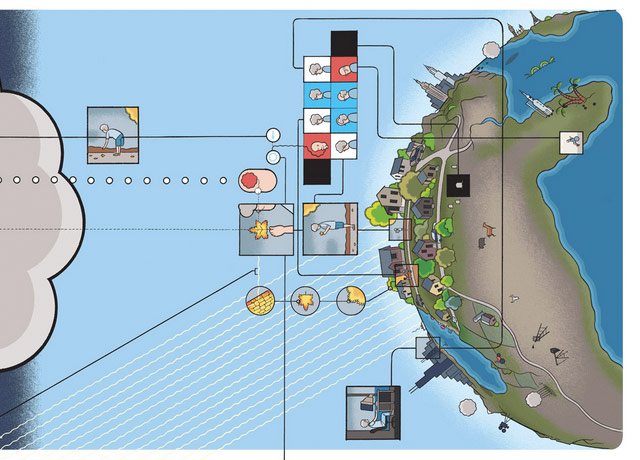
Chris Ware is publishing a new graphic novella called The Last Saturday on The Guardian web site, with a new installment appearing every Saturday. (via df)
Mojang’s popular game Minecraft has sold over 54 million copies. But that, and the $2.5 billion that Microsoft just paid to acquire the company, dramatically understates the impact that this game has had on [Dave Pell’s] third grader and his friends. They all wear Minecraft gear and watch Minecraft videos on YouTube. And several of them completed a week of Minecraft Camp over the summer. The way I see it, $2.5 billion just became the most anyone has ever spent on a babysitter.
The Verge: Why parents are raising their kids on Minecraft.
Markus Persson, the founder of Mojang (known as Notch), explains why he’s selling — and leaving — the company: “It’s not about the money. It’s about my sanity.”
Conflict photographer Ashley Gilbertson recently embedded himself in the video game The Last of Us Remastered and sent back a selection of war photos.

Reminds me a bit of Jim Munroe’s My Trip to Liberty City, a film made from the perspective of a tourist visiting the city featured in Grand Theft Auto III:
(via @atotalmonet)
Update: New Gamer took photos of a road trip in Grand Theft Auto: San Andreas. (via @johnke)
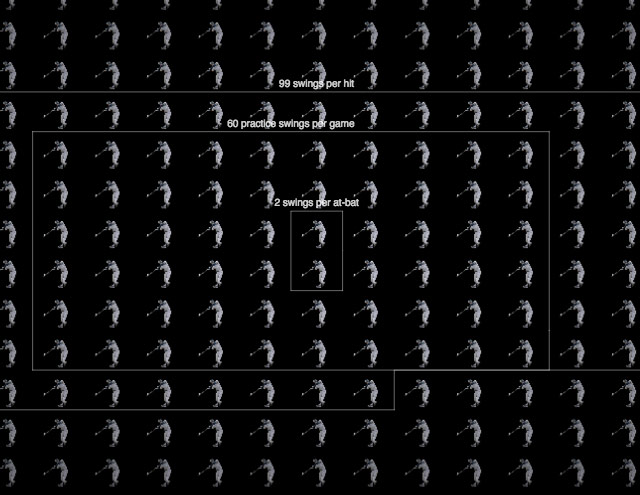
Love this New York Times visualization of how many times Derek Jeter has swung a bat during his career. This is like Powers of Ten, but with Derek Jeter bat swings.
This goal by AC Milan’s Jeremy Menez against Parma over the weekend is just beyond:
No-look backheel. Jeebus.
Originally from the sixth issue of the excellent Lucky Peach magazine, mad food scientist Harold McGee of the joys of aging canned food and its “extremely cooked flavor”.
This punishing heat treatment helps create the distinctive flavors of canned goods. So does the hermetically sealed container, which means that after any preliminary cooking outside the can-tuna is steamed to remove moisture, for example, and the best French sardines are lightly fried-oxygen can play only a limited role in flavor development, and that whatever happens in the can stays in the can-no aromas can escape. Hence the common presence of a sulfurous quality, which may be eggy or meaty or oniony or cabbagy or skunky, from compounds like hydrogen sulfide, various methyl sulfides, and methanethiol. Some of these notes can gradually fade during storage as the volatiles slowly react with other components of the food.
The overall flavor is nothing like freshly cooked foods. Food technologists often refer to it as “retort off-flavor.” But it’s only off in comparison to the results of ordinary cooking. It’s really just another kind of cooked flavor, an extremely cooked flavor, and it can be very good. Canned tuna, sardines, chicken spread, and Spam all have their own appeal.
(via @sippey)
I hid in the clouded wrath of the crowd,
but when they said, “Sit down,” I stood up.
— Bruce Springsteen, Growing Up
In the NYT Magazine, A.O. Scott reflects on the death of adulthood in American culture:
What all of these shows grasp at, in one way or another, is that nobody knows how to be a grown-up anymore. Adulthood as we have known it has become conceptually untenable. It isn’t only that patriarchy in the strict, old-school Don Draper sense has fallen apart. It’s that it may never really have existed in the first place, at least in the way its avatars imagined. Which raises the question: Should we mourn the departed or dance on its grave?
This guy Fik Shun? He knows how to dance.
The thing he starts doing with his chest around 2:10 is some Exorcist-level shit. (via digg)
Walter Isaacson has written books on Albert Einstein, Benjamin Franklin, and Steve Jobs. His newest book, The Innovators, is due out in early October and focuses on the people who invented computing and the Internet.
In his masterly saga, Isaacson begins with Ada Lovelace, Lord Byron’s daughter, who pioneered computer programming in the 1840s. He explores the fascinating personalities that created our current digital revolution, such as Vannevar Bush, Alan Turing, John von Neumann, J.C.R. Licklider, Doug Engelbart, Robert Noyce, Bill Gates, Steve Wozniak, Steve Jobs, Tim Berners-Lee, and Larry Page.
This is the story of how their minds worked and what made them so inventive. It’s also a narrative of how their ability to collaborate and master the art of teamwork made them even more creative.

The analysis of the weak parts of Apple’s recent introduction of the iPhone 6 and Apple Watch at the beginning of this piece is good, but the real gem is the complete reworking of the presentation as Steve Jobs might have approached it.
Jobs: It’s not easy being an engineer at Apple. (Laughs) How do you take the world’s best phone and make it even better? (Cheers)
When we first launched the iPhone back in 2007, we didn’t anticipate the central role it plays today-how it would touch every part of our lives. (Cheers)
Seven years later, our iPhones are the window to our world. Through this window I see my wife and kids. I see my friends, take care of work, and relax.
If this window is so important, what if we made it a little bigger?
(Steve holds out his hand and starts separating his fingers as if he’s stretching an iPhone)
(Once they get really far, he grins and quickly pushes them back together)
Jobs: But not too big! (Audience chuckles) You still want to be able to hold it in one hand and fit it inside your pocket.
Our team of smart engineers have come up with the perfect size.
The heartfelt folksiness is pitch perfect. And the whole thing about the iWatch is amazing:
Jobs: The iWatch comes with a special sensor that detects your heartbeat. In addition to linking to Apple Health, it does something very special.
Something very dear to me.
I’d like to see how my daughter is doing. Instead of sending her a text, what can I do? I press this button twice, and… (Heartbeats echo in the auditorium)
You can’t see it, but my watch is vibrating to her heartbeat. I can close my eyes and know that my daughter is alive, living her life halfway around the globe.
Not sure if Jobs would have approached it this way, but it made me actually want to get an Apple Watch. (via @arainert)
Erik Vance on why real working archaeologists don’t care for Indiana Jones.
“Oh God,” he groans, “Don’t even go there. Indiana Jones is not an archeologist.”
It’s not surprising that academics — hell bent on taking the fun out of everything — would hate our beloved and iconic movie version of them. But Canuto is no killjoy. His ironic tone and acerbic wit seem honed by long boring days in the sun. So I bite. I quickly learn that there’s a good reason why most every archeologist on Earth hates Indy. And that they might have a point. Because Jones isn’t an archeologist at all.
“That first scene, where he’s in the temple and he’s replacing that statue with a bag of sand — that’s what looters do,” Canuto says, grinning. “[The temple builders] are using these amazing mechanisms of engineering and all he wants to do is steal the stupid gold statue.”
Makes you wonder if Jones was one of the Raiders referred to in the title of the first movie. (via @riondotnu)

This Lego version of the Simpsons house looks amazing. Not sure if it’s $200 amazing, but still. These minimalist Lego Simpsons characters are much cheaper.

If you’re thinking of switching mobile carriers (b/c perhaps a certain fruit company is releasing new models), you should check Sensorly for “unbiased” coverage maps of AT&T, Verizon, T-Mobile, Sprint, and even smaller companies like Metro PCS and US Cellular. Looks like the maps are somewhat inaccurate because they rely on contributions only from Sensorly app users. For example, there are large swaths of upper Manhattan and the Bronx which show coverage only along major roads. But still helpful to use beside the companies’ official coverage maps. (via @ludacrisofficia)
Update: Rootmetrics also has coverage maps for the major carriers. (via @ropiku)
[Note: if you’re unable to read about domestic violence against women for any reason, you might want to skip this post. Possibly related: the number for the National Domestic Violence Hotline is 1-800-799-7233.]
From an anonymous author on The Frisky, Why I Married My Abuser.
One Saturday afternoon a few months after our first date, I opened one of the cards and then smelled it as he beamed on proudly. I sniffed and joked “like a woman” because he was the first man I ever knew to send a scented envelope.
I know it’s a cliche, but if I close my eyes, I can still see that moment in slow motion. His face changed from beaming to furious. And suddenly, I was on the floor. It wasn’t until he extended his hand down to me saying, “Oh baby I am so sorry! Why did you have to say that? I’m so sorry!” that I realized I was on the floor because his fist had put me there. I actually thought for a second that a piece of the ceiling must have fallen down. Surely Hank couldn’t have hit me? That was something that happened to other people.
“Why did you have to say that?” The insidiousness of that simple phrase is chilling. From Obsidian Wings, the perspective of someone who worked at a battered women’s shelter for five years: Why Do They Stay?
So imagine yourself, in love with someone, on your honeymoon or pregnant, when suddenly this guy just goes ballistic, often for very little reason, and hits you. For a lot of women, this is profoundly shocking and disorienting. There are things that are comprehensible parts of the world, even if they’re rare, like having your car stolen; and then there are things that are unexpected in a completely different sense, like having your car turn into an elephant before your eyes: things that make you wonder whether you’re completely crazy. Being beaten up by someone who apparently loves you is one of those things.
What this means is that precisely when a woman needs as much confidence in her own judgment as she can muster, the rug is completely pulled out from under her. And it’s not just that she questions her judgment because she got involved with this guy in the first place; she questions her judgment because something so completely alien to the world she thinks she knows has just happened.
And via the National Domestic Violence Hotline site, Sarah Buel’s Fifty Obstacles to Leaving, a.k.a., Why Abuse Victims Stay.
14. Financial Abuse: Financial abuse is a common tactic of abusers, although it may take different forms, depending on the couple’s socio-economic status. The batterer may control estate planning and access to all financial records, as well as make all money decisions. Victims report being forced to sign false tax returns or take part in other unlawful financial transactions. Victims also may be convinced that they are incapable of managing their finances or that they will face prison terms for their part in perpetrating a fraud if they tell someone.
Since the video of former NFL player Ray Rice knocking his then-fiancée out in an elevator leaked, the National Domestic Violence Hotline has seen an 84% increase in call volume. If any of the above rings true for you and your domestic situation, that phone number again is 1-800-799-7233.
The internet is full of remixes of movies and trailers these days: Wes Anderson’s Forrest Gump, The Shining as a romantic comedy, Toy Story 2 mashed up with Requiem for a Dream, Toy Story meets The Wire, and so on. But before all of that, from 1987, perhaps the first mashup of its kind, Apocalypse Pooh:
Todd Graham made this short film with VCRs and film nerds passed around copies on VHS tapes. (via @johankugelberg)
As part of a course he was teaching, a biologist sent away for a genetic testing kit from 23andMe for himself and his parents. When he went looking for other relatives on the service (which is now an automatic opt-out feature), he discovered he had a half-brother his dad had not told his family about.
At first, I was thinking this is the coolest genetics story, my own personal genetics story. I wasn’t particularly upset about it initially, until the rest of the family found out. Their reaction was different. Years of repressed memories and emotions uncorked and resulted in tumultuous times that have torn my nuclear family apart. My parents divorced. No one is talking to my dad. We’re not anywhere close to being healed yet and I don’t know how long it will take to put the pieces back together.
After this discovery was made, I went back to 23andMe and talked to them. I said, “I’m not sure all your customers realize that when they participate in your family finder program, what they’re participating in what are essentially really advanced paternity tests.” People find out that their parents aren’t who they think they are. They have nearly a million people in the database. If there happens to be anyone in there you’re related to, they’ll find your match. This is a solid science.
I know a family in which one of the children is adopted and they haven’t told her. Which is crazy…she’s gonna find out eventually (through something like 23andMe or because of some medical emergency or test) and go totally berzerk.
Some recent studies suggest that reading Harry Potter may make kids nicer people.
As the familiar story goes, not long ago there was an orphan who on his 11th birthday discovered he had a gift that set him apart from his preteen peers. Over the years he endured the usual adolescent challenges — maturation, relationships, social conflicts, general teenage neuroses. He also faced the less common challenge of battling a murderous, psychopathic wizard set on establishing a eugenic police state. I’m referring to the young wizard Harry Potter, the bespeckled, morally-upright protagonist in author JK Rowling’s wildly popular fantasy book series; his nemesis is Lord Voldemort, the story’s malevolent antagonist. And, while it might sound far-fetched, new research suggests that Rowling’s world of house-elves, half-giants and three-headed dogs has the potential to make us nicer people.
I’ve been reading Harry Potter with the kids for awhile now. We’re almost finished with The Prisoner of Azkaban. One of my favorite parts of reading it with them is when they’re confused about a situation or a particular word and we get to have a conversation. While reading Chamber of Secrets, we talked about mudbloods, prejudice, and fascism. We’ve talked about good and evil and how many of the books’ characters actually possess both good and not-so-good qualities. More recently, we talked about bravery and cowardice in the context of being a friend and how even Neville, who seems frightened of everything, is a brave and true friend for trying to stop Hermione, Ron, and Harry from leaving the Gryffindor common room in search of the Sorcerer’s Stone. I don’t know if they’re better people for it, but I value the chance to have those conversations with them about something they’re really into.
In August, the open source mapping project OpenStreetMap turned 10 years old.
When the project was begun by Steve Coast in 2004, map data sources were few, and largely controlled by a small collection of private and governmental players. The scarcity of map data ensured that it remained both expensive and highly restrictive, and no one but the largest navigation companies could use map data. Steve changed the rules by creating a wiki-like resource of the entire globe, which everyone could use without hinderance.
The magic of OSM’s early success was not just its timeliness — GPS was becoming affordable, storage was increasingly cheap, and the iPhone was around the corner — but its provision of a read-write canvas where emerging mapping enthusiasts could convert their frustration into action. Maps, of course, are intimately personal, but also overtly political: as a true, citizens’ map of the world, OSM could address that particular paradox — no longer were mapping resources allocated by revenue potential; instead, all one needed was time and a computer connection to add data about their country or their neighborhood.
As you can see, from a fledgling project, a rich collection of data has taken shape:
Still my favorite use of OSM: Stamen’s watercolor maps. Happy birthday, old thing.
Apple just announced the iPhone 6 and for the first time, I’m seriously thinking about upgrading my phone before my contract is up. A company called Statista recently surveyed several companies who buy old iPhones. It looks like the best place to sell your old iPhone is Amazon: they’re offering Amazon gift cards in the $300-400 range for good-condition iPhone 5s.

Glyde offers slightly less for iPhones than Amazon, but they’ll give you cash (although withdrawals take 3-5 business days). You can also try your luck on eBay or Craigslist…I’ve heard you can get a bit more because you’re selling direct but you have to deal with buyers and potential scams and whatnot.

Bill Murray is set to host the season premiere of Saturday Night Live and the internet is going to fucking EXPLODE.
According to several sources — including news posts yesterday by local NBC affiliate sites that have since been taken down — the one and only Bill Murray will be making a glorious return to SNL to help ring in its 40th year on the air, while fellow SNL alum Sarah Silverman and TV-turned-movie star Chris Pratt will host the second and third episodes, respectively.
(via @Choire)
Update: FALSE ALARM! I repeat, FALSE ALARM.
NBC has announced that Chris Pratt will be hosting the season premiere, with Sarah Silverman hosting the second episode. It’s not clear what happened to Murray-as-host — it may have been rescheduled to later in the season or canceled altogether.
Go back to your homes and places of business in peace. No looting please. (via @zakmahshie)
We’ve been using Eyefi cards to upload photos from the kids’ cameras to Flickr. Matt Haughey has a review of their newest card, the Eyefi Mobi, which automagically syncs to your phone, resulting in a 20-second DSLR-to-Instagram workflow.
In essence, the card turns any dumb camera into an outboard lens for your phone. Last week on a trip to NYC I took my new compact camera with me and could easily upload photos to Instagram and Twitter within seconds of taking the photos. I mean that literally: I can take a photo with my camera, open up my phone, touch the mobi app icon and about ten seconds later I can be saving that image to my phone’s camera roll. I could also manipulate and tweak the images in a plethora of iPhone apps like VSCOcam, Photoshop Express, etc. directly on the phone before sharing it out to the world.
This sounds amazing. Step one for me: get a camera. Any suggestions? I’ve been eyeing Fujifilm’s X100S for quite awhile…
Life-long NFL football fan Steve Almond recently wrote a book called Against Football in which he details why he is no longer watching the game he loves. Ian Crouch talked with Almond for the New Yorker.
Any other year, Steve Almond would have seen the play. But, after forty years of fandom, he’s quit the N.F.L. In his new book, “Against Football,” Almond is plain about what he considers the various moral hazards of the game: “I happen to believe that our allegiance to football legitimizes and even fosters within us a tolerance for violence, greed, racism, and homophobia.”
This part resonated most with me:
Even a casual N.F.L. fan can recognize that this is a particularly opportune time for a Raiders fan to stop watching football. The team is terrible. I asked Almond about that. “If the Raiders were really good, I might not have written the book,” he said. “How fucked up is that? It’s true, I love them. I see those colors, and it’s me.” For Almond, his struggle to confront his own hypocrisy is exactly the point: proof of football’s insidiousness, of its ominous power.
“Football somehow hits that Doritos bliss point,” he told me. “It’s got the intellectual allure of all these contingencies and all this strategy, but at the same time it is so powerfully connecting us to the intuitive joys of childhood, that elemental stuff: Can you make a miracle? Can you see the stuff that nobody else sees? And most of us can’t, but we love to see it. And I don’t blame people for wanting to see it. I love it, and I’m going to miss it.”
I’ve been a steadfast fan of NFL football for the past 15 years. Most weekends I’d catch at least two or three games on TV. Professional football lays bare all of the human achievement + battle with self + physical intelligence + teamwork stuff I love thinking about in a particularly compelling way. But for a few years now, the cons have been piling up in my conscience: the response to head injuries, the league’s nonprofit status, the homophobia, and turning a blind eye to the reliance on drugs (PEDs and otherwise). And the final straw: the awful terrible inhuman way the league treats violence against women.
It’s overwhelming. Enough is enough. I dropped my cable subscription a few months ago and was considering getting it again to watch the NFL, but I won’t be doing that. Pro football, I love you, but we can’t see each other anymore. And it’s definitely you, not me. Call me when you grow up.
Update: Chuck Klosterman recently tackled (*groan*) this issue in the NY Times Magazine: Is It Wrong to Watch Football?
My (admittedly unoriginal) suspicion is that the reason we keep having this discussion over the ethics of football is almost entirely a product of the sport’s sheer popularity. The issue of concussions in football is debated exhaustively, despite the fact that boxing — where the goal is to hit your opponent in the face as hard as possible — still exists. But people care less about boxing, so they worry less about the ethics of boxing. Football is the most popular game in the United States and generates the most revenue, so we feel obligated to worry about what it means to love it. Well, here’s what it means: We love something that’s dangerous. And I can live with that.
Ta-Nehisi Coates quit watching back in 2012 after Junior Seau died.
I’m not here to dictate other people’s morality. I’m certainly not here to call for banning of the risky activities of consenting adults. And my moral calculus is my own. Surely it is a man’s right to endanger his body, and just as it is my right to decline to watch. The actions of everyone in between are not my consideration.
Same here. I don’t feel any sense of judgment or righteousness about this. Just the personal loss of a hobby I *really* enjoyed. (via @campbellmiller & @Godzilla07)
This starts out ordinarily, but give it some time…it gets really good around 90 seconds in. The combination of panning and slow motion creates a powerful sense of energy around almost-still imagery; it’s a trippy effect. See also James Nares’ Street. (via subtraction)

Super bummed to hear that Berg is shutting down.
We’ve not reached a sustainable business in connected products. But: There’s our troop! Cultural inventions! I’m proud of this British Experimental Rocket Group.
They had a tough row to hoe w/ Little Printer and building the plumbing to the IoT, but their effort and thinking was always very inspirational. Cheers to Matt, Jack, and the whole gang; now on to the next one.
This list of philosophy student karaoke standards by Jarry Lee for McSweeney’s contain some top-shelf philosophy puns.
My Milkshake Brings All the Baudrillard
Psycho Schiller
Hit Me Baby Wittgenstein
Total Eclipse of Descartes
(via @tcarmody)
From Cinefix, the 100 most iconic shots in film.
Skews heavily toward pop culture favorites, but still worth a look. Here’s a video with annotations of each scene. (via digg)
Tighter FDA restrictions are keeping some classic French cheeses (Roquefort, Morbier, Tomme de Savoie) out of the US and even some American cheese makers are halting production of their cheeses because they’re afraid their products won’t meet the new standards.
In early August, these cheeses and many more landed on an FDA Import Alert because the agency found bacterial counts that exceeded its tolerance level. Cheeses on Import Alert can’t be sold in the U.S. until the producer documents corrective action and five samples test clean, a process that can take months.
Of course, French creameries haven’t changed their recipes for any of these classic cheeses. But their wheels are flunking now because the FDA has drastically cut allowances for a typically harmless bacterium by a factor of 10.
Even Parmigiano-Reggiano might be threatened by the new restrictions. Ridiculous.
In London in 1888, an unknown person known as Jack the Ripper killed at least five women in brutal fashion. Russell Edwards recently bought a shawl allegedly tied to one of the killings. After DNA testing, the shawl was shown not only to have the victim’s blood on it but also semen from the alleged perpetrator, hairdresser Aaron Kosminski. Edwards and the person responsible for the forensic research explain their findings in this article.
The tests began in 2011, when Jari used special photographic analysis to establish what the stains were.
Using an infrared camera, he was able to tell me the dark stains were not just blood, but consistent with arterial blood spatter caused by slashing — exactly the grim death Catherine Eddowes had met.
But the next revelation was the most heart-stopping. Under UV photography, a set of fluorescent stains showed up which Jari said had the characteristics of semen. I’d never expected to find evidence of the Ripper himself, so this was thrilling, although Jari cautioned me that more testing was required before any conclusions could be drawn.
Hmm. Given the source (The Daily Mail) and the lack of independent corroboration of the results, a little skepticism in in order here.
Dang! It looks as though the Shake Shack is gonna IPO at a value of $1 billion. (BTW, $1 billion would buy you about 210 million ShackBurgers.)
At that level, Shake Shack would debut at 50 times projected earnings of about $20 million this year, the people said, asking not to be named because the details are private. The company has tapped JPMorgan Chase & Co. and Morgan Stanley to manage the share sale, said the people.
That valuation would put it in line with other dining chains that have tapped into investor appetite for new stocks in recent years. El Pollo Loco Holdings Inc. (LOCO), which raised $123 million in July, now trades at about 60 times projected 2014 earnings, while Potbelly (PBPB) Corp. trades at over 64 times estimated earnings, data compiled by Bloomberg show.
The Shack has about 50 locations worldwide. But their flagship Madison Square Park location will be closing for a few months soon for renovations…hopefully they’ll have it back open for the IPO.
Update: And the Shack filed for their IPO on Dec 29, 2014.
Shake Shack is a modern day “roadside” burger stand serving a classic American menu of premium burgers, hot dogs, crinkle-cut fries, shakes, frozen custard, beer and wine. Founded by Danny Meyer’s Union Square Hospitality Group, LLC (“USHG”), Shake Shack was created leveraging USHG’s expertise in community building, hospitality, fine dining, restaurant operations and sourcing premium ingredients. Danny’s vision of Enlightened Hospitality guided the creation of the unique Shake Shack culture that, we believe, creates a differentiated experience for our guests across all demographics at each of the 63 Shacks around the world. As Shake Shack’s Board Chairman and USHG’s Chief Executive Officer, Danny has drawn from USHG’s experience creating and operating some of New York City’s most acclaimed and popular restaurants, including Union Square Cafe, Gramercy Tavern, Blue Smoke, The Modern, Maialino and Marta, to build what we believe is a new fine casual restaurant category in Shake Shack.
There are now 63 Shake Shacks. 63! I just wish the one across from the office would reopen. (via @caseyjohnston)
Update: From Tyler Cowen, Does the Shake Shack IPO mean you should stop eating there?:
A simple theory of IPOs suggests that they arrive when a product or company is experiencing “peak buzz,” or at least when the insiders in the privately held company think they are at or near peak buzz. This will maximize the expected returns on the IPO when it comes to market.
When it comes to food, peak buzz usually arrives a wee bit after peak quality, given reputational lags. So if you are seeing peak buzz, it is probably time to bail on the restaurant, at least on a restaurant which is going to be sold. Bailing on the restaurant may in fact be slightly overdue.
To test Cowen’s theory1, I went to the Shake Shack in Grand Central today (12/31/14). I stood in line for 10 minutes, ordered my customary Shack burger with fries (long live the crinkle cut), and then waited an additional 10 minutes for my food. Verdict: as delicious as ever. Service was snappy and friendly. Well worth the wait and price for me: I got exactly what I wanted.
This is BS actually. I’ve been jonesing for a Shack burger for weeks now and I finally made it happen today.↩
Watch as a group of Amish men raise almost an entire barn in a day.
(via colossal)
Red Bull is sponsoring a six-part series on the history of Japanese video game music. The first installment covers the music of Space Invaders through the Game Boy. Highlight: composer Junko Ozawa showing off her hand-drawn waveform library she used in composing scores for Namco. Bonus: Space Invader-only arcades in Japan were called “Invader houses” while arcades in New Zealand were known as “spacies parlours”.
Update: Beep is a feature-length documentary film that will attempt to cover the history of video game sounds from Victorian mechanical arcades on up to the present day games. They are currently raising funds on Kickstarter.
From Wikipedia, a list of common misconceptions, including a recent favorite about life expectancy in the Middle Ages:
It is true that life expectancy in the Middle Ages and earlier was low; however, one should not infer that people usually died around the age of 30. In fact, the low life expectancy is an average very strongly influenced by high infant mortality, and the life expectancy of people who lived to adulthood was much higher. A 21-year-old man in medieval England, for example, could by one estimate expect to live to the age of 64.
Also, Vikings didn’t wear horned helmets, Romans didn’t puke in vomitoriums after rich meals, the average housefly lives for 20 to 30 days, medieval Europeans didn’t believe the Earth was flat, Napoleon was taller than average, the Bible’s forbidden fruit was not explicitly an apple, and humans have more than 20 senses. (via @linuz90)
Let’s say you have latitude/longitude coordinates of 40.742041, -73.989579 (my current location). How precise are those 6 digits after the decimal point? Well, five decimal places will get you to within a meter and six will get you to within 11 cm:
The fifth decimal place is worth up to 1.1 m: it distinguish trees from each other. Accuracy to this level with commercial GPS units can only be achieved with differential correction.
The sixth decimal place is worth up to 0.11 m: you can use this for laying out structures in detail, for designing landscapes, building roads. It should be more than good enough for tracking movements of glaciers and rivers. This can be achieved by taking painstaking measures with GPS, such as differentially corrected GPS.
(via teendrama)
New Yorker music critic Sasha Frere-Jones recently compiled a series of five playlists on Spotify of “perfect” songs: vol 1, vol 2, vol 3, vol 4, vol 5. Among the songs found on the playlists are Maps by Yeah Yeah Yeahs, Blue Moon by Elvis, Pony by Ginuwine, Transmission by Joy Division, Tennis Court by Lorde, No Scrubs by TLC, and Rock Steady by Aretha Franklin. The playlists are also available on Rdio, courtesy of my friend Matt: vol 1, vol 2, vol 3, vol 4, and vol 5.
Update: And here’s an Rdio playlist with all five volumes of Perfect Recordings. This will be on shuffle at my place for months to come.

I don’t drink coffee — quelle horreur! quelle suprise! quelle whatevs! — but those around me seem excited by The Handpresso, a travel-sized espresso maker. The Wild Hybrid model even lets you use pods or your very own ground espresso (for less waste and better taste).
A compilation of some of the vehicles used in Wes Anderson’s movies, shot from the first-person POV.
(via devour)
I went to the newish Barcade in Chelsea last night to get some dinner and play Star Wars (and Ms. Pac-Man and Tetris and Donkey Kong) and discovered their tater tots are shaped like Tetris pieces:

ИOM ИOM ИOM. You can get these tots from a company called US Foods; they call them Puzzle Potatoes. Their sell sheet for the product is a wonder of corporate wishful thinking masquerading as marketing.
Here’s a menu item that will encourage kids to play with their food.
Yes! This is exactly what all parents want. Huge parental issue in America right now is that kids don’t play with their food enough.
When baked, these innovative Puzzle Potatoes are a fun and healthier alternative to regular fries…
Tater tots are not a health food. That’s the whole point. Also, aren’t regular fries also healthier when baked?
Puzzle potatoes are new innovative and interactive potatoes for kids.
Imagine the meeting. “Bob, what can we do about these smartphone? Kids just aren’t spending enough time with their potatoes anymore. Instead they’re Facebooking and Flappy Birding. Wait, I know… interactive potatoes!” [Cut to Bob being paraded around the office on his coworkers’ shoulders]
Our proprietary puzzle-piece shapes…
Well, someone else’s proprietary puzzle piece shapes, but why quibble with details?
Features & Benefits… 2D or 3D
I don’t. I can’t. What does that even mean? The sell sheet for these should be super simple: a photo of the tots and this caption in all-caps 120-point type: THEY’RE TATER TOTS SHAPED LIKE TETRIS PIECES! BUY THEM, YOU FOOL! (thx, kathryn)
The re/spin service helps you import any Spotify or Last.fm playlist into Rdio. Unfortunately, I have a feeling that before too long, we’ll need a service to convert Rdio collections and playlists to Spotify. (via @capndesign)

There’s a new king of the dinosaurs: Dreadnoughtus schrani. A skeleton of the species was unearthed in Argentina in 2005 and the results of the recently released analysis show this Dreadnoughtus was 85 feet long, weighed around 65 tons, and had a powerful “weaponized tail”. The kicker? It was not yet an adult and still growing when it died.
While other giants from Patagonia are known from a handful of bones, almost half of the Dreadnoughtus skeleton has been recovered. What’s more, the fossilised bones are in such good condition — even revealing where muscles attached — that the skeleton could provide unprecedented insights into the biology, movement and evolution of the group of huge plant-eating dinosaurs it belonged to, called the titanosaurian sauropods.
By comparison, an Apatosaurus (née Brontosaurus) is ~75 feet long and weighed 22 tons while a Boeing 737-900 weights around 50 tons. Here’s some more background on the Dreadnoughtus and a video showing some of the fossils:
Getty Images photographer Justin Sullivan recently captured some photos of lakes in California showing the extent of the drought there. For me, this is the craziest one, of Bidwell Marina at Lake Oroville:

And this is what it normally looks like:


Well, well. For a cookbook called Fried & True: More than 50 Recipes for America’s Best Fried Chicken and Sides, food genius Wylie Dufresne recreated the recipes for Popeye’s chicken and biscuits.
The tenders first get an overnight soak in buttermilk and hot sauce that makes them juicy and, um, tender. To nail the perfectly seasoned crust, he eventually landed on a breading that includes a packet of onion soup and a hefty dose of McCormick’s Italian Herb Spaghetti Sauce Seasoning Mix. (If this makes you cringe, remember who we’re talking about here, and trust.) Cornstarch, potato starch and baking soda added to the self-rising flour mixture ensure the signature craggy texture and exceptional crunch. Finally, after much experimentation to find the perfect frying temperature, he settled on a relatively low 300°, which renders the crust a deep golden-brown and keeps the lean meat moist.
Better than the original, says Serious Eats’ Maggie Mariolis. Dang.
Unless you’re a close follower of chess, you’re probably missing out on one of the most impressive feats the game has ever seen. Fabiano Caruana, an Italian born in the US and currently ranked #3 in the world, has won seven straight games in the “strongest ever chess tournament”, the Sinquefield Cup in St. Louis, MO. No losses, no draws, just 7 straight wins.
In terms of comparison, Magnus Carlsen, the world’s current #1 and owner of the highest ranking ever, is 2-1-4 at the same tournament. Which is pretty typical; the best players draw a lot. Over his career, Carlsen has drawn almost 50% of the time and Caruana about 40%.
The modern times of chess have a new king, king Fabiano Caruana. One has to look back to 1968 where in Wijk Aan Zee the legendary Korchnoi started with 8,0/8. The times now are so different and the competition so fierce that already Fabiano’s success can be proclaimed as the most memorable streak in the history of chess.
Along the way, Caruana has beaten Carlsen (#1), Levon Aronian (#2), Maxime Vachier-Lagrave (#9) twice, Hikaru Nakamura (#7), and Veselin Topalov (#6) twice. If you look at the unofficial live chess ratings, you’ll see he has moved into the #2 position in the world, jumping a whopping 34.1 points in rating. He also owns the fourth highest rating in history, behind Carlsen, Kasparov, and Aronian. Caruana plays Carlsen again today, starting from the more advantageous white position. (via @tylercowen)
Update: In his eighth match, Caruana drew against Carlsen but clinched first place overall with two matches remaining.
Update: Seth Stevenson has an article in Slate about what went down at the Sinquefield Cup, saying “one of the most amazing feats in chess history just happened, and no one noticed”.
James Ward runs the Boring Conference (“a one-day celebration of the mundane, the ordinary, the obvious and the overlooked — subjects often considered trivial and pointless, but when examined more closely reveal themselves to be deeply fascinating”) and writes in the Guardian about some of the people he’s met who fascinated by the mundane.
“How should we take account of, question, describe what happens every day and recurs every day?” asks the French writer Georges Perec in his 1973 essay on the “infra-ordinary” (his word for everything that’s the opposite of “extraordinary”). Perec challenges us to question the habitual. “But that’s just it, we’re habituated to it. We don’t question it, it doesn’t question us, it doesn’t seem to pose a problem, we live it without thinking, as if it carried within it neither question nor answers, as if it weren’t the bearer of any information.”
Perec’s point is that everything contains information. It’s just that, sometimes, it takes a bit of work to notice it. These days, an audience and a platform can be found for even the most niche interests, as people demonstrate that nothing is truly boring - not if you look at it closely enough.
(via mr)

Laura Ingalls Wilder wrote her autobiography, Pioneer Girl, in the early 1930s. The book was deemed unsuitable for publication, but Wilder reworked her story into the successful Little House on the Prairie series for children.
Now the South Dakota Historical Society is publishing an annotated version of Pioneer Girl, which includes stories from Wilder’s childhood that didn’t make it into the kids’ books. And for good reason.
It contains stories omitted from her novels, tales that Wilder herself felt “would not be appropriate” for children, such as her family’s sojourn in the town of Burr Oak, where she once saw a man became so drunk that, when he lit a cigar, the whisky fumes on his breath ignited and killed him instantly. In another recollection, a shopkeeper drags his wife around by her hair, pours kerosene on the floor of his house, and sets their bedroom on fire.
Wilder’s memoir also paints a different picture of her father, Charles Ingalls, known in the novels as Pa. Although the real man’s character is essentially the same as the version in the novels - affectionate, musical and restless to move on through America’s frontier - he is, said the book’s publisher, the South Dakota Historical Society Press, clearly “romanticised and idealised”. In Wilder’s autobiography, he is described sneaking his family out of town in the middle of the night after failing to negotiate the rent with the landlord, justifying the flit by calling the man a “rich old skinflint”.
Earlier this year, there was an open casting call for the role of Laura in a new movie version of Little House on the Prairie. Maybe the drunken self-immolation will make it into this one!
Update: Pioneer Girl has become an unlikely bestseller. The small press that published the book is doing a fifth printing and bookstores online and off can’t keep it in stock.
That a hardcover book of this heft and complexity — in addition to the side notes, there are scores of maps, illustrations and photographs — has been such a hit has surprised everyone, including the publisher. The South Dakota Historical Society Press is a seven-person operation based in Pierre. In the five months since the book’s release, it has been trying frantically to print more copies to keep up with demand (the first printing of 15,000 copies sold out in just a couple of weeks). “When people have to wait, they want it more,” says Nancy Tystad Koupal, director of the press.
It turns out that this close-up video of slow motion skateboard tricks is all I’ve ever wanted out of life.
I had no idea that’s what they were doing down there. It’s a symphony of footwork!
Socials & More