Entries for August 2013
If you’re at all interested in the Pioneer Anomaly (and you really should be, it’s fascinating), The Pioneer Detectives ebook by Konstantin Kakaes looks interesting.
Explore one of the greatest scientific mysteries of our time, the Pioneer Anomaly: in the 1980s, NASA scientists detected an unknown force acting on the spacecraft Pioneer 10, the first man-made object to journey through the asteroid belt and study Jupiter, eventually leaving the solar system. No one seemed able to agree on a cause. (Dark matter? Tensor-vector-scalar gravity? Collisions with gravitons?) What did seem clear to those who became obsessed with it was that the Pioneer Anomaly had the potential to upend Einstein and Newton — to change everything we know about the universe.
Kakaes was a science writer for The Economist and studied physics at Harvard, so this topic seems right up his alley. Available for $2.99 for the Kindle and for iBooks on iOS.
Check out this dog playing fetch with himself!
(via ★interesting)
Now this looks interesting: Steven Johnson is doing a six-episode series on PBS about the 500-year histories of several aspects of modern life. Sounds right up my alley…and also quite Connections-ish.
The show builds on many of themes in the innovation history trilogy of The Ghost Map, The Invention Of Air, and Where Good Ideas Come From, but is based on new material with a completely different structure. Each hour-long episode takes one facet of modern life that we mostly take for granted — artificial cold, clean drinking water, the lenses in your spectacles — and tells the 500-year story of how that innovation came into being: the hobbyists and amateurs and entrepreneurs and collaborative networks that collectively made the modern world possible. It’s also the story of the unintended consequences of these inventions: air conditioning and refrigeration didn’t just make it possible to build ski slopes in the desert; they also triggered arguably the largest migration of human beings in the history of the species — to cities like Dubai or Phoenix that would otherwise be virtually uninhabitable.
Outside of the nature documentaries like Planet Earth, I haven’t seen a decent science series on TV in a long while — most of them are too slow with too much filler and not enough actual, you know, science — so I’m not getting my hopes up too high, but hoping this one bucks that trend.
Hey there. Sleeping ok? Perhaps not after you watch this microscopic video of a mosquito’s mouthparts searching the flesh of its victim for blood vessels.
I’ve never been shy about killing mosquitos but now I am on a mission.
On Soundcloud, TheMusicalOdyssey put together an hour-long mix of old blues, folk, and jazz tunes that are full of references to sex, drugs, and crime. The track listing is available on the SC page.
Lucille Bogan & Walter Roland’s rendition of Shave Em Dry from 1935 is as nasty as anything 2 Live Crew put out. The lyrics are at the bottom of this page; this is the only verse printable in a family publication:
I will turn back my mattress and let you oil my springs,
I want you to grind me daddy till the bells do ring,
Ooh daddy, want you to shave ‘em dry.,
Oh pray God daddy, shave ‘em baby, won’t you try?
(via hero squad)
For the Journal of the American Revolution, Todd Andrlik compiled a list of the ages of the key participants in the Revolutionary War as of July 4, 1776. Many of them were surprisingly young:
Marquis de Lafayette, 18
James Monroe, 18
Gilbert Stuart, 20
Aaron Burr, 20
Alexander Hamilton, 21
Betsy Ross, 24
James Madison, 25
This is kind of blowing my mind…because of the compression of history, I’d always assumed all these people were around the same age. But in thinking about it, all startups need young people…Hamilton, Lafayette, and Burr were perhaps the Gates, Jobs, and Zuckerberg of the War. Some more ages, just for reference:
Thomas Jefferson, 33
John Adams, 40
Paul Revere, 41
George Washington, 44
Samuel Adams, 53
The oldest prominent participant in the Revolution, by a wide margin, was Benjamin Franklin, who was 70 years old on July 4, 1776. Franklin was a full two generations removed from the likes of Madison and Hamilton. But the oldest participant in the war was Samuel Whittemore, who fought in an early skirmish at the age of 80. I’ll let Wikipedia take it from here:
Whittemore was in his fields when he spotted an approaching British relief brigade under Earl Percy, sent to assist the retreat. Whittemore loaded his musket and ambushed the British from behind a nearby stone wall, killing one soldier. He then drew his dueling pistols and killed a grenadier and mortally wounded a second. By the time Whittemore had fired his third shot, a British detachment reached his position; Whittemore drew his sword and attacked. He was shot in the face, bayoneted thirteen times, and left for dead in a pool of blood. He was found alive, trying to load his musket to fight again. He was taken to Dr. Cotton Tufts of Medford, who perceived no hope for his survival. However, Whittemore lived another 18 years until dying of natural causes at the age of 98.
!!!

On January 15, 1919 in Boston’s North End, a storage container holding around 2.3 million gallons of molasses ruptured, sending a 8-15 ft. wave of molasses shooting out into the streets at 35 mph. Twenty-one people died, many more were injured, and the property damage was severe. In an article in Scientific American, Ferris Jabr explains the science of the molasses flood, including why it was so deadly and destructive.
A wave of molasses does not behave like a wave of water. Molasses is a non-Newtonian fluid, which means that its viscosity depends on the forces applied to it, as measured by shear rate. Consider non-Newtonian fluids such as toothpaste, ketchup and whipped cream. In a stationary bottle, these fluids are thick and goopy and do not shift much if you tilt the container this way and that. When you squeeze or smack the bottle, however, applying stress and increasing the shear rate, the fluids suddenly flow. Because of this physical property, a wave of molasses is even more devastating than a typical tsunami. In 1919 the dense wall of syrup surging from its collapsed tank initially moved fast enough to sweep people up and demolish buildings, only to settle into a more gelatinous state that kept people trapped.
This could just be a Boston urban legend, but it’s said that on hot days in the North End, the sweet smell of molasses can be detected wafting through the air.

Rachel Evans makes colorful world maps out of Spirograph-produced patterns. Prints are available.
The Andy Warhol museum has recently set up a webcam pointed 24/7 at Andy Warhol’s grave in a Pennsylvania cemetary. His gravestone is currently adorned with flowers, mylar balloons, and cans of Campbell’s Soup. Peter Schjeldahl wrote about the project for the New Yorker.
I have angled for reasons to snoot the webcam stunt. I can’t think of any. Along with more or less everybody else, I find it Warholian to the, well, life: watching the present habitation of a man who liked to watch. Warhol pioneered motion pictures of motionless subjects; and we have him to thank, or not, for prophesying reality television. His strictly beholding bent became, as it remains, a default setting of artistic and popular culture absolutely everywhere.
The live video feed includes sound, so I imagine it won’t be too long before some enterprising performance artists show up and do something entertaining.
Apple fan fiction is more popular than ever and usually takes the form of mockups of designs for new products and alternate designs for existing products. There’s been a recent burst of creative energy unleashed on Dribbble around the idea of an iPhone with a screen that wraps completely around the device (or at least down around the sides). Claudio Guglieri seems to have accidentally started it with this mockup of an RSS reader he’s working on:

Fabio Basile dubbed it iPhone 6 Infinity and made a Photoshop template that others could use to make further mockups. More mockups from them and others followed: Side Screen, another Photoshop template, a wrap-around social app, an alternate lock screen, and these subtle side indicators.

Leaving aside for the moment the issue of how a touchscreen device that’s all screen would function while being held, the visual effect is pretty cool.
Here’s the trailer for Visitors, a new film from Koyaanisqatsi collaborators Godfrey Reggio and Philip Glass. Most of the trailer consists of a single two-minute shot.
That shot reminds me of many things: Andy Warhol, long photos, James Nares’ Street, and Robbie Cooper’s work depicting kids playing video games.
Also interesting is that Visitors is comprised of only 74 shots, which with a runtime of 87 minutes means the average shot lasts over a minute. According to a recent investigation by Adam Jameson, an ASL (average shot length) of more than a minute is unusual in contemporary film. Inception, for instance, has a ASL of just 3.1 seconds and even a film like Drive, with many long shots, has an ASL of 7 seconds. But as Jameson notes, Alfonso Cuarón’s upcoming Gravity contains only 156 shots, including a 17-minute-long shot that opens the film. But the Hollywood master of long-running shots? Hitchcock, I presume:
1. Rope (1948, Alfred Hitchcock), ASL = 433.9 [seconds]
OK, this isn’t a recent recent film, but it has to be noted, as it’s most likely the highest ASL in Hollywood. Hitchcock used only 10 shots in making it (the film’s Wikipedia page lists them). (As you probably know, Hitchcock designed those shots, then edited them such that the finished film appeared to be a single take.)
A federal judge ruled this morning that NYC’s controversial stop-and-frisk practice violated the rights of “tens of thousands” of New Yorkers.
In a decision issued on Monday, the judge, Shira A. Scheindlin, ruled that police officers have for years been systematically stopping innocent people in the street without any objective reason to suspect them of wrongdoing. Officers often frisked these people, usually young minority men, for weapons or searched their pockets for contraband, like drugs, before letting them go, according to the 195-page decision.
These stop-and-frisk episodes, which soared in number over the last decade as crime continued to decline, demonstrated a widespread disregard for the Fourth Amendment, which protects against unreasonable searches and seizures by the government, according to the ruling. It also found violations with the 14th Amendment.
To fix the constitutional violations, Judge Scheindlin of Federal District Court in Manhattan said she intended to designate an outside lawyer, Peter L. Zimroth, to monitor the Police Department’s compliance with the Constitution.
This is good news. Treating every young black male in the city like a criminal is not a policing strategy and it’s embarrassing it has gone on this long. This kind of thing, along with the recent NSA revelations and other issues, make me wonder if “innocent until proven guilty” is still something the US citizenry and its law enforcement agencies still believe in. (via @beep)
Update: Using data from the last half of 2013, the NY Times says ‘Stop-and-Frisk’ Is All but Gone From New York.
Many who live and work in the neighborhoods say they see scant evidence of change, and some say the police are simply not reporting some or all of their stops. The police did not respond to requests for comment.
But something is clearly different: Misdemeanor drug and weapon charges, the most common arrests to result from a stop, are down considerably. Advocates say misdemeanor marijuana charges, which require that the drug is in plain sight, are a bellwether, because the police ordered thousands to empty pockets, and arrested them.
I’ll reserve judgement until the numbers from 2014 are in, particularly those post-Bloomberg.
WinCo is an Idaho-based grocery chain that frequently beats Walmart on price while providing health care benefits for any employee working over 24 hours a week as well as an annual pension.
While all of these factors help WinCo compete with Walmart on price, what really might scare the world’s largest retailer is how WinCo treats its employees. In sharp contrast to Walmart, which regularly comes under fire for practices like understaffing stores to keep costs down and hiring tons of temporary workers as a means to avoid paying full-time worker benefits, WinCo has a reputation for doing right by employees. It provides health benefits to all staffers who work at least 24 hours per week. The company also has a pension, with employees getting an amount equal to 20% of their annual salary put in a plan that’s paid for by WinCo; a company spokesperson told the Idaho Statesman that more than 400 nonexecutive workers (cashiers, produce clerks, and such) currently have pensions worth over $1 million apiece.
Pretty interesting history of how the children’s menu came to “grace” restaurant tables around the country.
Children tend to rise to the culinary bar we set for them, and children’s menus in America set the bar very low indeed. To look at the standard kids’ menu, greasy with prefab items like chicken fingers, tater tots, and mac-and-cheese, you might think that industrial food manufacturers have been responsible for setting it. But the delusion that a child even needs a special menu is a lot older than the chicken nuggets that have come to dominate it. In fact, the children’s menu dates back to Prohibition, when, remarkably, it was devised with a child’s health in mind.
I hate kid’s menus. Our kids would happily order off the main menu but as soon as the promise of hot dogs and chicken fingers arrives with crayons, it’s difficult to steer them away.
The team is rowing in a wild nighttime sea when a rogue wave the size of a small house hoists their boat, tosses it into a valley and crashes over it. The force of the water snaps one of the oars in Kreek’s hand.
What happens when four guys try to cross the Atlantic…in a rowboat.
The Send Me to Heaven app is simple: it tracks how high you can throw your phone.
You install the app (on your android, obviously). You then throw your phone as high as you can. Go on, throw it. Catching the phone is entirely optional, of course, but if you’re anything like me, your phone is carrying all kinds of incriminating evidence, so if it breaks, you’re in the clear.
And that’s it. Well, there’s more to it than that: what the app actually does is register how high it’s been thrown, then it uploads that height to a leaderboard. Effectively, it turns throwing your phone into a sport akin to Russian Roullette; do you want to be the best? Then you should risk your expensive phone to do so.
A bit of evil genius, that.
This is what the trees look like near Chernobyl when you cut them down. It’s a biiiit tricky but see if you can spot when the nuclear plant disaster happened…

Not surprisingly, researchers have found evidence that the radiation has affected the growth of trees near the accident site. From the paper:
Mean growth rate was severely depressed and more variable in 1987-1989 and several other subsequent years, following the nuclear accident in April 1986 compared to the situation before 1986. The higher frequency of years with poor growth after 1986 was not caused by elevated temperature, drought or their interactions with background radiation. Elevated temperatures suppressed individual growth rates in particular years. Finally, the negative effects of radioactive contaminants were particularly pronounced in smaller trees. These findings suggest that radiation has suppressed growth rates of pines in Chernobyl, and that radiation interacts with other environmental factors and phenotypic traits of plants to influence their growth trajectories in complex ways.
This compilation of videos shot with Vine is surprisingly good and a nice illustration of what Mat Honan is getting at in Why Vine Just Won’t Die.
Vine started from scratch. It built a ground up culture that feels loose, informal, and — frankly — really fucking weird. Moreover, most of what you see there feels very of-the-moment. Sure, there’s plenty of artistry that goes into making six second loops, and there are volumes of videos with high production values. But far more common are Vines that serve as windows into what people are doing right now. Many of the most popular Vines appear to be completely off the cuff. They don’t have to be great or slick or well produced. In some ways, its better that they’re not, because it creates a lower threshold if you just want to, you know, share a video of your cat. They have something that trumps quality, which is authenticity.
That authenticity is driving a distinct emerging culture. One that stars people like Riff Raff and Tyler, the Creator, and an army of kids whose names you’ve never heard of but who can still generate hundreds of thousands of likes and re-Vines, and even large scale in-person meetups. It’s the triumph of the loop, yes, but it’s also the triumph of youth.
Take a moment to stroll through Vine’s “Popular Now” videos, and you’d have to be willfully ignorant to not notice that those on Vine are distinctly younger, distinctly blacker, and distinctly, well, gayer than society in general. In short, it’s cool. It’s hip. It’s a scene. If Instagram is an art museum, Vine is a block party.
I was going to make a joke about this being what TV is going to look like in five years, but I think you could put 30 minutes of this on MTV2 or whatever, with six-second Vine-style ads placed seamlessly in the mix, and you’d have yourself a hit show. (via ★interesting)
Leave it to Werner Herzog to take the driver safety video to new heights. From One Second To The Next is a 35-minute documentary film by Herzog on the dangers of texting while driving.
Powerful stuff. Don’t text while you’re driving, okay? (via @brillhart)
Spike Jonze’s new movie features Joaquin Phoenix falling in love with his computer. The trailer:
That looks really good. I didn’t care for Where the Wild Things Are but Being John Malkovich is one of my favorite movies.
You might have hear of the prisoner’s dilemma, a classic example in game theory showing why individuals might not cooperate. But what you probably don’t know is the name comes from a thought experiment. No one had ever actually tested it on real prisoners. Until now. From Max Nisen at Business Insider Australia:
Surprisingly, for the classic version of the game, prisoners were far more cooperative than expected.
Menusch Khadjavi and Andreas Lange put the famous game to the test for the first time ever, putting a group of prisoners in Lower Saxony’s primary women’s prison, as well as students through both simultaneous and sequential versions of the game.
The payoffs obviously weren’t years off sentences, but euros for students, and the equivalent value in coffee or cigarettes for prisoners.
They expected, building off of game theory and behavioural economic research that show humans are more cooperative than the purely rational model that economists traditionally use, that there would be a fair amount of first-mover cooperation, even in the simultaneous simulation where there’s no way to react to the other player’s decisions.
And even in the sequential game, where you get a higher payoff for betraying a cooperative first mover, a fair amount will still reciprocate.
As for the difference between student and prisoner behaviour, you’d expect that a prison population might be more jaded and distrustful, and therefore more likely to defect.
The results went exactly the other way for the simultaneous game, only 37% of students cooperate. Inmates cooperated 56% of the time.
A great example of the prisoner’s dilemma in action can be seen in this clip from the British game show, Golden Balls. If you can get past the ridiculous name of the show, this illustrates the tension between opposing parties very well:
(via @justinwolfers)
The ultimate in YouTube rubbernecking. Normally a car or truck exploding is very unusual. To see one blow up repeatedly and spectacularly is jaw dropping. It looks like a truck carrying oil drums propane/gas canisters but it’s hard to tell.
Things seem to be all over at 4:50 and people start to slowly approach the site except at 7:01… (via @malki)
Last month it was revealed that JK Rowling of Harry Potter fame recently published the crime novel The Cuckoo’s Calling under the pseudonym Robert Galbraith. How’d she get outed? Turns out it was a tip-off from her law firm, but with just an anonymous tip there wasn’t much to go on. Time to call in the language experts. Ben Zimmer at the WSJ has a good general report but the real meat of things is in a post that computer science professor Patrick Juola wrote for the Language Log blog.
I was given e-text copies of Cuckoo to compare against Rowling’s own The Casual Vacancy, Ruth Rendell’s The St. Zita Society, P.D. James’ The Private Patient and Val McDermid’s The Wire in the Blood. […]
I actually ran four separate types of analyses focusing on four different linguistic variables. While anything can in theory be an informative variable, my work focuses on variables that are easy to compute and that generate a lot of data from a given passage of language. One variable that I used, for example, is the distribution of word lengths. Each novel has a lot of words, each word has a length, and so one can get a robust vector of X% of the words in this document have exactly Y letters. Using a distance formula (for the mathematically minded, I used the normalized cosine distance formula instead of the more traditional Euclidean distance you remember from high school), I was able to get a measurement of similarity, with 0.0 being identity and progressively higher numbers being greater dissimilarity.
Of the 11 sections of Cuckoo, six were closest (in distribution of word lengths) to Rowling, five to James. No one else got a mention. […]
Does this prove that Rowling wrote Cuckoo? Of course not. All it really “proves” — suggests, rather — is that out of the four authors studied, the most likely candidate author is probably Rowling.
(via @nostrich)
This Craigslist missed connection posting starts out like every other, but it slowly cracks open into something heartbreaking and beautiful.
I saw you on the Manhattan-bound Brooklyn Q train.
I was wearing a blue-striped t-shirt and a pair of maroon pants. You were wearing a vintage red skirt and a smart white blouse. We both wore glasses. I guess we still do. […]
Up and down the Q line, over and over. We caught the rush hour crowds and then saw them thin out again. We watched the sun set over Manhattan as we crossed the East River. I gave myself deadlines: I’ll talk to her before Newkirk; I’ll talk to her before Canal. Still I remained silent.
For months we sat on the train saying nothing to each other. We survived on bags of skittles sold to us by kids raising money for their basketball teams. We must have heard a million mariachi bands, had our faces nearly kicked in by a hundred thousand break dancers. I gave money to the beggars until I ran out of singles. When the train went above ground I’d get text messages and voicemails (“Where are you? What happened? Are you okay?”) until my phone ran out of battery.
The person behind the post is suspected to be Raphael Bob-Waksberg.
(thx @torrez)

An incredibly brave and cunning group of French prisoners of war were able to construct a camera inside the Nazi prison camp they were being held at and film their conditions.
Their rarely seen footage is called Sous Le Manteau (Clandestinely). So professional is it that on first viewing you would be forgiven for thinking it is a post-war reconstruction.
Prisoners filmed the camp secretly with a camera inside a hollowed-out dictionary. It is in fact a 30-minute documentary, shot in secret by the prisoners themselves. Risking death, they recorded it on a secret camera built from parts that were smuggled into the camp in sausages.
The prisoners had discovered that German soldiers would only check food sent in by cutting it down the middle. The parts were hidden in the ends.
The camera they built was concealed in a hollowed-out dictionary from the camp library. The spine of the book opened like a shutter. The 8mm reels on which the film was stored were then nailed into the heels of their makeshift shoes.
It gives an incredible insight into living conditions within the camp. The scant food they were given, the searches conducted without warning by the German soldiers. They filmed it all, even the searches, right under the noses of their guards.
A minute of the film is viewable on the BBC’s website. (via @DavidGrann)
Watch this orchestra composed of 167 theremins that have been built into Russian nesting dolls play Beethoven’s 9th symphony.
(via @nickd)
Tim Maly spoke to a vibration performance engineer with GM and found that the sounds you you think are engine or mechanical noses might not actually be sounds your car is making.
Strangely, to give people the impression that the Impala’s engine was working as intended, GM had to partially mask its real sound.
In general, to improve fuel economy in a car, you want to reduce the engine’s RPM. Over the past few decades, the auto industry has been doing that. In the 90s, says Gordon, a 4c engine might be cruising at 3,400 RPM. Today, it’s below 2,000.
But as you reduce the speed that the drive shaft is rotating, you lower the frequency of the sound it’s making. There comes a lower limit where the engine is making what Gordon calls “groan-y and moan-y” noises which people find unpleasant. The car sounds broken.[…]
Some sounds in the car are completely artificial. The telltale clicking of a turn signal was once an artifact of the mechanical process that turned the light on and off. But that mechanism has long since been replaced by an electronic circuit that operates silently. Still, audible feedback is valuable so the car plays an MP3 file of a turn signal over the speakers.
We’re made to hear what we expect to hear. If you’d like to learn a little more about this,
Roman Mars’ 99% Invisible has a great episode on the manufactured sounds that go into sports.
Abandoned halfway through construction, this 45 story tower in Caracas has become the world’s tallest slum. Ramón Iriarte of Vocativ visited recently and filmed the conditions.
You may have heard of Kowloon Walled City, the unregulated city block inside of Hong Kong, China. It was torn down and made into a park the ’90s. The Tower of David in Caracas, Venezuela is still standing and occupied today. According to the residents of the tower, there’s not more crime there than in the rest of the city. And residents actually pool money to keep essential services going in much the same way a condo board does.
(thx @knguyen)
McDonalds’s partnered with Visa to make a budgeting website for their employees. On it, they included a suggested monthly budget. That seems helpful. But what’s wrong with this picture?

The most egregious thing is that McDonald’s admits the fact that you need a second job—on top of working full time for them—to earn enough money to hope to survive. But it’s even worse than that. Robyn Pennacchia at Death and Taxes breaks it down further:
Also noticeably absent in this budget? Food. And gas. There’s a line for a car payment, but not for gas. Which is suspect, because if you’re working two jobs it’s possible you will pay more for your gas than you’d be paying for your car.
Also… health insurance for $20 a month? There is really no such thing as health insurance for $20 a month if you’re buying your health insurance on your own. I think the least amount is going to be about $215 a month- and that only covers hospital emergencies.
(via @bifurcations)

Each layer is different kind of cake which is baked and then pressed into the batter of the next larger cake, covered, and rebaked. The largest of which you bake in halves in two glass mixing bowls.
It’s like a dessert turducken. Mmmm.
(via @rustyk5)
Clive Thompson takes a look at a novel written in 1880 called “Wired Love: A Romance of Dots and Dashes”, the story of a telegraph operator flirting with a man across the country which has all the drama of an episode of Catfish.
Miss Nattie Rogers, telegraph operator, lived, as it were, in two worlds. The one her office, dingy and curtailed as to proportions, but from whence she could wander away through the medium of that slender telegraph wire, on a sort of electric wings, to distant cities and towns; where, although alone all day, she did not lack social intercourse, and where she could amuse herself if she chose, by listening to and speculating upon the many messages of joy or of sorrow, of business and of pleasure, constantly going over the wire. […]
“It must be very romantic and fascinating to talk with some one so far away, a mysterious stranger too, that one has never seen,” Miss Archer said, her black eyes sparkling. “I should get up a nice little sentimental affair immediately, I know I should, there is something so nice about anything with a mystery to it.”
“Yes, telegraphy has its romantic side—it would be dreadfully dull if it did not,” Nattie answered.
“But—now really,” said Quimby, who sat on the extreme edge of the chair, with his feet some two yards apart from each other; “really, you know, now suppose—just suppose, your mysterious invisible shouldn’t be—just what you think, you know. You see, I remember one or two young men in telegraph offices, whose collars and cuffs are always soiled, you know!”
“I have great faith in my ‘C,’” laughed Nattie.
“It would be dreadfully unromantic to fall in love with a soiled invisible, wouldn’t it,” said Miss Archer, with an expressive shrug of her shoulders.
Clive’s discussion of the book is here on Collision Detection and the novel itself is available here as a free ebook.
The third and final part of Anita Sarkeesian’s Feminist Frequency series on the damsel in distress trope in video games has been released and it deals with the few games that invert the trope and put the dude in distress. She looks at dozens of games and the cultural norms they attempt to subvert but end up reinforcing.
Back in our first episode I mentioned that Princess Peach is the star of exactly one platformer. That game is called Super Princess Peach and it was released in 2006 for the Nintendo DS handheld system. The premise is a simple inversion of the standard franchise formula with Bowser abducting Mario and Luigi, while Peach is tasked with their rescue this time. So finally after being kidnapped in 13 separate Super Mario games, Peach gets to be the hero for once. But don’t get too excited because everything else about the game ends up in a train-wreck of gender stereotypes. Nintendo introduced a new gameplay mechanic for Peach where the player can choose from four special powers or vibes as they’re called. And you know what those powers are? Her mood swings. That’s right. Peach’s powers are her out of control frantic female emotions. She can throw a temper tantrum and rage her enemies to death or bawl her eyes out and wash the bad guys away with tears. Essentially Nintendo has turned a PMS joke into a core gameplay mechanic.
The first two parts of the series are available here and here.
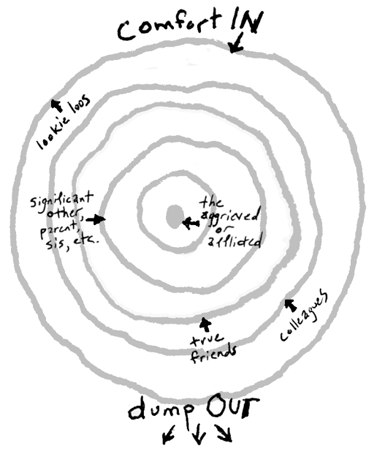
If you have a friend going through something painful that affects you too, can you complain about it and to who? Clinical psychologist Susan Silk has developed a mnemonic to let you know who it’s appropriate to dump your worries on.
It works for all kinds of crises: medical, legal, financial, romantic, even existential. She calls it the Ring Theory.
Draw a circle. This is the center ring. In it, put the name of the person at the center of the current trauma. For Katie’s aneurysm, that’s Katie. Now draw a larger circle around the first one. In that ring put the name of the person next closest to the trauma. In the case of Katie’s aneurysm, that was Katie’s husband, Pat. Repeat the process as many times as you need to. In each larger ring put the next closest people. Parents and children before more distant relatives. Intimate friends in smaller rings, less intimate friends in larger ones. When you are done you have a Kvetching Order. […]
If you want to scream or cry or complain, if you want to tell someone how shocked you are or how icky you feel, or whine about how it reminds you of all the terrible things that have happened to you lately, that’s fine. It’s a perfectly normal response. Just do it to someone in a bigger ring.
Comfort IN, dump OUT.
Next time someone says the wrong thing to you, it’ll be a lot easier to forward them this than get in a fight about it. (via @kissane)
This is a cover of Crystal Castles’ “Untrust Us” done by London’s Capital Children’s Choir.
OK so where’s the Kickstarter to get a children’s acapella group to cover all my favorite house music?
(via @heyitsgarrett)

PicaPic is a digitized collection of vintage handheld games made by Hipopotam studio. They’re all free and playable in your browser. It’s a really slick implementation. It even has the plasticy clacking sound of the buttons. (via @kump)
George Saunders gave the commencement address at Syracuse University this past spring and it was recently republished in the New York Times. It touches on the nature of success and kindness.
What I regret most in my life are failures of kindness. […]
[A]ccomplishment is unreliable. “Succeeding,” whatever that might mean to you, is hard, and the need to do so constantly renews itself (success is like a mountain that keeps growing ahead of you as you hike it), and there’s the very real danger that “succeeding” will take up your whole life, while the big questions go untended. […]
Since, according to me, your life is going to be a gradual process of becoming kinder and more loving: Hurry up. Speed it along. Start right now. There’s a confusion in each of us, a sickness, really: selfishness. But there’s also a cure. So be a good and proactive and even somewhat desperate patient on your own behalf - seek out the most efficacious anti-selfishness medicines, energetically, for the rest of your life.
In July, Jay Z rapped Picasso Baby at Pace Gallery in NYC for six hours. The fruits of that labor have been condensed by director Mark Romanek into a 10-minute music video that premiered on HBO last night. Here’s the film:
The idea of performance art came to mind. I was aware of Marina Abramovic’s Artist is Present, even though I was in London shooting ‘Never Let Me Go’ and didn’t get to go. And the idea that Jay-Z regularly performs to 60,000 people at a time, I thought, ‘What about performing at one person at a time?’ He absolutely loved it. He interrupted me and said, ‘Hold on! I’ve got chills. That idea is perfect.’ He thinks, like me, that the music video has had its era. I also wanted to make sure we had Marina’s blessing. So she attended the event and took part in the event. She couldn’t have been more happy or enthusiastic about us using her concept and pushing it forward.
Also, somehow, I have never heard Jay Z talk before. That’s his voice?
Ecstasy of Order is a documentary about Tetris and the quest to find the game’s grandmasters.
Tetris. We’ve all played it, rotating the pieces (“tetrominoes”) and dropping them in the perfect place, or despairing as we discover a piece won’t fit. You may have even joked about “mastering” the game during a stint of unemployment, or as a child, before you could afford any other Game Boy cartridges. But what about the people who’ve truly mastered Tetris? Where are the Kasparovs and Fischers, the great champions who’ve dedicated their minds to solving its deepest puzzles?
One man made it his mission to find them. In an effort to legitimize Tetris as a pro sport, Tetris super-fan Robin Mihara summoned the greatest Tetris players from around the country to compete in Los Angeles at the 2010 Classic Tetris World Championship. Among them are the only players known to have reached the unthinkable perfect ‘max-out’ score on classic Nintendo Tetris: Jonas Neubauer and Harry Hong. Add in the top players for most lines, Ben Mullen and Jesse Kelkar, as well as newcomer Dana Wilcox and modern-day Tetris Grandmaster Alex Kerr, and a storm of Tetris greatness is brewing.
The film is also on Hulu (US-only) if you don’t mind commercials.
In acceleration chess (aka progressive chess), each player gets to make one more move than the previous player.
White moves first, but then Black gets to move twice. Then White gets to move three times in a row, then Black four times in a row, then White five times in a row, and so on, with continuing escalation as the game proceeds.
You can see some gameplay here:
Pressure cookers and backpacks orig. from Aug 01, 2013
* Q: Wha? A: These previously published entries have been updated with new information in the last 24 hours. You can find past updates here.
Michele Catalano’s house was recently visited by 6 the FBI law enforcement officials who asked about various web searches made by members of the household. So, uh, it seems like your web searches ARE being monitored.
Most of it was innocent enough. I had researched pressure cookers. My husband was looking for a backpack. And maybe in another time those two things together would have seemed innocuous, but we are in “these times” now. And in these times, when things like the Boston bombing happen, you spend a lot of time on the internet reading about it and, if you are my exceedingly curious news junkie of a twenty-ear-old son, you click a lot of links when you read the myriad of stories. You might just read a CNN piece about how bomb making instructions are readily available on the internet and you will in all probability, if you are that kid, click the link provided.
Update: A little bit more to the story.
We found out through the Suffolk Police Department that the searches involved also things my husband looked up at his old job. We were not made aware of this at the time of questioning and were led to believe it was solely from searches from within our house.
[…]
If it was misleading, just know that my intention was the truth. And that was what I knew as the truth until about ten minutes ago. That there were other circumstances involved was something we all were unaware of.
GearSketch is a cool and simple gear-making game. Click on the “?” for a quick demo. If you spend fewer than 20 minutes on this, you’re a better person than I. (thx, nick)
Cennydd Bowles spends a day at the World Chess Championship Candidates Tournament. Lovely little piece.
I’m overwhelmed to be in the same room as these men. I played through their games (well, except the younger ones) as a teenager, developing a love or dislike of their styles, and scratching my head at their depth. The skill gap in chess is remarkable: these Grandmasters would demolish someone who would easily beat someone who would wipe me off the board. Amid my admiration, I feel a vertiginous impulse: I could leap out of my seat, scatter the pieces, and make history as the world’s first chess streaker. The temptation soon fades.
Each player aligns the pieces, although the boards are already laid out in pristine formation. It’s a curious habit I recognise from my own experience. It helps to get your hands on the tools of your trade, to feel they’re yours.
I expected more left-handers.
(via @beep)
Sabine Heinlein follows several people through a post-prison jobs program to see how ex-convicts prepare for re-entry into the workforce.
In prison Angel thought that it wouldn’t be too hard to find a job once he got out. He believed he had come a long way. At eighteen he hadn’t been able to read or write. He wet his bed and suffered from uncontrollable outbursts of anger. At forty-seven he had studied at the college level. He told me he had read several thousand books. He earned numerous certificates while incarcerated — a Vocational Appliance Repair Certificate, a Certificate of Proficiency of Computer Operator, a Certificate in Library Training, an IPA (Inmate Program Assistant) II Training Certificate, and several welding certifications — but in the outside world these credentials counted for little.
“Irrelevant,” Angel said. “They might as well be toilet paper.”
This piece is the seventh chapter from Heinlein’s book, Among Murderers: Life After Prison.
Newer posts





Socials & More