Entries for April 2012
Remember the Netflix Prize, the $1 million challenge cooked up by Netflix to improve their movie recommendation engine by 10%? Turns out they never implemented the winning algorithm, in part because their movie streaming service changed the game.
One of the reasons our focus in the recommendation algorithms has changed is because Netflix as a whole has changed dramatically in the last few years. Netflix launched an instant streaming service in 2007, one year after the Netflix Prize began. Streaming has not only changed the way our members interact with the service, but also the type of data available to use in our algorithms. For DVDs our goal is to help people fill their queue with titles to receive in the mail over the coming days and weeks; selection is distant in time from viewing, people select carefully because exchanging a DVD for another takes more than a day, and we get no feedback during viewing. For streaming members are looking for something great to watch right now; they can sample a few videos before settling on one, they can consume several in one session, and we can observe viewing statistics such as whether a video was watched fully or only partially.
(via waxy)
The latest installment of the Up Series of documentary films is due out in the UK in May. The films have followed the development of fourteen British children since 1964 with a new film appearing every seven years…the participants are now 56. A few details about the new film are revealed in this interview with one of the participants.
One of the issues that Apted reflects on in 56 Up is the way Britain has changed. “Michael asked us about how education had changed, because people are borrowing money to go to university now,” Mr Hitchon said. “In our day, none of us paid for our education. England’s also changed a lot. For instance, no one is farming the Dales any more and there are all these multimillion-pound houses. I don’t know what England’s like any more. I’ve been away for 30 years.”
Apted also revisits the theme of success. “If you’re still hanging in there and swinging punches then you’re a success,” said Mr Hitchon. “Does that apply to me? Sure, why not? I’m working all the time to solve problems that I think are important. I’m hanging in there despite the fact that it doesn’t all go the way you hope.”
This may be the last film in the series…director Michael Apted will be 78 when the next film is due and he’s unwilling to pass it off to someone else to finish. (thx, raynor)
Primer is one of my favorite films of the past ten years and is available on YouTube in its entirety.
Michael Abrash discusses how he came to work for Valve Software (he coauthored Quake with John Carmack back in the day) and, more interestingly, what Valve is like as a company.
The idea that a 10-person company of 20-somethings in Mesquite, Texas, could get its software on more computers than the largest software company in the world told him that something fundamental had changed about the nature of productivity. When he looked into the history of the organization, he found that hierarchical management had been invented for military purposes, where it was perfectly suited to getting 1,000 men to march over a hill to get shot at. When the Industrial Revolution came along, hierarchical management was again a good fit, since the objective was to treat each person as a component, doing exactly the same thing over and over.
The success of Doom made it obvious that this was no longer the case. There was now little value in doing the same thing even twice; almost all the value was in performing a valuable creative act for the first time. Once Doom had been released, any of thousands of programmers and artists could create something similar (and many did), but none of those had anywhere near the same impact. Similarly, if you’re a programmer, you’re probably perfectly capable of writing Facebook or the Google search engine or Twitter or a browser, and you certainly could churn out Tetris or Angry Birds or Words with Friends or Farmville or any of hundreds of enormously successful programs. There’s little value in doing so, though, and that’s the point - in the Internet age, software has close to zero cost of replication and massive network effects, so there’s a positive feedback spiral that means that the first mover dominates.
If most of the value is now in the initial creative act, there’s little benefit to traditional hierarchical organization that’s designed to deliver the same thing over and over, making only incremental changes over time. What matters is being first and bootstrapping your product into a positive feedback spiral with a constant stream of creative innovation. Hierarchical management doesn’t help with that, because it bottlenecks innovation through the people at the top of the hierarchy, and there’s no reason to expect that those people would be particularly creative about coming up with new products that are dramatically different from existing ones - quite the opposite, in fact. So Valve was designed as a company that would attract the sort of people capable of taking the initial creative step, leave them free to do creative work, and make them want to stay. Consequently, Valve has no formal management or hierarchy at all.
I wonder if Tim Cook’s recent visit to Valve is less about collaboration on specific products and more about Apple’s curiosity about their process. (Probably not, but fun to think about.)
Pinecraft, Florida is a popular spring vacation destination for Amish and Mennonites, a place where they can let their hair down by using cellphones and electricity.
Walking around Pinecraft is like entering an idyllic time warp. White bungalows and honeybell orange trees line streets named after Amish families: Kaufman, Schrock, Yoder. The local Laundromat keeps lines outside to hang clothes to dry. (You have to bring your own pins.) And the techiest piece of equipment at the post office is a calculator. The Sarasota county government plans to designate the village, which spreads out over 178 acres, as a cultural heritage district.
Many travelers I spoke to jokingly call it the “Amish Las Vegas,” riffing off the clich’e that what happens in Pinecraft stays in Pinecraft. Cellphone and cameras, normally off-limits to Amish, occasionally make appearances, and almost everyone uses electricity in their rental homes. Three-wheeled bicycles, instead of horses and buggies, are ubiquitous.
“When you come down here, you can pitch religion a little bit and let loose,” said Amanda Yoder, 19, from Missouri. “What I’m wearing right now, I wouldn’t at home,” she said, gesturing at sunglasses with sparkly rhinestones and bikini strings peeking out of a tight black tank top. On the outskirts of the village, she boarded public bus No. 11 with six other sunburned teenagers. They were bound for Siesta Key, a quartz-sand beach about eight miles away.
One of my favorite blogs in the whole wide world turned ten years old the other day…waxy.org is one of the handful of sites I visit manually every day. Creator Andy Baio talked about the milestone and shared some of his favorite posts from the past ten years.
Most of the interest in writing online’s shifted to microblogging, but not everything belongs in 140 characters and it’s all so impermanent. Twitter’s great, but it’s not a replacement for a permanent home that belongs to you.
And since there are fewer and fewer individuals doing long-form writing these days, relative to the growing potential audience, it’s getting easier to get attention than ever if you actually have something original to say.
Carving out a space for yourself online, somewhere where you can express yourself and share your work, is still one of the best possible investments you can make with your time. It’s why, after ten years, my first response to anyone just getting started online is to start, and maintain, a blog.
My favorite part is how Andy casually mentions he has a complete archive of The WELL. Ten more years!
The first episode of Girls, an eagerly awaited HBO series by executive producer Judd Apatow and writer/director Lena Dunham, is available for free on YouTube (HBO disabled embedding for some dumb reason). HBO plans to do this with Veep next week as well.
In the new issue of the New Yorker, Adam Gopnik talks about pop culture’s 40-year cycle of nostalgia.
So it seems time to pronounce a rule about American popular culture: the Golden Forty-Year Rule. The prime site of nostalgia is always whatever happened, or is thought to have happened, in the decade between forty and fifty years past. (And the particular force of nostalgia, one should bear in mind, is not simply that it is a good setting for a story but that it is a good setting for you.)
If you combine this with Kurt Andersen’s recent piece about the slowing rate of change of pop culture, perhaps there’s another lesson here other than Gopnik’s assertion that we’ll be nostalgic for the Obama age 40 years from now. Maybe we’ve reached Peak Nostalgia and in an effort to find more and more nostalgia for an ever-increasing audience, culturemakers are mining more from those eras outside of the appointed 40-year era and as a result, pop culture is feeling more timeless, echoing all eras, until it becomes a culture that can’t draw upon anything but itself.
And if not, I’m looking forward to the return of 70s-style moviemaking in the coming decade.
Is Tom Junod’s long piece in Esquire a takedown of Jon Stewart? Or just a thorough examination of the messiness of being an ambitious public figure these days? I couldn’t tell. But if you’re a Stewart fan or Daily Show viewer, Junod’s piece is well worth a read.
Now look at him. It’s seven years later, and he’s aged like a president. He’s been graying for years, but now he’s gone gray, and a transformation seems to have taken place. He’s forty-eight years old. He has a wife and two young kids whose lives he worries about missing because he stays so late and works so hard. Last year, when he did that thing, that Jon Stewart thing, that rally in Washington, D. C., he looked like he was starting to, like, fill out — his suit looked a little small on him as he made his big valedictory speech — but now he’s gaunt, and his face is sort of bladelike, collecting itself around the charcoal axis of his eyes, nose, and mouth. Still, he’s jacked. The whole studio is. You don’t have any choice at The Daily Show. For one thing, the music gets louder and louder as you wait before finally reminding you where Stewart’s from with a climactic rendition of Born to Run. For another, there’s a tummler, a warm-up guy who bounds around telling you that you might laugh to yourself while watching Jon Stewart at home, you might smile and chuckle at the apercus, you might silently congratulate yourself for getting the jokes, but you’re not at home anymore, and here you have a responsibility — you’re the laugh track. “Do you want to be on TV! Do you want to meet Jon Stewart! Then you better get loud…”
And now here he is. The man did stand-up for years, and in the studio you can actually see it on him, because whereas on television he clings to his desk like it’s an iron lung (former writers say that you know a bit is doomed if it requires him to get up from behind it), here he actually stands up and goes out to the audience to answer questions. And he’s a kibitzer — it’s not Plato’s Symposium, folks. The first question is “What’s your daily routine?” and Stewart answers as he’s been answering since Destiny’s Child was together: “Jazzercise.” The second question is “Which one of the animals on my T-shirt would you like to be?” and Stewart responds with a question of his own: “Is there a correct answer to that?” And even when a young woman with short hair and glasses and a faded cause on her T-shirt asks if “our greatest media critic” has actually had an impact on the way the media does business, he instantaneously cocks his chin, sucks in his cheeks, and narrows his eyes until he looks like a wizened version of the man whose image is emblazoned on the wall outside; then he deepens his voice confidentially and says, “Well, look who’s carrying the NPR tote bag.” Of course, he denies having an impact — “the satirist depends on shame, and everyone knows that our culture has become shameless” — but when somebody calls out, “But you killed Crossfire!” he says, “No, I didn’t. Crossfire was already dead…”
And there it is again, that denial of power upon which his power depends. It’s strange, isn’t it: One of the fastest and most instinctive wits in America feeling it necessary to go on explaining himself again and again; a man who lives to clarify resorting to loophole; the irrepressible truth-teller insisting on something that not one person of the two hundred watching his show in the studio — never mind the millions who will watch on television — can possibly believe.
Lovely type and illustration on these architectural stationery vignettes collected by BibliOdyssey.
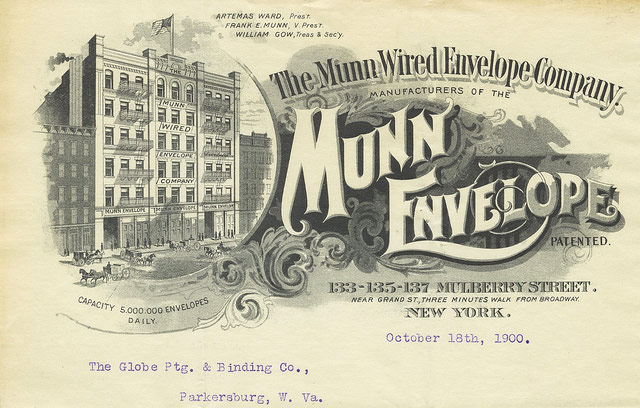
The images in this post all come from Columbia University’s very large assortment of commercial stationery (featuring architectural illustrations): the Biggert Collection.
The vast majority of the images below have been cropped, cleaned and variously doctored for display purposes, with an intent towards highlighting the range of letterform/font and design layouts. The underlying documents are invoices (most), letters, postcards, shipping records and related business and advertising letterhead ephemera from the mid-1800s to the 1930s.
See also the Sanborn fire insurance maps.
Directed by Ice-T, Something From Nothing: The Art of Rap is a documentary about the birth and evolution of rap and hip hop music.
Ice-T takes us on an intimate journey into the heart and soul of hip-hop with the legends of rap music. This performance documentary goes beyond the stardom and the bling to explore what goes on inside the minds, and erupts from the lips, of the grandmasters of rap. Recognized as the godfather of Gangsta rap, Ice-T is granted unparalleled access to the personal lives of the masters of this artform that he credits for saving his life. Interspersed with the performers’ insightful, touching, and often funny revelations are classic raps, freestyle rhymes, and never before heard a cappellas straight from the mouths of the creators. What emerges is a better understanding of, and a tribute to, an original American art form that brought poetry to a new generation.
(via @gavinpurcell)
Joe Eszterhas was working with Mel Gibson on a script for a movie called The Maccabees, aka “a Jewish Braveheart”. Eszterhas came to believe that Gibson was only pretending to do the film to soften Gibson’s anti-semitic image. Feeling betrayed, Eszterhas wrote a letter to Gibson that is just flat out amazing and crazy.
I’ve come to the conclusion that the reason you won’t make “The Maccabees” is the ugliest possible one. You hate Jews.
[…]
Let me remind you of some of the things you said which appalled me. You continually called Jews “Hebes”, “oven-dodgers” and “Jewboys.” It seemed that most times when we discussed someone, you asked “He’s a Hebe, isn’t he?” or “Is he a Hebe?” You said that most “gatekeepers” of American companies were “Hebes” who “controlled their bosses”.
And that’s not even close to the craziest bits of the letter. If even 10% of this is true, let’s hope this is the last we hear of Mel Gibson. (via @jakedobkin)
Cory Booker, mayor of Newark, New Jersey, fought off his security detail and ran into a burning house to rescue a trapped woman.
Newark Mayor Cory Booker was taken to a hospital Thursday night for treatment of smoke inhalation he suffered trying to rescue his next-door neighbors from their burning house.
“I just grabbed her and whipped her out of the bed,” Booker said in recounting the fire. Booker told The Star-Ledger he also suffered second-degree burns on his hand.
Two years ago, Booker helped shovel his constituents’ driveways after a huge snowstorm. Who is this guy, Batman?
They appear to be, although not in a way that we think of as intelligence sometimes. Fascinating article.
Octopuses have the largest brains of any invertebrate. Athena’s is the size of a walnut — as big as the brain of the famous African gray parrot, Alex, who learned to use more than one hundred spoken words meaningfully. That’s proportionally bigger than the brains of most of the largest dinosaurs.
Another measure of intelligence: you can count neurons. The common octopus has about 130 million of them in its brain. A human has 100 billion. But this is where things get weird. Three-fifths of an octopus’s neurons are not in the brain; they’re in its arms.
“It is as if each arm has a mind of its own,” says Peter Godfrey-Smith, a diver, professor of philosophy at the Graduate Center of the City University of New York, and an admirer of octopuses. For example, researchers who cut off an octopus’s arm (which the octopus can regrow) discovered that not only does the arm crawl away on its own, but if the arm meets a food item, it seizes it — and tries to pass it to where the mouth would be if the arm were still connected to its body.
“Meeting an octopus,” writes Godfrey-Smith, “is like meeting an intelligent alien.” Their intelligence sometimes even involves changing colors and shapes. One video online shows a mimic octopus alternately morphing into a flatfish, several sea snakes, and a lionfish by changing color, altering the texture of its skin, and shifting the position of its body. Another video shows an octopus materializing from a clump of algae. Its skin exactly matches the algae from which it seems to bloom-until it swims away.
Reporting for Marketplace, Rob Schmitz shows how iPads are made by Foxconn workers in Shenzhen.
(via daring fireball)
In 1982, Bob Stein, Alan Kay, and Glenn Keane came up with several illustrated scenarios for a concept called the Intelligent Encyclopedia, a ubiquitous always-on electronic encyclopedia.
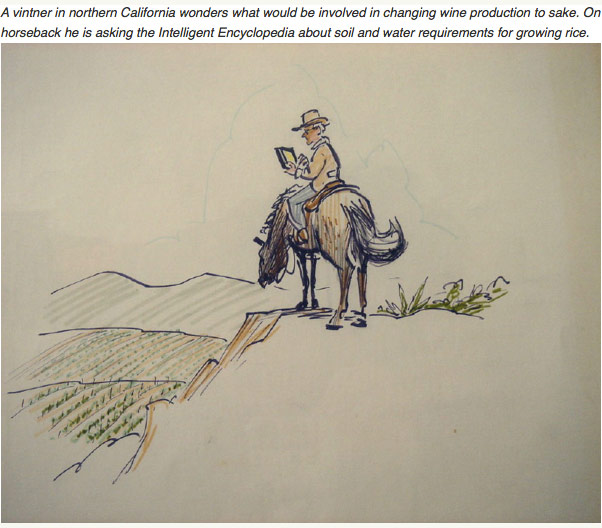
The most interesting thing for me today about these images is that although we foresaw that people would be accessing information wirelessly (notice the little antenna on the device in the “tide pool” image), we completely missed the most important aspect of the network — that it was going to connect people to other people.
This hits a lot closer to the mark than many futuristic scenarios I’ve seen. What’s interesting is that many of the panels shown would have seemed off target just two years ago before the introduction of the iPad and certainly five years ago before the iPhone. (via @steveportigal)
I don’t think this has anything to do with the actual invention of the football helmet, so consider this a more hilarious alternate history. Watch as the inventor of a new type of safer helmet gets kicked in the head, repeatedly bonked in the noggin with a baseball bat, and runs himself into a wall, over and over again.
(via ★dunstan)
From what I can tell, the Museum of Soviet arcade machines is an actual physical museum in Moscow but you can also play one of the games (called Morskoi Boi) online. The museum has around 40 machines, about half of which are playable, including Repka, Safary, Vozdushniy Boi, Duplet, and Snezhnaya Koroleva.

Stereogum writer Tom Breihan saw a Skrillex show at SXSW and loved it. In fact, it was his favorite act. His takeaway was that the Skrillex many people deride as a one-trick WUB WUB WUB pony on the basis of his albums is an extremely effective and talented live DJ.
But what I found was one of the more dynamic sets I heard during all of SXSW. Skrillex, see, knows what he’s doing. He does what great DJs do: He layers sounds and ideas on top of each other, building tension and releasing it, moving fluidly from one thing to the next. Parts sounded like the sort of early-’90s hardcore techno that was popular with people who wore lots and lots of smiley faces. Other parts sounded like the sort of dark, broody late-’90s breakbeat techno that was popular with scary white guys with dreads. There was also a lot of robotic one-drop reggae in there. Early on, Skrillex played a big chunk of Damian Marley’s “Welcome To Jamrock” unmolested. Later, he dug out Ini Kamoze’s “World-A-Music,” the song that Marley sampled on “Jamrock.” All of it fit in seamlessly. None of it was built around bass-drops.
In this video, Erlend Lavik compares the relatively spare visual style of The Wire with that of other TV programs.
(via @uxprinciples)
Letters of Note has a letter written by an 18-year-old Keith Richards to his aunt about meeting Mick Jagger for the first time since they were childhood friends.
Anyways the guy on the station, he is called Mick Jagger and all the chicks and the boys meet every Saturday morning in the ‘Carousel’ some juke-joint well one morning in Jan I was walking past and decided to look him up. Everybody’s all over me I get invited to about 10 parties. Beside that Mick is the greatest R&B singer this side of the Atlantic and I don’t mean maybe. I play guitar (electric) Chuck style we got us a bass player and drummer and rhythm-guitar and we practice 2 or 3 nights a week. SWINGIN’.
The Stones played their first show three months after the letter was written. (via ★thoughtbrain)
One of the more thought-provoking pieces on Instagram’s billion dollar sale to Facebook is Matt Webb’s Instagram as an island economy. In it, he thinks about Instagram as a closed economy:
What is the labour encoded in Instagram? It’s easy to see. Every “user” of Instagram is a worker. There are some people who produce photos — this is valuable, it means there is something for people to look it. There are some people who only produce comments or “likes,” the virtual society equivalent of apes picking lice off other apes. This is valuable, because people like recognition and are more likely to produce photos. All workers are also marketers — some highly effective and some not at all. And there’s a general intellect which has been developed, a kind of community expertise and teaching of this expertise to produce photographs which are good at producing the valuable, attractive likes and comments (i.e., photographs which are especially pretty and provocative), and a somewhat competitive culture to become a better marketer.
There are also the workers who build the factory — the behaviour-structuring instrument/forum which is Instagram itself, both its infrastructure and it’s “interface:” the production lines on the factory floor, and the factory store. However these workers are only playing a role. Really they are owners.
All of those workers (the factory workers) receive a wage. They have not organised, so the wage is low, but it’s there. It’s invisible.
Like all good producers, the workers are also consumers. They immediately spend their entire wage, and their wages is only good in Instagram-town. What they buy is the likes and comments of the photos they produce (what? You think it’s free? Of course it’s not free, it feels good so you have to pay for it. And you did, by being a producer), and access to the public spaces of Instagram-town to communicate with other consumers. It’s not the first time that factory workers have been housed in factory homes and spent their money in factory stores.
Although he doesn’t use the term explictly, Webb is talking about a company town. Interestingly, Paul Bausch used this term in reference to Facebook a few weeks ago in a discussion about blogging:
The whole idea of [blog] comments is based on the assumption that most people reading won’t have their own platform to respond with. So you need to provide some temporary shanty town for these folks to take up residence for a day or two. And then if you’re like Matt — hanging out in dozens of shanty towns — you need some sort of communication mechanism to tie them together. That sucks.
So what’s an alternative? Facebook is sort of the alternative right now: company town.
Back to Webb, he says that making actual money with Instagram will be easy:
I will say that it’s simple to make money out of Instagram. People are already producing and consuming, so it’s a small step to introduce the dollar into this.
I’m not so sure about this…it’s too easy for people to pick up and move out of Instagram-town for other virtual towns, thereby creating a ghost town and a massively devalued economy. After all, the same real-world economic forces that allowed a dozen people to build a billion dollar service in two years means a dozen other people can build someplace other than Instagram for people to hang out in, spending their virtual Other-town dollars.
Also worth a read on Facebook/Instagram: Paul Ford’s piece for New York Magazine.
Facebook, a company with a potential market cap worth five or six moon landings, is spending one of its many billions of dollars to buy Instagram, a tiny company dedicated to helping Thai beauty queens share photos of their fingernails. Many people have critical opinions on this subject, ranging from “this will ruin Instagram” to “$1 billion is too much.” And for many Instagram users it’s discomfiting to see a giant company they distrust purchase a tiny company they adore - like if Coldplay acquired Dirty Projectors, or a Gang of Four reunion was sponsored by Foxconn.
So what’s going on here?
First, to understand this deal it’s important to understand Facebook. Unfortunately everything about Facebook defies logic. In terms of user experience (insider jargon: “UX”), Facebook is like an NYPD police van crashing into an IKEA, forever - a chaotic mess of products designed to burrow into every facet of your life.
Caine is nine years old, lives in LA, and built his own arcade out of cardboard boxes in the back of his father’s auto parts store.
You’ve go to watch until at least 3:10 when he explains how to check the validity of the “Fun Pass” using the calculators located on the front of each game. So so so good!
Alive Inside is a documentary that follows social worker Dan Cohen as he discovers that music can “awaken” people suffering from degenerative memory loss (Alzheimer’s, etc.). Here’s a clip in which a man goes from a near-coma state to talking about his favorite songs after listening to music for awhile on headphones.
(via ★swissmiss)
Out today: Mike Monteiro’s Design is a Job. The book is an important reminder that how effective you are as a designer depends on many things aside from what you can do in Photoshop or InDesign. You need to build a stable environment for yourself (and your employees) to do your best work: you need to get clients, know how to talk to them, set up a stable and sustainable business, collaborate with others, etc. etc. For a taste of what the book has to offer, A List Apart has an excerpt of the second chapter, Getting Clients.
The biggest lie in this book would be if I told you I don’t worry about where the next client is coming from. I could tell you that once you build up enough of a portfolio, or garner enough experience, or achieve a certain level of notoriety in the industry, this won’t be a concern anymore. I could tell you I sleep soundly, not bolting out of bed at 4 a.m. to run laps around the local high school track. I could tell you that I never worry about enough presents under the tree. I could tell you these things, but I’d be lying. And I don’t want to lie to you. Getting clients is the most petrifying and scary thing I can think of in the world. I’d rather wrestle lady Bengal tigers in heat with meat strapped to my genitals than look for new clients.
If putting in the work to get the kind of work you want to do sounds too daunting, then close this book right now. Walk away. Rethink your life choices and take up a less stressful craft, like cleaning out cobra pits. Do it. No one will think less of you. Cover yourself in sackcloth and pray to your god for penance.
Go!
I was under the impression that not many photographs of the Titanic existed…especially those taken on the ship. But amateur photographer Francis Browne was aboard the Titanic from Southampton to Cobh, Ireland and captured many images of the ship’s interior, exterior, and voyage. The photos were widely known in the aftermath of the sinking but have been little seen since then.
Browne took this as he was boarding the ship:

The infamous deck chairs:

Browne traveled on a first class ticket…this is a view of some passengers on the second class promenade:

This was taken shortly after the ship dropped anchor in Cobh. Browne obviously did not take this photo because he was still aboard the ship…he acquired it from a photography friend after the fact:

And this is one of the last photos taken of Titanic before Bob Ballard and his team found the wreckage in the mid-80s:

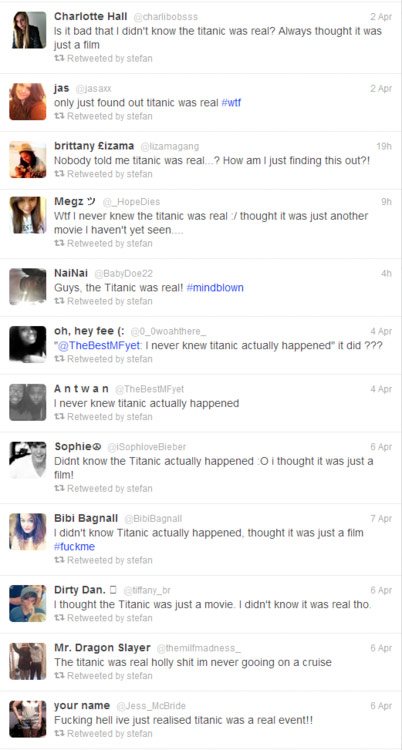
These photos will be a big blow to the remaining folks who believe that the Titanic was fictional:
What does a music conductor do? orig. from Apr 09, 2012
* Q: Wha? A: These previously published entries have been updated with new information in the last 24 hours. You can find past updates here.
From Jodi at Legal Nomads, a list of 21 practical tips she’s gleaned from traveling the world for the past four years. One tip is to take oranges with you on public transportation:
I started bringing a bag of oranges with me for long bus rides, primarily because they quench thirst and smell delicious. I quickly learned that many Thai and Burmese busgoers sniff the peels to stave off nausea, and that kids love oranges. Really: kids LOVE oranges. So for those who want to bring something for the bus ride but rightfully worry about giving sweets to kids, oranges are your friend. You will win over the parents, make the kids happy, occupy your hours and eventually get fed by everyone on the bus. Trust me. You should always have a bag of oranges on hand, the smaller the orange the better.
She also lists the five things she always carries with her while traveling…one of which, unusually, is a doorstop. I’m guessing that’s for keeping people out of rooms without door locks?
I did not know how much I had missed A Show with Ze Frank until I just watched the first episode of the new series:
I just caught myself waving my hands in the air. Sing it, Brother Ze.
George Dvorsky argues that if we wanted to, humanity could get a Dyson sphere up and running in a few decades.
The Dyson sphere, also referred to as a Dyson shell, is the brainchild of the physicist and astronomer Freeman Dyson. In 1959 he put out a two page paper titled, “Search for Artificial Stellar Sources of Infrared Radiation” in which he described a way for an advanced civilization to utilize all of the energy radiated by their sun. This hypothetical megastructure, as envisaged by Dyson, would be the size of a planetary orbit and consist of a shell of solar collectors (or habitats) around the star. With this model, all (or at least a significant amount) of the energy would hit a receiving surface where it can be used. He speculated that such structures would be the logical consequence of the long-term survival and escalating energy needs of a technological civilization.
Needless to say, the amount of energy that could be extracted in this way is mind-boggling. According to Anders Sandberg, an expert on exploratory engineering, a Dyson sphere in our solar system with a radius of one AU would have a surface area of at least 2.72x10¹⁷ km2, which is around 600 million times the surface area of the Earth. The sun has an energy output of around 4x1026 W, of which most would be available to do useful work.
The downside: we’d have to part with Mercury to do it.
And yes, you read that right: we’re going to have to mine materials from Mercury. Actually, we’ll likely have to take the whole planet apart. The Dyson sphere will require a horrendous amount of material-so much so, in fact, that, should we want to completely envelope the sun, we are going to have to disassemble not just Mercury, but Venus, some of the outer planets, and any nearby asteroids as well.
At Forbes, Alex Knapp explains why Dvorsky’s scheme and timeline might not work.
I emailed Astronomer Phil Plait about this project, who told me in no uncertain terms that the project doesn’t make sense.
“Dismantling Mercury, just to start, will take 2 x 10^30 Joules, or an amount of energy 100 billion times the US annual energy consumption,” he said. “[Dvorsky] kinda glosses over that point. And how long until his solar collectors gather that much energy back, and we’re in the black?”
Alan Gilbert is the music director of the New York Philharmonic and in this video, he talks about what a conductor does. I’ve been to the Philharmonic a few times in the past year and have wondered about the role of the conductor…specifically, is he actually doing anything up there to affect the music being played in realtime and could the orchestra play without him? The conductor obviously has a huge role in shaping the piece in rehearsal, but it seems like his presence on stage during the performance itself might be more performance than utility. But that’s just a guess.
Update: I got an informative response about this from professional classical musician Chris Brody:
You’re absolutely right that one of the main things an orchestra conductor does is to prepare the orchestra in rehearsal for the way he/she wants the piece to sound in performance. A lot of stuff is conveyed in that way that the conductor then won’t need to attempt to convey in real time during the performance. And furthermore, as you suspect, conductors are often in some sense kind of “dancing” for the audience during performances, in ways that are strictly superfluous to making the musicians play correctly, though sometimes an enjoyable part of the concert experience.
In order for a concert performance to come off correctly, someone has to take responsibility for giving what musicians call “cues”-concrete gestures that enable everyone to know when to start playing. In chamber music (classical music played in small groups), one of the players will do this, usually with an exaggerated, rhythmically timed gesture that connotes “taking a breath to start playing right NOW” or “preparing my bow to play the string right NOW”, and so on. In fact, there are entire smallish orchestras, like the Orpheus Chamber Orchestra, that play with no conductor, because members of the ensemble give cues when they are needed.
In larger (orchestral) settings, it is convenient to have a conductor to give cues instead. Of course, there are some pieces that are played with metronomic strictness, and the conductor in fact will have fairly little to do during those performances. You might have noticed that pieces from the Baroque and Classical periods are usually quite strict in time, and it is no coincidence that there was no such thing as a professional conductor until the nineteenth century-music prior to that was usually quite playable with the first-chair violinist (“concertmaster”) or the keyboardist giving a few cues as needed. (Conductors were occasionally used prior to the nineteenth century, but not so much that it was anyone’s entire job.)
Some pieces, by contrast, have a lot of changes of tempo, or a lot of starting and stopping. In cases like that, a conductor is really an indispensable part of having a performance come off non-disastrously! Furthermore, a lot of pieces are written in a complicated enough texture or rhythm that the musicians cannot necessarily hear what the beat is all the time, and need some visual help to stay together (this is especially true of very slow music, and of a lot of twentieth-century music).
Aside from this, when ensembles don’t need help staying together, the conductor will do a lot of gesturing to elicit slight changes in dynamic level, expressive character, and so on, from the musicians. Very good ensembles, when working with a conductor they respect, will absolutely respond in real time to these gestures. Less good ensembles will often not be able to do so and will mostly watch the conductor for cues. Also, ultra-elite ensembles are sometimes known to ignore the conductor during performances if they think he/she isn’t adding much value (a dirty secret of professional musicians!), or of course if they do not have confidence in the conductor’s ability to keep them together.
A couple more things that might interest you. Basic conducting is done via the use of “patterns” that correspond to certain time signatures. When a conductor conducts music in 3/4 (3 beats per measure), there will be 3 precise places that the baton is expected to be during the measure, and the musicians can always look up and follow that pattern. (The basic patterns are shown in this video.) If you watch, let’s say, a high-school band, you will see the conductor use these patterns very strictly and literally. In orchestral conducting, two things are different. First, the musicians don’t need much help keeping time, so the patterns are either heavily modified or abandoned entirely-although you can often see downbeats and things if you look for them. Second, orchestral conductors conduct WAY ahead of the beat the musicians are actually playing. This helps the musicians respond in real time to the conductor’s instructions. From the audience’s perspective, therefore, it can be nearly impossible to see the connection between what the conductor is doing and what you’re hearing from the musicians-they’re probably substantially out of sync.
Looks like I have a lot more to look for the next time I go to the symphony. (thx, chris!)
The first 10 seconds of Geoff Slattery’s This is United are the best, but the rest is pretty good, too. Haven’t seen that before.
The Collective Snapshot is a photographic series by Spanish photographer Pep Ventosa which blends “together dozens of snapshots to create an abstraction of the places we’ve been and the things we’ve seen.” He layers multiple pictures from several angles to create one image familiar and foreign at the same time.

His ‘Reconstructed Works’ aren’t bad either. And, oh, look at these carousels. (via My Modern Met)
A collection of scenes featuring movie stars before they were stars…like Nicolas Cage in Fast Times at Ridgemont High and Renee Zellweger in Dazed and Confused.
They missed one of my favorites…James Earl Jones as Lieutenant Zogg in Dr. Strangelove. (via devour)
Since Google released the video for their augmented reality glasses the other day, people have been busy making videos that show a more realistic (or cynical) portrayal of how the glasses might work. Here are a couple of the better ones. First a version of the glasses with Google ads:
And this one gives new meaning to the phrase “banner blindness”:
While not specifically about Google Glasses, this concept video by Keiichi Matsuda is also worth a look:
I will also direct your attention to the second episode of Black Mirror, a UK drama series by Charlie Brooker.
A satire on entertainment shows and our insatiable thirst for distraction set in a sarcastic version of a future reality. In this world, everyone must cycle on exercise bikes, arranged in cells, in order to power their surroundings and generate currency for themselves called Merits. Everyone is dressed in a grey tracksuit and has a “doppel”, a virtual avatar inspired by Miis and Xbox 360 Avatars that people can customise with clothes, for a fee of merits. Everyday activities are constantly interrupted by advertisements that cannot be skipped or ignored without financial penalty.
(via jake & stellar)
Jim Henson made this pitch video to sell The Muppet Show to CBS. It starts a bit slow but stick with it.
There’s also a scene with Kermit right at the end which unfortunately didn’t make it into the clip.
After Leo’s powerful speech, Kermit appears from off-screen against a CBS logo and shrugs, “What the hell was that all about?”
And just because, here’s the opening theme song of The Muppet Show. (via @gavinpurcell)
Arsenic and old poultry orig. from Apr 05, 2012
* Q: Wha? A: These previously published entries have been updated with new information in the last 24 hours. You can find past updates here.
Judging from the sheer number of you who sent in this link, it might be the kottke.orgest link in the history of the internet. In it, Sam Anderson goes long for the NY Times Magazine on casual games (like Angry Birds, Tetris, Bejeweled, etc.).
In 2009, 25 years after the invention of Tetris, a nearly bankrupt Finnish company called Rovio hit upon a similarly perfect fusion of game and device: Angry Birds. The game involves launching peevish birds at green pigs hiding inside flimsy structures. Its basic mechanism - using your index finger to pull back a slingshot, over and over and over and over and over and over and over - was the perfect use of the new technology of the touch screen: simple enough to lure a suddenly immense new market of casual gamers, satisfying enough to hook them.
Within months, Angry Birds became the most popular game on the iPhone, then spread across every other available platform. Today it has been downloaded, in its various forms, more than 700 million times. It has also inspired a disturbingly robust merchandising empire: films, T-shirts, novelty slippers, even plans for Angry Birds “activity parks” featuring play equipment for kids. For months, a sign outside my local auto-repair shop promised, “Free Angry Birds pen with service.” The game’s latest iteration, Angry Birds Space, appeared a couple weeks ago with a promotional push from Wal-Mart, T-Mobile, National Geographic Books, MTV and NASA. (There was an announcement on the International Space Station.) Angry Birds, it seems, is our Tetris: the string of digital prayer beads that our entire culture can twiddle in moments of rapture or anxiety - economic, political or existential.
But the real lily gilder here is that you can play Asteroids right on the article page…you can shoot almost everything off the page aside from the article itself — ads, comments, navigation, etc. This in-article game is based on this JavaScript hack that will let you play Asteroids on any old web page. Pretty cool. (thx, everyone)
Uniqlo, Costco, and Trader Joe’s are among the large retailers that are making more money by hiring more retail employees, which runs counter to the conventional wisdom.
The big challenge for any retailer is to make sure that the people coming into the store actually buy stuff, and research suggests that not scrimping on payroll is crucial. In a study published at the Wharton School, Marshall Fisher, Jayanth Krishnan, and Serguei Netessine looked at detailed sales data from a retailer with more than five hundred stores, and found that every dollar in additional payroll led to somewhere between four and twenty-eight dollars in new sales. Stores that were understaffed to begin with benefitted more, stores that were close to fully staffed benefitted less, but, in all cases, spending more on workers led to higher sales. A study last year of a big apparel chain found that increasing the number of people working in stores led to a significant increase in sales at those stores.
(thx, david)
Nicholas Kristof on factory farmed chicken…farmers load the birds up with caffeine, Tylenol, Benadryl, Prozac, and arsenic. Yes, arsenic. The poison.
Poultry-growing literature has recommended Benadryl to reduce anxiety among chickens, apparently because stressed chickens have tougher meat and grow more slowly. Tylenol and Prozac presumably serve the same purpose.
Researchers found that most feather-meal samples contained caffeine. It turns out that chickens are sometimes fed coffee pulp and green tea powder to keep them awake so that they can spend more time eating. (Is that why they need the Benadryl, to calm them down?)
And yet foie gras is the big problem. Right. Sadly, I imagine that hogs aren’t treated any differently.
Update: The National Chicken Council has released a statement about this study.
Chickens in the United States produced for meat are not given “arsenic” as an additive in chicken feed, or any of the other compounds mentioned in this study. Some flocks used to be given feed that contained a product called Roxarsone, which is a molecule that includes organic (carbon-rich, pentavalent) arsenic - not the inorganic, trivalent form that is considered a poison. This product was removed from the market last year, it is no longer manufactured and it is no longer used in raising chickens in the United States. Regardless, as the study’s authors point out: “There’s no evidence that such low levels of arsenic harm either chickens or the people eating them.”
In fact, organic arsenic is a naturally occurring element in our environment that is widely distributed within the earth’s crust. It is not surprising that in this study arsenic was detected on bird’s feathers because it is naturally present in the air, soil and water.
I’ll just quickly note a couple of things about this. This bit — “the top priority for America’s chicken farmers and processors is to raise healthy, top quality birds” — is pretty hilarious. But it’s the National Chicken Council…what are they gonna say? Also note they did not specifically deny giving chickens caffeine and the active ingredients in Prozac, Tylenol, and Benadryl.
A month ago, I launched a redesign of kottke.org. While there are still a few issues to iron out1, I am overall very happy with it so far.
If you’re actually reading this on the site and not in RSS (guys, come on in from the cold, don’t be shy), you’ll already have noticed that I changed the “look and feel” of the site. In doing the design, I focused on three things: simplicity, the reading/viewing experience, and sharing.
Aside from those three things, one of my unstated goals with the redesign was to increase the number of people reading kottke.org2 and I had a hunch that the focus on simplicity, sharing, the reading experience would do just that. Using Google Analytics and a couple of other sources, I compared the traffic stats from the past 30 days (I didn’t include the day of launch because that was an outlier day, traffic-wise) to that of the previous 30 days. Here are some of the results. (Except where noted, when I say “traffic”, I mean visits.)
- Overall traffic to kottke.org was up 14%. And February was a pretty good month itself so that’s a nice bump.
- As I hoped, the two areas that saw the most improvement were mobile and referral traffic. Mobile was the lowest-hanging fruit I addressed with the redesign…kottke.org’s previous mobile experience sucked. It’s better now. And the focus on sharing boosted referral traffic.
- Mobile traffic now accounts for 19% of kottke.org’s traffic and increased by 25% over the past 30 days. iPad usage in particular shot up 40% and iPad users are spending longer on the site than they previously were. iPhone and iPod touch traffic both showed double digit percentage increases as well.
- Referral traffic now accounts for 45% of kottke.org’s traffic and increased by 28% over the past 30 days. Most of this increase come from social network sharing. Traffic from Facebook increased by 45%, Facebook mobile was up 43%, Twitter increased by 6% (I already did Twitter sharing pretty well before, so not a huge jump here), and Tumblr referrals went up 125%.
- That big Tumblr increase was due to kottke.org’s new Tumblr blog. Having kottke.org posts be properly rebloggable is paying off. In addition, it’s got over 800 followers that are reading along in the dashboard. I’d like to see that number increase, but I’d probably need to engage a bit more on Tumblr for that to happen.
- For reference, kottke.org’s Twitter account added 1000 followers over the same period, about 20% more than the previous month.
- One of the small changes I made was to stop using post titles for posting to Twitter. I had hoped that using more descriptive text would make the tweets more easily retweetable…look at this tweet for example and compare to the title of the post it links to. This hasn’t really happened, which is surprising and disappointing.
- I also removed the links to the tag pages (like this and this) from the front page. I had a hunch that very few people were using those links compared to the real estate they took up and the traffic numbers bear that out…traffic to tag pages decreased only 3%.
That’s enough for now…I very rarely dig into the traffic stats so it’s difficult to stop when I do. That and it’s rewarding when you redesign something and it actually works out the way you thought it was going to.
[1] Like this weird Safari bug that results in overlapping link text. Many people have reported this but it only happens sporadically (and usually goes away with a refresh) and I can’t reproduce it or find any other sites/designers who are having the same issue. Oh, and it seems like it only happens on OS X Lion. I have no idea if it’s the web fonts or something in my CSS. Anyone have any ideas? ↩
[2] Not for $$$ reasons, although that is certainly a consideration. No, it’s more that I believe there are literally millions of people out there who are not reading kottke.org that would love it. I put a lot of myself into the site, I’m proud of it, and I want people to see it. That’s pretty much it. Oh, and I would also like the unlimited power that comes with millions of readers. evil cackle and cat stroking noises And the money. even more cat stroking noises And the chicks. expensive champagne cork popping noises And my kids’ love and respect. surprisingly loud whining noise that you can’t even believe came from someone less than 40 inches tall oh come on you just watched Wallace and Gromit for the past hour and you want more orange juice jesus come on give it a rest and now there’s a surprisingly loud whining noise coming from a 38-year-old man that should know better… ↩
Frontline is doing a four-hour show about the world financial crisis, which, according to many people featured on the program, is ongoing.
Since 2008, Wall Street and Washington have fought against the tide of the fiercest financial crisis since the Great Depression. What have they wrought? In a special four-hour investigation, FRONTLINE tells the inside story of the struggles to rescue and repair a shattered economy, exploring key decisions, missed opportunities, and the unprecedented and uneasy partnership between government leaders and titans of finance that affects the fortunes of millions of people around the world.
The program airs on April 24th.
Don’t know why exactly, but I am loving the hell out of Happy Wheels. The game is pretty simple — it’s a cross between CycloManiacs, Line Rider, and Jackass — you ride on a bike or Segway or mobility scooter through a course avoiding obstacles and trying to reach the end. Which is fun enough except that when you hit something hard, you body flies apart and blood sprays all over the place. Hilariously. Like this Skate 3 video, which is also inexplicably gut-busting. (via mlkshk)
Google has shared a bit about their augmented reality glasses project (more at the NY Times).
A video released by Google on Wednesday, which can be seen below, showed potential uses for Project Glass. A man wanders around the streets of New York City, communicating with friends, seeing maps and information, and snapping pictures. It concludes with him video-chatting with a girlfriend as the sun sets over the city. All of this is seen through the augmented-reality glasses.
The glasses look a little strange, like Geordi La Forge’s visor…they might go over a little better if they looked more Warby Parkerish.
Perez Hamilton is a site covering American history through the lens of gossip blogger Perez Hilton. It’s up to the 1690s now…here’s an account of Leisler’s Rebellion from 1691:
During all the drama between the Boston revolt, New England and New France going to war and King James II being overthrown, German-American Jacob Leisler seized control of New York and ruled it against the wishes of the new King William III. In response, KWIII sent a new governor to NY, but he didn’t get there for a couple years because he was lazy delayed by bad weather.
After an awkward stand-off resulting in words along the lines of, “You’re not governor, I am!” and, “No, bitch, NY is mine!” Jacob Leisler was finally arrested by the REAL governor and sentenced to death.
This is riDICKulous. You can’t just steal New York and expect to get away with it!!!!
If it was THAT easy, don’t you think we’d have stolen it loooong ago?? Where else can you get the best food and fashion in America??!
Makego is an interesting iPhone app…it turns your phone into a toy vehicle. This short video explains:
Makego turns your iPhone / iPod Touch into a toy vehicle. It encourages fun, open ended collaborative play between parent and child. Combining creativity and imagination with the virtual world on screen. Select your vehicle within Makego, then interact with the drivers and their world through animations and sound. This release has 3 vehicles to play with: a race car, ice-cream truck, and river boat.
I could easily see building a neat case out of paper and having Ollie and Minna playing with it. I could also see Ollie taking the race car over a big jump and smashing it into another car and oh shit the screen is cracked. The Lego case option is cool though…just slap some wheels on it and away you go.
How to win at blackjack orig. from Apr 02, 2012
* Q: Wha? A: These previously published entries have been updated with new information in the last 24 hours. You can find past updates here.
In a move certain to impact jokes about Canadian stereotypes for years to come, our neighbors to the north are jettisoning the penny. One hopes the United States co-opts this move, because it will be as good for us as Michael J. Fox, Wayne Gretzky, and poutine.
Here is noted penny adversary CPG Grey with more information on the move.
Been a few months since we’ve had one of these. Constellations is a simple game where you shoot jellyfish at stars and shoo fish out of the way. What, I was just playing that for 30 minutes? Oof.
The Intimacy 2.0 fashion garments become see-through when the wearer’s heart rate increases.
I think my pants are broken. They should be fully transparent at the moment… (via ★warrenellis)
Newer posts
Older posts





Socials & More