Entries for January 2012
I was addicted to this tower defense game awhile back as an in-browser Flash game, but the iPad version is even better. It’s like the iPad was made for games like these. (thx, jim)
ps. Can you hear that sound? That’s Kingdom Rush sucking all your free time away this weekend. You’re welcome.
This is mesmerizing: using Google Image Search and starting with a transparent image, this video cycles through each subsequent related image, over 2900 in all.
(via ★mattb)
If you’ve ever been to downtown Minneapolis, you’ve likely used the large network of above-grade covered walkways that now stretches into nearly every corner of the downtown area. I’d always assumed they were built to help downtown workers and residents avoid cold weather during the winter, but that’s not the case.
Rather, the skyway system originally emerged from a twofold desire. First, planners in the 1940s and 50s were very concerned about managing increasingly dense pedestrian flows, and viewed skyways as a way to maximize the use of urban space for both people and automobiles (Byers 1998 154). Second, business owners were interested in maximizing their property values, and saw the skyways an opportunity to double the amount of valuable retail space in their downtown buildings (Byers 1998 159).
I used to work in downtown Minneapolis, and the skyways were great in the winter. To be able to take a walk and get lunch without having to bundle up in coat, hat, mittens, scarf, etc. was almost like living in a warm climate…and that’s no small thing during a long, dark Mpls winter. (via ★than)
Micro-Macro is a Powers of Ten-style video in which the various scales are depicted with food.
(via ★glass)
I don’t particularly follow chess or play the game, but I’m fascinated by Magnus Carlsen. This line from him about how he approaches the game is great:
Having preferences means having weaknesses.
We interrupt this internet to bring you the very first trailer for Wes Anderson’s new movie, Moonrise Kingdom.
Set on an island off the coast of New England in the summer of 1965, MOONRISE KINGDOM tells the story of two twelve-year-olds who fall in love, make a secret pact, and run away together into the wilderness. As various authorities try to hunt them down, a violent storm is brewing off-shore — and the peaceful island community is turned upside down in more ways than anyone can handle.
It’s Wes Andersonmas, y’all!
This is a node.js module that determines if a sentence can be replied to with “that’s what she said”. You can use either a naive Bayes or k-nearest neighbor algorithm. This totally paves the way for a Michael Scott auto-replying Twitter bot. (via @kellan)
When life gives you lemons, turn them into spray bottles. This nifty little attachment lets you do just that.

The standard measure for the kilogram needs to change because, offically speaking, the universe is gaining mass. The trick is finding a technique that ties the kilogram to a fundamental constant (like the second is tied to energy transition times in cesium atoms).
Familiarly known as Le Grand K and held in a vault just outside of Paris under three bell jars, [the international prototype kilogram] dates back to the 1880s, when it was forged by the British metallurgist George Matthey from an alloy of nine-tenths platinum and one-tenth iridium. As a metric unit, the kilogram is “equal to the mass of the international prototype,” according to the official definition. In other words, as metrologists like to point out, it has the remarkable property of never gaining or losing mass. By definition, any physical change to it alters the mass of everything in the cosmos.
Aside from a yearly ceremonial peek inside its vault, which can be unlocked only with three keys held by three different officials, the prototype goes unmolested for decades. Yet every 40 years or so, protocol requires that it be washed with alcohol, dried with a chamois cloth, given a steam bath, allowed to air dry, and then weighed against the freshly scrubbed national standards, all transported to France. It is also compared to six temoins (witnesses), nominally identical cylinders that are stored in the vault alongside the prototype. The instruments used to make these comparisons are phenomenally precise, capable of measuring differences of 0.0000001 percent, or one part in 1 billion. But comparisons since the 1940s have revealed a troublesome drift. Relative to the t’emoins and to the national standards, Le Grand K has been losing weight — or, by the definition of mass under the metric system, the rest of the universe has been getting fatter. The most recent comparison, in 1988, found a discrepancy as large as five-hundredths of a milligram, a bit less than the weight of a dust speck, between Le Grand K and its official underlings.
The Cuppow turns any wide-mouth canning jar into a travel mug.

Get yours now for only $7.99. (via ★aaroncohen)
The sound and picture are poor, but the entirety of Errol Morris’ A Brief History of Time is available on YouTube.
Featuring music from Philip Glass, the film is a documentary about Stephen Hawking and his ideas about the universe. Morris recently stated on Twitter:
Yes. I plan to re-release [A Brief History of Time]. (It was never properly color corrected and is one of my best films.)
The film is difficult, if not impossible, to find on DVD and isn’t available on Netflix, Amazon Instant Video, or iTunes. And as far as I can tell, the soundtrack was never released either.
On the Clipart covers blog, you’ll find noted album covers redone with clip art and Comic Sans.

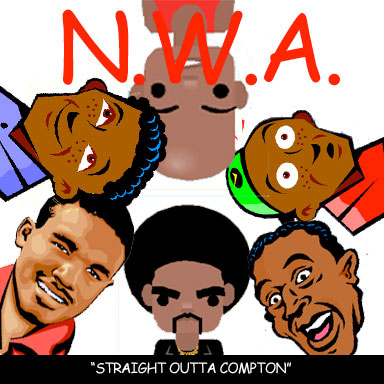

(via @aaroncoleman0)
I have rarely in my life seen something as physically impressive as this performance of Swan Lake:
It’s not just what she does, it’s how rock-still she is while doing it. Just, wow. (via ★interesting)
Old-school font foundry Emigre is doing most (all?) of their typefaces as web fonts. I’m going to redo my goth blog in Exocet.

Last year, Vice travelled to Matehuala, Mexico in search of dance crews who wear extremely pointy cowboy boots called botas vaqueras exóticas.
In Matehuala, guarachero has become an unlikely style of music where a bunch of people who in theory should not get along come together and get along. It’s also the music preferred by the men and boys in the long and pointed boots.
Participants in these dance contests spend the days and weeks prior choreographing intricate footwork routines and fabricating their own outfits with cheap paint and fabric. The grand prize, beyond the enthusiastic crowd’s affection, is either a bottle of whiskey or a few bucks.
(via mlkshk)
The Planet Money podcast explores why lard fell out of favor for cooking and baking. Upton Sinclair and Crisco each take some of the blame. (thx, jim)
Fotoshop is a new beauty product from Adobé (say aah-DOE-bay) that slims, gets rid of wrinkles, and can even lighten your skin color.
(via stellar)
Thirty Japanese giant hornets take on an entire hive of European honey bees and slaughter 30,000 bees in three hours.
Not having evolved alongside the giant hornet, European honey bees don’t have a natural defense against them. But the Japanese honey bee does:
The Japanese honey bee, on the other hand, has a defense against attacks of this manner. When a hornet approaches the hive to release pheromones, the bee workers emerge from their hive in an angry cloud-formation with some 500 individuals. As they form a tight ball around the hornet, the ball increases in heat to 47 °C (117 °F) from their vibrating wings, forming a convection oven as the heat released by the bees’ bodies is spread over the hornets. Because bees can survive higher temperatures (48 to 50 °C (118 to 122 °F)) than the hornet (44 to 46 °C (111 to 115 °F)), the latter dies.
(via ★aaroncohen)
Lakhdar Boumediene was imprisoned in the Guantanamo Bay detention camp for seven years on no charge and with no trial.
On Wednesday, America’s detention camp at Guantanamo Bay will have been open for 10 years. For seven of them, I was held there without explanation or charge. During that time my daughters grew up without me. They were toddlers when I was imprisoned, and were never allowed to visit or speak to me by phone. Most of their letters were returned as “undeliverable,” and the few that I received were so thoroughly and thoughtlessly censored that their messages of love and support were lost.
This is deeply deeply shameful.
In a piece for Vanity Fair, Kurt Andersen argues that for the first time in recent history, American pop culture (fashion, art, music, design, entertainment) hasn’t changed dramatically in the past 20 years.
Since 1992, as the technological miracles and wonders have propagated and the political economy has transformed, the world has become radically and profoundly new. (And then there’s the miraculous drop in violent crime in the United States, by half.) Here is what’s odd: during these same 20 years, the appearance of the world (computers, TVs, telephones, and music players aside) has changed hardly at all, less than it did during any 20-year period for at least a century. The past is a foreign country, but the recent past — the 00s, the 90s, even a lot of the 80s — looks almost identical to the present. This is the First Great Paradox of Contemporary Cultural History.
Think about it. Picture it. Rewind any other 20-year chunk of 20th-century time. There’s no chance you would mistake a photograph or movie of Americans or an American city from 1972-giant sideburns, collars, and bell-bottoms, leisure suits and cigarettes, AMC Javelins and Matadors and Gremlins alongside Dodge Demons, Swingers, Plymouth Dusters, and Scamps-with images from 1992. Time-travel back another 20 years, before rock ‘n’ roll and the Pill and Vietnam, when both sexes wore hats and cars were big and bulbous with late-moderne fenders and fins-again, unmistakably different, 1952 from 1972. You can keep doing it and see that the characteristic surfaces and sounds of each historical moment are absolutely distinct from those of 20 years earlier or later: the clothes, the hair, the cars, the advertising — all of it. It’s even true of the 19th century: practically no respectable American man wore a beard before the 1850s, for instance, but beards were almost obligatory in the 1870s, and then disappeared again by 1900. The modern sensibility has been defined by brief stylistic shelf lives, our minds trained to register the recent past as old-fashioned.
An entrepreneur shares the business lessons imparted to him by a organized crime boss.
Interesting things happen when we cut out the middleman. In addition to reducing cost, we often end up creating an internal byproduct that can be productized and sold to a completely new customer. (Amazon Web Services is an example of this.) Sometimes the middleman’s market is so huge, that a freaking enormous business can be built simply by providing their customers a lower cost and more efficient option.
This video, which takes its audio from a 2007 interview, takes a crack at defining it.
So, a dubstep or grime is kinda like this ultra slow, ultra dirty spawn of hip hop, but it’s almost at a breakbeat speed, but it’s at a halftime breakbeat speed. So it feels, like, abnormally slow, and just gives this really heavy feel.
Since the evolution of music has slowed since, say, the early 1980s, I thought it would be a long time before a popular genre of music came along that seemed, to my old ears, to be noisy garbage…but then dubstep came along. Industrial, happy hardcore, metal, punk, glitch, and even drum & bass I can appreciate, but dubstep makes me want to yell at children to get off lawns. And I actually like that door stopper noise!
That’s how a recent tweet referred to Scott Stevens and his snowboarding skills. Some pretty sick street snowboarding moves in this one.
MacAskill? Oh, he’s just this guy. (via @polarben)
Experience the restart sequences from a number of operating systems, all from a single page. Love this. (via stellar)
Parking is expensive to create — up to $140,000 per space in an underground garage — but is low-cost or even free to use, which results in strange economic situations and irrational human behavior.
After 36 years, Shoup’s writings — usually found in obscure journals — can be reduced to a single question: What if the free and abundant parking drivers crave is about the worst thing for the life of cities? That sounds like a prescription for having the door slammed in your face; Shoup knows this too well. Parking makes people nuts. “I truly believe that when men and women think about parking, their mental capacity reverts to the reptilian cortex of the brain,” he says. “How to get food, ritual display, territorial dominance — all these things are part of parking, and we’ve assigned it to the most primitive part of the brain that makes snap fight-or-flight decisions. Our mental capacities just bottom out when we talk about parking.”
(via @hotdogsladies)
You’ve probably seen the NY Times correction that everyone’s talking about. Ok, not everyone, just everyone who works in media. Anyway, here it is:
An article on Monday about Jack Robison and Kirsten Lindsmith, two college students with Asperger syndrome who are navigating the perils of an intimate relationship, misidentified the character from the animated children’s TV show “My Little Pony” that Ms. Lindsmith said she visualized to cheer herself up. It is Twilight Sparkle, the nerdy intellectual, not Fluttershy, the kind animal lover.
Here is said article. Jim Romenesko talked to Amy Harmon, the reporter who wrote the article, and uncovered this magical tidbit:
I was accompanying Kirsten to school, taking notes on my laptop as she drove. She was listening to music on her iPod known to Pony fans as “dubtrot,” — a take-off on “dubstep,” get it? — in which fans remix songs and dialogue from the show with electronic dance music.
Dubtrot! And leave it Urban Dictionary to gild the lily.
Dubstep music relating to My Little Pony: Friendship is Magic. Often created by bronies, dubtrot can include dubstep remixes of songs from the show and original pieces created as homage or in reference to the show.
Bronies! Defined as:
The term used to describe the fan community(usually of the older group, males and females) of the show My Little Pony: Friendship is Magic.
Anyway, would you like to listen to some dubtrot? Of course you would: Rainbowstep, Rainbow Dubtrot, and fluttershymix.
A group of buildings whose tenants continually complained about living conditions changed hands so frequently that city officials could do nothing about it….until a group representing the tenants used social network analysis to reveal the connections between all of the seemingly separate owners.
It was now obvious that properties exchanged hands not as independent and valid real estate investments but as a conspiracy to avoid fixing the building violations. The green links represent borrowed money flowing into the buildings through new mortgages. As time went on, and the buildings appreciated in value during a real estate boom — loans from the mortgage company allowed the owners to “strip mine” the equity from the buildings. This is a common slumlord modus operandi — they suck money out of a building rather than put money back in for maintenance.
Inspired by a video of a chain-smoking two-year-old from Indonesia, photographer Frieke Janssens took a series of portraits of kids smoking.

A video shows how Janssens made the photos…the cigarettes were made of cheese.
Tom Standage argues that civilization’s best invention is writing.
It is not just one of the foundations of civilisation: it underpins the steady accumulation of intellectual achievement. By capturing ideas in physical form, it allows them to travel across space and time without distortion, and thus slip the bonds of human memory and oral transmission, not to mention the whims of tyrants and the vicissitudes of history.
Another Quora gem: an answer to the question “what is it like to have an understanding of very advanced mathematics?”
You are comfortable with feeling like you have no deep understanding of the problem you are studying. Indeed, when you do have a deep understanding, you have solved the problem and it is time to do something else. This makes the total time you spend in life reveling in your mastery of something quite brief. One of the main skills of research scientists of any type is knowing how to work comfortably and productively in a state of confusion.
(via @pomeranian99)
During pregnancy, the mother and fetus exchange cells and some of those cells can live on forever in the two bodies after the child is born.
During pregnancy, cells sneak across the placenta in both directions. The fetus’s cells enter his mother, and the mother’s cells enter the fetus. A baby’s cells are detectable in his mother’s bloodstream as early as four weeks after conception, and a mother’s cells are detectable in her fetus by week 13. In the first trimester, one out of every fifty thousand cells in her body are from her baby-to-be (this is how some noninvasive prenatal tests check for genetic disorders). In the second and third trimesters, the count is up to one out of every thousand maternal cells. At the end of the pregnancy, up to 6 percent of the DNA in a pregnant woman’s blood plasma comes from the fetus. After birth, the mother’s fetal cell count plummets, but some stick around for the long haul. Those lingerers create their own lineages. Imagine colonies in the motherland.
Moms usually tolerate the invasion. This is why skin, organ, and bone marrow transplants between mother and child have a much higher success rate than between father and child.
Whoa.
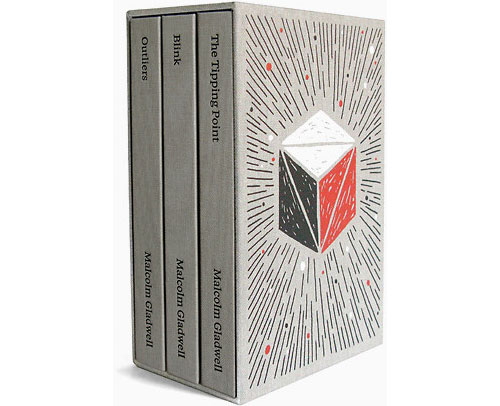
Paul Sahre and Brian Rea designed a 3-book boxed set for Malcolm Gladwell’s “intellectual adventure stories”.
“During our initial meeting with Malcolm, he referred to the three books as ‘intellectual adventure stories,’” Sahre tells Co.Design. “Brian and I really responded to that, as it suggested a specific and interesting way to think about how the books could be designed. We wanted the books to feel like first editions of Moby-Dick or Treasure Island or The Wizard of Oz.”
The tasteful gray cloth binding and foil stamping of the set and its “extremely conventional” design, as Sahre puts it (“maybe ‘comfortable’ would be a better way to describe it,” he adds) makes me think of famous children’s literature collections, like The Chronicles of Narnia. “This ‘traditional/comfortable’ design allowed for the drawings Brian was doing to venture off into the abstract and unconventional place they ended up,” Sahre continues. “More importantly, the quiet design allowed the text and the drawings room to interact and to breathe. I hope the reader doesn’t notice the design of the book at all.”
The set is available on Amazon.
From The Verge, a new-ish tech site, a mega-guide on everything you need to know about buying a camera. It starts at the beginning with the basics of photography, goes over ISO, aperture, shutter speed, megapixels, white balance, and the major types of camera.
If you’re new to digital photography, the three things you should acquaint yourself with first are the ISO, aperture, and shutter speed. The three work in concert, and if you can manipulate and control them all, you’ll take fabulous photos without even touching the rest of your camera. Together, they’re known as the Exposure Triangle, because they control how much light you’re exposing the camera to (aperture), how sensitive the camera is to that light (ISO), and how long your exposure lasts (shutter speed).
For an installation at the Gallery of Modern Art in Brisbane, artist Yayoi Kusama made a totally white room and gave colored dot stickers to all the visiting children and let them stick them wherever they wanted.
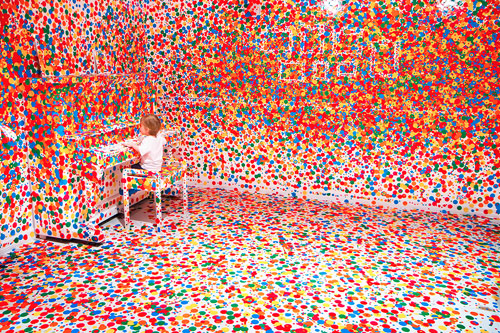
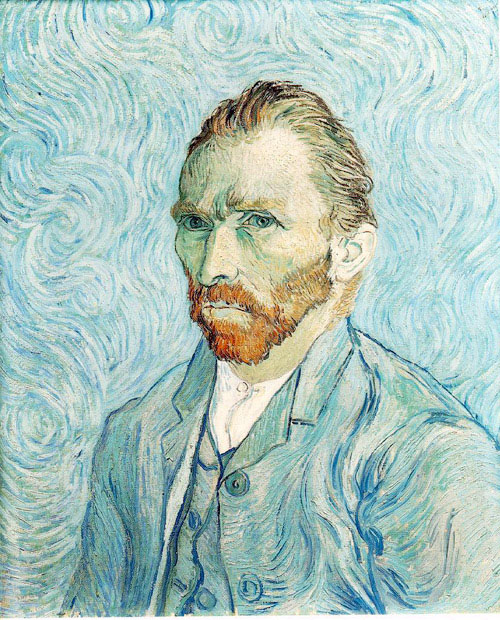
I love everything about this…I scrolled through the entire list. This one was my favorite:

(via waxy)
Kevin Kelly argues that Spielberg’s Tintin movie passes beyond the uncanny valley into the “plains of hyperreality”.
One of the great charms of the Tin Tin movie (besides its solid story, and uplifting sensibility) is the incredible degree of detail, texture, lighting, and drama that infuses every scene. Because the whole movie is synthetic, every scene can be composed perfectly, lit perfectly, arranged perfectly, and captured perfectly. There is a painterly perfection that the original Tin Tin comics had that this movie captures. This means that the stupendous detail found in say TinTin’s room, or in a back alley, or on the ship’s deck can be highlighted beyond what it could in reality. You SEE EVERYTHING. When TinTin’s motorcycle is chasing the bad guy and begins to fall apart, nothing is obscured. Every realistic mechanical part is illuminated realistically. This technique gives a heightened sense of reality because every corner of the entire scene is heightened realistically, which cannot happen in real life, yet you only see real-looking things. This trick lends the movie a hyperreality. Its artificial world looks realer than real.
The uncanny valley issue has been less noticeable lately, but what really snaps me out of being immersed in movies lately is the Impossible Camera™. In 100% CGI shots, when cameras move quickly with sharp changes in direction over long distances, something that actual cameras can’t do, it snaps me right out of the action because it’s so obviously fake. For instance, any scene in the Tobey Maguire Spider-Man movies where Spidey is flying through Manhattan. Fay, fay, fake.
A woman recently sold an antique French violin for $2500 to a buyer who disputed the violin’s worth/authenticity. What happened next is maddening and asinine.
I sold an old French violin to a buyer in Canada, and the buyer disputed the label.
This is not uncommon. In the violin market, labels often mean little and there is often disagreement over them. Some of the most expensive violins in the world have disputed labels, but they are works of art nonetheless.
Rather than have the violin returned to me, PayPal made the buyer DESTROY the violin in order to get his money back. They somehow deemed the violin as “counterfeit” even though there is no such thing in the violin world.
Hey Peter Thiel, instead of whining about the iPhone, Twitter, and internet not being innovative and life-changing enough, why don’t you fix this life-ruining piece of shit company that you crapped into the world? That would definitely be a “net plus”. And DAMMIT, you made me link to TechCrunch! Argh!! (via @ftrain)
The most important events of 2011 orig. from Jan 03, 2012
Wipeout track using quantum levitation orig. from Jan 03, 2012
* Q: Wha? A: These previously published entries have been updated with new information in the last 24 hours. You can find past updates here.
Still cleaning out some tabs from over the break…this list of the best “best of 2011” lists is worth looking at, even if you’ve got list fatigue. It includes lists like “10 Films Hypothetically Starring Ryan Gosling”, “Top 10 Classical Performances”, and “Top 10 Films of John Waters”.
The Morning News got a bunch of writers and thinkers to name the most important event of 2011.
While they may not yet have a common name, and their causes overlap but are hardly identical, the worldwide protests that began in December 2010 in Tunisia and swept through Egypt, the Middle East, Spain, Greece, the United Kingdom, every state in the U.S then thousands of worldwide cities — these, collectively, are the single most important event of 2011. It was so significant that the year itself may be the only possible name for these people’s revolutions and protests: the same way we talk about 1968 or Sept. 11 or Feb. 15, 2003: perhaps just “2011.”
As Joanne McNeil noted, hindsight provides clarity with questions like this. Events that are invisible at the time become important five or ten years later. Take 1993 for instance. At the time, the European Community eliminating customs barriers or Bill Clinton’s swearing-in or the first bombing of the WTC might have seemed most significant, but with hindsight, Tim Berners-Lee’s quiet invention of the World Wide Web in an office at CERN is clearly the year’s most significant and far-reaching happening.
Update: TBL invented the WWW in 1991, not 1993. ‘91 was a bit busier news-wise, what with the first Iraq war and Gorbachev’s resignation, but the Web’s invention ranks right up there in hindsight. (thx, sean)
This is kind of amazing: if you put a contact microphone on a hard surface and then process the sound in realtime, you can turn that surface into a touch screen…or a programmable musical instrument.
(via ★johnpavlus)

This map of the US was made by David Imus — he worked seven days a week for two years on it — and it won the Best of Show award at the Cartography and Geographic Information Society competition for 2010. Here’s why.
According to independent cartographers I spoke with, the big mapmaking corporations of the world employ type-positioning software, placing their map labels (names of cities, rivers, etc.) according to an algorithm. For example, preferred placement for city labels is generally to the upper right of the dot that indicates location. But if this spot is already occupied — by the label for a river, say, or by a state boundary line — the city label might be shifted over a few millimeters. Sometimes a town might get deleted entirely in favor of a highway shield or a time zone marker. The result is a rough draft of label placement, still in need of human refinement. Post-computer editing decisions are frequently outsourced-sometimes to India, where teams of cheap workers will hunt for obvious errors and messy label overlaps. The overall goal is often a quick and dirty turnaround, with cost and speed trumping excellence and elegance.
By contrast, David Imus worked alone on his map seven days a week for two full years. Nearly 6,000 hours in total. It would be prohibitively expensive just to outsource that much work. But Imus — a 35-year veteran of cartography who’s designed every kind of map for every kind of client — did it all by himself. He used a computer (not a pencil and paper), but absolutely nothing was left to computer-assisted happenstance. Imus spent eons tweaking label positions. Slaving over font types, kerning, letter thicknesses. Scrutinizing levels of blackness. It’s the kind of personal cartographic touch you might only find these days on the hand-illustrated ski-trail maps available at posh mountain resorts.
Update: The map is now in its fourth version of the second edition, updated in Sept 2022. I updated the image above to a snippet of the newest map.
The quantum levitation videos I showed you a couple months ago are pretty cool, but scientists scienticiens at the Japan Institute of Science and Technology have upped the game by using QL CGI to build a real-world Wipeout track.
Say it with me: science!! Also, do Rainbow Road next! (via ★interesting)
Update: Say it with me: advertising! Or some other such nonsense. Several people have alerted me that this video is a fake…you can see vapor trails passing through walls, etc. Boo. Boo-urns. (thx, all)
According to Dr. Ken Murray, doctors don’t die like the rest of us.
It’s not a frequent topic of discussion, but doctors die, too. And they don’t die like the rest of us. What’s unusual about them is not how much treatment they get compared to most Americans, but how little. For all the time they spend fending off the deaths of others, they tend to be fairly serene when faced with death themselves. They know exactly what is going to happen, they know the choices, and they generally have access to any sort of medical care they could want. But they go gently.
Of course, doctors don’t want to die; they want to live. But they know enough about modern medicine to know its limits. And they know enough about death to know what all people fear most: dying in pain, and dying alone. They’ve talked about this with their families. They want to be sure, when the time comes, that no heroic measures will happen-that they will never experience, during their last moments on earth, someone breaking their ribs in an attempt to resuscitate them with CPR (that’s what happens if CPR is done right).
People don’t know how to die anymore…advances in technology and medicine have lulled us into believing we can fix anything that’s wrong with our bodies, pain and expense be damned. And sometimes we can and do, and it’s that “what if” that makes it so difficult when thinking about what to do.
From New Scientist, a list of eight different ways to lose weight that actually work. Because science!
If your idea of a holiday workout is lifting glasses of beer late into the night, then it’s not just the extra calories you need to worry about. Randy Nelson and his team at Ohio State University in Columbus found that mice exposed to light at night weighed 10 per cent more at the end of the eight-week study than mice that had experienced a standard light/dark cycle, even though they ate the same total number of calories and did the same amount of exercise.
(via @daveg)
Newer posts




Socials & More